INTRODUCTION
The goblin shark, Mitsukurina owstoni (Jordan, Reference Jordan1898) is the single representative of the family Mitsukurinidae, order Lamniformes (mackerel sharks), distributed worldwide in deep waters down to at least 1300 m and occasionally reaching the shallow upper slopes of submarine canyons. It is one of the most bizarre large sharks known, attaining about 4100 mm total length, and characterized by its long and well depressed paddle-like snout, extremely narrow and unserrated lanceolate and acute teeth, and unusual pinkish-grey colour in live or freshly-dead specimens (Kukuev, Reference Kukuev and Parin1982; Compagno, Reference Compagno2001). The species was described based on one 1070 mm total length (TL) immature male from Yokohama, Japan and since then about 230 specimens have been recorded worldwide in the literature, mostly from Japanese waters, representing at least 185 specimens (summarized by Yano et al., Reference Yano, Miya, Ayzawa and Noichi2007) or about 80.4% of all known specimens since its original description.
Non-Japanese reports comprise a few individuals caught in the western Pacific—Taiwan (Lee & Shao, Reference Lee and Shao2010), Australia (Glover, Reference Glover1976; Stevens & Paxton, Reference Stevens and Paxton1985; Last & Stevens, Reference Last and Stevens2009) and New Zealand (Davison & Van Berkel, Reference Davison and Van Berkel1985; Stewart & Clark, Reference Stewart and Clark1988; Duffy, Reference Duffy1997); eastern Pacific—southern California (Ugoretz & Siegel, 1999); western Indian Ocean—off South Africa (Piotrovskiy & Prut'ko, Reference Piotrovskiy and Prut'ko1980); eastern Atlantic—Portugal, France, Guinea, (Bragança, Reference Bragança1904; Quéro, Reference Quéro1972; Quéro et al., Reference Quéro, Verron and Cattin1976; Cadenat & Blache, Reference Cadenat and Blache1981), western Cape, off South Africa (Bass et al., Reference Bass, D'Aubrey and Kistnasamy1975); western North Atlantic—Corner and New England Rising Seamounts (Kukuev, Reference Kukuev and Parin1982), Gulf of Mexico (Parson et al., 2002), Colombia (Grijalba-Bendeck & Acevedo, Reference Grijalba-Bendeck and Acevedo2009), French Guiana (Uyeno & Sasaki, Reference Uyeno, Sasaki, Uyeno, Matsuura and Fujii1983) and northern Brazil (Holanda & Asano-Filho, Reference Holanda and Asano-Filho2008).
Although widely distributed, some available biological and distribution data are controversial. For example, the first record from the western North Atlantic, in fact was not that published by Uyeno et al. (1983), but from Kukuev (Reference Kukuev and Parin1982) who reported nine specimens collected between 1976 and 1978 at Corner Mountains and New England Seamounts. One of these sharks measured 4100 mm TL (sex not given), representing the largest specimen effectively measured, despite the 3840 mm TL adult male recorded by Stevens & Paxton (Reference Stevens and Paxton1985) reputed to be the largest. Larger individuals would be expected considering the general growth pattern in sharks, in which the females usually attain larger sizes than males (Compagno, Reference Compagno2001). The large female recorded by Parsons et al. (Reference Parsons, Ingram and Havard2002) was estimated (based on photographs) between 5400 and 6170 mm TL.
Previous Brazilian records were made in the western North Atlantic area. The search for new deep-water fishery sources by the Brazilian Environmental Agency (IBAMA) on the north coast (States of Amapá and Pará) between 2002 and 2004, resulted in the capture of six specimens which were discharged at sea without further analysis, except one 1050 mm TL immature female deposited at the Museu Oceanográfico do Vale do Itajaí (MOVI 37411). Only photographic records of these specimens were saved and provide the positive species identification. Soto & Mincarone (Reference Soto and Mincarone2004) briefly list its institutional deposit. However, Holanda & Asano-Filho (Reference Holanda and Asano-Filho2008) in a report on these above mentioned north Brazilian specimens do not present any biological information, sex, size or even collection number of this specimen. Therefore, these records in Brazilian waters are confusing, split in different publications and lack additional information on the reported material.
The expected western South Atlantic record of M. owstoni started with rumours of its capture by the monkfish (Lophius gastrophysus Miranda Ribeiro, Reference Miranda-Ribeiro1915) fishery between 2000 and 2003 in southern Brazil off the Rio Grande do Sul coast. One photograph of a small goblin shark was credited to this fishery, but no confirmation of capture area, depth, boat or specimens were ever provided.
In the present study the occurrence of goblin shark in the western South Atlantic is positively reported based on a 3152 mm TL and 99 kg total weight (TW) mature male, providing biological data from this large and previously unknown distribution area for this species.
MATERIALS AND METHODS
The specimen was caught by the chartered Spanish 38 m long fishery vessel ‘Albamar’ with an otter trawl for deep-water scarlet shrimps, genus Aristaeopsis, on 27 November 2008 between 700 and 1000 m depth off the State of Rio de Janeiro, about 23°52.087′S–23°51.402′S and 41°52.708′W–42°05.236′W, frozen on-board and transferred to the freezer at the São Paulo State University (UNESP, CLP, São Vicente, São Paulo) where it was frozen for about three months before analysis.
In the laboratory, the specimen was weighted (total weight (TW)) and measured for TL. All measurements, body terminology and general biological data were taken according to the methods of Stevens & Paxton (Reference Stevens and Paxton1985) and Yano et al. (Reference Yano, Miya, Ayzawa and Noichi2007). Maturity was determined by the presence of semen in the seminal vesicle and claspers calcification. Stomach and intestine contents were collected and preserved in formalin (4%) and alcohol solutions (96%), respectively. The reproductive system was preserved in formalin (4%) for posterior analysis. The tooth count and terminology were modified from Shimada & Seigel (Reference Shimada and Seigel2005), where: S, symphysial tooth; A, anterior; I, intermediate; L, lateral; and P, posterior.
After biological and morphological analysis the specimen was donated to the Museu de Pesca de Santos, São Paulo (uncatalogued), where it was prepared by a taxidermist and displayed for public appreciation.
RESULTS
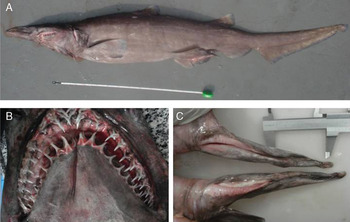
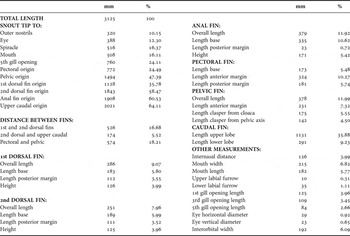
Proportional dimensions of the 99 kg TW and 3152 mm TL mature male goblin shark (Figure 1) are presented in Table 1 and expressed as percentage of the TL (in mm). General morphology is similar to most previous described similar-sized large specimens. Trunk robust, compressed and soft even in the large frozen specimen (Figure 1A). No lateral caudal keel, precaudal pit or abdominal grooves were observed. Trunk length (from 5th gill slit to upper caudal lobe origin) 40.0% of TL. Head length shorter than trunk length and slightly less than 1/3 of TL. Eye relatively small, its diameter about 0.92% of TL, more than 16 times in snout length. Large and angular mouth (not protused when caught and during the frozen process), its width 6.82% of TL and three times the head length. First dorsal fin origin slightly posterior to inner (distal) tip of the pectoral fin, similar in height to second and both smaller than anal, remarkably considering the overall length. Distance between dorsal fins similar to head length and about three times the second dorsal to upper caudal lobe distance. Pectoral to pelvic distance 18.21% of TL. Anal origin close to pelvic fin insertion, separated by a distance correspondent to 4.09% of TL, or about four times the distance between dorsal fins. Upper caudal lobe well developed, 35.88% of TL. Coloration dark-pink shortly after its capture and during the first weeks of freezing, but the pink was gradually replaced by a greyish-brown tone.
(A) Mitsukurina owstoni, 3152 mm total length mature male, from Rio de Janeiro, Brazil; (B) showing ventral view of mouth and teeth; and (C) well developed calcified claspers.

Proportional dimensions of 3152 mm total length mature male Mitsukurina owstoni expressed as percentages of total length.

The tooth count is right upper jaw 3(A)–0(I)–10(L)–11(P) = 24; left upper jaw 3(A)–0(I)–10(L)–12(P) = 25; right lower jaw 1(S)–3(A)–0(I)–9(L)–12(P) = 25; left lower jaw 1(S)–3(A)–0(I)–9(L)–10(P) = 23. Tooth similar in both jaws, slender, smooth-edged, acute and lanceolate, lacking lateral basal cusps (Figure 1B). Upper jaw with a gap between 3rd and 4th tooth rows without intermediate small tooth. For both jaws, anterior and lateral teeth are much larger than the posterior, with erect cusp, decreases in size towards mouth corner. Symphysial tooth present only in the lower jaw, smaller than and morphologically similar to anterior and lateral teeth. Posterior are much smaller, morphologically distinct with a less pronounced cusp, almost blunt near the mouth corner.
The shark herein examined is an adult male, since the claspers were rigid, calcified, fully developed, measuring 175 mm from pelvic fin inner margin (representing 5.55% TL—Figure 1C) and semen in the seminal vesicle. The epididymis measured ~304 mm long and ~4.5 to 5.6 mm wide and highly convoluted. The testes measured 113 mm long and 34 mm wide (left) and 152 mm long and 36 mm wide (right). The visceral organs were dorsally covered by the long epigonal organs, one on each side of vertebral column, extending to the cloacal region. Both seminal vesicles measured 402 mm long and 295 mm wide, showed semen constantly secreted by the urogenital papilla as dissection proceeded. The ventral wall of the belly was 50 mm thick and the organs were latero-ventrally protected by both liver lobes. Only the distal stomach and spleen were not ventrally covered by liver. The liver is long, weighted 12.43 kg (12.55% of the TW), extending from the heart to rectum in two lobes (935 mm left lobe). The stomach measured 670 mm long, and it was empty. The duodenum measured 390 mm long and the spiral valve intestine was 650 mm long with 19 lamellae (turns). The spiral valve was washed and examined under stereoscopic microscope, but no contents were found.
DISCUSSION AND CONCLUSION
Most morphometrics and morphological data herein observed agree with previous species descriptions concerning large individuals with similar size (Stevens & Paxton, Reference Stevens and Paxton1985; Ugoretz & Seigel, Reference Ugoretz and Seigel1999). Minor differences are attributed to distinct protocols and/or usual difficulties in manipulation of a large specimen. Some morphological differences between specimens from several regions are regarded as ontogenetic variations (Bean, Reference Bean1905; Stevens & Paxton, Reference Stevens and Paxton1985; Yano et al., Reference Yano, Miya, Ayzawa and Noichi2007). But Hussakof (Reference Hussakof1909, as Scapanorhynchus jordani) noted distinct snout shape (broad and acute) in two small females of similar size (1160 and 1330 mm TL). Kukuev (Reference Kukuev and Parin1982), studying large specimens between 2000 and 4100 mm TL from the western North Atlantic, noted some morphological differences between these specimens and the 1070 mm TL holotype from Japan (Jordan, Reference Jordan1898); remarkably the posterior first dorsal fin position (anterior in the Jordan's holotype) and the shorter upper caudal lobe (longer in the original description), suggest that such differences are due to ontogenetic reasons. In fact, most general descriptions and images of Mitsukurina available in the literature (including the present specimens), and even the small ones, have the first dorsal fin origin more posterior in relation to pectoral and upper caudal lobe relatively shorter if compared to the illustration provided in Jordan (Reference Jordan1898). In the holotype illustration the origin of first dorsal is over the pectoral insertion, and in most specimens recorded the first dorsal fin origin is over the pectoral inner margin, or over its tip or even posterior. Unfortunately, the holotype is lost, so comparisons cannot be made. Stevens & Paxton (Reference Stevens and Paxton1985) comparing morphometric data from several specimens in the literature stated that small specimens have a shorter trunk length and longer head length, and in larger sharks the head decreases in length and the larger trunk is due to the increases of fin bases and between fins.
All teeth rows were counted for the Brazilian specimen and the data are similar to values for this species. Pertaining to the dental formulae, the posterior diminute teeth rows are usually regarded as very difficult to count, resulting in some differences. Duffy (Reference Duffy1997) informs that the small size and flattened crown morphology of the lateral tooth (here regarded as posterior) made counting difficult, consequently the counts for three New Zealand specimens were incomplete for posterior teeth. Tooth arrangement and morphology also are variable among different individuals in part due to different tooth terminology. Brazilian specimens and most recorded sharks lack basal cusps in the tooth base, but the basal cusps were recorded in lateral teeth of some individuals (Stevens & Paxton, Reference Stevens and Paxton1985; Duffy, Reference Duffy1997; Ugoretz & Seigel, Reference Ugoretz and Seigel1999). The data of Mitsukurina from around the world do not permit to conclude, at the moment, if such tooth counts, arrangement and morphology heterodonty are related to size-classes, sex or geographical variation. Unfortunately some of these above mentioned published studies, although presenting consistent data, do not show any image of jaws and/or teeth.
There are a few reports on mature Mitsukurina but which lack data on reproductive biology, size at first maturity, litters and other important biological parameters. The shark herein examined is one of the few mature males known to date. The larger Japanese male studied by Yano et al. (Reference Yano, Miya, Ayzawa and Noichi2007), a 2085 mm TL immature, had claspers measuring 100 mm (2.4% of TL) described as soft and uncalcified. Stevens & Paxton (Reference Stevens and Paxton1985) examined a large adult male (3840 mm TL) and the claspers represented 3.9% of the TL. The smallest known mature male measured 2620 mm TL (Fowler, Reference Fowler1941). Additional mature males include individuals of 3220 mm (Piotrovskiy & Prut'ko, Reference Piotrovskiy and Prut'ko1980), 3500 mm (Masay et al., Reference Masay, Sato and Aoki1973) and 3730 mm (Kobayashi et al., Reference Kobayashi, Yamaguchi, Nonoda, Izawa and Ban1982).
Although previously recorded without any specimen's description or biological information (Holanda & Asano-Filho, Reference Holanda and Asano-Filho2008), the presence of the goblin shark in Brazilian waters is confirmed based on preserved specimens from the States of Amapá and currently in Rio de Janeiro and this present report suggests a continuous distribution of the species in deep waters (probably benthopelagic habits) along all Brazilian coasts, confirming its presence also in the western South Atlantic.
ACKNOWLEDGEMENTS
The authors are grateful to the crew of the Spanish fishery vessel ‘Albamar’ for donation, store and transportation of the shark. To Nelson Dreux (Instituto de Pesca de Santos, São Paulo), Aline F. Pasquino, Camila M.H. Santos, Debora Balbino and Fernanda Rocha, (Laboratório de Pesquisa de Elasmobrânquios, UNESP, Campus Experimental do Litoral Paulista, São Paulo) and Ana Rita Onodera Palmeira (Universidade Federal da Paraíba, João Pessoa) for helping in the specimen dissection.