Introduction
Historical social scientists are increasingly interested in explaining the spread of innovations—which social scientists commonly refer to as diffusion and, broadly conceived, can include the spread of new ideas, behaviors, technologies, and institutions (Rodgers Reference Rogers2003; Valente Reference Valente2017). One can point to several examples: such as when historical sociologists examine the spread of religious (Everton Reference Everton2018) and social movements (Andrews and Biggs Reference Andrews and Biggs2006; Hedström et al. Reference Hedström, Sandell and Stern2000); demographers probe fertility transition across time and space (Casterline Reference Casterline2001; Watkins Reference Watkins1991); political scientists tackle the dissemination of radicalism (Brooke and Ketchley Reference Brooke and Ketchley2018; Kenney Reference Kenney2018); archaeologists trace the reach of civilizations and borrowing of cultural practices (Brughmans et al. Reference Brughmans, Collar and Coward2016; Roux and Manzo Reference Roux and Manzo2018); and economic historians analyze the globalization of the industrial revolution (Becker et al. Reference Becker, Hornung and Woessmann2011; Lucas Reference Lucas2009).
Historical and comparative research in the social sciences typically has several characteristics. It is interested in large-scale outcomes based on dynamic causal processes. It tries to specify mechanisms through which causal factors exert effects within particular cases. It recognizes that variables and processes have a temporal structure (Mahoney and Thelen Reference Mahoney and Thelen2015). Given these preoccupations, research on social diffusion should occupy a central place in comparative and historical social science. In this review essay, we take stock of the some of the most important work in historical and comparative research on diffusion. We show that, although usually influenced by basic diffusion models, this literature is wide, varied, and heterogeneous. We discuss the several families of diffusion studies analyzing religion, social movements, and conflict with such heterogeneity in mind. We identify commonalities when possible but also reveal how different studies have employed distinct combinations of methods, data, and mechanisms. We point to how social network analysis is increasingly reshaping studies of diffusion and bringing greater coherence and comparability to the literature.
Conventionally, social diffusion refers to the outward movement of an innovation (or cultural trait) from one source to another. It is driven by two main factors: actors’ predisposition to adopting a particular innovation independently of others and their exposure to prior adopters (Burt Reference Burt1987). What makes the spread of new ideas and practices so interesting is that social scientists understand their adoption as dynamic and interdependent. Typically, the choice involves uncertainty. What others have done influences our perception of the risks, costs, and benefits at stake. Moreover, the choices they make may impose externalities that change the situation confronting us. Put simply, social diffusion occurs, at least in part, because people assess their choices in light of those of other people and may not adopt them unless some number (threshold) of relevant others has already done so (Granovetter Reference Granovetter1978; Schelling Reference Schelling1978).
Researchers propose at least three families of mechanisms to account for social diffusion, each of which could produce a pattern consistent with the S-shaped curve discussed in the following text (Hall Reference Hall2004; Palloni Reference Palloni and Casterline2001; Young Reference Young2009). First, preference heterogeneity is an important mechanism in many diffusion studies (see, e.g., Marwell and Oliver Reference Marwell and Oliver1993; Oliver and Marwell Reference Oliver and Marwell2001). As an extension of the threshold model, this refers to differences in underlying dispositions or interests that motivate people to alter their behavior through innovation. Early diffusion studies focused on the early adopters of innovations. One limitation of this perspective is that studies treat the sources and distribution of preferences or underlying disposition as exogenous. Another is that individual disposition may be less important than adoption choices that create externalities or change incentives. A growing body of social network analysis studies suggests that a network’s structural features may matter more than individual characteristics.
Another frequently invoked mechanism is learning, which provides the causal traction in most economic models of diffusion (Young Reference Young2009). The basic assumption of informational diffusion models is that rational actors are reluctant to adopt behavioral or technological innovations that might not work as hoped or involve transactional, opportunity, or institutional costs. As information about a beneficial innovation improves, increasing shares of the population adopt it (conversely, negative information can obstruct or reverse diffusion processes). The learning perspective influenced the study of economic history (Hall Reference Hall2004), as well as studies of the diffusion of social movements and tactical protest “repertoires” (Hedström Reference Hedström1994; Tarrow Reference Tarrow1994; Tilly Reference Tilly1978; Traugott Reference Traugott1995).
An important implication of learning models is that diffusion can occur without interpersonal influence. A host of studies explore how communications media account for diffusion, whether by books and pamphlets (Rubin Reference Rubin2014), newspapers (Andrews and Biggs Reference Andrews and Biggs2006), television (Crabtree et al. Reference Crabtree, Darmofal and Kern2015; Kern Reference Kern2011), or digital media (Howard Reference Howard2010; Hussain and Howard Reference Hussain and Howard2013). The claim that expanding access to information is associated with innovation and behavioral change is intuitively appealing, but it also has limitations. First, it may be difficult to explain first-movers (“initiators”) who act without information provided by others (a problem with social influence models as well). Second, habits and routine behaviors may be so inscribed in institutions and prevailing practices as to result in substantial status-quo bias and satisficing whatever the information about superior alternatives. Third, in many instances, potential adopters face repercussions, particularly from those invested in maintaining the status quo. Hence, new information may not be enough; social reinforcement through multiple ties to adopters may be necessary (Centola Reference Centola2018; Centola and Macy Reference Centola and Macy2007). In practice, information and social reinforcement probably work together to induce the adoption of risky innovations or collective action (Crabtree et al. Reference Crabtree, Kern and Pfaff2018; Gould Reference Gould1991; Hedström Reference Hedström1994; Young Reference Young2009).
The third common mechanism in research on diffusion is social influence. We find that social scientists increasingly recognize interdependence and social exchange as primary factors that account for innovations. Studies routinely evoke social influence through the metaphor of contagion because of the observation that contacts with others transmit ideas and practices. In some cases, such contact is explicitly modeled using social network data or computer simulation; in others, researchers capture it through proxies, such as cosmopolitanism, population density, organizational overlap, or counts of group memberships. However, because social influence operates through the patterns and structure of ties among people, such proxies can be unsatisfying. Social network analysis is thus increasingly important in historical and comparative research on innovations and social change across the social science disciplines (Erikson Reference Erikson2013; Erikson and Occhiuto Reference Erikson and Occhiuto2017; Moody Reference Moody, Hedström and Bearman2009; Ward et al. Reference Ward, Stovel and Sacks2011).
The abstract description of trends only takes us so far. To examine the literature we have to look closely at exemplary studies of social diffusion. Space constraints permit us to consider a handful of studies, so we focus our attention on scholarship in three areas: religious beliefs and practices, social and political movements, and violence and group conflict. We chose these three fields for two reasons: (1) because of our shared expertise in these areas and (2) because there has been an impressive range of diffusion research in them that employs various concepts and methods. Although studies in these areas have tended not to employ social network analysis, this is changing; recent studies are much more likely to employ explicit network concepts, methods, and measures, many of which we highlight in the text that follows. We acknowledge the story we tell might differ somewhat if we examined diffusion processes in other substantive areas, such as art or technology. However, it is also true that how diffusion occurs varies within substantive areas. The spread of a religious practice or social movement repertoire in one setting, for example, may differ from how they spread in another. Moreover, in most cases of diffusion, multiple mechanisms are at work. It is possible, in other words, that researchers will discover similar causal stories between, say, the spread of violence and the adoption of a new vaccine to combat a deadly virus. Our goal by focusing on these three areas is not to provide an exhaustive account of diffusion processes but rather to illustrate how adopting network concepts and measures for historical and comparative research is a worthwhile endeavor.
Social Diffusion—A Brief History of a Concept
The study of diffusion emerged as a subfield of rural sociology in the early twentieth century (Hägerstrand Reference Hägerstrand1965, Reference Hägerstrand and Pred1967; Ryan and Gross Reference Ryan and Gross1943). Although Everett Rogers popularized the study of diffusion with his book, Diffusion of Innovations (2003), which was first published in 1962, it was Bryce Ryan and Neal Gross (Reference Ryan and Gross1943) who laid the initial groundwork. They explored why some farmers adopted the use of hybrid corn sooner than others and showed that its diffusion was as much a social process as an economic one. They found that variables such as education, social participation, and media consumption “were more highly correlated with innovativeness, as measured by adoption, than economic variables such as size of farm and number of years farming” (Valente Reference Valente1995: 2).
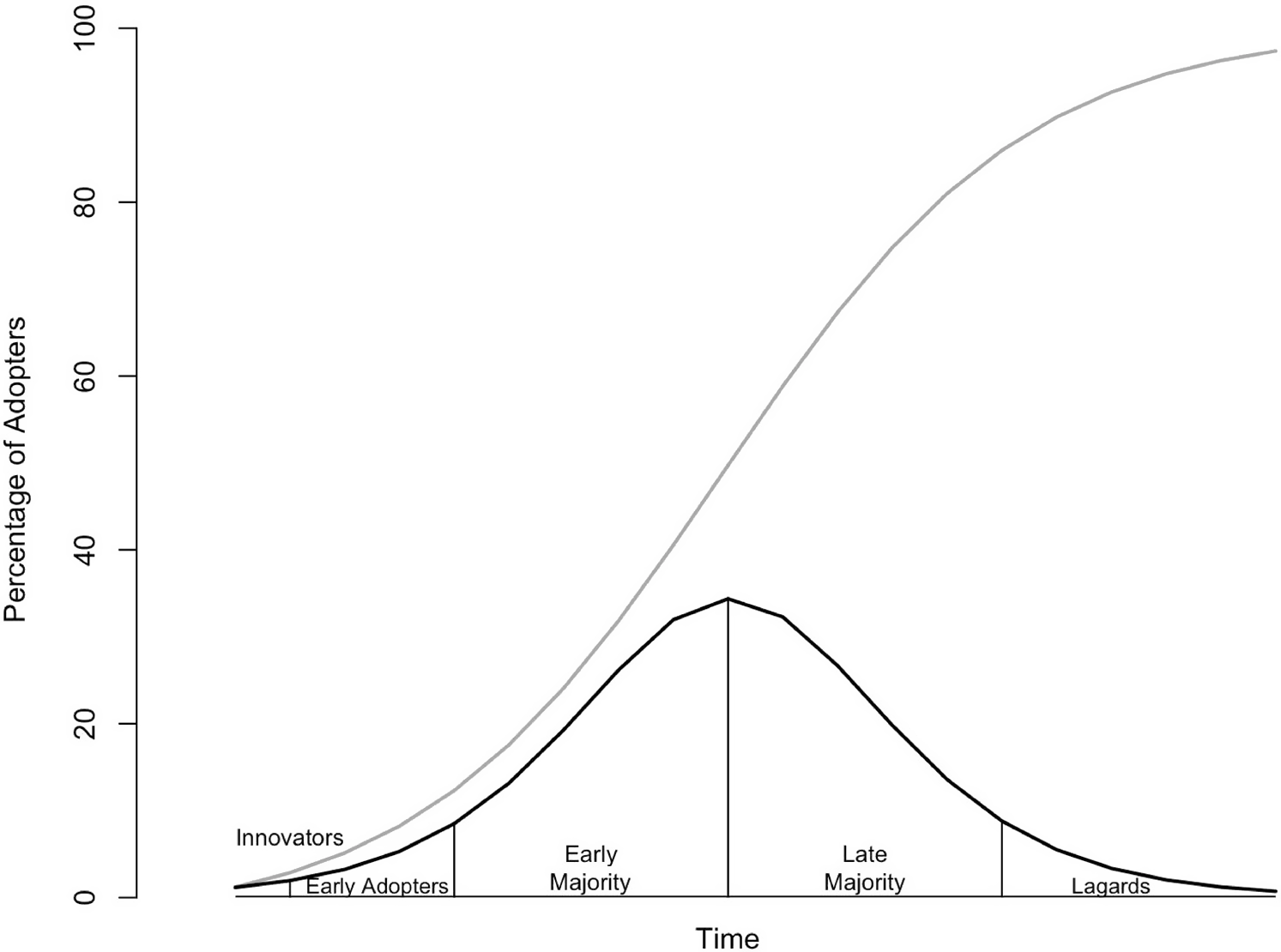
The adoption of hybrid corn roughly followed the standard diffusion process (ibid.), first identified by the French sociologist, Gabriel de Tarde (Reference de Tarde1903), and illustrated in figure 1. Ryan and Gross sorted Iowa farmers into five categories—innovators, early adopters, early majority, late majority, and laggards—categories that subsequently were adopted and modified (see, e.g., Abrahamson and Rosenkopf Reference Abrahamson and Rosenkopf1997; Midgley and Dowling Reference Midgley and Dowling1978; Rogers Reference Rogers2003). If one plots the cumulative number of adopters, it typically results in an S-shaped curve, indicating that adoption begins slowly, increases until approximately half of the population has adopted it, and then slows down as it approaches saturation. The curve reaches an inflection point about when the early majority begins adopting the innovation. It reaches another when most of the late majority has. Once a critical mass of adopters is obtained, somewhere between 10 and 20 percent, the diffusion process hits a tipping point and is difficult to reverse (de Nooy et al. Reference de Nooy, Mrvar and Batagelj2018; Gladwell Reference Gladwell2000; Macy Reference Macy1990; Marwell and Oliver Reference Marwell and Oliver1993; Rogers Reference Rogers2003—see, however, discussion of Hassanpour Reference Hassanpour2017 in the following text). As Valente (Reference Valente1995: 87) explains, in “most diffusion situations there exists a pool of individuals who are central” [and] “represent the potential critical mass. Once this pool … adopts the innovation, and sufficient other network properties … are present, the critical mass occurs.”
Diffusion of innovation.

Social Networks of Diffusion
James Coleman, Elihu Katz, and Herbert Menzel’s (1957, 1966) Medical Innovation study, which examined the adoption of a new drug (tetracycline) by doctors in four Illinois towns, was one of the first diffusion studies to use social network data. Coleman et al. found that doctors named more frequently by their peers as social and professional contacts prescribed the drug sooner, indicating that the more exposure one has to prior adopters, the sooner they will adopt an innovation. In more recent studies, exposure is often measured not in terms of the number of ties to prior adopters, but rather by the proportion of ties to prior adopters (de Nooy et al. Reference de Nooy, Mrvar and Batagelj2018; Granovetter Reference Granovetter1978; Macy Reference Macy1991; Valente Reference Valente, Carrington, Scott and Wasserman2005). This allows researchers to capture the effect of exposure to both adopters and nonadopters (Centola Reference Centola2018; Centola and Macy Reference Centola and Macy2007). Closely related to this is the idea that potential adopters need to reach a threshold of exposure before adopting an innovation. Thresholds vary from person to person and innovation to innovation. People with low thresholds typically only need to come into contact with just a handful of prior adopters before doing so themselves, while those with high thresholds may need to come into contact with several before they do, if they do so at all.
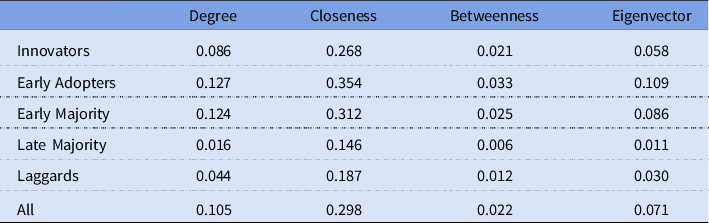
The centrality of prior and potential adopters is often important, but what constitutes “being central” is not always obvious. Is it having numerous ties to others (degree), being, on average, close (in terms of path distance) to other actors (closeness), lying on the shortest path between other pairs of actors (betweenness), or being connected to well-connected others (eigenvector)?Footnote 1 Consider, for example, the average centrality scores of the Medical Innovation doctors,Footnote 2 broken down by innovators, early adopters, early and late majority, and laggards (table 1). The innovators, on average, scored lower on all four centrality measures than the population average. This is not entirely unexpected as they are generally more inclined to adopt innovations, regardless of their ties to prior adopters. By contrast, the early adopters and early majority were, more central on average, suggesting that their centrality increased the likelihood they would prescribe tetracycline. These results are also consistent with the idea that a critical mass is reached once a pool of central individuals adopts an innovation. Finally, it is interesting that, on average, laggards scored higher than the late majority, possibly indicating that laggards have such high thresholds that just because some of their contacts began prescribing tetracycline, there was no guarantee they would.
Average centrality scores of doctors in medical innovation

Exposure can occur in ways other than direct contact. For instance, Ron Burt’s (Reference Burt1987) reanalysis of the Medical Innovation data found that holding a position similar to a prior adopter (i.e., being structurally equivalent), rather than having a direct tie, better predicted how quickly a physician prescribed tetracycline. Structurally equivalent actors do not necessarily have ties with one another, but their ties to others are similar or identical—like two physicians who do not know one another but share the same advisors, friends, or discussion partners. By holding similar positions within the network, structurally equivalent actors are associated “with a role or set of roles” that share “similar responsibilities or exhibit similar types of behavior” (Cunningham et al. Reference Cunningham, Everton and Murphy2016: 195). Notably, a later analysis found that structural equivalence and direct ties helped explain tetracycline’s diffusion (Strang and Tuma Reference Strang and Tuma1993).
Tie strength can also play a role. Mark Granovetter (Reference Granovetter1973) famously argued that weak ties (people seen seldom or rarely) are “stronger” in terms of a network’s overall structure than strong ties (people seen frequently) because they are more likely to form bridges between social circles that otherwise would be disconnected. Strong ties, by contrast, tend to cluster together because when two people share a strong tie with a third, it is likely they will form, or have already formed, a tie with one another, a process known as triadic closure. Thus, ties that span short social distances tend to be strong, while those that span long ones tend to be weak (Centola Reference Centola2018: 22–23). This led Granovetter to argue that “whatever is to be diffused,” it “will reach a larger number of people, and travel a greater social distance (i.e., path length), when passed through weak ties rather than strong” (Granovetter Reference Granovetter1973: 1366). As such, groups or communities whose members lack weak ties will find it more difficult to mobilize. To illustrate, Granovetter (ibid.: 1373–76) compared two attempts of community organizing, one successful and one not. He argued that a key difference between the two was that the one that failed lacked the weak ties it needed to bind its social circles together, leading to a level of fragmentation it could not overcome.
More recently, Damon Centola and Michael Macy (2007—see also, Centola Reference Centola2018) have argued that, although weak ties can facilitate the spread of some ideas or innovations, the adoption of a behavior, idea, or information that is “costly, risky, or controversial” (complex contagion) requires numerous, strong ties to prior adopters. This is because individuals often “require independent affirmation or reinforcement from multiple sources” (Macy Reference Macy1991: 703; for an empirical test, see also Manzo et al. Reference Manzo, Gabbrielini, Roux and M’Mbogosi2018). Centola and Macy’s models suggest that both a higher proportion and a greater number of ties to prior adopters—possibly across multiple networks—increases the likelihood of a complex contagion occurring.
Ties are often crosscutting, pushing and pulling actors in multiple (and sometimes conflicting) directions. For instance, consider Roger Gould’s (1991) analysis of the Paris Commune. He found that the insurgency spread across different arrondissements (districts) through overlapping ties of guardsmen enlistments. Although battalions primarily recruited guardsmen along neighborhood lines, guardsmen often fought in neighborhoods other than their own, and Gould showed that guardsmen “in different neighborhoods influenced each other’s degree of commitment to the insurrection through the network of links created by overlapping enlistments” (Gould Reference Gould1991: 726). Interestingly, influence often flowed in only one direction. A particular district might have influenced another, but the reverse did not necessarily occur.
Influence can extend beyond direct ties. For example, Nicholas Christakis and James Fowler (see, e.g., Christakis and Fowler Reference Christakis and Fowler2010, Reference Christakis and Fowler2013; Fowler and Christakis Reference Fowler and Christakis2010) have explored the diffusion of numerous health-related behaviors and found they spread, on average, up to three degrees of separation. As one of their better-known studies found (Fowler and Christakis Reference Fowler and Christakis2008: 1), one may be happy, not because they have a friend who is happy or because one of their friend’s friends is happy, but because one of their “friend’s friend’s friends” is happy. Although their findings are powerfully suggestive, the operant mechanisms are unclear (ibid.: 8).Footnote 3
Network structure is also important. Networks can be scale-free (Barabási Reference Barabási2002), small worlds (Travers and Milgram Reference Travers and Milgram1969; Watts Reference Watts1999; Watts and Strogatz Reference Watts and Strogatz1998), or otherwise, and they can range in terms of their density, size, centralization, level of clustering, and so on. Research suggests that innovations tend to diffuse faster through denser and/or more centralized networks (however, see Hassanpour Reference Hassanpour2017). Technology, for instance, is likely adopted more quickly today (Desjardins Reference Desjardins2018; Ritchie and Roser Reference Ritchie and Roser2019) because the world has become more interconnected (Hilbert Reference Hilbert2015). By contrast, individuals embedded in tightly knit clusters of nonadopters may lack sufficient ties to prior adopters to reach their adoption thresholds (Moody Reference Moody, Hedström and Bearman2009; Siegel Reference Siegel2009). Similarly, Centola (Reference Centola2015, Reference Centola2018) found that networks with high levels of social consolidation (i.e., when one’s friends, colleagues, and neighbors are all the same) tend to be poorly integrated in terms of shared norms and practices because their underlying structure produces highly segregated communities. However, although low levels of social consolidation increase the number of crosscutting ties, diffusion may not occur due to a lack of social support and reinforcement for adoption. By contrast, moderate social consolidation levels provide enough social homophily to create meaningful collective identities without eliminating ties that connect various social circles.
Ideally, researchers can access whole network data, which (theoretically) includes all relevant actors and ties. Collecting such data can be time-consuming or impossible, however, especially when examining historical phenomena. Thus, researchers often turn to other types of data, such as counts of ties or ego-networks. Ego-network data are preferred to tie counts because not only do they capture an actor’s (i.e., ego) ties to others (i.e., alters) but also the ties between ego’s alters (Everton Reference Everton2018). Ego-networks permit researchers to calculate numerous metrics, such as ego-network density (proportion of ties between ego’s alters), the strength of the ties and brokerage potential between egos and alters, and the heterogeneity of each ego’s network (i.e., the degree to which alters differ from egos in terms of gender, race, religion, etc.) (Crossley et al. Reference Crossley, Bellotti, Edwards, Everett, Koskinen and Tranmer2015; Perry et al. Reference Perry, Borgatti and Pescosolido2018). Researchers often collect ego-networks with surveys, but they can also gather them through personal interviews, social media accounts, or historical sources such as memoirs, letter exchanges, periodicals, and administrative records.
Whole network data are preferable to both tie counts and ego-networks because not only do they allow the calculation of the metrics available for ego-networks but they also permit the estimation of additional metrics and algorithms that might prove important. For historically oriented researchers, whole-network data can be difficult to assemble, and missing ties or nodes diminishes the reliability of network metrics (Borgatti et al. Reference Borgatti, Carley and Krackhardt2006; Smith and Moody Reference Smith and Moody2013; Smith et al. Reference Smith, Moody and Morgan2017; Ward et al. Reference Ward, Stovel and Sacks2011). Even so, whole network data can be reconstructed from historical source materials, as in Almquist and Bagozzi’s (Reference Almquist and Bagozzi2017) study that used automated text analysis of publications to uncover the organizational network structure of the radical environmental movement of the 1990s.
Finally, one of the greatest challenges is when multiple networks operate jointly in a particular place and time, consisting of different layers of social interaction through a multiplicity of simultaneous ties (Wasserman and Faust Reference Wasserman and Faust1994). If the reconstruction of a single network can be difficult, then reconstructing multiple networks can be even more daunting. Nevertheless, multiple network data can yield novel insights. Similar to his analysis of crosscutting resistance ties across Paris’s arrondissements, Gould (Reference Gould1995) used various French administrative records to reconstruct the diverse sets of overlapping social relations to explain why workers adopted a radicalized class identity during the Paris Commune. Where social ties forged in workplaces, kinship networks, and neighborhoods overlapped, Parisians were more likely to join the Communards—thus adopting a novel social identity—and remain on the barricades even after the national government waged war on the capital.
Closely related to the explicit modeling of social ties are the increasing use of geospatial data and computer simulation. Geospatial data are similar to network data in that they are “a network of connections based on distance” (Valente Reference Valente, Carrington, Scott and Wasserman2005: 100). They allow theorists to explore how geographic proximity affects the adoption of innovations (Audretsch and Feldman Reference Audretsch and Feldman1996; Blaikie Reference Blaikie1978; Hägerstrand Reference Hägerstrand1965, Reference Hägerstrand and Pred1967; Lengyel et al. Reference Lengyel, Clemente, Kertész and González2018; Toole et al. Reference Toole, Cha and González2012; Valente Reference Valente, Carrington, Scott and Wasserman2005). Researchers posit that actors closer to prior adopters are more likely to adopt than those who are distant. Even where personal ties allow for the wide reach of social influence, distance plays a role in diffusion in eras lacking modern communications media. Agent-based models and other forms of computer simulation that capture interactions between potential adopters allow researchers to test various hypotheses concerning diffusion (see, e.g., Becker et al. Reference Becker, Hsiao, Pfaff and Rubin2020; Centola Reference Centola2015; Flache Reference Flache2018; Marwell and Oliver Reference Marwell and Oliver1993). They can help “identify how network features, individual behaviors, and the content of what is being transmitted create more or less favorable conditions for the diffusion of cultural traits or new social practices” (Roux and Manzo Reference Roux and Manzo2018: 968). Computer simulation is complementary to social network modeling, especially when network data are absent or unobtainable, which is frequently the case in historical studies of diffusion.
Some of the most innovative work on historical diffusion using social network analysis has come at the hands of archeologists, who, despite hurdles, increasingly use its methods to analyze connections between archeological sites (see, e.g., Brughmans et al. Reference Brughmans, Collar and Coward2016; Knappett Reference Knappett2013). A major challenge is determining what constitutes a tie, but they have developed numerous approaches for doing so. Proximal point analysis (PPA), the oldest and simplest (Terrell Reference Terrell1997, Reference Terrell2010), connects sites by linking each to its k nearest neighbors, typically three (Broodbank Reference Broodbank1993: 321). Its weakness is its indifference “to the limitations of travel technology” (Rivers Reference Rivers, Brughmans, Collar and Coward2017: 133). Although two sites may be close in terms of “how the bird flies,” they may have been quite distant in terms of travel time, which is more important for diffusion premised on contagion (Brockmann and Helbing Reference Brockmann and Helbing2013). Nevertheless, its simplicity makes it attractive, which is why if archeologists “know only one network model, it is likely to be PPA” (Rivers Reference Rivers, Brughmans, Collar and Coward2017: 133). Another method, maximum distance network, links sites within a specified distance (Evans Reference Evans, Brughmans, Collar and Coward2017). Variations include those where two sites have to be visible to one another to be linked (Brughmans et al. Reference Brughmans, Keay and Earl2014), or where distance is weighted by travel costs. For instance, in “many ancient situations, travel by land was considerably slower than by water, so a sea route could involve more kilometers but actually be faster and hence a true measure of separation” (Evans Reference Evans, Brughmans, Collar and Coward2017: 152). A third method links sites together based on their similarity (Peeples et al. Reference Peeples, Mills, Haas, Clark, Roberts, Brughmans, Collar and Coward2016). Here, archeologists connect two sites if both share the same type of material culture (Mizoguchi Reference Mizoguchi2009). An example is the Southwest Social Networks Project, where Barbara Mills and her colleagues (e.g., 2013) link sites in terms of the similarities of ceramic ware assemblages.
We now turn to our examination of empirical work that has explored the spread of religious beliefs and practices, peace and violence, and social and political movements. We will show that, despite the profusion of diffusion studies in these domains, researchers do not always specify a diffusion model or its underlying causal mechanisms. Whereas many studies seek to document spatial diffusion, not all specify a vector, model flows of influence and information, or identify how people and places are connected (tied) to one another. We organize our discussions topically rather than by mechanisms because, as we noted earlier, diffusion studies usually find multiple causal mechanisms. We are primarily interested in network effects, but even in this regard, more than one is usually operative. Recall that both structural equivalence and direct ties help explain tetracycline’s diffusion (Burt Reference Burt1987; Strang and Tuma Reference Strang and Tuma1993). Our review begins with the diffusion of religious beliefs and practices before turning to first the spread of violence and peace and then social and political movements.
Examining the Diffusion of Religion
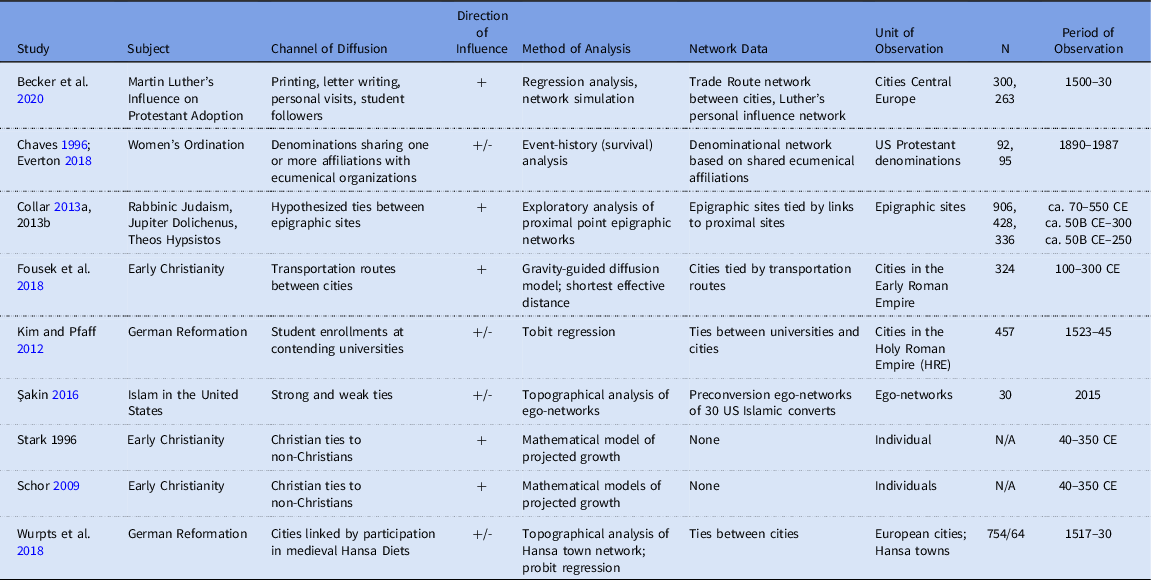
Recently, the volume of research on religion that makes explicit use of social network concepts and analysis to explain the diffusion of religious behavior and organization has been impressive (Everton Reference Everton2018). Here, we review some of the most interesting work on the historical diffusion of religious innovations that concerns themselves with questions like the rise of Christianity, the ascendance of Rabbinic Judaism, the proliferation of ancient cults, and the spread of Protestantism. Researchers have also examined the contemporary history of the diffusion of new religious movements and Islam in the United States and the movement to ordain women in contemporary Protestant churches. For ease of reference, table 2 summarizes the key features of the studies we review, such as the models they utilize, the nature of the data they employ, and so on.
Religious movements

Early Christianity
Much of the important work about religious diffusion has the seminal work of Rodney Stark on the rise of Christianity as its touchstone. Stark (Reference Stark1996a) drew on network concepts to help account for Christianity’s growth during the early Roman Empire, asserting that, similar to most new religious movements (Lofland and Stark Reference Lofland and Stark1965; Stark and Bainbridge Reference Stark and Bainbridge1980), the early church probably gained most of its converts through social ties. Were such ties strong or weak? István Czachesz (Reference Czachesz and Czachesz2011) argues that because the Apostle Paul was constantly traveling, he would have been unable to form strong ties with members of the communities he visited. Denis Duling (Reference Duling2013) disagrees, arguing that strong ties were necessary because converting was risky. He also notes that Paul’s longer stays as an artisan might have facilitated forming strong ties. Of course, Paul was not the only Christian missionary, but his evangelism model was widely influential.
Stark also argues that because most early Christians were Jews, when the Church sent missionaries to the far reaches of the Roman Empire, it would have been natural for them to stay with the Jewish Diaspora (i.e., Jews dispersed throughout the Roman Empire). He believes that the “mission to the Jews” was far more successful than most historians grant (see, e.g., Ehrman Reference Ehrman2018), and shows that cities with significant Diasporan communities Christianized sooner than did others (Stark Reference Stark1996a: 138–40; 2006: 134–35, 240).
Stark also shows that if the early church grew at a rate of approximately 40 percent per decade, a rate similar to that of the Mormon Church (Stark Reference Stark1996b), by 300 CE, it would have grown to approximately 6.3 million members, which is close to some estimates (Bagnall Reference Bagnall1982). In an expansion of Stark’s analysis, Adam Schor (Reference Schor2009) compares several potential growth scenarios, illuminating how different assumptions lead to various outcomes. He concludes by proposing a scale-free network model of early Christian growth (Barabási et al. Reference Barabási, Albert and Jeong1999). Scale-free networks are driven by preferential attachment (Merton Reference Merton1968), where most actors have only a few ties, while a handful (hubs) have numerous. Schor argues that such hubs could have served as brokers in the network for spreading Christian beliefs and practices. Moreover, scale-free networks can be resilient to external shocks because the random removal of actors tends to have little effect on network structure because most actors have few ties (Barabási Reference Barabási2002). Schor believes this might help explain the early church’s apparent ability to weather various storms (e.g., plagues, persecution), suggesting that it probably experienced “periods of relative stability broken by moments of explosive growth” (Schor Reference Schor2009: 497).
Stark (Reference Stark1996a, 2006) also tested several hypotheses regarding why Christianity took root in some cities but not others. Recently, Jan Fousek and several collaborators (Fousek et al. Reference Fousek, Kaše, Mertel, Výtvarová and Chalupa2018), using a dataset with as many as 324 cities, more robust population estimates, and distances weighted by travel costs, reconsidered two of Stark’s hypotheses: Christian congregations appeared sooner in (1) larger cities and (2) cities closer to Jerusalem. They found support for both, although the effects were stronger in the first two centuries. Additionally, they estimated the effective distance between pairs of cities, which is “the effect that a randomly seeded [innovation] in a peripheral node of the network has a higher probability of being transmitted to a well-connected hub than vice versa” (Brockmann and Helbing Reference Brockmann and Helbing2013: 1339). From this, they computed the shortest effective paths (beginning from Jerusalem), which allowed them to map a network of “the expected … spreading process” (Fousek et al. Reference Fousek, Kaše, Mertel, Výtvarová and Chalupa2018: 6) and measure Jerusalem’s direct impact on Christianity’s spread to nearby towns and distant regional centers (large cities). Their analysis suggests that once Christianity arrived at large cities, its diffusion no longer relied on Jerusalem.
Rabbinic Judaism, Military Cults, and Worshippers of the Most-High God
Archeologist Anna Collar has used network methods to map the spread of Rabbinic Judaism and other religious movements in the first few centuries of the Roman Empire. For Rabbinic Judaism, she draws on a modified version of PPA to link sites containing “Hebrew, Jewish symbols, or make explicit reference to Israel” (Collar Reference Collar and Knappett2013a: 235; Reference Collar2013b: 205). Specifically, she links each site to Judaea plus one established connection, “except in later cases where there are three [sites] close by” (Collar Reference Collar2013b: 212). Although “this skews the maps towards having very long-distance links and makes Judaea a heavy centre,” she believes it creates a more realistic picture of the “rabbinic ‘mission’ to the Diaspora” (Collar Reference Collar and Knappett2013a: 235). Because it is unclear how, whether, and when communities declined, she assumed that “once a piece of epigraphic evidence is recorded, Jews continued to be present” (Collar Reference Collar2013b: 212).
Collar shows that network connectivity in the Diaspora was sparse in the first and second centuries, suggesting minimal interaction between it and Jerusalem. In the third century, however, she constructs an increasingly interconnected network, which she attributes to the changes that ensued after the Romans destroyed the Second Temple in 70 CE. She argues that before the temple’s destruction, Diaspora Jews did not advertise their culture and identity because the temple was the center of religious life. Afterward, the influence of the Sadducees, which was tied to the temple, waned, while that of the rabbis, which was not, waxed. The ensuing Rabbinic reforms ultimately led to the “widespread dissemination and adoption of explicitly Jewish names, symbols, and language” (Collar Reference Collar and Knappett2013a: 230) throughout the Diaspora. Although Collar believes that the weak ties were important (ibid.: 242), she argues “that the new religious authorities … used … strong-tie ‘familial’ connections … to transmit the religious and social discipline of rabbinic Judaism” (ibid.: 230). Undoubtedly, many had to be “reactivated” because they had laid dormant for years (Collar Reference Collar2013b: 180). Like Stark (Reference Stark1996a), she believes that early Christianity probably utilized the same network and met some success among Diasporan Jews.
Collar turns to standard PPA to explore the diffusion of two other religious movements. One, Jupiter Dolichenus, which took its name from the Near Eastern storm god of Doliche (Dülük), a small town in what is now southeast Turkey, spread rapidly across the empire from about 125 to 300 CE before disappearing. At some point, this god became associated with war and the military, and Collar traces both its spread and disappearance to the mobility of Roman officers and the networks they left in their wake, “across which innovation and information flowed” (Collar Reference Collar2013b: 114). Her reconstructed networks (ibid.: 124–37) suggest that the cult peaked in the first half of the third century, but because it never took hold among the masses when Rome’s military networks fell into disarray in the third century due to political and military upheaval, its popularity waned. And once a plague struck in the middle to the late third century, it “could not sustain [itself], although a few dedications between 253 and 300 testify to its limping on in certain places” (ibid.: 144).
The other cult she explores, Theos Hypsistos, was a movement influenced by, but separate from, Judaism (ibid.: 269). She argues that two factors drove some “God-fearers,” those who observed Jewish rites without formally converting, to join the Hypsistarians: (1) the spread of Rabbinic Judaism and its associated reforms, and (2) a tax (fiscus Judaicus) imposed by the Roman Empire on anyone practicing Judaism (i.e., not just ethnic Jews). Rabbinic reforms had an effect because, reflecting increased tension between Jews and Romans due to various Jewish revolts, for a time, they drew distinct boundaries between who was and was not considered a Jew. This probably pushed the God-fearers away from Judaism and toward Hypsistarianism, where they could still “express their beliefs” (ibid.: 244). The fiscus Judaicus, which the Romans initially imposed to offset the lost revenues that Jews paid Rome for the destroyed Temple’s upkeep, was extended in 96 CE to all who openly practiced Judaism. This created an economic incentive for God-fearers to join the Hypsistarians, especially those who found the tax burdensome. Collar (ibid.: 274–81) demonstrates that the Hypsistarian network became increasingly interconnected in the second and third centuries, probably reflecting the influx of God-fearers. However, it all but disappeared in the fourth when the fiscus Judaicus lapsed, and Rabbinic Judaism relaxed its distinctiveness. The Hypsistarians probably also lost members to Christianity, given its similarities with Judaism, as well as becoming the Roman Empire’s state religion.
The Protestant Reformation
In an influential paper, economists Sascha Becker and Ludger Woessmann (2009) pioneered the use of distance from Wittenberg as an instrumental variable predicting the long-run influence of Protestantism on development. A slew of subsequent papers explored why self-governing cities adopted the Reformation, finding a positive association between proximity to Wittenberg, the center of the emerging Lutheran movement, and Zurich, the center of the emerging Reformed movement (Becker et al. Reference Becker, Pfaff and Rubin2016).
Distance measures from Wittenberg and Zurich work because they presume spatial diffusion from places of inception but is there evidence to suggest which mechanisms were at work? Steve Pfaff and his collaborators have drawn on social networks to help account for the spread of the German Protestant Reformation. In one, Kim and Pfaff (Reference Kim and Pfaff2012) examined the effect that student social networks had on the likelihood that a town embraced the Reformation (i.e., by abolishing the mass). In it, they argue that the university towns of Wittenberg and Basel, the respective intellectual homes of the Lutheran and Zwinglian reformers, acted as “critical communities” (ibid.: 190) that exposed the outside world to the Reformation’s theology. They show that the greater the number of students a city “sent” to Wittenberg or Basel, the more likely it would embrace reform. They also show that the greater the number of students a city sent to the orthodox Catholic strongholds, Cologne and Louvain, the more likely it would reject reform. Notably, these effects hold even after controlling for each city’s distance from Wittenberg or Basel (whichever was closer) and Cologne or Louvain (whichever was closer).
Subsequently, Wurpts, Corcoran, and Pfaff (Reference Wurpts, Corcoran and Pfaff2018) examined the Reformation’s diffusion in what is now Northern Germany. Previous studies found that members of the medieval Hansa (Hanseatic League), a network of merchants and trading cities with extensive ties in northern Europe, found the Reformation especially appealing for reasons of economy and local autonomy. To explore the Reformation’s diffusion among the Hansa, Wurpts et al. derived a network of ties between 34 Hansa towns based on their shared participation in 29 Hansa Diets (governance assemblies) in the 25 years leading up to the Reformation (1492–1516). Armed with these data, they first consider several topographical network measures (e.g., density, centralization, average path length) and conclude that the network meets the criteria for complex contagion. It enabled the “spread of information through multiple channels in the early years of the Reformation,” as well as offering “multiple opportunities for support and reinforcement, particularly at the center of the network” (ibid.: 233). Turning to generalized measures of degree, closeness, and betweenness centrality (Opsahl et al. Reference Opsahl, Agneessens and Skvoretz2010) allows them to control for both the number and weights of ties between towns. They find that tie strength between towns, having more ties to other towns (degree), being closer to other towns (closeness), and being located in positions of brokerage (betweenness) increased the likelihood that a town adopted reform.
Diffusion studies often confine themselves to a single channel of diffusion and model a single mechanism. However, a collaborative paper by Pfaff, fellow sociologist Yuan Hsiao, and economists Sascha Becker and Jared Rubin (Becker et al. Reference Becker, Hsiao, Pfaff and Rubin2020) proposes that the diffusion of radical institutional innovations depends on multiple networks and multiple forms of influence. Radical innovations spread where ideological entrepreneurs launch campaigns to persuade others, and multiple local social exchange ties reinforce those efforts, seeding local clusters of adopters across the network.
Answering Young’s (Reference Young2009) challenge to contend between learning, influence, and social contagion as explanations for diffusion, they use historical data and social network analysis to explain the diffusion of the early Reformation (up through 1530). They reconstructed the “influence network” of a single, hyperinfluential historical figure—Martin Luther—and compared its effect to learning using the printing press and spatial contagion. They found that about one-third of the cities in their sample that formed a personal tie with Luther by 1522, as measured through his correspondence network, his visits, and his students, adopted the Reformation. To get at a meaningful measure of social distance between cities, they reconstructed the sixteenth-century trade-route network based on historical atlases. A regression analysis revealed that, net of trade route centrality, a host of structural and economic factors, and the volume of local printing activity, ties to Luther increased the odds of adopting Protestantism.
Nevertheless, Becker et al. (Reference Becker, Hsiao, Pfaff and Rubin2020) acknowledge that multiple sources of endogeneity complicate a causal interpretation of the Luther effect. In response, they used computer simulations to pose counterfactual worlds in which only Luther’s influence operated, only spatial diffusion through trade networks from the Reformation’s point of inception at Wittenberg operated, and a world in which both factors combined to influence adoption. Based on simulation statistics drawn from their regression analyses and the historical record of adoption, agent-based modeling showed that a conservative scenario congruent with their theoretical model that combines Luther’s personal infectiousness and spatial contagion yields a rate of adoption close to the empirical observation.
Women’s Ordination
To study the spread of women’s ordination in American denominational Protestantism that has expanded rapidly since 1970, Mark Chaves (Reference Chaves1996, Reference Chaves1997) drew on the insights of the new institutionalism (DiMaggio and Powell Reference DiMaggio and Powell1983; Meyer and Rowan Reference Meyer and Rowan1977; Powell and DiMaggio Reference Powell and DiMaggio1991). The theory proposes that diffusion occurs through social exchange, positing that the more institutions interact, the more alike they become. To test whether this accounts for the spread of women’s ordination, Chaves estimated a series of event-history (survival) models that include several factors that could affect the likelihood that denominations would begin ordaining women. He included clergy shortages; theological beliefs; whether the denominations are predominantly rural, black, or Southern; founding dates; denominational structures (e.g., decentralized or autonomous women’s mission societies); feminism’s first (1880–1920) and second (1966–83) waves; and most importantly, ties to prior adopters in his models. Chaves first identified all the denominations that in 1992 had clergy, some degree of national-level organization, and more than 300 congregations. Because many of these resulted from mergers, he traced their development to determine all precursors. In the end, he identified 92 denominations, of which 44 ordained women. For network data, he constructed a series of (whole) networks where two denominations shared a tie if they belonged to one or more of the same ecumenical organizations at eight points in time between 1915 and 1985.
Chaves found that clergy shortages were not associated with adopting the innovation, but denominations that were younger, decentralized, or had autonomous women’s organizations were more prone to adopt. By contrast, denominations that were sacramental, predominantly Southern, and held the Bible was inerrant were less likely. Curiously, feminism’s second, but not first, wave increased the likelihood a denomination would begin ordaining women. The largest association Chaves uncovered, however, were ties to prior adopters. He found a positive relationship between the proportion of a denomination’s interorganizational ties to prior adopters and the likelihood it would begin ordaining women. Although his original analysis did not control for the effect that the more egalitarian Holiness and Pentecostal traditions may have had on the adoption of women’s ordination, a later analysis (Everton Reference Everton2018) using the same data did. It found that although the Holiness (but not the Pentecostal) tradition had a positive effect, the network effect remained, and its size was virtually identical.
The Spread of Islam in the United States
Erin Şakin (Reference Şakin2016) explored the diffusion of Islam in the United States. Collecting preconversion ego-network data for 30 recent Islamic converts, 18 in Michigan and 12 in Kentucky, he showed that in Michigan, which had an established Muslim community, individuals generally converted through weak ties, while in Kentucky, which did not, they generally converted through strong ties. Why? Şakin argues that because many Americans hold a negative perception of Islam, in areas where Muslims are more numerous (and thus more visible), non-Muslims are more likely to form weak ties with Muslims. By contrast, in areas with few Muslims, ties formed between non-Muslims and Muslims are more likely to be strong.
Diffusion in Social and Political Movements
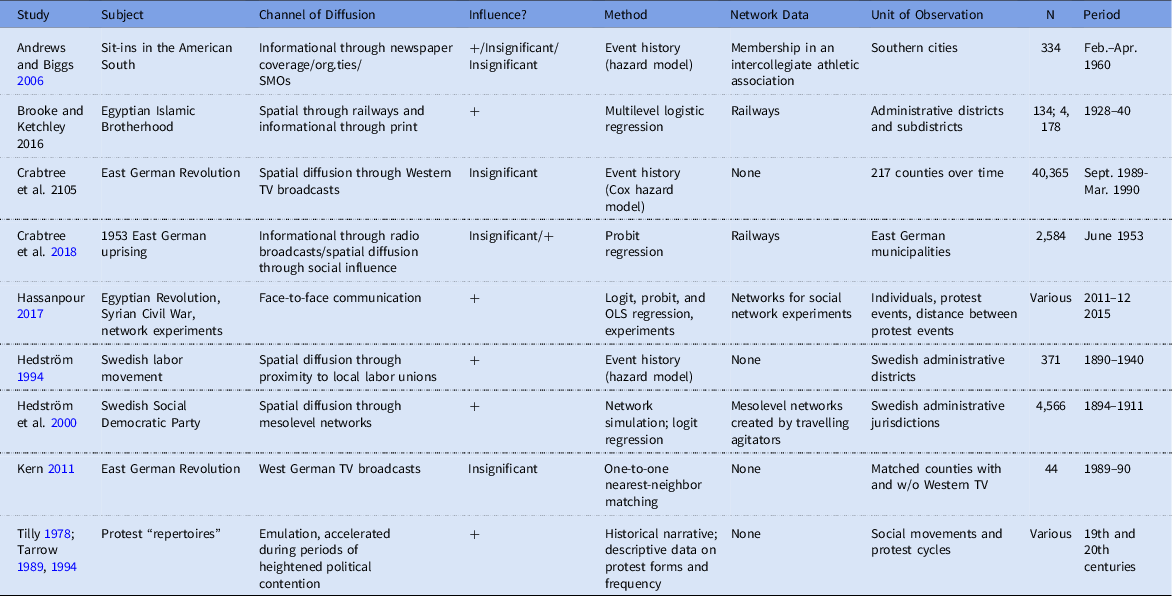
Diffusion powerfully shapes collective action, and prominent scholars regard it as one of the fundamental causal mechanisms explaining social movements (see, e.g., Givan et al. Reference Givan, Roberts and Soule2010; McAdam et al. Reference McAdam, Tarrow and Tilly2001: 22–27, 68–69, 333–40). Michael Biggs (Reference Biggs2005) has noted that, because interdependence and influence are ubiquitous features of collective action, metaphors invoking epidemics, bandwagons, snowball effects, wildfires, and so forth, frequently crop up in explanations of movements. The challenge, however, obtains in linking the appearance of similar forms of collective action, injustice frames, or organization across time and place to a plausible account of the transmission of influence or novel information. Taking interdependence and social influence seriously compels researchers to give due both to external conditions and endogenous processes like those generated by networks. Considerations like these have strongly influenced the contemporary research agenda in historical and comparative research on social movements. Table 3 summarizes the key features of the empirical studies we discuss.
Social movements

Repertoires and Cycles of Collective Action
Charles Tilly, Sidney Tarrow, and their many students and collaborators introduced an influential set of ideas about the spread of social movements (see, e.g., Traugott Reference Traugott1995). Based on an extensive program on the transformation of popular protest in Europe in the eighteenth and nineteenth centuries, Tilly (Reference Tilly1978) argued that people carry out a limited “repertoire” of collective action routines. These depend on their situation and exposure to different protest tactics, noting that national, modular, and autonomous forms of protest gradually replaced parochial and particular forms that relied on elite patronage. The gradual spread of the strike as the predominant form of labor protest exemplified this transition (ibid.: 151–66).
The notion of repertoires allowed Tilly to account for both the strong undercurrent of continuity, as well as the sweeping changes he documented in the comparative history of social movements. However, Tilly’s argument lacked a clear account of the origination and spread of novel protest forms. Why, for example, did new tactical forms seem to spread more rapidly in certain periods and jump across societies with different levels of economic development and urbanization? If we consider great waves of protest, such as those unleashed in 1848, 1968, 1989, or 2010, it seems that new forms of collective action spread rapidly both within and across societies, even when local conditions were unfavorable for their adoption and fostered strategic blunders (Hale Reference Hale2013; Weyland Reference Weyland2012). To better account for these periods, Tarrow (Reference Tarrow1994) developed the concept “cycles of contention,” which are conflict periods that feature the geographic and sectoral diffusion of protest. Of course, several factors could account for why diffusion occurs across cycles, among them heterogeneity, learning, and social influence. Indeed, Tarrow’s (1989) magisterial study of the great Italian protest wave of the 1960s and 1970s suggests that all three were at work. McAdam (Reference McAdam and Traugott1995) proposed a modification to this perspective in which “initiator” groups introduce innovations that other social movement organizations adopt as political opportunities expand.
Although the literature on protest repertoires originally focused on political opportunities and did not explicitly engage diffusion theory or network concepts and methods, this has changed. As one set of prominent social movement scholars declared, “Diffusion requires that movements across these multiple sites be linked together through activist networks, or at least informed and inspired by media-transmitted images or shared cultural understandings of popular struggles in other settings” (Givan et al. Reference Givan, Roberts and Soule2010: 6). Tarrow (Reference Tarrow, Givan, Roberts and Soule2010) argues that diffusion in movements is frequently complex, occurs through multiple network processes, develops in interaction with institutions, and causes shifts in the scale of collective action (local → regional → national → transnational).
Mesolevel Networks and the Diffusion of Social Movements
Some of the most influential papers on social movement diffusion have come from Peter Hedström and his colleagues, who have tackled the rise of the Swedish labor movement. Sweden was very conservative and industrialized slowly by Western European standards. Nevertheless, within a few decades, it had one of the best-organized and most successful labor movements in the world and became a standard-bearer for social democracy.
Hedström’s (Reference Hedström1994) first paper applied a spatial diffusion model to explain the spread of the trade union movement. He argued that social and geographical ecologies influence the formation of social networks in a population and, in turn, the resulting network structure influences social movements because mobilization can be contagious across places through networks. His analysis finds that in 1890 nearly all unions were located in cities. However, by 1905, unions existed in about half the districts, and most locals were in rural areas. In 1940, unions had spread to all but a few districts. Drawing on administrative and organizational data, including the founding date of the first trade union in hundreds of Swedish districts, Hedström used a hazard model to predict the first union in a district. His results suggest that spatial diffusion played an important part because, net of controls for total union density, the size of the industrial labor force, district size, and the presence of other organizations, prior union formation in proximate districts was associated strongly with adoption.
In a subsequent paper, Hedström and his colleagues reconstructed the role that social influence played in the socialist movement (Hedström et al. Reference Hedström, Sandell and Stern2000). Although the Swedish Social Democrats first appeared in 1889, it was the country’s leading electoral party with chapters in most parts of the country by the time of World War I. In the context of high uncertainty about the benefits of adoption and conservative resistance to socialism, Hedström and his colleagues proposed that multiple processes and multiplex networks explain its diffusion. The first is learning through labor organizing. As union members learned about socialism adopted elsewhere, they became more likely to found a party chapter. The second is the persuasiveness of peripatetic socialist agitators whose travels unintentionally created a “mesolevel” network that linked workers across the length and breadth of the country.
Hedström believed that these agitators were persuasive to the extent that they provided novel information in the context of latent demand for change. They further argued that the “mesolevel” network that resulted from the travels of party agitators linked districts differently than did interpersonal, microlevel networks. Overall, mesolevel networks have a low density with ties bridging long geographical and sociometric distances. The visits of socialist agitators created ties between districts that reduced the distances between them and between the neighbors of those districts. In creating these ties, the agitators thus unintentionally influenced the path of diffusion across Sweden. A computer simulation supported the proposition that diffusion would have occurred much less swiftly absent a mesolevel network of this kind.
To test the theory, they employed logit models to estimate the founding of a Social Democratic party organization in 4,566 administrative districts between 1894 and 1911. Their models predict party founding and include controls for union density, as well as the density of social and religious organizations. The results lend support to the theory, with both local and mesolevel networks influencing adoption. Counterpressures were also influential; conservative religious groups apparently hampered socialism’s adoption. Ecological factors clearly mattered; party organizations were more likely to form in cities, industrialized areas, and areas of working-class concentration. Perhaps the most interesting finding is that visits by agitators increased the odds of a party chapter in districts with few workers and low union density, suggesting two routes to Social Democratic Party adoption. One ran through local union organizing using the learning mechanism, the other through agitation using the mechanism of persuasion (or influence). Although we might expect that labor agitators were prone to visit towns where class conflict was intense, the regression models and historical evidence suggests otherwise. Agitators focused their efforts on unorganized workers and farm laborers (Hedström et al. Reference Hedström, Sandell and Stern2000: 148). Whereas this finding undercuts the notion that diffusion is more likely in the presence of latent demand, casting doubt on the primacy of learning, it boosts the causal interpretation of the relationship between visits and adoption through influence.
Communications Media and the Diffusion of Protest
In the spring of 1960, a new protest tactic swept the American South. Beginning in the city of Greensboro, North Carolina, African American protesters staged sit-ins at segregated lunch counters. Within two months, protesters had staged sit-ins in every Southern state except Mississippi. Kenneth Andrews and Michael Biggs (2006) rejected previous explanations for this tactic’s swift diffusion, which had focused on spontaneous adoption and preexisting activist communities (Morris Reference Morris1986). Instead, they proposed that movement organizations, social networks linking historically black colleges, and information about protests elsewhere fostered diffusion. Using event-history modeling to predict the first date of a sit-in in 334 Southern cities, they find little evidence that organizational networks or local movement organization explained adoption. However, they find that the hazard of sit-in adoption in a given city increased when local newspapers covered sit-ins in another city. Time and space constrained the relationship, though, with the relationship much greater when newspaper coverage of protests in a first city was covered in a second city within three days.
Andrews and Biggs argued that, although local social networks were probably important in organizing sit-ins in a given city, they do not explain why the tactic spread. Black college students adopted sit-in tactics because of news reports about protests elsewhere. They measure exposure by whether a given newspaper reporting on an event had at least 5 percent circulation in a city (p. 763), which, as a measure of penetration, tells us little about the exposure of local activists to the news. We might expect that radio or television news coverage would have been far more influential than newspapers with very modest regional circulation. Moreover, we have to be cautious about rejecting the social network diffusion hypothesis in this study because the network measure was far from robust: namely, a dummy variable for interorganizational ties between college campuses through the black Central Intercollegiate Athletic Association (p. 762). Although this captures one kind of linkage between college campuses, there were probably other, possibly more influential, ties between activists. Multiple processes and multiplex networks probably linked activists across cities and organizations, which propelled diffusion alongside newspaper coverage.
Whereas it is intuitively appealing that communication technologies spread the reach of social movements in democracies (Givan et al. Reference Givan, Roberts and Soule2010; Meyers Reference Meyers2000; Roscigno and Danaher Reference Roscigno and Danaher2001), what about in authoritarian regimes? In recent years, the role of diffusion through mass media has become an important line of comparative research. The velvet revolutions against communism in 1989, the “color revolutions” in post-Soviet states, and the Arab Spring brought attention to how foreign news broadcasts, the internet, and social media transmitted information that putatively triggered popular rebellions against authoritarian regimes (Beissinger Reference Beissinger2007; Hale Reference Hale2013; Howard Reference Howard2010; Hussain and Howard Reference Hussain and Howard2013; Weidmann Reference Weidmann2015; Weyland Reference Weyland2012). The prevailing notion is that better information fosters rebellion by providing models, injustice frames, and repertoires that aggrieved, but poorly organized citizens, can adopt. Perhaps more importantly, uncensored news can provide insight into aggregate levels of discontent in the populace that instills confidence in dissidents. Nevertheless, social influence models tend to cast doubt on the sufficiency of information. Collective actors generally require social reinforcement and multiple channels of influence before taking up something like risky protests.
A series of recent papers on the former German Democratic Republic (i.e., East Germany)—arguably a “most likely” case for foreign media’s impact in authoritarian polities—further call into question strong claims about the sufficiency of mass media to explain protest diffusion. East Germany was a rigidly controlled, authoritarian, Marxist–Leninist regime. Despite erecting a daunting surveillance and control system, East Germany was unusual in the Soviet bloc because West German television was widely available. Conventional wisdom maintains that this was the Achilles’s heel of East Germany: nearly every household had a TV. Once news reports about the Soviet bloc’s erosion and scattered protests in Leipzig and other cities flooded Eastern living rooms, the false sense of mass support for the regime evaporated, protests multiplied, and the system collapsed (Kuran Reference Kuran1991; Lohmann Reference Lohmann1994).
A paper by Holger Kern (Reference Kern2011) refutes the central tenant of this argument. Kern noted that Western television was not universally available because of topographical features and distances from broadcasting towers. This allowed him to exploit a “natural experiment” to test whether receiving West German television explains protest in East German counties. He created two groups of counties that differed as much as possible in terms of their access to West German television but were otherwise similar, dropping counties adjacent to access to limit the risk of spatial diffusion of television’s influence. His dependent variables measured protest events and participation from police reports. He used one-to-one nearest-neighbor genetic matching techniques to find good comparison units for 22 counties that lacked access to Western television. Comparing these two sets of counties from September 1989 through March 1990, Kern shows that those counties with Western television access adopted protest somewhat earlier, but they did not substantially differ from those without TV. This was true whether measured in terms of the rate of protest diffusion or its depth (the extent of protest activities measured by the number of events and the total number of participants). In a counterfactual world in which those 22 counties received Western broadcasts, there would have been no difference in the rate or depth of protest diffusion.
In a follow-up paper, Charles Crabtree, David Darmofal, and Kern (2015) take this analysis a step further by estimating the probability of protest events in the East German revolution with better measures of mass media penetration. Specifically, they use an electromagnetic signal propagation model precisely to estimate which counties fell below the threshold of receiving Western TV broadcasts. The comparison of counties above and below that threshold reveals substantial differences, including that those below the threshold experienced about a fifth fewer protest events on average than those above. Does the presence of Western TV explain the difference? To find out, they estimate Cox hazard models predicting protest events that include a host of county-level sociodemographic and economic characteristics while including spatial dependence, event dependence, and heterogeneity in a repeated events framework. Again, their findings reject the hypothesis that Western TV accounted for protest diffusion in East Germany in 1989–90.
Is the same true for other episodes of protest? In a subsequent paper, Crabtree, Kern, and Pfaff (Reference Crabtree, Kern and Pfaff2018) analyze an earlier uprising. In June 1953, East Germany experienced the Soviet bloc’s first mass uprising against Communist rule. From its inception in East Berlin, a raucous and seemingly spontaneous protest movement rapidly spread across the country. Within days, it brought the regime to its knees, requiring Red Army intervention to save it. The consensus shared by contemporary observers and historians is that Western radio broadcasts suffice to explain why popular protest spread so widely in such a short time frame. What makes this especially persuasive is that radio ownership was ubiquitous, and the United States operated a radio station as an arm of anti-Communist propaganda. Did the “Radio in the American Sector” (RIAS) and other Western broadcasters spread rebellion in the provinces by covering labor unrest in the capital? Using electromagnetic signal propagation models, Crabtree et al. estimated radio signal strength in 1 km × 1 km cells for all of East Germany by terrain characteristics, the location of transmitters, and the technical characteristics of broadcasters. Because radio reception was exogenous to other characteristics of places, it is plausible to interpret the relationship between broadcast strength and protest adoption as causal. Nevertheless, estimating probit models for protest occurrence in more than five thousand municipalities, they find no association between measures of signal strength and the probability of protest events.
They do find evidence for a rival interpretation based on spatial diffusion through social networks. Probit models strongly indicate that the greater the distance a municipality was from East Berlin, the lower its odds of experiencing protest. They account for this with historical evidence from security reports and other sources indicating that protests spread principally through interpersonal ties. In particular, train connections facilitated social diffusion as people commuting from the capital seeded local clusters of rebellion. To test this claim, they show that effective travel distance from East Berlin strongly predicts the probability of protest, with the estimated probability diminishing with increasing distance by train. Their findings suggest that the rail network’s characteristics, rather than radio broadcasts, better explains where protest diffused in June 1953.
Other case studies not only offer methodological innovations introducing better measures of mass media penetration but also theoretical modifications to network diffusion models. A good example is a study on the Arab Spring in which Navid Hassanpour (Reference Hassanpour2017) challenges a long-held assumption that successful social movements mobilize (diffuse) from the center. Using data from the Egyptian Revolution in Cairo, the Syrian Civil War in Damascus, and social network experiments, he demonstrates that mobilization is more likely to occur from the periphery than from the center under certain circumstances. In particular, when potential movement leaders are embedded within small-world networks and traditional communication channels are abruptly disrupted, mobilization is likely to shift to the social margins where individuals are generally less risk-averse, more likely to be early adopters, and less likely to have countervailing ties. In such situations, minimal cores, which Hassanpour defines as the smallest set of risk-takers who will continue to act among a majority opposed to its actions (Hassanpour Reference Hassanpour2017: 85), are more important than a critical mass. Cut off from risk-averse individuals who could dampen their enthusiasm, minimal cores located in clusters of resistance lying on the margins are more likely to continue to advocate for change. His data show that in Cairo and Damascus when internet and cell phone communications were completely and abruptly shut down, not only did protests increase but also they became more widely dispersed and locally clustered as contention shifted from the moderate center to the radical periphery. Rather than suppressing tentative coordination by people fearful of repression, the security forces confronted spontaneous protests by radicals on the margins of urban society who were far harder to intimidate.
Hassanpour’s book makes an important contribution by showing that it is not only network structures that matter but also the nature of social relations. As the Arab Spring case suggests, sometimes more communication (i.e., more ties) can work against mobilization because it links a radical minority to a risk-averse majority that drowns out “initial sparks of risk-taking” (ibid.: 72; see also Siegel Reference Siegel2009). His paper contributes to the growing awareness that social ties need not facilitate mobilization and that repressive regimes may exploit network structures and manipulate digital media to hinder protest diffusion (King et al. Reference King, Pan and Roberts2013; Kitts Reference Kitts2000; Siegel Reference Siegel2011).
Leadership and the Diffusion of Political Islam
Political Islam as a modern mass movement was born in Egypt. In a paper on the rise of Egypt’s Muslim Brotherhood, Steven Brooke and Neil Ketchley (2018) explain its rapid spread from 1928 through 1940. During that period, the Brotherhood expanded from a few provincial offices to more than two hundred chapters and spread to all but a handful of the country’s governorates (379–80; 388). To account for such rapid spatial diffusion, Brooke and Ketchley conduct an ecological analysis of the founding of Brotherhood chapters culled from movement publications. Combining year of founding with administrative data on more than four thousand districts, they estimate a multilevel logistic regression predicting a branch in 1937 and 1940. They find that, contrary to much of the literature identifying local reactive mobilization against foreigners and economic modernization as driving forces, the Brotherhood was more likely to be adopted in subdistricts with higher than average literacy rates and direct connections to the national railway network.
The analysis suggests two pathways to adoption. One is the diffusion of the movement through printed information, the other through social ties between places and the Brotherhood organization channeled through railway links. To support their proposed mechanisms, Brooke and Ketchely turn to process tracing of historical source materials to understand the movement’s spread. They describe a movement that published widely popular magazines and newsletters targeting the newly educated in provincial towns. Movement leaders intentionally exploited the railways. A crucial moment in the movement’s expansion occurred when it moved its headquarters to Cairo, the hub of the national railroad network. This allowed leading agitators to fan out across the country more efficiently (pp. 388–89). There are clear parallels between Brooke and Ketchely’s (2018: 390–91) argument and Hedström et al.’s (Reference Hedström, Sandell and Stern2000) theory of mesolevel networks, although Brooke and Ketchely’s study includes neither network data nor explicit social network analysis.
Conflict and the Diffusion of Violence (and Peace)
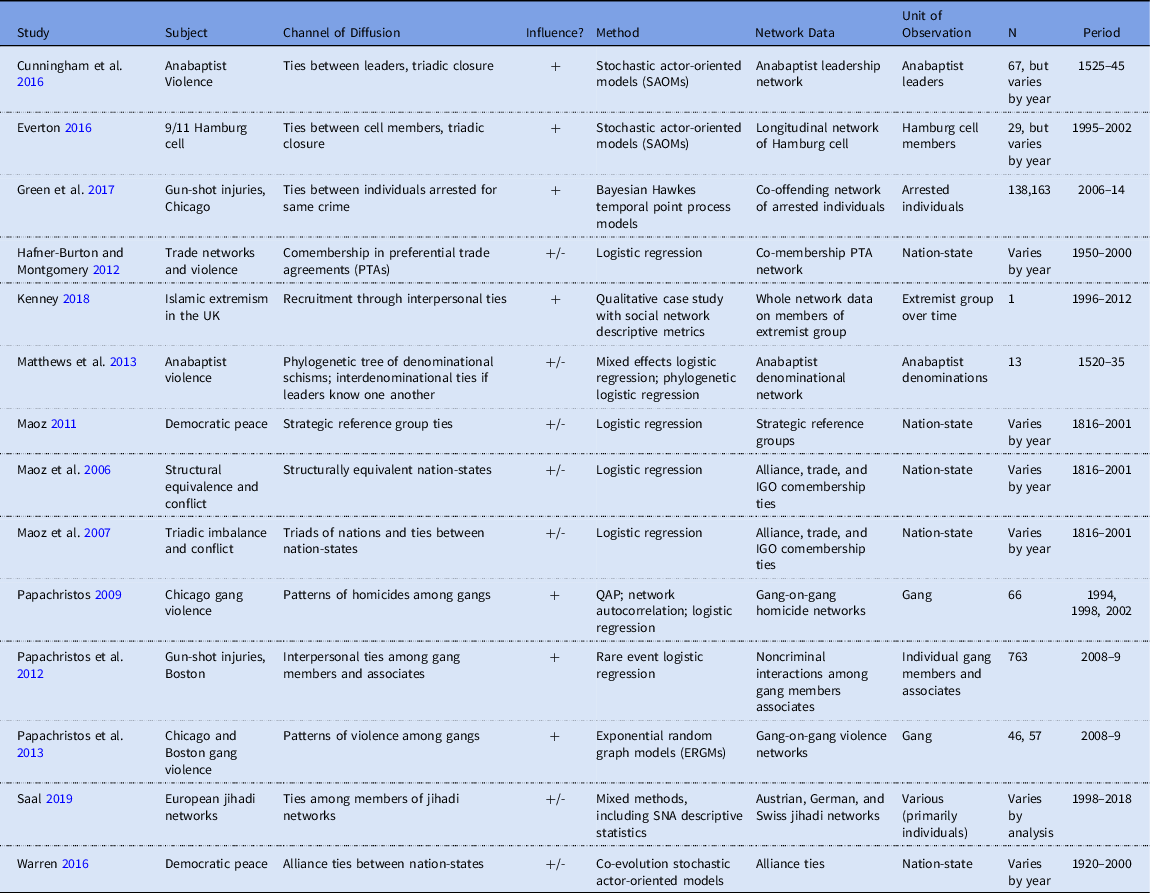
Although violence is rare (Collins Reference Collins2008) and possibly in decline (Pinker Reference Pinker2011—see, however, Arquilla Reference Arquilla2012), it remains a genuine threat for many (Fraga Reference Fraga2016; Krug et al. Reference Krug, Dahlberg, Mercy, Zwi and Lozano2002). Here, we consider studies in three domains where researchers have drawn on network concepts and methods to explore the diffusion of violence: (1) crime, in particular, gang violence; (2) violent extremist groups, such as terrorists and insurgencies; and (3) conflict in the international arena between nation-states. Interestingly, all the studies we examine draw on social network data of some sort instead of relying on proxies. Table 4 summarizes the key features of each.
Conflict and violence

Gang Violence
Criminologists are embracing network analysis to explore various features of crime (Carrington Reference Carrington, Scott and Carrington2011). These include the association between personal networks on crime and delinquency (Haynie Reference Haynie2001; Massey and Krohn Reference Massey and Krohn1986); the relationship between network fragmentation and neighborhood crime rates (Matsueda Reference Matsueda2006; Sampson and Groves Reference Sampson and Groves1989); the social organization of crime (Baker and Faulkner Reference Baker and Faulkner1993; Smith and Papachristos Reference Smith and Papachristos2016); the trade-off between efficiency and security (Crossley et al. Reference Crossley, Edwards, Harries and Stevenson2012; Morselli et al. Reference Morselli, Giguère and Petit2007); and the crafting of intervention strategies (Cavallaro et al. Reference Cavallaro, Ficara, De Meo, Fiumara, Catanese, Bagdasar, Song and Liotta2020; Klerks Reference Klerks2001). Network data is even used to enhance prosecution (Krebs Reference Krebs2002; Sparrow Reference Sparrow1991). Of particular note is the work of Andrew Papachristos and his colleagues, who have examined numerous aspects of criminal behavior, including the diffusion of violence through gang networks. Although prior studies focused on the effect of individual (e.g., age, gender, race), situational (e.g., the presence of weapons, drugs, alcohol) and community (e.g., mobility, cohesion, inequality) factors (Papachristos et al. Reference Papachristos, Braga and Hureau2012), Papachristos was among the first to bring social network data to bear on the study of gang violence.
In an early paper, Papachristos (Reference Papachristos2009) analyzed the patterns of homicides among Chicago gangs from 1994 to 2002. In it, he builds upon Gould’s (2003) dominance theory of violence, arguing that gang violence spreads like social contagion as status disputes arise and then resolved through violence. “What begins as a single murder soon generates a dozen more as it diffuses through these murder networks” (Papachristos Reference Papachristos2009: 76). To test this, Papachristos gathered data on all Chicago homicides from 1994–2002 and selected cases in which the victim or offender was a gang member. He then aggregated these to the gang level to construct networks of gang-on-gang homicides. He also used geospatial data to map each gang’s turf because they are “typically the setting of a group’s collective memories, a meaningful geographic space for young men as they transition from childhood to adulthood” (Papachristos et al. Reference Papachristos, Hureau and Braga2013: 42—see also Whyte Reference Whyte1943). Using quadratic assignment procedure (QAP), network autocorrelation, and logistic regression, he finds that both dominance competition (measured by the degree to which two gangs’ turf overlaps) and prior exposure to violence through gang-on-gang homicide networks increase the likelihood of violence.
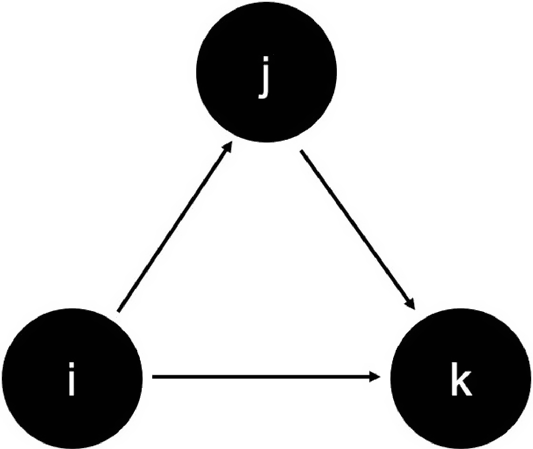
In a follow-up study, Papachristos, David Hureau, and Anthony Braga (2013) compared violence patterns among Chicago and Boston gangs in 2008 and 2009. As before, they aggregate their data to construct gang-on-gang violence network data. For this analysis, though, they draw on exponential random graph models (ERGMs) (Robins Reference Robins, Scott and Carrington2011; Robins et al. Reference Robins, Pattison, Kalish and Lusher2007) to disentangle dominance competition from turf disputes. Here, they distinguish dominance competition from turf in terms of actual patterns of violence. In particular, they test for the nonrandom presence of transitive triads (see figure 2), which they argue captures dominance hierarchies’ dynamics. Separately, they measure turf competition by whether gangs share turf boundaries. Interestingly, and contrary to their expectations, they find no evidence that gang violence contributes to establishing dominance hierarchies. However, they do uncover evidence that turf competition facilitates the spread of violence. Consistent with Papachristos’s earlier study, they also find that exposure to prior violence drives the spread of violence, even when gangs do not share turf boundaries.
Transitive triad.

Papachristos and his colleagues have also explored the diffusion of gun violence. In one study (Papachristos et al. Reference Papachristos, Braga and Hureau2012), they examined fatal and nonfatal gunshot injuries in Boston’s Cape Verdean community from 2008 to 2009. Using FIOs (Field Intelligence Observation cards), which record noncriminal encounters between two or more individuals, they mapped interactions between the known gang members, their associates, and other individuals. They found that the greater the proportion of ties that individuals have to others who have had a gunshot injury, the more likely they will suffer the same fate. However, the farther they are from a gunshot injury (in terms of path distance), the less prone they are to being be shot. A subsequent study (Green et al. Reference Green, Horel and Papachristos2017) examined the spread of violence among individuals living in Chicago from 2006 to 2014. Beginning with 138,163 arrested individuals who were victims of gun violence, the authors constructed a “co-offending network” where individuals arrested for the same offense share a tie with one another. They found that 63.1 percent of the gunshot violence resulted from social contagion. “Subjects of gun violence were shot on average 125 days after their infector (the person most responsible for exposing the subject to gunshot violence), with a median time difference of 83 days” (ibid.: 329). Their analysis also uncovered evidence that social distance plays a role. In fact, consistent with the Christakis and Fowler studies, it found that gun violence, at least in this network, spread to three degrees of separation.
Violent Extremism
Since the 9/11 terrorist attacks, analysts have increasingly drawn on network analysis to examine “dark networks,” that is, covert, illegal, and/or clandestine networks (Asal and Rethmeyer 2008; Everton Reference Everton2012; Krebs Reference Krebs2002; Pedahzur and Perliger Reference Pedahzur and Perliger2006; Raab and Milward Reference Raab and Milward2003; van der Hulst Reference van der Hulst, Scott and Carrington2011). Many have focused on using network measures for devising intervention strategies (Carley et al. Reference Carley, Lee and Krackhardt2002; Everton Reference Everton2012; Jordan et al. Reference Jordan, Mañas and Horsburgh2008; Sageman Reference Sageman2004), but analysts have cautioned against using them blindly (Carley et al. Reference Carley, Lee and Krackhardt2002; Krebs Reference Krebs2002; Moody Reference Moody2005; Roberts and Everton Reference Roberts and Everton2011, Reference Roberts, Everton and Dawoody2016). Analysts have also considered the role that social ties play in dark network recruitment (della Porta Reference della Porta2013; Sageman Reference Sageman2004), variation in the structure of dark networks (Oliver Reference Oliver2014; Xu and Chen Reference Xu and Chen2008), and the effect of network topography on efficiency, security, and resilience (Arquilla and Ronfeldt Reference Arquilla, Ronfeldt, Arquilla and Ronfeldt2001; Bakker et al. Reference Bakker, Raab and Milward2011; Everton and Cunningham Reference Everton and Cunningham2015).
Although most of these have looked at contemporary dark networks, some have turned their lens toward the past. For example, research on the so-called radical wing of the Reformation has considered how violence diffused among predominantly nonviolent Anabaptists (forerunners of the Amish and Mennonites). Anabaptists trace their beginnings to 1524 and a small group in Zurich, later known as the Swiss Brethren (Williams Reference Williams1975). They originally followed Ulrich Zwingli’s teachings, but they eventually embraced adult baptism, which led them to be targets of violent repression (McDaniel Reference McDaniel and Wellman2007). Although they leaned toward nonviolence, in 1534, one group briefly established a violent theocracy in Münster, Westphalia, where torture and public executions became commonplace (Stayer Reference Stayer1979). In June 1535, a handful of defectors helped the local Prince-Bishop regain control of the city, after which the rebellion’s leaders were tortured and executed (McDaniel Reference McDaniel and Wellman2007).
Luke Matthews and several others (Matthews et al. Reference Matthews, Edmonds, Wildman and Nunn2013) were curious whether the violence found among Anabaptists was “inherited” or “spread.” To test for the former, they constructed a “phylogenetic” tree tracing the history of schisms among Anabaptists beginning with one denomination in 1520 and ending with thirteen in 1535, from which they calculated a “distance” between denominations that represented the total amount of time (as measured by schisms) separating them. To test the latter, they mapped the ties between the same 13 denominations, linking two if one or more of their leaders knew one another. Their analysis shows that while most theological beliefs spread across the leadership network, violence may have been inherited, leading them to suggest “a good working hypothesis is that religious violence does not arise from a group’s characteristic theological beliefs and practices. Rather, violence may be a learned trait … [or] the outcome of other factors … inherited along congregational lines” (ibid.: 13).
In a related study, Cunningham, Everton, and Murphy (Reference Cunningham, Everton and Murphy2016) use an expanded Anabaptist dataset (McLaughlin Reference McLaughlin2015) to show that the leadership network associated with the rebellion grew increasingly insular and was more likely to hold apocalyptic beliefs. Their analysis builds on an earlier study that examined the evolution of the 9/11 Hamburg cell (Everton Reference Everton2016). Both draw on Cass Sunstein’s (2002) “law of group polarization” to argue that internally dense religious groups that maintain few external ties are more likely to radicalize. And when combined with apocalyptic beliefs, such groups can turn violent—other groups exhibiting similar dynamics include the Peoples Temple, the Branch Davidians, and the Armed Islamic Group of Algeria (GIA) (Everton Reference Everton2018).
Michael Kenney’s (2018) book on the contemporary Islamist movement in Great Britain deftly employs a mixture of qualitative evidence and network analysis to identify the dynamics that lead people to adopt an extremist identity. Focusing on a Salafi-jihadist group (al Muhajiroun) active since the 1990s, Kenney used extensive fieldwork, interviews with activists, and analysis of news reports and publications to reveal “a network of deeply-committed members who sought to replace Great Britain’s secular democracy with a religious theocracy based on their interpretation of Salafism and Islamism” (ibid.: 3). Although never larger than 200 members, the group was a prominent voice in Islamic radicalism in Britain. Kenney shows how people adopted an extremist identity through a process that involved both strong and weak ties. The group established weak ties to potential recruits by staging protest events and public outreach, targeting those with a strong sense of Muslim collective identity. Once it linked them to the movement, it fostered their radicalization through gradual acculturation and nurturing strong emotional attachments.
In particular, group solidarity relied on ties to its charismatic founder, an imam noted for his extremist positions and fiery sermons. However, after this “almost cultish” leader fled Britain, the group evolved from a centralized structure toward a cell-like, small-world structure with “high local clustering and short path lengths.” Kenney demonstrates these changes by contrasting the group’s network characteristics over three periods (1996–2005, 2005–9, and 2009–12), revealing clear evidence of decentralization (degree centralization fell from .840 to .599, and betweenness centralization fell from .747 to .357). Although it proved resilient in the wake of its leader’s departure and persuaded some followers to take up arms at home and abroad, the group ultimately dwindled. Its inflexible dogmatism limited its appeal, and recruiting new members became harder in the context of surveillance.
Using a similar approach, Johannes Saal (Reference Saal2019) draws on rational choice, social capital, and network theories to explore the spread of jihadi groups in Germany, Austria, and Switzerland. His analysis reveals that all three networks grew in waves. Strong ties were more important earlier in their development than later, suggesting that larger networks may be more vulnerable to infiltration than smaller ones. Why? Because, else being equal, network density is inversely associated with network size as the number of potential ties grows exponentially with each additional node (de Nooy et al. Reference de Nooy, Mrvar and Batagelj2018). As such, larger networks tend to be sparser than small ones, and we have learned that individuals are more likely to violate group norms in sparse networks than in dense ones (Festinger et al. Reference Festinger, Schachter and Back1950; Finke and Stark Reference Finke and Stark2005; Granovetter Reference Granovetter2005). Saal also highlights the key role that Salafist preachers play in the development and spread of Jihadism. He notes that, on average, preachers score higher in terms of most centrality measures, in particular betweenness. Thus, they are more likely to be located in brokerage positions, which allows them to play crucial roles in disseminating funds, teachings, and violence (Saal Reference Saal2019: 46). His analysis of travel networks that help individuals join ISIS or other jihadi groups found that poorly constructed ones often led to failure, while well-constructed ones were more likely to lead to success. The difference, according to Saal, depends largely on whether facilitators have access to bridging social capital. That is, did they possess the ties and trust needed to connect across to numerous groups and individuals who could help foreign fighters successfully reach the conflict zone of their choice?
Conflict, Peace, and the Networks of Nations
International relations scholars have long recognized that connections between nations facilitate the diffusion of various phenomena (Maoz Reference Maoz2012), such as conflict, peace, and human rights. However, it is only in recent years that they have turned to network methods to do so (Hafner-Burton et al. Reference Hafner-Burton, Kahler and Montgomery2009; Maoz Reference Maoz2012).Footnote 4 Emilie Hafner-Burton and Alexander Montgomery’s (2012) paper, which explores the effect of trade agreements on international conflict, is reflective of this approach. They use longitudinal network data to explore the effects of ties on the diffusion of conflict. Here, a tie between two states indicates the number of comemberships they share in one or more preferential trade agreements (PTAs). They find that while the presence of trade agreements between two states can dampen the spread of conflict, power disparities can increase it. Their analysis models two types of power disparities: dependence and access. They measure the first in terms of the total number of trade institutions two nations belong to together and separately. Given two states, A and B, “A’s dependence on B increases if A and B join additional trade institutions together, but A’s dependence on B decreases if A joins additional trade institutions without B” (ibid.: 262–63). To capture access, they use eigenvector centrality, which measures the degree to which actors are connected to well-connected actors. Power disparities, then, are the differences between the respective dependence and access scores of two nations.
Zeev Maoz, along with his many collaborators, deserves the most credit for pushing this line of research, collecting and analyzing various types of ties between nations (e.g., alliance, conflict, trade) to explore the causes of international conflict. For example, he, along with Ranan Kuperman, Leslie Terris, and Ilan Talmud (Reference Maoz, Kuperman, Terris and Talmud2006), explored structural equivalence’s effect on conflict. Recall that structurally equivalent actors hold similar network positions and tend to behave similarly. They are identified not by direct ties to one another but by the similarity of their ties to others. Using network data from 1816 to 2001, Maoz et al. (Reference Maoz, Terris, Kuperman and Talmud2007) identified structurally equivalent actors in terms of three types of ties: alliances, trade, and shared membership in one or more international government organizations (IGOs). They found that “strategic” and “trade-based” affinity, that is, structurally equivalent states based on patterns of alliance and trade-based ties, reduces conflict, but structural affinity in terms of shared IGO membership increases it. The latter result is surprising since many scholars believe that common IGO membership reflects a shared commitment to the management of international politics and, as such, should reduce conflict. However, when Maoz et al. (Reference Maoz, Kuperman, Terris and Talmud2006) only looked at ties among politically relevant states, they found that while the results for strategic and trade-based affinity essentially remained unchanged, IGO membership structural affinity did reduce conflict after the end of World War II. Finally, in both sets of analyses, they show that integrated structural affinity (i.e., one accounting for all three types of ties) reduces conflict.
In a companion article (Maoz et al. Reference Maoz, Terris, Kuperman and Talmud2007), the same authors drew on balance theory to explore the effect of balanced and imbalanced triads of nations on the diffusion of conflict. In the international arena, balance occurs when “an ally of an ally is also an ally” or “an enemy of an enemy is an ally,” and imbalance is where “an ally of an ally is an enemy” or “an enemy of an enemy is also an enemy.” Although networks gravitate toward balance (Cartwright and Harary. Reference Cartwright and Harary1956; Davis Reference Davis1967; Heider Reference Heider1946) imbalances can and do occur. Their analysis identifies numerous causes of imbalance (e.g., strategic rivalry, opportunism, contiguity) and balance (e.g., economic interdependence, shared IGO memberships, joint democracy). More importantly, at least for our purposes here, it finds that international relational imbalances reduce alliance formation and increase the spread of conflict.
Maoz (Reference Maoz2011) also draws on network analysis to examine the tendency among democracies to avoid conflict with one another. Known as the “democratic peace” (Russett and Oneal Reference Russett and Oneal2001), it is probably the closest thing “to an empirical law in international relations” (Levy Reference Levy1988: 662). However, Maoz notes that while this is true, democracies are just as conflict-prone as nondemocracies, and the greater the proportion of democracies in the international system does not lower the overall level of conflict (Maoz Reference Maoz2011: 251). To resolve this paradox, he analyzes the international system at several levels. Beginning with what he calls strategic reference networks (SRNs), which are ties among states that are of strategic relevance to one another, he derives two types of subnetworks: strategic reference groups (SRGs) and cliques (SRCs). A nation’s SRG is its ego-network, that is, its direct ties to other nations within its SRN and the ties between them. A nation’s SRCs are the various cliques to which it belongs within its SRN.Footnote 5 Maoz finds that SRG size is positively associated with conflict, while the proportion of allies within an SRG has the opposite effect. He also shows that the average level of democracy in the SRGs of democratic states lowers the spread of conflict, but the outcome is mixed in SRGs of primarily of nondemocratic states. Finally, he finds that democracies belonging to numerous SRCs (essentially those that are central within the international network) have a larger impact on democratization’s spread than those belonging to fewer (ibid.: 270).
A difficulty analysts face when exploring the relationship between democratization and peace is that it is unclear whether democratization results from conflicts resolved through treaties (social influence) or if democracies are more likely to form alliances with other democracies (social selection). Existing research offers evidence for both. To disentangle these influence and selection effects, Camber Warren (Reference Warren2016) has drawn on coevolution SAOMs (Steglich et al. Reference Steglich, Snijders and Pearson2010) to examine the interdependent relationship between military alliances, international conflict, and democratization from 1920 to 2000. His models find evidence for both selection and influence. States with similar regime types are more prone to form alliances with one another.Footnote 6 Democratic states are also less likely to engage in military disputes, and nondemocratic states that ally with democratic regimes are more likely to democratize. However, “military conflict between states tends to inhibit the development of democratic regimes” (Warren Reference Warren2016: 435), thus challenging the results of some earlier studies. In short, evidence for the democratic peace exists, but network interdependencies make the relationship between conflict, alliances, and democratization complex.
Conclusion and Implications for Historical and Comparative Social Science
This review makes clear to us that research on social diffusion should be at the center of historical and comparative social science. It is also clear to us that social network analysis has revolutionized the historical and comparative study of diffusion. The combination of comparative perspectives on change and innovation, new methods of historical data collection and analysis, and growing sophistication in the application of network concepts and models are shedding light on a host of substantive questions and contributing to our general understanding of diffusion.
Diffusion studies peaked in the early 1960s, but a resurgence driven by “the advent of more sophisticated network models and technology” has made “it possible to study the diffusion process more explicitly” (Valente Reference Valente, Carrington, Scott and Wasserman2005: 98). At one time, less than 1 percent of studies used social network data (Rogers Reference Rogers2003: 96–98), but now explicitly modeling social ties is considered crucial (de Nooy et al. Reference de Nooy, Mrvar and Batagelj2018). This is not to suggest that researchers now ignore factors other than social ties. They routinely account for the characteristics of actors and communities (e.g., cosmopolitanism, education level, age, socioeconomic status), the attributes of innovations (e.g., complexity, compatibility), systemwide factors (e.g., norms, culture, concentration of opinion leadership), and economic conditions (Rogers Reference Rogers2003: 94–100).
Historical and comparative social science on diffusion has much to offer the study of social change. One limitation, however, has been the relatively small role played by disciplinary historians. Perhaps the contemporary historical discipline has limited exposure to social network concepts and little training in the statistical and computational methods required for social network analysis. Historians might be rightly concerned that social network theories and methods can color our appreciation of the past by privileging quantifiable evidence and imposing ahistorical interpretative structures on it. Decontextualized analyses driven by sophisticated techniques, uncritical coding of historical sources for machine-readable data, and ignoring established historiography pose real risks for historical and comparative research in the social sciences (Van Bavel et al. Reference Van Bavel, Curtis, Hannaford, Moatsos, Roonsen and Soens2019). Carefully conducted research can avoid these pitfalls. For example, in Manzo et al. (Reference Manzo, Gabbrielini, Roux and M’Mbogosi2018), deep historical knowledge helped identify meaningful ties and objects of diffusion.
Nevertheless, these concerns should not lead us to miss the opportunities presented by social network analysis. Social network concepts are rendered at a level of generality and abstraction such that basic social network processes that can be observed today are likely to have operated similarly in the past (Brughmans et al. Reference Brughmans, Collar and Coward2016; Roux and Manzo Reference Roux and Manzo2018). Rather than confining itself to mathematical description, social network analysis is becoming increasingly sensitive to the necessity of understanding the constitution and meaning of social ties, the character of social relations, and the meaning of distance (Bellotti Reference Bellotti2014; Centola Reference Centola2015; Erickson 2013). Fortunately, as part of the burgeoning digital humanities movement, some historians are beginning to embrace the use of network methods and are publishing works explicitly designed to encourage historians to use network methods and visualization (see, e.g., Conroy et al. Reference Conroy, Elo, Rehbein and von Keyserlingk2020; Kerschbaumer et al. Reference Kerschbaumer, von Keyserlingk-Rehbein, Stark and Düring2020). An especially encouraging sign was inauguration of the Journal for Historical Network Research in 2017. Going forward, historians’ contributions will be vital if we are to understand the nature of social ties and the cultural and institutional constitution of networks.
Another challenge is causal interpretation. This problem looms large for historical research on diffusion. The limitations of historical data, the inability to assign treatments randomly, and the lack of true counterfactuals can frustrate the causal interpretation of historical outcomes (Palloni Reference Palloni and Casterline2001: 96). Even so, conceptual models of diffusion processes allow us to gain new insights into observed patterns and outcomes. Social network analysis allows us to pose questions anew and pose plausible counterfactuals through simulations that can support causal interpretation. By employing a variety of techniques, such as instrumental variable analysis, experiments that explore how influence operates, and by combining observations with dynamic network simulations that isolate key variables and allow for interdependent outcomes, we gain new causal insight (Manzo et al. Reference Manzo, Gabbrielini, Roux and M’Mbogosi2018; Roux and Manzo Reference Roux and Manzo2018).
Once we start looking for it, the spread of ideas and practices across time and space seems to crop up everywhere. This presents another challenge. Without evidence of interdependence in adoption, a study asserting that diffusion occurred will be unpersuasive. Demonstrating the plausibility of social diffusion as a causal process requires identifying a vector through which information or influence travels across people and places. This may necessitate reconstructing information flows or social ties among actors from diverse sources of historical evidence (see, e.g., Becker et al. Reference Becker, Hsiao, Pfaff and Rubin2020). There is a pro-innovation bias in much of contemporary social science, making it vital to consider the social structures and relations that inhibit the diffusion of innovations, whether by hindering the transmission of information and influence or by channeling competing information and counter-pressures.
A final lesson to consider is that, despite the evidentiary challenges and gaps in the historical record, it is sometimes easier to collect network data on the past than it is in the present. Because so much network data generated through social media is proprietary and because of ethical concerns and data protection norms that limit its use, it can be very difficult to construct whole network data on contemporary societies (Sagalnik Reference Sagalnik2017). When we do have information about people’s networks, we often lack a way to connect it to their behavior and vice versa. Historical research can help to overcome that problem, advancing both theory and substantive understanding.
We hope we have persuaded our readers that social diffusion is a central mechanism in explaining social and institutional change and that they consider adopting network concepts and measures in historical and comparative research on diffusions. Moving forward research on diffusion should seek to develop models that are thick with explanatory power. Doing so will often require multiple sources of data and a willingness to dig deeply into historical records, documents, and texts to trace processes and identify linkages between social actors. The ongoing digitalization of vast troves of publications and documents should provide abundant opportunities for historical researchers to use machine learning and textual analysis techniques to reconstruct network data (Golder and Macy Reference Golder and Macy2014).
Future research should also benefit from interdisciplinary work that crosses the usual boundaries of the social sciences and humanities (see, e.g., Everton and Cunningham Reference Everton and Cunningham2020; Hotson and Wallnig Reference Hotson and Wallnig2019). We think that the most persuasive work tackling historical episodes of diffusion will combine explanation of individual behavior with macrosociological processes, cultural understanding of social relations, and attention to network structure. The most exciting recent work on the diffusion of religion, peace and conflict, and social and political movements shows that compelling research thrives where a willingness to combine innovative concepts and methods meets careful attention to culture and historical context.
Acknowledgments
The authors would like to thank Yuan Hsiao and outstanding anonymous reviewers for their helpful comments and constructive criticism on the various drafts of this paper.