Serelaxin is a recombinant peptide of human relaxin-2, which is thought to contribute to the maternal haemodynamic adaptations to pregnancy, including arterial vasodilation, increased cardiac output, and renal blood flow. Given its potential for the treatment of heart failure, this drug has been tested in phase II and phase III randomised controlled trials in patients with acute heart failure.Reference Teerlink, Cotter and Davison 1 , Reference Teerlink, Metra and Felker 2 These trials found that serelaxin improved signs and symptoms of heart failure, reduced mortality, as well as biomarkers of cardiac, renal, and hepatic damage or dysfunction and congestion,Reference Metra, Cotter and Davison 3 and improved haemodynamics.Reference Ponikowski, Mitrovic and Ruda 4 The use of serelaxin in children with acute heart failure has not been reported to date. We report the first compassionate use of serelaxin in a child in acute heart failure.
Case report
A 6-month-old girl, with a prenatal diagnosis of non-compaction dilated cardiomyopathy, was brought to our institution for an out-of-hospital cardiac arrest with pulseless electrical activity in the context of an upper respiratory tract infection. She recovered spontaneous circulation after administration of high-dose epinephrine. Echocardiography showed a 13% left ventricular ejection fraction, with rising lactic acidosis (serum lactate 13 mmol/L). She was treated with dobutamine and milrinone infusions to stabilise her circulation and was ultimately placed on veno-arterial exchange membrane oxygenation. Owing to persistent severe left ventricular dysfunction, she was treated with an epinephrine infusion and a 48-hour course of levosimendan at 1 µg/kg/minute. On this maximal haemodynamic support, left ventricular function improved but would not allow weaning from extracorporeal membrane oxygenation, and several weaning trials over a 2-week period failed. The patient was listed for heart transplantation. The ethics committee of our institution and health authority (SwissMedic) approved our request for compassionate use of serelaxin, and informed consent was obtained.
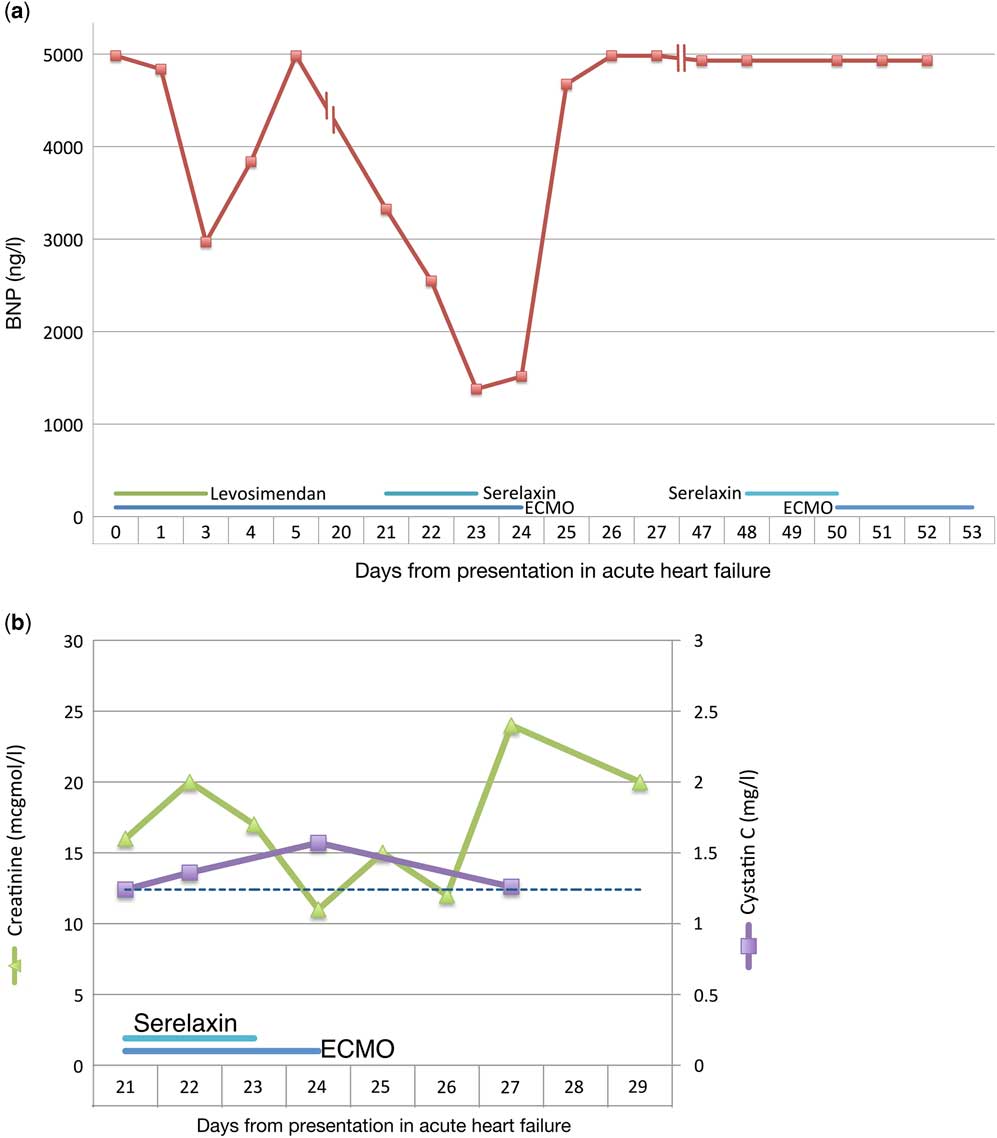
After 20 days of extracorporeal membrane oxygenation full support, echocardiography showed persistent left ventricular dysfunction (ejection fraction 21%) and dilatation (end-diastolic volume 51 ml) on epinephrine 0.05 mcg/kg/minute and milrinone 0.5 mcg/kg/minute. The patient was placed on a 48-hour course of serelaxin, 10 mcg/kg/day for 4 hours, followed by 30 mcg/kg/day for 44 hours. During the infusion, left ventricular dilatation improved (end-diastolic volume 39 ml), ejection fraction marginally improved to 24%, and brain natriuretic peptide decreased from 3324 ng/L before the infusion to 1379 ng/L after serelaxin administration (see Fig 1a). Renal function remained stable, with serum creatinine levels within normal limits and cystatin C levels rising slightly during serelaxin infusion (see Fig 1b). Extracorporeal membrane oxygenation support was successfully weaned on the 23rd day of support – 24 hours after the end of the serelaxin infusion – and left ventricular function continued to improve (ejection fraction 35%). Brain natriuretic peptide increased sharply with extracorporeal membrane oxygenation weaning, and remained above 4900 ng/L.
Effect of serelaxin infusion on biomarkers. ( a ) Values of b-type natriuretic peptide (BNP) for each day from initial presentation. ( b ) Values of creatinine and cystatin C during and after serelaxin infusion, on days from initial presentation. The high-normal value cystatin C is shown with a dotted line (1.24 mg/L), and for creatinine it was 53 μmol/L. ECMO=extracorporeal membrane oxygenation.

The patient remained stable off extracorporeal membrane oxygenation for 10 days, when she presented with sepsis and increasing requirement for inotropic support – epinephrine 0.05 µg/kg/minute, milrinone 0.5 µg/kg/minute, digoxin 4 µg/kg/day – in the setting of low cardiac output. Empirical antibiotics were started. Echocardiography showed acute worsening left ventricular distension – end-diastolic volume 91 ml – and dysfunction – ejection fraction 20%. A second course of serelaxin was started 23 days after weaning from extracorporeal membrane oxygenation. Serelaxin administration was well tolerated for 47 hours, and left ventricular distension and function – end-diastolic volume 57 ml, ejection fraction 27% – improved. A period of 1 hour before completing the second serelaxin infusion, she received teicoplanin for persistent Staphylococcus epidermidis sepsis and immediately presented with vasoplegia and poor perfusion. Despite increasing vasopressor support, she required extracorporeal membrane oxygenation support and died 4 days later owing to intractable sepsis from cellulitis and fasciitis around a left axillary venous line.
Discussion
We report the first use of serelaxin in a child suffering from an acute decompensation of dilated cardiomyopathy. In a 6-month-old girl with dilated cardiomyopathy receiving prolonged extracorporeal membrane oxygenation support, we found after a serelaxin infusion a marked improvement in brain natriuretic peptide, left ventricular systolic function and dilatation, and allowed successful extracorporeal membrane oxygenation weaning.
The treatment of acute heart failure has not changed significantly for the past two decades. Several promising drugs, such as nesiritide, levosimendan, milrinone, and others, have been studied in phase III trials in adults, but with mixed results; very limited data are available in children, and only milrinone has been shown to reduce low cardiac output syndrome after surgery for CHD.Reference Hoffman, Wernovsky and Atz 5
Serelaxin is a promising option for the treatment of acute heart failure. It has been tested in the phase II Pre-RELAX-AHFReference Teerlink, Metra and Felker 2 and phase III RELAX-AHF Reference Teerlink, Cotter and Davison 1 randomised controlled trials in adult patients with acute heart failure, and a second larger phase III trial is currently ongoing in the same patient population. The seRELAXin in Acute Heart Failure trial included 1161 adult patients with acute heart failure, dyspnoea, congestion on chest X-ray, and increased brain natriuretic peptide. They were randomly assigned to 48 hours i.v. infusion of serelaxin at 30 μg/kg/day for 48 hours or placebo. The study showed a mild decrease in dyspnoea but a 47% decrease in early worsening heart failure episodes (hazard ratio 0.53; p=0.002), a reduction of hospital and intensive care length of stay (0.9 and 0.3 days, respectively), as well as a 37% reduction in all-cause mortality (hazard ratio 0.63; p=0.02) at 180 daysReference Teerlink, Cotter and Davison 1 . An early reduction in biomarkers of cardiac (high-sensitivity troponin T), renal (cystatin C), and hepatic damage and congestion supported the hypothesis of a potential organ-protective effect of serelaxin.Reference Metra, Cotter and Davison 3
In our patient, serelaxin administration coincided with a measurable decrease in left ventricular distension and brain natriuretic peptide, as well as a slight increase in systolic function, and was associated with a slight increase in serum creatinine and cystatin C. More importantly, the patient was successfully weaned from mechanical circulatory support 24 hours after serelaxin infusion and experienced prolonged improvement of systolic function. The timing of events suggests a causal relationship between these favourable effects and the serelaxin treatment. On the other hand, the decrease in brain natriuretic peptide started before serelaxin infusion, and this decrease was almost as marked as that seen with serelaxin; furthermore, it did not decrease during the second serelaxin infusion and extracorporeal membrane oxygenation run. There are confounders for both the secondary decompensation requiring a second extracorporeal membrane oxygenation run – acute reaction upon teicoplanin injection – and the ultimately fatal outcome – documented S. epidermidis sepsis – although the most frequent side effect of serelaxin in trials with adults was hypotension. It is unclear whether the abrupt increase in brain natriuretic peptide levels following the discontinuation of the serelaxin infusion is reflective of the lack of a prolonged drug effect beyond what would be expected of its half-life of 5.28 days, the discontinuation of extracorporeal membrane oxygenation support, or some combination of these two factors. Serelaxin is currently being investigated in a phase II safety/PK trial in children with AHF (RELAX-PEDS-PK trial, clinicaltrials.org identifier: NCT02151383).
Acknowledgements
None.
Financial Support
This research received no specific grant from any funding agency or commercial or not-for-profit sectors.
Conflicts of Interest
None.
Ethical Standards
The authors assert that all procedures contributing to this work comply with the ethical standards of the relevant national guidelines on human experimentation and with the Helsinki Declaration of 1975, as revised in 2008, and has been approved by the institutional committees.