Introduction
It is difficult to imagine the psychological toll of the plague, a deadly, widespread and, above all, recurrent scourge that afflicted entire populations regardless of age, sex or social standing. In his popular book on the Black Death, Philip Ziegler paints a picture of abject despair: doctors were baffled; the Church had let its people down; the best of the clergy died, the worst survived; honesty, decency and sobriety vanished; public and private morality collapsed.Footnote 1 In a similar vein, Colin Jones highlights the impossibility of active control in the face of the capricious plague in early modern France: ‘Arbitrary, appearing and disappearing suddenly, cyclically and at whim, mocking human agency, threatening to make the first into the last, the disease often seemed an embodiment of Fortuna …’.Footnote 2
Yet, there is much evidence that, rather than resigning oneself to the whims of Fortuna, Europeans took active measures to counter the disease right from the start: the Sienese government banned gambling in 1348, in hopes that improved morality would find divine reward; in the same year, the civic authorities of Pistoia imposed travel bans and embargos on goods to limit contagion; flagellants took to the streets, zealously expiating their sins one lash at a time; and doctors, invoking venerable Galenic principles, wrote about regimen, composed recipes for medicines and offered guidelines for surgery. With each subsequent attack – plague struck multiple parts of Europe virtually every year between 1347 and 1700Footnote 3 – Europeans developed more and increasingly sophisticated measures to combat the disease. Innovative policies in public health, informed by medical knowledge, were taken; the first quarantine was imposed in Ragusa as early as 1377, and the first lazarettos (plague hospitals) sprang up in northern Italy over the course of the fifteenth century. Better medicines were offered. The number of medical plague tracts mushroomed in the fifteenth and sixteenth centuries and the genre endured well into the eighteenth.Footnote 4
Music played a part in this active response to pestilence. From the time of the Black Death to the end of the Renaissance, doctors prescribed song as a prophylaxis against the disease. In a sixteenth-century plague tract, for example, the Italian physician Niccolo Massa provides the following sanitary guidelines:
Many people, from fear and imagination alone, have fallen to pestilential fever; therefore, it is necessary to be joyful … One should stay in a beautiful place, such as a bright home adorned with tapestries and other trappings, with scents and fumigations, according to one's station and means. Or take a walk in a well-appointed garden, since the soul is restored by this. Furthermore, the soul gladdens in meeting dear friends and in talking of joyful and funny things. It is especially advantageous to listen to songs [cantilenas] and lovely instrumental music, and to play now and then, and to sing with a quiet voice, to read books and pleasant stories, to listen to stories that provoke moderate laughter, to look at pictures that please the eyes … to wear lovely and colourful silken garments, to look at silver vessels and to wear rings and gems, especially those with properties that resist plague and poison.Footnote 5
To our modern eyes, Niccolo's advice may not be acceptable as a serious medical prescription. Aside from a few notes that may resonate with us as ‘aroma therapy’ or ‘music therapy’ – which are not medical commonplaces in any event – this passage of Niccolo's plague tract seems to be no more than well-intentioned encouragement to ‘stay positive’ or to ‘relax’. Moreover, we may be tempted to dismiss Niccolo's caution against fear and imagination as a case of squeamishness. Certainly, his prescriptions elsewhere of what to eat and drink and his recipe for a plague pill register with us as more substantial advice – diets and drugs, after all, are the more recognisable touchstones of modern medicine.
Imaginatio facit casum
To locate music's place in the pestilential pharmacopoeia, we must first understand the pre-modern process of perception-cognition and its impact on health. The key here is the imagination, or imaginatio, an internal sense faculty that is seated either in the front ventricle of the brain (according to Galen and Avicenna) or the heart (Aristotle). Broadly speaking, the imaginatio functions as a gateway between sense and intellection. When an object is perceived by one or more of the external senses – sight, hearing, smell, taste and touch – a simulacrum of its accidental properties is taken into the inner senses.Footnote 6 This simulacrum would first enter the sensus communis (the common sense), which perceives and collates the incoming sensations. (We owe our ability to perceive a well-cooked piece of steak by sight, taste, smell and touch, for example, to the sensus communis.) The sensus communis, however, cannot retain these sensations for long; otherwise, we would constantly perceive an object that is no longer there. Instead, the sensible forms are passed on to the imaginatio, a kind of memory that stores the sensations. If the sensus communis is like water – receptive of impressions, but ephemeral – then the imaginatio is like stone, more recalcitrant, allowing for more permanence. The imaginatio can pass sensations back into the sensus communis so that they can be perceived even when nothing is directly sensed.
The imaginatio also serves as a seat for higher cognitive processes. One of these, the vis extimativa, extracts intentions and forms judgements upon the materials in the imaginatio based either on instinct or previous experience, giving rise to passions (variously termed ‘affections of the soul’, or ‘accidents of the soul’); a dog fears the form of a stick, for example, or a patient the sound of a funeral bell on account of this process. Although we can roughly think of passions as ‘emotions’, these products of the imagination were not mere ‘mental states’ nor did they merely create ‘mental illness’ in our modern-day sense of the term. In the pre-Cartesian world, there was a psychosomatic two-way traffic by which the mind could affect health and by which physical problems could affect the mind.Footnote 7 The passions can disturb the balance of humours and cause the body's inner vital heat to move inwards or outwards. Such movements of heat within the body can have powerful consequences. Cautioning against the negative affections (especially fear) in his 1504 plague tract, Gaspar Torella enumerates their negative effects: ‘Fury, sadness, fretting, worry and fear are also to be avoided, for in a state of fear, heat and the vital spirit move inward rapidly, and it corrupts, chills, dries up, emaciates and diminishes the natural human state, for it freezes the entire body, dims the spirit, blunts ingenuity, impedes reason, obscures judgement and dulls the memory.’Footnote 8
Occasionally, the matter of the body may even adapt itself directly to the forms apprehended in the imaginatio. These perceived forms travel into the blood and imprint themselves onto the body, resulting in some potent somatic changes. In one of the earliest plague tracts to be issued after the Black Death, Jacme d'Agramont (1348) warns against a wayward imagination by recalling the common knowledge that the influence of a mother's imaginatio is so great, ‘it will change the form and figure of the infant in the mother's womb’.Footnote 9 So that there is no doubt regarding the power of the imagination, Jacme invokes biblical authority:
To prove the great efficacy and the great power of imagination over our body and our lives one can quote in proof … the Holy Scripture where we read in Genesis chap. 30 that the sheep and goats that Jacob kept, by imagination and by looking at the boughs which were of divers colors put before them by Jacob when they conceived, gave birth to lambs and kids of divers colors and speckled white and black.Footnote 10
The effects of the imaginatio can be downright miraculous. The medieval mystic Margaret of Città di Castello (1287–1320), despite being blind, imagined and spoke of the holy family so fervently throughout her life that, post mortem, her heart was dissected and was found to contain three little stones carved with the Nativity scene: baby Jesus, Mary at the manger and Joseph with a white dove.Footnote 11 Her habitual and concentrated meditation had carved the images of her imaginatio onto her very flesh. Biblical and hagiographical accounts aside, the power of the imaginatio is evident enough through everyday experiences. ‘Imagine someone eating a sour fruit’, Nicolas Houël writes in his plague tract, ‘and your teeth will ache and go numb.’Footnote 12
All things considered, the imaginatio is a potent sensory faculty. Not only can it recall forms that are absent from immediate sensation, it can also conjure formal hybrids ‘such as cannot be brought to light by nature’, according to Pico.Footnote 13 Considering also the psychosomatic effects that the imaginatio may generate, we can begin to appreciate why the mere imagining of plague, regardless of whether calamity is actually at hand, was thought to be enough to bring on buboes.Footnote 14 The care of the imaginatio and the passions was therefore crucial during times of plague. To that end, the senses – gateways to the internal sensitive faculties and ultimately to the body – had to be safeguarded. Niccolo Massa warns against ‘lingering in dark and fetid places, gazing upon sick and dead bodies and other monstrous things, and looking at dreadful pictures’, for they weaken and dispose the viewers to illness.Footnote 15 Similarly, Jacme d'Agramont advises that during such calamitous times, ‘no chimes and bells should toll in case of death because the sick are subject to evil imaginings when they hear the death bells’.Footnote 16 When plague broke out in Pistoia in 1348, civic authorities sought to control the soundscape of the city precisely for that reason, revealing the depth of belief in the capacity of sound negatively to affect the sick. On 2 May, a city ordinance was issued, banning, among other things, town criers and drummers from summoning any citizen of Pistoia to a funeral or corpse visitation, under penalty of 10 denari.Footnote 17 Furthermore, items 10 and 12 of the ordinance state:
10. In order that the sound of bells does not attack or arouse fear amongst the sick, the keepers of the campanile of the cathedral church of Pistoia shall not allow any of the bells to be rung during funerals, and no one else shall dare or presume to ring any of the bells on such occasions, under the penalty of ten denari … When a parishioner is buried in his parish church, or a member of a fraternity without the fraternity church, the church bells may be rung, but only on one occasion and not excessively; same penalty.
12. No one shall dare or presume to raise a lament or cry for anyone who has died outside Pistoia, or summon a gathering of people other than the kinsfolk and spouse of the deceased, or have bells rung, or use criers or any other means to invite people throughout the city to such a gathering, under the penalty of twenty-five denari …
However it is to be understood that none of this applies to the burial of knights, doctors of law, judges, and doctors of physic, whose bodies can be honoured by their heirs at their burial in any way they please.Footnote 18
It is possible that this initial prohibition did not gain much traction, since the authorities soon felt the need to increase the fine and totalise the ban; on 4 June, this revision was issued: ‘At the burial of anyone no bell is to be rung at all … under the penalty of twenty-five denari from the heirs or next of kin of the deceased.’Footnote 19
If horrific sounds on the pestilential soundscape can have a negative effect on the imagination and the body, then joyous and harmonious music can conversely function as an anodyne. To counteract the effects of fear with joy (gaudium), or at least to distract the mind from vile imaginings, authors of plague tracts prescribe, time and again, socialisation, games, storytelling, beautiful objects and joyous music. Such prescriptions appear in the earliest of medical plague treatises. Responding to the Black Death, the Florentine Tommaso del Garbo writes:
Do not occupy your mind with death, passion, or anything likely to sadden or grieve you, but give your thoughts over to delightful and pleasing things. Associate with happy and carefree people and avoid all melancholy. Spend your time in your house, but not with too many people, and at your leisure in gardens with fragrant plants, vines and willows, when they are flowering … And make use of songs and minstrelsy and other pleasurable tales without tiring yourselves out, and all the delightful things that bring anyone comfort.Footnote 20
Similar prescriptions can be found throughout the Renaissance. In the fifteenth century, one writer champions the use of stories and music, writing that they, along with ‘good hope and imagination’, are ‘often more useful than a doctor and his instruments’.Footnote 21 In 1504, Gaspar Torella warns especially against thinking of the plague and recommends the use of ‘dance [with] a variety of music (tripudiis sonis variis) that delight the soul’.Footnote 22 A Frenchman, Nicolas de Nancel, personally recommends that
before and immediately following meals, stay quiet and calm; some time after, take small walks, and refresh the spirit by some chaste activity. And in my opinion, I prefer music (la musique) to all else, if someone knows how to play the lute (toucher du luth) or some other instrument, just as I do. For it's not a good idea immediately after drinking and eating to sing with force; for that much force incites the rheums, especially for those who are not accustomed to it.Footnote 23
Later, on the accidents of the soul, Nicolas writes:
It will be good to read the holy Bible or holy and notable stories; tell some fun tales without villainy; play games sometimes, such as aux eschecqs, à l'ourche, aux dammes, tarots, reinette, triquetrac, au cent, au flux, au poinct and other such games, which are well known through the jokester Frenchman Rabelais, the father and author of Pantagruelism. But play without choler and with pleasure; not for high stakes or for greed … Also sing sweetly and melodiously some sweet spiritual song (chanson spirituelle), not crass words or songs of villainy that some drunk singers and musicians might belch or vomit up. Or play musical instruments, as I said before, for music greatly refreshes the spirit …Footnote 24
A number of generalisations can be made about the medical prescription of music in these plague tracts. First, where music is mentioned, it is almost always within a discussion of the imagination and the accidents of the soul. Nicolas de Nancel's description of music as a post-meal activity falls under his discussion of exercise and is therefore idiosyncratic in that respect. Second, although explicit references to music do not appear in every plague treatise, an overwhelming number of authors advise their readers to safeguard the accidents of the soul with recreation. Therefore, even where music is not specifically mentioned, there is presumably still a place for it in the anti-pestilential regimen.
Third, recommendations for music often accompany suggestions of adorning a home with beautiful furnishings and decorations. The authors thereby impart a sense of domesticity and seem to advocate music-making in private, rather than public, contexts. Consistent with this view, music is very often mentioned in the same breath as games, jokes, stories and keeping company with a small coterie of close friends and loved ones. Nicolas Houël comes closest to this point when he writes that ‘keeping to yourself and being solitary is not good, but neither is being in a large crowd; find happy people and honest recreation, occasionally sing, play flutes, viols and other musical instruments’.Footnote 25 A large part of the emphasis, therefore, falls on the idea of light-hearted and private sociability; the writers are not prescribing solitary contemplation, but rather active and intimate engagement. Lastly, the authors used a variety of terms for music and music-making. While some such as ‘cantus’, ‘melodia’, ‘carmina’ and ‘harmonia’ are very general and could refer to a variety of music, others like ‘canzone’, ‘cantilena’, ‘toucher du luth’ and references to ‘tripudium’ imply lower genres of secular, amatory and dance music. These genres, again, suggest social and even physical participation. Once more, Nicolas de Nancel's specification of ‘chanson spirituelle’ is idiosyncratic in this regard, as is the direct juxtaposition of high-minded activities (reading the Bible) with low-brow amusements (Gargantua's games). This instance aside, the beneficial joy conferred by music was, from the medical perspective, meant very much to be a worldly one.
Martini and gaspar – o beate sebastiane
Two motets by Johannes Martini and Gaspar van Weerbeke provide a fitting case study of music's power to provide salutary joy.Footnote 26 They set the same prayer text to St Sebastian:Footnote 27

Sebastian was a third-century martyr who worked as an imperial guard under the rule of Diocletian. Using the access granted to his office, Sebastian secretly visited imprisoned Christians in order to confirm their faith. With miraculous acts of healing, he was also able to convert thousands of pagans, including high-profile Roman citizens such as the city's prefect and his entire household. When Sebastian was finally discovered, Diocletian ordered his death by arrows; miraculously, he survived and was brought back to health by St Irene. He suffered his martyrdom when he later ambushed and publically admonished the Emperor, who, enraged, ordered Sebastian to be bludgeoned and his body tossed into the Cloaca maxima.
Significantly, Sebastian was never associated with pestilence during his lifetime, having neither cured anyone of plague nor himself been afflicted by the disease. In fact, it was via a posthumous miracle – the liberation of Lombardy from pestilence, cited in Martini's and Gaspar's text – that Sebastian came to be considered a special protector against pestilence. Paulus Diaconus recounts this event in his Historia langobardorum:
There was a lunar eclipse during the eighth indiction (680 ce), and around the same time, there was also a solar eclipse (around the 10th hour, 2 May). Soon after, plague struck between July and September. So many died that parents with children, brothers with sisters were placed two-by-two in biers and led through Rome to their graves. Pavia was also depopulated by the same plague. With the entire population having fled to the hills and other places, thickets grew in the forum and streets of the city. Then it appeared visible to many that a good and a bad angel were roaming through the city at night, and by the command of the good angel, the bad one, who was seen to carry a spear in hand, would strike a home with it. As many times as he struck, that many occupants died in the following days. Then it was revealed to a certain man that the plague would not subside until an altar to the martyr St Sebastian was erected in the Basilica of St Peter in Vincoli. It was done, and the relic of St Sebastian was brought from Rome; as soon as the altar was built in said basilica, the plague subsided.Footnote 28
A number of details in this narrative suggest that Sebastian did not have specific anti-pestilential powers prior to this time. First, the Pavians had to be prompted to turn to Sebastian.Footnote 29 Furthermore, the art historian Sheila Barker points out, it would have been anachronistic at this point that a cult of a Christian saint would have ‘attained functional specificity’; rather, Sebastian was likely to have been invoked for his special martyr status. It was likely through Jacobus de Voragine's later retelling of this seventh-century miracle – a story that Jacobus himself claims was not widely known – that Sebastian was decisively installed as a plague saint.Footnote 30
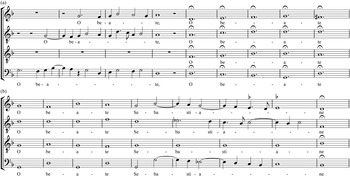
The citation of Sebastian's posthumous miracle in Martini's and Gaspar's settings of O beate Sebastiane might suggest a Milanese provenance for the motets; the episode might be recalled as a sort of salvific precedence or special patronage for the city. Certainly, both composers had associations with Milan. Gaspar spent the bulk of his career with the Sforzas over two tenures (1471–80, 1489–95), and Martini had a brief stay in 1474.Footnote 31 Additionally, extended chordal-declamatory passages bookend both motets, a musical feature that is distinctively Milanese (see Example 1 and Example 7 below).Footnote 32
O beate Sebastiane: (a) Martini, bb. 1–9; (b) Gaspar, bb. 1–9

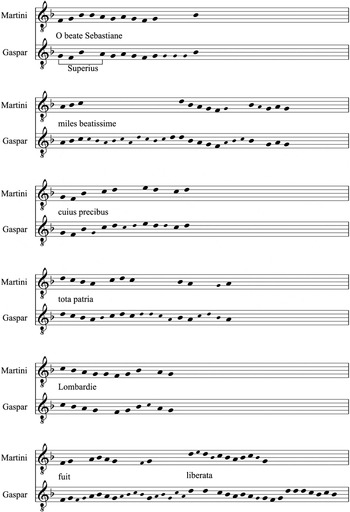
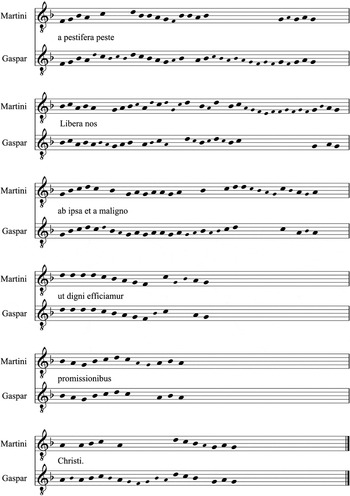
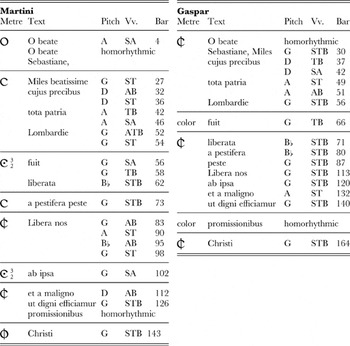
Beyond the use of the same text, the two motets are linked by a number of musical similarities as well. John Brawley has suggested the use of a common chant melody in the tenor voices (see Example 2).‘It is in fact’, Brawley writes, ‘the tenor lines which are primarily responsible for the similarities [of the two motets], and within the tenor lines the likenesses involve the structurally important tones, those most likely to be derived from a plainsong, rather than specifics of a more ornamental nature.’Footnote 33 The final pitches of the tenor melodic phrases determine the polyphonic cadential pitches in both works, resulting in a remarkably similar cadential pattern (see Table 1).
O beate Sebastiane, Martini and Gaspar Tenors compared


Metre changes, textural changes and cadential structures of Martini's and Gaspar's O beate Sebastiane

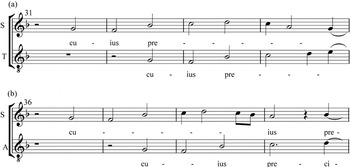
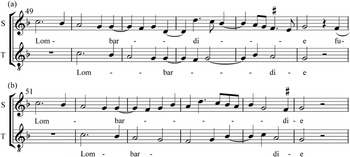
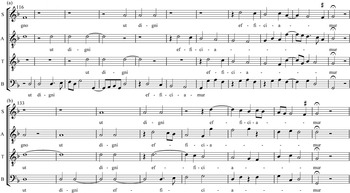
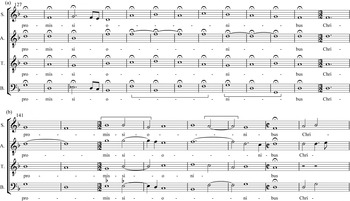
But given that the motets set a non-liturgical text that is unlikely to be associated with a chant melody, the similarity between the tenors may be the result of modelling between the composers, rather than the use of a common cantus firmus. A number of shared features between the two settings bear out this hypothesis. In both, metre changes occur at ‘fuit liberata’ and ‘promissionibus Christi’. There are also a number of textural similarities, especially at the beginning or end of important sections. ‘Sebastiane’ and ‘promissionibus’ are set to a succession of block chords in both motets. ‘Libera nos’, which opens the secundae partes, is treated to four overlapping duos in both works. More significantly, a number of contrapuntal structures are very similar (and in some cases identical) in both pieces: (1) the superius and tenor combination in Martini at bars 31–4 creates a contrapuntal module similar to that of Gaspar's superius and altus at bars 36–9 (Example 3). (2) An even more extended example occurs at bars 49–54 in Martini and bars 51–6 in Gaspar. In this instance, the module occurs between the same voices, superius and tenor (Example 4). The two composers moulded the melodic profile of the superius voice from the tenor melody in very similar ways and combined two instances of the soggetto at the same time interval to create almost identical modules. (3) Martini's tenor–bassus duo that sets the word ‘fuit’, bars 57–8, appears, broken up, as the start and end of Gaspar's extended tenor–bassus duo setting the same word between bars 57 and 65 (Example 5). (4) All of the parts setting ‘ut digni efficiamur’ are remarkably similar (Example 6). Especially notable is the insertion of rests that break up the two parts of the text phrase – all voices in Martini, top three voices in Gaspar. (5) Lastly, the chordal structures for ‘promissionibus’ share a close affinity (Example 7). The homorhythmic sections begin and end with identical chords, with the same voicing; in between, the same succession of sonorities occurs with different voicings.
(a) Martini, O beate Sebastiane, bb. 31–4; (b) Gaspar, O beate Sebastiane, bb. 36–9

(a) Martini, O beate Sebastiane, bb. 49–54; (b) Gaspar, O beate Sebastiane, bb. 51–6

(a) Martini, O beate Sebastiane, bb. 57–9; (b) Gaspar, O beate Sebastiane, bb. 57–9, 64–6

(a) Martini, O beate Sebastiane, bb. 116–26; (b) Gaspar, O beate Sebastiane, bb. 133–40

(a) Martini, O beate Sebastiane, bb. 127–39; (b) Gaspar, O beate Sebastiane, bb. 141–8

Joshua Rifkin has suggested two events in 1491 that could have occasioned a meeting of the two composers and spurred the composition of these works.Footnote 34 There were two nuptials between members of the Este and Sforza families in that year (Martini would have been working for the Estes around this time): the wedding of Ludovico il Moro to Beatrice d'Este, which took place in Pavia on 17 January with a celebration at Milan on 22 January, and the wedding of Alfonso I d'Este and Anna Maria Sforza, which took place on 23 January. Significantly, both of these weddings fell close to St Sebastian's 20 January feast day. It is also possible that these motets were a direct response to pestilence. Between 1481 and 1487, the plague struck various parts of Lombardy, and Milan itself was particularly hard hit in the years 1483–5. If the two motets were composed in the mid-1480s, they would have spoken to the ongoing or recent calamity.
Cantus jocosos
At the heart of these two motets, I would suggest, lies great healing potential. The switch from duple into triple metre at the phrase ‘fuit liberata’ (see above, Example 5) and the extended melismas on the two following phrases, ‘a pestifera peste’ and ‘libera nos’, sonically paint the idea of liberation from the plague. In Martini's setting, the superius sings the word ‘peste’ on an ecstatic melisma that rises, with semiminim and fusa turns, through a twelfth, the entire range of its tessitura. ‘Ab ipsa’ similarly goes into a lilting triple time in that setting. Bernhard Meier writes of such isolated triple-metre passages:
Episodic adoption of triple meter as a rhythmic peculiarity instead of the duple meter ( or
 ) used formerly can also act to express words. Passages in triple meter have an almost dancelike effect in comparison to the rest of the work. Consequently, they serve to express ‘joy’ in general, but also depict events that are characteristically associated with dance: for example, to portray the term ‘wedding’, but also ‘idolatry’ (think, for example, of the dance around the Golden Calf, also often represented in painting).Footnote 35
This sense of joy is particularly palpable in Martini's setting because of the markedly increased musical activity beginning with the imitative entries on ‘Lombardie’ (see above, Example 4) – each previous point of imitation had begun ponderously, with staid semibreves – and the instantly memorable tune that sets ‘fuit liberata’ (see above, Example 5).
At the thematic level, the allusion to dance appropriately celebrates Sebastian's miraculous work in Lombardy. But more than this, I would suggest, Martini's and Gaspar's topical reference is here not merely a description of joy, but also a prescription for the supplicant singers and their listeners. Recall that doctors emphasised, time and again, the idea of sociability in their plague tracts, whether in playing games, telling stories or sharing a laugh and a song. And although they are not always precise when it comes to pinpointing genres of music, they nevertheless give the impression that lower, secular and social music was more suitable to the task. Thinking in these terms, one could argue that within the stylistic limits of the motet – itself a nebulous genre situated between the cantilena and the mass, capable of incorporating a variety of topicsFootnote 36 – Martini and Gaspar are here invoking the lower stratum of dance music. Considering, too, that both of these works were published by Petrucci and disseminated through the marketplace, we can imagine the kinds of social performance situations prescribed by doctors that might attend the works' salubrious gestures of joy.Footnote 37
But what of the austere chords that bookend the two motets and cordon off the celebratory eruptions? If, on the one hand, the generically fluid motet can accommodate lower elements and be performed in secular settings, then so too can it incorporate aspects higher-minded genres and rituals. Bonnie Blackburn has termed the opening and closing homorhythmic style of writing the ‘devotional style’. When found in masses, these devotional chords most often set the vocative ‘Jesu Christe’ or the word ‘Amen’, and in motets, they are often used for invocations, as they are here.Footnote 38 The topical reference may also be Eucharistic, given that chordal passages in motets – particularly in the Milanese repertory – sometimes accompanied the Elevation during the Mass; ‘promissionibus Christi’ may certainly hint at that sense. To account for this topical juxtaposition between the high and the low, the dance against the prayer, we need to turn our attention to the pre-modern aetiology of disease and the religious perspective on music's place in the times of pestilence.
The divine and natural plague
The Hippocratic–Galenic medical system inherited by Renaissance doctors was built on a naturalist and pagan framework that, in its original form, took little account of the role of the divine. In the encounter between this classical paradigm and Christianity, a potential conflict arose between the natural explanation of disease and the concept of disease as divine punishment and between ‘the physician's role as an autonomous healer and his function as a mere agent of God, the true healer’.Footnote 39 Without recounting the many nuances of the medicine–religion debate, it is generally safe to say that Hippocratic naturalism, which was itself empty of divine character, was subsumed by the Christian church under God's work.Footnote 40 By the Renaissance, the majority opinion held that God was the ultimate cause of diseases. As Penelope Gouk explains, ‘even the most progressive medical writers believed that new forms of plague and other virulent diseases recently visited on European society were divine retribution for sin’.Footnote 41 But although God could bring about such punishments directly through supernatural means, the usual assumption was that He worked through nature, inciting remote events such as the conjunction of celestial bodies and more proximate phenomena such as weather or the corruption of the elements. And if God worked through such natural means, then medical intervention, using the medicine that God, in his mercy, had placed on earth for our benefit, represented a viable response to illness.Footnote 42
The commingling of the religious and the natural within such a bifocal aetiology is evident in all varieties of prescriptive plague writing throughout the late Middle Ages and Renaissance. It was openly acknowledged in many plague treatises that God, working through natural means, was the primary cause of the affliction. Johannes de Saxonia provides one of the most explicit accounts of pestilential teleology in his fifteenth-century treatise:
God and the heavens, per se, are not the causes of epidemic … God is the most remote cause of epidemic, the heavens are the more remote, the air is remote, the humour is near, putrid air is nearer, and the putrid vapour infused in the heart is the nearest … This is clear, for the cause is more remote when there are more intermediate causes between the agent and the effect, and the cause is closer when there are fewer intermediate causes. And between God and epidemic, there are many other intermediate causes, and there is nothing between putrid vapours of the heart and illness.Footnote 43
Because God sat atop the teleological chain, it was to Him that doctors ultimately had to defer. Nicolo de Burgo begins his otherwise wholly secular tract with the caveat that ‘only Jesus Christ can heal’ and that any healing is done with his help.Footnote 44
That is not to say, however, that the intermediate and proximate causes of plague should be ignored in favour of divine intervention. In his survey of religious literature on the plague, Franco Mormando found that, while some religious writers and preachers do prioritise spiritual answers over medicine, none of them counsels their audiences simply to disregard medical advice; ‘both forms of response, the spiritual sources say outright or imply, are to be attended to’.Footnote 45 To ignore available medical advice completely in favour of the help of God was to spurn the magnanimity of God and to commit the sin of self-destruction.Footnote 46 Moreover, as Ambroise Paré writes in his Traicté de la peste, medicine gives us the opportunity to glorify the Lord:
My advice to the surgeon is to not neglect the remedies approved by ancient and modern medicine. For as much as this malady is sent by the will of God, so it is by His divine will that the means and help are gifted to us by Him to use as instruments of His glory, looking for remedies for our illnesses, even in His creatures, in which He gave certain properties and virtues for the relief of the unfortunate. And He wishes us to use secondary and natural causes as instruments of His blessing. Otherwise, we could be ungrateful and spurn His beneficence. For it is written that the Lord gave the knowledge of the art of medicine to men in order to be glorified in its magnificence …Footnote 47
It was also thought that God granted medicine to man so that it might serve as a model for the therapy of the soul.Footnote 48 Such a parallel between spiritual and natural medicine is often evident in discussions of regimen. The doctor's advice for moderation in things such as food, drink, passions, sex and sleep had moral equivalents in the preacher's caution against excesses such as gluttony, wrath, lust and sloth. In such a scheme, humoural balance went hand in hand with spiritual cleanliness. It is rather meaningful, in understanding the parallels between natural and spiritual medicine, that priests were called ‘physicians of the soul’.Footnote 49
In the broadest terms, medieval and Renaissance Christians wove their inherited Hippocratic–Galenic medicine into a generally coherent model of disease that saw the natural world subsumed under divine providence. It can be said that, whether addressing the ultimate cause of plague by placating God or whether attending to the proximate causes such as the environment or the patient's humours, priests and doctors laboured ultimately towards the same goal. Yet such a theoretical model of health belies the uneasy rift between the spirit and the flesh in Christian theology. This deeply rooted divide becomes particularly apparent in the details of some therapies: what is good for the body may not necessarily be good for the soul, and measures against natural causes may exacerbate spiritual ones (and vice versa). While often prescribed by doctors, music, with its sensuous and fleshly qualities called into question long ago by the likes of St Augustine, was one of the subjects that problematised the coherent surface of pre-modern aetiology.
Defining gaudium
Although nearly all authors of plague treatises would have agreed that timor and tristitia were to be avoided, they did not all prescribe gaudium unequivocally. Some writers of plague tracts distinguished between two types of joy: a healthy, temperate, permissible kind and an excessive, harmful kind. Johann von Glogau spells out the medical consequences of the respective types:
It is said that joy, which is used against pestilence, is of two kinds, namely the permitted (permissivum) and the harmful (perniciosum). The former type of joy does not spread the plague, but greatly impedes it, for by such joy man is delighted and increases his vital spirits, and it should be both suitable and moderate. But harmful joy is that which is suddenly caused in man and infects and corrupts the vital spirits and occurs especially in women, who, sometimes on account of one strange thing or another, expand so much their vital spirits, that they lose such spirits and their life. Furthermore, fear harms and greatly weakens men, and sadness also consumes men.Footnote 50
Similarly, Gaspar Torella explains that ‘joy is to be used, but not excessively, because such excess induces fainting spells and sudden death’.Footnote 51 With a different rationale, one writer warns against too much happiness, for excessive laughter causes the inhalation of a great deal of corrupted air.Footnote 52 An excess of joy, it turns out, is as detrimental as fear and sadness. By extension, an excessive use of music becomes unhealthy. As Nicolaus of Udine advises, attain joy ‘by means of cantilenas and other favourite melodies, but temper their use, for excesses are noxious, destroying the spirit and natural heat’.Footnote 53
Music's place in the anti-pestilential regimen straddled this very distinction between the permissible and the excessive. The prescription for moderation naturally invited moralising from high-minded authorities who emphasised the idea of plague as an arm of divine punishment. Adopting a religious perspective, they argue that music and other entertainments such as comedies, theatre and spectacles represent excesses and gateways to serious vices that are themselves the causes of plague. In the most extreme rhetoric, the threat of music to a healthy regimen is not its immoderate use, but rather its use tout court. In the 1557 Florentine tract Cause et rimedii della peste, et d'altre infermità, recently attributed to the Jesuit Antonio Possevino,Footnote 54 the author provides five categories of plague-inducing offences: (1) pride, arrogance, ambition, vanity and blasphemy; (2) heresy; (3) theft, rapine, usury; (4) luxury and carnality; (5) music as well as other frequently prescribed delights:
The fifth cause of plague is that which is the cause of carnality and lust, that is immodest madrigals and canzonas, lascivious dance, indecent familiar conversation, the extravagance of clothing, lewd literature … [and] the use of nude images in which under the pretext of artistic expression, the world is easily roused to every sordid from of concupiscence.Footnote 55
For Possevino, these entertainments lead to the luxury and the carnality that invite pestilential punishment. This suspicion against music and other entertainments circulated not only within plague treatises. According to the Golden Legend, a plague struck Rome in the sixth century because, after a period of clean living over Lent and Easter, the Romans broke their fast with unrestrained feasting, games and carnival celebrations.Footnote 56 The mistrust of music even became religious policy during the Milanese plague of 1575–8. Carlo Borromeo instructed his priests to preach against immorality throughout the city, especially to the men guarding the city gates. Vices to be avoided included sloth, dishonesty, theft, blasphemy, games, dancing and singing.Footnote 57
If these temporal means for attaining gaudium could so easily lead to sin, then the solution must be found with God. One plague-tract writer, who is otherwise mostly interested in the natural aspects of plague, repeats the frequently encountered advice to avoid the ‘negative’ accidents of the soul, but provides a spiritual prescription: ‘Ire, sadness, worry should be avoided, and be joyful, honest, and in delightful company. One is always gladdened by making peace with God, for then, one will not fear death.’Footnote 58 Another writer advises: ‘Joy and happiness should be used to comfort the spirits. Similarly, through peace, good hope, meditation and the worship of God, the fear of death would be diminished and wrath, worry and sadness, greatly avoided.’Footnote 59 These writers graft together the religious aspect of plague writing with the medical. But at the juncture of these two discourses lies a curious conundrum: should the imagination be turned away from illness and death altogether or focused on the preparation for the life hereafter?
This particular complication between the medical and religious streams of thought is evident in Giovan Filippo Ingrassia's Informatione del pestifero et contagioso morbo, in which the author initially proposes salubrious merriment, but, caught up in his subsequent attack on music, concludes with recommendation of sobriety. Ingrassia, the head medico of Palermo when plague struck in 1575, first advises his readers to put aside their worries and to preserve their imaginations by being happy, dressing beautifully, wearing jewels, abiding in brightly lit places decorated with a variety of paintings, and by avoiding fearful thoughts of death.Footnote 60 Unlike other doctors, however, he distinguishes between different temporal comforts. He goes on to write:
But we do not wish to follow what some say we should do in such times: attending banquets, enjoying pleasurable pastimes with friends, games, witty conceits, laughter, comedy, songs, music (canzone, musiche) and other such nonsense. As we continually witness, in this divine battle, many dying in the space of a few days, others from one moment to the next without confession or other sacraments (amongst whom are very close friends, relatives, or neighbours), carried off to be buried away from the churches in the countryside, having their possessions burned, and the whole world going to ruin; despite this, worse than irrational beasts, they expect to have as good a time as possible and a leisure-filled life … Who could be so fatuous and thoughtless, with no fear for his own life, witnessing daily so many who, despite diligence and extreme caution, are nevertheless being carried off by the contagion and unexpectedly dying? And finally, what blind mole could, in such a situation, be happy and carefree, mindlessly living like Sardanapalus?Footnote 61
Here, Ingrassia distinguishes solitary pleasures such as inspecting pictures and wearing elegant clothing from social entertainments such as music and storytelling. He inveighs against levity; solemnity and spiritual vigilance are imperative when sudden death is quotidian. Ingrassia then caps off his tirade with a warning from Horace: ‘Your property is in danger, when your neighbour's wall burns.’ So much for not worrying. Neither suggesting a rapprochement between the medical and the religious perspectives on regimen, nor even pleading for sensible moderation, Ingrassia ends up plainly arguing against his initial advice, taxing the imaginations of his readers and patients.
If Ingrassia's stance on the care of the passions and the imagination is circuitous and ultimately contradictory, prescriptions by other religious authorities are far more direct. Savonarola's message from the previous century, for example, leaves no room for uncertainty:
The devil, when he realizes that you want to think about death, goes about provoking others to distract you from these thoughts; he sets it in the mind of your wife and your relatives as well as the doctor that they should tell you that you will soon recover and that you should not worry and that you should not think that this [illness] means that you will die.Footnote 62
Here, the doctor's advice is turned on its head. Where some writers might caution against the mere mention of plague, the hardliner Savonarola condemns optimistic distractions. Equally revealing is Giovanni Pietro Giussano's report that, during the Milanese plague of the 1570s, Carlo Borromeo publicly denounced a finely dressed woman for her levity and (medically sound) sartorial ostentation, saying, ‘Wretched woman! thus to trifle with your eternal salvation, when you know not that this day may not be your last in the world!’ The next morning, the woman died suddenly, and all who had witnessed Borromeo's earlier rebuke felt, in Giusanno's words, a ‘salutary fear’.Footnote 63 It is precisely on account of this roaming yardstick of what is permissible joy and what is excessive joy (and what is pernicious fear and salutary fear) that the place of temporal luxuries and entertainments in the pestilential regimen was never entirely secure.
Plague and the carnivalesque
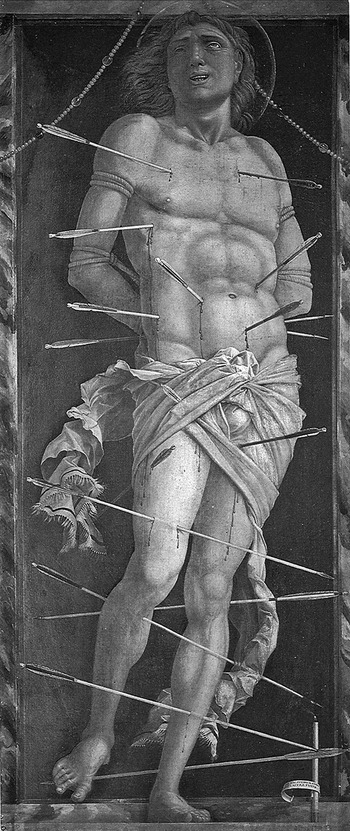
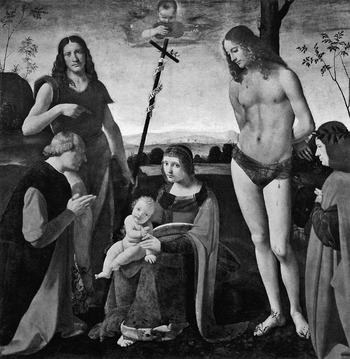
Several scholars have explored this uneasy juxtaposition between spiritual and temporal remedies in relation to other forms of artistic production. Sheila Barker distinguishes between the ‘horrific memento mori’ type of St Sebastian images and the therapeutically beautiful type.Footnote 64 The former is exemplified by Andrea Mantegna's St Sebastian (c. 1506), where the grimacing saint, pierced by a multitude of arrows, stands beside an inscription reminding the viewer that ‘nothing except the divine is stable; all else is smoke’ (nil nisi divinum stabile est caetera fumus; Figure 1). In contrast, elaborately gilded depictions of St Sebastian where his form is tranquil and wounds minimised (Giovanni Antonio Boltraffio's 1500 Casio altarpiece, Figure 2) offer salubrious sensual pleasures, not unlike being surrounded by precious clothing, metals and gems.Footnote 65 Such sensual pleasures can go too far, however. For Renaissance artists, the sensuous and nude image of St Sebastian often served as a platform for ‘one-upmanship’ of artistic excellence. Vasari tells an anecdote of how Fra Bartolomeo responded to the frequent taunt that he was unable to depict nudes by painting an extremely attractive, borderline erotic image of St Sebastian, earning praise from other artists. While the picture was on display in San Marco in Florence, ‘the friars found out by the confessional that women had sinned in looking at it, because of the comely and lascivious realism with which Fra Bartolomeo had endowed it’, whereupon the painting was removed to the chapter house, where it could only be seen by men.Footnote 66 Other Renaissance Sebastian images were likewise so beautiful that they eventually ran afoul of the Council of Trent (recall Possevino's complaint about nudes).Footnote 67
Andrea Mantegna, St Sebastian. Galleria Franchetti, Cà d'Oro, Venice.

Giovanni Antonio Boltraffio, Casio Madonna Altarpiece, The Virgin and Child with St John the Baptist, St Sebastian and Two Donors. Louvre, Paris.

In a similar vein, Glending Olson argues that some plague literature closely reflects the belief in medical recreation. The conceit of the Decameron, for example, parallels the medical recommendation to flee infected areas and to delight in storytelling (and, I would add, music-making).Footnote 68 As such, Boccaccio's scenario is not ‘merely escapist but therapeutic’ – and therapeutic not only thematically, for the brigata, but therapeutic for readers as well.Footnote 69 Olson does not find the competing spiritual and medical demands on Boccaccio's storytellers particularly problematic. The brigata, Olson writes,
chose first to live ‘onestamente’ in orderly cheerfulness … and subsequently chose storytelling as one means of such living … The company maintains decorum, refuses to overindulge itself even in a time of license, and uses storytelling properly, for pleasure and profit and their resulting benefits to mind and body. The very act of intelligent listening (and, by extension, reading) becomes part of the shared values of propriety, harmony, and amity.Footnote 70
But what of the stories they tell, the mordant ecclesiastical satires, the raunchy fabliaux and the scatological farces that, on more than one occasion, leave the brigata breathless and aroused?Footnote 71 And what of Boccaccio's apologies for these lurid tales and lewd language? In the epilogue, he insists that he is merely a dispassionate reporter of the tales told at the gathering, using common expressions of the marketplace. Furthermore, he insists, ‘It is perfectly clear that these stories were told [not] in a church, of whose affairs one must speak with a chaste mind and a pure tongue … nor in any place where churchmen … were present.’Footnote 72 And finally, Boccaccio warns, ‘The lady who is forever saying her prayers, or baking pies and cakes for her father and confessor, may leave my stories alone’, and ‘If it should cause [the readers] to laugh too much, they can easily find a remedy by turning to the Lament of Jeremiah, the Passion of Our Lord, and the Plaint of the Magdalen’.Footnote 73 Reading between the lines of his apology, we may suspect that his stories reach so low that they may do more harm than good.
Within this rift between the high and the low, the permissible and the excessive, the official and the unsanctioned, Bakhtin finds a spirit of the carnivalesque. He writes of Boccaccio's conceit:
The plague in his conception … grants the right to use other words, to have another approach to life and to the world … Life has been lifted out of its routine, the web of conventions has been torn; all the official hierarchic limits have been swept away … Even the most respectable man may now wear his ‘breeches for headgear’.Footnote 74
During this loosening or suspension of normal time, occasioned by plague, Boccaccio trots out the lower bodily stratum – images of the material body and its gross and festive acts – to create a laughter that is at once creative, healing and regenerative, but is also antithetical to the intolerant seriousness of the church ideology.Footnote 75
Colin Jones describes a similar function of plague time, from the religious perspective, writ large on the level of life itself. ‘In an odd way’, he writes, ‘plague is like carnival – another disruptive, subversive event that slips the bounds of conventional time and space, and another target for Catholic moralizing … Indeed anyone who can seek out fun in these conditions is seen as extraordinarily contemptible.’Footnote 76 René Girard speaks of moral inversion, another aspect of the carnivalesque, in the times of plague: ‘The plague will turn the honest man into a thief, the virtuous man into a lecher, the prostitute into a saint.’Footnote 77 Girard's observation is substantiated by plague chroniclers, who were especially vehement either in praising the heightened virtue of a city, or in denouncing marked moral decay. Alessandro Canobbio, for example, was particularly impressed by the Veronese citizens; when plague struck in the 1570s, concubines of the city ‘left one another and returned to their legitimate partners, other sinners changed their ways, and many enemies voluntarily made peace’.Footnote 78 The situation in Milan was quite the opposite during the same outbreak, according to Olivero Panizzone Sacco, who complained of sex, games, dancing, excessive feasting, adultery and other sins throughout the city, behind closed doors and even in the city's lazaretto, when the citizens should have been fasting and making devotions.Footnote 79
An account of San Gregorio by its warden, Fra Paolo Bellintano of Salò, confirms Sacco's claims. He describes an incident at the lazaretto:
One night the inmates were staging a dance, in order to cheer themselves, keeping the event secret even though I forbid all such activities. The day before, brother Andrea had recounted to me that he had seen among the cart of dead bodies a very old woman, and knowing about these festivities, he planned to instill a bit of terror among the dancers. He went that night to the pit in the middle of the lazaretto where they threw corpses, and searching among them diligently, finally found her again. Hoisting her on his shoulders, her stomach stretched taut forcing air in her gut out through a great belch from her mouth. Who wouldn't be frightened of such a thing? Not our Andrea. He said in our language [Brescian dialect], ‘Quiet old girl, we're going to a dance’. And he went into the room, knocked on the door, and announced, not as friars do with ‘God bless’, but in local [Milanese] dialect, ‘Let us in, we've come to party!’ When they opened the door, he hurled the body into the middle of the room saying, ‘Let her dance, too’. Then he added, ‘Is it really possible you will stay here debauching, offending God, when your deaths are so close at hand?’ And he told them other such things and then left. The dance ended.Footnote 80
This grotesque tale of a ball of the infected illustrates many of the parallels between the carnival and the plague: the laughter and the festive impulse of the inmates; the spectacularly disgusting lower bodily stratum of the corpse as fodder for shock and comedy; and the Christian moralising of a killjoy friar. For the patients at San Gregorio, staging such a joyous and social event ‘in order to cheer themselves’ is exactly what the doctor would have ordered. But this earthly laughter is wholly offensive to Christian ideology, with its nagging emphasis on death and the afterlife. In life and in art, plague serves as a site where the earthly and the spiritual meet, at times placing incommensurate demands on both the lower and the upper bodily strata.
Just as these competing demands from the doctor and the priest leave their marks on pestilential artworks such as the St Sebastian images (salubrious beauty vs. frightful memento mori) and the Decameron (raunchy stories vs. pious decorum), they likewise mould the very contours of Martini's and Gaspar's motets. The pious homorhythmic openings of the two works resist, but eventually break down into a laughter that is earthly, bodily and carnivalesque. Dancelike triple-metre writing, uplifting tunefulness and exuberant melismas in the middle of the motets evoke a joy squarely at odds with the sobriety demanded by the preacher. Dance, as we have witnessed in the Milanese lazaretto, has a very real potential to upset ecclesiastical order. Because dance ‘called the body into play’ and ‘sent couples into each other's embraces’, Kate van Orden writes, it represented ‘a central locus of the ambivalence toward music's power to induce immoral conduct’, and its accompanying music ‘came under ready reprobation’.Footnote 81 Recall Meier's description of celebratory, triple-metre music; his reference to both ‘wedding’ and ‘idolatry’ points to the bivalence of dance, from the legitimate (a community celebrating a marital bond) to the subversive (heretical revelry).Footnote 82
But for all of Martini's and Gaspar's evocations of dance, joy and laughter, theirs are sacred and prayerful songs, not lascivious madrigals or canti carnascialeschi. Here, the laughter tends towards the lower stratum, but never becomes wildly immodest. Although the eruption of dancing in these motets gesture towards ‘degradation’ in the Bakhtinian sense – a ‘coming down to earth’ and an emphasis on the material body – this degradation is not intent on rapturous blasphemy, but rather (in an orthodox manner) on bodily health. At the end of the motets, homorhythmic declarations of ‘promissionibus’ cordon off the festivities and re-establish the solemn tone. These devotional-elevation chords complete the works’ textural symmetry, enveloping the works with high-minded piety – a final turn, then, to the Passion of Christ, lest we, like the unfortunate Romans, laugh too much. Through the course of the works, we move between degradation and elevation, between our physical dancing bodies and Christ's metaphysical Eucharistic body. The works offer, in essence, both the chanson spirituelle and Gargantua's entertainment prescribed by Nicolas de Nancel. Such a juxtaposition of topics betokens the motets’ (and the Motet's) capacity for achieving a rapprochement between spiritual and temporal medicines. The messy juxtapositions of the medical and spiritual prescriptions are still very much present and heard, but Martini and Gaspar have combined their respective prescriptions for a double dose of medicine that treats the body and the soul.
Conclusion
The pre-modern ambivalence towards music found its way into the texture of pestilential thought. Music's reputed effects on the body and the soul as well as its implications for morality bring about conflicted views of its place on the pharmacy shelf. In the most positive sense, music was a life-preserving prophylaxis that buttressed the mind and body against insidious imaginings and corruptive passions; in the most negative, it was a sinful distraction that exacerbated the divinely imposed disaster at hand. These were high stakes, indeed, for music in times of pestilence. But whether it was prescribed or prohibited, whether it ultimately helped or harmed, music was expected to have real and potent effects on those who made use of it and forms a part of the active response against the capricious will of plague.