Introduction
Nodal disease at presentation with a mucosal head and neck squamous cell carcinoma (HNSCC), typically portrays a worse outcome than those patients with no neck nodes.Reference Kowalski, Bagietto, Lara, Santos, JF and Magrin1 Having N3 disease indicates a more serious outcome.Reference Ballonoff, Raben, Rusthoven, Bassetti, Kane and Song2, Reference Jones, Goodyear, Ghosh, Husband, Helliwell and Jones3 Whilst there have been various changes to the American Joint Committee on Cancer/International Union Against Cancer (AJCC/UICC) Staging Systems over the years, consistent across all the different editions, is that N3 has stayed the same at nodal diameter greater than 6 cm. The most recent edition (Eighth Edition), adds extra-nodal spread as an N3 variable; however, most published series have nodal diameter as the determinant of classification.
Clinical N3 (CN3) related to mucosal head and neck (H&N) squamous cell carcinoma (SCC) (AJC/UICC Seventh Edition) is a poorly documented entity, being sparsely represented in clinical trials,Reference Ang, Harris, Wheeler, Weber, Rosenthal and Nguyen-Tân4 and not frequently represented in surgical studies, where studies usually cover small numbers and collected over significant time frames. A recent report from the National Cancer Database described chemoradiotherapy (CRT) as the more likely treatment in America, without including any information on site-specific failure data.Reference Ko, Chen, Wieland, Yu, Baschnagel and Hartig5
Witek et al. endeavoured to address this feature with data from two centres.Reference Witek, Morris, Alexander, Dontu, Koroulakis and Regine6 This study demonstrated poor overall survival (not uncommon in this population given co-morbidities), however with a respectable regional control rate of 80%. Many factors can influence loco-regional control where radiotherapy is a principal component of the treatment, such as patient factors (age,Reference Jung, Roh, Lee, Kim, Lee and Choi7 active drinking,Reference Jung, Roh, Lee, Kim, Lee and Choi7 co-morbiditiesReference Smee, De-Loyde, Broadley and Williams8), whether the patient is fit enough for any treatment,Reference Smee, De-Loyde, Broadley and Williams8 has had previous treatment (was there second or subsequent cancer?) and if the patient is a continuous smoker.Reference Overgaard, Mohanti, Begum, Ali, Agarwal and Kuddu9 Over recent years, human papillomavirus (HPV) status for patients with oropharynx SCC has also been shown to have an impact.Reference Ang, Harris, Wheeler, Weber, Rosenthal and Nguyen-Tân4 Treatment factors are also very relevant, with Carsuzaa et al. reporting that patients who had completed CRT had a better relapse-free survival than those who had neo-adjuvant chemotherapy, whilst although primary neck dissection provided a better loco-regional relapse rate, it was associated with more morbidity.Reference Carsuzaa, Dufour, Gorphe, Righini, Cosmidis and Rogé10
However, not included in much of the literature is whether local control/failure influences the ability to achieve regional control. This review will address this and whether N3 nodal disease is invariably linked to bulky T3/T4 local disease. Whilst overall survival may be poor, how does cancer-specific survival (CSS) eventuate? This review will use a dedicated H&N database with consistent reporting over the years to evaluate the heterogeneity in this patient group, and if present, its impact upon survival.
Materials and methods
The Prince of Wales Hospital H&N Cancer Database is an Ethics approved study vehicle, with retrospective evaluation of prospectively collected information. All patients were evaluated in a multidisciplinary H&N cancer clinic setting, with patient data recorded and with subsequent input into a Database. The data were bracketed into patient, disease and treatment categories, using all information available. Follow-up information was sourced by clinical assessment from specialists and/general practitioner letters.
Eligibility criteria included: adult patients (> 18 years) newly diagnosed with histology confirmed SCC of the larynx, oropharynx, hypopharynx or oral cavity, who received definitive treatment within our facility from 1980 to 2019. Excluded from evaluation were those who had metastatic disease (other than nodal disease), a prior mucosal head and neck SCC, had a nasopharyngeal origin (due to different pattern of nodal spread), no medical record number (patients with missing information), non-external beam treatment and overseas-based patients with no follow-up information. Staging was clinical (including imaging), utilising the 2007 AJC/UICC Seventh Edition.
Treatment decisions were typically made at a multidisciplinary tumour clinic attended by experienced H&N Surgeons (resective and reconstructive), Radiation Oncologists, with Medical Oncologists, Diagnostic Radiologists and Allied Health staff in attendance. For those patients having radiotherapy, all fields were treated daily, with appropriate immobilisation and progression from 2D to 3D & Intensity Modulated Radiotherapy (IMRT)-based delivery over the time frame of the study.
Follow-up was typically senior clinician based during the first 2 years post treatment at 3 monthly intervals, then 4–6 monthly to 4 years, then at 6–12 months intervals. Contact with referring local doctors, and specialists (infrequently directly with the patient), enabled clinical information to be received with death verification via the New South Wales Birth & Death Registry.
Patients were grouped by nodal disease presentation, with those presenting with N1 or N2 disease combined. The three groups investigated and compared were N0 (nil nodal involvement), N1–N2 and N3. Primary outcomes were local and regional control, with consequent ultimate local control (ULC) and regional control allowing for salvage treatment. Local control was defined as the eradication of disease following primary treatment with no evidence of persistent disease or recurrence within the study period. Patients were defined as failing locally if disease was still present at the first follow-up post initial treatment, or if the patient recurred at the primary site. ULC was determined to have been achieved if there was absence of disease after initial treatment or following salvage treatment. Ultimate local failure was therefore defined as persistent disease, or recurrence despite salvage treatment. Regional control was defined similarly with reference to nodal disease. Time to failure (both locally and regionally) was calculated from the start date of treatment (of any modality) to the date of detection of recurrence (in the case of persistent disease, this was zero). Control time points were calculated from start date of treatment to the last date of follow-up where patients were found to be disease-free. Survival was defined as the length of time from the start date of treatment to either death due to the primary disease of the H&N, CSS or death due to any cause (overall survival).
Statistical analysis
All statistical analysis was conducted using SPSS Statistics version 27.0 (IBM, Armonk, New York). Normality of data distribution was determined using the Shapiro–Wilk test, with mean (± standard deviation (SD)) and median (interquartile range (IQR)) values reported for normally and non-normally distributed data respectively. Categorical variables were analysed using Pearson chi-squared or Fisher’s exact tests as applicable, and normally distributed continuous variables analysed with t-tests or one-way analysis of variance (ANOVA), and the Kruskal–Wallis test if non-normally distributed. Time-to-event analysis, including survival and regional/local/ultimate control comparisons were conducted using the Kaplan–Meier method with log-rank test reported. All p-values are two-sided and the level of significance for all tests was p < 0.05.
Results and analysis
A total of 2029 patients were evaluable with 764 with nodal disease on presentation, the majority with N1–N2 disease (92%). A greater proportion of patients presented a tumour of the larynx (60%); however, most of those with N3 nodal disease (52%) had oropharynx SCC. It should be noted that the majority of these patients were treated prior to the HPV-induced aspect of this cancer. The majority of the cohort were male (80%), as is common in HNSCC, and those patients with N3 disease were comparatively younger than the N0 patients (59 versus 63 years; p < 0.001), though similar to the N1-N2 patients(Table 1).
Patient characteristics

Abbreviations: CRT, concurrent chemoradiotherapy; ECOG, Eastern Cooperative Oncology Group; Gy, Gray; IQR, interquartile range; RT, radiotherapy; SD, standard deviation.
* Not included in chi-squared analysis due to small numbers.
† Kruskal–Wallis test for comparison of medians in multiple groups.
There was no difference between the three groups relating to fitness for surgery (using modified Charleston co-morbidity indices, even if surgery was not undertaken) and performance score. Surgery, as the only treatment, was less likely to be used with N1-N2 (7%) and N3 disease (zero). Proportionally, compared to the N1–N2 group, more patients with N3 disease had radiotherapy only (49% vs 29%; p < 0.001), with 83% of these patients presenting prior to the year 2000. Dose in Grays for patients with N3 was a median of 65 (IQR 60-68), 33 fractions (median, IQR 30–34), with medium treatment length of 40 days (IQR 38-44). Although not significant, treatment interruptions of more than 1 week during radiotherapy were more frequent in the N3 population, this occurring in six patients (10%; p = 0.109) with N3.
T-stage was bracketed across the various groups with 28 patients (47%) in the N3 group having T3–T4 local disease at presentation. Despite comparable T-classification when considering the various nodal classifications, local control (and ultimate local failure) was worse for those patients with N3 disease (p = 0.004 and p > 0.001, respectively). Time to local failure was significantly shorter as well at a median of zero months (IQR 0–11; p < 0.001), implying persistent malignancy, with no disease-free interval. Where salvage treatment was performed, the time to ultimate local failure was only 6 weeks (IQR 0–13.3 months, p < 0.001). It is then no surprise to note that regional control was worse with only two-thirds of patients having regional control compared to 80% with N1–N2 disease. The time to regional failure is also much shorter at only a median of 2 weeks for the N3 group compared to 8 months (N0) and 7 months (N1–N2) (p < 0.001).
Local (and ultimate) control was worse for patients with N3 nodal disease with a much shorter time to local failure (median 0 months; p < 0.001) (Table 2) (Figure 1a and 1b). Regional control was also worse in patients with N3 disease and a short time to regional failure (median 0.5 months (IQR 0–2.0), compared with N0 of 8 months and N1–N2 of 7 months; p < 0.001) (Fig. 1c).
Treatment outcomes

Abbreviations: IQR, interquartile range; HNC, head and neck cancer.
* Kruskal–Wallis test for comparison of medians in multiple groups.
a) Local control comparison b) Ultimate local control comparison c) Regional control comparison

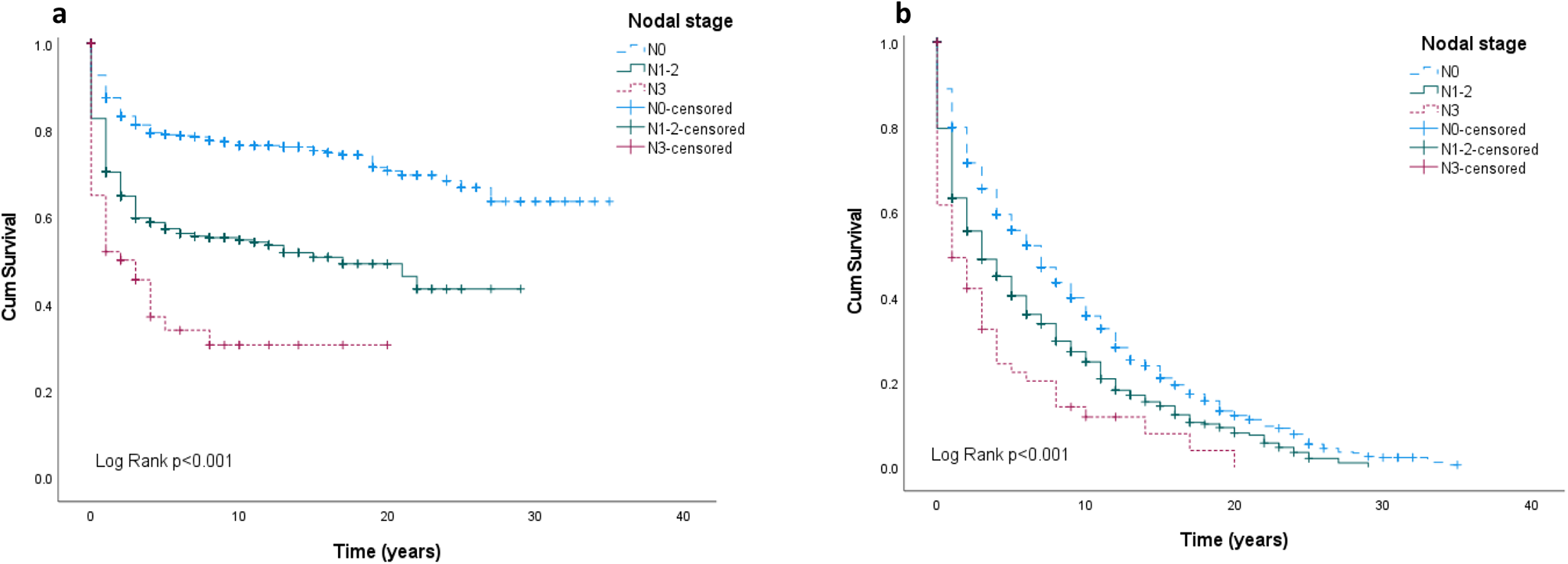
Given these circumstances, it is not surprising then that CSS is worse for patients with N3 disease (p < 0.001) (Figure 2a), with a 5-year CSS of 34% (compared to 79% N0 and 57% N1–N2). Overall survival was worse also in the N3 patients, compared to N0 and N1–N2, p < 0.001 (Figure 2b). It should be noted that more patients with N3 disease had a death due to HNC (60%; p < 0.001).
a) Cancer-specific survival b) Overall Survival

Discussion
It is apparent that those patients who present with N3 disease (UICC/AJC Seventh Ed.), have a worse chance of having regional control, as well as local (and ultimate) local control. This would then lead to a worse cancer-specific survival. However, as these patients may have various co-morbidities and risks of other malignancies becoming apparent, it is not unexpected that overall survival is also worse.
Not surprisingly, this review indicates that ultimate local, as well as regional control, progressively worsens with the transition from N0 to N1–N2, and then to N3. As well as the time to failure (both locally and regionally) there is also a shorter time to death, and 60% of these events relate to the H&N cancer that these patients present with.
Regional control in this population was 67%, a lower figure than other series. Witek et al.Reference Witek, Morris, Alexander, Dontu, Koroulakis and Regine6 reported their figure to be 80% (in a two-centre study), and Igidbashian et al.Reference Igidbashian, Fortin, Guertin, Soulières, Coulombe and Belair11 noted a 2-year regional relapse free-rate of 87.8%. Ballonoff et al., in a small population of 32 patients, comparable to our cohort, recorded a loco-regional control of 88%.Reference Ballonoff, Raben, Rusthoven, Bassetti, Kane and Song2 This is more likely to reflect the heterogeneity of small patient populations.
The type of treatment is focused upon in the literature. In a review of the USA National Cancer Database, comment is made that the management of N3 disease relies predominately on CRT, with improved outcomes in the oropharyngeal population, (a reflection of the HPV-positive component, and consequently worse in the HPV-negative patients).Reference Ko, Chen, Wieland, Yu, Baschnagel and Hartig5 Corry et al. reports no additional benefit for neck dissection in N2–N3 disease, if a complete response is achieved to initial CRT.Reference Corry, Peters, Fisher, Macann, Jackson and McClure12 Jones et al. noted that aggressive treatment of the neck improves survival.Reference Jones, Goodyear, Ghosh, Husband, Helliwell and Jones3 Smyth et al. also records the lack of improvement in survival for those patients who had a neck dissection as a component of their treatment.Reference Smyth, Deal, Huang, Weissler, Zanation and Shores13 Carsuzaa et al. reports though this has relevance for loco-regional relapse.Reference Carsuzaa, Dufour, Gorphe, Righini, Cosmidis and Rogé10 There were a significant number of patients who were treated by radiotherapy only, in contrast to current practice,Reference Bernier, Domenge, Ozsahin, Matuszewska, Lefèbvre and Greiner14 although Carlander et al. reports infrequent use in the evaluation of a Danish population of oropharyngeal cancer patients.Reference Carlander, Bendtsen, Rasmussen, Jakobsen, Garset-Zamani and Grønhøj15
Distant failure is an occurrence reported by several authors. Both Ballonoff et al. and Witek et al. argue for further studies investigating the role of adding systemic treatment, defined in the MARCH studies as being apparent where this treatment is given both concurrently with the radiotherapy (RT), as definitive treatment, and, post-surgery adjuvant therapy.Reference Ballonoff, Raben, Rusthoven, Bassetti, Kane and Song2, Reference Witek, Morris, Alexander, Dontu, Koroulakis and Regine6
Other factors may also play a role in the management of these patients. Barton et al. and Herrmann et al. have reported the importance of the treatment time effects, as others have, particularly where treatment interruptions occur.Reference Barton, Keane, Gadalla and Maki16, Reference Herrmann, Jakubek and Trott17 Overgaard et al. noted that shortening the overall treatment time with six fractions versus 5 per week, improved outcomes.Reference Overgaard, Mohanti, Begum, Ali, Agarwal and Kuddu9 The presence of co-morbidities, as well as nutritional deficiencies,Reference Vangelov, Kotevski and Smee18, Reference Vangelov, Smee, Moses and Bauer19 are also noted to lead to worse outcomes.
The limitations applicable to this study are the relatively small numbers and the time frame over which the review took place. Although there were some changes over time, the philosophy and treatment approach remained reasonably constant and documentation was similar. It is thus unlikely that significant changes occurred based on time alone.
N3 nodal disease, whilst infrequent, proportionally provides a challenge to address. It is frequently associated with more locally advanced disease and is more typically addressed with CRT in present circumstance. A routine neck dissection does not seem to advance the outcome and achieving loco-regional control is difficult. Irrespective of this, overall survival tends to be poor, influenced by patient factors and the tendency for metastatic disease, the development of which influences the ultimate outcome.
• Presentation with N3 neck disease indicates a greater volume of malignancy in patients with head and neck cancer
• There may still be early T-stage disease however, and non-surgical treatment is more likely to be used
• Irrespective of T-stage at presentation, patients in our study who presented with N3 nodal disease had worse local (and ultimate local) control rate
• Regional control was also worse for patients with N3 nodal disease in addition to shorter time to failure
• Interestingly, these patients exhibited worse cancer-specific survival (5-year survival of 34%) when compared to those with lesser nodal involvement
Conclusion
In evaluating outcomes in the treatment of mucosal SCC of the head and neck, patient and treatment variables are important. However, nodal bulk (N3), as demonstrated in this review, exhibits dominance irrespective of the local extent of the disease.
Data availability statement
Any data associated with this manuscript will not be made available to other researchers. This research was not preregistered in an independent, institutional registry.
Competing interests
The authors declare none.
Ethical standards
Approval was obtained from the ethics committee of The South Eastern Sydney Local Health District (10/040). The procedures used in this study adhere to the tenets of the Declaration of Helsinki.
Acknowledgements
The authors acknowledge Damian Kotevski for his involvement in data collection for this research, and the contribution to care of the patients by the many clinicians working at this facility is also acknowledged.
Author contributions
All authors meet the ICMJE conditions for authorship. Robert Smee: conceptualisation, formal analysis, investigation, methodology, project administration, validation, writing (original draft, review and editing). Janet Williams: data curation, formal analysis, investigation, methodology, validation, writing (review and editing). Belinda Vangelov: data curation, formal analysis, investigation, methodology, validation, visualisation, writing (original draft, review and editing).
Financial support
This research received no specific grant from any funding agency, commercial or not-for-profit sectors