INTRODUCTION
A long-standing tradition of representation scholarship revolves around questions about social identity and political representation. There is an extensive representation literature exploring various forms of representation for disadvantaged groups such as racial and ethnic minorities (Hero and Tolbert Reference Hero and Tolbert1995) and women (Selden Reference Selden1997). Following Pitkin (Reference Pitkin1967), scholars focus on the link between descriptive and substantive representation with many contending that increasing descriptive representation of disadvantaged groups is likely to produce policy outputs and outcomes that substantively benefit these groups (Mansbridge Reference Mansbridge1999).
Political scientists have also renewed interests in studying the representation of racial minorities in elected political offices. Studies on minority legislators largely draw from roll-call data (Broockman Reference Broockman2013; Swain Reference Swain1995; Whitby Reference Whitby2000) and conclude that minority lawmakers, compared with their non-minority peers, are more attentive to minority concerns (Griffin Reference Griffin2014). Scholars also find that the presence of minority legislators shifts agenda setting toward policy areas that disproportionately affect racial and ethnic minority communities (Barrett Reference Barrett1995; Bratton and Haynie Reference Bratton and Haynie1999; Hero and Preuhs Reference Hero and Preuhs2010; Juenke and Preuhs Reference Juenke and Preuhs2012), but both electoral systems and political parties can alter the link between the descriptive and substantive representation of minorities. Nevertheless, many studies focus on how legislators behave once elected to office (Broockman Reference Broockman2013; Griffin Reference Griffin2014; Hero and Tolbert Reference Hero and Tolbert1995).
Yet, less attention has been given to other important questions concerning what enables minority candidates to hold office. Despite the progress in including members of disadvantaged groups in legislative offices, gains for minorities in state legislatures have failed to match the demographic changes in state populations. In some states, the shortfall is even growing. For example, blacks make up 13% of the U.S. population and Hispanics account for about 17% of the U.S. population, the proportions of state lawmakers with these racial identities are far smaller––9 and 5%, respectively. Political scientists have addressed this under-representation with both a demand-side perspective focusing on voters' ideology and policy preferences and a supply theory focusing on minority candidate emergence (Shah Reference Shah2014). Going beyond what drives candidate supply, scholars also have examined how macro-level institutional factors, such as electoral rules, affect the representation of minorities (Meier et al. Reference Meier, Juenke, Wrinkle and Polinard2005; Treggbi, Aghion, and Alesina Reference Treggbi, Aghion and Alesina2008).
We extend the existing literature by providing a resource-based perspective of disadvantaged groups' electoral success. We theorize that a candidate cannot win an elective office without necessary political resources and argue that social capital, commonly understood as civic engagement and social connectedness, is an important political resource that affects the emergence and electoral success of minority candidates. Joining candidate-level data on 2012 state legislative elections with social capital measures by race and ethnicity, we examine the impact of social capital on minorities' electoral prospects. With data on more than 10,000 state legislative election entries across both chambers, we find promise in positing social capital as a political resource for minority candidates in legislative elections.
THE DETERMINANTS OF MINORITIES' ELECTORAL FORTUNE
What explains the under-representation of racial and ethnic minorities in elected political offices? Focusing on the supply and demand side of legislative representation, scholars link candidates' electoral success to their personal characteristics and voters' demographic and political makeup. The underlying logic is that candidates' personal traits and voters' characteristics both affect the important resources critical to electoral success. On the one hand, scholars focus on candidate emergence and attribute the presence of ethnic minority candidates to personal-level factors such as political ambition, prior experience of public service, and candidate quality (Maisel and Stone Reference Maisel and Stone2014). These studies find that the under-representation of racial and ethnic minorities is because minorities are less likely to run for office (Fox and Lawless Reference Fox and Lawless2014; Shah Reference Shah2014) and often face higher electoral barriers than their non-minority rivals in primary elections (Juenke Reference Juenke2014; Lawless and Pearson Reference Lawless and Pearson2008).
On the other hand, scholars find that voters' demographic and political makeup affect elective officeholding by racial and ethnic minorities. Branton (Reference Branton2009) finds that black and Hispanic candidates are more likely to run and win in electoral districts with more registered black voters. Casellas (Reference Casellas2009) reports a consistent pattern for Latino legislative candidates. Additional studies find that minority candidates are more likely to win elections in electoral jurisdictions with high concentrations of minority voters and liberal voters (Norrander and Wilcox Reference Norrander, Wilcox, Thomas and Wilcox1998; Shah Reference Shah2014).
The existing literature also uncovers other forms of political capital for minority candidates. Some scholars attribute the under-representation of minorities to their comparative disadvantages in generating campaign receipts (Burrell Reference Burrell1985; Reference Burrell1990; Uhlander and Schlozman Reference Uhlander and Schlozman1986). Others find that support from political parties affects whether candidates decide to run for office because party support allows minority candidates to access campaign finance networks critical to electoral fortune (Hassell Reference Hassell2015; Herrnson Reference Herrnson2009).
At the macro-level, scholars have given attention to institutional rules that shape the electoral prospects for minorities. Studies on institutional rules suggest that candidates from ethnic minority groups usually fare better in multi-member districts than in single-member districts (Casellas Reference Casellas2009; Darcy, Hadley, and Kirksey Reference Darcy, Hadley and Kirksey1993; Davdson and Korbel Reference Davdson and Korbel1981; Welch Reference Welch1990). Multi-member districts benefit ethnic minorities because proportional systems allow power-sharing among representatives from different social groups rather than creating zero-sum games of power competition (Brokington et al. Reference Brokington, Donovan, Bowler and Brichetto1998; Marschall, Ruhil, and Shah Reference Marschall, Ruhil and Shah2010). On the contrary, single-member districts (SMD) can dilute minority votes and reduce the overall influence of minority representatives (Gerber, Morton, and Rietz Reference Gerber, Morton and Rietz1998; Rocha, Tolbert, and Clark Reference Rocha, Tolbert and Clark2010; Shah Reference Shah2009).
Key findings in the electoral-rule literature point out the importance to move beyond individual-level factors and consider macro-level institutional forces that shape minorities' electoral fortune. As effective multi-racial coalitions contribute to minority candidates' electoral success, certain formal electoral institutions can facilitate the formation of broader electoral coalitions. Electoral rules, however, are not the only macro-level factors that can affect minority representation. Overlooked in the literature is the important role of social capital, rising from informal social institutions, collective membership, and reciprocity among individuals.
SOCIAL CAPITAL AS POLITICAL CAPITAL
For decades, scholars have examined factors related to the political representation of racial and ethnic minorities across different levels of government. Existing research focuses on different questions related to this topic, including the exclusion of minority groups from city-level politics and the development of bi-racial coalitions (Sonenshein Reference Sonenshein1993), the multiracial and multi-ethnic electoral coalitions that develop for minority candidates at the city level (Hero Reference Hero1989), and how social contexts shape minority representation (Karnig Reference Karnig1976; Liu and Vanderleeuw Reference Liu and Vanderleeuw2001; Trounstine and Valdini Reference Trounstine and Valdini2008; Vedlitz and Johnson Reference Vedlitz and Johnson1982). Generally, voters are more likely to support a candidate who shares their racial identity (Barreto, Segura, and Woods Reference Barreto, Segura and Woods2004; Vanderleeuw and Engstrom Reference Vanderleeuw and Engstrom1987), so the electorate's racial composition is also important for minority representation (Cameron, Epstein, and O'Halloran Reference Cameron, Epstein and O'Halloran2014; Highton Reference Highton2004; Juenke and Preuhs Reference Juenke and Preuhs2012; Juenke and Shah Reference Juenke and Shah2016; Lublin Reference Lublin1999; Ocampo Reference Ocampo2018).
Although there is an extensive line of research on the social contexts that contribute to minority representation, we argue that social capital should receive greater attention from representation scholars. Social capital is an expansive concept that has received considerable attention in the study of public policy and politics (Lin, Cook, and Burt Reference Lin, Cook and Burt2008). The concept of social capital stems from the sociology literature (Blau Reference Blau1967; Coleman Reference Coleman1990; Lin Reference Lin2001) and was proliferated by Robert Putnam's seminal works, Making Democracy Work (Reference Putnam1993) and Bowling Alone (Reference Putnam2000). Putnam (Reference Putnam1993; Reference Putnam1995) describes social capital as an asset that is inherent in social relations and networks. Putnam's collective approach of social capital emphasizes the importance of community-level characteristics such as civic engagement, network associability, and reciprocity among members from the same group and/or community (Putnam Reference Putnam2000). Lin (Reference Lin2001) compares the individual and collective approaches of social capital, noting that social capital can also be seen as individuals' investment in social relationships and private resources embedded in social relations. Similar to Lin (Reference Lin2001), Compton and Meier (Reference Compton and Meier2016) distinguish between private and public dimensions of social capital and conceptualize them as different assets for effective policy implementation.
In recent years, political scientists renewed interests in social capital, especially its political consequences in equalizing political participation and improving democratic representation (Boix and Posner Reference Boix and Posner1998; Putnam Reference Putnam1995; Reference Putnam2000). Social capital is found to be associated with increased political participation (Hays and Kogl Reference Hays and Kogl2007), particularly when political discussion occurs in one's social networks (McClurg Reference McClurg2003). But there have been calls for greater consideration of race and ethnicity in the conceptualization and exploration of social capital (Hero Reference Hero2003). Some recent studies focus on social capital in black communities (Newman, Velez, and Pearson-Merkowitz Reference Newman, Velez and Pearson-Merkowitz2016), and the role of the black church in the formation of social capital development for blacks (Liu, Wright Austin, and Orey Reference Liu, Wright Austin and Orey2009), particularly churches that expose members to political discussions and encourage political engagement (Brown and Brown Reference Brown and Brown2003; Calhoun-Brown Reference Calhoun-Brown1996; McClerking and McDaniel Reference McClerking and McDaniel2005). High stocks of social capital are also found to increased civic engagement (Lewis, MacGregor, and Putnam Reference Lewis, MacGregor and Putnam2013; McKenzie Reference McKenzie2008) and political participation among blacks (Farris and Holman Reference Farris and Holman2014).
Building on the existing literature, we posit social capital, formed based on organizational membership, social networks, and community engagement, as important political capital for minorities that build opportunities and capacities to participate in politics (Fuchs, Minnite, and Shapiro Reference Fuchs, Minnite and Shapiro1998). Moving beyond the sheer size of the minority electorate, we highlight the role of social capital in mobilizing minority voters, generating campaign resources, and collective preference formation, all of which might contribute to minorities' electoral success.
Social Capital, Campaign Resources, and Political Participation
Minority candidates often face greater electoral barriers than white candidates because of racial/ethnic imbalances in voter turnout and a disadvantage in campaign resources. Focusing on local elections, Hajnal and Trounstine (Reference Hajnal and Trounstine2005) find that lower turnout among ethnic minorities, especially low-income ethnic minorities, is associated with substantial reductions in Latino and Asian representation. If minority candidates face electoral barriers due to low levels of voter participation from their co-ethnic voters, then high stocks of minority social capital may contribute to the reduction of the mobilization bias disadvantaged groups face. The social movement's literature explores this topic. Though several definitions exist, “social movements” refer to informal groups of individuals who focus on specific social or political issues. Scholars note that since many majority movements are openly hostile toward minority groups and focus on non-ethnic issues, mobilizing via social movements allows “disadvantaged” minorities to focus on making progress toward important, shared goals (Oliver Reference Oliver2017). The type of mobilization that occurs via social movements provide one mechanism that may result in social capital acting as political capital for minority candidates.
Research also suggests that social capital embedded in personal and social networks facilitates political participation by increasing one's likelihood of engaging in politics (Harell Reference Harell2000; Lake and Huckfeldt Reference Lake and Huckfeldt1998).Footnote 1 There are several possible mechanisms that contribute to this relationship. For example, in communities with high levels of social capital, individuals' sense of civic duty and the collective norms of political participation are enforced through social interactions and relationships, which in turn are positively associated with voting (Blais Reference Blais2000; Gerber, Green, and Larimer Reference Gerber, Green and Larimer2008). Analyzing voluntarism, Ayala (Reference Ayala2000) finds that activity in voluntary non-political groups have significant effects on political participation, and the effects of volunteer-oriented activities are more salient than those of the socioeconomic status variables. Farris and Holman (Reference Farris and Holman2014) show, once considering the impact of social capital, that many of the socioeconomic factors associated with political participation matter less for the political participation of black women as a group. Similarly, McFarland and Thomas (Reference McFarland and Thomas2006) find that one's voluntary activities have long-term effects in political participation. Civic engagement through voluntary associations strengthen ones' social interactions with other group members. These voluntary organizations are often formed for shared-goals concerning community services, representation, and various public policy issues, allowing civic engagement through such voluntary associations to “train” individuals to be more attentive to politics and encourage political participation.
High stocks of overall social capital may also help minority candidates overcome another electoral hurdle: limited financial contributions. Deficits in campaign resources are an electoral disadvantage. Minority candidates tend to come from poorer districts and are more likely to campaign with less money than their white counterparts. Black candidates and Latino candidates tend to represent majority-minority districts (Herrick Reference Herrick2017; Hogan Reference Hogan2000). Analogous to physical capital and human capital, social networks, group associations, and inter-personal/inter-organizational relationships can become sources for raising campaign money (Putnam Reference Putnam2000). There are other factors, such as socioeconomic status and financial resources, that are important for electoral success. Intangible assets such as civic skills, information, and social relationships are also critical to mobilizing voters in elections. Candidates and elected officials must have a solid base of core constituents to sustain their campaign finance. In communities with more overall social capital, citizens are more engaged in politics and are more likely to contribute to political campaigns. To this end, social capital may have profound resource implications, because candidates can draw material resources from their social relationships, which may allow social capital to transmute into important political capital critical to electoral success. Because social capital may help minority candidates overcome electoral barriers due to imbalanced voter turnout and disadvantages in campaign resources, we expect a positive relationship between social capital and the electoral success of minority candidates.
H1: Minority candidates are more likely to win an election in places with higher levels of overall social capital than in places with lower levels of overall social capital.
Private Goods? Group-Based Social Capital and Minorities' Electoral Success
Building on the theoretical motivations discussed in the previous section, we examine the possibility of minority social capital acting as an important, private good for minority candidate emergence and electoral success. Although the literature on social capital and its political consequences provides insights into how communities rich in social capital may facilitate minority candidates' electoral success, whether social capital affects electoral outcomes as minorities' private political capital remains unclear. However, this possibility, aligns with recent research that finds subgroups develop social capital and the effects may be limited to the specific subgroup communities who develop it (Orr Reference Orr1999). Our theoretical motivation for these expectations builds on racial inequality scholars' criticism of exiting social capital theories. For example, Hero (Reference Hero1998) shows that the overall stock of social capital is positively correlated with the racial homogeneity of the population. In other words, high stocks of social capital and increased levels of racial/ethnic diversity are associated with opposite effects. By contrasting the racial diversity thesis and the social capital thesis Hero (Reference Hero2007)'s findings highlight that while many of the expected benefits of social capital on political participation and an array of specific policy outcomes occur, racial/ethnic minorities do not accrue many of these benefits. Putnam uses the “Constrict Theory” to explore the complicated relationship between social capital and diversity. The Constrict Theory argues that (in the short run) ethnic diversity results in less interaction by individuals in diverse communities (Putnam Reference Putnam2007, 150–151) thus reducing social capital. There is an interactive, conditional relationship between social capital and diversity. Scholars argue that the benefits of social capital will not be equal across sub-groups (Meier, Favero, and Compton Reference Meier, Favero and Compton2016) and that there may be negative effects from high stocks of social capital for those viewed as “others” (Hawes Reference Hawes2019). Social capital is conditioned by racial/ethnic contexts (Hawes and McCrea Reference Hawes and McCrea2018) and social capital and racial diversity impact policy equity differently (Hawes and Rocha Reference Hawes and Rocha2011). Social capital is associated with an increase in negative outcomes for blacks (Hawes Reference Hawes2017), but these outcomes can be mitigated by a supportive diversity climate (Moon Reference Moon2018) and an institutional commitment to diversity (Compton and Meier Reference Compton and Meier2016).
How would group-specific social capital improve minority candidates winning probabilities for elective officeholding? Interactions among individuals who share the same social identities (e.g. race, ethnicity, gender, etc.) are deemed as bonding social capital (Putnam Reference Putnam2000). Such in-group ties can reinforce homogeneity and mobilize group members to support candidates who share the same group identity. Social capital is not distributed equally across communities (Lin Reference Lin2000) and there are many institutions important to social capital development. For example, social capital derived from HBCUs has promising effects on minority outcomes (Brown and Davis Reference Brown and Davis2001; Palmer and Gasman Reference Palmer and Gasman2008). These institutions range from formal ones, such as religious, legal, and/or economic institutions, to informal ones (Tabellini Reference Tabellini2010).
Recent work on social movements suggests social capital has a central role in promoting important policy agendas for ethnic minority groups (Nooteboom Reference Nooteboom2007; O'Brien, Phillips, and Patsiorkovsky Reference O'Brien, Phillips and Patsiorkovsky2005). Focusing on the civil rights movements, scholars identify social networks and shared cultural asses in indigenous institutions and southern black churches as the important roots for the civil rights movement that not only mobilized key policy agendas for minority communities but also gave rise of minority political leaders (Ling Reference Ling2006; Morris Reference Morris1984). More recently, Schneider and Robnett (Reference Schneider, Robnett, Kreider and Baldino2016) find that political black churches enhance the social capital of church members and explicitly encourage church members' political participation. This finding is consistent with early work by Brown and Brown (Reference Brown and Brown2003), which suggests that church-based social capital resources expose individuals to political discussions and enrich black activists civic/political skill development and make them competent in political participation. Viewing churches as political communities, scholars find involvement in political churches mobilizes black voters (Calhoun-Brown Reference Calhoun-Brown1996) and provide a channel for political candidates to spread campaign messages to in-group voters McClerking and McDaniel (Reference McClerking and McDaniel2005).
Ethnicity also shapes social capital development (Chavez, Wampler, and Burkhart Reference Chavez, Wampler and Burkhart2006). Increasingly scholars are recognizing that minorities are not a monolithic group and design studies to give separate consideration to different minority groups. Since Latinos are the largest ethnic group in the United States, they are the focus of a growing portion of the research. This research suggests that involvement in in-group social networks and civic associations increase political participation for Latinos. Social/civic contexts matter for the mobilization and participation of Latinos (Hritzuk and Park Reference Hritzuk and Park2000) and Latinos are more likely to participate in politics when they are integrated into politically active social networks and active in civic-association membership. Hritzuk and Park (Reference Hritzuk and Park2000) contend that Latinos' civic affiliation “acts as critical contexts for socialization, information dissemination, and mobilization, thereby providing some requisite resources central to facilitating participation” (151). In her analysis of the bonding social capital possessed by Latinos and their Anglo counterparts, Manzano (Reference Manzano, Espino, Leal and Meier2007) finds evidence that social capital resources encourage members of Latino organizations to politically bond with co-ethnics, e.g., mobilizing Latinos to vote for Latino candidates as a group, volunteering for a Latino campaign, and donating money to a Latino candidate. Meanwhile, bonding social capital among Latinos decreases political engagement with non-Latino specific politics.
As Verba, Scholzman, and Brady (Reference Verba, Scholzman and Brady1995) contend, in-group social ties and networks provide a channel for the collective formation of group members' policy preferences, to direct their support toward political representatives who share their identities, and to serve as arenas for recruiting in-group members into politics (Ayala Reference Ayala2000; Cassel Reference Cassel1999; Teorell Reference Teorell2003). In other words, social capital may become private goods that exclusively benefit in-group members, and reinforce inter-group competitions. Therefore, we expect a positive association between minority social capital and the probability of winning an election by a minority candidate. On the other hand, we expect the stock of white social capital to be negatively associated with the probability of a minority candidate winning an election. Stated as our final set of hypotheses, we expect:
H2a: The probability of a minority candidate winning an election increases as the stock of minority social capital increases.
H2b: The probability of a minority candidate winning an election decreases as the stock of white social capital increases.
RESEARCH DESIGN
To empirically test these hypotheses, we construct a dataset that includes all 2012 General Elections for the state legislature. Our analysis extends existing studies in this area in several ways. First, our dataset is an extension of the State Legislative Election Returns Series (Klarner et al. Reference Klarner, Berry, Carsey, Jewell, Niemi, Powell and Snyder2013), which covers state-level legislative elections up to years before the decennial redistricting. We focus on general elections in 2012, as such, we analyze the first elections immediately after redistricting, which include a larger number of open-seat elections and a relatively high rate of new legislators. Our study also extends Juenke and Shah (Reference Juenke and Shah2016)'s analysis of minority legislative candidates by extending their analysis of 14 state legislative elections to a full sample of the 43 states that held legislative elections in 2012. In total, our dataset includes 6,015 election entries (1,301 senate seats and 4,714 house seats) and 10,035 candidate-level entries.
The Electoral Success of Minority Candidates
Our dependent variables measure the electoral success of minority candidates in state legislative elections. Focusing on general elections, we model minorities' electoral success as a two-stage selection process: the presence of a minority candidate in the first stage, and then the success of a minority candidate in winning a legislative seat in the second stage (Juenke and Shah Reference Juenke and Shah2016; Marschall, Ruhil, and Shah Reference Marschall, Ruhil and Shah2010; Shah Reference Shah2014). To capture the two-stage election process, we include two dependent variables: (1) a dummy variable coded as “1” if a candidate is nonwhite, and (2) a dummy variable coded as “1” if the winner is nonwhite. We code for candidate's race and ethnicity using a multi-step approach that involves multiple information sources. First, since most candidates are registered voters, we rely on voting records for candidates in states where this information is publicly available. In states where these records are not available, we rely on online databases that provide information on the race/ethnicity self-identification of legislators. We also rely on information available from the National Hispanic Caucus or State Legislators, the National Association of Latino Elected and Appointed Officials, the National Conference of State Legislators and non-partisan sites that provide race/ethnicity information and photos of candidates.Footnote 2
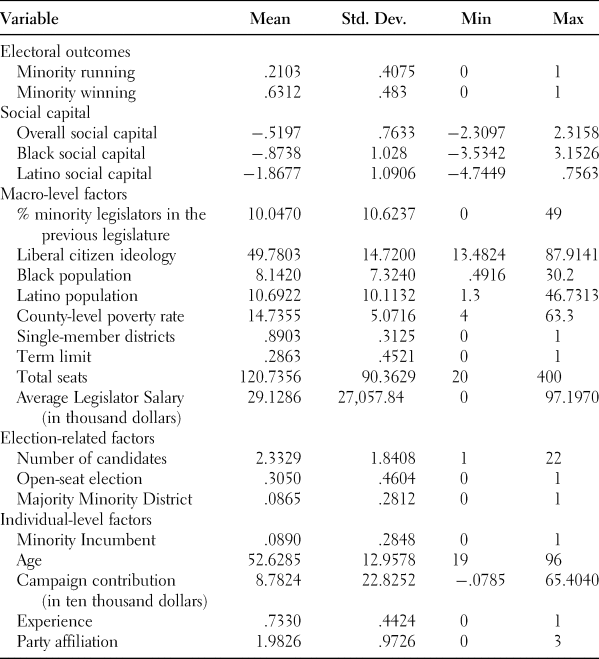
We study electoral success by focusing on (1) the emergence of a minority candidate and (2) a minority candidate being elected to office.Footnote 3 The top portion of Table 1 presents the descriptive statistics of our dependent variables. Table 1 shows, overall, minorities constituted about 21% of all the legislative candidates, and about 21% of the winners in the 2012 General State Legislative Elections were nonwhite.
Descriptive statistics of variables

Note: The total number of observations at the candidate level is 10,191. The sample includes 6,015 election level entries from 43 states in 2012.
Measuring Social Capital
Drawing data from the 2012 Current Population Survey (CPS) Civic Engagement Supplement, we validate measures to capture the overall stock of social capital in states and the stock of social capital possessed by whites, African Americans, and Latinos. Our measurement approach draws on the work of Hawes, Rocha, and Meier (Reference Hawes, Rocha and Meier2013) and the CPS Civic Engagement Supplement provides survey items that mirror Putnam's conceptualization of civic engagement and social interactions. Specifically, we use questions from the following CPS survey items: charitable activity, community volunteerism, community and organizational life, engagement in public affairs, and informal sociability. The charitable activity items we use to capture information about whether and how often survey respondents donated clothing, food, money, or participated in fundraising activity. The community volunteerism items include questions on whether respondents attended a public meeting, and helped fix a problem in the community or did not help because of lack of interest, lack of resources, or due to a life situation. Incorporating this item in our index is important as scholars highlight voluntary associations lead to coordination solving collective action problems (Brehm and Rahn Reference Brehm and Rahn1997), and lead to the development of social capital. Community and organizational life items ask respondents about their participation in church or other religious institution, civic organizations, how often they engage in volunteer activities with specific organizations, and their motivation for joining the organization. A few examples of the engagement in public affairs items are if the respondent discusses politics with friends, is registered to vote, or voted in the last election, and some of our informal sociability items are whether the respondent contacted employers directly and whether the respondent does favors for neighbors.
Following the steps of Hawes, Rocha, and Meier (Reference Hawes, Rocha and Meier2013), we aggregate individual-level responses to the above mentioned CPS survey questions to the state-level.Footnote 4 We then use factor analytical models to estimate an overall state-level social capital index. Our overall social capital index reflects the social connectedness and civic engagement activities of all individuals—irrespective of the gender and race of respondents. There is a correlation of .44 between our measure and the measure from Hawes, Rocha, and Meier (Reference Hawes, Rocha and Meier2013), which highlights that our measure is comparable to other existing measures. The CPS provides representative samples of sub-population groups at the state-level, so we develop group-specific social capital indexes for blacks, Latinos, and whites. The three group-specific social capital variables allow us to compare whether there are differences in social capital across racial/ethnic groups and examine if the electoral success of one social group is tied to in-group social capital.
Because all four social capital measures are standardized factor indexes, a value of zero corresponds to states with average levels of social capital. Negative values on the social capital index correspond to low levels of civic engagement and volunteerism, while higher values correspond to greater social capital. There is considerable variation in the four measures of social capital across the 43 in-sample states and the Appendix contains a figure with the variation of overall social capital. Our overall social capital ranges from −2.3 to 2.3, while both the black social capital index and Latino social capital index are skewed toward the low-end with mean values less than zero.
Control Variables
In our empirical models, we include three sets of control variables that may affect minority candidates' electoral returns. Macro-Level Factors. Based on existing research, we expect minority candidates to fare better as the proportion of minority legislators in a state increases (Shah Reference Shah2014). We account for this by including the percent of minority state legislators in the previous legislature as a control.Footnote 5 We rely on Berry et al. (Reference Berry, Ringquist, Fording and Hanson1998)'s citizen liberalism scale to measure the state-level political environment; this allows us to control for citizen ideology. We expected members of traditionally under-represented groups are more likely to be elected in liberal states than more conservative states. Minority voters are often the strongest source of support for minority candidates running for office, so we include separate measures to account for the size of the black, Latino, and white populations in each state.Footnote 6 We also control for county-level poverty rates.Footnote 7
Next, we consider electoral rules. We account for the potential effects of electoral system using a dummy variable for single-member districts (SMD). This variable is coded as “1” for SMD districts and “0” for all other types of districts. Based on in-sample cases, around 89% of candidates running for elections in SMD. The Term Limit variable is also dichotomous, coded “1” if there are term limits in the state and “0” if there are not. Table 1 shows that in 2012, near 30% of the legislative candidates run for elections in states with term-limit laws. Lastly, we control for the size of state legislatures using the number of total legislative seats, and average legislator annual salary as a proxy for legislative professionalism.Footnote 8
Election-Related Factors. The number and type of candidates running in an election are also likely to effect electoral outcomes. Re-election rates are high in U.S. elections, in part, due to the incumbent advantage. We code the Open Seat variable “1” if there is not an incumbent in an election and “0” otherwise. We expect minority candidates to have less electoral success in elections where they challenge incumbents and about 31% of candidates run in open-seat elections. The Majority Minority District variable is coded “1” for districts comprised of 50.1% or more of racial and ethnic minorities and we expect minority candidates to be more likely to win an election in this type of district. The Minority Incumbent variable captures whether there was a minority incumbent in the election.
Individual-Level Factors. Candidate characteristics also impact electoral success. Party identification is key in shaping who voters support in an election. Our Party variable has four values: “0” (non-partisan), “1” (Republican), “2” (Independent), and “3” (Democratic). We expect minority candidates to have more electoral success with the Democratic party. We include a control for the contributions each candidate receives, their age, and their experience. Variable Experience is coded as “1” for candidates who have previous experience running for public office or working in the public sector, and “0” otherwise. Table 1 shows, about three quarters of candidates had prior experience either in running for office or working as a public servant. Our Age variable ranges from 19 to 96.Footnote 9
Model Specification
Conceptualizing legislative elections as a two-stage selection process, we specify two probit models. The first probit model acts as a “selection equation” by capturing the probability of a minority candidate running for office as the outcome variable. The second probit model acts as an “outcome equation” by capturing the probability of a minority candidate winning an election. Given that we nest candidate-level information with elections in our data, we cluster standard errors by districts (i.e., elections).Footnote 10
FINDINGS
Effects of Social Capital on Minorities' Electoral Success
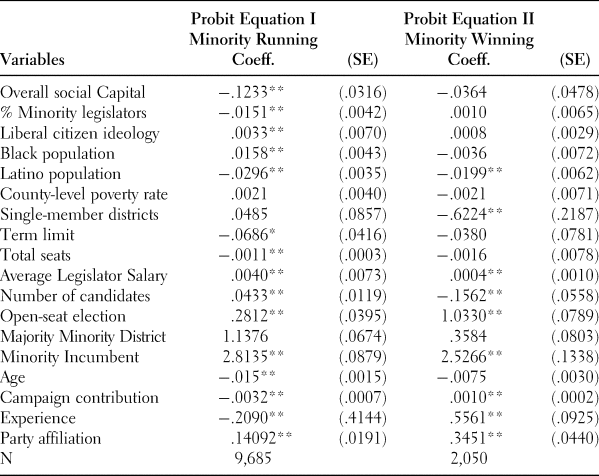
Many of the variables in Table 2 are significant predictors of the fate of minorities. The results for Overall Social Capital are presented in the first row of Table 2. These results highlight Overall Social Capital as having a negative, significant effect on the probability of seeing a minority candidate in an election, but no significant effect on the probability of seeing a minority winner. Additional results show that a more liberal citizen ideology, sizable black population, higher legislator salary, the greater number of candidates in the election, more open-seat elections, having a minority incumbent, and affiliation with the Democratic Party increase the likelihood of a minority candidate running. On the other hand, states with larger Latino populations, a greater number of seats in their legislature, and term limits make it less likely to see a minority candidate running for an election in single-member districts. Individual-level factors, such as increases in age, higher campaign contributions, and increased experience, also make seeing a minority candidate running for election less likely.
The impact of overall social capital on minority candidates' electoral outcomes

Note: Significance levels: **p < .05, *p < .1.
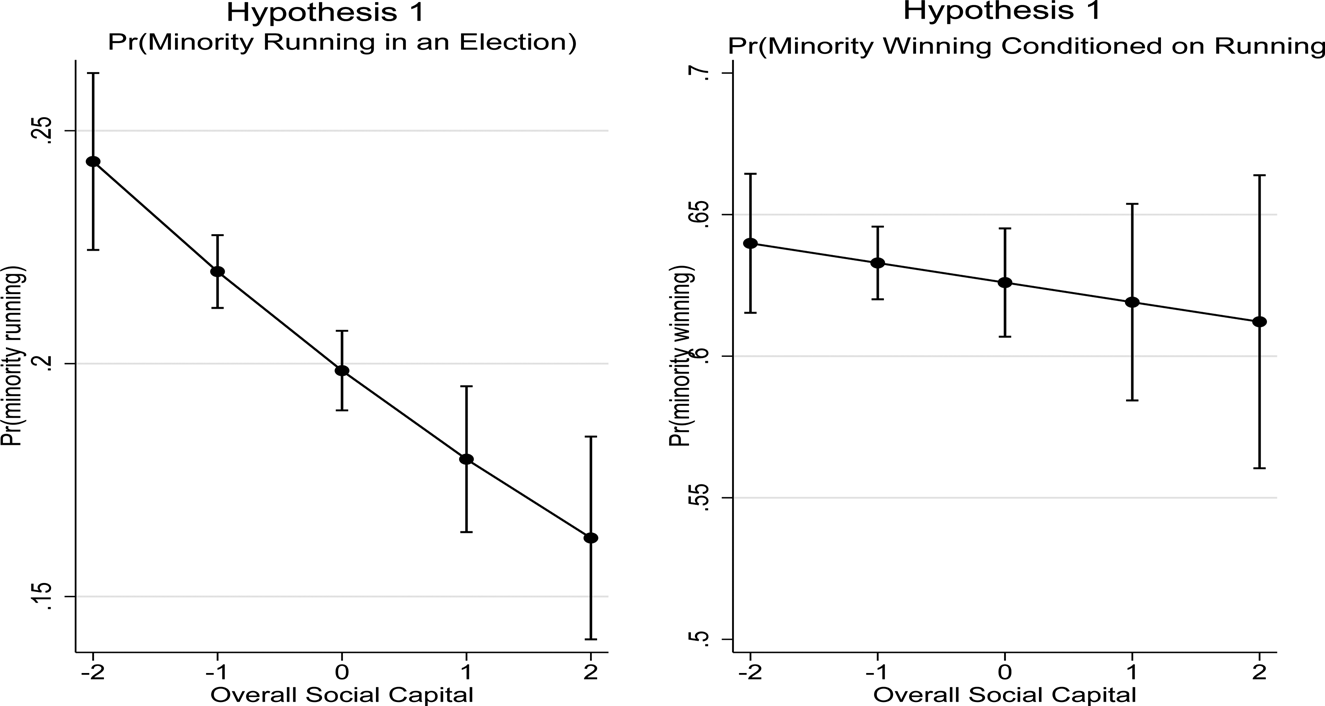
Figure 1 presents the predicted probabilities of minority candidate emergence and the predicted probabilities of seeing a minority winner across the full range of the overall social capital index. We calculate these predicted probabilities by holding all the other explanatory variables constant. Figure 1a shows, all else being equal, the probability of seeing a minority in an election decreases substantially as we move from states with low levels of overall social capital to states that are rich in overall social capital. On the other hand, Figure 1b shows the predicted probability of a minority candidate winning an election is not significantly effected by overall social capital.
Effects of overall social capital on minority candidates' electoral outcomes.

These findings reveal a negative consequence of high levels of social capital for the probability of minorities seeking electoral office. Results in Table 2 and Figure 1 do not support our expectations in H1. These results also do not align with the extensive amount of existing research that argues there are benefits from highly connected communities. Instead, our results are consistent with Hero's (Reference Hero1998) critique to the social capital literature that social capital can have distributional consequences in the context of racial politics. That is, our results suggest that high stocks of overall social capital do not improve the outcomes or directly benefit racial and ethnic minorities.
Group-Based Social Capital and Minority Candidates' Electoral Success
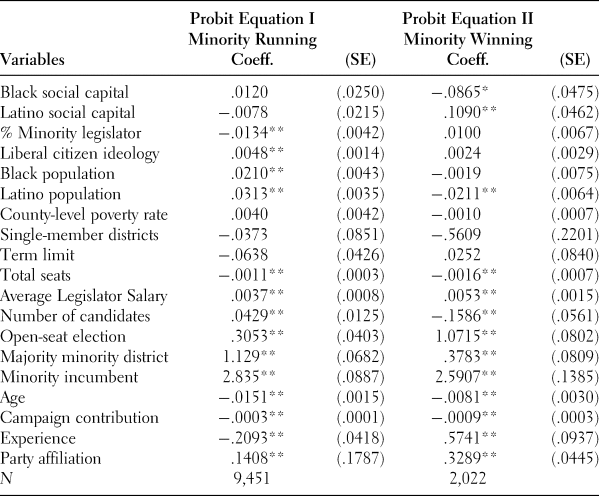
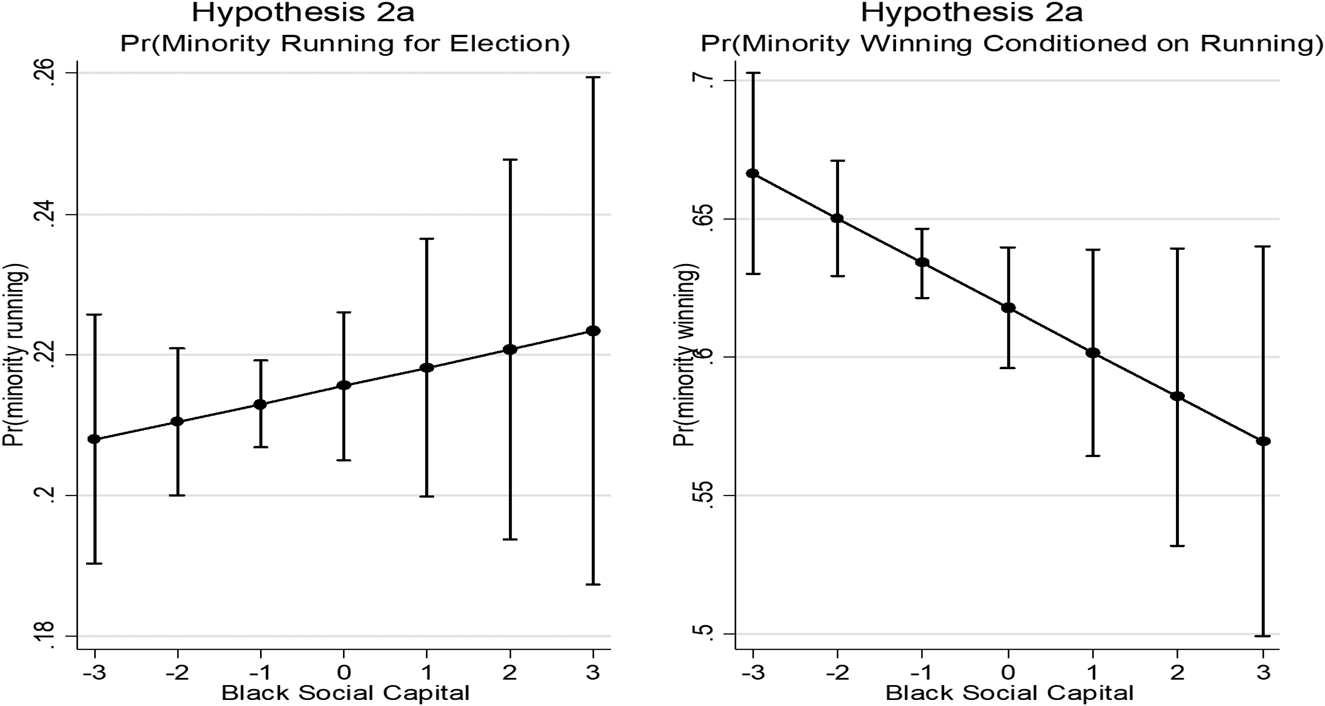
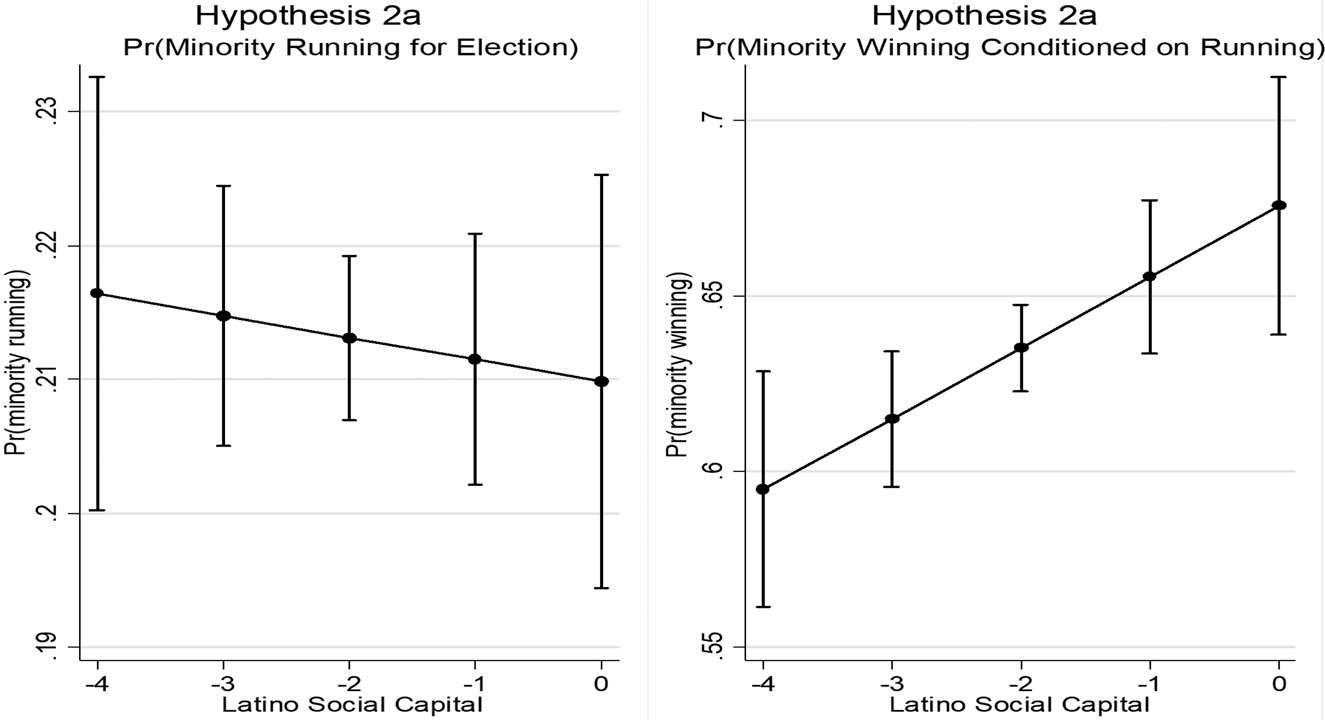
In Table 3, we examine the effects of black social capital and Latino social capital on the electoral outcomes of minority candidates.Footnote 11 We find mixed support for H2a as neither black nor Latino group-based social capital has a statistically significant effect on the emergence of minority candidates. Interestingly, both measures affect a minority candidate winning an election. These findings do not align with our expectations, but we offer a possible explanation. Our results suggest that high stocks of black social capital make it less likely that a minority candidate will win a state legislative election, while high stocks of Latino social capital has a positive and statistically significant effect on this factor. This seems to reflect the competition that occurs between candidates who belong to different minority groups. When minority candidates decide to run for office, they often face other minority candidates. Scholars note that although it seems that blacks and Latinos (the two largest minority groups in the United States) would be natural allies, competition for power and resources can lead to conflict (Kaufmann Reference Kaufmann2006, 107). In light of this, the effects of these sub-group measures of social capital highlight two important caveats to our argument that sub-group social capital is a resource. First, sub-group social capital is not a resource for the emergence and electoral success of minorities; second, the indexes of minority social capital do not have the same directional effects on minority representation. Latino social capital has significant effects on minority representation and acts as a “resource” by promoting the electoral success of minority candidates. These findings highlight the importance of distinguishing the race/ethnicity of minority candidates. We elaborate on this as a direction for future research in the conclusion.
Impact of Black and Latino social capital on minority candidates' electoral outcomes

Note: Significance levels: **p < .05, *p < .1.
Figures 2 and 3 contain the plot of the predicted probabilities for minority candidate emergence and officeholding across the full range of both minority social capital indexes. Although black social capital has insignificant effects on the emergence of minority candidates, states rich in black social capital are associated with substantially lower probability of minority candidates winning than states with low stock of black social capital. Similar to black social capital, our findings in Figure 3 suggest that Latino social capital does not effect the probability of minority candidates running in an election, but does affect the probability of seeing a minority winner.
Effects of Black social capital on minority candidates' electoral outcomes.

Effects of Latino social capital on minority candidates' electoral outcomes.

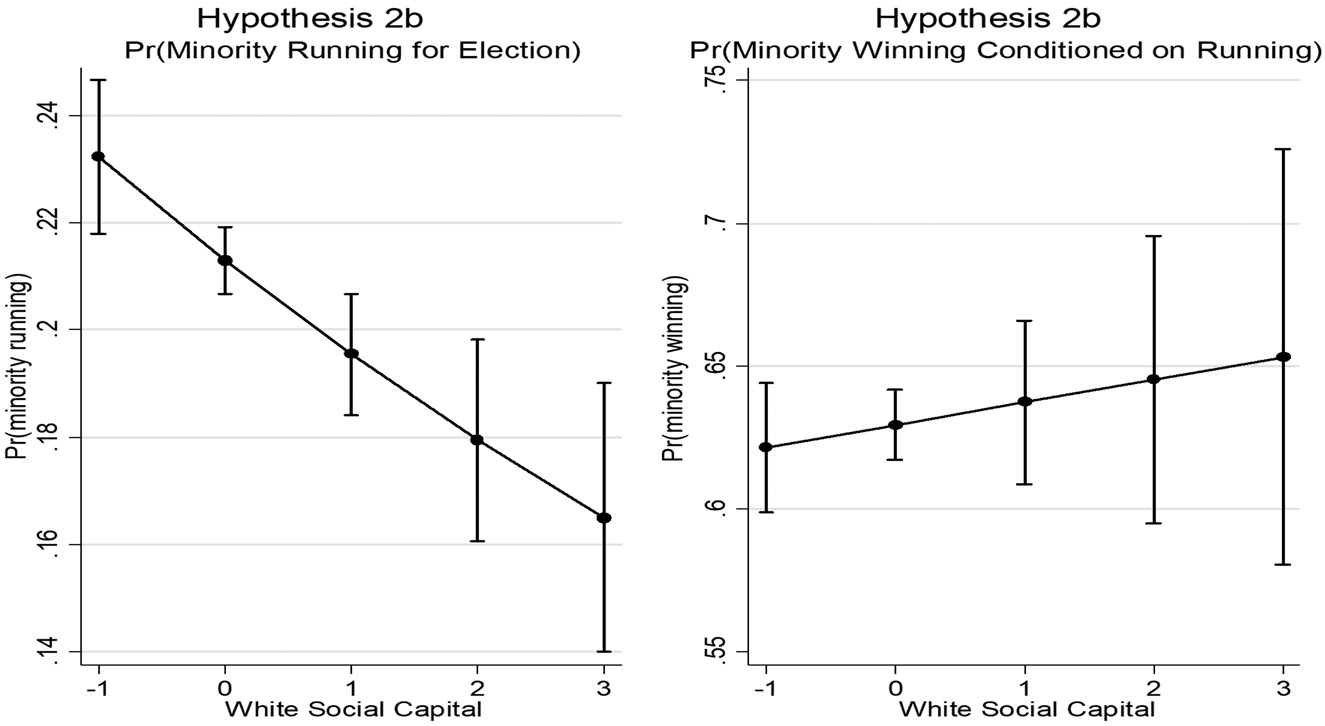
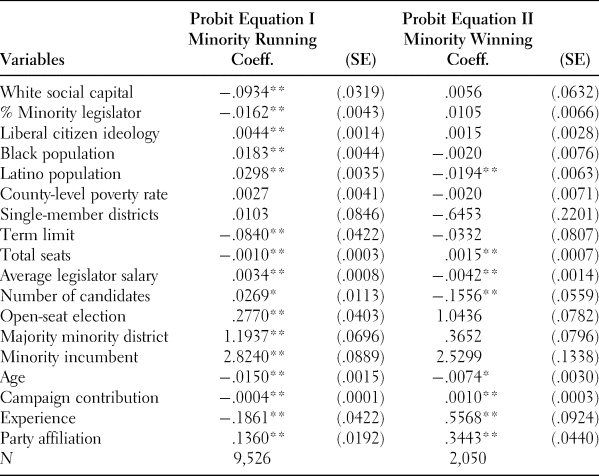
Table 4 presents the empirical results regarding how social capital owned by whites affects minority candidates' electoral outcomes. Figure 4 shows the predicted probabilities of seeing a minority candidate and the predicted probabilities of seeing a minority winner across the full range of the white social capital variable. Consistent with our expectations, states rich in white social capital are less likely to see a minority running for an election than states with low stock of white social capital. States rich in white social capital do not differ from states with low stock of white social capital in terms of minority candidates' electoral success. Figure 4 highlights the negative association between white social capital and the probability of a minority running in a state legislative election. The substantive effect of white social capital on minority candidates is quite small (slightly more than .5 at the lowest and highest levels of white social capital), but these findings highlight that minority candidates are less likely to emerge in states with white voters that are more civically engaged.
Effects of White social capital on minority candidates' electoral outcomes.

The impact of White social capital on minority candidates' electoral outcomes

Note: Significance levels: **p < .05, *p < .1.
Overall, the results in this paper provide mixed support for our expectations. Although unexpected, there are several possible explanations. First, there may be an under-examined relationship between racial diversity of population and voter turnout. We argue that high stocks of subgroup social capital will promote the emergence and electoral success of minority candidates. One of the mechanisms we put forth is an expected positive relationship between the stock of subgroup social capital and minority voter turnout. However, the racial and ethnic context may be contributing to the mixed results as minorities are more likely to turnout for coming elections when racial and ethnic minorities comprise a majority of the population (Fraga Reference Fraga2016) and Hispanic majority districts have limited effects on co-ethnic voter turnout (Henderson, Sekhon, and Titiunik Reference Henderson, Sekhon and Titiunik2016). While we focus on the effects of social capital, the mixed findings highlight the promise of studying the factors that shape the stock of subgroup measures of social capital. We elaborate on this in the conclusion.
CONCLUDING DISCUSSIONS
In this paper, we explore social capital as a potentially overlooked political resource for members of historically under-represented social groups. Scholars often study how factors such as the personal characteristics of candidates and their core constituents' demographic and political makeup affect minority office-holding. We build on existing theories of social capital and theorize that it is important to consider the social contexts of minority candidates' electoral success by arguing that social capital is an overlooked political resource for minorities. Although scholars have established a relationship between social capital and other political-related factors such as political participation, campaign donations, and preference formation, this is the first to study how high stocks of social capital shape the emergence and electoral success of minority candidates. A major contribution of this paper to social capital research is the linking of social capital to electoral outcomes, which allows us to unveil a complex relationship between social capital and the electoral fortunes of minority candidates.
Our findings suggest that while overall social capital negatively affects the electoral success of minority candidates, social capital owned by minorities promotes minority candidates' electoral success. Although the effects of black social capital do not align with our expectations, we find support for our expectations for the effects of Latino social capital as well as the possibility that group-based social capital only benefits in-group candidates with shared identities. On the other hand, our findings suggest that minority candidates are less likely to emerge in states with high levels of white social capital. Given patterns that exist in these states (racially homogeneous, etc.), this finding gels with the existing literature that suggests the presence of blacks living near whites heightens whites' prejudice (Dixon Reference Dixon2006) and the white group racial threat literature that highlights the increased complexity minority candidates face in obtaining votes from whites in white districts (Canon Reference Canon1999, 10), even when a minority candidate shares the partisan affiliation of white voters (Krupnikov and Piston Reference Krupnikov and Piston2015).
Although the social capital index developed and used in this project improves upon existing measures and offers important insight, we are not able to account for bridging and bonding social capital. This is a promising direction. Building on the work of Garcia Bedolla and Scola (Reference Garcia Bedolla and Scola2004) and others who study the factors that influence social capital development will also be insightful for future research. Our mixed findings regarding black and Latino social capital call for future research that distinguishes minority candidates. As noted in Lemi (Reference Lemi2018), there are weaknesses in many popular approaches scholars use to code race/ethnicity; moving forward, completing elite interviews may be a promising “tool” for more accurately accounting for race/ethnicity and determining if there are differences in how the sub-group measures impact in-group candidates (i.e. how black, Latino, or white social capital impacts black, Latino, and white candidates, respectively). Relatedly, generating social capital indexes at the local level and indexes that better incorporate measures of social movements, which scholars highlight as being important for social capital development, will be important for developing future research on the political consequences of social capital.
Lastly, it would be insightful to apply intersectionality. Social identities have important interactive effects on female legislators (Scola Reference Scola2008) and factors that promote the emergence of female candidates do not have the same effects of minority female candidates (Silva and Skulley Reference Silva and Skulley2018). Building on this, the “puzzle” of the over-representation of minority women at the state-level despite minorities and women being traditionally under-represented groups makes this a promising avenue for future research.
SUPPLEMENTARY MATERIAL
To view supplementary material for this article, please visit https://doi.org/10.1017/rep.2020.12.