INTRODUCTION
Colonial hosts offer unique opportunities for exploitation by parasites as a consequence of their extensive capacity for asexual reproduction that amplifies clonal genotypes over space and time. Increases in colony size are achieved by budding of new modules that permits colony growth trajectories to extend indefinitely. Modular budding can, in turn, lead to a propensity for fragmentation and the establishment of daughter colonies elsewhere (Jackson and Coates, Reference Jackson and Coates1986). Colony fragmentation is particularly appreciated in corals (Highsmith, Reference Highsmith1982), often as a consequence of disturbance, and can be reflected in population genetic structure (e.g. Williams et al. Reference Williams, Miller and Baums2014). However, fragmentation has also been observed in ascidians (Bullard et al. Reference Bullard, Sedlack, Reinhardt, Litty, Gareau and Whitlatch2007), sponges (Wulff, Reference Wulff1991), zoanthids (Acosta et al. Reference Acosta, Sammarco and Duarte2001), gorgonians (Lasker, Reference Lasker1984), hydroids (Bavestrello et al. Reference Bavestrello, Puce, Cerrano, Castellano and Arillo2000) and marine and freshwater bryozoans (Wood, Reference Wood, Boardman, Cheetham and Oliver1973; O'Dea, Reference O'Dea2006). In addition, many colonial invertebrates in seasonal environments produce dormant propagules from which small colonies emerge when conditions improve (e.g. sponge gemmules, hydroid cysts and frustules, bryozoan hibernaculae and statoblasts). Such processes of clonal propagation rely fundamentally on totipotent cells that enable budding and post-budding differentiation. These processes also offer parasites and pathogens unique opportunities for transmission and spread via infection of a genetically homogeneous (barring mutations) but potentially disjunct resource over space and time.
Much of our limited understanding of colonial host–parasite interactions is based on emerging diseases of corals (e.g. Ward et al. Reference Ward, Kim and Harvell2007; Ushijima et al. Reference Ushijima, Smith, Aeby and Callahan2012), which, being novel, lack any prolonged period of coevolution. Mechanisms of defence and exploitation may therefore be only partially established at best in these systems. Identifying strategies resulting from long-term reciprocal interactions requires examination of established colonial host–parasite systems. Freshwater bryozoans and endoparasitic myxozoans offer such a system and recent investigations have begun to provide novel insights into how these endoparasites take advantage of unique traits associated with host coloniality. For example, infections of Buddenbrockia allmani Allman, 1856 are transmitted to some 99% of daughter colonies produced by fission of the bryozoan, Lophopus crystallinus Pallas, 1768 (Hill and Okamura, Reference Hill and Okamura2007) and preliminary evidence suggests that Tetracapsuloides bryosalmonae Canning et al. 2002, similarly undergoes transmission when colonies of its bryozoan host, Fredericella sultana Blumenbach, 1779, undergo fragmentation (Morris and Adams, Reference Morris and Adams2006). In addition, both B. allmani and T. bryosalmonae are able to infect asexual seed-like propagules (statoblasts) produced by their bryozoan hosts (Hill and Okamura, Reference Hill and Okamura2007; Hartikainen et al. Reference Hartikainen, Fontes and Okamura2013; Abd-Elfattah et al. Reference Abd-Elfattah, Fontes, Kumar, Soliman, Hartikainen, Okamura and El-Matbouli2014) – a process that can be equated to vertical transmission since statoblast hatching effects recruitment when conditions improve. Finally, transmission of T. bryosalmonae is shown to depend on host condition, with energetically expensive spore production coinciding with periods of vigorous bryozoan growth (Hartikainen and Okamura, Reference Hartikainen and Okamura2012). This host condition-dependent developmental cycling occurs as bouts of observable, spore-producing overt infections that impact host growth and reproduction, and inapparent covert infections (sensu Sorrell et al. Reference Sorrell, White, Pedersen, Hails and Boots2009) that are persistent, not transmitted horizontally and impose little cost. Covert infections of T. bryosalmonae have no apparent impact on host growth and are sustained when conditions are suboptimal for bryozoan hosts (Tops et al. Reference Tops, Lockwood and Okamura2006; Hartikainen and Okamura, Reference Hartikainen and Okamura2012).
Despite recent insights, how myxozoans exploit opportunities for transmission offered by colonial hosts and the concomitant effects on hosts remain poorly understood. Transmission achieved during colony fragmentation has received initial laboratory study but with low sample sizes and is therefore scarcely documented. Thus, 7 out of 22 fragments released from three colonies were found to be infected and artificial fragmentation of a single colony demonstrated infection in 4 of 5 recruited fragments (Morris and Adams, Reference Morris and Adams2006). In addition, how infection levels influence transmission, whether transmission to statoblasts influences viability, how parasites respond to hosts in very poor condition and how covert infections influence host fecundity remain largely unknown. Gaining insights on such issues is essential for understanding colonial host–parasite interactions. The aims of our study were therefore to more robustly examine how T. bryosalmonae takes advantage of the multiple transmission routes offered by F. sultana, to evaluate the effects of such transmission on its bryozoan host, and to test the hypothesis that poor host condition provokes T. bryosalmonae to undergo terminal investment in order to bail out of a resource that may soon be unsustainable. We therefore investigated the following questions related to these aims: (1) What proportions of colony fragments are infected and do these vary in space and time? (2) Does infection of statoblasts and of maternal colonies influence statoblast hatching and thus parasite transmission? (3) Does infection influence host fecundity? (4) Does host starvation induce production of infectious stages?
MATERIALS AND METHODS
Study system
Freshwater bryozoans are sessile suspension feeders that are common but overlooked constituents of freshwater habitats (Wood and Okamura, Reference Wood and Okamura2005). T. bryosalmonae infects freshwater bryozoans as primary hosts, particularly the species F. sultana. Secondary hosts are salmonids in which infections cause PKD (proliferative kidney disease) – a disease affecting wild and farmed fish in Europe and North America (see Okamura et al. Reference Okamura, Hartikainen, Schmidt-Posthaus and Wahli2011 for review).
F. sultana reproduces mainly asexually (Wood, Reference Wood, Boardman, Cheetham and Oliver1973) via colony growth and the production of colony fragments and statoblasts. A limited period of sexual activity has been observed in some sites in summer (Wood, Reference Wood, Boardman, Cheetham and Oliver1973; A. Gruhl, personal communication; Okamura, personal observation) although we have never observed larval production in numerous sites in southern England (Fontes, personal observation; Okamura, personal observation; Tops, personal observation). During the summer, F. sultana colonies increase in size by budding zooids to form branching colonies. Currents and other forms of disturbance cause branches to detach and these colony fragments then attach and establish new colonies elsewhere (Wood, Reference Wood, Boardman, Cheetham and Oliver1973). F. sultana statoblasts are bean-shaped, asexually produced, dormant stages (approximately 1 mm in longest dimension) that develop throughout the growing season (Wood, Reference Wood, Boardman, Cheetham and Oliver1973). Statoblasts overwinter and hatch in early spring, giving rise to a new colony. In many sites, colonies of F. sultana also overwinter.
Cryptic stages of T. bryosalmonae that cause covert infections are single cells associated with the bryozoan body wall and are detected by PCR. Overt infections are detected using a stereomicroscope when multicellular sacs filled with spores can be seen circulating in the host body cavity. Sac development is induced when bryozoan hosts are vigorously growing in response to higher food levels (Hartikainen and Okamura, Reference Hartikainen and Okamura2012) and temperatures (Tops et al. Reference Tops, Hartikainen and Okamura2009). Such overt infections reduce growth (Tops et al. Reference Tops, Hartikainen and Okamura2009) and cause temporary castration of F. sultana by depressing statoblast production (Hartikainen and Okamura, Reference Hartikainen and Okamura2012). Overt infections can be maintained for months in laboratory conditions favourable for bryozoan growth, however moderate-to-high field prevalences of overt infections are only detected for weeks coinciding with periods of enhanced bryozoan growth in late spring and autumn (Okamura et al. Reference Okamura, Hartikainen, Schmidt-Posthaus and Wahli2011; Hartikainen and Okamura, Reference Hartikainen, Okamura, Okamura, Gruhl and Bartholomew2015). Spores produced within sacs are released in the water and are infectious for a brief time (degrading in <24 h; De Kinkelin et al. Reference De Kinkelin, Gay and Forman2002) to a range of salmonid fish (Okamura et al. Reference Okamura, Hartikainen, Schmidt-Posthaus and Wahli2011). Infection trials have confirmed that brown and brook trout serve as natural hosts in the UK and Europe (Feist et al. Reference Feist, Longshaw, Canning and Okamura2001; Morris and Adams, Reference Morris and Adams2006; Grabner and El-Matbouli, Reference Grabner and El-Matbouli2008). However, infection of some fish is accidental. For example, exotic rainbow trout in European fish farms are dead-end hosts. Spore production coincides with periods when bryozoan hosts are able to support energetically demanding infections. This is supported by laboratory feeding trials (Hartikainen and Okamura, Reference Hartikainen and Okamura2012) the apparent disparity in overt infection duration in favourable laboratory (maintained for months) and field conditions (high prevalences and severities of infection being detected for weeks) and the spring and autumn peaks in overt infection prevalences in the field (Tops, Reference Tops2004). Fish hosts are present year-round and are often observed to take shelter under the cover of roots that support dense populations of infected bryozoans (Fontes, personal observation). This suggests that horizontal transmission could occur throughout the year and that peaks in overt infection prevalences enable maximising transmission to fish by exploiting bryozoan hosts that can support the production of large numbers of spores.
Colony fragments
F. sultana colony fragments were collected in early and late summer (June and September) from three streams in southern England: the River Avon (SU14613 12741), the River Dun (SU342926 8576) (both sampled on 22/06/12 and 10/09/12) and the River Itchen (SU49860 32170) (sampled on 24/06/13 and 10/09/13). In each river, three submerged alder tree roots that were known to harbour T. bryosalmonae-infected F. sultana populations were gently agitated. Colony fragments released by agitation were caught in a mesh panel or colander held approximately 0·5 m downstream from the root system for up to 5 min or until >100 fragments were captured. Water temperature at each root system was measured during each sampling trip. Root sizes were roughly estimated on the first sampling trip as length × width × height. The material collected was retained in aerated river water at room temperature for 24 h prior to examination of individual colony fragments (using a stereo-microscope at 10–40× magnification) to count the number of zooids (to characterize fragment size), to identify overt infection (requiring dissection to confirm the presence of T. bryosalmonae sacs), to determine if mature statoblasts were present, and if dead/moribund (no functional zooids). Fragments were then preserved in 100% EtOH (ethanol). Fragments that were not overtly infected were screened using PCR (see below) to characterize proportions of uninfected and covertly infected fragments. The number of fragments screened by PCR was determined by availability or, when numerous, by haphazardly choosing 30–40 fragments per root.
Statoblasts
We undertook further analyses of data for material collected in southern England as reported in Abd-Elfattah et al. (Reference Abd-Elfattah, Fontes, Kumar, Soliman, Hartikainen, Okamura and El-Matbouli2014) and present new data on statoblast infection intensity. Briefly, F. sultana maternal colonies were subsampled from three root systems in the Rivers Avon and Dun on 29/08/12 and 05/09/12, respectively. Statoblasts were collected from these colonies and routine methods were employed to assess hatching. These entailed storing in deionized water at 4 °C for 5 months to simulate winter and then placing statoblasts in artificial pond water at 20 °C to allow hatching over a 7-day period. Infection status of maternal colonies and statoblasts is described in Abd-Elfattah et al. (Reference Abd-Elfattah, Fontes, Kumar, Soliman, Hartikainen, Okamura and El-Matbouli2014). We present results of Generalized Linear Mixed Models (GLMMs) (see below) to determine whether maternal colony factors (infection status and infection severity) influence variation in statoblast infection status and intensity, propensity to hatch and to analyse effects of infection on host fecundity (statoblast production). We used zooid number to examine effects of maternal colony size in analyses. Fecundity was characterized by standardising to the number of statoblasts per zooid. Because we have never observed F. sultana statoblasts to hatch after 7 days using our routine methods, it is unlikely that infection status would have influenced hatching.
Response to host starvation
Haphazardly chosen branches (of ~3–5 zooids in size) of F. sultana were detached from three submerged alder tree root systems in the River Itchen (SU49860 32170) during relatively favourable conditions for bryozoans (10/09/13). Detached branches were placed in cool water for transport to the laboratory. Mixing of fragments ensured their random placement in groups of 12 on 60 plastic Petri dishes (20 dishes per treatment) for 3 days to induce attachment via the adherent growing tips. The attaching colony fragments (henceforth referred to as colonies) were acclimated to laboratory conditions by daily additions of food-rich water (approximately 2 mL) from bryozoan culture systems (mesocosms). We note that recovery from field collection is likely to have initially compromised host condition as it requires healing and attachment to the substratum. Infection status could not be determined a priori because covert infection detection requires PCR and field-collected bryozoans are opaque, precluding detection of overt infections. Any infections present were gained in the field prior to collection, as transmission is achieved by spores released from brown trout Salmo trutta Linnaeus, 1758.
Petri dishes with attached colonies were placed into a bryozoan culturing system (mesocosm, representing benign conditions) and into two aerated tanks with diluted mesocosm water (representing starvation conditions). The benign condition treatment (henceforth referred to as ‘undiluted’) was a 10 L tank that serves as a component of recirculating, aerated mesocosms that offer temperatures and food levels conducive for bryozoan growth (see Hartikainen and Okamura, Reference Hartikainen and Okamura2012 for further details on mesocosm design). The starvation treatments consisted of two aerated 10 L tanks filled with deionized water. In one tank (dilution 1), 0·5 L of deionized water was replaced by mesocosm water every other day. In a second tank (dilution 2), 1 L of mesocosm water replaced deionized water every other day. The tanks in all treatments were exposed to constant light and relatively warm temperature (18 ± 0·5 °C) conditions. Our laboratory studies demonstrate that low temperatures and reduced food levels inhibit overt infections of T. bryosalmonae and reduce the growth of F. sultana. Thus, by conducting starvation experiments at a relatively warm temperature that is conducive to sac production we could determine specifically the effects of food deprivation. We note that the temperature employed is relatively high but not unprecedented. Temperatures experienced by bryozoans taken at the site on the River Itchen where material was collected ranged from 6·9 to 15·1 °C (as measured once every 45 days over 1 year). Temperatures up to 16 °C were measured at a site on the River Cerne (Dorset, UK) where infected bryozoans are present (as measured once every three weeks from spring to autumn: Tops, Reference Tops2004). Bruneaux et al. (Reference Bruneaux, Visse, Gross, Pukk, Saks and Vasemägi2016) report July temperatures of around 20 °C in a river in Estonia where brown trout are infected by T. bryosalmonae. Petri dishes were placed in inverted positions in tanks to prevent sedimentation and smothering of colonies. From the third day onwards 9–11 colonies were removed every other day from each treatment and dissected to determine their infection status and severity and to assess colony growth and mortality. The first determination of infection status thus took place 7 days after colonies were collected. This first experiment (experiment 1) was run for 11 days (13/09/13 to 24/09/13).
Food deprivation was characterized by determining chlorophyll-a concentrations as measures of food availability using methods as outlined in Appendix S1. The numbers of cells in a 1-mL Sedgewick Rafter counter were independently determined to estimate food levels.
To test for consistency and time-dependency of responses and to determine whether the imposed starvation conditions eventually led to reduced growth and increased colony mortality, a transplant experiment (experiment 2) was conducted following the 11-day experiment 1 using all the available material. Because the chlorophyll-a concentrations did not differ between the two dilution treatments and preliminary analyses suggested similar parasite and bryozoan responses, experiment 2 involved two treatments: undiluted and starvation imposed by the dilution 1 regime as described earlier. Accordingly, the remaining Petri dishes with colonies from all treatments were distributed as equally as possible to new treatments (diluted and undiluted). Half of the colonies were dissected after 7 days (02/10/13) and the other half on the final 14th day of the transplant experiment (09/10/13) to determine infection status and severity and to assess colony growth and mortality.
Characterizing infections
Appendix S2 outlines how covert infections were detected and how infection intensity was estimated semi-quantitatively based on inspection of band intensity on agarose gels after endpoint PCR (with thresholds potentially precluding accurate estimates of very high and low estimates). This technique provided a cheap alternative to qPCR that, within a range of DNA concentrations, provides insights on infection intensities. Infection severities of fragments and maternal colonies were calculated by dividing infection intensity by the number of live zooids.
Selected samples positive for T. bryosalmonae were verified by direct sequencing on an ABI PRISM® 3700xl DNA analyser (Applied Biosystems) using BigDye v1.1 chemistry. Seventeen positive fragments (one per root per river during each sampling trip with the exception of Root A in the River Itchen in June which yielded no fragments) and four positive statoblasts (two from the River Dun, two from the River Avon) were selected haphazardly.
Contamination was variously controlled. We retained bryozoans for 24 h to purge any ingested spores via feces and to promote breakdown of free spores (the soft spores of T. bryosalmonae become inviable and presumably degrade over 12–24 h; De Kinkelin et al. Reference De Kinkelin, Gay and Forman2002). We also conducted PCR on the artificial pond water supplied to hatching statoblasts and employed negative controls during DNA extractions and PCR amplification.
Statistical analyses
Statistical analyses were performed using R version 2.15.1 (R Core Team, 2014). Generalized Linear Models (GLMs) that assumed a binomial error distribution were used to test differences between the proportions of covertly infected fragments in early and late summer in the three rivers and also between the proportions of infected colonies between host starvation treatments and experimental shredding dates. GLMs that assumed a Gaussian error distribution were used to test differences in the: mean infection severity of covertly infected fragments between rivers and months; mean infection intensity of infected statoblasts between rivers; mean fecundity of infected and uninfected maternal colonies; and mean covert infection severity and respective sampling dates in the host starvation study. A Gaussian error distribution was used for these response variables as parasites are typically log-normally distributed. GLMs that assumed a Poisson error distribution were used to test differences in colony size according to host starvation treatment, shredding dates within treatments and the last experimental day. Colonies were not expected to vary in size amongst treatments at the start of the experiment as these were randomly allocated. The GLM results were presented using likelihood ratio tests to test the goodness of fit of a full model containing the variable in question against the reduced model.
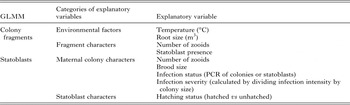
Relationships between infection state, features of hosts and parasites (Table 1) and environmental factors were assessed with GLMMs following methods in Zuur et al. (Reference Zuur, Ieno, Walker, Saveliev and Smith2009). The infection state variables were: (1) infection status of fragments or statoblasts (presence vs absence); (2) conditional on an infection being present in statoblasts, the intensity of infection and (3) conditional on a covert infection being present in fragments, infection severity. For infection status we used the package lme4 version 1.1–7 (Bates et al. Reference Bates, Maechler, Bolker and Walker2015) and assumed a binomial error distribution, whereas for infection intensity and severity we used the package nlme version 3.1–117 (Pinheiro et al. Reference Pinheiro, Bates, DebRoy, Sarkar and Team2016). GLMMs were also used to assess the effects of infection status and intensity on hatching status as well as colony fragment size on statoblast presence. Variability in numbers of fragments and statoblasts and in infection intensity and severity between rivers, roots, months and maternal colonies was investigated graphically. Random effects models were then built to find the optimal random structure using restricted maximum likelihood estimation (REML) and maximum likelihood estimation (ML) for infection intensity and status (presence/absence), respectively. Univariable analyses were used to explore the influence of each fixed explanatory variable (Table 1). Only those variables with P-values <0·25 were included in a maximal model using ML estimation following visual inspection of the data. Variables and interactions were then removed from the maximal model in a stepwise fashion by establishing whether their removal caused a significant change in the model's AIC value. Random intercept and slope models with intercept values of the significant fixed effects (i.e. the random effects included in the model are allowed to have differing intercepts and slopes in relation to the fixed effect) were compared with random intercept models and only retained if they led to a significant reduction in a model's log-likelihood. The results presented for infection intensity and severity (except likelihood ratio tests) were based on REML. If, for a particular analysis, random effects were not included (when they explained little variability), models were run with only fixed effects using a GLM with the appropriate error distribution. In this case, we then proceeded with the same approach as in GLMM to optimize the model so that only significant explanatory variables (P ⩽ 0·05) were retained.
Fixed explanatory variables according to different categories that were incorporated in mixed model statistical analyses (GLMMs) of colony fragments and statoblasts. See Materials and Methods for further explanation

Results from starvations experiments were examined by contingency table analysis to analyse the frequencies of colonies according to infection status (uninfected, covertly infected, overtly infected). Because sac development and release occurs rapidly (within 3 days; Canning and Okamura, Reference Canning and Okamura2003) and we did not know when sac development might commence, subsets of material were sampled every other day across all treatments. While low sample sizes within each sampling time preclude analysing temporal effects, our main aim, to examine overall evidence for overt infection development and transmission in response to starvation, is not compromised. A one-way analysis of variance (ANOVA) was used to test differences in mean chlorophyll-a concentrations per treatment.
RESULTS
Colony fragments
We collected a total of 717 bryozoan fragments (live colonies or dead but with statoblasts) from the three roots in each of the three rivers in early (n = 391) and late (n = 326) summer. Overall, 204 fragments were covertly infected, 204 were uninfected and six were overtly infected. A further 303 fragments were not overtly infected and were not screened by PCR. Infection status varied across roots, rivers and times (see Table 2). Dead or moribund fragments that contained no mature statoblasts were not included in analyses nor were dead or moribund fragments with statoblasts (n = 26). As expected, these were collected in larger numbers in September (see Table 2). Sequences of representative fragments showed 100% sequence similarity to T. bryosalmonae collected from the UK (KJ150280 from bryozoans and KF805631 from trout), confirming the identity of our material.
Summary data on the number of colony fragments that were collected from the Rivers Avon, Dun and Itchen in each of the two sampling periods. Data are the total number of fragments for each sampling period (and the number of fragments on Roots 1, 2 and 3) that were: alive but not producing statoblasts (− stats); alive and producing statoblasts (+ stats); dead with no statoblasts (− stats); dead with mature statoblasts (+ stats). The last three columns provide data for the number (and percentage) of covertly infected and uninfected fragments that were identified by PCR for Roots 1, 2 and 3, and the number (and percentage) of overtly infected fragments that were identified by dissection. See Materials and Methods for further details on sampling to determine infection status

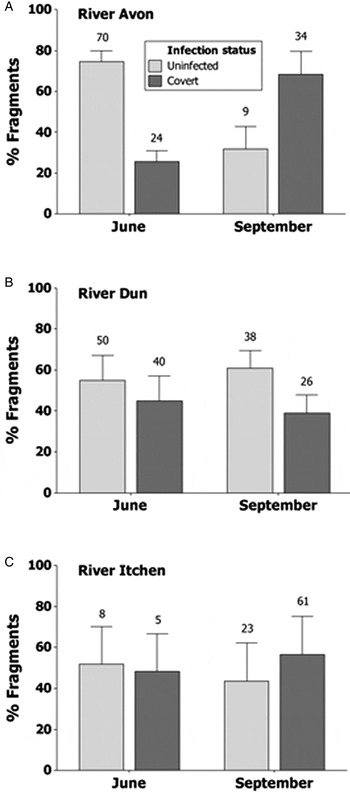
Covertly infected fragments were collected in all three rivers (see Fig. 1) with mean covert infection prevalences ranging from 25·6 to 68·4%. There was a significantly higher proportion of covertly infected fragments released in September than in June in the Rivers Avon and Itchen (25·6 and 68·4% in June and September in the River Avon; GLM assuming a binomial error distribution: regression coefficient = 2·400 ± 0·443 s.e., z = 5·414, d.f. = 4, P < 0·001) (48·3 and 56·5% in June and September in the River Itchen; regression coefficient = 1·445 ± 0·620 s.e., z = 2·330, d.f. = 3, P = 0·020). However, there was no significant difference in the proportion of covertly infected fragments in June (44·9%) and September (39·2%) in the River Dun (GLM assuming a binomial error distribution: regression coefficient = −0·156 ± 0·331 s.e., z = −0·472, d.f. = 4, P = 0·637). Overtly infected fragments were rare in all three rivers and on all sampling dates (prevalence range = 0–3·4%) and were not included in analyses.
The mean proportion (and n-values) of bryozoan fragments that were uninfected, and covertly infected (including colonies with and without statoblasts) across three roots in the Rivers Avon (a), Dun (b) and Itchen (c) in June and September. Bars are one standard error.

Roots sampled within rivers and sampling date nested within roots explained a large amount of variation in fragment infection status (e.g. see Table 2) and these factors were therefore included as random effects within GLMMs (as River/Root/Date) to assess the significance of fixed explanatory variables (Table 1). Only colony (fragment) size was found to be significantly associated with infection status (likelihood ratio test: χ 2 = 4·952, d.f. = 1, P = 0·026), with a unit increase in the number of zooids (i.e. one zooid) increasing the likelihood of infection by 1·040 times (odds ratio). The optimal model had a random intercept (i.e. we assumed the effect of colony size on infection status is the same for all dates per root, between roots and between rivers) and a non-random slope. Notably, statoblast production was not significantly associated with fragment infection status.
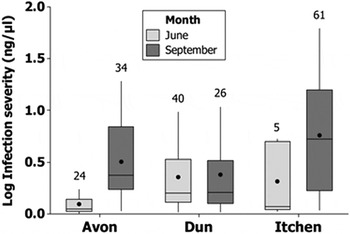
The log infection severity (i.e. infection intensity standardized for colony size) of covertly infected fragments was significantly higher in September than in June in the Rivers Avon (GLM assuming a Gaussian error distribution: regression coefficient = 2·453 ± 0·374 s.e., t = 6·555, d.f. = 56, P < 0·001) and Itchen (GLM assuming a Gaussian error distribution: regression coefficient = 1·9422 ± 0·856 s.e., t = 2·269, d.f. = 64, P = 0·027) but not in the River Dun (GLM assuming a Gaussian error distribution: regression coefficient = 0·016 ± 0·410 s.e.; t = 0·039, d.f. = 64, P = 0·969) (Fig. 2).
Boxplot and mean (black circles) covert infection severity of released bryozoan fragments in the Rivers Avon, Dun and Itchen at two time points (June and September). N values above bars are the numbers of covertly infected fragments.

Because rivers and months within rivers explained a large amount of the variation in infection severity, these factors were included as random effects in GLMMs (as River/Month) to assess the significance of fixed explanatory variables (Table 1). Only root size was significantly associated with infection severity (likelihood ratio test: D = 4·728, d.f. = 1, P = 0·030), with a unit increase in root size (i.e. 1 m3) decreasing infection severity by −0·419 (±0·187 s.e.). The optimal model had a random intercept (i.e. we assumed the effect of root size on infection severity is the same between sampling dates per river and between rivers) and a non-random slope. Statoblast production was not significantly associated with infection severity.
Statoblasts
Maternal colony identity substantially influenced variation in statoblast infection status (see Fig. S1) and was therefore specified as a random effect in the GLMM to assess the significance of fixed explanatory variables (Table 1). Only hatching status came close to our significance threshold (likelihood ratio test: χ 2 = 3·713, d.f. = 1, P = 0·054), with hatched statoblasts being 3·28 times (odds ratio) more likely to be infected than unhatched statoblasts, mirroring results based on frequency analyses (Abd-Elfattah et al. Reference Abd-Elfattah, Fontes, Kumar, Soliman, Hartikainen, Okamura and El-Matbouli2014). Removal of one outlying point causing a large amount of variation between maternal colonies (colony #199, with 70 statoblasts) strengthened the relationship between hatching and statoblast infection status (likelihood ratio test: χ 2 = 4·433, d.f. = 1, P = 0·035). In this case, hatched colonies were 3·65 times (odds ratio) more likely to be infected. Infection severity of the maternal material also had a significant effect on statoblast infection status (likelihood ratio test: χ 2 = 14·539, d.f. = 1, P < 0·001; when colony #199 was excluded), with a unit increase in infection severity of maternal material (i.e. 1 ng µL−1) increasing the likelihood of a statoblast being infected by 1·08 times (odds ratio). Optimal models had random intercepts (i.e. we assumed that both the effect of hatching status on statoblast infection status and that of infection severity of maternal colonies on statoblast infection status are the same for all maternal colonies) and a non-random slope.
There was no variation in infection intensity of statoblasts collected from the two rivers. Maternal colony identity explained most of the variation in statoblast infection intensity and was included as a random effect in GLMMs to assess the significance of fixed explanatory variables (Table 1). Simplification of the maximal model did not identify any of the further maternal colony characters as significant explanatory variables. Hatching status was not tested due to low sample size in the unhatched group (n = 3). However, the three unhatched statoblasts exhibited an average infection intensity of 1·9 ng µL−1 while that of the hatched group (n = 62) was 0·5 ng µL−1, suggesting a trend for reduced hatching success in statoblasts with heavier covert infections.
Maternal colony infection status had a significant effect on fecundity (GLM assuming a Gaussian error distribution: t = 2·206, d.f. = 70, P = 0·031), with the log number of statoblasts produced per zooid being 0·627 (± 0·284 s.e.) times higher in infected colonies than in uninfected colonies. The mean fecundity of infected material was 0·75 statoblasts/zooid (s.d. = 1·052, n = 63) and of uninfected material was 0·40 statoblasts/zooid (s.d. = 0·349, n = 12). When material from the outlying covertly infected ‘colony #199’ was excluded, infection still influenced fecundity with the mean fecundity of infected material = 0·63 statoblasts/zooid (s.d. = 0·530, n = 62) (GLM assuming a Gaussian error distribution: regression coefficient = 0·580 ± 0·266 s.e., t = 2·179, d.f. = 69, P = 0·033).
Response to host starvation
Measurements of chlorophyll-a concentrations indicated that food levels were reduced by dilution with mean measurements (and s.d.) being 2·16 (0·47), 2·24 (0·70), and 13·79 (3·52) μg L−1, in the dilution 1, dilution 2, and undiluted treatments, respectively (controls were 0·27 (0·06) μg L−1). Concentrations were not significantly different between the two dilution treatments (one-way ANOVA: d.f. = 1, F = 0·004, P = 0·949) and analyses were therefore conducted on pooled data. These results were supported independently by cell counts in a Sedgewick Rafter counting chamber (control = 0, dilution 1 = 0, dilution 2 = 301, undiluted = 802).
Some 40% of the colonies successfully attached to Petri dishes (n = 299 of 720). Similar proportions of infected colonies were assigned to the treatments (Table S1) (assessed a posteriori for all the colonies per treatment; 84·3 and 78·1% for undiluted and the pooled diluted treatments, respectively) (likelihood ratio test: D = 0·861, d.f. = 2, P = 0·354). Only two colonies died during the experiment, both in the diluted treatment (Table S1).
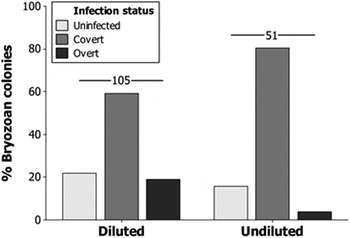
Both covert and overt infections were detected over the 11 days of the first experiment (Table S1). A total of 22 overt infections were observed and 20 of these were expressed in starved bryozoans. Accordingly, overt infection frequencies were dependent on treatment (χ 2 test using Yates correction: χ 2 = 4·070, d.f. = 1, P = 0·022; based on assumption of equal frequencies in diluted and undiluted treatments; see Fig. 3). Covert infection severity was unaffected by treatment (likelihood ratio test: D = 3·158, d.f. = 1, P = 0·123).
Proportions of colonies according to infection status (uninfected, covertly and overtly infected) sampled over all dates in the diluted and undiluted treatments in experiment 1.

The remaining 152 colonies from the 11-day experiment 1 were incorporated into the food dilution (n = 86 colonies) and undiluted (n = 66 colonies) treatments in the 14-day experiment 2 transplant (see Table S2). Colonies originally from the undiluted treatment in experiment 1 that were assigned to the undiluted treatment in experiment 2 increased significantly in size over the 14 days of the experiment (mean colony size in undiluted treatment on the last day of first experiment = 4·2 zooids, s.d. = 4·2, n = 10; mean colony size in undiluted treatment at end of the transplant experiment = 10·0 zooids, s.d. = 10·5, n = 14) (likelihood ratio test: D = 27·824, d.f. = 1, P < 0·0001). In contrast, colonies that were moved from the undiluted treatment in experiment 1 to the diluted condition in experiment 2 did not increase in size (mean colony size at the end of the experiment = 3·4, s.d. = 1·7, n = 25) (likelihood ratio test: D = 1·224, d.f. = 1, P = 0·269). In addition, colonies from starvation conditions in experiment 1 did not increase in size when maintained in the undiluted treatment of experiment 2 (mean colony size in starvation treatment on the last day of experiment 1 = 3·2 zooids, s.d. = 2·0, n = 19; mean colony size in the dilution treatment at end of experiment 2 = 3·9 zooids, s.d. = 2·7, n = 51) (likelihood ratio test: D = 2·039, d.f. = 1, P = 0·153). These results provide evidence that there was insufficient time for growth responses during the 11 days of experiment 1 and that food dilution substantially reduced growth.
Mortality was also dependent on treatment – more colonies originally from starvation conditions and subsequently maintained in the food dilution treatment died (8 dead in 60 colonies sampled) than when transplanted to the undiluted treatment (1 dead in 52 colonies sampled) (χ 2 test with Yates correction: χ 2 = 3·485, d.f. = 1, P = 0·031). Overt infections were only observed to develop in two of the 152 colonies examined during the transplant experiment, providing evidence that overt infections were largely expressed during the first 11 day study (developing in 22 of 156 colonies). Covert infections were routinely sampled throughout both experiments and characterized overall some 66% (103 of 156, discounting dead colonies) of colonies sampled during the first 11 day study and some 59% (85 of 143, discounting dead colonies) of colonies incorporated in the subsequent transplant study.
DISCUSSION
Infection over space and time
To the best of our knowledge, our study provides the first demonstration of substantial transmission of parasites as a result of fragmentation of colonial hosts over space and time. Thus, the mean proportions of covertly infected fragments collected across rivers and times ranged from 26% to nearly 75% and varied inconsistently amongst rivers, times and roots systems. Infection of fragments will result in the simultaneous dispersal of both the parasite and the susceptible host. Larger fragments were more likely to carry covert infections. However, because infections do not promote colony growth (Tops et al. Reference Tops, Hartikainen and Okamura2009) we suggest this reflects a higher probability of detecting infection when more parasite DNA is present. Larger fragments may also have proportionally more parasite DNA as a result of exposure to multiple infections and within-host parasite proliferation over a longer time period. However, we note that inferring age from fragment size is highly problematic because regression, partial colony mortality and fragmentation itself will leave behind small but relatively old portions of previously larger colonies. There is currently no method to estimate age from field collected colonies.
The substantial transmission of cryptic stages via covertly infected colony fragments (as shown here) and in statoblasts (as shown by Abd-Elfattah et al. Reference Abd-Elfattah, Fontes, Kumar, Soliman, Hartikainen, Okamura and El-Matbouli2014) should promote persistence of infections in bryozoans that propagate asexually over space and time. Such persistence enables continued exploitation of a genetic resource that has supported successful invasion and development. Amplification of infection achieved by transmission to colony fragments and statoblasts is likely to contribute to the high prevalences of covert infections in field populations (e.g. on some occasions >80% of F. sultana colonies; Fontes, Reference Fontes2015). Such amplification may increase the likelihood of periodic horizontal transmission to fish, with virulent overt infections developing when bryozoans are in good condition and can support the explosive production of numerous parasite sacs that cause gigantism of zooids (Hartikainen et al. Reference Hartikainen, Fontes and Okamura2013). T. bryosalmonae clearly, however, hedges its bets and undergoes developmental cycling. Thus, most colonies retain covert infections after release of spores for transmission to fish (e.g. 64%; Tops et al. Reference Tops, Hartikainen and Okamura2009). Accordingly, cycling between covert and overt infections is evident in F. sultana colonies maintained in laboratory microcosms (Tops et al. Reference Tops, Hartikainen and Okamura2009; Hartikainen, personal observation) and also in B. allmani infecting L. crystallinus (Hill and Okamura, Reference Hill and Okamura2007). Such cycling should further contribute to persistent infection.
Persistence as a bet-hedging strategy that increases survival via alternation of phenotype is likely to be common in clonal populations of parasites and pathogens, as well as free-living microbes. For example, Bacillus subtilis Cohn, 1872, achieves such persistence via a developmental switch that generates ‘bistability’ – the presence of two distinct subpopulations (Veening et al. Reference Veening, Smits and Kuipers2008). When nutrient sources diminish certain cells form highly resistant endospores. The population is then comprized of sporulating and vegetative, non-sporulating cells that utilize alternate secondary metabolites. The vegetative cells are poised for rapid growth given a new influx of nutrients while the sporulators are committed to spore formation. Host condition-dependent development of two phenotypes in T. bryosalmonae is rather similar. Mature sacs develop and release infectious spores when bryozoan hosts are well-nourished while infection is maintained by cryptic stages during suboptimal conditions. It is proposed in the case of bacteria that the simultaneous specialization of cells achieves optimal use of resources in the long run as a result of different reproductive potentials under unpredictably varying environments (Veening et al. Reference Veening, Smits and Kuipers2008). Populations of bacteria and myxozoans may thus have convergently adopted a form of bet-hedging based on a strategy of persistence and environmental variability in clonal populations. Other parasites and pathogens that persist as quiescent, asymptomatic or covert infections may be similarly convergent (e.g. viruses in insects; Bonsall et al. Reference Bonsall, Sait and Hails2005; Sorrell et al. Reference Sorrell, White, Pedersen, Hails and Boots2009, other invertebrate parasites and pathogens; Okamura, Reference Okamura2016, and the causative agent of malaria; Sutherland, Reference Sutherland2016).
Impacts on host
We found that infection generally promoted statoblast hatching – hatched statoblasts were >3 times more likely to be infected than unhatched statoblasts. Infections therefore increase the ‘effective fecundity’ of bryozoans, a term we prefer to ‘recruitment’ since the latter should be addressed through field studies. Covert infections were also associated with a nearly 2-fold increase in the fractional number of statoblasts produced per zooid. This latter result may reflect a further direct and positive effect of infection on fecundity. Alternatively, the result may reflect correlations of both infection and statoblast production with zooid age (older, mature zooids that undergo statoblast production are also more likely to be infected). This scenario is supported by a greater likelihood of statoblast production (GLM with binomial error distribution: estimate = 0·099 ± 0·026, z = 3·776, P < 0·001) and of infections in larger fragments. If the apparent increase in fecundity reflects correlations with age, it follows that covert infections exert little influence on the number of statoblasts produced per zooid. These outcomes contrast with those for overtly infected colonies that produce few, small and deformed statoblasts (Hartikainen et al. Reference Hartikainen, Fontes and Okamura2013) with poor hatching success (Hartikainen and Okamura, Reference Hartikainen and Okamura2012). We also found that greater covert infection severities in maternal colonies increased the likelihood of statoblast infection, suggesting that proliferation of cryptic stages increases the chance of the infection being incorporated into developing statoblasts. However, we also found poor hatching success for statoblasts harbouring high-intensity covert infections, a result most likely reflecting the combined demands of parasites and hosts on vitellogenic supplies. Overall these results suggest that levels of infection in maternal colonies and statoblasts will influence statoblast hatching, that there is a tipping point beyond which positive impacts of infection on hatching disappear but that, in general, transgressing this tipping point is avoided. As discussed later, these traits may promote host tolerance of infection.
Terminal investment
Spore production may not only be timed to coincide with periods of host vigour but might also be induced if hosts are highly stressed and resource quality is poor. In short, parasite fitness may be threatened if hosts are likely to disappear. We have addressed this issue and provide the first demonstration that bryozoan host starvation and impending death may provoke transmission. In particular we found that overt infections were expressed disproportionately in hosts subjected to low food levels. Notably, parasites were apparently able to detect and respond to cues associated with poor host condition and to produce overt infections before host development was itself evidently compromized (in the form of reduced growth and increased mortality). Such detection is in keeping with a strategy of terminal investment (Clutton-Brock, Reference Clutton-Brock1984). Thus, horizontal transmission at a time of high risk of host mortality may offer an escape route, contingent on encountering new hosts. Infection of fish in winter (Gay et al. Reference Gay, Okamura and de Kinkelin2001) may be explained by this response as colonies will be in poor condition at this time.
The lack of overt infection development in the majority of covertly infected colonies in our starvation study may be explained by variation in host condition or in the ability or propensity of parasites to respond accordingly. It seems unlikely that resistance to overt infection development can generally explain this result in view of the expense of mounting an immune response when subject to starvation. A more likely scenario is that there was simply insufficient energy to support the development of cryptic stages to sacs in most cases. This is supported by the nearly complete conversion of covert to overt infection observed when bryozoans were placed in highly productive laboratory mesocosm environments (Hartikainen and Okamura, Reference Hartikainen and Okamura2012). It is also possible that some hosts are inappropriate but are still infected. For example, arrested development of myxozoans has been demonstrated in certain strains of oligochaetes (Baxa et al. Reference Baxa, Kelley, Mukkatira, Beauchamp, Rasmussen and Hedrick2008) and this may, for example, explain the lack of overt infection development that was observed in a small number of covertly infected bryozoans maintained at high food levels (Hartikainen and Okamura, Reference Hartikainen and Okamura2012). This explanation is, however, also unlikely to broadly explain the results reported here. We note that the bryozoans generally appeared to habituate to the warm laboratory temperatures. Relatively few (12 out of 311 colonies sampled) died over the course of the two studies. Indeed, most mortality was associated with bryozoans experiencing consecutive low food treatments (n = 11) providing evidence for the success of our study design.
Host tolerance and resistance
It is increasingly appreciated that animal defences against infectious diseases can incorporate both resistance and tolerance (Råberg et al. Reference Råberg, Graham and Read2009). Tolerance as explicitly defined by evolutionary ecologists is the relationship between host fitness and parasite density, and its demonstration thus necessitates experimental designs akin to modelling reaction-norms across environmental gradients. These can be highly challenging because they require accommodating for variation in host and parasite genotypes and environment and in disentangling the joint control of outcomes (e.g. Little et al. Reference Little, Shuker, Colegrave, Day and Graham2010; Graham et al. Reference Graham, Shuker, Pollitt, Auld, Wilson and Little2011). The interactions of F. sultana with T. bryosalmonae are in keeping with tolerance. For example, despite high virulence (castration), F. sultana supports overt infections of T. bryosalmonae when in good condition and may limit (i.e. tolerate) the harm done because statoblast production is resumed during periods of covert infection. Intriguingly, we found that infected statoblasts actually experienced greater hatching success than uninfected statoblasts (except for those few with high infection intensities). Infection thus promotes a higher ‘effective fecundity’ and this may help to compensate for costs of infection. Such dynamics are possible because totipotent cells in colonial hosts enable the development of new zooids and propagules (statoblasts and larvae), thus restoring colony growth and fecundity. Potential drivers for tolerance could be: (1) the costs of mounting an effective immune response to overt infection, and (2) the benefits of infection on recruitment (statoblast hatching).
The possibility that F. sultana prevents overt infection development requires evaluation as this would imply resistance. Controlled laboratory studies demonstrate increased overt infection prevalences when bryozoan growth is enhanced at higher food levels (Hartikainen and Okamura, Reference Hartikainen and Okamura2012) and warmer temperatures (Tops et al. Reference Tops, Lockwood and Okamura2006, Reference Tops, Hartikainen and Okamura2009). Overt infections also peak in the field during periods of bryozoan growth (Tops, Reference Tops2004). A resistance scenario would thus imply that immune responses suppress overt infections during suboptimal or adverse conditions for bryozoans. We pose two arguments against this view. First, food-deprived hosts are often immunocompromized (Singer et al. Reference Singer, Mason and Smilanich2014). Second, our starvation study demonstrated increased development of overt infections in bryozoans deprived of food, thus providing evidence that at least some hosts experiencing adverse conditions are unable to suppress infection development (whether or not an immune response is elicited). Present data therefore provide little support for suppression of infection – instead they paint a picture of host tolerance facilitated by a colonial life history that can sustain waxing and waning infections as a result of the capacity for renewed colony growth and clonal replication in a seasonal environment.
Concluding remarks
Coloniality has evolved repeatedly across the Metazoa and a unique correlate of coloniality is the spread of clonal genotypes over space and time due to the proliferation of physiologically connected modules (zooids). Typically, the inherent capacity for unlimited growth leads to fragmentation of colonies as a result of breakage, partial predation and programmed colony fission. Many colonial invertebrates also achieve clonal spread by the production of asexual propagules. These processes contribute to further clonal spread and create complex demographic profiles for colonial invertebrates. Our study highlights how parasites take advantage of the distinct opportunities afforded by colonial hosts, achieving transmission via host fragmentation and infection of asexual propagules to enable persistent infection. However, they can also undergo terminal investment if hosts are highly stressed. Hosts may tolerate such exploitation because fecundity is effectively enhanced when they are moderately infected, thus compensating for the costs of infection. Notably, the strategies of parasite persistence and host tolerance inferred here are associated with a multiplicity of transmission pathways and host-dependent developmental cycling that depend on colonial attributes that afford and accommodate these processes. Our investigations further establish bryozoans and myxozoans as the model system for understanding the evolutionary ecology of colonial hosts and their endoparasites. Accordingly, we predict that host tolerance and parasite persistence will characterize many colonial host–parasite systems. Indeed such strategies may have provided the foundation required for the symbiotic associations evident in many sponges, corals, bryozoans and ascidians.
SUPPLEMENTARY MATERIAL
The supplementary material for this article can be found at https://doi.org/10.1017/S0031182017000269
ACKNOWLEDGEMENTS
The authors thank all field assistants and are grateful to Darren Butterworth (River Avon), Robert Starr (River Dun), Mrs Pearse and Winchester College (River Itchen) for access to collecting sites. They are also grateful to comments from reviewers that have helped them to improve their manuscript.
FINANCIAL SUPPORT
The work was funded by a NERC Open CASE Studentship (NE/019227/1). Additional funding for I.F. was provided by the Fundação para a Ciência e a Tecnologia (SFRH/BD/86118/2012) and Pescanova, S.A.