




No CrossRef data available.
Specialization and Regulation: The Rise of Professionals and the Emergence of Occupational Licensing Regulation
Published online by Cambridge University Press: 26 August 2005
Abstract
During the Progressive Era, advances in knowledge and specialization led to the emergence of modern-day professions. This growth in professions was accompanied by the adoption of occupational licensing regulation. In this article we explore the origins and effects of occupational licensing regulation during this period. Although most studies argue that occupational licensing regulation is adopted to restrict entry and reduce competition, the evidence from the Progressive Era suggests that regulation arose to improve markets as specialization and advances in knowledge made it increasingly difficult for consumers to judge the quality of professional services.
Not long ago, the Governor of a midwestern state was approached by representatives of a particular trade anxious to enlist the Governor's support in securing passage of legislation to license their trade.“Governor,” the men said, “passage of this licensing act will ensure that only qualified people will practice this occupation; it will eliminate charlatans, incompetents or frauds; and it will thereby protect the safety and welfare of the people of this state.”The governor, from long experience, was somewhat skeptical. “Gentlemen,” he asked, “are you concerned with advancing the health, safety and welfare of the people under the police powers of the state, or are you primarily interested in creating a monopoly situation to eliminate competition and raise prices?”The spokesman for the occupational group smiled and said, “Governor, we're interested in a little of each.”Council of State GovernmentsCouncil of State Governments, Occupational Licensin g, p. 1.
Information
- Type
- ARTICLES
- Information
- Copyright
- © 2005 The Economic History Association
The late nineteenth and the early twentieth centuries witnessed the birth of modern-day professions. Prior to the late 1800s only medicine, law, and theology were considered “learned professions.” The growth of modern day professions was fueled not only by a transformation of these older professions but also by a significant increase in new professional occupations such as teaching, engineering, dentistry, and accountancy to list a few. Between 1900 and 2000 the percentage of the labor force engaged in technical and professional occupations increased from 4 percent to over 20 percent.2
U.S. Department of Commerce, Statistical Abstract.
For many economists, occupational licensing regulation is primarily motivated by a profession's interest in “creating a monopoly situation to limit competition and raise prices.”3
Historically, licensing has also been a source of revenue for state governments.
Friedman and Kuznets, Income.
See Stigler, “Theory of Economic Regulation.”
This literature is vast. For a comprehensive overview see Olsen, “Regulation.”
However, there is an alternative explanation. The sale and purchase of professional services are often subject to problems of asymmetric information.7
Although there are numerous definitions of the term “professions,” most definitions seem to suggest that professions sell specialized services whose quality is difficult to verify ex ante by the buyer. According to the Merriam-Webster Dictionary a profession is “a calling requiring specialized knowledge and often long academic training.” See Merriam-Webster, Dictionary, p. 585. William Rothstein argues that a profession is “a manner of earning a livelihood through the application of a body of highly abstract knowledge in some set of institutions.” See Rothstein, American Physicians, p. 8. An even more detailed definition has been offered by Paul Starr, who writes: “A profession … is an occupation that regulates itself through systematic, required training and collegial discipline; that has a base in technical, specialized knowledge; and that has a service rather than a profit orientation enshrined in its code of ethics.” See Starr, Social Transformation, p. 15. In medicine, the concern about asymmetric information was explicitly incorporated into law. Judges in the United States ultimately classified medical malpractice suits as torts rather than contracts because they believed that a “meeting of minds” was not possible between a physician and a patient. Contracts between physicians and patients were not possible because the latter lacked the necessary knowledge to bargain equally. However, physicians could be sued under torts defined broadly as “private civil wrongs that violate certain duties or responsibilities.” See DeVille, Medical Malpractice, pp. 156–86.
See Akerlof, “Market for Lemons”; Arrow, “Uncertainty”; Leland, “Quacks and Lemons”; and Weingast, “Physicians.”
There also seems to be some ambiguity in the use of the word “capture.” Some scholars use the term “capture” to refer to the process of enacting legislation. In this usage, capture arises when producer groups influence government officials into drafting and passing new regulation. Both efficiency-improving and efficiency-retarding regulation may thus be the product of capture. In this article, we use the term to refer to outcomes. The “capture” thesis refers to regulations that are passed to acquire monopoly rents at the expense of efficiency whereas the “public interest” or “asymmetric information” thesis refers to regulations that are enacted to improve markets. This approach makes a clear distinction between regulation that benefits certain producers and reduces welfare and regulation that benefits certain producers but also improves efficiency.
Whereas the asymmetric information hypothesis argues that licensing should increase quality, the capture hypothesis argues that quality should remain unchanged, or may even deteriorate as competition is reduced. A handful of scholars have examined the relationship between licensing and proxies for professional quality using contemporary data. See, for instance, Carroll and Gaston, “Occupational Restrictions”; Feldman and Begun, “Welfare Cost”; Haas-Wilson, “Effect of Commercial Practice Restrictions”; and more recently, Angrist and Guryan, “Does Teacher Testing.”
We explore in this article the causes and consequences of state government occupational licensing regulation in the United States during the Progressive Era.11
The Progressive Era was accompanied by a rise in government regulation more generally and this article contributes to this larger literature. Fishback, “Operations of ‘Unfettered’ Labor Markets,” surveys the rise of government regulation in the nonprofessional labor market. The market failures (monopsony and labor immobility) that may have led to regulation of nonprofessional labor markets differ from the market failure (asymmetric information) that was most relevant in professional labor markets.
See Council of State Governments. Occupational Licensing, pp. 20–27.
We examine the factors that led to the adoption of licensing regulation and the effect of licensing on entry for eleven different occupations between 1880 and 1930.13
Occupations in our sample include architects, attorneys, barbers, beauticians, dentists, engineers, nurses, physicians, plumbers, teachers, and veterinarians.
At least for the Progressive Era, evidence we present seems to be more consistent with the asymmetric information hypothesis. The fact that licensing regulations were more likely to be adopted in states with significant urban populations is consistent with this perspective. In this period, as growth in scientific knowledge was accompanied by specialization and urbanization, individuals became less knowledgeable about the goods and services they purchased in the marketplace. Although firms were able to use advertising and brand-names and other devices to signal their commitment not to cheat, these devices worked imperfectly.14
Kim, “Markets and Multiunit Firms,” argues that multiunit firms arose in part as a market solution to the growing informational problems in the product market. As consumers became less knowledgeable about the quality of products they consumed, conditions were ripe for the lemons problem. Because multiunit firms were able to economize on advertising costs and because the costs of reneging were so much greater for multiunit rather than single-unit firms, multiunit firms were better able to solve the asymmetric information problem than single-unit firms. However, as noted by Law, “Origins of State Pure Food Regulation,” private solutions were not sufficient to completely solve the asymmetric information problem in certain markets because increases in the complexity of many products (for instance, foods) made it difficult for consumers to determine whether they had been cheated.
Sokoloff, “Inventive Activity”; and Lamoreaux and Sokoloff, “Inventive Activity.”
Indeed, licensing regulations seem to have been stricter for those occupations where informational asymmetries were most troubling to consumers. Consumers are more likely to be concerned with informational asymmetries when they purchase services directly from professionals and when the consequences of poor purchases are great. Consumers are less likely to be concerned with regulating professions such as engineers and nurses because they are mostly hired by firms rather than consumers.16
For example, the American Machinist wrote that a code of ethics was unnecessary for engineers as compared to doctors and lawyers because few engineers were independent consultants: “The employer [of the engineer] is the final judge of the manner in which his money shall be spent. He is usually more or less of an engineer himself, and frequently a competent one.” Quoted in Calvert, Mechanical Engineer, p. 267.
Although it is true that barbers have historically also played a public health role, at least with respect to haircuts, the costs of receiving poor service are low.
To delve more deeply into whether Progressive Era licensing regulation was introduced to reduce information asymmetries or to limit competition, we analyze the medical profession in greater detail. We collect detailed information on specific licensing regulations to examine what types of regulations were most effective in regulating entry. Because licensing regulations were rarely static, especially for physicians, it is important to determine what types of regulations had the most significant impact on entry. Indeed, we investigate not only how the evolution of licensing standards affected entry, but also whether licensing affected the earnings of physicians and the quality of physicians' services. In particular, we examine whether medical licensing lowered mortality rates and the incidence of medical malpractice suits or whether it merely restricted entry into the medical profession and raised physician incomes.
We find that those licensing regulations that had the most negative impact on entry were also those that were most likely to increase physician quality. A close analysis of the effects of specific state medical licensing requirements on the number of physicians per capita shows that the licensing regulations that most sharply reduced entry were those that increased the length of the medical degree and increased the length of premedical college education.18
Friedman and Kuznets, Income, pp. 8–30, report that acceptance rates at medical schools between 1926 and 1941 were near 60 percent and the passing rate for licensing was around 96 percent. For dental schools in 1941, the acceptance rate was over 83 percent whereas the licensing passing rate was a little over 80 percent. However, it would be erroneous to believe that medical schools rather than licensing regulation were responsible for restricting entry into medicine. It is more likely that medical schools, as compared to dental schools, internalized licensing restrictions into their admissions decisions and did not accept unqualified applicants in order to preserve their reputations. Most scholars believe that stricter licensing regulation was the binding constraint on the number of physicians admitted to the profession. See, for instance, Starr, Social Transformation, pp. 118–21.
Not all of the consequences of licensing were in the general interests of practicing physicians. If physicians were unified in their desire for licensing regulation, they were also unified in their opposition to the growth of medical malpractice suits during this period. Surprisingly, we find that licensing increased rather than reduced the incidence of state appellate malpractice suits. It appears that medical licensing regulations, by better defining the standards of local practice, made it easier for consumers to successfully sue physicians for poor outcomes.19
See De Ville, Medical Malpractice, for a general discussion of the rise of malpractice suits in the United States over the nineteenth century.
Although it is extremely difficult to rule out the importance of the industry-capture explanation for professional regulation, we urge scholars to pay greater attention to motivations based on asymmetric information. The desire to eliminate charlatans and quacks from a given profession is more than mere rhetoric for both the practitioner and the consumer. However, we are fully aware that if professionals are granted powers to limit entry into their own professions, then the potential for misusing the state for private gain is always present. Indeed, the fundamental dilemma of licensing regulation is that it can improve efficiency, or limit competition, or do “a little of each.”
THE GROWTH OF PROFESSIONS AND THE EMERGENCE OF LICENSING
Scientific knowledge expanded tremendously during the nineteenth and twentieth centuries. The scope and depth of human understanding about the physical, social, and biological world underwent a massive expansion during these centuries. Not only did the total stock of knowledge grow, but scientific knowledge became increasingly specialized. Over time, this new scientific knowledge found applications in occupations such as medicine, dentistry, architecture, and engineering.20
See Price, Little Science; Flexner, Medical Education; Ludmerer, Learning to Heal; and Society for the Promotion of Engineering Education, Report.
The consequences of this explosion of specialized knowledge were twofold. First, it became increasingly difficult to be a successful generalist. Within particular fields, specialists emerged who possessed a deeper knowledge of a more specific subject area. Second, the benefits of longer periods of formal education increased as many occupations became increasingly technical. Universities, colleges, and other institutions of higher learning emerged to educate individuals who wanted to acquire the knowledge and skills to work in occupations where the growth of relevant knowledge was greatest.
Advances in knowledge made it increasingly difficult for consumers to judge the quality of professional services. In fields such as medicine and dentistry, for instance, technical advances made it harder for consumers to know if they were getting the right treatment.21
In medicine, for instance, the development of tools such as the microscope, ophthalmoscope, and laryngoscope made it possible for physicians to “see things” that ordinary consumers could not. Without the ability to independently verify and understand what physicians were doing, it was harder for patients to evaluate the quality of the diagnosis.
See Rothstein, America Physicians.
These changes in the market for professional services were accompanied by a sudden surge in state government occupational licensing regulation.23
Occupational licensing in America did not begin in the late 1800s. During the colonial period and into the early nineteenth century, state governments regulated the practice of law and medicine in various ways. Nevertheless, occupational licensing on a wide scale did not begin until the late nineteenth century. In the latter half of the 1800s and continuing through the first half of the 1900s, state governments throughout America enacted legislation that regulated a wide variety of occupations. This second wave of licensing regulation differed from colonial licensing laws in several ways. First, it applied to a wider variety of occupations than medicine and law; the licensing statutes enacted in the late 1800s and early 1900s included occupations ranging from barbers and beauticians to architects, engineers, and dentists. Second, the requirements that were established by these regulations were generally stricter than those that were in place during the colonial era. Although colonial era licensing laws generally did not preclude unlicensed individuals from practicing law or medicine, in the late nineteenth and early twentieth centuries, a license was usually a prerequisite to practice a given occupation. Third, the enforcement of these more recent regulations was more vigilant than in the colonial era. Indeed, enforcement of these laws was generally placed in the hands of independent or state licensing boards, whose members were largely drawn from the occupational group being licensed. See Council of State Governments, Occupational Licensing, pp. 13–19.

WHY DID LICENSING ARISE? AN EMPIRICAL ANALYSIS
Why did occupational licensing arise in turn-of-the-century America? Several studies have examined the effects of licensing on entry and on the incomes of certain professionals (such as physicians, dentists, and nurses) using more contemporary data but to our knowledge no scholarship has analyzed the factors that led to the adoption of initial licensing legislation in the late nineteenth and early twentieth centuries, or the effects of these early licensing laws on entry into a wide variety of occupations. Hence, in this section, we exploit cross-state variation in the timing of licensing legislation for 11 different occupations in order to investigate the factors that influenced the adoption of initial licensing legislation and the impact of licensing on the number of workers per capita in a given occupation.24
We would also have liked to examine the effect of early licensing laws on the incomes of these 11 occupations. Unfortunately, prior to the 1940s the Census of Population did not include information on wages or incomes. In our case-study section, we use the earliest available data on professional incomes to test whether stricter medical licensing laws increased physician incomes in the late 1920s and early 1930s.
The primary source for our data on licensing is the Council of State Governments study, which reports information on when each state adopted licensing legislation for several different occupations.25
See Council of State Governments, Occupational Licensing. For physicians, we use information contained in Baker, “Physician Licensure Laws,” on the state medical licensing statutes.
See Edwards, Comparative Occupation Statistics.
Event History Analysis of the Adoption of Licensing Laws
To determine what factors motivated state governments to enact licensing regulation, we conduct an event history analysis. In particular, we estimate hazard regressions of the adoption of licensing legislation. Hazard models are appropriate for this purpose because they allow us to exploit the longitudinal structure of our data set. Within the class of hazard models, we use the logistic discrete time hazard model. This is a sensible choice because the adoption of licensing legislation was a single, nonrepeated event and because our observations are separated by ten-year intervals along the temporal dimension.27
See Allison, Event History Analysis.
The basic regression equation we estimate takes the following form

Prt is the probability that occupational licensing legislation for a given occupation is adopted by year t; Lit/Pit is the per capita number of individuals working in a given occupation in state i in year t; Uit is the urbanization rate in state i in year t; and εit is an error term. The per capita population of individuals working in a given occupation is included to proxy for producer interests. We also include the square of the per capita population of workers in a given occupation to allow for nonlinearity in the effect of occupational group size. Although increases in the per capita size of the occupational group may lower the time until licensing is adopted (i.e., increase the licensure hazard), the effect of group size may eventually become negative because free riding or coordination problems among members of the group reduces its political effectiveness.
The urbanization rate is included because it controls for other factors that may have contributed to the rise of licensing.28
The urbanization rate is defined as the population in incorporated places with 2,500 or more divided by state population.
Government officials were also aware that specialization and urbanization contributed to problems of asymmetric information. For instance, the Council of State Governments, Occupational Licensing, p. 3, made the following argument in favor of licensing regulation: “First, in modern urban society, where great multitudes of people live under increasingly crowded conditions, government agencies become responsible for ensuring adequate knowledge and competence among those ministering to the public health and well-being. This can only be accomplished by defining the conditions of admission and retention into the occupations. Second, the intense specialization in all fields that is characteristics of complex society often means that the public may fail to distinguish between competent and incompetent, honorable and dishonorable practitioners. State occupational licensing agencies therefore perform vital functions in protecting the people from fraud and dishonesty.”
We estimated this equation separately for each of the 11 occupations, and pooled across all 11 occupations. In the pooled regression, the effects of occupational size per capita and its square are constrained to be the same across occupations but each occupation has its own fixed effect. The occupational fixed effect indicates whether a given occupation is more likely to be regulated sooner or later relative to the average time of adoption across all occupations, other things held constant.
Table 2 presents the coefficient estimates when the regression equation was estimated separately for each of the 11 occupations. For architects, attorneys, physicians, and veterinarians, urbanization had a positive and statistically significant effect on the licensure hazard, indicating that more urban states were more likely to enact licensing legislation for these occupations sooner. For the other occupations, the coefficient on urbanization is not statistically significant. The per capita number of workers in an occupation had a positive and statistically significant effect on the licensure hazard for barbers, beauticians, dentists, engineers, nurses, physicians, plumbers, and veterinarians. Hence, for these occupations, greater producer representation increased the probability that licensing would be adopted sooner.

Table 3 presents the coefficient estimates from the pooled regression. The coefficients on workers per capita, workers per capita squared and urbanization all have the predicted signs and are statistically significant. Additionally the occupational fixed effects indicate that there were occupational-specific differences in the timing of licensing. Barbers are the omitted category and hence the fixed effects should be interpreted as the occupational-specific effect on the timing of licensure relative to barbers. The coefficients indicate that occupations such as architects, attorneys, dentists, nurses, physicians, and veterinarians were regulated earlier than barbers whereas plumbers and teachers were regulated later.

The regression results suggest that for most occupations, producer interests were an important factor influencing the timing of licensure, and that for certain professions, urbanization also affected the timing of licensure. Because producer groups were generally the main proponents of licensing, the statistical significance of producer interests in most of the hazard regressions is not altogether surprising: producer interests probably stood to gain most from licensing, either because they perceived it would function as an entry barrier or because of its potential to reduce informational asymmetries and help make a market for their services. That urbanization also had a positive and significant effect on the licensure hazard for some professions (architects, attorneys, physicians, and veterinarians) is also potentially consistent with both hypotheses.30
One potential problem with the urbanization variable is that it might be correlated with political activity among professionals. If the per capita number of workers is correlated with urbanization, then collinearity between urbanization and the per capita number of workers may explain why urbanization is not significant in some of the regressions. To check for this, we reestimated the regression equations for those occupations where urbanization was not significant excluding the number of workers per capita and its square and we still found that urbanization was not significant. Hence, the failure of urbanization to be significant in these regressions is unlikely to be a consequence of collinearity among the independent variables.
Effect of Licensure on Entry
In this section we conduct an empirical investigation of the effect of early state occupational licensing laws on entry into these eleven occupations. The basic fixed effect regression equation we estimate is as follows

Pit denotes the population of state i in year t; Lit denotes the number of workers in a particular occupation in state i in year t; Si denotes a fixed-effect for state i; Yt denotes a fixed-effect for year t; Rit denotes a binary variable that is equal to one in all years t in which occupational licensing is in place in state i and zero otherwise; and Xit denotes a vector of time-varying control variables for state i in year t. The two time-varying state-level control variables we include are the urbanization rate; and real income per capita.
31Data on real income per capita at the state level are taken from Kuznets and Brady, Population Redistribution. Values for 1890 and 1910 were imputed.
We also examine the effect of occupational licensing on entry by estimating a “dynamic” version of equation 1 which takes the following form

In regression equation 2, the dependent variable is %ΔLit, which is the growth rate between adjacent census years (approximated by the first difference in the natural logarithm) in the number of individuals working in a given occupation. As before,α is the coefficient of interest. If α < 0, then occupational licensing regulation reduced the growth rate of the number of persons in a given occupation (i.e., reduced the rate of entry). On the other hand, if α ≥ 0, then occupational licensing had no impact or increased the growth rate of the number of persons working in a given occupation (i.e., did not affect or increased entry).
Our analysis from the previous section suggests that there is potentially an endogeneity problem with respect to Rit, the regulation binary variable, and our dependent variables. The hazard regressions indicated that an increase in the per capita number of workers in a given occupation increased the likelihood that occupational licensing regulation would be enacted. As a result, a positive correlation exists between the regulation binary variable and the error term in equations 1 and 2, which implies that ordinary least squares estimates of the coefficient on the regulation binary variable will be biased.32
To some degree the fixed effect framework should deal with the problem of correlation between the regulation indicator variable and the error term. If the state fixed effects are capturing unmeasured correlations between the regulation variable and the error, then the coefficient on the regulation binary variable should be “less positive” when fixed effects are included. We estimated both equations 1 and 2 with and without fixed effects and found that for most occupations, the coefficient on the regulation dummy variable was significantly smaller with state fixed effects than without them. Hence, we believe that the fixed effect framework goes some way in dealing with this problem.
Because we have information on the licensing of eleven occupations, our index variable takes on values from zero to ten.
For instance, to instrument for whether physicians were regulated in 1910 in Alabama we construct an index variable that is equal to the total number of other occupations (excluding physicians) licensed by Alabama in 1910. This index variable should be correlated with the probability that physicians were licensed in Alabama in 1910, but not with the per capita number of physicians or the growth rate of physicians in Alabama.
Table 4 presents ordinary least squares (OLS) and two stage least squares (2SLS) regression estimates of the effects of licensing regulation on the number of workers per 1,000 persons for each occupation. In none of the regressions is the coefficient on the regulation binary variable negative and significant; early licensing laws do not appear to have reduced the per capita number of workers in any of these occupations, regardless of whether we estimate these regressions by OLS or by 2SLS. For beauticians the coefficient on the regulation dummy is positive and significant in both the 2SLS and OLS regressions suggesting that regulation increased entry into this occupation. In the 2SLS regressions, we find that the coefficient on the regulation variable is negative but not significant for architects, dentists, nurses, physicians, plumbers, and teachers, and positive but not significant for attorneys, barbers, engineers, and veterinarians. The first stage regression results give us confidence that our instrument for licensing performs well; the coefficient on the licensing instrument is positive and significant in nearly all of the first-stage regressions. Finally, the control variables in each of the regression equations generally have plausible signs. For many occupations, urbanization and real per capita income are positively correlated with the number of workers per 1,000.

However, because the enactment of licensing regulation is more likely to have an impact on the rate of entry over time, the dynamic version of the entry restriction regression model is likely to be more informative. Table 5 reports the OLS and 2SLS regression estimates of equation 2 for each occupation. Although the OLS estimates suggest that regulation only had a negative and significant effect on the growth rate in the number of architects and veterinarians, the 2SLS estimates suggest that regulation also had a negative and significant effect on the growth rate of physicians and dentists. For beauticians, the coefficient on the regulation variable is positive and significant, but for the remaining occupations, the coefficient on the regulation variable is insignificant. Hence, whereas regulation may have functioned as an entry barrier for architects, dentists, physicians, and veterinarians, it did not function in this way for the rest of the occupations in our sample. As before, the coefficient on the licensing instrument is positive and significant in most of the first-stage regressions.

The regression results therefore suggest that the occupational licensing laws enacted in turn-of-the-century America were negatively correlated with entry for a handful of occupations. For most occupations, licensing did not reduce entry, perhaps because the standards set by most early licensing statutes were not very strict, or because enforcement of early licensing laws was weak. However, it is interesting to note that licensing had a negative effect on entry on physicians, dentists, and veterinarians—professions whose services tended to be purchased directly by consumers, for which the costs associated with low quality service were potentially greatest, and where advances in technique gave rise to greater heterogeneity in professional quality—and that licensing did not have a negative effect on entry for engineers and teachers, whose services were generally purchased by firms, or barbers and beauticians, for which the costs of obtaining low quality service were not substantial.35
From this perspective, architects are an outlier, as their services tend to be purchased by firms, rather than individuals and we do find that licensing reduced entry into architecture.
CASE STUDY OF THE MEDICAL PROFESSION
We focus on the medical profession for several reasons. First, licensing regulations were not static for physicians and it is important to determine which types of regulations were most effective for limiting entry. Second, the availability of data on physician incomes allows us to investigate whether state licensing led to higher incomes. Third, data on health outcomes (i.e., disease-specific mortality rates) can be used to provide a sharper test of whether licensing increased physician quality. Fourth, it is interesting to examine whether medical licensing regulation affected the incidence of medical malpractice suits. Finally, because the medical profession was (and continues to be) more strictly regulated than other professions, it is important to determine whether medical licensing improved quality of physician services or merely restricted entry and reduced competition.
Our data on the nature of medical licensing legislation from 1870 to 1930 is taken from Baker and from the American Medical Association's (AMA) Council on Medical Education.36
See Baker, “Physician Licensure Laws”; and Council on Medical Education, “Medical Education in the United States.”
Our basic empirical strategy is simple. As before, we match our information on licensing with data on the outcomes that are of interest to us (per capita number of physicians, physicians' incomes, disease specific-mortality rates, and the incidence of malpractice suits) and we exploit cross-state variation in licensing to estimate the effect of medical licensing laws on these outcomes. Because our outcome measures are not always available for every state or for the full sample period (1880-1930), sample sizes do vary across regressions. Nevertheless, we believe that the data are rich enough to furnish a nuanced picture of the effects of medical licensing laws.
Effects of Medical Licensing Laws on Entry
Table 6 presents OLS regression estimates of the effects of particular medical licensing requirements on the number of physicians per 1,000 persons from 1880 to 1930. OLS estimates of the effect of licensing on entry are likely to be biased against finding a negative effect, because states with more practitioners per capita were also more likely to enact regulation. Hence, our regression estimates of the effect of specific licensing requirements on reducing entry into medicine will understate the true effect. In the first column we control for licensing by including a binary variable for each of the seven medical licensing requirements. In the second column we construct two separate indices to measure early licensing and later licensing requirements separately. Early licensing requirements were the initial licensing law and the introduction of a state board. These requirements were generally introduced prior to 1900. To index for these early requirements we summed the binary variables that indicate whether a state had an initial law and whether the state had a licensing board. Later licensing requirements were those introduced after 1900 (licensing exam, four year medical school requirement, two year premedical college requirement, internship requirement, and the science requirement). The index for these later requirements is a sum of the binary variables that indicate whether the state had introduced these requirements by a given year. Finally, in column 3, we construct a composite licensing index to measure the overall strictness of a state's medical licensing laws. This index is simply the sum of each of the individual binary variables. Because there are seven requirements, this index takes on values between 0 and 7. As before, we also control for the real per capita income in each state and the urbanization rate in each state to account for other factors that might have influenced the number of physicians per capita.

When we control for each licensing requirement separately (column 1), we find that the introduction of a two-year premedical college requirement and the four-year medical school requirement had a negative and statistically significant impact on the number of physicians per 1,000 persons. Thus, the licensing requirements that restricted entry were those that were most likely to improve physician quality. When we index separately for early and later medical licensing requirements, (column 2) we find that earlier requirements had a positive and significant effect on the number of physicians per 1,000, whereas later requirements had a negative and significant impact. Hence, it seems that those licensing requirements that were introduced in the post-1900 period were those that were most negatively correlated with entry.37
Superficially, this would appear to be inconsistent with our analysis in the previous section, which found that initial state licensing regulation reduced entry into medicine. We believe that this is a consequence of the fact that the stricter licensing standards were correlated over time with initial legislation.
Effects of Medical Licensing Laws on Physician Incomes
Perhaps the most highly cited evidence supporting the industry capture explanation for professional licensing comes from the classic study by Milton Friedman and Simon Kuznets.38
Friedman and Kuznets, Income.
The data on physician and dental incomes are taken from a U.S. Senate Report.39
U.S. Senate, “National Income.”
An examination of the effects of licensing on the ratio of physician to dentist incomes is potentially problematic if dental licensing varied significantly across states. The available evidence suggests that dental licensing requirements were fairly similar across states at this time. See Fraundorf, “Organized Dentistry.”
We restricted our attention to 1929 because licensing requirements did not change significantly during these few years. Qualitatively similar results were obtained when we examined 1930, 1931, and 1932 individually.
Urbanization and real per capita personal income are somewhat collinear. Qualitatively similar coefficient estimates were obtained when we control for only urbanization but not real per capita income (and vice versa).
Table 7 displays OLS regression estimates of the impact of medical licensing regulation on the natural logarithm of average physician incomes and the ratio of physician to dentist incomes.43
OLS estimates are likely to underestimate the true effect of licensing on doctors' incomes because doctors from states where physician earnings were low likely faced the strongest incentive to lobby for regulation in order to restrict entry and raise their incomes. Accordingly, these estimates should be interpreted as a lower bound of the actual effect. Qualitatively similar results were obtained when we used the licensing instrument developed in the empirical analysis section to instrument for the strictness of medical licensing. This suggests that the OLS bias is small.

Effects of Medical Licensing on State-Level Mortality Rates
In this section we analyze the correlation between licensing and quality by investigating the relationship between physician licensing and mortality.44
A large and growing body of scholarship has been devoted to analyzing the determinants of mortality in America during the twentieth century. In general, little attention has been paid to the role that medical licensing and improvements in physician quality may have played in reducing mortality rates. See Fogel, “Economic Growth”; Costa and Steckel, “Long Term Trends”; Cutler and Meara, “Changes”; and Cutler and Miller “Role of Public Health Improvements.”
See U.S. Bureau of the Census, Mortality Statistics.
Because estimates of impact of medical licensing regulation on mortality rates may be subject to an endogeneity problem, we take the following empirical strategy.46
One might imagine that states that were more likely to enact stricter medical licensing requirements were also those states that were more “health conscious.” “Health conscious” states may have differed from other states not only in terms of their willingness to adopt stricter medical licensing regulations, but also in terms of their level of public health or nutrition. Presumably, the residents of “health conscious” states enjoyed above-average nutrition and were also more willing to invest in public health infrastructure. Hence, mortality may therefore tend to be lower in “health conscious” states, not because stricter licensing improved physician quality, but rather, because investments in public health and better nutrition altered the disease environment in these states or the ability of individuals in these states to fight disease. Without controlling for these other factors, OLS will be biased toward showing that licensing improved health outcomes.
Even after controlling for these factors, OLS estimates may still be biased, but in the opposite direction. One might argue that states with worse health outcomes were more likely to enact licensing if they believed that licensing would improve health outcomes. In this case, OLS will be biased toward showing that licensing did not improve health outcome. Any finding that licensing improved health outcomes would therefore be robust.
We collected data on six different mortality rates: the overall mortality rate, cancer mortality rate, diabetes mortality rate, infant mortality rate, maternal mortality rate, and appendicitis mortality rate. To measure the strictness of medical licensing in each state, we used our composite medical licensing index. Table 8 presents OLS regression estimates of the determinants of these six mortality rates. In each regression we control for the urbanization rate in each state, real income per capita, the strictness of medical licensing regulation, state fixed effects, year fixed effects, and the number of physicians per 1,000 persons.48
We include the number of physicians per 1,000 persons to control for variation in physician access. Year fixed effects were included to control for overall improvements in the treatment of certain diseases that may have been unrelated to licensing. Using a time trend as opposed to year fixed effect to control for overall improvements in medical treatment does not materially affect our results.

The coefficient estimates of the effects of licensing on mortality suggest that licensing, by increasing the quality of physicians, lowered mortality rates due to those illnesses where physician quality is likely to have mattered during this period. Although stricter medical licensing did not have a significant impact on overall mortality rates, cancer mortality rates, diabetes mortality rates, or infant mortality rates, it appears to have significantly reduced rates of maternal mortality and appendicitis mortality.49
Qualitatively similar results were obtained when we used the lagged value of the composite licensing index to control for physician quality and when we instrumented for medical licensing using the occupational licensing instrument developed in the empirical analysis section.
Collins and Thomasson, “Declining Contribution,” examine whether the racial gap in infant mortality rates from 1920 to 1970 at the state level can be explained by differences in income, urbanization, women's education, and physicians per capita.
The coefficients on the remaining control variables are worth discussing briefly. Although the urbanization variable is generally not significant, it appears that the lack of significance of urbanization is due to the inclusion of state fixed effects. When we omit the fixed effects in the regressions, the urbanization coefficient generally becomes significant with the correct sign and the signs and significance levels of the other variables remain unchanged. The absence of a significant correlation between cancer and real income also seems reasonable. The positive and significant correlation between real per capita income and diabetes and appendicitis mortality is somewhat puzzling, but the size of these coefficients is small.
The coefficient on physicians per 1,000 persons, which proxies for physician access, is positive but not significant in the overall mortality rate regression; negative but not significant in the cancer, diabetes, infant, and maternal mortality rate regressions; and negative and significant in the appendicitis mortality rate regressions. Although access to a physician may not have been important for overall mortality or cancer mortality (because physicians were powerless to treat most illnesses, especially cancer, at this time), it may have been important for appendicitis mortality as surgery requires access to a physician. Finally, access to physicians may not have been critical for infant or maternal mortality rates because of the availability of midwives as a substitute, although it is worth noting that physician quality (as proxied by the composite licensing index) did matter for maternal mortality.
Effects of Medical Licensing Regulation on State-Level Appellate Court Malpractice Suits
In this section, we examine the relationship between state medical licensing requirements and the incidence of medical malpractice suits. In principle, if licensing requirements increased physician quality, then one might expect to observe a reduction in the number of malpractice suits in response to medical licensing legislation. However, the frequency of medical malpractice suits seems to have increased dramatically over the Progressive Era. According to Kenneth De Ville, the growth in malpractice suits during this period was caused by competition among physicians of different sects as well as dramatic advances in medical technology.51
DeVille, Medical Malpractice.
Our data on malpractice cases are taken from Hubert Smith, who reports the number of appeals court cases on medical malpractice over each decade and in each state from 1790 to 1940.52
Smith, “Legal Responsibility.”
Because we expect that the number of malpractice cases should be greater in more populous states, we normalize Smith's data by state population (in millions) to obtain our dependent variable. Because Smith reports the number of appellate court malpractice cases filed over a decade, our dependent variable is the cumulative number of appellate court cases in a given state over the decade per million persons in a given state at the beginning of the decade. As control variables, we include state fixed effects, the number of physicians per 1,000 persons, the urbanization rate, real per capita income, and medical licensing variables. Our time varying control variables (physicians per 1,000, urbanization, real per capita income, and medical licensing) are matched with the dependent variable so they control for conditions as they existed at the beginning of the decade. We also include a time trend to sweep out factors that may have contributed to an overall rise in litigation during this period.
Fixed effect OLS regression estimates of the determinants of medical malpractice are displayed in Table 9. In column 1, we use separate binary variables to control for each of our seven medical licensing requirements. Surprisingly, the data indicate that the four year medical degree requirement significantly increased the incidence of medical malpractice suits. In columns 2, 3, and 4 we group the medical licensing requirements in different ways and continue to find a positive and significant relationship between medical licensing and the frequency of medical malpractice suits.53
In order to determine whether the lack of significance of some of these medical licensing requirements was due to collinearity among these binary variables, we grouped together the requirements in various ways. In column 2 we control for the presence the four-year medical degree requirement, but we group the initial licensing law and state board together, and the exam, college, internship, and science requirements together. In this regression, the four-year medical school requirement continues to be significant but the other requirements are not. In column 3 we group licensing requirements into two categories: early requirements (initial law and the presence of a state board) and later requirements (the remaining five requirements). We find that later requirements had a positive and significant effect on the incidence of malpractice suits, but early requirements did not. Finally, in column 4, we combine all of these medical licensing requirements into a composite licensing index to measure the overall strictness of licensing regulations and find that increases in the index increased the incidence of malpractice suits. In each regression the Durbin-Watson statistic is close to two, which indicates that serial correlation in the residuals is unlikely to be problematic.
The positive correlation we observe between licensing and the incidence of medical malpractice suits may be biased if stricter licensing laws were adopted in response to increases in the frequency of medical malpractice suits. To test for this source of endogeneity, we estimated a regression of the composite licensing index in a given state in year t +10 on the number of malpractice cases per million over the decade between t and t +10 and the other control variables discussed earlier. In this regression, the coefficient on the number of malpractice cases per decade per million persons was negative but not significantly different from zero, which suggests that stricter licensing requirements were not enacted in response to malpractice cases. Qualitatively similar results were obtained when other measures of licensing were used in place of the composite licensing index as the dependent variable. Hence, we believe we can rule out this source of endogeneity bias.

We believe that there is a plausible explanation why licensing may have increased the incidence of medical malpractice suits. Throughout the Progressive Era, as well as for most of the modern period, the courts ruled on medical malpractice suits based on standards of care available in a given locality.55
DeVille, Medical Malpractice.
Smith, “Legal Responsibility.”
CONCLUSION
The Progressive Era marked the transformation of the United States from a traditional to a modern society. During this period, with advances in science and knowledge based on ever increasing specialization, modern professionals emerged in numerous occupations. In addition, the spatial organization of everyday life changed radically as peopled moved away from rural villages and small towns to large urban areas where market exchanges became more impersonal and anonymous. The expansion of knowledge, specialization, and urbanization were accompanied by a more expansive role of government in the economy. In this article, we examine why state governments began to regulate the professional labor market at this time.
The evidence presented suggests that the emergence of professional licensing regulation during the Progressive Era was motivated by a desire to improve the market for professional services. During this period, advances in knowledge and increased specialization gave rise to asymmetric information problems in the market for professional services, especially in urban areas. But, because private mechanisms alone could not eliminate all unqualified practitioners from the market, it was necessary for state governments to enact regulations that set standards of qualification to practice these occupations. Our analysis finds that licensing legislations were adopted earlier and were more likely to restrict entry into professions where informational asymmetries were most likely to be problematic. In addition, a detailed study of the effects of medical licensing shows that the specific licensing regulations that restricted entry most effectively were those that were likely to increase physician quality. Accordingly, we also find that stricter licensing also lowered mortality rates from diseases where physician quality may have mattered.
When the Council of State Governments met in 1951 to request a survey of the professional and occupational licensing practices of states, it was aware that state licensing powers could be used not only as an instrument to “protect the safety and welfare” of consumers, but also as a device to create “monopoly conditions.” However, when the survey was reported in 1952, the council reached no definitive conclusions regarding which of these forces was more important. Although we believe that the evidence from the Progressive Era is more consistent with a public interest explanation for licensing regulation than one based on industry capture, we, like the skeptical Midwestern governor quoted in our introduction, cannot dismiss the fact that licensing regulations also “lay the foundation for creating monopolies that inhibit market competition.” We hope that future scholars will take up the task to determine if and when licensing regulations became a tool to advance the narrow interests of professionals at the expense of the general public.
For helpful comments and suggestions on earlier drafts of this article, we are grateful to Lee Benham, Zeynep Hansen, Mindy Marks, as well as seminar participants at Harvard University, Washington University, the 2004 Western Economics Association Annual Meeting, and the 2003 Canadian Network for Economic History Conference. This article was also greatly improved by comments from Jeremy Atack and two anonymous referees. All errors are of course our own.
References
Akerlof George.
1970
“The Market for ‘Lemons’: Quality Uncertainty and the Market Mechanism.”
Quarterly Journal of Economics
84,
no. 3
488–
500.Google Scholar
Allison Paul D.
1984.
Event History Analysis: Regression for Longitudinal Event Data,
Beverly Hills, CA:
Sage Publications,
Angrist Joshua, and
Jonathan Guryan.
March 2003.
“Does Teacher Testing Raise Teacher Quality? Evidence from State Certification Requirements.”
NBER Working Paper No. 9545,
Cambridge, MA,
Arrow Kenneth J.
1963
“Uncertainty and the Welfare Economics of Medical Care.”
American Economic Review
53,
no. 5
941–
73.Google Scholar
Baker Samuel L.
1984
“Physician Licensure Laws in the United States, 1865–1915.”
Journal of the History of Medicine and Allied Sciences
39,
no. 2
173–
97.Google Scholar
Calvert Monte A.
1967.
The Mechanical Engineer in America, 1830–1910: Professional Cultures in Conflict,
Baltimore:
Johns Hopkins University Press,
Carroll Sidney L., and
Robert J. Gaston.
1981
“Occupational Restrictions and the Quality of Service Received: Some Evidence.”
Southern Economic Journal
48,
no. 4
959–
75.Google Scholar
Collins William J., and
Melissa A. Thomasson.
2004
“The Declining Contribution of Socioeconomic Disparities to the Racial Gap in Infant Mortality Rates.”
Southern Economic Journal
70,
no. 4
746–
76.Google Scholar
Costa Dora L., and
Richard H. Steckel.
1997.
“Long-Term Trends in Health, Welfare, and Economic Growth in the United States.”
In Health and Welfare During Industrialization, edited by
Roderick Floud and
Richard H. Steckel,
47–
89.
Chicago:
University of Chicago Press,
Council of State Governments.
1952.
Occupational Licensing Legislation in the States,
Chicago:
Council of State Governments,
Council on Medical Education.
1920
“Medical Education in the United States.”
Journal of the American Medical Association
76,
no. 6
379–
88;
vol.95,
no. 7
1930
487–
524.
Cutler David M., and
Ellen Meara.
October 2001.
“Changes in the Age Distribution of Mortality Over the 20th Century.”
NBER Working Paper No. 8556,
Cutler David M.,
Ellen Meara, and
Grant Miller.
May 2004.
“The Role of Public Health Improvements in Health Advance: The 20th Century United States.”
NBER Working Paper No. 10511,
De Ville Kenneth Allen.
1990.
Medical Malpractice in Nineteenth Century America: Origins and Legacy,
New York:
New York University Press,
Edwards Alba M.
1942.
Comparative Occupation Statistics for the United States, 1870 to 1940,
Washington, DC:
GPO,
Feldman Roger, and
James W. Begun.
1985
“The Welfare Cost of Quality Changes Due to Professional Regulation.”
Journal of Industrial Economics
34,
no. 1
17–32Google Scholar
Fishback Price V.
1998
“Operations of ‘Unfettered’ Labor Markets: Exit and Voice in American Labor Markets at the Turn of the Century,”
Journal of Economic Literature
36,
no. 2
722–
65.Google Scholar
Flexner Abraham.
1910.
Medical Education in the United States and Canada: A Report to the Carnegie Foundation for the Advancement of Teaching,
New York, NY:
Carnegie Foundation,
Fogel Robert W.
1994
“Economic Growth, Population Theory, and Physiology: The Bearing of Long-Term Processes on the Making of Economic Policy.”
American Economic Review
84,
no. 3
369–
95.Google Scholar
Fraundorf Kenneth C.
1984
“Organized Dentistry and the Pursuit of Entry Control.”
Journal of Health Politics, Policy, and Law
8,
no. 4
759–
81.Google Scholar
Friedman Milton, and
Simon Kuznets.
1945.
Income from Independent Professional Practice,
New York, NY:
National Bureau of Economic Research,
Haas-Wilson Deborah.
1986
“The Effect of Commercial Practice Restrictions: The Case of Optometry.”
Journal of Law and Economics
29,
no. 1
165–
86.Google Scholar
Kim Sukkoo.
2001
“Markets and Multiunit Firms from an American Historical Perspec-tive.”
Advances in Strategic Management
18
305–
26.Google Scholar
Kuznets Simon, and
Dorothy S. Thomas, eds.
1965.
Population Redistribution and Economic Growth: United States 1870–1950,
Philadelphia:
American Philosophical Society,
Lamoreaux Naomi, and
Kenneth Sokoloff.
May 1999.
“Inventive Activity and the Market for Technology in the United States, 1840–1920.”
NBER Working Paper No. 7107,
Leland Hayne.
1979
“Quacks, Lemons and Licensing: A Theory of Minimum Quality Standards.”
Journal of Political Economy
87,
no. 6
1328–
46.Google Scholar
Law Marc T.
2003
“The Origins of State Pure Food Regulation.”
This JOURNAL
63,
no 4
1103–
30.Google Scholar
Ludmerer Kenneth M.
1985
Learning to Heal: The Development of American Medical Education.
New York, NY:
Basic Books,
Merriam-Webster Inc.
1997.
Merriam-Webster Dictionary,
Springfield, MA:
Merriam-Webster,
Olsen Reed Neil.
2000.
“The Regulation of Medical Professions.”
In Encyclopedia of Law and Economics, edited by
Boudewijn Bouckaert and
Gerrit De Geest,
1018–
54.
London:
Edward Elgar,
Price Derek
J. deSolla.
1963.
Little Science, Big Science,
New York, NY:
Columbia University Press,
Rothstein William.
1972.
American Physicians of the Nineteenth Century: From Sects to Science,
Baltimore:
Johns Hopkins University Press,
Smith Hubert Winston.
1941
“Legal Responsibility for Medical Malpractice: The Legal Matrix of Medical Malpractice.”
Journal of the American Medical Association
116,
no. 16
942–
47;
vol. 116,
no. 19
1941
2149–
59;
vol. 116,
no. 24
1941
2670–
79;
vol. 117,
no. 1
1941
23–
33.Google Scholar
Society for the Promotion of Engineering Education.
1930.
Report of the Investigation of Engineering Education: Volume I,
Lancaster, PA:
Lancaster Press,
Sokoloff Kenneth L.
1988
“Inventive Activity in Early Industrial America: Evidence from Patent Records, 1790–1846.”
This JOURNAL
50,
no. 4
363–
78.Google Scholar
Starr Paul.
1982.
The Social Transformation of American Medicine: The Rise of a Sovereign Profession and the Making of a Vast Industry.
New York, NY:
Basic Books,
Stigler George.
1971
“The Theory of Economic Regulation.”
Bell Journal of Economics and Management Science.
2,
no. 1
3–
21.Google Scholar
U.S. Bureau of the Census.
Census of Population.
Washington, DC:
GPO,
various years.
U.S. Bureau of the Census.
Mortality Statistics.
Washington, DC:
GPO,
various years.
U.S. Department of Commerce.
2001.
Statistical Abstract of the United States.
Washington, DC:
GPO,
U.S. Senate.
1934.
“National Income, 1929–32.”
Senate Document No. 124, 73rd Congress, 2nd Session, v. 9788,
Wallis John J., and
Douglass C. North
1986.
“Measuring the Transaction Sector of the American Economy, 1870–1970.”
In Long Term Factors in American Economic Growth, edited by
Stanley Engerman and
Robert Gallman,
85–
148.
Chicago:
University of Chicago Press.
Weingast Barry.
1980.
“Physicians, DNA Research Scientists, and the Market for Lemons.”
In Regulating the Professions: A Public Policy Symposium, edited by
Roger D. Blair and
Stephen Rubin,
81–
91.
Lexington, MA:
DC Heath and Company,
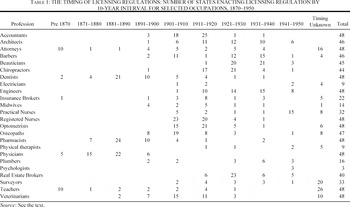
TABLE 1: THE TIMING OF LICENSING REGULATIONS: NUMBER OF STATES ENACTING LICENSING REGULATION BY 10-YEAR INTERVAL FOR SELECTED OCCUPATIONS, 1870-1950
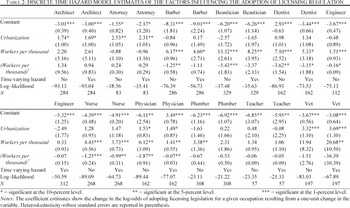
TABLE 2: DISCRETE TIME HAZARD MODEL ESTIMATES OF THE FACTORS INFLUENCING THE ADOPTI ON OF LICENSING REGULATION
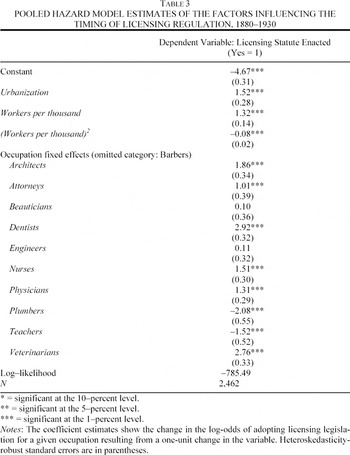
TABLE 3: POOLED HAZARD MODEL ESTIMATES OF THE FACTORS INFLUENCING THE TIMING OF LICENSING REGULATION, 1880–1930
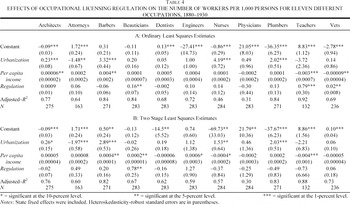
TABLE 4 EFFECTS OF OCCUPATIONAL LICENSING REGULATION ON THE NUMBER OF WORKERS PER 1,000 PERSONS FOR ELEVEN DIFFERENT OCCUPATIONS, 1880–1930
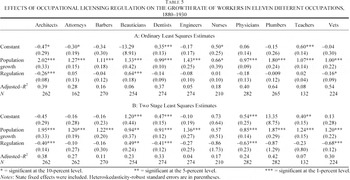
TABLE 5 EFFECTS OF OCCUPATIONAL LICENSING REGULATION ON THE GROWTH RATE OF WORKERS IN ELEV EN DIFFERENT OCCUPATIONS, 1880–1930
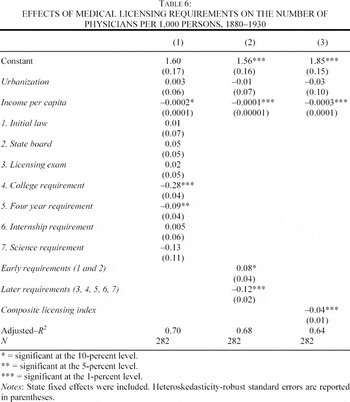
TABLE 6: EFFECTS OF MEDICAL LICENSING REQUIREMENTS ON THE NUMBER OF PHYSICIANS PER 1,000 PERSONS, 1880–1930
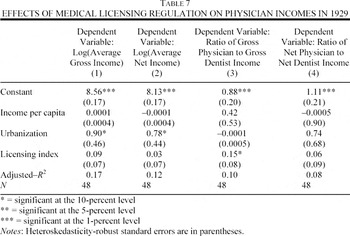
TABLE 7 EFFECTS OF MEDICAL LICENSING REGULATION ON PHYSICIAN INCOMES IN 1929
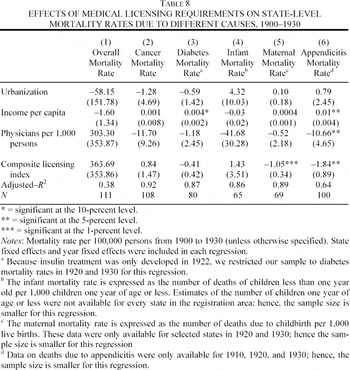
TABLE 8 EFFECTS OF MEDICAL LICENSING REQUIREMENTS ON STATE-LEVEL MORTALITY RATES DUE TO DIFFERENT CAUSES, 1900–1930
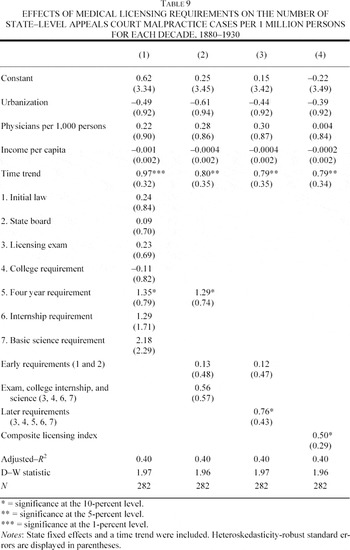
TABLE 9 EFFECTS OF MEDICAL LICENSING REQUIREMENTS ON THE NUMBER OF STATE—LEVEL APPEALS COURT MALPRACTICE CASES PER 1 MILLION PERSONS FOR EACH DECADE, 1880–1930
 You have Access
- 92
- Cited by