Antimicrobial stewardship programs (ASPs) are patient quality and safety initiatives designed to optimize antimicrobial prescribing. Most patients admitted to US children’s hospitals receive antibiotics.Reference Gerber, Newland and Coffin 1 Much of this antimicrobial use is inappropriate and contributes to antimicrobial resistance, unnecessary cost, and adverse drug effects.Reference Dellit, Owens and McGowan 2 – Reference Gholami, Parsa, Shalviri, Sharifzadeh and Assasi 6
One primary stewardship approach is prior authorization. 3 , 7 One strategy to facilitate prior authorization is to approve targeted antimicrobials for a predefined duration after which they automatically stop. Computerized order-entry systems can facilitate this automatic discontinuation or “auto-stop” strategy. While this type of program has been successful in some settings, missed or delayed doses, potentially leading to patient harm, have been reported in other settings.Reference Murray, Shaw and Lloyd 8 – Reference Cleary, Taylor and Nolan 12 The Infectious Diseases Society of America and the Centers for Disease Control and Prevention have issued recommendations favoring auto-stop policies, and the Centers for Medicare and Medicaid Services require that medication orders expire after a “reasonable” time period. 3 , 7 , 13 Despite these guidelines, safety concerns persist.
Concurrent with the implementation of a new electronic health record (EHR) system, our hospital initiated an EHR-based auto-stop program for select antimicrobials. We aimed to evaluate whether this approach negatively affected patient outcomes.
PATIENTS AND METHODS
Preintervention
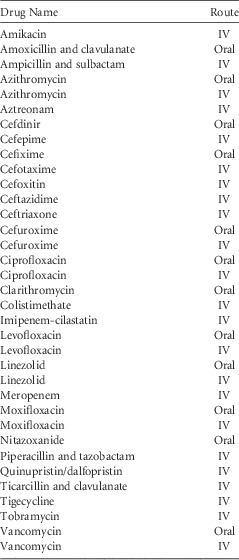
Prior to implementation of a new EHR system (Epic Systems) in January 2011, the hospital’s ASP had an established prior authorization system for restricted antimicrobials (Table 1). When the ASP-approved duration (commonly 48 hours) for a restricted antimicrobial ended, the pharmacy ceased dispensing medication unless additional approval was obtained. The original antimicrobial order remained visible in the EHR, serving as a reminder to obtain extended approval.
Restricted Antibiotics

NOTE. IV, intravenous.
Postintervention
With implementation of the auto-stop program, restricted antimicrobial orders required end dates matching the approved duration; end dates had not been required previously. After the end date, the orders and the reminders were automatically discontinued. To continue therapy, a new order with ASP approval was required. To help avoid unintended discontinuations, the stewardship program provided printed reminders, and upcoming expirations were indicated in the EHR.
Study Design and Outcomes
This study was approved by the Institutional Review Board of The Children’s Hospital of Philadelphia (CHOP). This retrospective study included patients <19 years old discharged from CHOP between January 1, 2009, and January 31, 2013. Two cohorts were analyzed: (1) an overall cohort of all hospitalized patients analyzed as a repeated, cross-sectional study and (2) a subcohort of patients with monomicrobial bacteremia with a pathogenic organism between January 1, 2009, and October 1, 2013. These cohorts were analyzed as a matched cohort study.
Demographic and outcome data from the Pediatric Health Information System, an administrative database, were linked to antimicrobial administration and laboratory data extracted electronically from the CHOP data warehouse. Outcomes included hospital length of stay, 30-day hospital readmission, and all-cause in-hospital mortality. For readmission and length of stay, only patients who survived until discharge were included.
Statistical Analysis
For the overall cohort, a marginal analysis was performed using longitudinal piecewise models using logit or log-gamma link, as appropriate, with a knot at the new EHR implementation (February 2011).Reference Fitzmaurice, Laird and Ware 14 Robust variances accounted for clustering by physician, and estimates were standardized for patient-level variables including sex, categorical age, Medicaid insurance, complex chronic condition (CCC) diagnosis, surgery during admission, mechanical ventilation or vasopressor use in the first 2 days of admission, and specialty of the primary attending physician.Reference Feudtner, Christakis and Connell 15 Confidence intervals were obtained by bootstrap resampling (999 replicates) for physicians.
For the bacteremia cohort, full matching based on propensity score with the statistical R package optmatch was used.Reference Hansen and Klopfer 16 Patients were matched before and after new EHR implementation with regard to days to first positive culture, age, CCC, insurance, surgery during admission, and physician specialty. Observations were weighted so the ratio of weights within matched groups was 1:1. Matched data were analyzed with the R survey package, and appropriate matching was confirmed by assessing the balance of covariates. Risk differences comparing post- to pre-EHR implementation were estimated using a weighted generalized linear model (GLM) approach with binomial distribution and identity link.Reference Horrace and Oaxaca 17 Statistical analyses were performed using Stata 12 with R≥3.1.
RESULTS
Overall Cohort
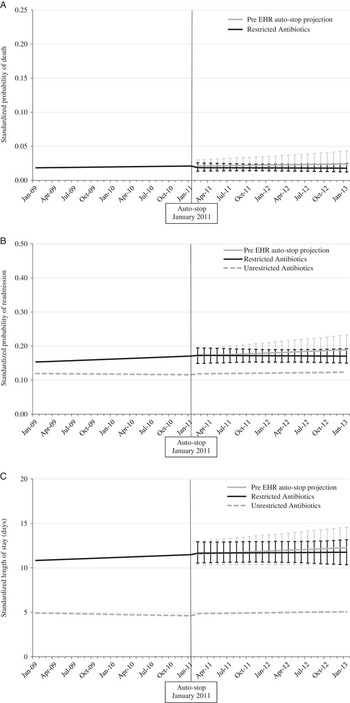
Of 116,897 admissions, 25,871 children (22.1%) received a restricted antibiotic. Restricted antibiotics accounted for 44% of all antibiotic use. Following the implementation of the auto-stop program, we observed no change in either the level of mortality or trend in mortality among patients who received restricted antibiotics (P=.37 and P=.57, respectively) (Figure 1A). We also observed no changes in either level of or trend in readmission (P=.88 and P=.28, respectively) or length of stay (P=.75 and P=.43, respectively) (Figure 1B and 1C).
Longitudinal analysis of the effect the implementation of an HER-based auto-stop program on patient outcomes. (A) All-cause in-hospital mortality. (B) Readmission in 30 days. (C) Length of stay in days. Error bars are 95% confidence intervals.

Readmission and length of stay analyses were replicated in patients who received only unrestricted antibiotics to assess the potential impact of the EHR implementation on the data. No meaningful changes were observed (Figures 1B and C). Mortality was too rare in the unrestricted cohort to replicate.
Bacteremia Cohort
Among 814 patients identified with bacteremia (480 preintervention, 334 postintervention), full matching resulted in an effective sample size of 318 per group. Among matched pairs, we observed no difference in mortality: risk difference between postintervention and preintervention rates was −0.9% (95% CI −4.1 to 2.3). After excluding patients who died prior to discharge, the effective sample size was 300 per group. Comparing preintervention and postintervention rates, there were no differences in 30-day readmission (−0.4%; 95% CI, −7.6 to 6.8).
DISCUSSION
We examined the clinical impact of an EHR-based antimicrobial auto-stop program to facilitate the prior authorization component of an established ASP. In this setting, the automatic discontinuation of restricted antimicrobial orders did not adversely affect in-hospital mortality, length of stay, or readmission rates, even in a subset of patients with bacteremia, for whom the timely delivery of antimicrobials is critical.Reference Kumar, Roberts and Wood 18 , Reference Weiss, Fitzgerald and Balamuth 19 These data suggest that antimicrobial auto-stop orders can safely be employed as a part of an antimicrobial stewardship program.
Several important features of this program likely contributed to its safe implementation. Although the auto-stop program introduced a significant and novel change, prior authorization was already in place, with the pharmacy enforcing approved durations without order discontinuation. Additionally, the auto-stop program coincided with the ideal progression of antimicrobial use: reevaluation of the need for antimicrobials following availability of culture results before 48 hours. Finally, other reminders were put in place, including noninterruptive her-based alerts, and initially, the ASP provided daily notifications of expiring orders. Previous guidelines and clinical studies regarding auto-stop programs specifically identify the importance of active surveillance and effective communication in safely managing an auto-stop program.Reference Do, Walker, Walker, Cornish and Simor 11 , Reference Di Pentima and Chan 20
Although safety concerns among clinicians persist, studies report that 25% to 71% of acute-care hospitals utilize auto-stop programs.Reference Lesar and Briceland 21 , Reference Van Gastel, Costers, Peetermans and Struelens 22 A study of pediatric inpatients revealed that premature discontinuation due to an auto-stop policy comprised 9% of antimicrobial prescription errors or, by extrapolation, <1 error per 1,000 patient days.Reference Di Pentima, Chan, Eppes and Klein 23
Our study has several limitations. First, our analyses could not detect a subtle effect if only a few individual patients were harmed due to delayed therapy; however, no verified safety events (from our institution’s safety reporting event system) due to delayed antimicrobial therapy were identified. Second, adverse effects might have been masked by the new EHR system, which might have affected patient care via other mechanisms.Reference Longhurst, Parast and Sandborg 24 The EHR change could have affected how the data used in the analysis were recorded; however, our analysis of patients who only received unrestricted antibiotics, which were unaffected by the auto-stop program, showed no notable changes. Third, our bacteremia sample was not powered to rule out potential changes in adverse events, and continued follow-up will be necessary to confirm the safety of this system.
Overall, the results of this study indicate that an antimicrobial stewardship program can safely include an auto-stop order as part of its comprehensive strategy.
ACKNOWLEDGMENTS
Financial support: Funding for this study was provided by The Center for Pediatric Clinical Effectiveness and Office of Safety and Medical Operations at the Children’s Hospital of Philadelphia.
Potential conflicts of interest: All authors report no conflicts of interest relevant to this article.