Introduction
Depression is a major contributor to disability (Murray and Lopez Reference Murray and Lopez1996) and is a common reason for primary care consultation (Shah Reference Shah1992). Recent estimates of depression prevalence among the over 50s in Europe range from around 17 to 36 per cent (Castro-Costa et al. Reference Castro-Costa, Dewey, Stewart, Banerjee, Huppert, Mendonca-Lima, Bula, Reisches, Wancata, Ritchie, Tsolaki, Mateos and Prince2007). The social precursors of depressive symptoms are socioeconomically patterned (Brown and Harris Reference Brown and Harris1978) and include those which increase susceptibility to depression (such as chronic stressors and chronic health conditions) and those which are protective or buffer against depression (such as social relationships and social support (House, Landis and Umberson Reference House, Landis and Umberson1988). The neighbourhood social environment may be a setting which exposes people to factors that can be either beneficial or harmful for depression. Recent studies indicate concepts such as neighbourhood social capital and social cohesion are associated with depressive symptoms in the general population (Almedom Reference Almedom2005; De Silva et al. Reference De Silva, McKenzie, Harpham and Huttly2005; Xue et al. Reference Xue, Leventhal, Brooks-Gunn and Earls2005) and the neighbourhood environment is potentially of greater importance among older compared with younger adults (Laporte, Nauenberg and Shen Reference Laporte, Nauenberg and Shen2007). Over the lifecourse, people become attached to their neighbourhood and to their home (Rubinstein and Parmelee Reference Rubinstein, Parmelee, Altman and Low1992; Sampson Reference Sampson1988; Scharf, Phillipson and Smith Reference Scharf, Phillipson and Smith2003) and perform most of their daily activities there (Baltes et al. Reference Baltes, Maas, Wilms, Borchelt, Little, Baltes and Mayer1999). This attachment can develop through increased length of residence which can contribute to a sense of familiarity and security (Lawton Reference Lawton1990) and because of the experiences which have taken place there and contribute to a person's identity (Shenk, Kuwahara and Zablotsky Reference Shenk, Kuwahara and Zablotsky2004).
Various pathways linking the neighbourhood social environment to depressive symptoms have been theorised (Kawachi and Berkman Reference Kawachi and Berkman2001a; Scheffler, Brown and Rice Reference Scheffler, Brown and Rice2007). These include the potential for providing psychological support and guidance to aid coping with difficulties and protect against depressive symptoms and providing a sense of purpose and belonging that may directly influence psychological wellbeing. Empirical investigation of these pathways is limited. This study explores the association between two components of the neighbourhood social environment, namely social cohesion and perceived safety, and depressive symptoms, and the aim is to elucidate explanatory mechanisms linking these among older adults.
Neighbourhood social cohesion and perceived safety
Neighbourhood social cohesion refers to norms of trust, solidarity and reciprocity, which have been extensively studied in relation to depression in children (Xue et al. Reference Xue, Leventhal, Brooks-Gunn and Earls2005), the general population (Almedom Reference Almedom2005; Aneshensel and Sucoff Reference Aneshensel and Sucoff1996; Boreham, Stafford and Taylor Reference Boreham, Stafford and Taylor2002; De Silva et al. Reference De Silva, McKenzie, Harpham and Huttly2005; Ellaway, Macintyre and Kearns Reference Ellaway, Macintyre and Kearns2001; Elliott Reference Elliott2000; Pevalin and Rose Reference Pevalin and Rose2003; Phongsavan et al. Reference Phongsavan, Chey, Bauman, Brooks and Silove2006; Ross Reference Ross2000) and specifically in older adults (Cannuscio, Block and Kawachi Reference Cannuscio, Block and Kawachi2003; Keating, Swindle and Foster Reference Keating, Swindle, Foster and Frank2005; McMunn et al. Reference McMunn, Nazroo, Wahrendorf, Breeze and Zaninotto2009; Pollack and von dem Knesebeck Reference Pollack and von dem Knesebeck2004; Schieman and Meersman Reference Schieman and Meersman2004). Another aspect of the neighbourhood social environment that has received attention in relation to depressive symptoms is that of social disorder (Kim Reference Kim2008), encapsulating for example worry about crime (Martin et al. Reference Martin, Shreffler, Schoster and Callahan2010; Roman and Chalfin Reference Roman and Chalfin2008; Stafford, Chandola and Marmot Reference Stafford, Chandola and Marmot2007) and incivilities such as graffiti and litter (Ellaway et al. Reference Ellaway, Morris, Curtice, Robertson, Allardice and Robertson2009; Sampson, Raudenbush and Earls Reference Sampson, Raudenbush and Earls1997). Neighbourhood social disorder is theorised to signal lack of care amongst residents and local authorities and can lead to a downward spiral of increasing disorder, antisocial behaviour and crime (Wilson and Kelling Reference Wilson and Kelling1982). The focus of the present study is on perceived safety and incivilities, hereon referred to as perceived safety.
Previous studies have used various methods to capture neighbourhood social cohesion and perceived safety including participant's individual perceptions and perceptions aggregated over residents located in the same small area. The approach taken in the present study is to use individual perceptions because aggregate data would require larger numbers of participants in each neighbourhood than were available here. This choice of methodology is discussed later.
Pathways linking the neighbourhood social environment to depressive symptoms
Greater levels of neighbourhood-based social cohesion may be associated with lower prevalence of depressive symptoms through higher-quality social interactions with people in the neighbourhood (Berkman et al. Reference Berkman, Glass, Brissette and Seeman2000; Kawachi and Berkman Reference Kawachi, Berkman, Berkman and Kawachi2001b; Scheffler, Brown and Rice Reference Scheffler, Brown and Rice2007; Szreter and Woolcock Reference Szreter and Woolcock2004). Living in a cohesive neighbourhood may support interpersonal connections which provide health-promoting information. In residential environments where norms of trust and reciprocity abound, it is expected that relationships between friends and neighbours would be characterised by positive rather than negative social exchanges. Positive aspects of social relations at the individual level (including greater perceived emotional and instrumental support) have been associated with lower risk of depressive symptoms (Boreham, Stafford and Taylor Reference Boreham, Stafford and Taylor2002; Lin, Ye and Ensel Reference Lin, Ye and Ensel1999; Stansfeld and Candy Reference Stansfeld and Candy2006; Stansfeld, Fuhrer and Shipley Reference Stansfeld, Fuhrer and Shipley1998; Van der Horst and McLaren Reference Van der Horst and McLaren2005) and negative aspects of social relations have been associated with higher risk of depressive symptoms (Hobfoll and Stephens Reference Hobfoll, Stephens, Sarason, Sarason and Pierce1990; Ingersoll-Dayton, Morgan and Antonucci Reference Ingersoll-Dayton, Morgan and Antonucci1997; Rauktis, Koeske and Tereshko Reference Rauktis, Koeske and Tereshko1995) although the temporal sequence is complex (Fyrand et al. Reference Fyrand, Moum, Finset and Glennas2002).
Greater social cohesion and perceived safety may also induce a greater sense of control or reduce a sense of powerlessness amongst residents as they recognise their roles in effecting change in their neighbourhood (Hawe and Shiell Reference Hawe and Shiell2000; Ross Reference Ross2000). Perceived control is understood as a sense of self-determination – an ability to actively intervene in one's environment (Rodin Reference Rodin1986) and has been linked to lower rates of depressive symptoms (Chou Reference Chou2005; Keeton, Perry-Jenkins and Sayer Reference Keeton, Perry-Jenkins and Sayer2008; Ross and Mirowsky Reference Ross and Mirowsky2006; Steptoe et al. Reference Steptoe, Tsuda, Tanaka and Wardle2007; Yang Reference Yang2006). On the other hand, greater social cohesion could diminish personal freedom of choice in some instances (Portes Reference Portes1998) and so the relationship of personal sense of control to neighbourhood social cohesion remains a question to address empirically.
Our empirical model tests these two proposed pathways linking social cohesion and perceived safety to depressive symptomatology. The norms of trust, solidarity and reciprocity which make up neighbourhood social cohesion might enable residents to develop and maintain more supportive friendships. Conversely, a lack of neighbourhood cohesion might increase a resident's experiences of negative aspects of friendships within that community. In addition, weaker social cohesion and lower perceived safety may reduce residents' personal sense of control.
Study aims
The aims of this study are twofold. Using longitudinal data from a general population of adults aged 50 and over, we describe the relationships of neighbourhood-based social cohesion and perceived safety with depressive symptoms. We then assess the extent to which the quality of friendships and personal sense of control mediate the relationship between neighbourhood social cohesion/perceived safety and depressive symptoms.
Methods
The English Longitudinal Study of Ageing
The data for this study come from the English Longitudinal Study of Ageing (ELSA) study. ELSA is a sample of people aged 50 and older living in England. ELSA was drawn from a general population sample of households that responded to the Health Survey for England (HSE) in 1998, 1999 and 2001. The HSE uses a multi-stage clustered sampling design, stratified by region and socioeconomic characteristics, to select households and residents (Erens and Primatesta Reference Erens and Primatesta1999). ELSA therefore provides a sample representative of community living over 50s in England. Individuals were classified as core ELSA sample members at wave 1 if they were included in the HSE and were aged 50 in 2002–03 when the first wave of ELSA took place. At wave 1, of the 17,744 eligible HSE sample members, 648 had died, moved outside of England or into an institution. A total of 11,392, 67 per cent of eligible sample members, took part in wave 1 of ELSA. Of these, 8,781 (82 per cent) also participated in the second wave (in 2004–05). More detail on the sampling and response rates for ELSA are given elsewhere (Taylor et al. Reference Taylor, Conway, Calderwood, Lessof, Cheshire, Cox and Scholes2003). Here we use data on the neighbourhood social environment and quality of social relations at wave 1 to predict the number of depressive symptoms at wave 2. Data were accessed through the Economic and Social Data Service. Ethical clearance for the study was obtained from the Multicentre Research and Ethics Committee.
Depressive symptoms, friendships, sense of control and perceived neighbourhood
All data were collected by face-to-face interviews conducted in the participant's home, except for measures of perceived neighbourhood environment, quality of friendships and sense of control which were collected in a self-completion booklet. Depressive symptoms were measured at waves 1 and 2 using an eight-item version of the Center for Epidemiologic Studies Depression Scale (CES-D). This tool has been validated against the full CES-D (Turvey, Wallace and Herzog Reference Turvey, Wallace and Herzog1999) and used in community settings to predict mortality (Turvey et al. Reference Turvey, Schultz, Beglinger and Klein2009).
Items capturing quality of friendships were included at wave 1. Participants were asked if they had any friends. For the 93 per cent who reported that they did, a further six items captured positive and negative aspects of those friendships: ‘How much do they understand the way you feel about things?’, ‘How much can you rely on them?’, ‘How much can you open up to them?’, ‘How much do they criticise you?’, ‘How much do they let you down?’ and ‘How much to they get on your nerves?’ Possible responses were scored from 0 (‘not at all’) to 3 (‘a lot’).
Four items thought to capture personal sense of control were included at wave 1. These items were taken from the CASP-19 – a tool which captures quality of life on four domains (control, autonomy, self-realisation and pleasure) in older people (Hyde et al. Reference Hyde, Wiggins, Higgs and Blane2003). Possible responses to the following items were scored from 0 (‘often’) to 3 (‘never’): ‘My age prevents me from doing the things I would like to’, ‘I feel that what happens to me is out of my control’, ‘I feel free to plan for the future’, ‘I feel left out of things’.
Seven items captured elements of the neighbourhood social environment at wave 1. A priori, five were thought to capture neighbourhood-based social cohesion and two were thought to capture perceived safety. However, goodness-of-fit indices indicated that an item capturing whether people in the area would help if you were in trouble was more closely related to perceived safety than to social cohesion (see Table 2 for item descriptions). Possible responses ranged from 1 to 7 (the latter indicating greatest agreement with the statement). It should be noted that these items capture individual perceptions of the neighbourhood social environment. Ideally, we would have used neighbourhood-level data but this was not available from external sources and although ELSA participants are geographically clustered into primary sampling units, there are insufficient numbers per area to aggregate data in a meaningful way.
Other covariates
Four categories of employment status were derived to capture being in paid employment, retired or semi-retired, home makers, and unemployed or long-term sick. Total wealth (including housing and non-housing wealth but excluding pension wealth) was assessed using a battery of items (Banks, Karlsen and Oldfield Reference Banks, Karlsen, Oldfield, Marmot, Banks, Blundell, Lessof and Nazroo2003) and analysed as quintiles. Marital status was analysed as married or cohabiting versus never married, separated or widowed.
Statistical methods
Descriptive statistics were weighted for the multi-stage sampling design and non-response based on known probability of sampling. Neighbourhood social cohesion, perceived safety, positive and negative aspects of friendships and personal sense of control were analysed as latent variables. To assess whether the observed data were consistent with each latent construct, goodness-of-fit indices were calculated. A latent variable model with three or fewer items capturing one factor is not identifiable and so latent variables were tested pair-wise and in other combinations but only the final measurement model including all 17 items capturing five latent constructs is presented (Table 2). In this model, each latent variable is correlated with all others and no structure is imposed on the relationships between latent variables. The Standardised Root Mean Squared Residual (SRMR), the Root Mean Square Error of Approximation (RMSEA) and the Tucker–Lewis index (TLI) are presented as they are appropriate for larger sample sizes and have been shown to provide complimentary information on goodness of fit under different model scenarios using the following cut-offs: SRMR<0.08, RMSEA<0.06 and TLI>0.95 (Hu and Bentler Reference Hu and Bentler1999).
The associations between number of depressive symptoms at wave 2 and the latent variables capturing the neighbourhood social environment at wave 1 were assessed using a structural equation model, controlling for gender, age, employment status, total wealth, marital status and depressive symptoms at previous wave. To this initial structural model, we added personal sense of control and positive and negative aspects of friendships to investigate their role as mediators. Analyses were undertaken in MPlus using maximum likelihood estimation and including participants who provided any pair-wise covariances (resulting in the exclusion of 38 participants).
Results
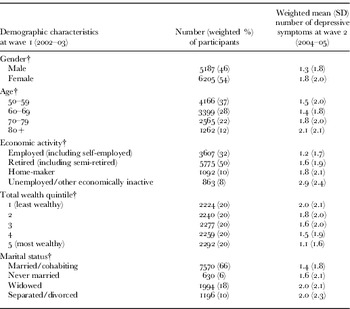
In this cohort of community-dwelling adults aged 50 and over, there was a higher proportion of women than men and sizeable proportions of retired and widowed people (Table 1).
Wave 1 (2002–03) demographic characteristics and health at two-year follow-up for participants aged 50 and over in the English Longitudinal Study of Ageing

Note: SD: standard deviation.
Significance level: † p<0.001.
The mean number of symptoms was higher for women and showed a U-shaped relationship with age, being the lowest for those in the 60–69 age bracket. Unemployed participants and those in the lowest wealth quintile (the least wealthy) had a higher mean number of symptoms, as did those who were widowed or separated/divorced.
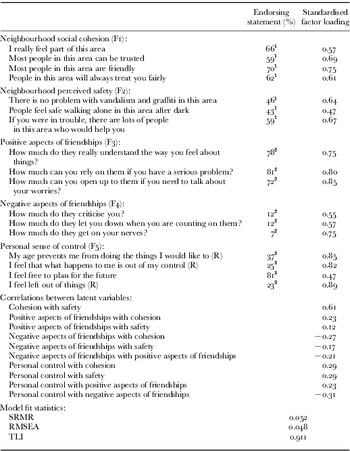
Participants endorsed statements which indicated reasonably high levels of neighbourhood social cohesion but were slightly less positive about perceived safety (Table 2).
Measurement model for all latent factors simultaneously included

Notes: 1. Percentage endorsing boxes 6 or 7 (highest agreement with statement). 2. Percentage endorsing boxes ‘A lot’ or ‘Some’. 3. Percentage endorsing boxes ‘Often’ or ‘Sometimes’. R: reverse coded. SRMR: Standardised Root Mean Squared Residual. RMSEA: Root Mean Square Error of Approximation. TLI: Tucker–Lewis Index.
Positive aspects of friendships were endorsed more frequently than were negative aspects. The latent variables are summarised in Table 2. The measurement model for the five latent variables together showed acceptable fit to the data on the SRMR and RMSEA although the TLI indicated some lack of fit. Factor loadings were >0.50 for all items, with the exception of one item (‘I feel free to plan for the future’) on the personal sense of control factor. Because this item has been included in previous studies using the CASP19, we elected to retain it here. Neighbourhood social cohesion and perceived safety were moderately correlated (rho=0.61) and other correlations between latent variables were around 0.20 or below.
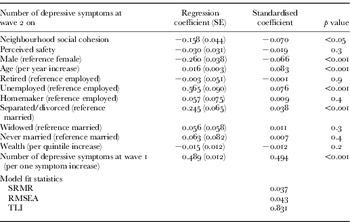
The initial structural model is summarised in Table 3. Greater neighbourhood social cohesion was associated with fewer depressive symptoms, over and above gender, age, employment status, wealth, marital status and depressive symptoms at previous wave. The standardised coefficients indicate the relative importance of each predictor in the model whereas the unstandardised coefficients are interpreted as regression coefficients in the usual way. Each one unit increase in neighbourhood social cohesion is associated with a 0.158 decrease in depressive symptoms. The standardised coefficients indicate that a one standard deviation increase in neighbourhood social cohesion is of similar effect size to a one year increase in age or to being unemployed.
Model estimates and goodness-of-fit indices for structural model for neighbourhood social environment as a predictor of number of depressive symptoms

Note: SE: standard error. SRMR: Standardised Root Mean Squared Residual. RMSEA: Root Mean Square Error of Approximation. TLI: Tucker–Lewis Index.
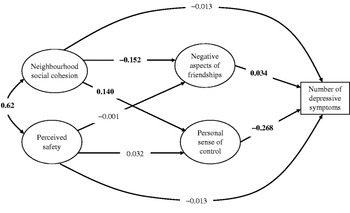
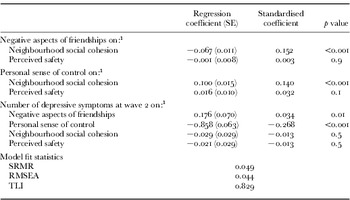
In bivariate models (not shown), greater positive aspects of friendships, fewer negative aspects of friendships and greater personal sense of control were associated with reporting fewer depressive symptoms. However, positive aspects of friendships were not associated with depressive symptoms independently of the other mediators and were not included in subsequent models. In the full model (Table 4), fewer negative aspects of friendships and greater personal sense of control were found among participants who reported higher neighbourhood social cohesion and these intermediate variables fully mediated the association between neighbourhood social cohesion and depressive symptoms (Figure 1). The standardised total effect of neighbourhood social cohesion on number of depressive symptoms at wave 2 was −0.056. The indirect effect, acting through negative aspects of friendships and personal sense of control was −0.043, leaving a direct effect of −0.013. Although the SRMR and RMSEA indicate good fit to the data, the TLI suggests that improvements could be made and so the final model must be interpreted with this in mind.
Mediators of the association between neighbourhood social environment and depressive symptoms: standardised coefficients. Bold figures indicate p<0.05.

Model estimates and goodness-of-fit indices for full structural model including mediators

Notes: 1. Number of depressive symptoms is additionally regressed on gender, age, employment status, marital status, wealth and number of depressive symptoms at wave 1 (estimates available from author on request). SE: standard error. SRMR: Standardised Root Mean Squared Residual. RMSEA: Root Mean Square Error of Approximation. TLI: Tucker–Lewis Index.
Discussion
In this longitudinal follow-up study of community-dwelling adults aged 50 and over, neighbourhood social cohesion was found to be associated with subsequent depressive symptoms independent of demographic and socioeconomic factors and baseline depressive symptoms. Negative aspects of relationships with friends and personal sense of control were strongly associated with neighbourhood social cohesion and also with fewer depressive symptoms and fully mediated this association.
Before discussing these findings in more detail, some important methodological limitations must be noted. Depressive symptoms were self-reported (though extensively validated in several previous studies), as were the measures of quality of friendships, personal sense of control and neighbourhood social environment. Same source bias might therefore account for some of the associations seen and it is not possible to rule out personality or other unmeasured characteristics as drivers of the association between neighbourhood environment and depressive symptoms. However, adjustment for prior depressive symptoms should reduce the extent to which this biases the analysis. We find that, conditional on wave 1 depressive symptoms, those reporting lower neighbourhood social cohesion were more likely to report depressive symptoms at two-year follow-up. Furthermore, the direction of the association between neighbourhood social environment and friendship quality or personal sense of control cannot be inferred from these analyses which used wave 1 measures.
Items capturing the quality of friendships were not limited to friends in the neighbourhood and this probably dilutes the estimated association between neighbourhood factors and friendship quality. Omitted characteristics of the neighbourhood, such as residential mobility, deterioration, deprivation or affluence (Krause Reference Krause2006), may confound the relationships seen here. Alternatively, these structural characteristics may be viewed as determinants of neighbourhood social cohesion itself (Wen, Browning and Cagney Reference Wen, Browning and Cagney2003). In either scenario, it is important to remember that environments characterised by low social cohesion are likely to be multiply disadvantaged on several indicators.
Discussion of main findings
The study adds to a growing literature testing associations between socio-cultural characteristics in the neighbourhood and common mental disorders including depressive symptoms. A recent review concluded that there is evidence for an inverse association between constructs such as neighbourhood-based trust, solidarity and reciprocity measured at the individual level and depressive symptoms but highlighted a preponderance of cross-sectional studies which are unable to assess the temporality of the association (De Silva et al. Reference De Silva, McKenzie, Harpham and Huttly2005). Our findings based on longitudinal data indicate that neighbourhood social cohesion may be relevant for the development of depressive symptoms in older adults and are in line with previous studies. Mair et al. (Reference Mair, Diez Roux, Shen, Shea, Seeman, Echeverria and O'Meara2009) found that a summary neighbourhood score based on social cohesion along with violence and aesthetic environment was associated cross-sectionally with CES-D score but not with incident depression in a sample that included participants from 45 to 84 years of age. However, neighbourhood scores did differ in the expected direction for those who did and did not develop depression through follow-up and the odds ratios for women were suggestive of a protective association. A study of older Australians found a positive, unadjusted correlation between a scale comprising items capturing social cohesion (which they referred to as sense of neighbourhood) and mental health on the SF-36 (Young, Russell and Powers Reference Young, Russell and Powers2004).
The explanatory pathways underlying this relationship were also explored as part of this study. Socially cohesive environments are thought to be more conducive to supportive social relations. Summarising Kawachi and Berkman's (Reference Kawachi and Berkman2001a) work linking egocentric ties to the wider social context, Phillips writes ‘Trusting social environments in turn tend to beget trustworthy citizens’ (2006:203). Although previous studies have proposed social support as one of the potential mechanisms linking the neighbourhood social environment to mental health (Berkman et al. Reference Berkman, Glass, Brissette and Seeman2000), this has seldom been empirically tested. Elliott (Reference Elliott2000) showed that social support, personal sense of control and social integration mediated the relationship between socioeconomic position and depression and interestingly found that social integration was protective for depression only in less disadvantaged neighbourhoods and sense of control appeared to afford greater protection against depression in more disadvantaged neighbourhoods. That study, along with another that found the association between neighbourhood problems and depressive symptoms was moderated by social support received (Schieman and Meersman Reference Schieman and Meersman2004), suggests that further refinement of the current model may be appropriate, for example allowing the explanatory pathways linking social cohesion to depressive symptoms to vary according to neighbourhood type. Our findings suggest that neighbourhood social cohesion has implications for residents' individual psychosocial factors (sense of control and friendship quality) and for symptoms of depression. However, given the self-reported nature of the exposures and outcome, we must interpret the findings with caution. Multilevel studies linking true contextual measures of the neighbourhood social environment are needed, although such studies would have their own set of limitations around how to define the appropriate neighbourhood and whether residents truly agree on how they experience that neighbourhood.
Implications for future research and policy
Our findings show that negative aspects of friendships, lower personal sense of control and more depressive symptoms are more commonly experienced by people who perceive their neighbourhood to be low in social cohesion. One implication of this is that improvements in neighbourhood social cohesion might play a role in reducing the experience of negative social encounters and depression symptomatology. Exploration of the factors which shape social cohesion is beyond the scope of this study and is clearly a complex issue requiring careful consideration of the socioeconomic and political context, state institutions and social infrastructure (Baum Reference Baum2000; Lynch et al. Reference Lynch, Due, Muntaner and Davey Smith2000; Szreter and Woolcock Reference Szreter and Woolcock2004).
This work is based on one of the largest longitudinal samples of community-living middle-aged and older people and has an important message about the health and wellbeing of older people in England's ageing population. Future work is needed to tease out health effects of the neighbourhood social environment according to different ages. Whilst it is possible that the young-old spend more time in and around their neighbourhood compared with working-age adults, it is possible that the oldest-old are more physically constrained, or choose to focus on a narrower set of intimate social ties (Carstensen, Isaacowitz and Charles Reference Carstensen, Isaacowitz and Charles1999) and spend the majority of their time in the home. For the latter group, the neighbourhood might assume less importance. The relationships between neighbourhood-based characteristics and friendships, control and health might therefore vary according to age among older people. This should be explored in future studies.
Conclusion
This prospective study links neighbourhood social cohesion to depressive symptoms through friendship quality and personal sense of control. It indicates that the perceived neighbourhood social environment may influence the quality of an older resident's friendships and that less negative aspects of friendships are reported by those who perceive their environment to be characterised by trust, solidarity and reciprocity. Future work might attempt to replicate the findings in other cohorts, using neighbourhood-level indicators and examining alternative explanatory pathways.
Acknowledgements
The data were made available through the UK Data Archive. The English Longitudinal Study of Ageing was developed by a team of researchers based at University College London, the Institute of Fiscal Studies and the National Centre for Social Research. The funding is provided by the National Institute on Aging in the United States (grants 2RO1AG7644-01A1 and 2RO1AG017644) and a consortium of UK government departments coordinated by the Office for National Statistics. The developers and funders of ELSA and the Archive do not bear any responsibility for the analyses or interpretations presented here.