Significant outcomes
-
∙ Asenapine reduces anxiety-related behaviours.
-
∙ Asenapine increases serotonin release in the rat hippocampus.
Limitations
-
∙ Our findings were based on an acute assay: the conditioned fear stress test.
-
∙ The underlying mechanism of the asenapine-induced anxiolytic-like activity remains unknown.
Introduction
Atypical antipsychotics, such as olanzapine and clozapine, are effective in treating depression and anxiety in individuals with schizophrenia. Olanzapine significantly improved mood status compared with placebo in schizophrenic patients (Reference Tollefson, Sanger, Beasley and Tran1,Reference Davis and Chen2). Moreover, olanzapine has been demonstrated to be efficacious in individuals with bipolar disorder, treatment-resistant major depressive disorder, post-traumatic stress disorder, and social anxiety disorder (Reference Tohen, Vieta and Calabrese3–Reference Barnett, Kramer, Casat, Connor and Davidson5). Clozapine has been reported to result in significantly greater improvements in symptoms of anxiety-depression similar to that seen in psychosis, hostile-suspiciousness, and thought disturbance in severely refractory schizophrenia (Reference Kane, Marder and Schooler6). In some preclinical studies, olanzapine and clozapine have exhibited anxiolytic- and antidepressant-like effects in animal models assessed using the elevated plus-maze and forced swimming tests (Reference Corbett, Hartman and Kerman7–Reference Szewczak, Corbett and Rush10). Atypical antipsychotics have a potent antagonistic activity against the dopamine D2 receptor and serotonin 5-HT2A receptor, and also act on other types of receptors, including adrenergic and histaminergic receptors (Reference Coward, Imperato, Urwyler and White11,Reference Bymaster, Calligaro and Falcone12). The pathogenic mechanisms of depression and anxiety have not been fully established, but stimulation of the 5-HT1A receptor or blockade of the 5-HT2C receptor is considered to be relevant to anxiolytic mechanisms (Reference Peroutka13,Reference Jones and Blackburn14).
Asenapine is an atypical antipsychotic used for the treatment of schizophrenia and bipolar I disorder. Similar to clozapine, this compound acts on multiple types of receptors. Asenapine is characterised by its potent antagonistic activity on a broad range of 5-HT receptor subtypes, including the 5-HT2A, 5-HT2C, 5-HT6, and 5-HT7 receptors (Reference Schotte, Janssen and Gommeren15,Reference Shahid, Walker, Zorn and Wong16), and acts as a partial agonist of the 5-HT1A receptor (Reference Ghanbari, El Mansari, Shahid and Blier17). As with other atypical antipsychotics, asenapine is effective in treating not only the positive symptoms, but also the negative symptoms associated with schizophrenia (Reference Potkin, Cohen and Panagides18). In addition, it has been reported to have beneficial effects on depression in individuals who experience manic episodes (Reference Szegedi, Zhao, van Willigenburg, Nations, Mackle and Panagides19,Reference Samalin, Charpeaud and Llorca20).
The rat conditioned fear stress paradigm has been widely used as an animal model to evaluate anxiolytic activity, as evidenced by the fact that benzodiazepine anxiolytics and selective serotonin reuptake inhibitors (SSRIs) reduce freezing behaviour (Reference Fanselow and Helmstetter21–Reference Rittenhouse, Bakkum, O’Connor, Carnes, Bethea and van de Kar24). Previous studies have also demonstrated that local administration of 5-HT1A agonists into the hippocampus can reduce freezing behaviour in an animal model (Reference Li, Inoue and Abekawa25). These findings suggest that an increase in serotonergic function in the hippocampus plays a role in reducing freezing behaviour. In the present study, we compared the effects of the atypical antipsychotics asenapine, clozapine, and olanzapine in the rat conditioned fear stress model and measured serotonin concentrations in the hippocampus using in vivo microdialysis, to explore the relationship between anxiolytic activity and serotonergic function.
Materials and methods
Animals and husbandry
Male Sprague-Dawley and Wistar rats (Charles River Laboratories Japan Inc.) were used for the conditioned fear stress model and cerebral microdialysis studies, respectively. Animals arrived at 6 weeks of age, and were quarantined and acclimated for 7 days before the experiments.
Rats were housed in cages (200×180×350 mm [width×depth×height]) in groups of two to three animals under controlled conditions (temperature of 21–25°C, relative humidity of 45–65%, and ventilation rate of at least 10 times/h) with a 12-h light-dark cycle (lights on 07:00 h to 19:00 h). Food and water were available ad libitum. The study protocol was reviewed and approved by the Animal Care and Use Committee of the Pharmaceutical Research Center, Yokohama, Meiji Seika Pharma Co., Ltd.
Drugs
Asenapine maleate (Toronto Research Chemicals, Ontario, CA, USA) was suspended in 10% hydroxypropyl-β-cyclodextrin (Sigma-Aldrich, St. Louis, MO, USA). Clozapine (Toronto Research Chemicals) and olanzapine (Kemprotec Limited, Cumbria, UK) were dissolved in 1N HCl and diluted with saline to a pH of about 6. Buspirone hydrochloride (Sigma-Aldrich), SB242084, 6-chloro-2,3-dihydro-5-methyl-N-[6-[(2-methyl-3-pyridinyl)oxy]-3-pyridinyl]-1H-indole-1-carboxyamidedihydrochloridehydrate (Sigma-Aldrich), WAY100635, N-[2-[4-(2-methoxyphenyl)- 1-piperazinyl]ethyl]-N-2-pyridinylcyclohexanecarboxamidemaleate salt (Sigma-Aldrich), and Ro60-0175, (αS)-6-chloro-5-fluoro-α-methyl-1H-indole-1-ethanamine fumarate (Tocris Bioscience, Bristol, UK) were dissolved in saline. All drugs were administered in a volume of 1 ml/kg body weight.
Conditioned fear stress test
Rats were fear-conditioned using electrical foot shocks. On day 1, rats were individually placed in a Skinner box (31×25×31 cm [width×depth×height]). An inescapable electrical shock (1 mA, 30-s duration) was delivered five times (at 30-s intervals) by a shock generator (SGS-002, Muromachi Kikai, Tokyo, Japan). Approximately 24 h later (day 2), individual animals were returned to the same Skinner box (without electrical shock administration) and their behaviour was observed for 5 min. The quantitative analysis of a subject’s freezing response (defined as the lack of body movements other than those associated with breathing) was performed using Freeze Frame (Actimetrics, Wilmette, IL, USA).
Animals were injected intraperitoneally (i.p.) with asenapine, clozapine, olanzapine, buspirone, or SB242084 at 30 min before freezing behaviour assessment. In the drug combination experiments, WAY100635 or Ro60-0175 was injected i.p. concomitantly with asenapine.
Microdialysis
After rats were anaesthetised with sodium pentobarbital (45 mg/kg, i.p.), the incision site was locally anaesthetised with 0.8% lidocaine (10-fold diluted Xylocaine® Pump Spray). A guide cannula (AG-4, Eicom, Kyoto, Japan) was placed into the dorsal hippocampus (AP: −3.6 mm, L: 1.2 mm, V: 2.3 mm from the bregma), according to a rat brain atlas (Reference Pixinos and Watson26). Rats were used in the microdialysis experiments 3–5 days after guide cannula placement. The day before the experiment, the animals were anaesthetised with 2% isoflurane, and a cannula (polyethylene tube, 0.58 mm i.d., Becton, Dickinson and Company, Franklin Lakes, NJ, USA) was inserted into the peritoneal cavity for drug administration, in order to reduce the handling stress on the animals. A dialysis probe (A-I-4-03, Eicom) was inserted through the guide cannula. After awakening, the animals were acclimated in a measurement room until microdialysis measurement commenced. On the day of the experiments, Ringer’s solution (147 mM NaCl, 4 mM KCl, and 2.3 mM CaCl2) was perfused through the dialysis probe at a flow rate of 1 μl/min in conscious and unrestrained rats. The dialysate was collected at 20 min intervals and directly injected into a cation exchange column (Eicompak CAX, 2.00 mm, i.d.×200 mm, Eicom) connected to an HPLC system (EP-700, Eicom), which was equipped with an electrochemical detector (ECD-700, Eicom) to determine serotonin concentrations in the dialysate. The mobile phase, consisting of 50 mg/l EDTA·2 Na and 0.05 M sodium sulphate in 0.1 M ammonium acetate buffer (pH 6.0)/methanol (7 : 3, v/v), was eluted at a flow rate of 0.25 ml/min. The column temperature was maintained at 35°C; detection was performed at +450 mV (against Ag/AgCl). Serotonin concentrations in the collected dialysate samples were determined using the peak area of a serotonin standard solution (100 pg in 10 μl), which was injected into the HPLC system immediately before analysis of the dialysate samples.
The drug suspension or solution was administered via the cannula to the peritoneal cavity after the chromatographic baseline was stabilised. Basal serotonin concentrations were determined as the mean of three fractions collected before drug administration; serotonin concentrations in dialysate samples were expressed as percentage of basal levels. After the end of the experiment, the animals were anaesthetised with sodium pentobarbital; 2% Fast Green in saline was perfused through the dialysis probe. The animals were then sacrificed by decapitation and their brains were removed. The position of the probe in each brain was examined histologically. Animals with an incorrect probe implantation were excluded from the data analysis.
Statistical analysis
All results are expressed as the mean±standard error of the mean (SEM). Statistical analyses of the data were performed using Dunnett’s multiple comparisons test or Student’s t-test, implemented in analytical EXSUS software. A p-value of <0.05 was considered to be significant.
Results
The anxiolytic-like effects of asenapine, clozapine, and olanzapine in the conditioned fear stress test
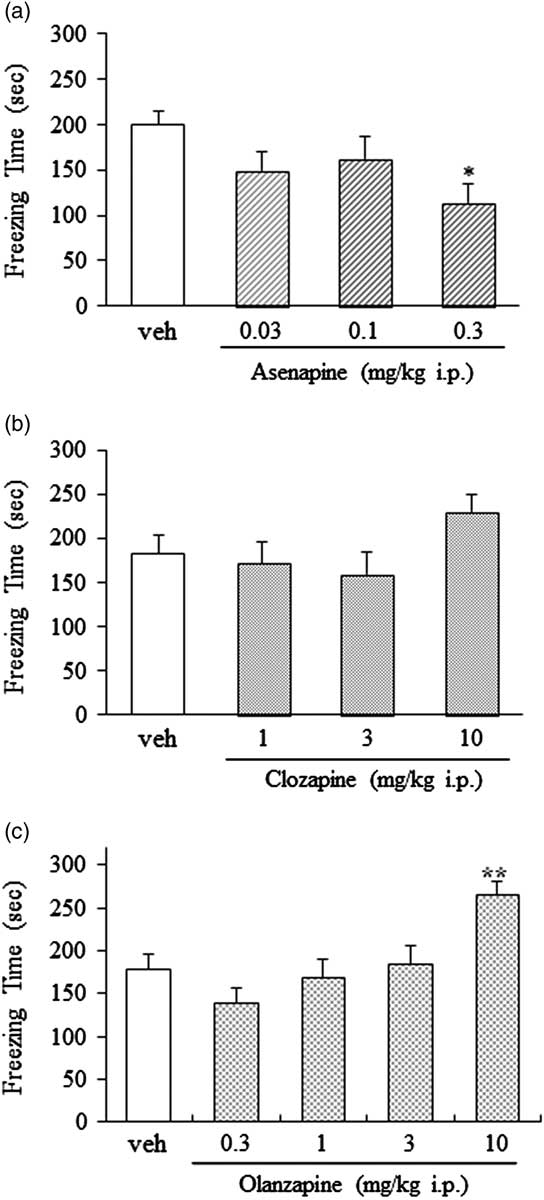
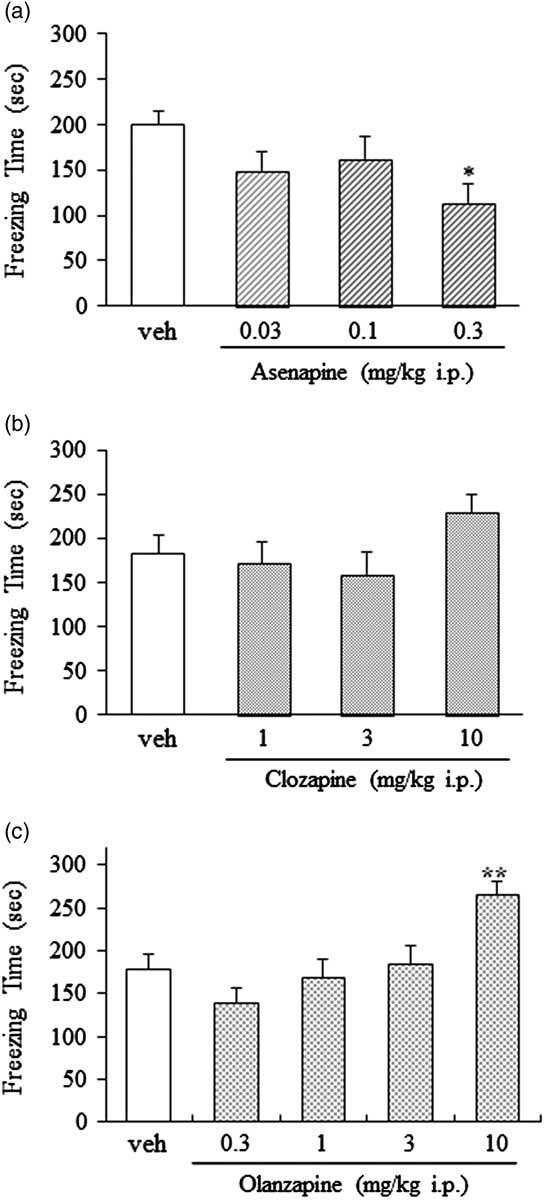
Asenapine administration at a 0.3 mg/kg body weight dose, but not at lower doses, resulted in significantly reduced freezing behaviour (Fig. 1a; at 0.03 mg/kg, t (36)=−1.561, p=0.2896, 95% confidence interval for differences of means [95% CI for diff: −28.49 to 128.3], at 0.1 mg/kg, t (36)=−1.153, p=0.5256, [95% CI for diff: −41.55 to 115.3], at 0.3 mg/kg, t (36)=−2.698, p=0.0281, [95% CI for diff: 7.881 to 164.7], (vs.) vehicle, Dunnett’s test). Clozapine (1–10 mg/kg) did not affect freezing behaviour (Fig. 1b; at 1 mg/kg, t (34)=−0.3407, p=0.9742, [95% CI for diff: −66.31 to 87.65], at 3 mg/kg, t (34)=−0.7599, p=0.7925, [95% CI for diff: −53.18 to 100.8], at 10 mg/kg, t (34)=−1.449, p=0.3507, [95% CI for diff: −129.8 to 33.53], (vs.) vehicle, Dunnett’s test). Olanzapine (0.3–3 mg/kg) did not affect freezing behaviour but did significantly increase freezing behaviour at the highest dose (10 mg/kg) (Fig.1c; at 0.3 mg/kg, t (49)=−1.475, p=0.4023, [95% CI for diff: −27.70 to 105.4], at 1 mg/kg, t (49)=−0.3703, p=0.9887, [95% CI for diff: −58.08 to 78.03], at 3 mg/kg, t (49)=0.2373, p=0.9979, [95% CI for diff: −74.45 to 61.67], at 10 mg/kg, t (49)=2.947, p=0.0176, [95% CI for diff: −161.2 to −12.39], (vs.) vehicle, Dunnett’s test).
The effects of asenapine (a), clozapine (b) and olanzapine (c) on freezing time in the rat conditioned fear stress test. Each drug was administered 30 min before the behavioral assessment. The data are presented as the mean ± SEM. (n = 8-12). *p<0.05 vs. vehicle control, Dunnett's multiple comparison test.
The anxiolytic-like effects of buspirone and SB242084 in the conditioned fear stress test
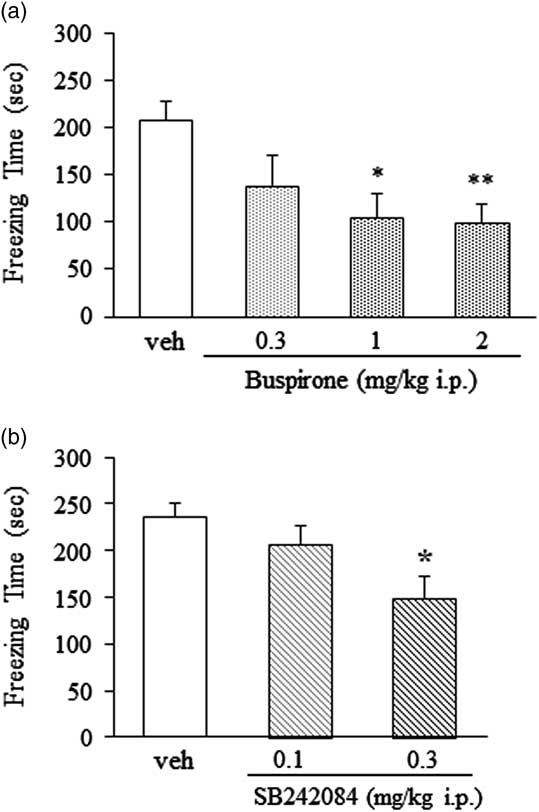
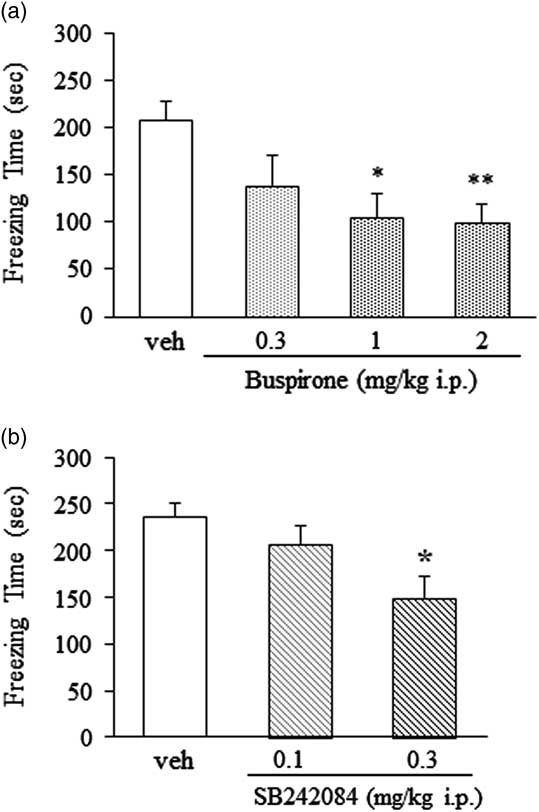
To determine the possible involvement of 5-HT1A and 5-HT2C receptors in freezing behaviour, the behaviour of the rats was assessed after the administration of either the 5-HT1A receptor partial agonist buspirone (0.3–2 mg/kg) or the 5-HT2C receptor antagonist SB242084 (0.1 and 0.3 mg/kg). Both buspirone and SB242084 reduced freezing behaviour in a dose-dependent manner (Fig. 2; buspirone: at 0.3 mg/kg, t (35)=−1.955, p=0.1440, [95% CI for diff: −17.33 to 152.7], at 1 mg/kg, t (35)=−3.027, p=0.0127, [95% CI for diff: 19.27 to 184.7], at 2 mg/kg, t (35)=−3.170, p=0.0088, [95% CI for diff: 24.10 to 189.6]; SB242084: at 0.1 mg/kg, t (21)=−1.015, p=0.5041, [95% CI for diff: −37.76 to 94.18], at 0.3 mg/kg, t (21)=−3.093, p=0.0104, [95% CI for diff: 20.03 to 152.0], (vs.) vehicle, Dunnett’s test).
The effects of buspirone (a) and SB242084 (b) on freezing time in the rat conditioned fear stress test. Each drug was administered 30 min before behavioral assessment. The data are presented as the mean ± SEM. (n = 8-10). *p<0.05, **p<0.01 vs. vehicle control, Dunnett's multiple comparison test.
The effects of WAY100635 and Ro60-0175 on the anxiolytic-like activity of asenapine
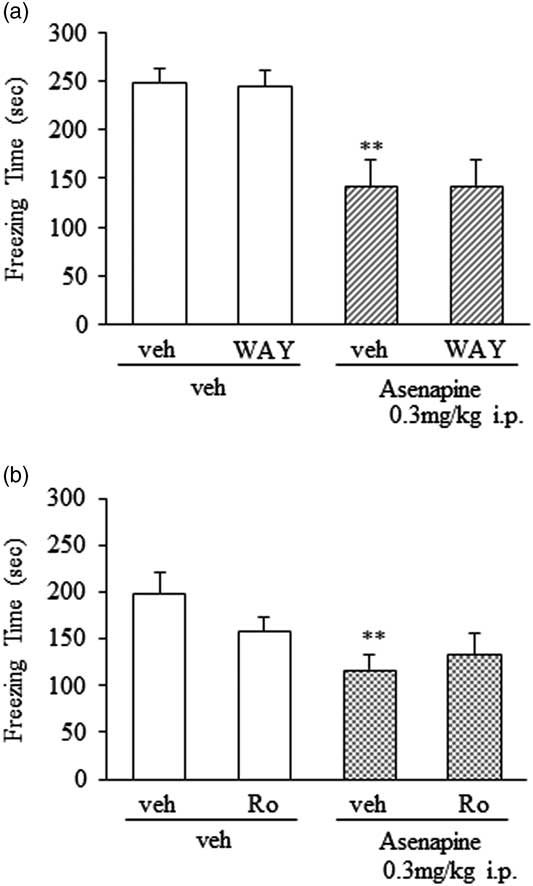
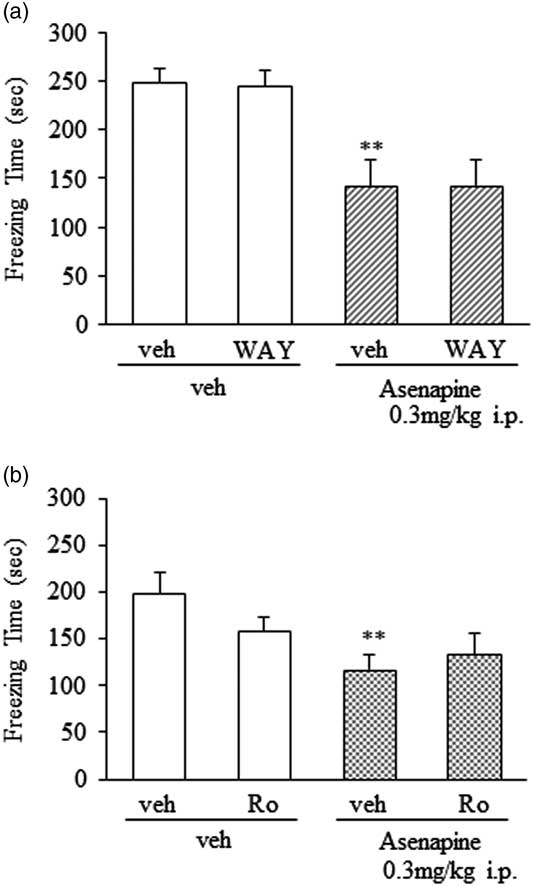
Freezing behaviour was assessed after the concomitant administration of asenapine (0.3 mg/kg) and the 5-HT1A receptor antagonist WAY100635 (3 mg/kg) or the 5-HT2C receptor agonist Ro60-0175 (3 mg/kg). Neither of these compounds affected freezing behaviour when administered alone at the selected doses (Fig. 3a; vehicle+WAY100635: t (12)=−0.1393, p=0.8915, [95% CI for diff: −48.24 to 54.83], vehicle+Ro60-0175: t (18)=−1.527, p=0.1442, [95% CI for diff: −15.03 to 94.95], (vs.) vehicle+vehicle, Student’s t-test). Concomitant administration of WAY100635 did not affect the asenapine-induced reduction in freezing behaviour (Fig. 3a;asenapine+WAY100635: t (11)=0.0357, p=0.9722, [95% CI for diff: −87.78 to 84.98] (vs.) asenapine+vehicle, asenapine+vehicle: t (12)=−3.296, p=0.0064, [95% CI for diff: 36.14 to 177.1] (vs.) vehicle+vehicle, Student’s t-test). Ro60-0175 also did not influence the effect of asenapine (Fig. 3b; asenapine+Ro60-0175: t (18)=0.6004, p=0.5557, [95% CI for diff: −72.42 to 40.23] (vs.) asenapine+vehicle, asenapine+vehicle: t (18)=−3.041, p=0.0070, [95% CI for diff: 25.09 to 137.3] (vs.) vehicle+vehicle, Student’s t-test).
The effects of the concomitant administration of WAY100635 (3 mg/kg, [WAY]) (a) and Ro60-0175 (3 mg/kg, [Ro]) (b) on the anxiolytic-like effects of asenapine (0.3 mg/kg) in the rat conditioned fear stress test. WAY100635 or Ro60-0175 was administered concomitantly with asenapine. The data are presented as the mean ± SEM. (n = 6-10). **p<0.05 vs. vehicle control, Student’s t-test.
The effects of asenapine, clozapine, and olanzapine on hippocampal serotonin release
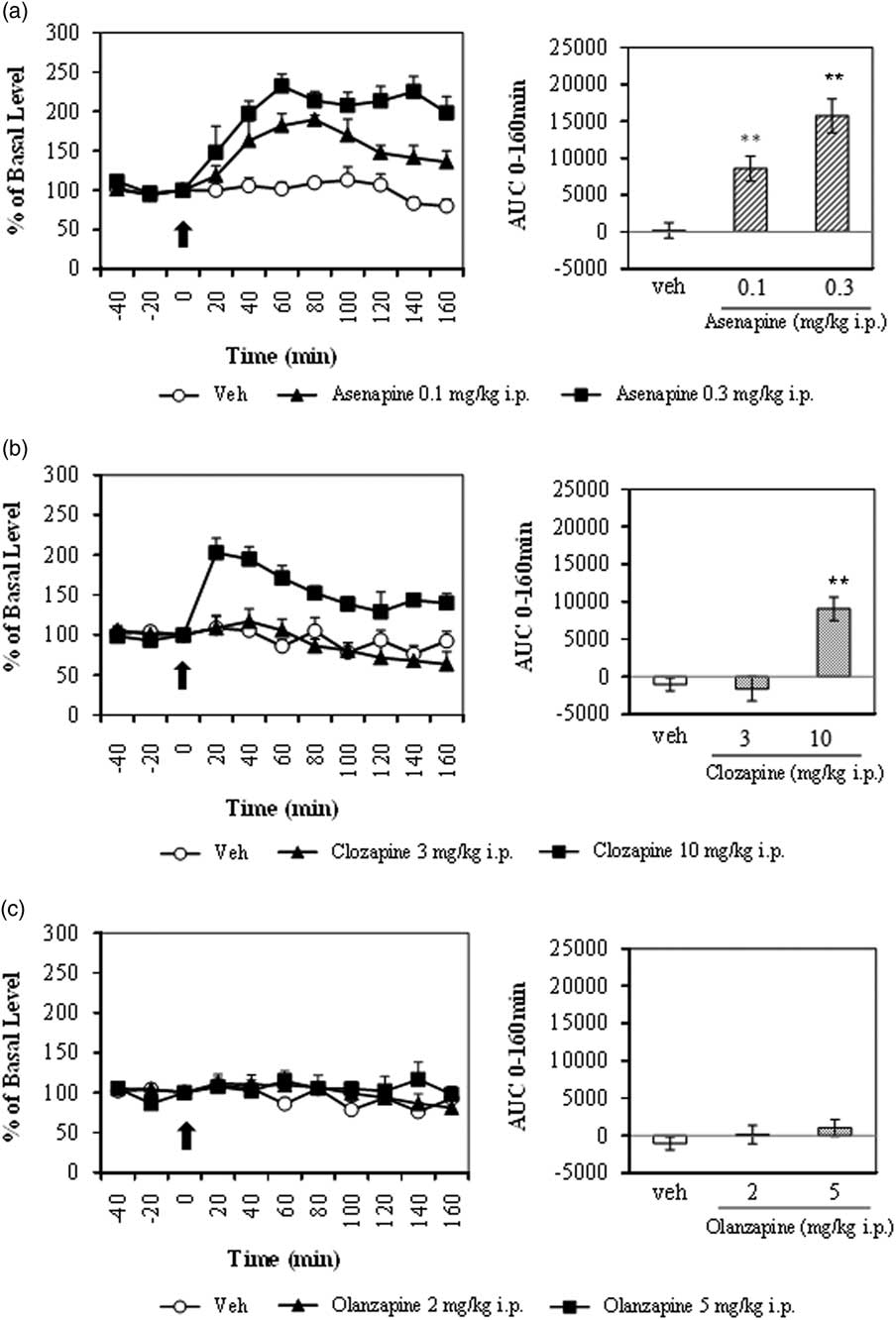
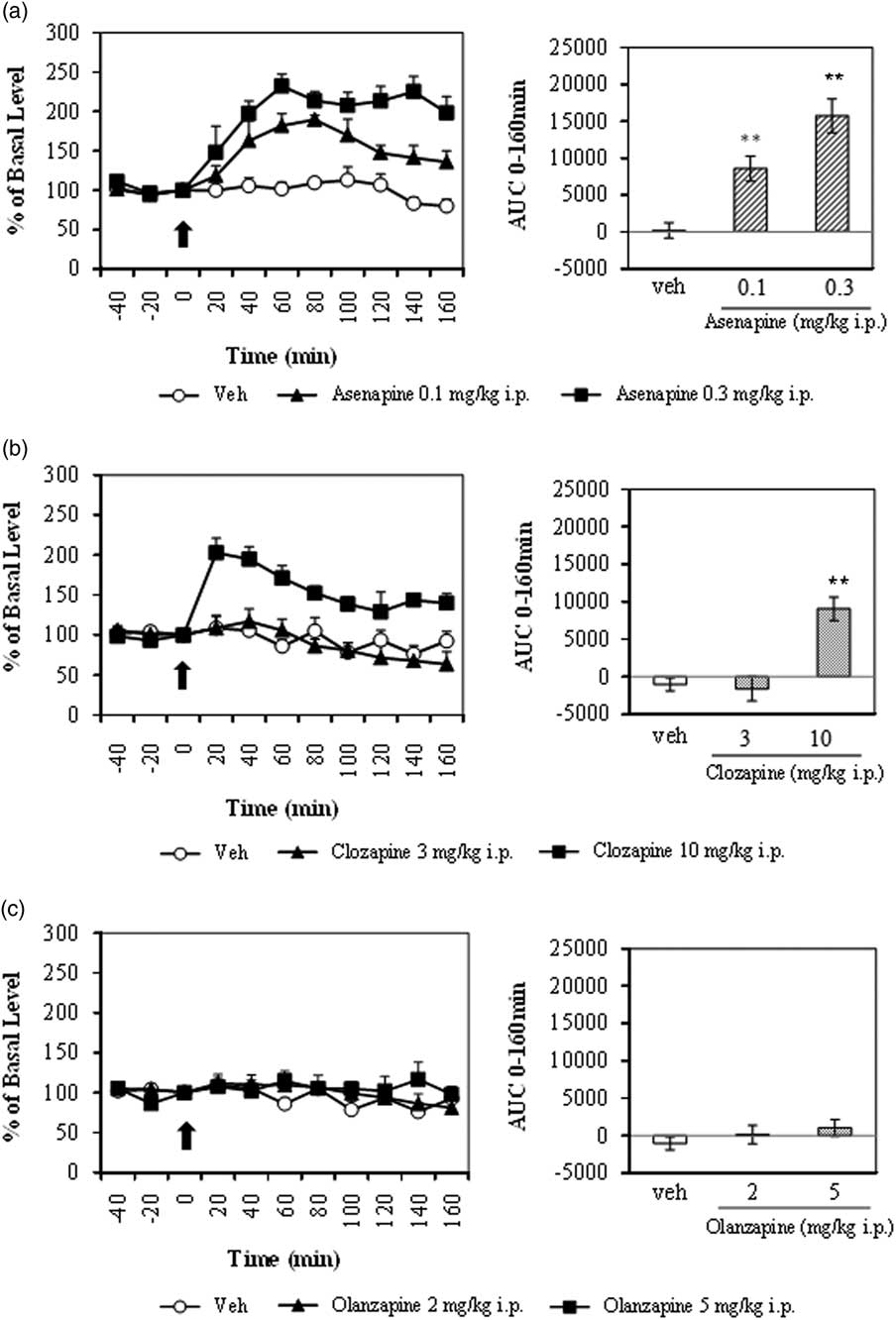
The effect of asenapine on serotonin release in the rat hippocampus was compared to those of clozapine and olanzapine. Asenapine increased serotonin release at 0.1 and 0.3 mg/kg in a dose-dependent manner (Fig. 4a; at 0.1 mg/kg, t (12)=3.393, p=0.0099, [95% CI for diff: −14 570 to −2207], at 0.3 mg/kg, t (12)=6.286, p=0.0001, [95% CI for diff: −21 730 to −9362], (vs.) vehicle, Dunnett’s test). Clozapine did not affect serotonin release at 3 mg/kg, but did increase serotonin release at 10 mg/kg (Fig. 4b; at 3 mg/kg, t (12)=−0.3054, p=0.9346, [95% CI for diff: −4322 to 5525], at 10 mg/kg, t (12)=5.105, p=0.0005, [95% CI for diff: −14 980 to −5131], (vs.) vehicle, Dunnett’s test). Olanzapine (2 or 5 mg/kg) did not affect serotonin release (Fig. 4c; at 2 mg/kg, t (12)=0.7529, p=0.6792, [95% CI for diff: −5004 to 2688], at 10 mg/kg, t (12)=1.328, p=0.3414, [95% CI for diff: −5888 to 1804], (vs.) vehicle, Dunnett’s test).
(Left): The effects of asenapine (a), clozapine (b) and olanzapine (c) on serotonin release from the rat hippocampus. Drug or vehicle was administered as indicated by the arrows. The data are presented as the mean ± SEM. of the percentage of basal levels (n = 5). (Right): The histograms show the areas under the concentration-time curves (AUCs) from 0 to 160 min. Each column and error bar represent the mean ± SEM., respectively (n = 5). **p<0.01, vs. vehicle control, Dunnett's multiple comparison test. Veh = vehicle.
Discussion
Asenapine is an atypical antipsychotic indicated for the treatment of schizophrenia and bipolar I disorder. This agent acts on multiple subtypes of serotonergic, adrenergic, and histaminergic receptors (Reference Schotte, Janssen and Gommeren15,Reference Shahid, Walker, Zorn and Wong16). The atypical antipsychotic drugs, olanzapine and clozapine, are effective for the negative symptoms, depression, anxiety, as well as for the positive symptoms of schizophrenia (Reference Tollefson, Sanger, Beasley and Tran1,Reference Davis and Chen2,Reference Kane, Marder and Schooler6). Both drugs exhibit anxiolytic- and antidepressant-like effects in animal models assessed using the elevated plus-maze and forced swimming tests (Reference Corbett, Hartman and Kerman7–Reference Szewczak, Corbett and Rush10). The anxiolytic- and antidepressant-like effects of asenapine have been reported in only a few studies of animal models (Reference Costall, Domeney, Kelly, Naylor and Tomkins27,Reference Marston, Martin, Papp, Gold, Wong and Shahid28). In this study, therefore, we evaluated and compared the anxiolytic-like effects of asenapine with those of clozapine and olanzapine using the rat conditioned fear stress test, an animal model of anxiety.
The results demonstrated that asenapine reduced freezing behaviour, while neither clozapine nor olanzapine had this effect. The dose of asenapine that produced a significant decrease in freezing time was similar to that which was effective in a conditioned avoidance task and a model of anhedonia in rats; these assays have predictive validity for the efficacy of antipsychotics and antidepressants, respectively (Reference Marston, Martin, Papp, Gold, Wong and Shahid28,Reference Frånberg, Wiker and Marcus29). Our finding for asenapine (0.3 mg/kg) supported those of recent reports that demonstrated the anxiolytic-like effects of asenapine in mice, and that this dose had no effect on locomotor activity (Reference Ene, Kara, Barak, Reshef Ben-Mordechai and Einat30). Inoue et al. (Reference Inoue, Tsuchiya and Koyama31) showed that asenapine, clozapine, and olanzapine reduced stress-induced freezing behaviour when administered before electric shock in the conditioned fear stress test, while clozapine did not affect freezing behaviour when administered before behavioural assessment. There have been no published studies of the effects of asenapine administered before behavioural assessment. Ishida-Tokuda et al. (Reference Ishida-Tokuda, Ohno and Sakamoto32) found that clozapine reduced freezing behaviour at 10 mg/kg (p.o.) when administered before behavioural observations. This finding was inconsistent with the result reported by Inoue et al. (Reference Inoue, Tsuchiya and Koyama31). A few reports have indicated the anxiolytic properties of olanzapine (Reference Mead, Li and Kapur33,Reference Sun, He, Hu and Li34). Therefore, we included both clozapine and olanzapine in this study. Our results were different from the findings of the previous reports that demonstrated that clozapine and olanzapine show anxiolytic effects. This inconsistency may be due to differences in experimental methods; for example, inescapable electrical shock for feared conditioning or presentation of freezing behaviour. Olanzapine did not affect freezing behaviour at 1 or 3 mg/kg, but did significantly increase freezing behaviour at 10 mg/kg. Olanzapine (3.0 mg/kg, i.p.) was effective in attenuating MK801-induced hyperactivity, an animal model used to evaluate antipsychotic activity. Olanzapine also induced catalepsy, a means to assess extrapyramidal side effects, at 10 mg/kg or higher (i.p.) (Reference Kołaczkowski, Mierzejewski, Bienkowski, Wesołowska and Newman-Tancredi35). Based on these previous findings, the observed olanzapine-induced increase in freezing time may have been due to extrapyramidal symptoms (Reference Broekkamp, De Graaf and van Delft36). The previous work by Ene et al. examined the effects of asenapine in black Swiss mice, a strain that is suggested to be a model for manic-like behaviour (Reference Ene, Kara and Einat37). Accordingly, the reduction of activity levels in black Swiss mice may be related to mood stabilisation effects of asenapine rather than sedation. Furthermore, intraperitoneal treatment with asenapine at up to 0.3 mg/kg does not affect spontaneous locomotors activity in rats and mice (Reference Ene, Kara, Barak, Reshef Ben-Mordechai and Einat30,Reference Kołaczkowski, Mierzejewski, Bienkowski, Wesołowska and Newman-Tancredi35). Therefore, we consider that anxiolytic effect of asenapine observed at 0.3 mg/kg was not attributable to the effect on spontaneous locomotors activity, and it is unlikely that asenapine reduced freezing response as a result of increased locomotor activity.
Among the different 5-HT receptor subtypes, stimulation of the 5-HT1A receptor or blockade of the 5-HT2C receptor is considered to play an important role in the mechanisms underlying anxiolytic effects (Reference Peroutka13,Reference Jones and Blackburn14). Buspirone, a 5-HT1A receptor partial agonist clinically available for the treatment of anxiety, reduces freezing behaviour in the rat conditioned fear stress test (Reference Thompson and Rosen38–Reference Kakui, Yokoyama and Yamauchi40). This effect of buspirone is reversed by the 5-HT1A antagonist WAY100625, which suggests that freezing behaviour may be mediated through the 5-HT1A receptor (Reference Kakui, Yokoyama and Yamauchi40). The 5-HT2C receptor is a potential target for the treatment of psychiatric disorders, such as depression and anxiety (Reference Millan41). The possible involvement of the 5-HT2C receptor in stress-related behaviours in rodents is based on the findings that 5-HT2C agonists can enhance stress-induced anxiety and that 5-HT2C receptor antagonists exhibit anxiolytic-like effects in Vogel-type conflict and social interaction tests (Reference Harvey, Swallows and Cooper42–Reference Dekeyne, Mannoury la Cour and Gobert44). In the present study, we used buspirone and SB242084 to investigate the effects of a 5-HT1A receptor partial agonist and a 5-HT2C receptor antagonist, respectively. Both buspirone and SB242084 reduced freezing behaviour in a dose-dependent manner. The effective doses of buspirone were similar to those previously reported (Reference Wisłowska-Stanek, Zienowicz and Lehner39,Reference Kakui, Yokoyama and Yamauchi40). Although Masuda et al.(Reference Masuda, Nishikawa and Inoue45) that demonstrated that SB242084 (0.5 mg/kg) did not affect freezing behaviour, we detected anxiolytic-like effects of SB242084 at the dose that were exhibit anxiolytic-like effects in animal models (Reference Bagdy, Graf, Anheuer, Modos and Kantor43,Reference Martin, Ballard and Higgins46). Therefore, the test system used in this study allowed us to evaluate the anxiolytic-like effect of drugs that have both 5-HT1A receptor agonistic and 5-HT2C receptor antagonistic activities.
Previous studies have demonstrated that asenapine acts as a 5-HT1A receptor partial agonist in vivo, inhibiting neuronal firing in the rat raphe nucleus and hippocampus (Reference Ghanbari, El Mansari, Shahid and Blier17). Asenapine also increases dopamine release in the medial prefrontal cortex by stimulating 5-HT1A receptors (Reference Huang, Li, Dai, Shahid, Wong and Meltzer47), and has potent affinity for the 5-HT2C receptor (pKi value of 10.46) (Reference Shahid, Walker, Zorn and Wong16). These findings suggest that asenapine reduces anxiety symptoms through 5-HT1A and/or 5-HT2C receptors. To determine the possible involvement of these receptors in the anxiolytic effects of asenapine, we administered asenapine concomitantly with the 5-HT1A receptor antagonist WAY100635 or the 5-HT2C receptor agonist Ro60-0175 before assessing freezing behaviour. Neither WAY100635 nor Ro60-0175 affected asenapine-induced reductions in freezing behaviour, although the doses of WAY100635 and Ro60-0175 used in these evaluations were sufficient to antagonise 5-HT1A receptors and to stimulate 5-HT2C receptors, respectively (Reference Kakui, Yokoyama and Yamauchi40,Reference Kennett, Lightowler, Trail, Bright and Bromidge48). Therefore, it is unlikely that asenapine reduced freezing behaviour only through agonistic activity at the 5-HT1A receptor or via antagonistic activity at the 5-HT2C receptor.
Previous studies have demonstrated that SSRIs and the serotonin precursor 5-hydroxy-L-tryptophan, which increases serotonin levels in the brain, reduce stress-induced freezing behaviour in conditioned fear stress test (Reference Inoue, Tsuchiya and Koyama22–Reference Rittenhouse, Bakkum, O’Connor, Carnes, Bethea and van de Kar24). This effect of SSRIs can be reversed or attenuated when animals are pre-treated with the serotonin-depleting agent p-chlorophenylalanine or when SSRIs are administered concomitantly with the α1 adrenergic receptor antagonist prazosin, which decreases serotonin levels in the hippocampus and prefrontal cortex (Reference Masuda, Nishikawa and Inoue45,Reference Takamura, Masuda, Inoue, Nakagawa and Koyama49). Taken together, these findings suggest that an increase in hippocampal serotonin concentrations contribute to a reduction in freezing behaviour. Given that only asenapine exhibited an anxiolytic-like effect, we next measured hippocampal serotonin levels using microdialysis to investigate and compare the effects of asenapine, olanzapine, and clozapine on serotonin release. An increase in serotonin release was observed with asenapine and clozapine, but not olanzapine. Asenapine significantly increased serotonin release at a dose of 0.3 mg/kg (i.p.), which is the same dose that produced an anxiolytic-like effect. A previous study showed that asenapine (0.05 and 0.1 mg/kg, subcutaneous injection [s.c.]) did not affect serotonin release in the hippocampus (Reference Huang, Li, Dai, Shahid, Wong and Meltzer47). However, another study demonstrated that asenapine (0.2 mg/kg) increased serotonin levels in the forebrain (Reference Frånberg, Marcus, Ivanov, Schilström, Shahid and Svensson50). The former result may have been due to insufficient doses of asenapine. Local administration of asenapine did not affect neuronal firing in the dorsal raphe nucleus, the site of origin of serotoninergic neurons (Reference Ghanbari, El Mansari, Shahid and Blier17), suggesting that the asenapine-induced increase in serotonin release is limited locally to the nerve terminals. Assié et al. reported that neither clozapine nor olanzapine affects serotonin release in the hippocampus (Reference Assié, Ravailhe, Faucillon and Newman-Tancredi51). Similarly, in the present study, olanzapine did not affect serotonin release. Clozapine, at 10 mg/kg, increased serotonin release and did not reduce freezing behaviour, which is inconsistent with our results showing that asenapine increased serotonin release in the hippocampus but reduced freezing behaviour.
The results of this microdialysis study are inconsistent with the results of the rat conditioned fear stress study, possibly because the rat strain used for the microdialysis study was different from the strain used in the behavioural study. We usually use Wistar rats for microdialysis study and SD rats for conditioned fear experiment. In the present study, we followed such a way. Although we used to use Wistar rat in most of our experiments in the past, we changed the strain from Wistar to SD rat because it showed more stable freezing behaviour in conditioned fear experiment. Both strains are frequently used for experiments including CNS and behavioural studies. Furthermore, the microdialysis study was conducted in rats that had not experience of fear conditioning, and therefore the effects of the drugs on serotonin release were measured in intact animals, and not in animals that represent a pathological-like state. It is therefore difficult to conclude whether the results have any relevance to the effects of drugs in the pathological-like state.
However our results demonstrated that the anxiolytic-like effect of asenapine was not reversed by a 5-HT1A antagonist. In addition, clozapine increased serotonin release, but failed to show an anxiolytic-like effect, suggesting that the anxiolytic-like effects observed in this system are not induced only through the stimulation of 5-HT1A receptors. Asenapine also has a high affinity for other 5-HT receptor subtypes, including the 5-HT6 and 5-HT7 receptors (Reference Schotte, Janssen and Gommeren15,Reference Shahid, Walker, Zorn and Wong16). The 5-HT6 receptor is involved in antidepressant and anxiolytic activities, while other studies have suggested that antagonism of the 5-HT7 receptor is a potential therapeutic target for depression (Reference Hedlund52,Reference Wesołowska53). Thus, these receptor subtypes may contribute to the anxiolytic-like effect of asenapine, although additional studies are required to elucidate the underlying mechanism. The simultaneous treatment and/or local injection of subtype-selective 5-HT receptor ligands into the hippocampus may reveal the potential role of 5-HT receptor subtypes.
In conclusion, the anxiolytic-like effects of asenapine, clozapine, and olanzapine were investigated here, and were compared by a conditioned fear stress test in a rat model. Only asenapine reduced freezing behaviour. Therefore, asenapine may have superior therapeutic efficacy for anxiety symptoms than other agents, although the specific underlying mechanism of asenapine-induced anxiolytic activity was not fully elucidated in this study.
Acknowledgements
The authors wish to thank Ikuko Hosoda for her technical support and Yasuhiro Iwama for statistical analysis. Authors Contributions: All authors were involved in the design of the studies. M. Ohyama, M. Kondo, M. Yamauchi, and T. Imanishi were involved in acquisition of data or analysis and interpretation of data. M. Ohyama, M. Kondo, and M. Yamauchi performed the experiments. M. Ohyama, M. Kondo, M. Yamauchi, and T. Imanishi contributed to writing the initial draft of the manuscript. T. Koyama was involved in the design of the study, the interpretation of data and the final writing of the manuscript.
Financial Support
This research received no specific grant from any funding agency, commercial or not-for-profit sectors.
Conflicts of Interest
M. Ohyama, M. Kondo, M. Yamauchi and T. Imanishi are employees of Meiji Seika Pharma Co., Ltd. that is developing asenapine in Japan. There were no conflicts with the company’s development of asenapine to the content of this article, and the results were confirmed by the repetition of studies. T. Koyama declares no conflicts of interest.
Ethical Standards
The experimental procedures were reviewed and approved by the Animal Care and Use Committee of the Pharmaceutical Research Center, Meiji Seika Pharma Co., Ltd.