Introduction
Parasites are recognized as having important roles in ecological and evolutionary host dynamics (Gregory & Keymer, Reference Gregory and Keymer1989; Poulin, Reference Poulin1997), and the investigation of factors influencing the dynamics and structures of parasite communities is central to host ecology research. For example, it is helpful to understand the spatial distribution of parasites for the study of host extinction, emerging diseases, biological invasions and climate changes (Morand & Krasnov, Reference Morand and Krasnov2010). Because parasites are recognized as fundamental factors effecting the dynamics and structure of diversity within wild communities, assessing the composition and epidemiology of parasite communities is essential for conservation management (Fournié et al., Reference Fournié, Goodman and Cruz2015), as well as understanding their influence on native fauna or invasive species.
Several factors influence the dynamics and structure of parasite communities. These factors can be associated with the environment (e.g. climatic seasonality and environmental heterogeneity) or with the host (e.g. size, sex, diet and behaviour) (Aho, Reference Aho, Esch, Busch and Aho1990). Sex differences in infection patterns can be due to ecological (morphology and behaviour) or physiological (hormonal or immune) factors (Zuk & McKean, Reference Zuk and McKean1996), such as when males and females have differential exposure to pathogens because they have different foraging rates. Ontogenetic differences in infection levels and richness are expected because they can be related to differences in physiology, behaviour, habitat or diet between juveniles and adults (Poulin, Reference Poulin1997). In this sense, patterns of infection (e.g. abundance and prevalence) can be influenced by complex interactions between local abiotic and biotic proprieties (Pope et al., Reference Pope, Masuoka, Rejmankova, Grieco, Johnson and Roberts2005; Borer et al., Reference Borer, Seabloom, Mitchell and Power2010; Moore & Borer, Reference Moore and Borer2012).
Parasites that inhabit exotic species may originate from the exotic species' native habitat or from its current location through interaction with native hosts. Exotic species have, on average, a lower parasite richness and are less heavily parasitized than native populations, a result of the reduced probability of parasite introduction through exotic species, the absence of intermediate hosts and the host-specific limitations on native parasites adaptions to new hosts (Torchin et al., Reference Torchin, Lafferty, Dobson, McKenzie and Kuris2003); and this reduction in natural parasites aids the successful invasion by the exotic species. In addition, invasive species can potentially influence native parasite dynamics by altering ecological interactions in two ways: by disease facilitation, when the exotic species increases the infection of native hosts by parasites, or by suppressive spill-over, when the parasite suppresses the ability of the exotic species to expand and, thus, becomes invasive (Chalkowski et al., Reference Chalkowski, Lepczyk and Zohdy2018).
Despite recent studies on the neotropical helminthic fauna of lizards (Ávila & Silva, Reference Ávila and Silva2013; Barreto-Lima et al., Reference Barreto-Lima, Toledo and Anjos2011), our knowledge of the ecological aspects of host–parasite relationships remains scarce, as most of these studies simply listed the species and their hosts. Hemidactylus mabouia (Moreau de Jonnès, 1818) (Squamata, Gekkonidae) is a lizard species native to and widely distributed throughout Africa (Carranza & Arnold, Reference Carranza and Arnold2006), but it is an exotic invader that has become well established in anthropic environments of America (Baldo et al., Reference Baldo, Borteiro, Brusquetti, García and Prigioni2008; Rocha et al., Reference Rocha, Anjos and Bergallo2011). Aspects of its ecology have been thoroughly described (Vitt, Reference Vitt1995; Rocha & Anjos, Reference Rocha and Anjos2007; Anjos & Rocha, Reference Anjos and Rocha2008), as have its parasites (Anjos et al., Reference Anjos, Rocha, Vrcibradic and Vicente2005; Ávila & Silva, Reference Ávila and Silva2013; Harris et al., Reference Harris, Borges-Nojosa and Maia2015). Rocha et al. (Reference Rocha, Anjos and Bergallo2011) raised concerns about H. mabouia as an invasive species in Brazil, since it is sometimes found in natural environments and could possibly compete with native gekkonids species. However, we generally consider each urban aggregation of H. mabouia as a separate population, as they do not have a continuous distribution among cities and natural environments. Additionally, because this lizard species has a wide distribution, its relative abundance and several ecological aspects are well understood, and it is considered a good model organism for ecological studies. In this way, understanding host–parasite interactions and epidemiological patterns across the different H. mabouia populations can help with studies of interactions with native species to reveal the stability of this species in Brazil.
In this study, our goal was to investigate spatial variations in the composition and epidemiological levels of infection by helminth parasites in seven populations of H. mabouia in Northeast Brazil, and to describe the ontogenetic and sex variations within these epidemiological patterns.
Materials and methods
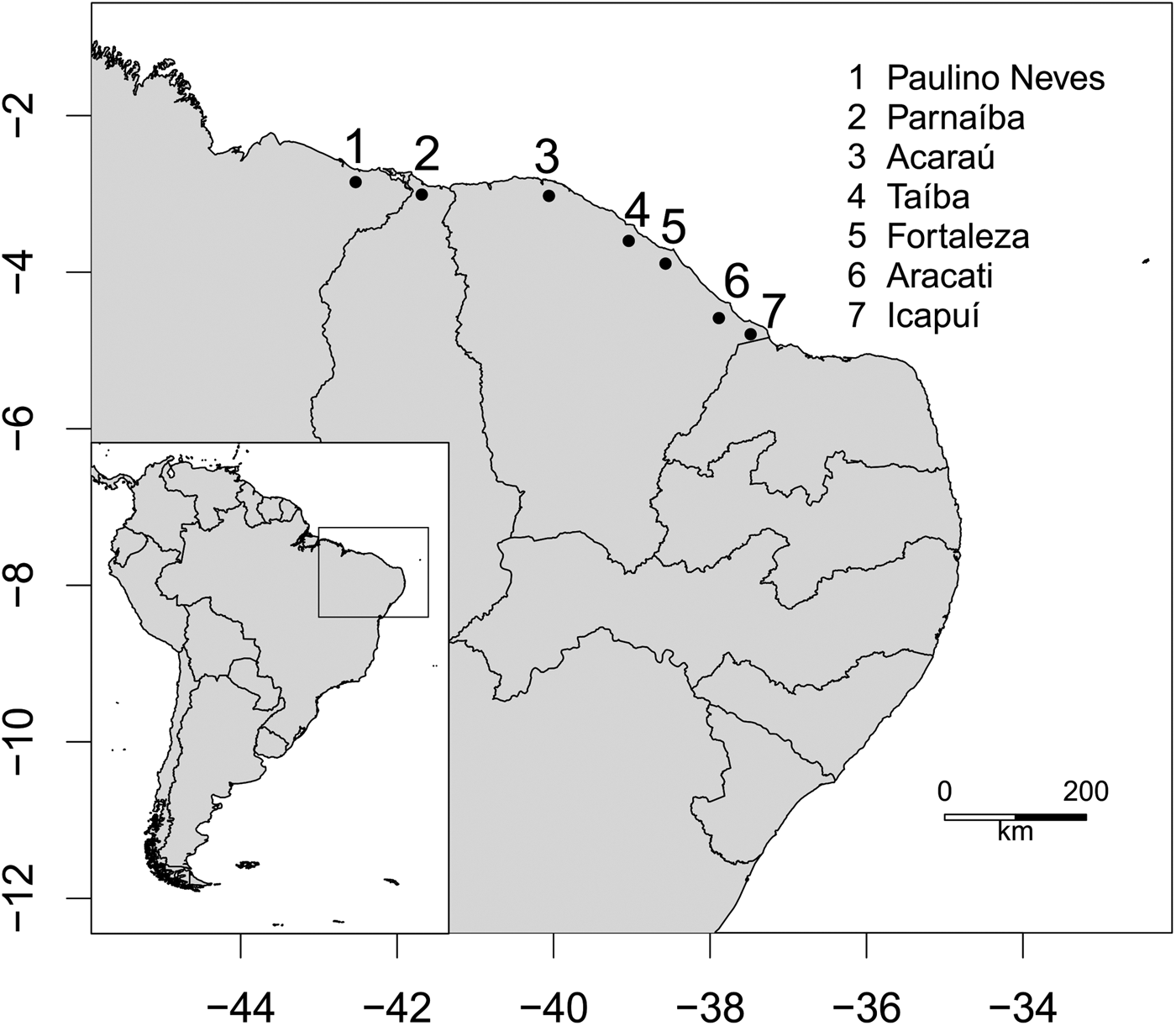
We collected lizards from seven urban sites on the north-eastern coast of Brazil (fig. 1) during the wet season, between March and June 2013. The linear distances between the collection sites varied from 48 to 619 km. This study area is a biogeographically complex region, with vegetal species from several Brazilian biomes, including Caatinga (xerophytic vegetation), Cerrado (savanna-like vegetation), Atlantic and Amazon rainforests and vegetation from a ‘resting’ ecosystem, typical of the Brazilian coast (Ab'Sáber, Reference Ab'Sáber2001; Moro et al., Reference Moro, Macedo, Moura-Fé, Castro and Costa2015). Annual rainfall ranges from 986 to 1222 mm/year, and average temperatures range from 26 to 27.5°C across all collection sites (Santos-Filho, Reference Santos-Filho2009; Oliveira & Frota, Reference Oliveira and Frota2011; Castro et al., Reference Castro, Moro and Menezes2012). We collected lizards manually or with a rubber band (an elastic strip manually fired at a target), between 18:00 and 05:00 h. Individuals were anesthetized with ketamine and euthanized with potassium chloride (AVMA, 2013). The lizards were fixed in 10% formaldehyde, preserved in 70% alcohol and deposited in the ‘Coleção de Herpetologia da Universidade Federal do Ceará’.
Sampling map of Hemidactylus mabouia in Northeast Brazil.

To obtain parasites, we dissected the lizards and inspected their organs (stomach, intestines, lungs, liver, gall bladder and body cavity) for endoparasites. We removed the parasites and preserved them in 70% ethanol. We then identified the helminths and pentastomids and deposited them in ‘Coleção Helmintológica do Departamento de Parasitologia do Instituto de Biociências of Unesp, Campus de Botucatu’. We measured the snout-vent length (SVL) of the lizards using digital callipers (0.01 mm of precision) and evaluated the sex by inspecting the gonads. We used the parasite ecology terms from Bush et al. (Reference Bush, Lafferty, Lotz and Shostak1997).
We used generalized linear models (GLMs) to test differences in prevalence (using binomial distribution) and intensity of infection (using Poisson distribution) related to size (SVL), sex and sites, using the most frequent parasite species found at all sampling sites. In these analyses, we only used the host individuals if we could assess the sex. We used GLM (using negative binomial distribution) to test if parasite richness correlated with host size (SVL). To test the differences in the composition of component communities between sites and differences in the composition of males and females, we performed a permutational multivariate analysis of variance (PERMANOVA) test (with 1000 permutations). We analysed the variables using a significance level of P < 0.05. Analyses were conducted in R program (R Development Core Team, 2018) using MASS and Vegan packages.
Results
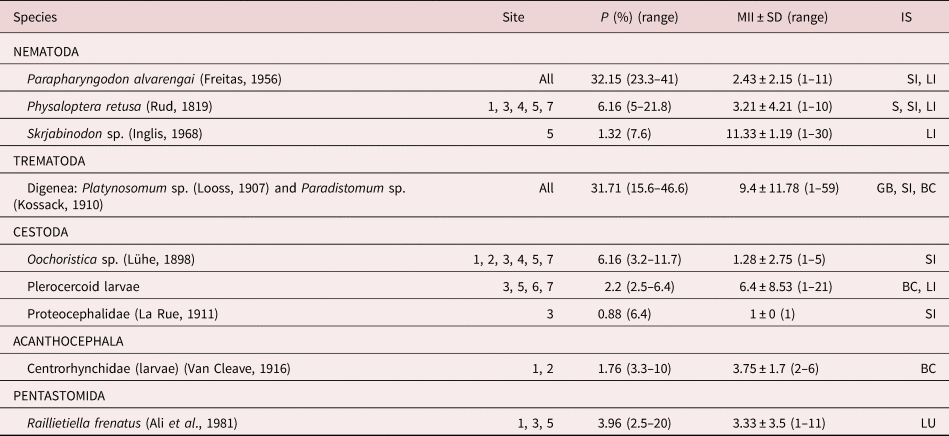
We collected 227 specimens of H. mabouia from the seven sites across the north-eastern coast of Brazil, in which we found one pentastomid and nine helminth species, including one Acanthocephala, two trematodes, three cestodes and three nematodes (table 1). Despite recognizing two species of digenetic trematodes, we could not quantify all specimens due to methodological issues, and they were referred to as Digenea. The nematode Parapharyngodon alvarengai was the most prevalent helminth, present in 32.15% of individuals, and Digenea was the most abundant taxa, with a mean intensity of 9.3 trematodes per host, representing 63.9% of all helminth specimens collected (table 1). Parapharyngodon alvarengai was the only helminth species found at all the sampling sites, so we used this species to test the host–parasite epidemiological relationships for sex, size and geographic variations.
Parasite species of the lizard host Hemidactylus mabouia.

Collection sites: (1) Paulino Neves (n = 30); (2) Parnaíba (n = 30); (3) Acaraú (n = 31); (4) Taíba, São Gonçalo (n = 34); (5) Fortaleza (n = 39); (6) Aracati (n = 31); (7) Icapuí (n = 32). P, prevalence (for all sampled specimens from all sites) and the range among populations; MII, mean intensity of infection; SD, standard deviation; IS, infection sites; S, stomach; SI, small intestine; LI, large intestine; BC, body cavity; LU, lung; LI, liver; GB, gall bladder.
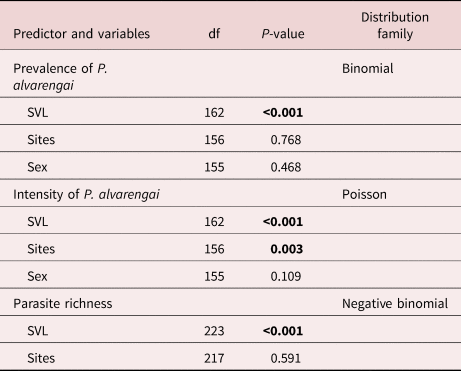
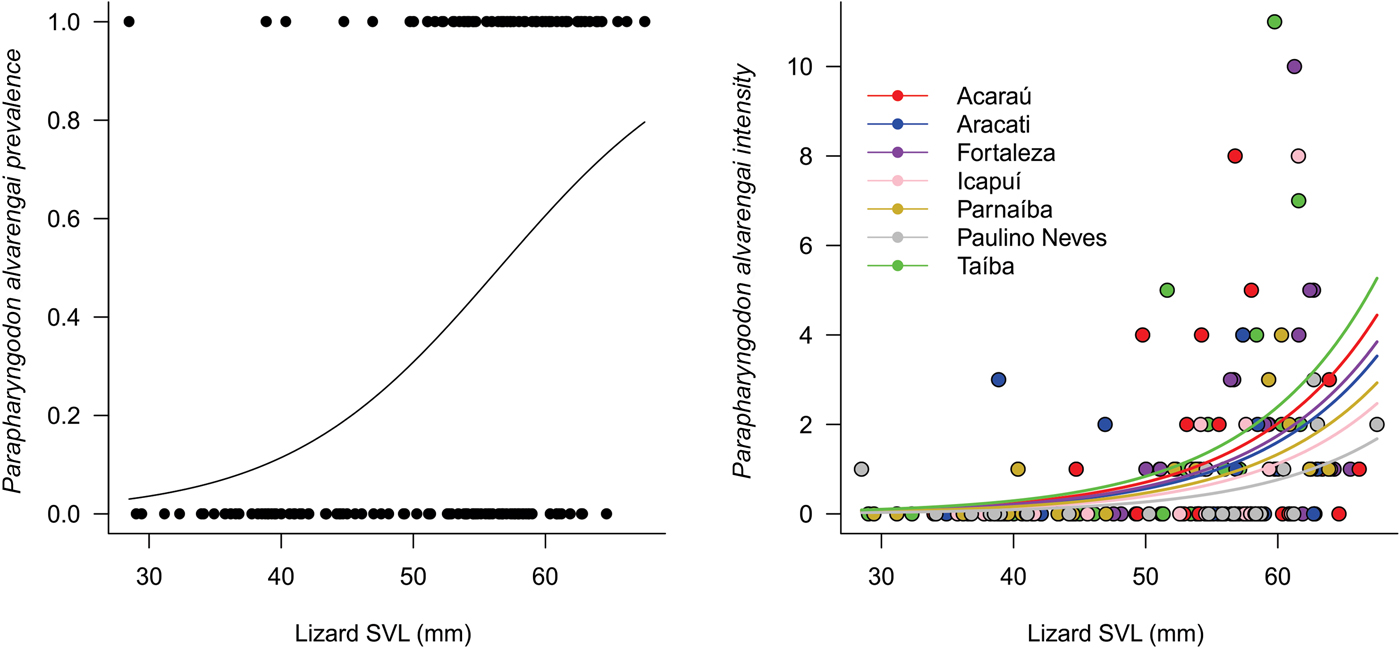
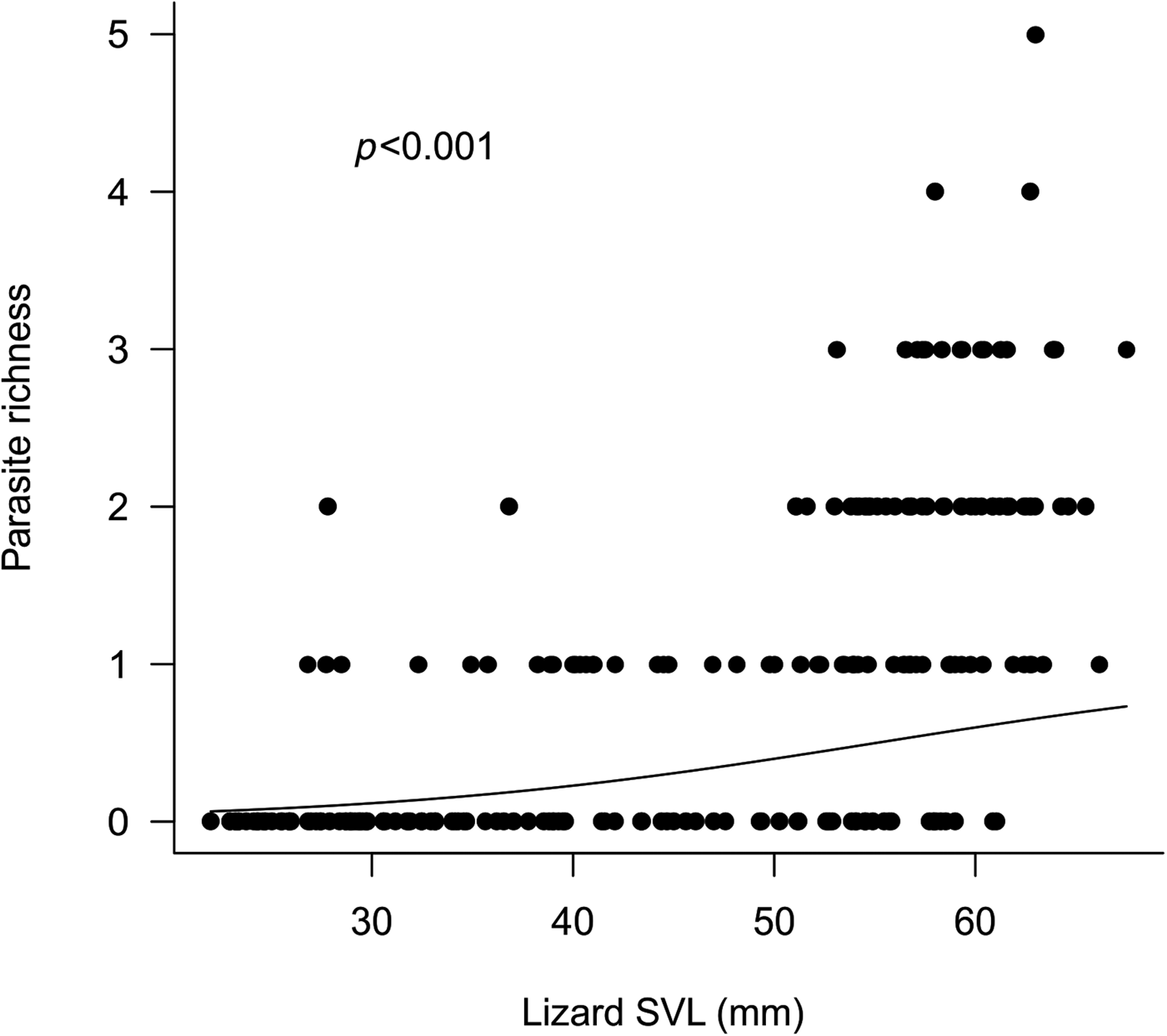
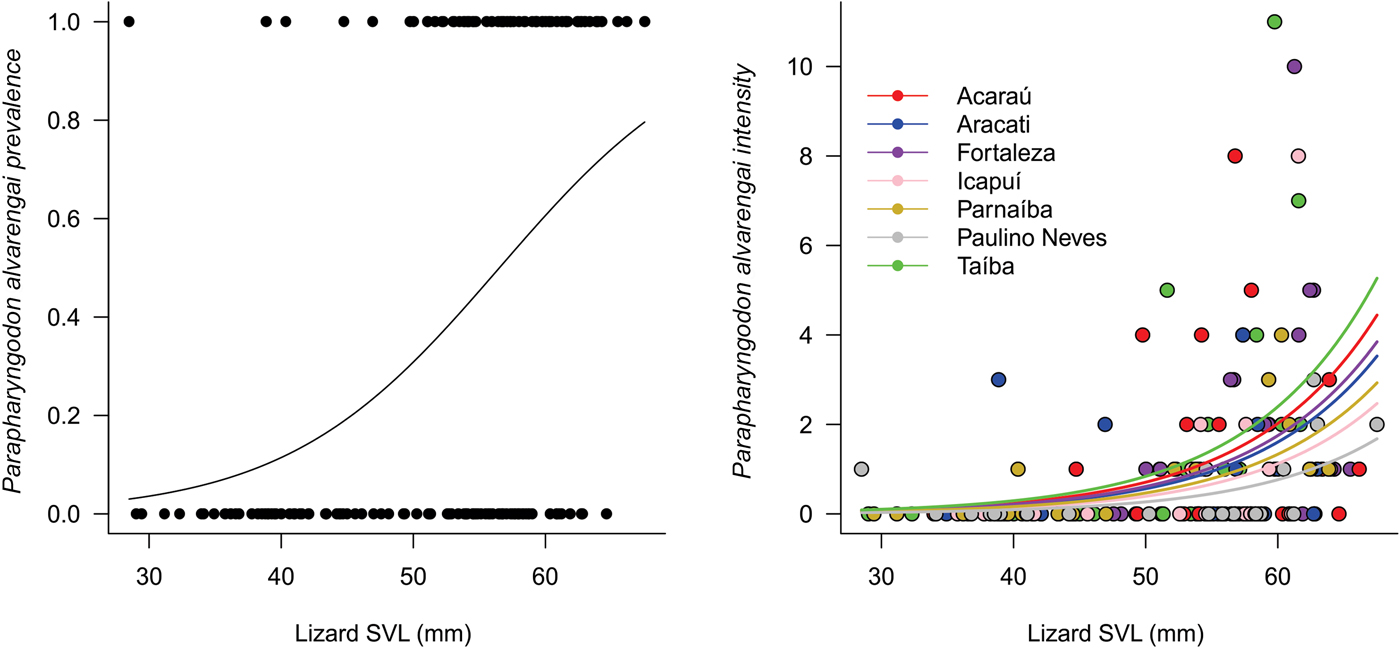
The component communities from each population of the host H. mabouia were slightly different in composition (PERMANOVA: F = 1.78; R 2 = 0.09; P = 0.008). The intensity of infection in P. alvarengai varied across sites, but the prevalence was similar (table 2 and fig. 2). In these analyses, we excluded the host individuals if we were not able to identify the sex, which was usually the case in very young specimens. Host size positively correlated with the prevalence and intensity of infection in P. alvarengai and with endoparasite richness (table 2 and fig. 3). Sex did not influence the composition of the parasite component communities (PERMANOVA: F = 0.911; R 2 = 0.008; P = 0.45), the prevalence or intensity of infection in P. alvarengai (table 2).
GLM analysis results, which we used as predictors of the prevalence and intensity of infection of the most abundant and frequent parasite species found in the host, Hemidactylus mabouia, across all populations (Parapharyngodon alvarengai) and, as response variables, the size (SVL, snout-vent length), sex and collection site of the host.

The last GLM result shows parasite richness as predictor variable and SVL as response.
Prevalence and intensity of infection of the most common parasite found in the host, Hemidactylus mabouia, and their relation to host size (SVL, snout vent length) in the seven sampled sites. Prevalence was similar between sites; however, the intensity relationships differed, representing the relationships of parasite intensity with the different host sizes at the sites.
Relation between the number of endoparasite species (richness) and host size (SVL, snout-vent length) in the lizard, Hemidactylus mabouia, showing an increase of richness with size.

Discussion
Lizards are hosts for several helminth species in Neotropical areas (Ávila & Silva, Reference Ávila and Silva2013), and the host populations investigated in this study had endoparasite component communities of three to seven species. All the parasites can also be found in native host lizards (Ávila & Silva, Reference Ávila and Silva2013), except for Raillietiella frenatus, which probably came with this exotic host from its native habitat (Anjos et al., Reference Anjos, Almeida, Vasconcelos, Freire and Rocha2008). We found variations in the richness and composition of the component parasite communities, which may be associated with the level of anthropic impact between the sampled sites because, although the host H. mabouia may be a characteristic anthropic species, this parasitic fauna is common to other regional lizard species (Ávila & Silva, Reference Ávila and Silva2013). As a result, an area with a low diversity of lizard fauna, such as large urban environments, will probably be accompanied by a poor diversity of parasite fauna, affecting the richness of component communities of all remaining host species.
A few studies have been published on the biogeography of parasitism in wildlife, and these indicate that variation in parasite abundance across space is determined mainly by local-scale biotic and abiotic attributes (Blasco-Costa et al., Reference Blasco-Costa, Rouco and Poulin2015; Fournié et al., Reference Fournié, Goodman and Cruz2015). Both the prevalence and intensity of infection in H. mabouia increase with body size, but we found the correlation with intensity can change between populations, indicating that local environmental conditions or intrinsic properties of the host population and community influence the parasite composition and epidemiological patterns of infection (Borer et al., Reference Borer, Seabloom, Mitchell and Power2010; Seabloom et al., Reference Seabloom, Borer, Mitchell and Power2010). In fact, local host diversity can reduce the risk of infection and disease, and consecutively drive the host community structure (Halliday et al., Reference Halliday, Heckman, Wilfahrt and Mitchell2018), as well as reduce the abundance of some parasites (Civitello et al., Reference Civitello, Cohen and Fatima2015). In this way, differences in parasite abundance and richness between host populations investigated in this study might reflect the local host diversity, which can vary depending on the size of the city and the degree of separation between green areas and, therefore, other lizard species. Small cities, like Paulino Neves, can have a high parasite richness because the contact between H. mabouia with native lizards is more frequent, as there are green areas close to the anthropic buildings where the exotic host H. mabouia live. On the other hand, big cities like Aracati may have many anthropic buildings very distant from natural environments, hampering the transmission of parasites between the exotic and native lizards. Despite it being the largest city, Fortaleza can be considered an exception because the lizards were captured in an area very close to residual native forest, which enables interactions with native fauna and harbours a richness of parasite species.
We found similar compositions and epidemiological levels of infection in male and female lizards. Sex differences in epidemiological levels are expected, due to the physiological, behavioural or life history differences between males and females, which may affect immune responses and the probabilities of being infected throughout life (Vogel & Bundy, Reference Vogel and Bundy1987; Zuk & McKean, Reference Zuk and McKean1996). For example, many parasite species with indirect life cycles are transmitted to their hosts through feeding; therefore, we can expect variations in the parasite species and levels of infection in host species with trophic sexual dimorphism. In our study, most of the parasite species infect their host via their food; however, there are no differences between females and males regarding diet or habitat (unpublished data), which explains why males and females had similar parasite communities and levels of infection.
We found that lizard body size positively correlated with endoparasite richness. This is in line with results from other populations of H. mabouia (Anjos et al., Reference Anjos, Rocha, Vrcibradic and Vicente2005) and for other animal species (Aho, Reference Aho, Esch, Busch and Aho1990; Barreto-Lima et al., Reference Barreto-Lima, Toledo and Anjos2011), in which larger individuals had a higher probability of being infected, more parasite species and a greater abundance of parasites. Differences in body size can reflect ontogenetic differences in physiology, behaviour, habitat or diet, affecting the ways the hosts come in contact with the parasites, and a larger host has a higher chance of becoming parasitized in its lifetime (Poulin, Reference Poulin1997). Moreover, the Island Biogeography Theory (MacArthur & Wilson, Reference MacArthur and Wilson1967) proposed that larger islands shelter more richness than smaller ones and, if we think of the hosts as islands for the parasites (Kuris et al., Reference Kuris, Blaustein and Alió1980), a larger host provides more space and can support more parasite species.
An unusual outcome of our investigation was the frequent and abundant presence of the trematodes Platynosomum sp. and Paradistomum sp. (Digenea group). This group of parasites was not found in other studied populations of H. mabouia in Brazil (Anjos et al., Reference Anjos, Rocha, Vrcibradic and Vicente2005; Ávila et al., Reference Ávila, Anjos, Ribeiro, Morais, Silva and Almeida2012; Sousa et al., Reference Sousa, Brito, Ávila, Teles, Araújo-Filho, Teixeira, Anjos and Almeida2014), despite Pinto et al. (Reference Pinto, Mati and Melo2014) describing this lizard as part of the life cycle of Platynosomum illiciens, for which domestic cats are the main definitive hosts. These felids are common predators of H. mabouia and can carry high levels of infection in anthropic environments. Braga et al. (Reference Braga, Teixeira, Oliveira and Cavalcanti2016) found a 42.5% prevalence and intensity of 1–219 for the trematode in these felids in Fortaleza city, one of the sampling sites in the present study. However, there is no recorded data of digenetic trematodes in sympatric lizards of H. mabouia or in other populations of this species in north-eastern regions of Brazil (Anjos et al., Reference Anjos, Rocha, Vrcibradic and Vicente2005; Ávila et al., Reference Ávila, Anjos, Ribeiro, Morais, Silva and Almeida2012; Bezerra et al., Reference Bezerra, Ávila, Passos, Zanchi-Silva and Galdino2015; Galdino et al., Reference Galdino, Ávila, Bezerra, Passos, Melo and Zanchi2014; Sousa et al., Reference Sousa, Brito, Ávila, Teles, Araújo-Filho, Teixeira, Anjos and Almeida2014). Some Brazilian lizard species that harbour these trematode species contain a prevalence of between 7% and 28%, and intensities range from 1 to 25 (Vrcibradic et al., Reference Vrcibradic, Rocha, Bursey and Vicente2002; Ávila & Silva, Reference Ávila and Silva2013), which is lower than what we observed in our study. The high prevalence and intensity in our data can be explained by conditions of temperature and humidity favourable to both intermediated hosts (molluscs and crustaceans) and metacercaria trematodes (Chai, Reference Chai, Toledo and Fried2014), as well as by the high number of abandoned domestic cats in urban sites, resulting in high levels of infection of both cats and H. mabouia. For these hosts, the high rate of infection can result in a disease-like thickening of the bile duct, mixed inflammatory infiltrate and ductal proliferation (Braga et al., Reference Braga, Teixeira, Oliveira and Cavalcanti2016), which was observed in our study, indicating an unbalanced host–parasite relationship – possibly due to the short time available for evolution with these parasites (Tizard, Reference Tizard and Tizard2004).
Invasive species can be susceptible to native parasites, which can affect their establishment or expansion range. Barnett et al. (Reference Barnett, Phillips, Heath, Coates and Hoskin2018) found a native parasite that may reduce the survival of individuals of the congeneric host Hemidactylus frenatus in an Asian house gecko that had been accidentally introduced to many tropical and subtropical areas. In some places, such as Northern Australia, H. frenatus are spreading from urban areas into bushland (Hoskin, Reference Hoskin2011). This is very similar to what was observed in Brazil for H. mabouia, which has a high abundance in urban areas but was also sometimes found invading natural environments (Rocha et al., Reference Rocha, Anjos and Bergallo2011). Further studies may help to elucidate if the high levels of infections by native parasites can interfere in the complete establishment of this exotic species in some areas of Brazil.
In the current study, we found that one species was more prevalent and abundant in all populations evaluated, but the levels of infection varied according to host size among sites. We did not find any variation in epidemiological patterns associated with sex, which is likely to be due to the similarity in diet and habitat use between male and female H. mabouia. Lastly, we found an unusually high abundance and prevalence of trematodes infecting H. mabouia and have included some hypotheses that may explain this anomaly.
Acknowledgement
We thank the Instituto Chico Mendes de Conservação da Biodiversidade (ICMBio) for granting the license to collect the animals.
Financial support
This work was supported by the Coordenação de Aperfeiçoamento de Pessoal de Nível Superior (CAPES), with the scholarship awarded to the main author (finance code 001) during this research.
Conflicts of interest
None.