A primary developmental task during infancy and early childhood involves the development of self-regulatory capacities. The influence of parenting on this process is key. Infants and young children are highly dependent on their caretakers for regulatory support. Initially regulation is facilitated primarily by the parent, and over time, the infant gradually learns to participate in co-regulatory dyadic processes that lead to the capacity for self-regulation (Beebe, Reference Beebe2011; Beeghly, Fuertes, Liu, Delonis, & Tronick, Reference Beeghly, Fuertes, Liu, Delonis and Tronick2011). Mothers with a history of child maltreatment are at increased risk for psychopathology and exposure to traumatic stress during adulthood, which may impair their ability to support the healthy development of regulatory capacities in their young children. Utilizing a multimethod approach, the current study uses a sample of women with a history of maltreatment to evaluate the influence of a mother's childhood abuse and neglect, and associated adult psychopathology, on her parenting behaviors and to examine whether each of these factors predicts infants’ physiological reactivity and behavioral/emotional regulation following exposure to a social stressor (maternal still-face paradigm; Tronick, Als, Adamson, Wise, & Brazelton, Reference Tronick, Als, Adamson, Wise and Brazelton1978) at 7 months of age.
Infant Biobehavioral Reactivity and Regulation
The capacity for self-regulation underlies psychosocial health, while deficits in regulation are foundational in the development and expression of psychopathology (Tronick & Beeghly, Reference Tronick and Beeghly2011). Regulatory capacities encompass the complex interplay of emotional, physiological, and behavioral components. Successful regulation following exposure to stress involves the ability to modify the intensity and duration of arousal and affective states to avoid excessive stimulation or disorganization, modulate affective expressions, and organize behavior (American Psychiatric Association, 2000). Early regulatory deficits are thought to be strong predictors of individual differences in self-regulation problems in later childhood that, when chronic, may lead to later behavioral and emotional problems. Consistent with this hypothesis, studies show that high behavioral reactivity and poor regulation in infancy are linked to later distress, defiance, and avoidance (for review see Calkins & Degnan, Reference Calkins, Degnan and Ammerman2006).
Behavioral and emotional regulation can be defined as the intrinsic and extrinsic processes underlying the management of emotional arousal and adaptive behavioral responses (Calkins, Reference Calkins1994; Gross, Reference Gross2009; Thompson, Reference Thompson1994). Undoubtedly, emotion regulation involves the management of temperamentally based differences in individual reactivity (Bosquet Enlow et al., Reference Bosquet Enlow, Kitts, Blood, Bizarro, Hofmeister and Wright2011; Rueda & Rothbart, Reference Rueda and Rothbart2009); that is, the capacity for emotion regulation is influenced by individual variability in the intensity and valence of physiological and emotional responses to stimuli. Behavioral and emotional levels of reactivity and regulation are typically measured via parent report or via direct observation in infancy.
Physiological reactivity can be measured via cortisol, a biological marker of the hypothalamic–pituitary–adrenal (HPA) axis stress response. Although psychological stressors eliciting fear, anger, or frustration do not reliably stimulate cortisol secretion in young children from 6 months of age through toddlerhood (Jansen, Beijers, Riksen-Walraven, & de Weerth, Reference Jansen, Beijers, Riksen-Walraven and de Weerth2010), well-documented individual differences in cortisol reactivity exist even early in life, and increased cortisol levels following stressors may constitute a marker of neurodevelopmental risk (Haley & Stansbury, Reference Haley and Stansbury2003; Jansen et al., Reference Jansen, Beijers, Riksen-Walraven and de Weerth2010). Cortisol levels may also influence the development of regulatory capacities and emotional and behavioral disturbances during childhood (Granger, Stansbury, & Henker, Reference Granger, Stansbury and Henker1994; Granger, Weisz, McCracken, & Ikeda, Reference Granger, Weisz, McCracken and Ikeda1996). In contrast, hypoactivation of the HPA axis can be indicative of psychological problems among adults (Heim & Nemeroff, Reference Heim and Nemeroff2009), but the lack of mobilization of the cortisol response appears to be normative and adaptive among infants (Jansen et al., Reference Jansen, Beijers, Riksen-Walraven and de Weerth2010).
A well-validated assessment of infant reactivity and regulatory capacities is the still-face paradigm (SFP; Mesman, van IJzendoorn, & Bakermans-Kranenburg, Reference Mesman, van IJzendoorn and Bakermans-Kranenburg2009; Tronick et al., Reference Tronick, Als, Adamson, Wise and Brazelton1978), which induces robust increases in infant negative affect, a decrease in positive affect, and social disengagement from the mother (Haley & Stansbury, Reference Haley and Stansbury2003; Mesman et al., Reference Mesman, van IJzendoorn and Bakermans-Kranenburg2009). After a still-face episode, when mothers reengage in normal social play with their babies, infants typically exhibit a carryover of negative affect, as well as a partial rebound of positive affect and social engagement with the mother (Mesman et al., Reference Mesman, van IJzendoorn and Bakermans-Kranenburg2009). In terms of physiological responses, increases in cortisol levels are documented among 27% of infants after the SFP (Grant et al., Reference Grant, McMahon, Austin, Reilly, Leader and Ali2009).
The Development of Regulatory Capacities Within a Relational Context
The behavioral and physiological manifestations of reactivity and regulation are shaped by both biological predispositions and early environmental influences (Cole, Zahn-Waxler, Fox, Usher, & Welsh, Reference Cole, Zahn-Waxler, Fox, Usher and Welsh1996; Rueda & Rothbart, Reference Rueda and Rothbart2009), especially early mother–child interactions (Eisenberg et al., Reference Eisenberg, Spinrad, Eggum, Silva, Reiser and Hofer2010; Loman & Gunnar, Reference Loman and Gunnar2010). In early childhood, the caregiving environment interacts with individual predispositions and broader environmental risk factors to shape child development (Sameroff, Reference Sameroff, Olson and Sameroff2009). Infants first learn regulatory skills in the context of the parent–infant relationship, through the repeated experience of being calmed and soothed by the parent (Schore, Reference Schore2003). Research supports strong links between maternal characteristics (maternal mental health) and behaviors (parenting), and infant biobehavioral regulation (e.g., Feldman et al., Reference Feldman, Granat, Pariente, Kanety, Kuint and Gilboa-Schechtman2009; Field, Diego, & Hernandez-Reif, Reference Field, Diego and Hernandez-Reif2009).
Maternal positive parenting refers to a constellation of maternal behaviors (e.g., behavioral and affective sensitivity, engagement, warmth, and positive affect) that are associated with less infant negative affect during stressful situations and more positive affect and social behaviors after the stressor (Braungart-Rieker, Garwood, Powers, & Wang, Reference Braungart-Rieker, Garwood, Powers and Wang2001; Kogan & Carter, Reference Kogan and Carter1996; Mesman et al., Reference Mesman, van IJzendoorn and Bakermans-Kranenburg2009; Weinberg, Tronick, Cohn, & Olson, Reference Weinberg, Tronick, Cohn and Olson1999). Negative parenting has been found to have an opposite effect, with maternal hostility predicting less infant interactive behaviors during the reunion episode (Mesman et al., Reference Mesman, van IJzendoorn and Bakermans-Kranenburg2009). Infants’ ability to reengage in dyadic play and rebound from the stress of the still-face predicts infants’ secure attachment status at 12 months, an important marker of positive infant development (Braungart-Rieker et al., Reference Braungart-Rieker, Garwood, Powers and Wang2001). In contrast, parent–child interactions characterized by low levels of sensitive/responsive parenting and high levels of hostility are associated with increased difficulties regulating distress during challenges, emotional reactivity, more negative mood, and increased fearfulness during infancy and early childhood (Edhborg, Seimyr, Lundh, & Widström, Reference Edhborg, Seimyr, Lundh and Widström2000; Little & Carter, Reference Little and Carter2005; Pauli-Pott, Mertesacker, & Beckmann, Reference Pauli-Pott, Mertesacker and Beckmann2004).
The development of the HPA axis response is also highly influenced by the social environment (Gunnar & Donzella, Reference Gunnar and Donzella2002). Responsive maternal parenting can also buffer infants from high levels of physiological arousal. Greater maternal sensitivity predicts less infant cortisol reactivity to psychosocial stress (Feldman et al., Reference Feldman, Granat, Pariente, Kanety, Kuint and Gilboa-Schechtman2009; Gunnar, Larson, Hertsgaard, Harris, & Brodersen, Reference Gunnar, Larson, Hertsgaard, Harris and Brodersen1992) and lower resting cortisol levels (Blair et al., Reference Blair, Granger, Kivlighan, Mills-Koonce, Willoughby and Greenberg2008), which adaptively minimizes the deleterious neurotoxic effects of chronic brain tissue exposure to cortisol (Charmandari, Tsigos, & Chrousos, Reference Charmandari, Tsigos and Chrousos2005). In contrast, more hostile parenting has been associated with heightened stress-induced cortisol production (Dougherty, Klein, Rose, & Laptook, Reference Dougherty, Klein, Rose and Laptook2011).
A history of childhood maltreatment (i.e., physical, sexual, and psychological abuse, as well as emotional and physical neglect) impacts multiple domains of psychosocial functioning during adulthood, and victims have increased risk for posttraumatic stress disorder (PTSD) and depressive symptomatology (Beitchman, Zucker, Hood, & DaCosta, Reference Beitchman, Zucker, Hood and DaCosta1992; Feerick & Snow, Reference Feerick and Snow2005; Gladstone et al., Reference Gladstone, Parker, Mitchell, Malhi, Wilhelm and Austin2004), high rates of retraumatization (Arata, Reference Arata2002; Barnes, Noll, Putnam, & Trickett, Reference Barnes, Noll, Putnam and Trickett2009; Desai, Arias, Thompson, & Basile, Reference Desai, Arias, Thompson and Basile2002), and increased risk of single parenthood and poverty (Lipman, MacMillan, & Boyle, Reference Lipman, MacMillan and Boyle2001), which may all influence parenting behaviors. Women with histories of childhood sexual abuse report more negative views of their parenting capacities and engage in parenting practices that are both more physically punishing and more permissive (Banyard, Reference Banyard1997; Cole, Woolger, Power, & Smith, Reference Cole, Woolger, Power and Smith1992; Obel et al., Reference Obel, Hedegaard, Henriksen, Secher, Olsen and Levine2005; Robinson, Mandleco, Olsen, & Hart, Reference Robinson, Mandleco, Olsen and Hart1995).
Maternal psychopathology during the postpartum period can also interfere with mothers' capacity to care for her infant. Although individual differences are marked, depressed women as a group tend to be less responsive and attentive, more withdrawn, intrusive, and negative in their interactions with their infants, and report more negative perceptions of their child (Connell & Goodman, Reference Connell and Goodman2002; Feng, Shaw, Skuban, & Lane, Reference Feng, Shaw, Skuban and Lane2007; Gelfand & Teti, Reference Gelfand and Teti1990; Hammen, Burge, & Adrian, Reference Hammen, Burge and Adrian1991; Hammen, Shih, & Brennan, Reference Hammen, Shih and Brennan2004; Reissland, Shepherd, & Herrera, Reference Reissland, Shepherd and Herrera2005). Consequently, infants and young children of depressed women are more likely than children of nondepressed women to show increased levels of negative affect or reactivity (Huot, Brennan, Stowe, Plotsky, & Walker, Reference Huot, Brennan, Stowe, Plotsky and Walker2004), deficits in fear regulation (Davis et al., Reference Davis, Snidman, Wadhwa, Glynn, Schetter and Sandman2004; Feldman et al., Reference Feldman, Granat, Pariente, Kanety, Kuint and Gilboa-Schechtman2009), and heightened cortisol reactivity after a stress-induction task (Brennan et al., Reference Brennan, Pargas, Walker, Green, Newport and Stowe2008; Feldman et al., Reference Feldman, Granat, Pariente, Kanety, Kuint and Gilboa-Schechtman2009).
The effect of maternal PTSD on parenting, and infant reactivity and regulation is less well understood. Some research suggests that traumatized women experiencing PTSD symptoms engage in less sensitive parenting than their nontraumatized counterparts (Levendosky & Graham-Bermann, Reference Levendosky and Graham-Bermann2001), potentially due to heightened fear responses to trauma-related triggers, which result in frequent frightened or frightening behaviors during interactions with their children (Cassidy & Mohr, Reference Cassidy and Mohr2001). Maternal PTSD symptoms are associated with infants’ heighted emotional reactivity during the SFP (i.e., hard crying during the still-face episode) and greater difficulty in regulation and recovery following the stressor (i.e., hard crying after the still-face episode; Bosquet Enlow et al., Reference Bosquet Enlow, Kitts, Blood, Bizarro, Hofmeister and Wright2011). Although only a handful of studies have evaluated the link between maternal PTSD and offspring physiological reactivity, results show increased cortisol reactivity to a fear-induction task among infants of women with concurrent PTSD symptoms, secondary to a history of child abuse (Brand et al., Reference Brand, Brennan, Newport, Smith, Weiss and Stowe2010). However, these studies do not account for the influence of maternal parenting or evaluate the independent effects of maternal childhood maltreatment, psychopathology, and maternal parenting on infant outcomes.
In the current study, we evaluate these associations using a sample of mothers with a high rate of childhood maltreatment. The current study fills an important gap in the literature by examining the independent contributions of mothers’ history of childhood maltreatment and postpartum maternal psychopathology to observer-rated parenting behaviors. In addition, we assessed the influence of poverty and single parenthood, both of which are associated with maternal history of childhood maltreatment, as well as maternal parenting behaviors on infants’ emotional reactivity during stressful experiences (i.e., distress exhibited during a social stressor, the maternal still-face), physiological reactivity to stressors (i.e., stress-related cortisol levels), and emotional regulation following the stressor (i.e., a rebound of positive engagement with mother and positive affect during the SFP reunion episode). Our findings shed light on specific mechanisms that may result in biobehavioral dysregulation among infants of mothers with histories of childhood maltreatment and suggest promising avenues for future research.
Hypotheses
-
1. Women's history of childhood maltreatment will predict higher levels of depressive and PTSD symptoms at 7 months postpartum.
-
2. Women's history of childhood maltreatment, demographic risk factors, and higher depressive and PTSD symptoms will predict maternal parenting at 7 months postpartum.
-
3. Maternal psychopathology and parenting at 7 months will predict infants’ distress levels during a stressor episode, and their behavioral and physiological recovery after the stressor. Specifically, mothers with higher levels of concurrent depressive or PTSD symptoms and lower levels of positive parenting at 7 months postpartum will have infants who display more behavioral reactivity during the still-face episode and who show greater behavioral and physiological evidence of stress or distress following it.
Method
Participants
This research uses data collected through an ongoing longitudinal study (N = 268) that evaluates the effects of a history of childhood maltreatment on mothers’ postpartum psychosocial adaptation and parenting, and whether these factors predict children's behavioral and physiological outcomes (the Maternal Anxiety during the Childbearing Years study; MACY; NIMH K23 MH080147). Participants were recruited either from a pregnancy survey of the effects of PTSD on childbearing via three prenatal care clinics (n = 155; for a comprehensive description, see Seng, Low, Sperlich, Ronis, & Liberzon, Reference Seng, Low, Sperlich, Ronis and Liberzon2009) or through community advertisement (n = 113). Recruitment via the first method involved direct invitation of women at their first prenatal visit. Recruitment through the second method involved flyers posted in antenatal and primary care clinics, informal and state-funded (e.g., WIC, Maternal–Infant Health Programs) resource centers for pregnant and postpartum women, baby clothing and toy stores, and perinatal mental health clinics within the same community. Mothers were eligible to participate if they were at least 18 years of age at intake, were English speaking, were pregnant or had a healthy baby between 0 and 6 months of age who was not born more than 6 weeks prematurely, had no history of schizophrenia or bipolar disorder, and endorsed no problems with alcohol or drugs during the past 3 months. Interested women completed an initial telephone survey to determine eligibility, which included the Childhood Trauma Questionnaire (CTQ; Bernstein & Fink, Reference Bernstein and Fink1998), a measure of childhood maltreatment experiences. Women who met eligibility criteria were invited to participate in the study and provided oral assent for participation. During the first in-person assessment (at 7 months) mothers provided written consent for participation. One hundred and fifteen women were recruited into the study at 4 months postpartum but did not complete the 7-month home visit for several reasons: study team members were unable to contact participants (75%), participants did not want to continue their involvement in the study (11%), participants were ineligible (11%), or participants had moved (3%). The women who did not complete the 7-month home visit did not differ from the rest of the sample on the severity of childhood maltreatment experienced or their levels of depression and PTSD, but they had significantly lower yearly income than the women who completed the 7-month home visit.
Analyses in the current study were based on data collected from a subset of 153 mother–infant dyads (52% with male infants) that completed the 7-month home assessment. Ninety-four women came from the pregnancy survey and 59 came from the community recruitment. Community recruits had lower income and higher levels of childhood maltreatment, depression, and PTSD symptoms, but they did not differ in regards to infant outcomes. At intake, mothers’ age ranged from 18 to 45 years (M = 29.06, SD = 5.67). Fifty-six percent of the mothers self-reported their race/ethnicity as Caucasian, 22% as African American, 13% as multiracial, 4% as Hispanic, and 5% as “other.” Seventy-seven percent of the mothers were married or living with a partner, whereas 23% were single and/or not living with a partner. The sample varied in educational and socioeconomic status: 15% of the mothers had completed a high school degree or less education, 30% had completed some college, 31% had completed a bachelor's degree, and 24% had attained postgraduate education (master's or doctoral degree). The median annual family income was $45,000–49,999 with a range from below $15,000 to $150,000 yearly. Seventy-six percent of mothers had a history of childhood maltreatment, and many women experienced multiple forms of abuse, including emotional abuse (60%), emotional neglect (50%), physical abuse (35%), physical neglect (31%), and sexual abuse (43%). Participating women were classified as maltreated and with a history of PTSD (50%), maltreated without a history of PTSD (27%), and nonmaltreated without a history of PTSD (23%).
Procedure
All participants completed the screening questionnaire when their infants were about 4 months old and agreed to complete two home assessments when their baby was 7 months old. During the first home visit, mothers signed a written consent to participate with their infants in the study, completed interviews and interactive tasks, and were left with a packet of self-report questionnaires to complete, which was retrieved at the second home visit (approximately 1–2 weeks later). A small percentage of dyads (12%) did not complete the SFP during the first home visit but completed it instead during the second home visit. Preliminary bivariate analyses showed that salivary cortisol reactivity was not different for infants who completed the SFP on the first versus the second home visit. The examiners who conducted the home visits were all trained bachelor's or master's level study team members.
Measures
Dependent variables: Infant outcomes
The primary dependent variables in this analysis were infants’ behavioral and affective responses during the still-face episode and the reunion episode of the SFP (Tronick et al., Reference Tronick, Als, Adamson, Wise and Brazelton1978) and infants’ physiological responses (cortisol reactivity) following the SFP. The SFP is a widely used, well-validated observational paradigm designed to evaluate individual differences on maternal and infant behavioral and physiological responses before and after a social interactive challenge (a maternal still face). In the current study, the SFP was videotaped in the home setting when infants were about 7 months old (M = 6.14 months, SD = 0.71, range = 5–8). Prior research has demonstrated the feasibility of conducting the SFP in the home environment with infants at this age (Meijssen et al., Reference Meijssen, Wolf, Koldewijn, Houtzager, van Wassenaer and Tronick2010; Neu & Robinson, Reference Neu and Robinson2010). During the SFP, the baby was seated in an infant car seat on the floor facing the mother. A mirror was placed behind the dyad to allow for optimal camera views of each partner. The SPF comprised three successive 2-min episodes: a “normal” dyadic play episode (Play 1), during which the mother was asked to play with her infant in an en face position in a normal manner; followed by a maternal still-face episode, during which the mother was instructed to hold a neutral/unresponsive face while looking at her infant and to refrain from touching or talking to the infant; followed by a reengagement episode (the reunion), during which the mother resumes her normal social play with the infant. No toys or pacifiers were allowed during the SFP.
Coding of infant behavior
Infants’ behavior during each episode of the SFP was scored from videotapes by a trained, reliable coder masked to maternal trauma history and other study variables using relevant scales from the MACY Infant–Parent Coding System (MIPCS; Earls, Muzik, & Beeghly, Reference Earls, Muzik and Beeghly2009). The MIPCS includes 14 maternal, 10 infant, and 4 dyadic rating scales (all described as 5-point Likert scales) that assess multiple dimensions of mother–infant interactive behavior relevant to attachment formation as guided by attachment theory and related literature (e.g., Ainsworth, Blehar, Waters, & Wall, Reference Ainsworth, Blehar, Waters and Wall1978; Crittenden, Reference Crittenden1981; Lyons-Ruth, Bronfman, & Parsons, Reference Lyons-Ruth, Bronfman and Parsons1999; Lyons-Ruth, Zoll, Connell, & Grunebaum, Reference Lyons-Ruth, Zoll, Connell and Grunebaum1986; Main & Hesse, Reference Main and Hesse1990). With a few exceptions, MIPCS scales were adapted from those used in several extant scoring systems (e.g., Beeghly, Reference Beeghly2006; Clark & Seifer, Reference Clark and Seifer1985; Dayton, Levendosky, Davidson, & Bogat, Reference Dayton, Levendosky, Davidson and Bogat2010; Egeland & Hiester, Reference Egeland and Hiester1995; Feldman, Reference Feldman1998). Infants’ level of distress during the still-face episode was scored using the MIPCS infant negative affect scale (M = 1.24, SD = 1.03, range = 0–3) and used as a covariate to control for individual differences in infant reactivity prior to the reunion episode (Rueda & Rothbart, Reference Rueda and Rothbart2009). A composite variable reflecting infants’ positive “recovery” from stress during the reunion episode was derived using principal-components factor analysis. The positive recovery score (M = 2.56, SD = 0.84, range = 1.00–4.67) is the sum of three interrelated infant scales: responsivity/compliance, social engagement, and positive affect. The standardized Cronbach α for this variable was 0.86.
Intercoder reliability with the primary coder was assessed for each infant scale described above using intraclass correlations (ICC) on 40 randomly selected videotapes that were independently scored by a trained coder masked to maternal trauma history and background variables. Each scale had good to excellent intercoder reliability: infant responsivity/compliance ICC = 0.91, infant social engagement ICC = 0.89, infant positive affect ICC = 0.95, and infant negative affect ICC = 0.94.
Infant salivary cortisol
Repeated saliva samples were collected from the infant before (baseline) and after the SFP. The baseline was collected 15 min into the home visit, after the consent form was explained and signed, and before any interactive tasks had begun. Consistent with established protocols (Granger et al., Reference Granger, Cicchetti, Rogosch, Hibel, Teisl and Flores2007), cortisol was collected again 20, 40, and 60 min following the SFP. Mothers were asked to place a cotton roll, securely attached to a strand of floss, in their infant's mouth until it was saturated with saliva. It was then removed and placed in a Salivette Tube (Sarstedt, Sevelen, Switzerland). Saliva samples were centrifuged at 7000 rpm for 10 min, and stored at –20 °C until assayed. Samples were assayed using one of three techniques based on lab and equipment availability: ELISA (40%), RIA (21%), or Immulite (39%). All samples from the same infant were assayed in the same batch to minimize interassay variation. Inter- and intraassay coefficients of variation were consistently below 10%. Following the assays, cortisol data were cleaned. Samples with values above 3 mg/dl, which indicate likely errors, were deleted, as were samples whose cortisol values fell three or more standard deviations above or below the assay means. In the samples retained, cortisol values ranged from 0.01 to 1.36 mg/dl.
Several variables were recorded as potential covariates in cortisol analyses. Given known diurnal fluctuations in resting cortisol levels among older children and adults, sample collection time was recorded. Infants’ birth weight, health at the time of the 7-month visit, and the time at which infants were last fed and last slept that day were also recorded.
Classification of infant cortisol response
Following Schuetze, Lopez, Granger, and Eiden (Reference Schuetze, Lopez, Granger and Eiden2008), infants who displayed a cortisol increase ≥10% from baseline at 20 or 40 min post-SFP were classified as “responders” (Schuetze et al., Reference Schuetze, Lopez, Granger and Eiden2008). Infants who did not increase by at least 10% after the SFP were classified as “nonresponders.” This classification system was adopted based on the inter- and intraassay variability coefficients (>10%), such that difference scores higher than 10% represent an increase unlikely to be due to chance. Using this methodology, cortisol responder status has reliably discriminated individual and environmental characteristics in previous research, including higher prenatal tobacco exposure (Schuetze et al., Reference Schuetze, Lopez, Granger and Eiden2008), more negative emotional reactivity during frightening and frustrating tasks among infants (Fortunato, Reference Fortunato2009) and more avoidance during social interactions among toddlers (Corbett, Schupp, Simon, Ryan, & Mendoza, Reference Corbett, Schupp, Simon, Ryan and Mendoza2010). Within our sample, 48% of infants were classified as responders and 52% as nonresponders. The percentage of children classified in each group was not significantly different across assay techniques.
To validate this classification method within our sample, we also examined the trajectories of change in cortisol levels. Twenty-three percent of infants showed a ≥10% increase from baseline to post-SFP (at 20 or 40 min), 45% showed a ≥10% decrease from baseline to post-SFP (at 20 or 40 min), and 22% showed an unstable pattern, such that they displayed increased cortisol levels at one post-SFP time point and decreased cortisol levels at another post-SFP time point (e.g., decreasing ≥10% from baseline to 20 min and increasing ≥10% from baseline to 40 min). A preliminary comparison of these three groups using analysis of variance revealed that infants who showed the decreasing pattern of cortisol differed from those who increased or were unstable, showing more positive affect during the SFP reunion and higher levels of maternal positive parenting. Responder and unstable infants did not differ in their environmental or individual characteristics, suggesting that cortisol increase is the key element that distinguishes infants. Thus, the responder (1) versus nonresponder (0) classification was used in all statistical analyses.
Independent variables: Maternal parenting and risk factors
Maternal parenting
Multiple dimensions of maternal parenting behavior were scored from videotapes of mother–infant interaction during two different tasks: a 5-min free-play task and a 6-min teaching task. The free-play task was completed twice (once during each home visit), and an average score was computed to reflect how dyads typically interact under nonchallenging circumstances. A standard set of age-appropriate toys provided by the study team was arranged on a quilt on the floor, and mothers were invited to play with their infant as they normally would. Following one of the two free-play sessions, dyads participated in two consecutive teaching tasks (each lasting about 3 min). In the first task, mothers were instructed to teach their infant how to put colorful plastic blocks into a bucket. In the second task, mothers were instructed to teach their infant how to stack a set of nesting cups and then knock them down. Both teaching tasks were designed to be beyond the infants’ developmental capacities and were used to provide an assessment of maternal parenting under more challenging circumstances. Laboratory free-play tasks have been demonstrated to have moderate ecological (Goossens & Melhuish, Reference Goossens and Melhuish1996), concurrent (Clark, Reference Clark1999), and predictive validity (Aoki, Zeanah, Heller, & Bakshi, Reference Aoki, Zeanah, Heller and Bakshi2002) for both maternal- and infant-coded behaviors.
Maternal behavior was scored by a trained, reliable coder using the maternal ratings included in the MIPCS (described above). Maternal ratings in the two teaching tasks were significantly correlated and averaged for analytic purposes. Intercoder reliability for each maternal rating scale was assessed using ICCs. Trained coders masked to maternal trauma history and other study variables independently scored 40 randomly selected videotapes. The ICCs for the maternal scales were generally well above 0.80, with one exception (see below), denoting very good intercoder agreement: maternal behavioral sensitivity ICC free play = 0.85, ICC teaching tasks = 0.86; maternal engagement ICC free play = 0.86, ICC teaching tasks = 0.71; maternal warmth ICC free play = 0.84, ICC teaching tasks = 0.91; maternal affective sensitivity ICC free play = 0.86, ICC teaching tasks = 0.85; maternal positive affect ICC free play = 0.93, ICC teaching tasks = 0.85; maternal hostility ICC free play = 0.87, ICC teaching tasks = 0.87; and maternal overcontrolling behaviors ICC free play = 0.88, ICC teaching tasks = 0.89.
Following a conceptually driven data reduction analysis (principal-components factor analysis), positive parenting composite scores were computed for the free-play task and the teaching task, by averaging scores from the five interrelated maternal rating scales. The standardized Cronbach α for the positive parenting composite during free play was 0.92, and scores ranged from 1.63 to 4.58 (M = 3.76, SD = 0.65). The standardized Cronbach α for the positive parenting score during the teaching tasks was 0.92 and scores ranged from 1.46 to 4.54 (M = 3.14, SD = 0.74). The hostility and overcontrolling scores emerged as independent factors.
Maternal history of child abuse
The CTQ (Bernstein & Fink, Reference Bernstein and Fink1998) was completed by mothers at 4 months postpartum. Mothers self-rated their childhood maltreatment experiences on a 28-item, 5-point Likert scale (1 = never true, 5 = very often true). The CTQ yields subscale scores for childhood emotional, physical, or sexual abuse, as well as physical and emotional neglect. Test–retest reliabilities range from 0.79 to 0.86, and good validity has been reported, based on correlations with trauma sequelae (Bernstein & Fink, Reference Bernstein and Fink1998), a structured interview for childhood trauma, and therapist ratings of childhood trauma (Bernstein et al., Reference Bernstein, Stein, Newcomb, Walker, Pogge and Ahluvalia2003). In the present study, a total abuse score was obtained by adding the abuse and neglect scales. Scores ranged from 25 to 121 (M = 44.49, SD = 17.66).
Maternal depressive symptoms
Mothers reported current depressive symptoms at the 7-month home visit using the Postpartum Depression Screening Scale (PPDS; Beck & Gable, 2002). The PPDS includes 35 items that are rated using a 5-point Likert scale (1 = strongly disagree, 5 = strongly agree). Scores are summed to yield a total symptom score. This scale has a sensitivity of 0.78, a specificity of 0.99, and a positive predictive value of 0.93 compared with a Structured Clinical Interview of DSM Disorders (SCID) depression diagnosis. In prior research with postpartum women, internal consistency was standardized Cronbach α of 0.97 (Beck & Gable, Reference Beck and Gable2000). A score of 80 or higher denotes clinically significant symptomatology (Beck & Gable, Reference Beck and Gable2000). Twenty-five percent of women had clinically significant depression at the 7-month data collection. In the present study, a continuous total score was used in the statistical analyses. PPDS scores in this sample ranged from 35 to 132 (M = 63.79, SD = 23.31).
Maternal PTSD symptoms
Mothers reported on their lifetime PTSD symptoms during the telephone screening or at the home visits. Women also reported their current PTSD symptoms at the 7-month home visit using the National Women's Study PTSD Module (Resnick, Kilpatrick, Dansky, Saunders, & Best, Reference Resnick, Kilpatrick, Dansky, Saunders and Best1993). This 26-item instrument is a version of the Diagnostic Interview Schedule that was modified for use in large epidemiological studies. The scale items assess all three PTSD domains (intrusion, avoidance, and hyperarousal), and an algorithm follows DSM-IV criteria to derive a PTSD diagnosis (must meet at least one intrusion, three avoidance, and two hyperarousal symptoms). External validity is good, as shown by adequate agreement (κ = 0.77) with a clinician-administered structured interview (SCID), high sensitivity of 0.99, and adequate specificity of 0.79, as compared with the SCID (Resnick et al., Reference Resnick, Kilpatrick, Dansky, Saunders and Best1993). Twenty-seven percent of women met PTSD criteria at the 7-month data collection. A continuous current PTSD symptom count score was used in statistical analyses. PTSD scores ranged from 0 to 17 in this sample (M = 4.51, SD = 4.55).
Psychosocial stress exposure
During the 4-month telephone interview, mothers reported on their exposure to specific stressors and traumatic events during the time interval between 6 weeks and 4 months postpartum using a modified version of the Life Stressors Checklist (Wolfe & Kimerling, Reference Wolfe and Kimerling1997). Items included common stressful or traumatic experiences, such as environmental and interpersonal stressors (e.g., money problems, harassment, and physical or sexual abuse). For analytic purposes in this study, a total trauma exposure score was computed adding all items, ranging from 0 to 6 (M = 0.81, SD = 0.97).
Demographics
During the 7-month home visit, mothers reported on their current living situation, relationship status, race/ethnicity, employment status, and education level, and provided information regarding their family's total annual income.
Results
Missing data
Results of preliminary bivariate analyses revealed no evidence for differential attrition: the subsample of participants who completed the 7-month visit (N = 153) did not differ significantly from the participants in the larger MACY study (N = 268) on key demographic characteristics, including maternal age, race/ethnicity, education, or partner status, the family's total annual income, or infant race/ethnicity or gender. In the present analysis, 9% of all data points were missing overall. For infant salivary cortisol, the most common reason for missing scores was the infant being asleep at the time or unable to provide enough saliva for the assay. Those infants with complete salivary cortisol data did not differ from those with missing samples on any demographic or independent variable evaluated. Bivariate associations showed no relationships between any cortisol measures (including responder status) and time of sample collection, infants’ birth weight, infants’ health at the time of the 7-month visit, or time from last feeding or sleeping. Therefore, these factors were not included in final statistical models.
Reasons for missing behavioral data included technical problems with videotaping, participant scheduling conflicts, or examiner error. Mother–infant dyads with complete observational data did not differ from those with missing scores on any demographic or risk variable included in this study. Thus, there is no indication of sample bias owing to missing data. Full information maximum likelihood (FIML) was used to handle missing data in all statistical analyses. The FIML approach fits the model to all of the nonmissing values for each observation and maximizes power by using all of the participants in the analysis (Widaman, Reference Widaman2006). In addition, the M-plus program, which is used for the structured equation models (SEM) reported in this paper, employs test statistics in FIML that are robust to nonnormally distributed data (Allison, Reference Allison2003; Muthén & Muthén, Reference Muthén and Muthén2007).
Descriptive statistics
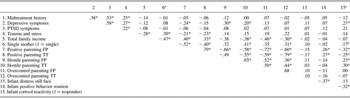
Bivariate correlations were used for preliminary examination of the pattern of associations between variables. Pearson product-moment correlation was used to measure the association between continuous variables, while point-biserial correlations and the phi coefficient were used for the two dichotomous variables (single mother and cortisol reactivity). As seen in Table 1, a history of childhood maltreatment was significantly associated with increased psychosocial stress postpartum, as well as current levels of depressive and PTSD symptoms. Positive parenting was not associated with a history of childhood maltreatment, severity of abuse, or type of abuse (i.e., physical vs. sexual). Maternal positive parenting showed moderate to strong associations with demographic risk variables (i.e., total annual income and single mother status), and with maternal postpartum PTSD and depressive symptoms. Infants’ positive behavior during the reunion episode of the SFP was associated with maternal positive parenting and infant distress during the still-face episode. Finally, infants’ cortisol reactivity status (responder vs. nonresponder) was moderately associated with maternal levels of depression and maternal positive parenting.
Bivariate correlations between all variables

Note: PTSD, posttraumatic stress disorder; FP, free play task; TT, teaching task.
a Point-biserial correlation.
b Phi coefficient.
*p < .05.
Hypothesis testing
To investigate the relationships among maternal history of childhood abuse, environmental risk, maternal psychopathology, and maternal parenting on infant behavioral and physiological dysregulation, SEM was used. All SEM models were fitted using M-plus 5.2 (Muthén & Muthén, Reference Muthén and Muthén2007) with FIML estimation. Global model fit was evaluated using the overall χ2 test of model fit (p > .05), the root mean square error of approximation (RMSEA < 0.08; Browne & Cudeck, Reference Browne, Cudeck, Bollen and Long1993), and the comparative fit index (CFI > 0.95). Based on the widely used guideline of 5 to 10 cases per parameter, the present sample size was appropriate for model testing.
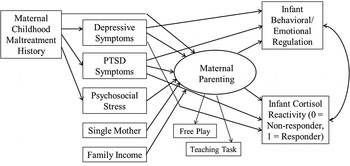
The hypothesized model is displayed in Figure 1. A history of childhood maltreatment was predicted to influence mothers’ postpartum exposure to psychosocial stressors, depressive and PTSD symptom levels, and maternal parenting quality. In addition, maternal depressive and PTSD symptom levels and environmental risks (psychosocial stress, being a single parent, and total family income) were expected to predict maternal parenting in observed mother–infant interactions across both low- and high-challenge observational tasks. Finally, our indices of maternal mental health and parenting behaviors assessed at 7 months were hypothesized to influence each infant's behavioral and physiological regulation following a social stressor (SFP) at the same age. Infants’ observed levels of positive affect and behavior during the post-still face reunion were used as the behavioral outcome, while children's classification as cortisol nonresponder (0) or responder (1) following the SFP was used as the physiological outcome. Because of the high correlation among the three dimensions of maternal parenting (i.e., positive parenting, overcontrolling behaviors, and hostility), three independent models were estimated, each examining one of the parenting variables.
The partial mediation model and the proposed direct and mediated effects of maternal childhood abuse on maternal parenting via maternal psychopathology and traumatic stress. Direct and indirect effects for maternal psychopathology on infant biobehavioral regulation via maternal positive parenting are also included. PTSD, posttraumatic stress disorder.

For the model including positive parenting, global fit indices indicate the proposed model does not provide a good fit for the observed data (χ2 = 72.90, df = 24, p = .00; CFI = 0.85, RMSEA = 0.12). The paths predicting infant outcomes from maternal levels of depressive and PTSD symptoms at 7 months were nonsignificant and were taken out of the model. In addition, maternal positive parenting at 7 months was not associated with maternal childhood maltreatment history. To further examine this association, post hoc correlations between different types of childhood abuse and maternal parenting were estimated. All correlations were nonsignificant (r = –.13 to .05). In addition, analysis of variance was used to compare the parenting of those who experienced severe abuse and those who did not. Results indicated nonsignificant differences: F (1, 140) = 0.26, p = .61 for free-play positive parenting, and F (1, 140) = 0.08, p = .78 for teaching-task positive parenting. Thus, the path from childhood maltreatment to positive parenting was also dropped from the model. Model trimming resulted in improved fit (χ2 = 77.47, df = 29, p = .01; CFI = 0.85, RMSEA = 0.11). In addition, and consistent with expectations, maternal levels of depression and anxiety at 7 months were highly correlated, although each measure was differentially associated with maternal positive parenting. When the correlation between depressive and PTSD symptoms was included, model fit was good (χ2 = 42.32, df = 28, p = .04; CFI = 0.96, RMSEA = 0.06).
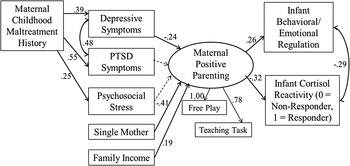
The final model (see Figure 2) explained 10% of the variance in infants’ cortisol responder status and 7% of the variance in infants’ positive behavioral and affective responses during the reunion episode of the SFP. A history of childhood maltreatment significantly predicted higher levels of maternal depressive symptoms (standardized b = 0.39, p = .00), PTSD (standardized b = 0.55, p = .00), and psychosocial stress (standardized b = 0.25, p = .00) at 7 months postpartum. In turn, higher levels of maternal depressive symptoms (standardized b = –0.24, p = .01), being a single mother (standardized b = –0.41, p = .00), and income (standardized b = 0.19, p = .02) were significantly associated with maternal parenting. Finally, positive maternal parenting at 7 months predicted a higher level of infants’ positive behavior and affect during the reunion episode of the SFP at the same age (standardized b = 0.26, p = .00) and decreased the odds of infants being classified as cortisol responders (standardized b = –0.32, p = .00). The indirect effect of depression on infant outcomes via positive parenting was tested, and it was significant for both cortisol responder status (standardized b = 0.07, p = .04), and infant positive behavior and affect during the SFP reunion (standardized b = –0.06, p = .04).
Structural equation modeling results using full information maximum likelihood with standardized parameter estimates. Solid lines indicate p < .05, and dashed lines indicate p > .05. PTSD, posttraumatic stress disorder.

The second model examined a maternal hostility latent variable. Again, the proposed model does not provide a good fit for the observed data (χ2 = 76.15, df = 24, p = .00; CFI = 0.81, RMSEA = 0.12). Similar to the previous models, the paths predicting infant outcomes from maternal levels of depressive and PTSD symptoms, and the path from childhood maltreatment history to maternal hostile parenting behaviors were nonsignificant and removed the model. Following the previous model, the correlation between maternal depression and PTSD was included in the model to account for the high levels of comorbidity observed.
The final model provided an adequate fit for the data (χ2 = 44.66, df = 28, p = .02; CFI = 0.94, RMSEA = 0.06), but it only explained 6% of the variance in infants’ cortisol responder status and about 1% of the variance in infants’ positive behavioral and affective responses during the reunion episode of the SFP. Similar to the previous model, hostile maternal parenting was predicted by maternal depression (standardized b = 0.32, p = .00), income (standardized b = –0.24, p = .01), and being a single mother (standardized b = 0.45, p = .00). In turn, maternal hostile parenting was only associated with infant cortisol (standardized b = 0.25, p = .01), predicting an increase in the likelihood of being a responder. There was no association between maternal hostile parenting and infant behavioral/emotional outcomes. The indirect effect of depression on infant outcomes via negative parenting was tested, but it only approached significance at a trend level (standardized b = 0.002, p = .052).
Finally, the model including maternal overcontrolling behaviors was estimated. The proposed model had inadequate fit estimates (χ2 = 75.06, df = 24, p = .00; CFI = 0.81, RMSEA = 0.12). In this model, overcontrolling parenting was only associated with household income and maternal marital status, while infant outcomes were not significantly associated with any of the risk factors included in the model. Following the steps taken for the two previous models (i.e., direct paths from maternal history of childhood maltreatment to overcontrolling parenting and from maternal overcontrolling behaviors to infant outcomes were removed from the model), the correlation between maternal depression and PTSD was estimated, and the trimmed model demonstrated improved fit (χ2 = 45.42, df = 28, p = .02; CFI = 0.93, RMSEA = 0.06), but it did not explain a significant amount of variance in infant outcomes. Overcontrolling maternal parenting was only predicted by demographic risk (income standardized b = –0.30, p = .00; maternal single status standardized b = 0.31, p = .00), and infant outcomes were not significantly associated to maternal overcontrolling parenting.
The models were also estimated controlling for the association between an infant's distress during the still-face episode and the infant's positive affect and behavior during the recovery episode, and results were unchanged. To explore potential differences between participants recruited from the community and those who previously participated in the pregnancy trauma survey, a two-group SEM model was estimated. Model fit for this model was acceptable, but it was worse than that of the more parsimonious one-group model, suggesting that the initial one-group model provides the best explanation for these data.
Discussion
Using observational, self-report, and biobehavioral assessments, the present study examined the association of a maternal history of maltreatment during childhood, maternal PTSD, and depressive symptoms at 7 months postpartum, with concurrent assessments of maternal parenting and children's behavioral and physiological reactivity and regulation following exposure to a relational stressor (SFP). Findings suggest that a history of child maltreatment, in and of itself, is not associated with decreases in maternal positive parenting or increases in negative parenting at 7 months postpartum. However, survivors of child maltreatment were more likely to report postnatal psychosocial stress and higher levels of depressive and PTSD symptoms. In turn, high levels of depressive symptoms, though not PTSD symptoms, were associated with less positive and more hostile maternal parenting behaviors. Further, less positive maternal parenting was associated with more infant physiological reactivity and less behavioral/emotional regulation. Increases in hostile parenting were also associated with infant physiological reactivity but not with behavioral/emotional regulation.
Maternal positive parenting
Consistent with prior studies of physically and sexually abused women (Arata, Reference Arata2002; Barnes et al., Reference Barnes, Noll, Putnam and Trickett2009; Beitchman et al., Reference Beitchman, Zucker, Hood and DaCosta1992; Feerick & Snow, Reference Feerick and Snow2005; Gladstone et al., Reference Gladstone, Parker, Mitchell, Malhi, Wilhelm and Austin2004), our results suggest that a history of maltreatment during childhood is robustly associated with higher adult levels of depressive symptoms, PTSD symptoms, and exposure to psychosocial stress. However, contrary to our prediction, a history of childhood maltreatment was not directly associated with maternal positive or negative parenting behaviors. Further, post hoc mean difference and correlational analyses revealed that maternal parenting was also not influenced by the severity of abuse or the type of abuse experienced (i.e., physical vs. sexual). Opposite to findings using women's self-reports of parenting, previous objective observations of mother–child interactions have shown similar levels of maternal sensitivity, support, assistance, and confidence among abused and nonabused mothers (DiLillo, Tremblay, & Peterson, Reference DiLillo, Tremblay and Peterson2000; Fitzgerald, Shipman, Jackson, McMahon, & Hanley, Reference Fitzgerald, Shipman, Jackson, McMahon and Hanley2005), suggesting that, among child maltreatment victims, perceptions of one's parenting may not translate into observable behaviors.
Instead, parenting behaviors were associated only with demographic characteristics (e.g., single parenthood and low socioeconomic status) and level of concurrent depressive symptomatology. The association of maternal depressive symptoms at 7 months postpartum with maternal parenting is consistent with expectations and prior research findings (Connell & Goodman, Reference Connell and Goodman2002; Hammen et al., Reference Hammen, Shih and Brennan2004; Reissland et al., Reference Reissland, Shepherd and Herrera2005). One possible mechanism accounting for this association has been identified by Lovejoy, Gracjzik, O'Hare, and Neuman (Reference Lovejoy, Graczyk, O'Hare and Neuman2000); these authors propose that parenting difficulties among depressed women may stem from disturbances in the regulation of positive and negative affect, such that women who experience lower levels of positive affect (e.g., symptoms denoting a lack of interest/pleasure and low energy) are more likely to display less engaged and positive affect during social interactions with their children. In addition, specific depressive symptoms (e.g., difficulty concentrating and suicidal thoughts) may interfere with a mother's capacity to be emotionally available and attentive to her child's needs and to respond appropriately during daily interactions (Goodman, Reference Goodman2007).
In contrast to the significant influence of depressive symptoms on parenting behaviors, and contrary to our hypothesis, higher levels of PTSD symptoms were not associated with poorer maternal parenting quality during parent–infant interactions. Although clinical work and trauma theory suggest that PTSD symptoms may be associated with insensitive parenting (Appleyard & Osofsky, Reference Appleyard and Osofsky2003), little empirical data exist to support this hypothesis. PTSD symptoms are psychiatrically unique in that they are, by definition, tied to one or more traumatic events. Thus, it is possible that women's traumatic experiences translate into maladaptive parenting behaviors only under markedly stressful situations or in response to particular environmental “triggers.” If infant cues are not experienced as “triggering” by mothers, then symptoms may not interfere with a mother's ability to engage in sensitive, warm, and responsive interactions with her infant.
The striking lack of association between PTSD and parenting may also be a result of the method used to assess maternal parenting in the present research. We captured mothers’ interactional style by assigning global codes to free play and teaching tasks, and creating a latent variable that represents maternal behaviors across these settings. Assessment of moment-to-moment interactive behaviors is recommended to more accurately understand the parenting behaviors of women with posttraumatic stress symptoms, because their deficits may entail subtle difficulties in appropriately reading infant cues, while positive relational elements (such as engagement and positive affect) are preserved (Feldman et al., Reference Feldman, Granat, Pariente, Kanety, Kuint and Gilboa-Schechtman2009).
Infant reactivity and regulation
The ability of infants to regulate biobehavioral processes is embedded in their social context. In this sample, maternal parenting was associated with infant cortisol reactivity to stressors, as well as affective and behavioral responses after the stressor, but not with the infant's response during the stressful situation (i.e., distress during the still-face episode). In addition, none of the additional maternal or environmental characteristics were associated with infant outcomes. Findings may have significant long-term implications, because infants’ ability to rebound from stressors may facilitate a good foundation for later self-regulation (Sroufe, Reference Sroufe1997). Similarly, previous research has established relative continuity from lack of adaptive regulatory behaviors (i.e., less frequent active strategies) to increased behavioral problems and anxiety during toddlerhood and to psychiatric problems during childhood (Calkins & Degnan, Reference Calkins, Degnan and Ammerman2006).
Infants’ positive affect and social engagement during the reunion episode was negatively associated with their level of distress during the still-face episode (see Bosquet Enlow et al., Reference Bosquet Enlow, Kitts, Blood, Bizarro, Hofmeister and Wright2011, for similar results), suggesting that infants who have higher behavioral reactivity to a stressor have a more difficult time reengaging in positive interactions with their mother after the stressor is withdrawn (Tronick & Beeghly, Reference Tronick and Beeghly2011). However, maternal positive parenting predicted more positive affect and behavior after the stressor, even after accounting for the effects of behavioral reactivity, suggesting that maternal caregiving may buffer the influence of behavioral risk. An infant's behavior during the reunion episode of the SFP may provide particularly valuable information about the dyad's ability to repair “mismatches” and the infant's ability to be soothed, use the caregiver for comfort, and reorganize behavioral and affective states after the stressor is terminated. Findings are consistent with Mesman et al.’s (Reference Mesman, van IJzendoorn and Bakermans-Kranenburg2009) meta-analytic review and Beeghly and Tronick's (Reference Beeghly, Fuertes, Liu, Delonis and Tronick2011) “open systems” framework, which proposes that repeated interactions with responsive caregivers result in secure working models of relationships, allowing infants to be more flexible and reorganize in the face of environmental perturbations.
Consistent with prior research (Feldman et al., Reference Feldman, Granat, Pariente, Kanety, Kuint and Gilboa-Schechtman2009), maternal positive and hostile parenting predicted infants’ cortisol response following the SFP. Infants with less sensitive, warm, engaged, and joyful mothers and those with mothers who displayed increased hostile parenting were more likely to be classified as cortisol responders, that is, to show an increase in cortisol levels poststressor (as compared to baseline). This pattern of cortisol reactivity to psychosocial stressors has been proposed as a marker of neurodevelopmental vulnerability, because it is opposite to the characteristic lack of HPA axis reactivity to psychosocial stressors seen in infants and children (e.g., beginning at 6 months; Jansen et al., Reference Jansen, Saridjan, Hofman, Jaddoe, Verhulst and Tiemeier2011), which is hypothesized to protect the developing brain from the potentially neurotoxic effects of chronic cortisol exposure (Charmandari et al., Reference Charmandari, Tsigos and Chrousos2005). Cortisol responder status was not associated with infant distress during the still-face episode, so physiological reactivity was not merely a reflection of behavioral reactivity. Findings highlight the social processes involved in HPA axis early functioning (Gunnar & Donzella, Reference Gunnar and Donzella2002), as well as the potential long-term neurodevelopmental impact of early caregiving (Charmandari et al., Reference Charmandari, Tsigos and Chrousos2005).
Infants’ physiological reactivity following the SFP was associated with their behavioral regulation during the reunion episode. Both of these were positively linked to maternal positive parenting. The disparate temporal course of behavioral reactivity/regulation (which can occur in minutes) and cortisol reactivity (which unfolds over a substantially longer time frame and may be shaped by numerous aspects of the paradigm) makes it difficult to evaluate the causal agents in these linkages. Previous studies examining coordination of physiological and behavioral regulation early in development have yielded inconsistent findings, perhaps owing to use of different stress-induction tasks (e.g., doctor visit in Gunnar, Brodersen, Krueger, & Rigatuso, Reference Gunnar, Brodersen, Krueger and Rigatuso1996; repeated SFP in Haley & Stansbury, Reference Haley and Stansbury2003) and differential time courses in different response channels. We speculate that poor behavioral regulation and higher cortisol levels in the aftermath of the SFP might both reflect weakened infant regulatory capacity as a consequence of the lack of sensitive parenting. Further research is needed to determine whether there is a direct relationship between the early behavioral dysregulation and the later rise in cortisol, or if this relationship is entirely mediated by their joint linkage to parenting behaviors.
Maternal depressive and PTSD symptoms were not linked to infant outcomes within our sample, suggesting that concurrent maternal depressive and PTSD symptoms do not directly influence infant physiological or behavioral responses, and any impact must be indirect through maternal parenting behaviors. However, despite high rates of childhood maltreatment experiences (76% percent maltreated), the number of women currently diagnosed with clinically significant depression or PTSD is relatively low (25% and 27%, respectively), and results may be different with clinical samples. The lack of association may also be a result, at least in part, of the timing of our psychopathology assessment. Women who are currently asymptomatic may have a history of depression or PTSD, and potential genetic vulnerabilities may increase the risk for physiological reactivity and emotional regulation, despite a mother's current functioning.
Finally, in the current sample, positive parenting was more robustly associated with infant outcomes in comparison to the two negative parenting factors: hostile and controlling parenting. Hostile parenting predicted infant cortisol response in the expected direction, but it had no effect on infant behavioral outcomes, and controlling parenting was not predictive of biological or behavioral outcomes in infants. Taken together, these findings suggest that the presence of maternal delight (e.g., joy, warmth, and sensitivity) toward her infant is an especially potent predictor of infant regulatory capacities. Affective and behavioral mismatches occur regularly within the parent–infant relationship, and within a secure relationship, they are generally repaired when a positive connection is reestablished (Tronick & Gianino, Reference Tronick and Gianino1986). Infants may be relatively resilient to negative parenting behaviors as long as a high degree of parental positive parenting is in place. However, when positive parenting is absent or reduced, the infant may be left without effective coping capacities and may be less able to regulate negative affect in the face of stress.
Limitations and conclusions
Results of the present study should be interpreted in light of its limitations. The cross-sectional nature of the data does not permit making causal attributions for the association between maternal parenting and infant biobehavioral measures. It is possible that child characteristics exert an evocative effect on maternal parenting, and bidirectional associations exist. Within our data, an infant's level of distress during the stressor (a potential marker of negative emotionality) was not associated with the mother's positive parenting, supporting mother-to-infant effects. However, longitudinal studies are needed to establish the proposed causal link.
In addition, the present study does not include information about genetic vulnerability, and there are known genetic contributions to infants’ reactivity and regulation capacities (Luijk et al., Reference Luijk, Velders, Tharner, van IJzendoorn, Bakermans-Kranenburg and Jaddoe2010). The results of the present study may be influenced by a gene–environment association, such that genetic similarity contributes to both low positive parenting and infant biobehavioral outcomes. Future research would benefit from a more nuanced understanding of the effects of genetic factors and potential Gene × Environment relationships on infants’ physiological and behavioral reactivity and regulation.
In summary, the results of the present evaluation highlight the impact of maternal parenting behaviors on early biobehavioral reactivity and regulation, a potentially key contributor to long-term neurodevelopment. Mothers who are sensitive, warm, engaged, and joyful during interactions have babies who may be less likely to experience frequent HPA axis activation following distressing events and who may be better able to engage socially and display positive affect once a stressor is terminated, regardless of current maternal mental health symptoms, childhood maltreatment history, and demographic status. Consistent with previous reports, maternal parenting is influenced by women's depressive symptoms and demographic risk, but it is not a direct result of maternal maltreatment history. Findings underscore the importance of early maternal parenting, suggesting that single, low-income, depressed mothers are at heightened risk for parenting deficits, and interventions with this high-risk group that target parenting skills may interrupt one mechanism implicated in infant biobehavioral risk.