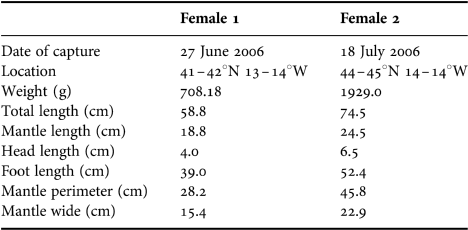
During the summer of 2006, two live specimens of football octopus (Ocythoe tuberculata, Rafinesque, 1814) were captured at the sea surface by live-bait boats off the north-west Iberian Peninsula, at the northernmost limit of the species distribution in the North Atlantic according to Nesis (Reference Nesis1985). The first individual was caught on 27 June at 41°–42°N 13°–14°W (west of Portugal), and the second on 18 July at 44–45°N 14.5°–15.5°W (north-west of Spain).
This species is known to be cosmopolitan in tropical and temperate seas (Sweeney et al., Reference Sweeney, Roper, Mangold, Clarke and Boletzky1992; Vechione, Reference Vechione and Carpenter2002), especially in the northern hemisphere (Roper & Sweeney, Reference Roper and Sweeney1975). In the north-east Atlantic, it has been reported off the Azores and Canary archipelagos (Cardoso, Reference Cardoso1991) and in the western Mediterranean (Naef, Reference Naef1923; Petrus & Pablo, Reference Petrus and Pablo1993; Ezzeddine-Najai & El Abed, Reference Ezzeddine-Najai and El Abed2001). However, in the southern hemisphere, this species seems to be less common. In this way, a single catch has been reported off South Africa, associated with a storm in this area (Roper & Sweeney, Reference Roper and Sweeney1975), and some other specimens were obtained in New Zealand and Australian waters (O'shea, Reference O'shea1997; Landsdell & Young, Reference Landsdell and Young2007). The majority of the specimens, however, have been found in the stomach of its predators (swordfish, yellowfin tuna and dolphins), probably associated with their seasonal migrations.
Little is known about the biology and behaviour of Ocythoe tuberculata, except that it has pelagic habits and is found near the surface waters at night (Vechione, Reference Vechione and Carpenter2002). There is a strong sexual dimorphism in this species, where males are usually smaller than 3 cm in mantle length, and females are significantly larger with mantle lengths that can reach 35 cm (Roper & Sweeney, Reference Roper and Sweeney1975; Cardoso & Paredes, Reference Cardoso and Paredes1998). Curiously, females of this species are the only known cephalopods with a swimbladder, a feature that makes them able to control their buoyancy (Packard & Wurtz, Reference Packard and Wurtz1994), and are the only known cephalopods that give birth to live young that hatch internally (Naef, Reference Naef1923).
Morphological features
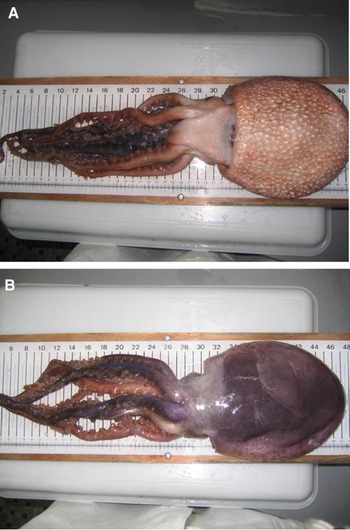
The measurement of both specimens was taken according to Pickford & McConnaughey (Reference Pickford and McConnaughey1949), Thomas (Reference Thomas1977), Roper & Voss (Reference Roper and Voss1983) and Clarke (Reference Clarke1986). In both females, the pairs of tentacles II and III were shorter than the pairs I and IV. The mantle was muscular and strong. The ventral side was wrinkled, totally covered with hard pyramidal protuberances, but the dorsal side was smooth (Figure 1A & B, respectively). The head was more spherical than in other octopus species, and it showed two ventral pores. In Table 1 the weights and body lengths of both octopus individuals are shown.
Female of Ocythoe tuberculata captured in the north-east Atlantic in June 2006. (A) Ventral view; (B) dorsal view.

Geographical and morphological data of the two females Ocythoe tuberculata caught in the north-east Atlantic.

Environmental features
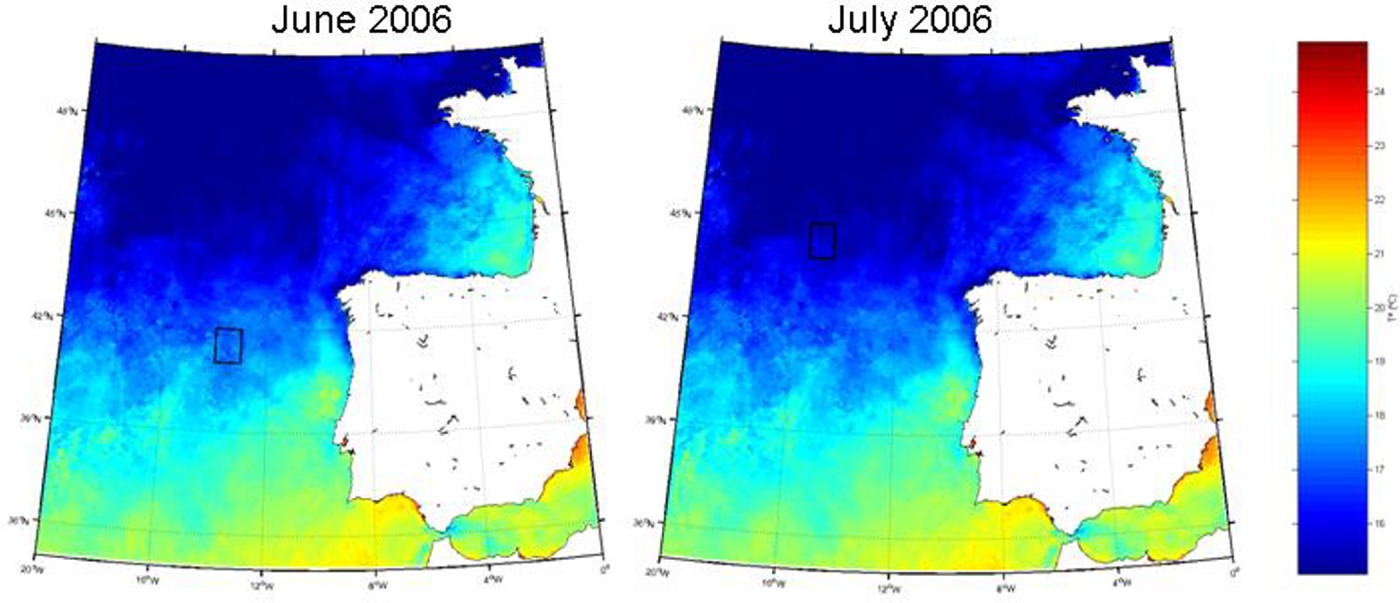
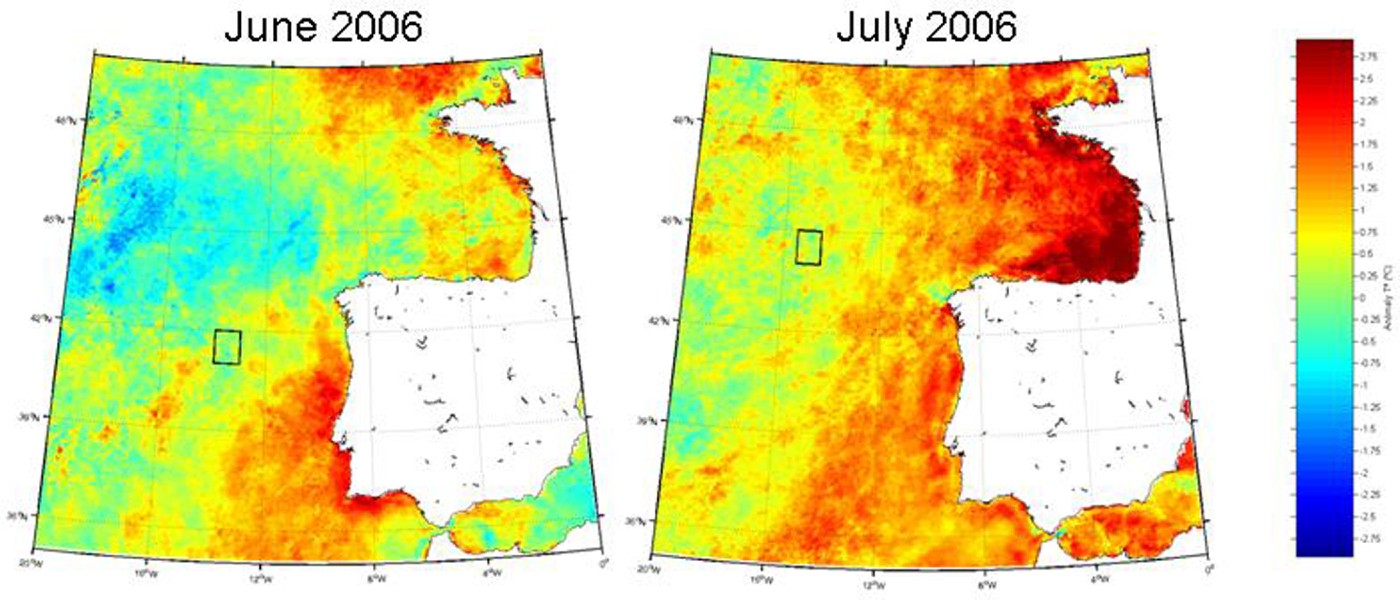
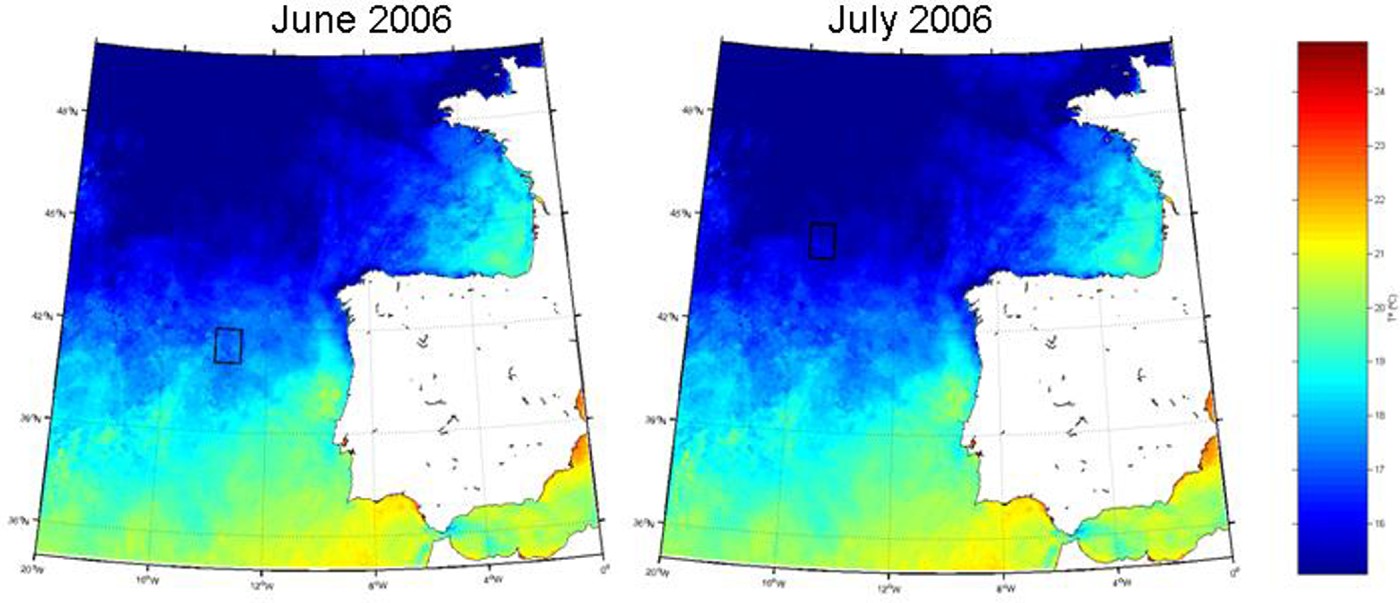
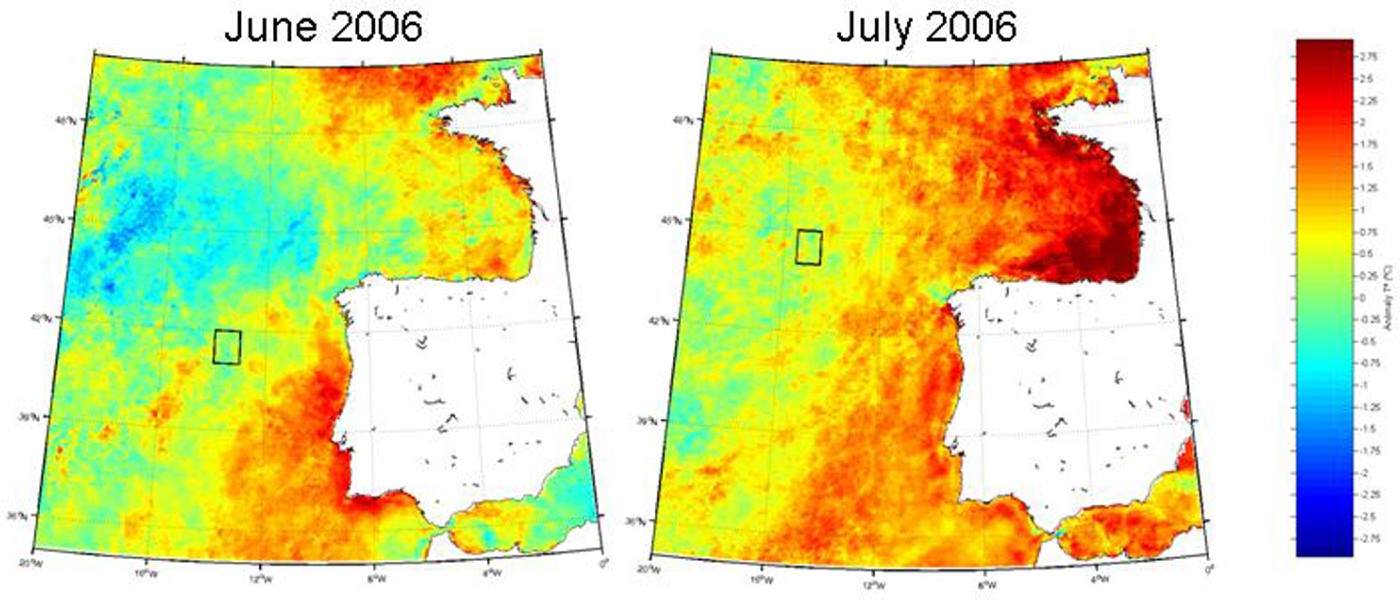
Although this species has been reported in the Bay of Biscay in 1936, when Bouxin & Legendre found one specimen in the stomach content of an albacore (Thunnus alalunga), the presence of live specimens north of the Azores (41–45°N) has not been observed in the scientific literature. It has typically been reported in more temperate waters and probably its capture in this higher latitude area was associated with a seasonal warming process (Figure 2). Furthermore, in June–July of 2006, the sea surface temperature in the west of Portugal and north-west of Spain was 1°C warmer than the mean temperature in both months in this area (Figure 3). This warming process was also associated with an anomalous peak of jellyfish abundances in June 2006 in the coastal areas of north-west Spain (La Voz de Galicia, 7 June Reference de Galicia2006).
Mean sea surface temperature (SST) for June (left) and July (right) 2006 (night tracks) from the MODIS sensor of the AQUA satellite (MODISA Level-3 Standard Mapped Image), which has a space resolution of 4 km. The squares represent the approximate location of football octopus captures.
Sea surface temperature (SST) anomaly result of the subtraction, in the left image, of the mean June (left) and July (right) SST from 1985 to 2001, obtained in the night tracks from the AVHRR sensor in the NOAA satellite (Casey, Reference Casey2004) in order to take out the climatological component for the temperature. The squares represent the approximate location of football octopus captures.
The anomalous warm summer of 2006 could favour the presence of Ocythoe tuberculata in the oceanic area off the west of Portugal and off the north-west of Spain, and probably associated with the high abundance of jellyfish. Males are sometimes found inhabiting the tests of salps as are young females (Naef, Reference Naef1923; Okutani & Osuga, 1986), and both phenomena could be related.
The progressive south–north warming process is a normal annual environmental event which occurs at the end of the spring in the north-east Atlantic. But, this is the first time that the presence of Ocythoe tuberculata has been reported associated to this event, as it has been observed in other oceanic species like Ranzania laevis off the Canary Islands (Castro & Ramos, Reference Castro and Ramos2002). In this way, the capture of football octopus may support the idea that populations can displace temporarily to higher latitudes when anomalous water warming occurs.
ACKNOWLEDGEMENTS
Our thanks to the crews of the fishing boats ‘Leporre Anaiak’ and ‘Oskarbi’, for making possible these new records.