Introduction
In typical development child gesture plays an important role in language development and there is evidence that the way parents respond to these gestures, by translating them using spoken words and phrases, could be one mechanism by which gesture facilitates language acquisition. However, given that children continue to use and develop gesture into later childhood, this raises the question of how gesture facilitates language in later childhood, and whether the way parents respond to their children's gestures continues to be influential in language learning. A second question concerns how parent responses facilitate language in situations where a child's language is developing atypically, for example in children with developmental language disorder (DLD).
Developmental Language Disorder is identified when a child exhibits persistent language deficits relative to age. This impedes everyday communication and affects 7.5% of children at school entry (Norbury et al., Reference Norbury, Gooch, Wray, Baird, Charman, Simonoff and Pickles2016). These difficulties may include deficits in the comprehension or production of vocabulary, grammar, and/or discourse (American Psychological Association, 2013) and occur in the absence of other clinical diagnoses, sensory impairments, or intellectual disability (though recent changes to DSM5 criteria and international consensus have removed requirements for a discrepancy between verbal and non-verbal ability). How parents of children with DLD respond to their children's gestures is of interest because there is evidence that children with DLD express more unique information through gesture that they do not express through oral language, relative to age-matched peers (Blake, Myszczyszyn, Jokel, & Bebiroglu, Reference Blake, Myszczyszyn, Jokel and Bebiroglu2008; Evans, Alibali, & McNeil, Reference Evans, Alibali and McNeil2001; Iverson & Braddock, Reference Iverson and Braddock2011; Wray, Saunders, McGuire, Cousins, & Norbury, Reference Wray, Saunders, McGuire, Cousins and Norbury2017). Thus parent responses to child gesture could serve both to provide opportunities to model the verbal messages children are having difficulty expressing, and to provide feedback on the child's communication attempt, ensuring any misunderstanding may be repaired.
Gesture development throughout childhood
Most research on parent–child gestures in relation to language acquisition focuses on the preschool period. Children's first gestures are deictic (pointing) gestures and these emerge from 10 months (Bates, Reference Bates1979), followed by representational gestures (iconic gestures which map closely to the intended referent, e.g., flapping arms to indicate flying) around 12 months. Later in development children continue to show a preference for deictic gestures and these gestures begin to integrate with spoken language around two to three years of age (Iverson, Capirci, & Caselli, Reference Iverson, Capirci and Caselli1994; see also Tellier, Reference Tellier, de Bot, Makoni and Schrauf2009, for a review). Between the ages of three and five years, the frequency of representational gestures increases dramatically and becomes synchronised with speech (Tellier, Reference Tellier, de Bot, Makoni and Schrauf2009). As children's language becomes more complex, so does their use of gesture. For example, representational gestures are produced with adjectives and verbs rather than nouns (cf. Capone & McGregor, Reference Capone and McGregor2004).
Although toddlers show a preference for gestural communication, this begins to decrease around 20 months, when verbal communication becomes the dominant mode of communication (Capone & McGregor, Reference Capone and McGregor2004; Iverson et al., Reference Iverson, Capirci and Caselli1994). However, gesture use continues to change and develop throughout childhood and into adulthood; for example, six-year-old children produce fewer gestures during narrative retelling than both ten-year-old children and adults (Colletta, Pellenq, & Guidetti, Reference Colletta, Pellenq and Guidetti2010). In addition, studies of school-aged children indicate that the gestures children continue to produce alongside speech often reveal information that is not present in their spoken utterances (Church & Goldin-Meadow, Reference Church and Goldin-Meadow1986). Church and Goldin-Meadow assessed 28 children aged five to eight on a Piagetian conservation task. They reported that 82% of children's explanations were accompanied by gesture and that 40% of these were gestures expressing information that was not in speech, demonstrating that gestures can often help older children express information that they cannot readily verbalise.
Few studies have focused on gesture and new language learning in the school years, making it difficult to draw conclusions about how gesture facilitates language in later childhood. Studies of early language development focus on deictic gestures as these are the most prevalent at this age; however, other gesture types which emerge later may also play a role in language development. These findings prompt questions about the mechanisms by which gestures facilitate language learning at later ages, and also whether the mechanisms that underpin gesture's role in language learning extend beyond deictic gestures.
How may gesture facilitate early language acquisition?
One hypothesis is that gesture supports language learning because child gesture elicits verbal responses from adults that extend the child's language capacity (Goldin-Meadow, Goodrich, Sauer, & Iverson, Reference Goldin-Meadow, Goodrich, Sauer and Iverson2007). For example, if a child points to a bird and says “fly” and the parent says “yes, birds fly”, the parent is both providing a verbal label and also a verbal model of how a more complex utterance could be structured. In early childhood, it is common for parents to provide verbal labels in response to their child's pointing gestures (Olson & Masur, Reference Olson and Masur2011), and these verbal responses are realised later in the child's spoken vocabulary (Goldin-Meadow et al., Reference Goldin-Meadow, Goodrich, Sauer and Iverson2007; Masur, Reference Masur1982). Goldin-Meadow et al. (Reference Goldin-Meadow, Goodrich, Sauer and Iverson2007) observed parent–child dyads of ten typically developing (TD) infants from 10 months to 24 months and reported that gestured items that were translated into words by parents entered the child's spoken lexicon earlier than words that were not translated.
However, to our knowledge there is no research regarding parent translations in later childhood, or whether such translations would influence language development once children have acquired more complex vocabulary and grammar. In later childhood, children rely more on spoken communication, and thus may not use gesture as a means to elicit new information from interlocutors. In contrast, for toddlers, gesture is often their only means of communication and thus parent translations may be a critical scaffold for developing oral language. For children who develop language less readily, gesture may remain an important means of highlighting language limitations to conversation partners. Parent responses may therefore continue to play an important role in language development, or may primarily serve to prevent communication breakdown when verbal messages are incomplete or unclear.
Parent responses to children's gestures in atypical development
Studies of gesture use in children with DLD suggest that such children have a typical drive to communicate both verbally and non-verbally, and that these children express more unique information through gesture than their peers (Blake et al., Reference Blake, Myszczyszyn, Jokel and Bebiroglu2008; Evans et al., Reference Evans, Alibali and McNeil2001; Iverson & Braddock, Reference Iverson and Braddock2011; Wray et al., Reference Wray, Saunders, McGuire, Cousins and Norbury2017). What is not known is whether parent responses to these ‘extending’ gestures provide language learning opportunities for children with language deficits.
A study of children with Down Syndrome (DS) and Autism spectrum disorder (ASD) demonstrated the same advantage of parental translations of gesture on child language development (20–40 months), as reported in TD literature (Dimitrova, Özçalışkan, & Adamson, Reference Dimitrova, Özçalışkan and Adamson2015). Dimitrova et al. observed parent–child dyads of TD children, children with DS, and children with ASD, all matched for expressive language ability. Dimitrova et al. reported that, for all groups, parents predominantly responded to their child's gestures with verbal responses, and the majority of these verbal responses were translations (TD = 74%, ASD = 77%, DS = 82%). Furthermore, items translated by parents were more likely to enter the child's vocabulary than items not translated, with a similar pattern evident in all groups. Dimitrova et al. highlight both that parents’ verbal translations can help facilitate word learning in children with developmental disorders and that parents of TD, ASD, and DS children responded in similar ways to their children's gestures. Whilst Dimitrova et al. have examined parent responses in relation to two developmental disorders, their groups were matched on expressive language and so it is difficult to establish whether the language deficits that are commonly associated with these disorders yield different parent responses to those of age-matched peers.
As previous investigations by Goldin-Meadow et al. (Reference Goldin-Meadow, Goodrich, Sauer and Iverson2007) and Dimitrova et al. (Reference Dimitrova, Özçalışkan and Adamson2015) only focused on very young children and predominantly on the production of deictic and ‘give’ gestures, we currently do not know how parents respond to child gestures in later childhood. As a result, the extent to which other gesture types elicit translation responses from parents is unknown. In later childhood we would expect to see children producing a more varied gesture repertoire and it is important to establish the extent to which non-deictic gestures elicit verbal responses from parents that may further facilitate language development.
Another outstanding issue is that previous studies have coded parent responses as either translations or not translations and do not provide further detail about the characteristics of non-translation responses and their potential role in language acquisition. These responses may also facilitate language acquisition by providing general feedback or praise, which may serve to provide children with feedback about the adequacy of their communication attempts, repair any misunderstandings, or simply keep children engaged in the interaction.
Children's responses to parental input
To our knowledge, there are no studies that have explored the next step in interaction by addressing how children subsequently respond to parent translations of their gestures. Children's ability to imitate the verbal input they are exposed to relates to later vocabulary (Masur, Reference Masur1995; Masur & Eichorst, Reference Masur and Eichorst2002). For example, Masur and Eichorst (Reference Masur and Eichorst2002) observed parent–child interaction at 13, 17, and 21 months and reported that children's imitation of novel words at 13 months was significantly related to later vocabulary (17 and 21 months), even when children's earlier language ability was controlled in the statistical model. This raises the possibility that parent translations facilitate word learning because children repeat the translated word, making it easier for that word to enter their verbal lexicon. However, Masur and Eichorst also highlight that some children who did not imitate novel words still showed significant increases in vocabulary, indicating that word imitation alone is not necessary or sufficient for word acquisition. The extent to which parent translations extend child utterance length and complexity remains an open question.
The present study
The current study extends previous literature by investigating the full range of parent responses to extending gestures in school-aged children (ages six to eight years) with varying degrees of language proficiency. In addition, we examined how children subsequently responded to their parent translations or requests for clarification, providing a first look at the next step in exchanges that include extending gestures.
The study had three aims. First, we asked what types of responses school-aged children's gestures elicited from parents and whether parents of children with developmental language disorder respond to their children's gestures in the same way as parents of typically developing children and children with low language (LL) and educational concerns. We predicted that parents of all groups may produce more varied responses in contrast to those reported with younger children, due to differences in the types of gestures children produced and different task demands. In addition, we predicted parents of children with DLD and LL would produce proportionately more translations than parents of TD children, in order to support their child's language and communication development. In addition, we predicted that parents of children with DLD would likely produce more requests for clarification, given that these groups produce less accurate hand gestures than their peers (Wray et al., Reference Wray, Saunders, McGuire, Cousins and Norbury2017).
Our second aim was to investigate the relationship between parent translations and language ability in school-aged children. We predicted that, in contrast to studies of young, typically developing children, more gesture translations in our sample would be associated with more severe language difficulties, reflecting parents’ use of verbal and non-verbal strategies to facilitate communication.
Our third aim was to examine how children respond to parental translations. We were particularly interested in the extent to which children in all groups repeat the translated words or phrases, which we considered would be evidence of active attention to the parent response that could facilitate language learning.
Method
Participants
Participants comprised 63 monolingual children aged six to eight years, and their parents. Three families of children reported a diagnosis of ASD and were excluded from further analysis. Children were recruited as part of the Surrey Communication and Language in Education Study (SCALES), a population study of language disorder at school entry (Norbury et al., Reference Norbury, Gooch, Wray, Baird, Charman, Simonoff and Pickles2016). Reception class teachers completed the Children's Communication Checklist-S, (CCC-S, a short-form of the CCC-2; Bishop, Reference Bishop2003) for 7,267 children aged four to five year in state-maintained schools in Surrey, a county in southeast England (Stage 1). From this screen, the bottom 14% (stratified by season of birth and gender) of children were classified as high-risk (HR) for language disorder, whilst children scoring above this threshold were classified as low-risk (LR) of DLD. Following this, 529 monolingual children took part in an in-depth assessment of language, non-verbal cognition, and motor skills in Year 1 of school (ages five to six years; 329 HR and 200 LR children; see Norbury et al., Reference Norbury, Gooch, Wray, Baird, Charman, Simonoff and Pickles2016, for details).
For the current gesture study, we aimed to visit approximately 10% of the total in-depth cohort, oversampling high-risk children at a ratio of 2:1. One hundred and thirty families were contacted, and invited to take part in the study; 50 families did not consent and a further eleven families initially consented, but suitable arrangements could not be made for the home visit.
Sixty-three monolingual parent–child dyads (61 mother–child) consented and were observed for the current study when they were aged six to eight years. There were no statistically significant differences between those families who opted in and those who opted out, on measures of social economic status (t(111) = –0.08, p = .937, d = .02), speech and language concerns (χ 2 = 1.06, p = .304), or high-risk status (χ 2 = 1.58, p = .209) (Opt-in: 41 high-risk; Opt-out: 38 high-risk).
Defining groups
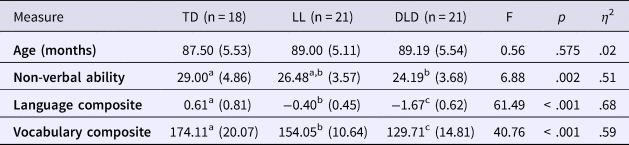
Prior to home visits for the current study, children completed an in-depth test of language and cognitive function at their school with a trained member of the SCALES research team. A total language composite score was derived from tests of expressive and receptive vocabulary (Brownell, Reference Brownell2000a, Reference Brownell2000b); receptive and expressive grammar (Bishop, Reference Bishop2003; Marinis, Armon-Lotem, Piper, & Roy, Reference Marinis, Armon-Lotem, Piper and Roy2011), and narrative retelling and comprehension (Adams, Cooke, Hesketh, & Reeves, Reference Adams, Cooke, Hesketh and Reeves2011). The core language battery consisted of tests that did not have current UK standardisations, either because they were standardised in North America, or were recently developed. We therefore adjusted raw scores for child age using the full weighted SCALES sample (see Norbury et al., Reference Norbury, Gooch, Wray, Baird, Charman, Simonoff and Pickles2016, for details of this procedure). For this study, children were categorised as DLD (n = 21) if their total language composite z-score was 1 standard deviation (SD) below the SCALES population mean. Typically developing children (n = 18, 8 males) were low-risk at screening and scored within the normal range on the total language composite. Twenty-one children were high-risk at screening, indicating communication skills 1SD below the normative mean at school entry, but scored within the normal range on the total language composite a year later. These children obtained intermediate total language composite scores that were significantly lower than TD peers, and significantly higher than children with DLD (Table 1). In addition, eight of these children are receiving special education support at school and six had previously been referred to speech-language therapy services. Due to their history of language and communication concerns and ongoing special educational needs, they were not combined with the TD group, but instead formed an intermediate group of children with low language (LL) and educational concerns (n = 21, 9 male). Including this intermediate group ensured that we could explore gesture use in relation to language across the whole spectrum of language abilities.
Means (SD) of background measures for children in each language group

Notes. Different superscripts within the same row indicate differences between group means that are significant at p < .05. TD: typically developing, LL: low language, DLD: developmental language disorder. All means are raw scores other than the language composite which is reported as a z-score.
Procedure
All children and their parents were visited at home by the first author. During this home visit children and parents completed a number of structured and semi-structured gesture tasks. Child gesture and parent gesture data are reported elsewhere (Wray & Norbury, Reference Wray, Saunders, McGuire, Cousins and Norbury2017; Wray et al., Reference Wray and Norbury2018). Prior to the home visit background data were collected in school through the SCALES study.
Background measures
Through the SCALES study background data on children's language (expressive and receptive vocabulary, expressive and receptive grammar, and narrative), non-verbal IQ, and social economic status were collected (see Norbury et al., Reference Norbury, Gooch, Wray, Baird, Charman, Simonoff and Pickles2016, for full assessment battery). Previous studies of gesture and language have focused on vocabulary as a measure of language (Rowe & Goldin-Meadow, Reference Rowe and Goldin-Meadow2009; Rowe, Özçalışkan, & Goldin-Meadow, Reference Rowe, Özçalışkan and Goldin-Meadow2008); as such the current paper used a vocabulary composite which summed raw scores on the Receptive One-Word Picture Vocabulary Test (ROWPVT; Brownell, Reference Brownell2000b) and Expressive One-Word Picture Vocabulary Test (EOWPVT; Brownell, Reference Brownell2000a), to index vocabulary. Non-verbal IQ was measured using the WISC Block Design (Wechsler, Reference Wechsler2003), and social economic status was estimated using the Income Deprivation Affecting Children Index rank scores (IDACI). This measure assessed Social Economic Status (SES) using children's home postcodes. Scores in England range from 1 (most deprived) to 32,844 (most affluent), with a mean of 16,352 (data from 2010).
Referential communication task
In this task, each parent and child sat opposite each other and each had a board in front of them which the other person could not see, though they could see each other. Children and parents performed both describer and listener roles across four trials, which were counterbalanced across participants. The child always started in the describing role and this alternated thereafter. The describer was given a board with eight animal pictures (either cats, dogs, mice, or rabbits) displayed in a specific order on a 4 × 2 grid. The listener was given a blank board and 12 cards which included the eight target cards and four distractor cards. The describer was instructed to describe each of their cards and the order in which they appeared so that the listener could locate the correct card and place it in the correct position. Parents and children were free to communicate naturally throughout the task.
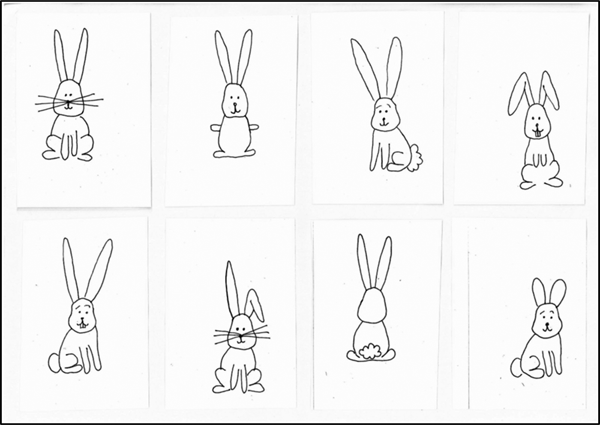
All drawings were in black and white and were designed to be visually similar, to ensure that pictures could not be identified with one description and to encourage participant discussion. For example, a child could not just say “the rabbit with the long ears” as there would be multiple rabbits with long ears (see Figure 1). All sessions were video-recorded and coded off-line.
Example experimental stimuli for the Referential Communication task.

For the current analysis, only data obtained when the child was in the describing role were included; child gesture data are reported in detail elsewhere (Wray et al., Reference Wray, Saunders, McGuire, Cousins and Norbury2017).
Verbal transcription and gesture coding
The verbal dialogue was transcribed using Systematic Analysis of Language Transcripts software (SALT; Miller & Iglesias, Reference Miller and Iglesias2012). Gestures were coded from the videos by the first author and a trained research assistant using Observer XT software (Grieco, Loijens, Zimmermann, & Spink, Reference Grieco, Loijens, Zimmermann and Spink2013). The number of different gesture types produced by children during each of these tasks were coded. Gesture types included: deictic gestures, or pointing gestures used to draw attention to a particular object, person, or location in the environment; representational gestures, which show a close relationship to the object, action, idea, or concept that they refer to (e.g., making a circular shape with a hand to represent a ball); conventional gestures are culturally specific and convey meaning without the need for speech (e.g., nodding to symbolise ‘yes’); and beat gestures, rhythmic movements which emphasise aspects of speech (McNeill, Reference McNeill1992). Sixty-six percent of the gestures produced were representational, 20% were deictic gestures, 12% conventional gestures, and less than 1% of gestures were beat gestures.
Following this the function of each gesture was also coded as either extending or redundant. Extending gestures included gestures that extend communication either by adding extra information that is not in speech (e.g., “the cat had a tail like that”, whilst simultaneously producing a curly tail gesture) or by conveying information and meaning, in the absence of any speech (e.g., producing a curly tail gesture without speech). Thus, they ‘extend’ the child's utterance to include information not realised in speech and in doing so continue the conversation by expressing meaning through gesture. Within the literature others have also referred to these types of gestures as ‘non-redundant’ (Alibali, Kita, & Young, Reference Alibali, Kita and Young2000), complementary (McNeill, 1992), and supplementary gestures (Ozcaliskan & Goldin-Meadow, 2005). In addition, our term ‘extending gesture’ differ slightly from other terms as it also encompasses gestures that occurred in isolation to speech and not just gesture–speech combinations. Eighty-one percent of children's extending gestures occurred with speech and 19% of their extending gestures occured in isolation to speech.
Redundant gestures included gestures that reinforced the spoken message; although these gestures may highlight important aspects of an utterance, they do not add extra information to the utterance (e.g., “the cat had a curly tail”, whilst simultaneously producing a curly tail gesture).
Parent responses
Parental responses to children's extending gestures were then coded. First, the modality of each response was coded as either verbal, non-verbal, or integrated (response with both verbal and non-verbal elements). Verbal responses were classified as either translation, positive feedback, request for clarification, prompt for verbal equivalent, verbatim, or other response (see ‘Appendix 1’ for examples). Non-verbal responses were classified as either: extending gesture, copy child's gesture, or nod/shake head, and had to occur in isolation to speech. Integrated responses, were classified as any response that included instances when any of the above verbal responses occurred with any of the above non-verbal responses.
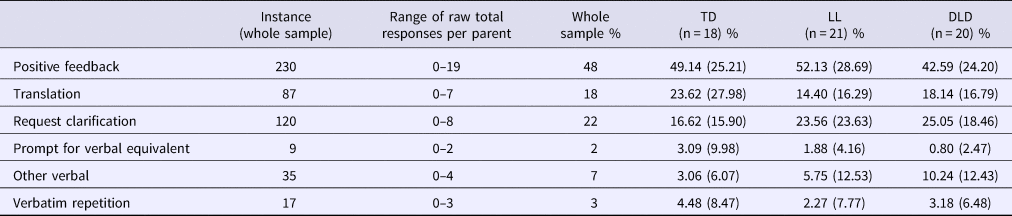
We were particularly interested in whether parent responses were translations, requests for clarification, or positive feedback. Despite identifying other parent responses, such as prompt for the verbal equivalent and verbatim repetition of child's utterance, these were too rare for formal analysis (nine and 17 occurrences, respectively). Parents’ production of ‘other’ verbal responses (e.g., response unrelated to child's utterance), also did not occur often (n = 35); however, our observations were that ‘other’ responses may reveal something interesting about the DLD group and so were included (see Table 2 for ratio of all verbal response types, and supplementary material for raw scores, available at <https://doi.org/10.1017/S0305000918000582>).
Percentage (SD) of each verbal response to an extending gesture across the whole sample

Note. Total number of extending gestures across the whole sample was 1621.
The percentage of verbal, non-verbal, and integrated responses were calculated (the number of verbal responses / total number of extending gestures). Following this, the percentage of each verbal type was calculated (e.g., number of translations / total number of verbal responses); this included both verbal alone and integrated responses.
Child responses
Finally, children's responses to parent translations or requests for clarification were coded. Translation responses were coded as either repetition of the translated word, yes or no response, continue with the task (no verbal response), or correction of the translated word (see ‘Appendix 2’ for examples).
Request for clarification responses were coded as either: ‘yes or no’, add information, unrelated response, or continue with the task (no verbal response; see ‘Appendix 2’ for examples). As unrelated responses were rare (six occurrences across the entire sample) they are not included in the following analysis.
Positive feedback responses were coded as either continue with the task, child request for clarification / follow-up question, and unrelated responses. As both child request for clarification and unrelated responses occurred on only five and two occasions respectively, they were not included in the following analysis.
Reliability
Ten percent of participant videos were double coded, by a rater blind to the child's diagnostic group. Disagreements were resolved through discussion. The inter-rater reliability indicated good reliability for all verbal response categories: translation (83.33% agreement, kappa = .75), prompt for verbal equivalence (100% agreement, kappa = 1.00), request for clarification (83.33% agreement, kappa = .75), positive response (93.3% agreement, kappa = .79), verbatim repetition (100% agreement, kappa = 1.00), and ‘other’ responses (100% agreement, kappa = 1.00). Inter-rater reliability for parent gesture was 72% (kappa = .69).
Results
Data analysis plan
The analysis focused on differences in parent responses to children's extending gestures, in relation to child language ability. A series of ANOVAs compared language groups on the proportion of parent responses to children's extending gestures and children's responses to parent translations and requests for clarification. As data were proportional, an arcsine transformation was used for all analysis. Untransformed percentages are reported in the text and graphs. Cohen's d effect sizes are reported and interpreted as an effect size of .2 is a small effect, .5 a medium effect, and .8 a large effect (Cohen, Reference Cohen1988). As previous studies have focused on vocabulary as a measure of language (Rowe & Goldin-Meadow, Reference Rowe and Goldin-Meadow2009; Rowe et al., Reference Rowe, Özçalışkan and Goldin-Meadow2008), the current paper used a vocabulary composite which summed raw scores on the ROWPVT (Brownell, Reference Brownell2000b) and EOWPVT (Brownell, Reference Brownell2000a), to index vocabulary.
Exclusions
Sixty-three parent–child dyads were observed. However, three of these children had a known diagnosis of ASD, and so were excluded from the following analyses. In addition, one child in the DLD group did not produce any extending gestures and was also excluded from the following analysis.
Child gesture
On average, 36% of children's gestures were extending gestures (MTD = 32.61% (SD = 14.50); MLL = 28.14% (10.65); MDLD = 49.20% (SD = 23.78)). As reported previously (Wray et al., Reference Wray, Saunders, McGuire, Cousins and Norbury2017), children with DLD produced significantly more extending gestures than either the TD (p = .03, d = .84) or LL (p = .002, d = 1.15) groups. Overall, the most common gesture type was representational gestures: 66.84% of children's extending gestures were representational. As children with DLD produced proportionately more extending gestures than children in the TD group, parent response comparisons were analysed as a percentage of responses within each category.
Do children's gestures elicit verbal responses?
First, we considered the proportions of parental verbal, non-verbal, integrated, and no responses. There was considerable variation, but no group differences in parent responses; parents in all groups most commonly provided a verbal response to a child's extending gesture (MTD = 57.90% (SD = 22.54); MLL = 47.46% (17.86); MDLD = 54.67% (SD = 22.87)). However, they frequently did not respond at all to children's extending gestures (MTD = 37.70% (SD = 21.13); MLL = 47.02% (18.63); MDLD = 37.41%, (SD = 19.68)). There were no group differences in the proportion of verbal (F(2,59) = 1.01, p = .370,  $\eta _p^2 $ = .04) or no responses (F(2,59) = 0.997, p = .375,
 $\eta _p^2 $ = .03).
Solely non-verbal responses were extremely rare (nine instances); when parents used non-verbal cues they were almost always accompanied by speech. Again there were no group differences in the proportion of non-verbal (F(2,59) = 0.01, p = .988,  $\eta _p^2 $ = .00) or integrated (F(2,59) = 0.70, p = .503,
 $\eta _p^2 $ = .02) responses made by parents (see Table 3).
Mean (SD) percentages and overall raw number of parent responses to children's extending gestures

Notes. The average number of extending gestures in each group were: MTD = 12.50 (9.54), MLL = 14.05 (7.02), MDLD = 18.55 (18.55). TD: typically developing, LL: low language, DLD: developmental language disorder. Range refers to the variability of responses, e.g., some parents never produced verbal responses and some parents did this 24 times.
Are parents using language that is beneficial to language learning?
Next we considered the type of verbal responses produced, and included both verbal only and integrated responses. Parents of all groups were most likely to respond with positive feedback (MTD = 49.14% (SD = 25.21), MLL= 52.13% (28.69); MDLD = 42.59% (24.20)). Less commonly, parents produced requests for clarification (MTD = 16.62% (SD = 15.90); MLL = 23.56% (23.63); MDLD = 25.05% (18.46)) and direct verbal translations (MTD = 23.62% (SD = 27.98); MLL =14.40% (16.29); MDLD = 18.14% (16.79)) (see Table 4). Other responses (repetition, prompts for verbal language, other) were exceedingly rare. Groups did not differ in the proportion of responses that provided positive feedback (F(2,55) = 0.64, p = .531,  $\eta _p^2 $ = .02), request for clarification (F(2,55) = 1.25, p = .296,
 $\eta _p^2 $ = .04), or translations (F(2,55) = 0.77, p = .467,
 $\eta _p^2 $ = .03). There was a borderline effect of language group for ‘other’ verbal responses (F(2,55) = 2.97, p = .060,
 $\eta _p^2 $ = .10). There was a trend for parents of children with DLD to produce proportionally more ‘other’ responses than parents of TD children (MTD = 3.06%; MDLD = 10.24%); these generally included utterances focused on child behaviour, such as asking the child to look or sit down. Thus, parents of children with DLD may spend proportionately more time managing behaviour than parents of TD children.
Mean (SD) percentages and overall raw scores for each type of parent verbal responses

Notes. The average number of extending gestures eliciting verbal responses were: MTD = 8.11 (7.08), MLL = 7.43 (4.81), MDLD = 9.80 (5.73). TD: typically developing, LL: low language, DLD: developmental language disorder.
How are parental verbal responses related to child language ability?
First, we considered differences in language ability between children of parents who never translate (n = 21, TD = 7, LL = 9, DLD = 5), never request clarification (n = 16, TD = 8, LL = 5, DLD = 3), or never produce positive feedback (n = 6, TD = 2, LL = 2, DLD = 2) in comparison to those who produced these types of responses at least once. There were no significant differences in child language ability between those whose parents produced at least one translation (M = 149.13, SD = 23.87) and those who never translated (M = 156.57, SD = 23.87) (F(1,57) = 1.34, p = .252,  $\eta _p^2 $ = .02), nor those whose parents produced at least one request for clarification (M = 149.35, SD = 23.70) and those who never requested clarification (M = 158.31, SD = 23.23) (F(1,57) = 1.69, p = .199,
 $\eta _p^2 $. = .03). There was, however, a significant difference in language ability between those whose parents produced at least one positive response (M = 153.92, SD = 22.25) and those who did not (M = 132.83, SD = 29.90) (F(1,57) = 4.52, p = .038,
 $\eta _p^2 $ = .07), with children whose parents produced at least one positive response displaying higher language scores.
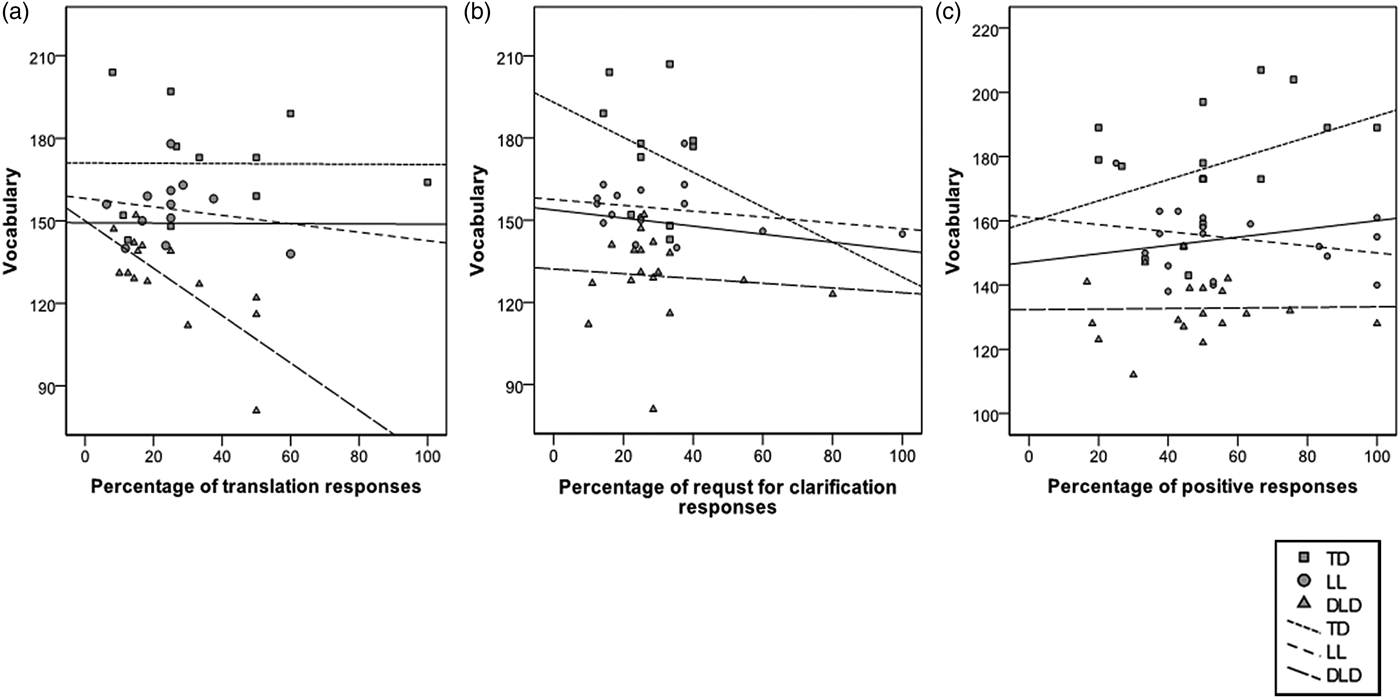
Next, we explored the relationship between translations and requests for clarification in relation to language abilities. Next, we explored the relationship between translations and requests for clarification in relation to language abilities (see Figure 2). Given the wide variation in responses, those who never translate, never request clarification, or never produce a positive response were excluded from the following analysis. This enabled us to focus on the parents who did produce these responses, and whether the frequency with which parents produced these responses was related to language.
Scatterplots showing the relationship between vocabulary and (a) the percentage of parent translations, (b) the percentage of parent request for clarification, and (c) the percentage of parent positive responses.

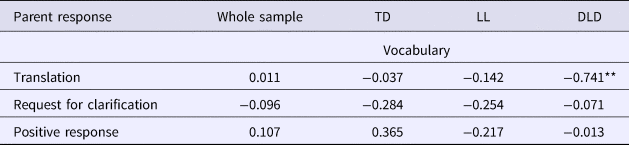
As demonstrated by Table 5, across the whole sample, vocabulary was not significantly related to the proportion of parent translations, requests for clarification, or positive reinforcement. When analysing groups separately, there was a significant relationship between parent translations and vocabulary within the DLD group. Table 5 demonstrates a significant negative association between parent translations and vocabulary (r(15) = –0.741, p = .002) for parents responding to children with DLD.
Correlation matrix indicating the relationship between vocabulary and parent responses

Note. ** p < .001.
Do children actively acknowledge their parent's verbal responses?
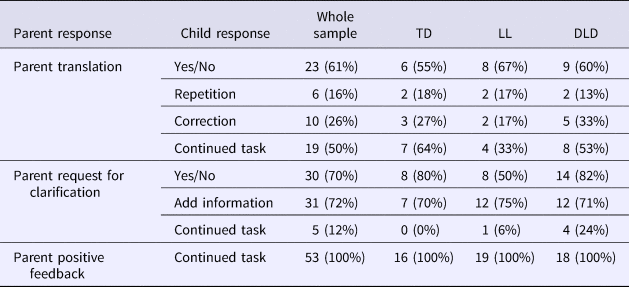
Due to the small number of child responses, the following section provides descriptive statistics only. Following a translation, children frequently either acknowledged the translation with a ‘yes or no’ response (MTD = 36.36% (SD = 40.01); MLL = 55.56% (45.13); MDLD = 44.13% (44.94)) or continued with the task without acknowledging their parent's input (MTD = 45.45% (SD = 42.22); MLL = 23.61% (39.22); MDLD = 34.92%, (40.80)). There were few instances of children actually repeating the translated word (MTD = 8.33% (SD = 20.75); MLL = 12.50% (31.08); MDLD = 6.67%, (18.69)), or correcting a parent's incorrect translation (MTD = 9.85% (SD = 17.80); MLL = 8.33% (19.46); MDLD = 14.29% (28.07)) (see Table 6 for number and percentage of children making each response type).
Number (and percentage) of children producing each type of response

Notes. 64% of the sample (38 parents) made at least 1 translation: TD (n = 11), LL (n = 12), DLD (n = 15). 73% of the sample (43 parents) produced at least 1 request for clarification: TD (n = 10), LL (n = 16), DLD (n = 17). 90% of the sample (53 parents) made at least one positive feedback response: TD (n = 16), LL (n = 19), DLD (n = 18).
Following a request for clarification, children in both groups predominantly responded with a confirmatory ‘yes or no’ response (MTD = 53.75% (SD = 38.21); MLL = 27.60% (32.59); MDLD = 50.74% (32.22)) or added further information (MTD = 42.08% (SD = 36.98); MLL = 54.69% (41.72); MDLD = 37.25% (31.78)). Contrary to the lack of response to parent translations, TD children always provided a verbal response to a parental request for clarification. Similarly, failure to respond was rare in children with LL and DLD, although the latter group had higher no response rates (MLL = 2.08% (SD = 8.33); MDLD = 8.09% (17.08)).
Following positive feedback, the task continued without a related response from the child 97% of the time; a pattern seen across all groups (MTD = 98.72% (SD = 4.62); MLL = 94.12% (16.61); MDLD = 96.67% (10.27)).
Discussion
This study is the first to explore parent responses to school-aged children's gestures and the extent to which these responses are related to children's language ability. Overall, there were no group differences in the types of responses parents provided to extending gestures. In contrast to early childhood, we observed more varied responses to children's extending gestures, with all parents predominantly responding with positive feedback. In addition, translations and requests for clarification were also observed. Across the entire sample, the proportion of parent translations was not associated with language ability. However, group analyses indicated a significant negative association for the DLD group only. Thus, parents of children with DLD produce proportionately more translations for children with the most severe language disorders. Exploration of children's responses to a parent's verbal translations indicated that children rarely repeat parent translations. The implications of these findings are now considered in relation to the study aims.
Do school-aged children's extending gestures elicit verbal responses from parents?
Contrary to our initial prediction, parents of children with DLD and LL were as likely as parents of TD children to produce verbal responses to extending gestures. This is consistent with Dimitrova et al. (Reference Dimitrova, Özçalışkan and Adamson2015), who reported similarities in parental responses across children with different developmental difficulties. Over 50% of parent responses were verbal, and the most common verbal response was to provide positive feedback for the child's communication attempt. Translations and requests for clarification were the next most common responses and occurred in response to approximately one-third of gestures. Surprisingly, for a large proportion of opportunities (38%), parents did not respond to their children's extending gestures at all. Similarly, parents of children with DLD, LL, and TD did not differ in the proportions of each type of verbal response produced. Thus, parents of school-aged children produce a wide variety of responses to their children's gestures.
At first glance this seems at odds with previous research which suggested that parents respond over 90% of the time with verbal responses and that parents predominantly respond with verbal translations (Dimitrova et al., Reference Dimitrova, Özçalışkan and Adamson2015). One reason for the disparity between studies may be the type of task; the current study employed a goal-orientated task in comparison to the naturalistic play settings used by Dimitrova et al. Goal-orientated tasks may elicit more praise responses from parents, in an attempt to keep their child engaged in the challenging task. This in turn would reduce the opportunity for parents to produce responses that may facilitate language development, such as translations. In addition, the wide variation in responses in the current study maybe reflect the wide variation in language level in the current study in comparison to Dimitrova et al., whose participants were matched for expressive language ability. Finally, and perhaps more crucially, differences in participant ages and subsequently the gestures they use might contribute to these discrepant findings. Previous studies have focused on pointing gestures, whereas the current study explored responses to all gesture types, though representational gestures were most commonly produced at this age. In addition, the incidence of extending gestures was relatively low and certainly less frequent than that observed in studies of early childhood.
Deictic gestures are closely tied to the intended referent (Özçalışkan, Gentner, & Goldin-Meadow, Reference Özçalışkan, Gentner and Goldin-Meadow2014), which may prompt verbal object labelling from parents more readily. Representational gestures on the other hand often express a referent's shape, action, or function and so these types of gestures may not as obviously elicit verbal labelling. In the context of the current task, representational gestures may elicit positive responses that indicate to the child that the intended meaning of the gesture has been understood. In contrast, deictic gestures may indicate that the child is unfamiliar with the object or object label, and therefore directly elicit responses that facilitate word learning.
Indeed, some investigators have suggested that it is only deictic gestures that predict later language abilities (Özçalışkan, Adamson, & Dimitrova, Reference Özçalışkan, Adamson and Dimitrova2016). Thus, in early language development, deictic gestures may be the most beneficial, while the types of response representational gestures elicit may not drive later language development. However, the Özçalışkan et al. study considered children who were not yet producing representational gestures, so the impact of these gesture types on language development was not measured. Our results suggest that children use gesture in different ways throughout childhood, and that parents alter the way they respond to extending gestures as their child's language develops. Longitudinal research exploring the role of both deictic and representational gestures in children's longer-term language development is needed to examine, first, whether different gestures elicit different responses from parents, and second, the specific way that different gesture types facilitate language acquisition throughout childhood.
How are parental verbal responses related to child language ability?
Contrary to our initial prediction, gesture translations were not associated with language ability across the whole sample. The fact that vocabulary was not related to parent translations further supports the idea that parent responses to school-aged children's gestures differ from those reported in infant studies. It may be that parent responses at this age focus more on attention and task completion than facilitating language development, which may explain why positive feedback was the most common parental response. However, it is also possible that the goal-oriented nature of our task led to parents becoming more focused on task completion than facilitating language learning and, as such, more naturalistic observations of school-aged children may yield different findings. Future naturalistic research in this area would help to identify whether the observed differences from infant studies are due to developmental changes in the way parents communicate with their children, a consequence of task demands, or a combination of the two factors influencing parent behaviour.
However, within the DLD group, parent translations were significantly negatively related to vocabulary. Thus parents of children with the most severe language disorder produced the highest proportion of verbal translations. Given that some children within the sample have profound language deficits and have difficulties producing complex multiword utterances, this may indicate that parents of children with the most severe language disorders respond to gestures in similar ways to parents of younger TD children. Future research with younger, language ability matched comparison groups may further elucidate whether gesture patterns in DLD are simply immature, or qualitatively different to those seen in typical language development.
Do children actively acknowledge their parent's verbal responses?
Studies have indicated that items translated by parents are more likely to enter a child's verbal lexicon than items not translated (Dimitrova et al., Reference Dimitrova, Özçalışkan and Adamson2015; Goldin-Meadow et al., Reference Goldin-Meadow, Goodrich, Sauer and Iverson2007). To explore the mechanism behind this, we examined children's responses to parent translations. The extent to which children imitate verbal input from parents has been related to language growth (Masur, Reference Masur1995; Masur & Eichorst, Reference Masur and Eichorst2002), thus, it was predicted that children would repeat the translated word or sentence, helping to facilitate language change. However, children very rarely spontaneously repeated the target utterance; instead they were more likely to respond with a simple ‘yes or no’ response or not respond at all (and just carry on with the task). This finding makes it more challenging to identify the mechanism by which parent translations help facilitate language learning. This study is limited in that we were not able to directly measure whether specific items translated by parents were more likely to enter a child's verbal repertoire at a later date, and whether this is more likely if children repeat the parent translation. Obviously children learn many linguistic forms that they hear, but do not actively imitate, so it is possible that exposure to translations is sufficient to facilitate language development. Future longitudinal research comparing the likelihood of translated words/phrases entering the child's language repertoire, whether or not they have actively engaged with the response, would further elucidate the mechanism by which parental translations facilitate language development. Intervention studies may provide the strongest evidence concerning the causal mechanism by which parent translations facilitate learning. For example, intervention studies could manipulate the semantic complexity of parent translation of extending gestures and explore the long-term language benefits this may have. In addition, interventions have the potential to help parents see extending gestures as opportunities to provide more language content, especially for children with a language disorder.
Summary and conclusions
Our results demonstrate that most of the time children's extending gestures elicit verbal responses from parents. However, unlike in early childhood, parent responses did not predominantly function to facilitate language development, but rather may have been primarily focused on acknowledging communication attempts and facilitating children's engagement with a challenging communication task. One key developmental difference is that young children predominantly produce deictic gestures, which have been positively associated with language development. In contrast, older children more commonly produce representational gestures. Thus the findings could be an indication that representational gestures are less likely to directly support language development, but may be essential in facilitating communication.
In addition, the results demonstrate that the nature of parental responses does not vary across parents of TD, LL, or DLD children. However, within the DLD group, parents of children with the most severe language disorders did produce the highest proportions of gesture translations. This suggests that parents of children with the most profound language difficulties may utilise translations as a means to facilitate communication and provide optimal language models.
Although parents translate their children's gestures approximately 30% of the time, children rarely actively respond to parent translations by repeating the translated word. These findings indicate that, in early childhood, pointing gestures alone may drive language development, but later on, in school-aged children, the types of extending gestures produced elicit rather different parent responses that may be determined more by task demands than by child language ability, and as such serve to facilitate communication and engage children in the task at hand.
Supplementary materials
For supplementary material for this paper, please visit <https://doi.org/10.1017/S0305000918000582>.
Author ORCIDs
Charlotte Wray, 0000-0002-6483-8318
Acknowledgements
This research is funded by grants from the Wellcome Trust (WT094836AIA) and a British Academy Mid-Career Fellowship (MD140035) awarded to CFN, and the Waterloo Foundation to CFN and CW. We would like to thank all of the children and parents who took part in this study.
Appendix 1 Examples of parent responses to children's extending gestures

Appendix 2 Examples of children's responses to parents