




No CrossRef data available.
Article contents
Optical holography as an analogue for a neural reuse mechanism1
Published online by Cambridge University Press: 22 October 2010
Abstract
We propose an analogy between optical holography and neural behavior as a hypothesis about the physical mechanisms of neural reuse. Specifically, parameters in optical holography (frequency, amplitude, and phase of the reference beam) may provide useful analogues for understanding the role of different parameters in determining the behavior of neurons (e.g., frequency, amplitude, and phase of spiking behavior).
Information
- Type
- Open Peer Commentary
- Information
- Copyright
- Copyright © Cambridge University Press 2010
Footnotes
1.
The authors of this commentary are employed by a government agency, and as such this commentary is considered a work of the U.S. government and not subject to copyright within the United States. Each commentator contributed equally to this response and are thus listed in alphabetical order.
2. Sandia is a multiprogram laboratory operated by Sandia Corporation, a Lockheed Martin Company, for the United States Department of Energy's National Nuclear Security Administration under Contract DE-AC04-94AL85000.
References
Cormier, S. M. (1987) The structural processes underlying transfer of training. In: Transfer of learning: Contemporary research and applications, ed. Cormier, S. M. & Hagman, J. D., pp. 152–82. Academic Press.Google Scholar
Gick, M. L. & Holyoak, K. J. (1983) Schema induction and analogical transfer. Cognitive Psychology
15:1–38.CrossRefGoogle Scholar
Hunt, R. R. (1995) The subtlety of distinctiveness: What von Restorff really did. Psychonomic Bulletin and Review
2:105–12.Google Scholar
Kalman, E., Kobras, S., Grawert, F., Maltezos, G., Hanssen, H., Coufal, H. & Burr, G. W. (2004) Accuracy and scalability in holographic content-addressable storage. Paper presented at the Conference on Lasers and Electro-Optics (CLEO). San Francisco, CA, May 2004.Google Scholar
Novick, L. R. (1988) Analogical transfer, problem similarity, and expertise. Journal of Experimental Psychology: Learning, Memory, and Cognition
14:510–20.Google ScholarPubMed
Plate, T. A. (1995) Holographic reduced representations. IEEE Transactions on Neural Networks
6(3):623–41.Google Scholar
Psaltis, D. & Burr, G. W. (1998) Holographic data storage. Computer February 1998:52–60.Google Scholar
Roodenrys, S. & Miller, L. M. (2008) A constrained Rasch model of trace redintegration in serial recall. Memory and Cognition
36:578–87.CrossRefGoogle ScholarPubMed
Sutherland, J. G. (1992) The holographic neural method. In: Fuzzy, holographic, and parallel intelligence, ed. Soucek, B. & the IRIS Group, pp. 7–92. Wiley.Google Scholar
Wess, O. J. (2008) A neural model for chronic pain relief by extracorporeal shockwave treatment. Urological Research
36:327–34.Google Scholar
Westlake, P. R. (1970) The possibilities of neural holographic processes within the brain. Biological Cybernetics
7(4):129–53.Google ScholarPubMed
Wilshaw, D. J., Buneman, O. P. & Longuet-Higgins, H. C. (1969) Non-holographic associative memory. Nature
222:960–62.Google Scholar
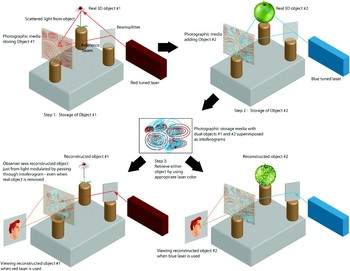
Figure 1. Holographic data storage and retrieval. Inset illustrates an interference pattern on film that is the physical storage of the holographic image.
 You have
Access
Optical holography hypothesis
In this commentary, we highlight a possible physical mechanism for neural reuse. Importantly, how reuse is implemented in neural tissue is one of the primary open questions, as the author states in section 6.4, paragraph 4, of the target article. Specifically, we wonder if there might be utility in a theory of reuse (i.e., recruitment of the same cortical area for multiple cognitive functions) based on an analogy to optical holography. This analogy has been proposed by several authors as early as the late 1960s and early 1970s (e.g., Westlake Reference Westlake1970) and as recently as 2008 (Wess Reference Wess2008). It has influenced work in distributed associative memory, which involves neural reuse in the form of individual processors contributing to multiple distributed representations (Plate Reference Plate1995; Sutherland Reference Sutherland and Soucek1992). However, the full potential of the analogy does not appear to have been realized. Therefore, we describe optical holography and the neural analogy, state some predictions about neural function based on this analogy, and propose means for testing these predictions. (See our Fig. 1.)
Holographic data storage and retrieval. Inset illustrates an interference pattern on film that is the physical storage of the holographic image.
Optical holography was developed by Dennis Gabor, for which he won the 1971 Nobel Prize in Physics. It is a method for encoding, and then retrieving, multiple images onto a single (color-sensitive) photographic plate using different wavelengths of light emitted by a laser. Illustrated in Figure 1, laser light is split into two equally coherent beams of light by a beam splitter. One path goes through the beam splitter and reflects off of the target (real three-dimensional) object; some of this reflected light hits the storage media (photographic film). The other path is reflected by the beam splitter directly towards the storage media. The difference in path length of the two coherent beams of light from the beam splitter to the storage media creates a phase difference that exposes the photographic film with an intoferogram image (inset, Fig. 1). To retrieve the stored image, the real object can be removed and the laser light is sent through the beam splitter, all of which is reflected to the photographic film. After passing through the photographic film, the optical holographic image is reconstructed and visible to the eye. Importantly, if lasers of different wavelength are used, different holograms can be encoded on the same photographic film, essentially allowing reuse of that film.
Reuse
That multiple images can be encoded in a distributed manner on a single plate at different wavelengths is the foundation of the applicability to the neural reuse hypothesis, although we imagine it would apply to more than just storage of memories. Specifically, optical holography has fundamentally three parameters that can be varied to encode each unique hologram onto a photographic medium: (1) frequency of the laser, (2) amplitude of the laser, and (3) phase relationships to other stored representations. On the surface, these three variables might be analogous to frequency, amplitude, and phase relationships in firing of individual neurons and neural circuits or ensembles. However, there are additional variables affecting neural behavior, including: (i) involvement of various neurotransmitters; (ii) afferent, lateral, and feedback connectivity; and (iii) temporal relationships between thousands of inputs. This implies a large variety of ways in which an individual neuron, circuit, or area can be recruited for different functions.
One prediction that follows from this part of the analogy is that one should be able to elicit fundamentally different behaviors from a neuron, circuit, or even a cortical region by changing the input or the larger context in which the input occurs. This could take the form of electrical stimulation with different properties or the presentation of different neurotransmitters to the same neuron or circuit and measuring the resulting outputs. If the electrical stimulation or neurotransmitter acts as an analogue to the wavelength of the reference beam, different behaviors should result. Such testing could be done in slice preparations, in engineered networks, or in simple animal models such as Drosophila.
Interference
Harmonic interference, or holographic aliasing, leads to errors that may have analogues in human memory and learning. Specifically, aliasing in holography may be analogous to confabulation or abstraction into a schema representation. Aliasing can occur as a result of two objects being encoded onto the same plate using lasers with similar wavelengths, and results in retrieval of an image that is an amalgamation of the two original objects. An analogue in human behavior would be two skills learned under similar contextual conditions. When those skills are functionally similar, they are considered to positively transfer to one another, and can result in a generalized representation of that particular class of problems. When they are functionally dissimilar, this is considered to be an example of negative transfer (e.g., Cormier Reference Cormier, Cormier and Hagman1987; Gick & Holyoak Reference Gick and Holyoak1983; Novick Reference Novick1988). This might also cause enhancement of a particular memory (e.g., the von Restorff effect; Hunt Reference Hunt1995).
Additional implications of the holographic analogy include:
1 The fact that a single beam of a particular frequency recalls the entire image may be analogous to redintegration (Roodenrys & Miller Reference Roodenrys and Miller2008).
2 The capacity for storage and reuse increases with the number of variables used in defining neural and circuit behavior (Kalman et al. Reference Kalman, Kobras, Grawert, Maltezos, Hanssen, Coufal and Burr2004; Plate Reference Plate1995; Psaltis & Burr Reference Psaltis and Burr1998; Sutherland Reference Sutherland and Soucek1992).
3 The number of parameters defining neural and circuit behavior in a given organism should predict behavioral/cognitive complexity, and such complexity should scale similarly to the predicted capacity.
As indicated above, tests of predicted capacity and interference can be done using computational simulations, experiments with networks in preparation, or engineered networks of neurons.
In the past, the optical holography analogy has been criticized (e.g., Wilshaw et al. Reference Wilshaw, Buneman and Longuet-Higgins1969). Certainly, the analogy does break down in certain places–for example, the fact that any piece of the photographic plate encodes the entire image, thus destroying some parts of the plate, merely degrades image quality rather than creating an analogue to aphasias seen in humans. However, using the holographic analogy as a starting point for hypothesis development might provide a foundation from which the physical mechanisms of neural reuse might be identified.