The progress in clay science is of considerable importance for solving environmental pollution and energy problems (Kaufhold et al., Reference Kaufhold, Chryssikos, Kacandes, Gionis, Ufer and Dohrmann2019). Therefore, at present, expanding the types and application areas of clay minerals should be considered an important research direction (Zheng et al., Reference Zheng, Han, Huang, Dai, Qian, Zhang and Ren2010). Clay minerals are produced via the chemical weathering of silicate minerals on the Earth's surface, and the development and study of clay-based mineral resources provide a scientific basis for exploring the evolutionary laws of the Earth's crustal surface (Lu & Wang, Reference Lu and Wang2022). Because of their superior adsorption capacities, clays have developed as effective and safe scavengers for pollutant removal (Largo et al., Reference Largo, Haounati, Akhouairi, Ouachtak, El Haouti and El Guerdaoui2020; Qiu et al., Reference Qiu, Guo, Qi, Cheng and Jing2021; Zhou et al., Reference Zhou, Wang, Alcântara and Ding2023). However, naturally occurring clay minerals contain high levels of impurities, thereby limiting their potential for application. Synthesis techniques have enabled an in-depth understanding of the specific compositions and properties of clay minerals, resulting in the development of novel applications (Sun et al., Reference Sun, Xiao, Liu, Zhao and Xiao2014).
With the development of nanotechnology, application of smectite as a natural nanomaterial has attracted the interest of a wide range of researchers with the aim of utilizing their nanoscale layer spaces to develop highly novel functional composites (Tanboonchuy et al., Reference Tanboonchuy, Grisdanurak and Liao2012; Maitlo et al., Reference Maitlo, Kim, Kumar, Kim and Park2019; Jiang et al., Reference Jiang, Han, Jiang, Xu, Ouyang and Sun2021). Currently, composites based on clay minerals have been successfully applied in high-end fields such as adsorbents and cosmetics (Tanboonchuy et al., Reference Tanboonchuy, Grisdanurak and Liao2012; Ezati et al., Reference Ezati, Bang and Rhim2021).
Compared to other smectites, such as montmorillonite and kaolinite, the application field of illite is developing, and demand for high-end illite-finished products is increasing. Ilmenite has high potassium and aluminium contents, a small particle size, a large specific surface area and good corrosion resistance, adsorption, heat resistance and plasticity. Therefore, ilmenite has been used in several fields, and its development and utilization prospects are broad. To solve the phase-change microcapsule core leakage problem, researchers have used hybrids of two or more materials as phase-change cores, which improved the thermal-storage efficiency of the microcapsules whilst reducing the liquid-phase leakage of the cores. Zhang et al. (Reference Zhang, Shin and Santhanagopalan2019) prepared a high-temperature-resistant microcapsule with a high encapsulation rate by using a binary mixture of lithium carbonate and sodium carbonate as the core material and the inorganic material silica (SiO2) as the wall material.
Herein, for the first time, the preparation and synthesis of phase-change microcapsules with SiO2 as the inorganic shell layers and paraffin (Pa) wax and illite as the phase-change core materials were proposed. This provides a novel opportunity for exploring the application of a smectite in the field of microcapsules and expands the development of clay minerals in the field of phase-change materials. Furthermore, these microcapsules can be successfully applied in silicone rubber foam (SRF), which is a material with good elasticity and toughness and is widely used for providing support to building structures. For example, Guo et al. (Reference Guo, Yang, Jiang, He, Zhang and He2019) prepared a morphologically stable composite foam SRF/Pa@SiO2, in which SiO2 acts as a shell material to provide barrier protection for the phase-change core material Pa and as an inorganic filler to enhance the mechanical strength of SRF. Lou et al. (Reference Lou, He, Li, Li, Zhou and Lin2020) introduced Pa@lead tungstate microcapsules into foam substrates with SRF as the carrier, and these researchers were able to prepare composite phase-change foams with relatively stable shapes.
Materials and methods
Raw materials and chemical reagents
Pa (solid), cetyltrimethylammonium bromide (CTAB; powder), hydrochloric acid (liquid) and tetraethyl silicate (TEOS; liquid) were purchased from Sinopharm Chemical Reagents Ltd (Shanghai, China). A 2000-grade illite powder (2000 mesh powder) was sourced from Antu County, Yanbian, Jilin Province, China. Liquid silicone rubber (107-LSR), E620-A (liquid), E620-B (liquid), hydrogen-containing silicone oil (liquid) and methyl silicone oil (liquid) were obtained from China Jinan Feng Chemical Co., Ltd (Jinan, China).
Modification
The crystal structure of illite primarily comprises a layer of aluminium–oxygen octahedra sandwiched between two layers of silicon–oxygen tetrahedra, with hydroxyl groups present on the surface and edges of this lamellar structure, and it has a chemical formula K1–1.5Al[Si6.5–7Al1–1.5O20](OH)4. Illite was modified as follows: purified illite, CTAB and distilled water were mixed well and stirred at 60°C for 30 min in a magnetic stirrer, washed three times and dried. The modification mechanism occurred mainly through an ion-exchange reaction between the interlayer cations of illite and cationic surfactants using the alkyl chains in the surfactant structure to reduce the hydrophilicity and increase the lipophilicity of illite. This ensures that a tight connection can be made with the Pa (Wang et al., Reference Wang, Wang, Yu, Zhang and Yan2021).
Preparation of phase-change microcapsules
Illite–CTAB (0.2 g) and distilled water (100 mL) were thoroughly mixed and then ultrasonicated, heated and stirred. Subsequently, this mixed solution was added to a Pa (9.8 g) emulsion and allowed to emulsify for 2 h. An encapsulated precursor solution was obtained via combining TEOS (10 g) and distilled water (20 g) in a beaker and adjusting the pH of the mixture to between 2 and 3 using hydrochloric acid. Then, the solution was incrementally added to the Pa emulsion and stirred for 4 h at 70°C. Finally, the white powder was collected on filter paper, washed three times with hot anhydrous ethanol and dried at 25℃. The resulting solid powder is the microencapsulated Pa@SiO2@illite–CTAB.
Preparation of the composite phase-change foam materials
107-LSR, hydrogenated silicone oil, methyl silicone oil and E620-B were mixed to obtain component A and 30 wt.% E620-A catalyst and Pa@SiO2@illite–CTAB were mixed to obtain component B. The mixtures were stirred and placed in an oven to obtain SRF. The preparation of SRF/Pa@SiO2@illite–CTAB is depicted in Fig. 1.
Preparation of Pa@SiO2@illite–CTAB and SRF/Pa@SiO2@illite–CTAB.

Characterization and performance analysis
Characterization
The morphology of the prepared microcapsules was observed using optical microscopy (OM; D106B, Dongwan, China). The microstructures of the microcapsules and composite foam samples were observed using scanning electron microscopy (SEM; SU8010, Shanghai, China). Elemental analysis of the samples was obtained using Fourier-transform infrared (FTIR) spectrometry (370 IS10; Thermo Fisher Scientific, Shanghai, China) in attenuated total reflectance mode in the 4000–500 cm–1 range. X-ray photoelectron spectroscopy (XPS; K-Alpha, Thermo Fisher Scientific, Shanghai, China) was used to analyse the elements on the microcapsule surface. The crystal structure of the microcapsules was characterized using X-ray diffraction (XRD; Rigaku Ultima IV, Thermo Fisher Scientific, Shanghai, China) in the range of 5–90° with a scanning speed of 10° min–1. The thermal properties were analysed using differential scanning calorimetry (DSC; DSC 25, TA Instruments, Inc., Shanghai, China) at a heating rate of 10°C min–1 from 30°C to 70°C under a nitrogen atmosphere with a holding time of 5 min. The thermal stability was analysed using thermogravimetric analysis (TGA; EXSTRA 6300, Shanghai, China) at a heating rate of 20°C min–1 from 25°C to 800°C in a synthetic air atmosphere (50 mL min–1).
Performance analysis
The thermal conductivities of the composite foam samples were measured using the transient plane method with a thermal conductivity tester (DRE-III, Shanghai, China) at room temperature and averaged over several tests per sample. Heat transfer experiments for the composite foam materials were performed in an environmental chamber. Leakage rate experiments for the composite foams were performed in an oven at a temperature (75°C) higher than the melting point of Pa. The initial weight of the samples is represented as m 0, and their subsequent weight is represented as mn. The equation for calculating the leakage rate (μ) is shown in Equation 1 (Zuo et al., Reference Zuo, Li, Zhao, Yang and Chen2020):

where μ is the leakage rate, m 0 is the initial weight of the experimental sample and mn is the weight of the nth heating at 75°C.
Results and discussion
Optical microscopy
Figure 2 illustrates the microstructures of Pa@SiO2 and Pa@SiO2@illite–CTAB observed via OM. The dispersion of the microspheres is mostly uniform, and the particle size ranges from 10 to 50 μm.
OM images of (a) Pa@SiO2 and (b) Pa@SiO2@illite–CTAB.

FTIR spectroscopy
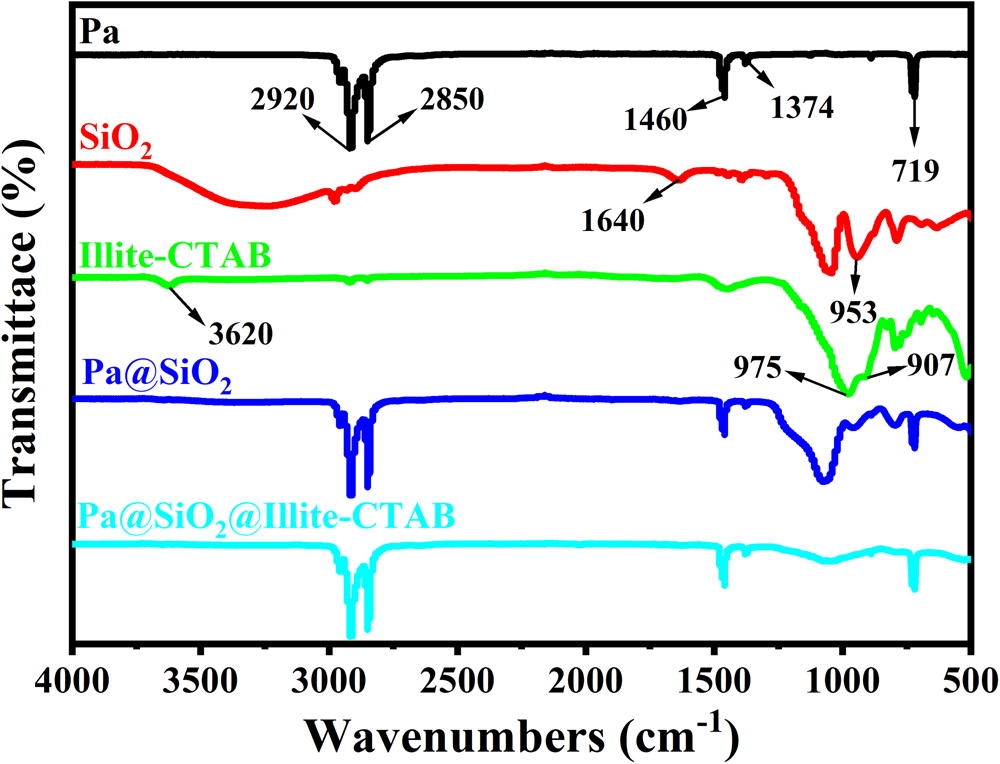
Figure 3 shows the FTIR spectra for Pa, SiO2, illite–CTAB, Pa@SiO2 and Pa@SiO2@illite–CTAB. The peaks at 2915 and 2841 cm–1 correspond to the stretching vibrations of CH3 and CH2, respectively (Zhang et al., Reference Zhang, Cai, Li, Li, He and Chen2022). Moreover, these peaks appear in the FTIR spectrum of illite–CTAB, suggesting that illite was successfully modified using CTAB. The peaks at 1460 and 1374 cm–1 correspond to the deformed vibrational peaks of CH2 and CH3, respectively. The absorption bands at 3000–3600 and 1600–1700 cm–1 correspond to the stretching and bending vibrations of the –OH functional group in SiO2, respectively. The bending vibrations of the Si–O functional group are observed at 1040 and 798 cm–1. The peak at 948 cm–1 corresponds to the Si–OH group.
FTIR spectra of Pa, SiO2, illite–CTAB, Pa@SiO2 and Pa@SiO2@illite–CTAB.

Since SiO2 can only be formed at paraffin interfaces, the FTIR spectroscopy results indicate that SiO2 shells are formed on the surface of paraffin droplets (Fang et al., Reference Fang, Chen and Li2010). In the FTIR spectra of Pa@SiO2 and Pa@SiO2@illite–CTAB, there was no change in the absorption peaks at 2920, 2850, 1460 and 719 cm–1 for paraffin. This result demonstrates that there is no chemical interaction between the Pa molecule and SiO2.
XPS analysis
To further understand the content of illite in the Pa@SiO2@illite–CTAB microcapsules, the elements of Pa@SiO2@illite–CTAB were analysed using XPS. The elemental composition of the microcapsules comprises C, O, Si and Al (Fig. 4a). The C binding mode of Pa@SiO2@illite–CTAB was investigated via curve fitting the high-resolution spectrum of C 1s, as shown in Fig. 4b. The 284.4 and 286.0 eV peaks of C 1s, corresponding to C–C or C=O and C–O, were attributed to the Pa in the microcapsules (Atri et al., Reference Atri, Uma and Nagarajan2020). The fitted curve of the Si 2p energy band is shown in Fig. 4c. The main peak at 103.2 eV corresponds to the binding energy of O–Si–O, confirming the presence of SiO2 microspheres in the microcapsules. The curves shown in Fig. 4d suggest that the peaks at 74.3 and 68.5 eV correspond to the Al 2p signal peaks (Hu et al., Reference Hu, He and Wang2012), which are mainly attributed to the aluminium present in illite. The ratio of Al to Si in illite is 1:5, and that in the microcapsules is 1:8 (Table 1), indicating that SiO2 microspheres exist on the microcapsule surface, in addition to illite. Combining the FTIR spectroscopy results of the microcapsules reveals that SiO2 was successfully encapsulated on the microcapsule surface.
XPS analysis: (a) full-spectrum scan, (b) C 1s, (c) Si 2p and (d) Al 2p.

Elemental contents of C, O, Si and Al in Pa@SiO2@illite–CTAB.

XRD analysis
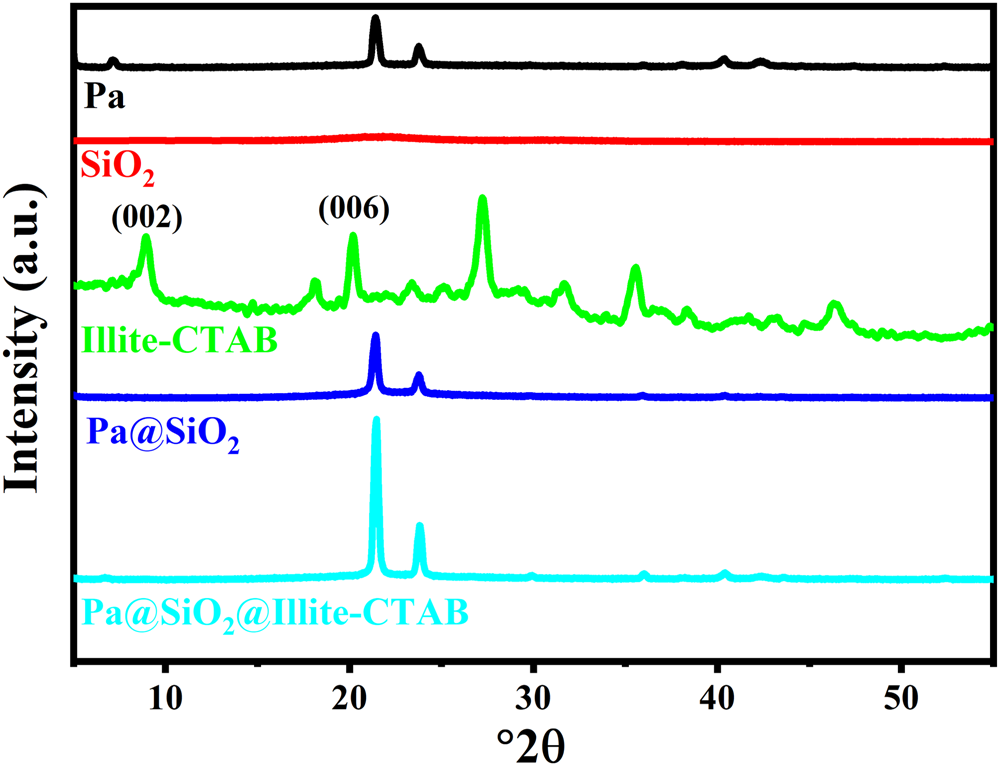
Figure 5 shows the XRD spectra of Pa, SiO2, illite–CTAB, Pa@SiO2 and Pa@SiO2@illite–CTAB. As can be seen from Fig. 5, the regular crystallization of Pa occurs at 21.47° and 23.79°. SiO2 has a flat peak in the 2θ range of 20–25°, indicating that SiO2 has an amorphous structure and has the conditions to form microcapsule shells. The characteristic diffraction peaks of the XRD spectrum of illite–CTAB at 2θ = 8.91° and 20.23° correspond to the crystallographic indices (002) and (006), respectively. The XRD peaks of Pa in Pa@SiO2 and Pa@SiO2@illite–CTAB are based on the SiO2 flat peaks shown. However, due to the low content of illite in the microcapsules, no characteristic peaks belonging to illite were observed in the XRD spectra of Pa@SiO2@illite–CTAB. In addition, there are no other diffraction peaks in the XRD spectrum of Pa@SiO2@illite–CTAB, so the microencapsulation of Pa does not change its crystalline structure, which ensures that the microcapsule still has a good thermal-storage capacity and can be thermally managed by the solid–liquid phase transition.
XRD spectra of Pa, SiO2, illite–CTAB, Pa@SiO2 and Pa@SiO2@illite–CTAB.

SEM analysis
SEM images of Pa@SiO2/illite, Pa@SiO2@illite–CTAB, SRF and SRF/Pa@SiO2@illite–CTAB are shown in Fig. 6. To prove that the illite was successfully modified using CTAB, microencapsulated Pa@SiO2/illite was prepared using unmodified illite instead of illite–CTAB. As shown in Fig. 6a,b, unmodified illite was heavily agglomerated with Pa@SiO2 microspheres, and the microsphere surface was smooth without illite attached. Lipophilicity of illite–CTAB increased due to the presence of alkyl chains on the CTAB structure, ensuring that illite forms strong bonds with Pa (Wang et al., Reference Wang, Wang, Yu, Zhang and Yan2021). Therefore, the illite unmodified by CTAB was directly added to the preparation of the microcapsules, and illite existed in the system in an independent state, also proving that the modification of Illite by CTAB was successful.
SEM images of (a,b) Pa@SiO2/illite, (c,d) Pa@SiO2@illite–CTAB, (e) SRF and (f) SRF/Pa@SiO2@illite–CTAB.

As detailed in Fig. 6c,d, Pa@SiO2@illite–CTAB exhibited a distinct spherical microstructure, and its surface revealed the laminar structure of the illite that was not encapsulated by silica. Combined with FTIR and XRD analyses, it can be observed that in the Pa@SiO2@illite–CTAB system, SiO2 generated from the hydrolysis of TEOS is spread on the surface of the paraffin droplets, and strong bonds are generated between the illite–CTAB and the Pa to form a heterogeneous core, with the illite acting as a filler to be distributed in the core. As detailed in Fig. 6e,f, the blank SRF exhibits a uniform circular vesicle structure, and the microcapsules are well dispersed within the pore structures of the composite foam and did not break.
Phase-change temperature and latent heat capacity
The phase-change temperatures were denoted as the melting temperature (T m) and crystallization temperature (T c), and the phase-change enthalpies were denoted as the enthalpy of melting (H m) and the enthalpy of crystallization (H c). Figure 7 shows the phase-change temperatures and enthalpies for all of the samples. Furthermore, the DSC curves exhibit two heat-absorption peaks and two heat-release peaks, wherein the primary and secondary peaks indicate solid–liquid and solid–solid processes, respectively. Both Pa@SiO2@illite–CTAB and SRF/Pa@SiO2@illite–CTAB exhibit excellent phase-change capabilities, with enthalpies of 98.24 and 16.91 J g–1, respectively. The increase in T m and slight decrease in T c for Pa@SiO2@illite–CTAB compared to Pa and Pa@SiO2 are primarily attributed to the presence of large amounts of illite within the silica shell layer.
DSC of (a) Pa, Pa@SiO2 and Pa@SiO2@illite–CTAB and (b) SRF/Pa, SRF/Pa@SiO2 and SRF/Pa@SiO2@illite-CTAB.

Thermal stability analysis
The TGA and differential thermogravimetry (DTG) curves of the Pa, Pa@SiO2, Pa@SiO2@illite–CTAB and composite phase-change foams are shown in Fig. 8a,b. Pa exhibits a typical one-step thermal decomposition process, with thermal decomposition starting at 102°C and finishing at ~257°C. The thermal decomposition temperatures of Pa@SiO2 and Pa@SiO2@illite–CTAB are 127°C and 135°C, respectively, and their residual masses are 26.02% and 32.46%, respectively, after combustion. This is due to the protective effect of the SiO2 shell on the core material, which slows down the thermal degradation of Pa. Additionally, illite–CTAB increases the thermal decomposition temperature of the microcapsules. The composite foams exhibit a two-step thermal degradation process: the first step occurs between 100°C and 300°C, corresponding to the thermal decomposition of the Pa molecular chain, and the second step happens between 500°C and 700°C, attributed to the thermal degradation of SRF.
(a) TGA and (b) DTG curves for Pa, Pa@SiO2, Pa@SiO2@illite–CTAB, SRF/Pa, SRF/Pa@SiO2 and SRF/Pa@SiO2@illite–CTAB.

Leakage rate analysis
In addition, a composite foam, SRF/Pa/illite–CTAB, was prepared using equal proportions of Pa@SiO2@illite–CTAB and illite–CTAB. Figure 9 shows the digital images of the composite phase-change foam before and after 200 thermal cycles with its leakage rate variation curve. The leakage rate for SRF/Pa is 11.9%, whereas those of SRF/Pa@SiO2 and SRF/Pa@SiO2@illite–CTAB are 3.2% and 2.6%, respectively. Pa@SiO2@illite–CTAB exhibits excellent low leakage rates and recyclability. Thermal cycling experiments for over 200 cycles demonstrate that illite–CTAB as a microcapsule core material could effectively prevent the Pa liquid phase from leaking.
Thermal cycle test over 200 cycles: leakage rate curves.

Thermal conductivity
The thermal conductivities of the Pa, SRF and composite phase-change foams are presented in Fig. 10. The thermal conductivity of the composite foam SRF/Pa@SiO2@illite–CTAB is reduced to 0.1138 W (m·K)–1, and SRF/Pa@SiO2 exhibits a higher value of 0.1568 W (m·K)–1. Moreover, the presence of a large amount of illite as a filler in the microcapsule core causes decrease in the rates of heating and cooling, reducing the thermal conductivity of the composite foam. Therefore, this composite foam is suitable for application in the field of insulation.
Thermal conductivities of Pa, SRF, and composite phase-change foam materials.

Analysis of heat transfer characteristics
The heat transfer tests on the foam samples, which were conducted in an environmental chamber, employed the following procedure: the foam samples were placed on a 100°C temperature-controlled rubber heating plate, a K-type thermocouple was attached to the surface of the foam and the temperature was recorded using an Agilent data acquisition system.
Temperature–time graphs of the collected data are shown in Fig. 11. The temperature–time curves of all of the composite foams plateau between 350 and 1340 s. These plateaus arise due to the latent heat absorption of Pa at its phase-change temperature, resulting in the substantial delay of a temperature increase. In contrast to the SRF/Pa, SRF/Pa@SiO2 and SRF/Pa/illite–CTAB profiles, the plateau of the composite foam material with SRF/Pa@SiO2@illite–CTAB persists for longer. This is primarily due to the replacement of a portion of the core Pa by illite–CTAB, resulting in high hysteresis in the Pa heat uptake.
Temperature–time curves of SRF, SRF/Pa, SRF/Pa@SiO2, SRF/ Pa@SiO2@illite-CTAB and SRF/Pa/illite-CTAB.

The results of the heat transfer tests confirm that illite–CTAB as a filler for the microcapsule core does not change the microcapsule phase-change properties whilst offering considerably enhanced temperature regulation stability.
Hardness analysis
The hardness of the composite foam materials SRF, SRF/Pa, SRF/Pa@SiO2, SRF/Pa@SiO2@illite–CTAB and SRF/Pa/illite–CTAB were tested and analysed, as shown in Fig. 12. The hardness of the blank SRF foamed material is 2.73 HC, and the hardness of the composite SRF/Pa after the addition of Pa is 2.89 HC. Combined with the results from the SEM analysis of the SRF/Pa composite foam material, the majority of the SRF vesicles were determined to be filled with Pa, increasing the hardness of SRF/Pa. However, the hardness of the SRF/Pa@SiO2@illite–CTAB composite material is greater.
Hardness of SRF, SRF/Pa, SRF/Pa@SiO2, SRF/Pa@SiO2@illite–CTAB and SRF/Pa/illite–CTAB.

The presence of illite in the core portion of the microcapsule increases the hardness of the microcapsule and SRF/Pa@SiO2@illite–CTAB foam.
Conclusion
In this study, a new thermal storage microcapsule, Pa@SiO2@illite–CTAB, was successfully prepared using illite as the core filler. The complete structure of the Pa@SiO2@illite–CTAB system, with SiO2 as the encapsulated shell and Pa and illite–CTAB as the hybridized core materials, was clarified using FTIR spectroscopy, XRD and SEM characterizations. Characterization experiments such as 200 rounds of thermal cycling showed that illite was encapsulated as a filler for the core Pa in a silica shell, and the liquid-phase leakage of Pa was significantly reduced. The microencapsulated Pa@SiO2@illite–CTAB could maintain its intact morphology, good phase-transition characteristics and excellent mechanical properties after being applied to SRF.
In summary, the modified illite could be used as a support material for microcapsule cores for preventing the thermal decomposition and leakage of phase-change cores at room temperature, to improve the thermal stability and strength of microcapsule systems and to achieve effective practical value in the field of phase-change materials. Most of the current research on clay minerals by researchers has been limited to observing the microstructure of clay pores. Analysing the utilization of the natural adsorption properties of clays in combination with other materials will extend their application value and is a direction worth exploring.
Financial support
This work was supported by the Shanghai University of Engineering Science, Program of Graduate Research Innovation Project (No. 023E4600019grfz004).
Conflicts of interest
The authors declare that they have no known competing financial interests or personal relationships that could have appeared to influence the work reported in this paper.