Introduction
Avoidant personality disorder (AVPD) and obsessive-compulsive personality disorder (OCPD) have, since the introduction of the DSM-III manual (APA, 1980), been placed in the DSM Cluster C classification nosology, characterized by anxiousness and fearfulness. Being two of the most prevalent personality disorders (PDs) (Zimmerman et al. Reference Zimmerman, Rothschild and Chelminski2005; Bernstein et al. Reference Bernstein, Arntz, Travaglini, Blaney, Krueger and Millon2014; Reichborn-Kjennerud & Knudsen, Reference Reichborn-Kjennerud, Knudsen, Blaney, Krueger and Millon2014), they are associated with major societal costs in terms of medical expenses and loss of productivity (Soeteman et al. Reference Soeteman, Hakkaart-van Roijen, Verheul and Busschbach2008).
AVPD and OCPD are, along with the other DSM-5 PDs, assumed to have an onset in adolescence or early adulthood and to be fairly persistent over time (APA, 2013). Stability has always been a central part of the definition of PDs, and the introduction of DSM Axis II from 1980 was partly due to the assumption that PDs are more enduring than other mental disorders (Krueger, Reference Krueger2005). Empirical studies on stability of PDs did, however, not show up until several years later (Lenzenweger, Reference Lenzenweger1999). More recently, longitudinal studies ranging from 2 to 10 years, on the phenotypic stability of AVPD and OCPD, have demonstrated that the absolute stability, defined as consistency in the number of endorsed criteria (Morey & Hopwood, Reference Morey, Hopwood and NolenHoeksema2013) is moderate, with a decrease in symptom mean levels ranging from 0% to 57% (Johnson et al. Reference Johnson, Cohen, Kasen, Skodol, Hamagami and Brook2000; Grilo et al. Reference Grilo, Sanislow, Gunderson, Pagano, Yen, Zanarini, Shea, Skodol, Stout, Morey and McGlashan2004), and that the rank-order stability, defined as temporal consistency in the ranking of individuals (Morey & Hopwood, Reference Morey, Hopwood and NolenHoeksema2013) is modest, with Pearson correlations ranging from 0.13 to 0.67 (Lenzenweger, Reference Lenzenweger1999; Johnson et al. Reference Johnson, Cohen, Kasen, Skodol, Hamagami and Brook2000; Grilo et al. Reference Grilo, Sanislow, Gunderson, Pagano, Yen, Zanarini, Shea, Skodol, Stout, Morey and McGlashan2004; Sanislow et al. Reference Sanislow, Little, Ansell, Grilo, Daversa, Markowitz, Pinto, Shea, Yen, Skodol, Morey, Gunderson, Zanarini and McGlashan2009; Hopwood et al. Reference Hopwood, Morey, Donnellan, Samuel, Grilo, McGlashan, Shea, Zanarini, Gunderson and Skodol2013). AVPD is often found to be more stable than OCPD.
Previous cross-sectional twin studies have established that both AVPD and OCPD are influenced by genetic factors (Torgersen et al. Reference Torgersen, Lygren, Oien, Skre, Onstad, Edvardsen, Tambs and Kringlen2000; Reichborn-Kjennerud et al. Reference Reichborn-Kjennerud, Czajkowski, Neale, Orstavik, Torgersen, Tambs, Roysamb, Harris and Kendler2007), and that the heritability of PDs increases substantially when measurement error is taken into account (Kendler et al. Reference Kendler, Myers, Torgersen, Neale and Reichborn-Kjennerud2007; Gjerde et al. Reference Gjerde, Czajkowski, Roysamb, Orstavik, Knudsen, Ostby, Torgersen, Myers, Kendler and Reichborn-Kjennerud2012; Torgersen et al. Reference Torgersen, Myers, Reichborn-Kjennerud, Røysamb, Kubarych and Kendler2012). To what extent the latter point applies to OCPD is currently unknown. Despite being placed within the same cluster, the two disorders have been found to have mainly distinct genetic and environmental influences (Reichborn-Kjennerud et al. Reference Reichborn-Kjennerud, Czajkowski, Neale, Orstavik, Torgersen, Tambs, Roysamb, Harris and Kendler2007; Kendler et al. Reference Kendler, Aggen, Czajkowski, Roysamb, Tambs, Torgersen, Neale and Reichborn-Kjennerud2008). However, studies on how the genetic and environmental effects of these PDs relate to one another and develop over time are currently lacking.
In the present study, we applied biometric twin models to longitudinal data from the Norwegian Institute of Public Health Twin Panel (NIPHT) on DSM-IV AVPD and OCPD traits assessed in early adulthood and approximately 10 years later. With this approach we sought to: (i) determine the phenotypic stability of AVPD and OCPD, (ii) estimate the time-specific and stable genetic and environmental influences on the two PDs, and (iii) examine the etiology of the association between the parts of AVPD and OCPD that are stable over time.
Material and method
Sample
Twins were recruited from the Norwegian Twin Registry (NTR) at the Norwegian Institute of Public Health. The participants were identified through information from the Norwegian Medical Birth Registry (MBR), which was established 1 January 1967. The twins born between 1967 and 1979 (N = 15 374) were invited to participate in questionnaire studies in 1992 and 1998. Altogether, 12 700 received the second questionnaire, and 8045 twins responded after one reminder (63%). Zygosity was determined by the use of questionnaire items for the entire sample, as well as by microsatellite markers for 676 of the same-sex twin pairs, which in a combined discriminant analysis predicted a zygosity misclassification rate of <1% of pairs (Tambs et al. Reference Tambs, Ronning, Prescott, Kendler, Reichborn-Kjennerud, Torgersen and Harris2009). The NTR is further described in detail elsewhere (Harris et al. Reference Harris, Magnus and Tambs2006; Nilsen et al. Reference Nilsen, Knudsen, Gervin, Brandt, Roysamb, Tambs, Orstavik, Lyle, Reichborn-Kjennerud, Magnus and Harris2013).
The data derive from the studies ‘Mental Health among Twins’ and ‘Axis I and Axis II psychiatric disorders in Norwegian Twins’ (AI/AII), conducted from 1998 to 2004 (wave 1) and a follow-up interview and questionnaire study (AI/AII FU), conducted in 2010 and 2011 (wave 2). Wave 1 interviews were mainly face-to-face, although for practical reasons 231 interviews (8.3%) were done by telephone. Of the 6442 eligible twins, 2801 twins (43.5% of those eligible) participated in wave 1 (1390 complete pairs and 21 singletons). To maximize participation rate, interviews in wave 2 included only a selection of the disorders, and were conducted by telephone. Of the 2801 twins that participated in wave 1, 17 had withdrawn their consent, 14 had unknown addresses and 12 had died, leaving 2758 eligible twins who were invited to participate in a follow-up study. Altogether, after two written reminders and a final telephone contact to non-responders, 2284 twins (82.8%, 987 complete pairs and 310 singletons) were interviewed in wave 2.
Interviewers at wave 1 were mainly senior clinical psychology graduate students, in addition to experienced psychiatric nurses and medical students. Interviewers at wave 2 comprised senior clinical psychology graduate students, experienced psychiatric nurses, experienced clinical psychologists that also were interviewers at wave 1 and clinical nurse specialists. Interviewers received a standardized training program administered by one psychiatrist and two psychologists. The interviewers received supervision during the entire data collection period. At both waves each twin in a pair was interviewed by a different interviewer.
Inter-rater reliability at wave 1 was assessed based on two raters scoring 70 audiotaped interviews. The number of subjects with specific PDs was too low to calculate kappa coefficients. Intra-class (and polychoric) correlations for the number of criteria endorsed at the sub-threshold level (see below) were all high: AVPD 0.96 (0.97), and OCPD 0.92 (0.87). At wave 2, inter-rater reliability was assessed similarly by two raters’ re-scoring of 95 audiotaped interviews. Intra-class (and polychoric) correlations for the number of endorsed sub-threshold criteria were: AVPD 0.84 (0.92), and OCPD 0.75 (0.83).
The studies were approved by the Regional Committees for Medical and Health Research Ethics, and informed consent was obtained from all participants.
Measures
A Norwegian version of the Structured Interview for DSM-IV Personality (SIDP-IV; Pfohl & Zimmerman, Reference Pfohl and Zimmerman1995) was used to assess all 10 DSM-IV PDs at wave 1 and six PDs (two from each DSM-IV cluster) at wave 2; paranoid, schizotypal, antisocial, borderline, avoidant and obsessive-compulsive. The SIDP-IV is a comprehensive semi-structured diagnostic interview that includes non-pejorative questions organized into topical sections (e.g. social relationships and work style) rather than by individual PDs, thereby improving the interview flow.
The SIDP-IV uses a ‘5-year rule’, meaning that behaviors, cognitions and feelings that predominated for most of the past 5 years are considered representative of an individual's long-term personality. Each DSM-IV criterion is scored on a 4-point scale (0 = absent, 1 = sub-threshold, 2 = present, 3 = strongly present).
We used a dimensional modeling approach that operationalized each of the PDs as ordinal count variables instead of diagnostic cut-off scores. Each criterion for each PD scored ⩾1 (sub-threshold) increased the count variable by 1. The two count variables AVPD and OCPD are meant to reflect avoidant and obsessive-compulsive PD traits – that is, PD tendencies that do not necessarily constitute a clinical PD diagnosis (Krueger et al. Reference Krueger, Derringer, Markon, Watson and Skodol2012; APA, 2013).
Using multiple threshold tests, our group has previously shown that the use of individual sub-threshold PD criteria reflected varying levels of severity on a single continuum of liability (Reichborn-Kjennerud et al. Reference Reichborn-Kjennerud, Czajkowski, Neale, Orstavik, Torgersen, Tambs, Roysamb, Harris and Kendler2007).
Due to low frequencies of high counts, the PD variables were further truncated by collapsing the upper criteria counts into four ordered categories (0–3) for AVPD and to five categories (0–4) for OCPD to avoid empty cells in the twin analyses. This approach has been used in previous publications on the same sample (Kendler et al. Reference Kendler, Czajkowski, Tambs, Torgersen, Aggen, Neale and Reichborn-Kjennerud2006, Reference Kendler, Myers, Torgersen, Neale and Reichborn-Kjennerud2007; Reichborn-Kjennerud et al. Reference Reichborn-Kjennerud, Czajkowski, Neale, Orstavik, Torgersen, Tambs, Roysamb, Harris and Kendler2007; Torgersen et al. Reference Torgersen, Czajkowski, Jacobson, Reichborn-Kjennerud, Roysamb, Neale and Kendler2008, Reference Torgersen, Myers, Reichborn-Kjennerud, Røysamb, Kubarych and Kendler2012; Gjerde et al. Reference Gjerde, Czajkowski, Roysamb, Orstavik, Knudsen, Ostby, Torgersen, Myers, Kendler and Reichborn-Kjennerud2012) and is, according to results from multiple threshold tests, consistent with differences in severity on a normally distributed continuum of liability (Kendler et al. Reference Kendler, Aggen, Czajkowski, Roysamb, Tambs, Torgersen, Neale and Reichborn-Kjennerud2008). The phenotypes under study are therefore not AVPD and OCPD at a diagnostic level, but AVPD and OCPD traits.
From the interviews in wave 1, 2793 twins had valid data for DSM-IV PDs; 220 monozygotic male (MZM), 117 dizygotic male (DZM), 449 monozygotic female (MZF), 259 dizygotic female (DZF) and 340 dizygotic unlike-sexed (DZU) twin pairs, in addition to 23 single twins. From the follow-up in wave 2, 2282 twins had valid data for DSM-IV PDs; 154 MZM, 76 DZM, 358 MZF, 179 DZF and 219 DZU twin pairs, in addition to 310 single twins.
Statistical analyses
Stability analyses
In order to investigate absolute stability, we calculated the difference in the average number of endorsed sub-threshold criteria from wave 1 to wave 2. Rank-order stability was measured using polychoric correlations between the sub-threshold-criteria count-variable at waves 1 and 2, as well as Pearson correlations (included to obtain meaningful comparisons with previous studies). All phenotypic analyses were conducted in the statistical environment and programming language R version 2.15 (R Development Core Team, 2012) using the packages ‘polycor’ and ‘psych’ (Fox, Reference Fox2010; Revelle, Reference Revelle2013), on non-truncated scores.
Longitudinal twin model fitting
Our twin models are based on the classical twin design, where the total variation in the PD traits (disorder liability) studied is assumed to come from three different sources: additive genetic (A), shared environmental (C), and non-shared environmental (E). MZ twin pairs share all, and DZ twin pairs on average half of their segregating genes. Thus, A would tend to make MZ twins correlate twice as high as DZ twins. C is defined as environmental factors that contribute to similarity between twins (such as childhood socioeconomic conditions, diet, etc.), and is assumed to have an equal effect on MZ and DZ pairs. E is per definition environmentally based experiences not shared between twins in a pair, and assumed therefore not to contribute to twin similarity. The E factor also contains random measurement error. Using this decomposition framework, the influence of the A, C and E factors on AVPD and OCPD at waves 1 and 2 can be estimated.
As the data were ordinal, we applied a liability-threshold approach (Falconer, Reference Falconer1965), where it is assumed that ordered categories (in this case the truncated PD trait scores) are indicators of an unobserved, normally distributed liability that can be estimated as thresholds discriminating between categories. Liability-threshold models were fitted using full information maximum likelihood (FIML) applied to raw data with the open source statistical software OpenMx (Boker et al. Reference Boker, Neale, Maes, Wilde, Spiegel, Brick, Spies, Estabrook, Kenny, Bates, Mehta and Fox2011). If minimum regularity conditions are satisfied, the difference in −2 times log likelihood (Δ − 2LL) is asymptotically χ2-distributed, which allows testing for significant deterioration in χ2 for nested submodels. Akaike's Information Criterion (AIC), calculated as −2LL – 2df (Akaike, Reference Akaike1987) penalizes more highly parameterized models, and is used for selecting a best-fitting model. The best model is reflected by the lowest AIC value.
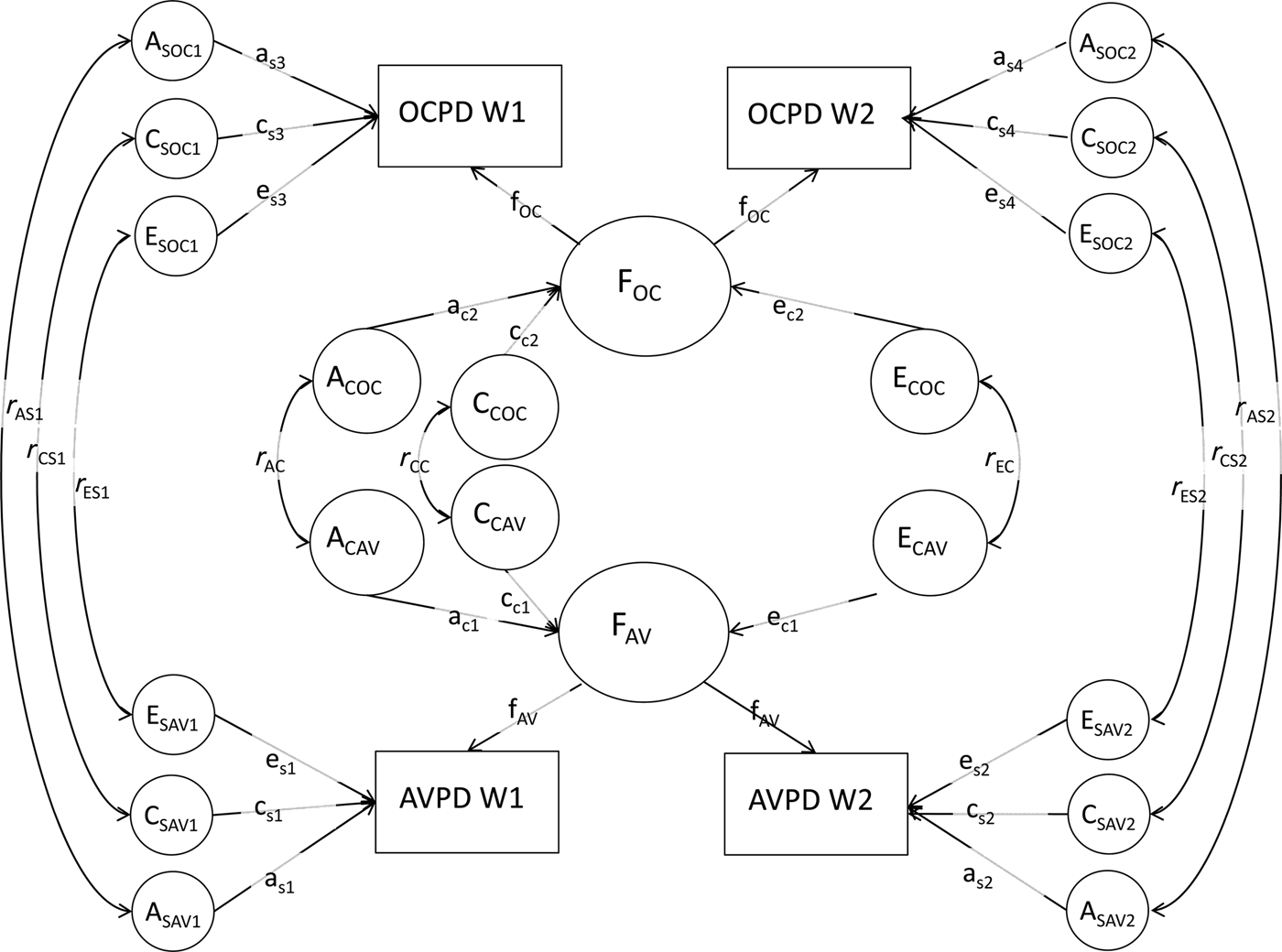
With two separate measures of each PD over different periods of time, it is possible to model a latent liability stability factor to each PD trait set as part of the psychometric measurement model. In our model (shown in Fig. 1), we assume that each variable has variance that to some extent is shared between the two measurement time-points. This shared variation between the measured PD variables across waves 1 and 2 can be modeled as common psychometric factors for each PD (FAV for AVPD and FOC for OCPD, also referred to as the latent PD factors). The f pathways (fAV and fOC) from the latent PD factors to the measured PD variables were constrained to be equal across time and index temporal stability in the PDs. The latent PD factors are both influenced by a set of genetic and environmental factors common to the same PD across time (ACAV, CCAV, and ECAV for AVPD, and ACOC, CCOC and ECOC for OCPD) through pathways ac1, cc1, ec1, ac2, cc2, and ec2. Squaring the ac pathways gives the heritability of the stable component of each PD factor. These common genetic and environmental factors are allowed to correlate across PD sets (r ac, r cc, r ec). They reflect the degree to which additive genetic, shared and unique environmental sources of the across-time PD stability correlate between AVPD and OCPD. A correlation of unity on any of these common factors would indicate that the risk factors are completely shared between the two PD factors.
The full longitudinal structural equation path model used for the twin analyses, shown for one member of a twin pair. AVPD, Avoidant personality disorder; OCPD, obsessive compulsive personality disorder; W1, wave 1; W2, wave 2; A, additive genetic factors; C, shared environmental factors; E, unique environmental factors; ASOC1 and ASOC2, time-specific A factors for OCPD at waves 1 and 2, respectively, ASAV1 and ASAV2, time-specific A factors for AVPD at waves 1 and 2, respectively, CSOC1 and CSOC2, time-specific C factors for OCPD; CSAV1 and CSAV2, time-specific C factors for AVPD; ESOC1 and ESOC2, time-specific E factors for OCPD; ESAV1 and ESAV2, time-specific E factors for AVPD; ACOC, stable A factor for OCPD; ACAV, stable A factor for AVPD; CCOC, stable C factor for OCPD; CCAV, stable C factor for AVPD; ECOC, stable E factor for OCPD; ECAV, stable E factor for AVPD; FOC, latent OCPD construct; FAV, latent AVPD construct; fOC, factor loading reflecting stability coefficient for OCPD; fAV, factor loading reflecting stability coefficient for AVPD; suffix C, common (stable) factors and paths; suffix S, time-specific factors and paths; r AS1 and r AS2, within-wave specific A correlations; r CS1 and r CS2, within-wave specific C correlations; r ES1 and r ES2, within-wave E correlations; r AC, stable (time-invariant) A correlation; r CC, stable C correlation; r EC, stable E correlation.

The observed unique PD variances are also decomposed into A, C, and E time-specific components (ASAV1, CSAV1, ESAV1, ASOC1, CSOC1, ESOC1 and ASAV2, CSAV2, ESAV2, ASOC2, CSOC2, ESOC2) which are allowed to correlate within time (r AS1, r CS1, r ES1 and r AS2, r CS2 and r ES2).
Due to limited sample size we did not have statistical power to investigate sex differences in genetic and environmental effects. The differences between the phenotypic correlations for the same sex DZ twins compared to the opposite sex DZ twins at both waves suggested that qualitative sex differences might be present for the phenotypes. However, no significant sex differences for AVPD and OCPD have been found in previous analyses in this sample (Reichborn-Kjennerud et al. Reference Reichborn-Kjennerud, Czajkowski, Neale, Orstavik, Torgersen, Tambs, Roysamb, Harris and Kendler2007; Gjerde et al. Reference Gjerde, Czajkowski, Roysamb, Orstavik, Knudsen, Ostby, Torgersen, Myers, Kendler and Reichborn-Kjennerud2012). The model parameters were therefore set equal for males and females, but we allowed the thresholds to differ between the sexes as there were differences in the number of endorsed sub-threshold criteria.
Results
Descriptives
The mean age of the participants at wave 1 was 28.2 (range 19–36) years and 37.9 (range 30–44) years at wave 2. On average, there were 9.6 (s.d. = 1.39) years between the two interviews.
Stability
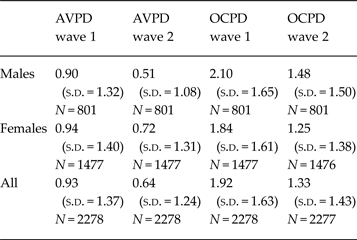
The mean [and standard deviation (s.d.)] of the count of sub-threshold endorsed criteria, indexing absolute stability for AVPD and OCPD traits for the sample participating in both waves 1 and 2 interviews are shown in Table 1. The average count of endorsed sub-threshold criteria decreased 43% for males and 23% for females for AVPD, and 30% for males and 32% for females for OCPD. In total, the decline was 31% from wave 1 to wave 2 for both AVPD and OCPD. Mean change for each individual (in absolute values) was 0.8 criteria for AVPD and 1.4 for OCPD.
Mean number of endorsed sub-threshold criteria for AVPD and OCPD at waves 1 and 2

AVPD, Avoidant personality disorder; OCPD, obsessive-compulsive personality disorder; s.d., standard deviation.
The polychoric correlations [95% confidence interval (CI)] between waves 1 and 2, indexing rank-order stability were 0.54 (95% CI 0.50–0.58) for males and 0.54 (95% CI 0.50–0.57) for females for AVPD, and 0.39 (95% CI 0.34–0.44) for males and 0.36 (95% CI 0.32–0.40) for females for OCPD. For the sexes in total, the polychoric correlations were 0.54 (95% CI 0.51–0.57) for AVPD and 0.37 (95% CI 0.34–0.40) for OCPD. Corresponding numbers for the Pearson's correlation coefficients were 0.47 (95% CI 0.44–0.50) for AVPD, and 0.34 (95% CI 0.30–0.38) for OCPD.
Longitudinal twin model fitting
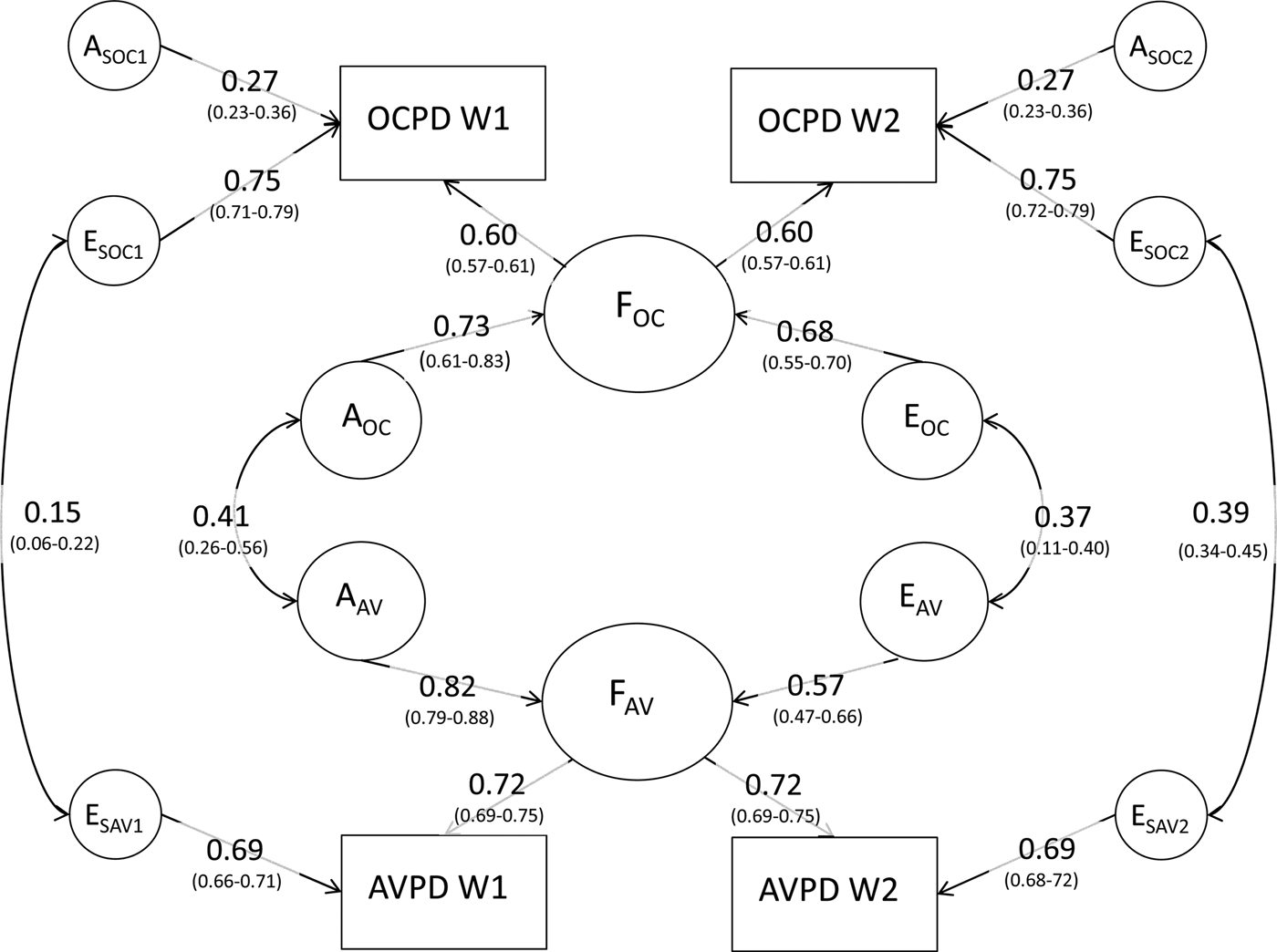
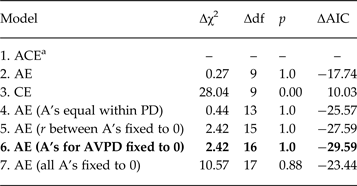
A full ACE twin model as depicted in Fig. 1 was first fitted to the AVPD and OCPD longitudinal data, and then compared to reduced submodels. As shown in Table 2, dropping all the C paths from the full model did not result in significant deterioration in χ2 and was associated with lower AIC (model 2). Dropping all A paths in model 3, however, resulted in a significant worsening of fit. Subsequent reduced submodels were therefore based on model 2, (an AE model) in order to examine further etiologically informative aspects. In model 4, we constrained the specific A paths to be equal across waves within each PD, resulting in improved fit. Dropping the correlation between the specific A paths in model 5 also did not result in a significant deterioration in χ2 and further improved the fit according to AIC. In model 6, we dropped the specific A paths for AVPD and this restriction resulted in a lower AIC. However, attempting to drop the specific A paths for OCPD as well (model 7) resulted in a higher AIC than in models 4, 5 and 6. The best-fitting model according to AIC was therefore model 6, an AE model without specific A paths for AVPD (Δχ2 = 2.42, Δdf = 16, p = 1.0, ΔAIC = 29.59). The parameter estimates with 95% CIs from the best-fitting model are shown in Fig. 2.
Parameter estimates (and 95% confidence intervals) for the best-fitting model. AVPD, Avoidant personality disorder; OCPD, obsessive-compulsive personality disorder; W1, wave 1; W2, wave 2; FOC, latent OCPD construct; FAV, latent AVPD construct; ASOC1 and ASOC2, time-specific A factors for OCPD at waves 1 and 2, respectively; ASAV1 and ASAV2, time-specific A factors for AVPD at waves 1 and 2, respectively; ESOC1 and ESOC2, time-specific E factors for OCPD; ESAV1 and ESAV2, time-specific E factors for AVPD; ACOC, stable A factor for OCPD; ACAV, stable A factor for AVPD; ECOC, stable E factor for OCPD; ECAV, stable E factor for AVPD.

Model fitting results for avoidant personality disorder and obsessive-compulsive personality disorder traits at waves 1 and 2

Best fitting model in bold type.
All comparisons of χ2, df and AIC are against the full ACE model.
A, additive genetic effects; C, shared environmental effects; E, unique environmental effects; PD, personality disorder; AVPD, avoidant personality disorder; AIC, Akaike's Information Criterion.
a The full model had −2LL = 25 351.53, df = 10 098 and number of parameters estimated = 57.
The heritability of the stable AVPD factor (FAV) was 0.67 (0.822), whereas the heritability of the observed AVPD measures was 0.35 [(0.72 × 0.82)2]. For the stable OCPD factor (FOC), the heritability was 0.53 (0.732), whereas the heritability of the observed OCPD measures was 0.26 [0.272 + (0.60 × 0.73)2].
The estimated factor loadings equated across waves within AVPD and OCPD were 0.72 and 0.60, respectively. The heritability estimate of the common stable factors is interpreted as the proportion of the total latent stability variance that is attributable to genetic variance (in this case: 67% for AVPD and 53% for OCPD). The rest of the stability was explained by unique environmental sources.
The correlation between the two latent PD constructs (FAV and FOC) was 0.39. Genetic and environmental correlations were modest and estimated to be 0.41 (95% CI 0.26–0.56) and 0.37 (95% CI 0.11–0.40), respectively. The proportion of overlap between the two PD constructs that was due to genetic variance (bivariate heritability) was 0.63.
The full genetic and environmental correlations (not split into time-specific and time-invariant correlations as in Figs 1 and 2) within and between the two PDs at both time-points are shown in Table 3. The genetic correlation between AVPD at waves 1 and 2 was 1.00 (95% CI 1.00–1.00), and slightly lower, at 0.72 (95% CI 0.54–0.93) between OCPD at waves 1 and 2. The extremely narrow confidence interval for AVPD is due to the dropping of specific A paths, which corresponds to fixing the across-wave AVPD correlation to 1. The environmental correlations were much lower: 0.26 (95% CI 0.23–0.27) for AVPD and 0.23 (95% CI 0.16–0.30) for OCPD.
Genetic and environmental correlations between waves 1 and 2 AVPD and OCPD traits

AVPD, Avoidant personality disorder; OCPD, obsessive-compulsive personality disorder.
The genetic correlations between the personality disorders are shown in the upper triangle, the environmental correlations in the lower triangle. 95% confidence intervals are given in parentheses.
a There is no confidence interval for the genetic correlation between AVPD waves 1 and 2 as this correlation has in effect been fixed to 1.00.
Discussion
Using a population-based sample of Norwegian twins interviewed approximately 10 years apart, we sought to investigate phenotypic as well as genetic and environmental stability of AVPD and OCPD traits.
We found only two relevant studies on absolute stability and four on rank-order stability with which to compare our results. In the clinical Collaborative Longitudinal Study on PDs (Skodol et al. Reference Skodol, Gunderson, Shea, McGlashan, Morey, Sanislow, Bender, Grilo, Zanarini, Yen, Pagano and Stout2005), AVPD symptoms declined 51% for men and 55% for women, whereas OCPD symptoms declined 53% for men and 57% for women over 10 years (Sanislow et al. Reference Sanislow, Little, Ansell, Grilo, Daversa, Markowitz, Pinto, Shea, Yen, Skodol, Morey, Gunderson, Zanarini and McGlashan2009). This was a larger drop than found in the present study (from 43% to 23% for AVPD for men and women, respectively and from 3% to 32% for OCPD for men and women, respectively), and may be due to the differences in study samples. Our estimates of absolute stability also differ from a community-based sample of adolescent subjects followed to adulthood, where AVPD symptoms were found to decline 57%, while OCPD symptoms did not change at all during 10 years (Johnson et al. Reference Johnson, Cohen, Kasen, Skodol, Hamagami and Brook2000). This discrepancy may be due to the differences in age range in the samples. In contrast to other PDs, OCPD is found to have higher prevalence in older adults (Grant et al. Reference Grant, Mooney and Kushner2012), and hence the few OCPD cases in the Johnson et al. (Reference Johnson, Cohen, Kasen, Skodol, Hamagami and Brook2000) study could be expected to persist rather than decline at this point in life.
A reasonable suggestion for the decrease in symptom levels in the present study might be that self-esteem increases during young adulthood (Erol & Orth, Reference Erol and Orth2011). It is also possible that having children may suppress the reporting of symptoms, in that one may be less self-focused. However, further studies are needed to clarify the mechanisms behind symptom decline in PDs.
The rank-order stability in the present study was moderate; with Pearson correlations of 0.47 for AVPD and 0.34 for OCPD. Pearson's r for AVPD approximately 10 years apart has previously been found to range between 0.30 and 0.42 (Johnson et al. Reference Johnson, Cohen, Kasen, Skodol, Hamagami and Brook2000; Sanislow et al. Reference Sanislow, Little, Ansell, Grilo, Daversa, Markowitz, Pinto, Shea, Yen, Skodol, Morey, Gunderson, Zanarini and McGlashan2009; Hopwood et al. Reference Hopwood, Morey, Donnellan, Samuel, Grilo, McGlashan, Shea, Zanarini, Gunderson and Skodol2013), which is slightly lower than found in the present study. For OCPD, however, the estimates from previous studies, ranging from 0.13 to 0.32 (Johnson et al. Reference Johnson, Cohen, Kasen, Skodol, Hamagami and Brook2000; Sanislow et al. Reference Sanislow, Little, Ansell, Grilo, Daversa, Markowitz, Pinto, Shea, Yen, Skodol, Morey, Gunderson, Zanarini and McGlashan2009; Hopwood et al. Reference Hopwood, Morey, Donnellan, Samuel, Grilo, McGlashan, Shea, Zanarini, Gunderson and Skodol2013), are closer to our findings.
The most central findings of the present study are the relative contributions from genes and environmental factors to the stability of AVPD and OCPD traits. The stability factor loadings (f) were substantial for both PDs, but highest for AVPD. These coefficients were also to a large extent explained by genetic factors present at both waves. The stability of the genetic effects for AVPD is reflected in the genetic correlations (Table 3), where the correlation across waves was not significantly different from unity. For OCPD, the picture is slightly different, as the total genetic correlation was somewhat lower, in addition to the evidence for time-specific genetic factors contributing significantly to the variation at waves 1 and 2 (Fig. 2). We can only speculate what these age-specific factors might reflect, but as OCPD often has a higher prevalence later in life (Grant et al. Reference Grant, Mooney and Kushner2012), persons who develop OCPD in adolescence or early adulthood might have an additional genetic risk factor operating, for instance through comorbidity with other PDs or mental disorders, or through a particular liability to high conscientiousness or compulsivity. Nevertheless, the genetic stability within the observed PD measures was remarkably high. This implies that genetic influences on PDs stabilize in early adulthood and do not change much throughout middle adulthood. Our findings fit well with what has recently been found for Cluster A and B PDs (Kendler et al. Reference Kendler, Aggen, Neale, Knudsen, Krueger, Tambs, Czajkowski, Ystrom, Orstavik and Reichborn-Kjennerud2014; Reichborn-Kjennerud et al. unpublished data).
The unique environmental influences, however, were to a much higher extent specific to the two waves (Fig. 2). In fact, the environmental time-specific factors contribute with around half the variance to the observed PD trait scores. This probably implies that a non-negligible amount of measurement error is contributing to the total PD variance, but that there are, to some degree, differences between the environmental exposures that influence liability to AVPD or OCPD in early adulthood and 10 years later. Thus, possible environmental targets for interventions might be different at different ages. More research should be conducted to identify what types of exposures are associated with liability to AVPD and OCPD, as this information would be valuable for prevention and treatment of these PDs.
In addition to being specific, the environmental factors also contributed to the stability, and thus in maintaining symptoms of AVPD and OCPD traits. This seems more the case for OCPD, as almost half of the stable variance was explained by environmental factors common to both waves. As the model we have used corrects for measurement errors, these environmental factors contributing to PD stability probably reflect true environmental influences. The most important reason, however, for why there was an association between the stable, time-invariant aspects of AVPD and OCPD was shared genetic influences, explaining 63% of the association. This is in contrast to previous findings, where OCPD was found to be mostly genetically distinct from AVPD and the third Cluster C PD – dependent PD (Reichborn-Kjennerud et al. Reference Reichborn-Kjennerud, Czajkowski, Neale, Orstavik, Torgersen, Tambs, Roysamb, Harris and Kendler2007).
By using the same structured interview at both waves, we found a heritability estimate of 0.67 for the stable AVPD factor. This is reassuringly close to the latent heritability found in a previous publication based on the data from the present sample's first wave responses in addition to questionnaire data (0.64; Gjerde et al. Reference Gjerde, Czajkowski, Roysamb, Orstavik, Knudsen, Ostby, Torgersen, Myers, Kendler and Reichborn-Kjennerud2012). For OCPD, there are, to the best of our knowledge, no previous studies with which to compare our result. However, the latent heritability of 0.53 is slightly lower than what has been found for dimensional representations of the other nine DSM-IV PDs – which ranged from 0.55 to 0.72 (Kendler et al. Reference Kendler, Myers, Torgersen, Neale and Reichborn-Kjennerud2007; Gjerde et al. Reference Gjerde, Czajkowski, Roysamb, Orstavik, Knudsen, Ostby, Torgersen, Myers, Kendler and Reichborn-Kjennerud2012; Torgersen et al. Reference Torgersen, Myers, Reichborn-Kjennerud, Røysamb, Kubarych and Kendler2012). This fits well with the findings from previous studies on PD heritability from our group (Reichborn-Kjennerud et al. Reference Reichborn-Kjennerud, Czajkowski, Neale, Orstavik, Torgersen, Tambs, Roysamb, Harris and Kendler2007), where OCPD was found to have a lower amount of the total variance explained by genetic variance, compared to AVPD and dependent PD.
Strengths and limitations
This is, to our knowledge, the first population-based longitudinal study of two of the Cluster C PDs investigating genetic and environmental contributions to the PDs at each time-point, measured with the same structured interview (SIDP-IV). This provides a unique opportunity to investigate time-invariant and time-specific influences, as well as estimating the heritability of the stable aspects of AVPD and OCPD traits. Although approximately 10 years separated the first and second interviews, the attrition rate was remarkably low, as 82.8% of the original sample also participated in the second wave.
The results should, however, be interpreted in light of some potentially important limitations. First, as the wave 2 interviews were conducted by phone, it was necessary to reduce the interview length. Assessment of dependent PD was therefore not included in this interview, which prevents giving a full picture of the Cluster C genetic architecture.
Second, analyses of sex differences on genetic and environmental effects in the present study were not included, due to insufficient power. Preliminary exploratory analyses, however, did not reveal evidence for qualitative or quantitative sex differences. Studies with larger sample sizes are needed before firm conclusions can be drawn on this matter.
Third, we used AVPD and OCPD traits instead of categorical diagnoses. It has previously been shown that counts of criteria index the same underlying liability that underlies full clinical PD diagnoses (Kendler et al. Reference Kendler, Aggen, Czajkowski, Roysamb, Tambs, Torgersen, Neale and Reichborn-Kjennerud2008). With this approach it follows that much of the variance in the data used originates from individuals that are below the diagnostic threshold for clinical PD diagnoses. However, as the multiple threshold tests indicated that different criteria scores represent different degrees of severity on a single continuum, we expect no qualitative differences in the results compared to if we had used categorical PD diagnoses.
Fourth, although the attrition rate was low from wave 1 to wave 2 (17.2%), there was substantial attrition from the original sample to the first interview wave. Attrition may affect generalizability, and if non-random, may also result in biased estimates of genetic and environmental effects (Heath et al. Reference Heath, Madden and Martin1998). Detailed analyses have been conducted to investigate the patterns of attrition, and out of a broad range of predictors, including predictors of mental health, participation was clearly influenced only by female sex, monozygosity, older age, and higher educational status (Tambs et al. Reference Tambs, Ronning, Prescott, Kendler, Reichborn-Kjennerud, Torgersen and Harris2009). We also investigated attrition from wave 1 to wave 2 using GEE corrected logistic regression analyses, controlling for sex and age. Participation at wave 2 was neither significantly predicted by the amount of AVPD sub-threshold criteria at wave 1 (p = 0.06), nor by the amount of OCPD sub-threshold criteria (p = 0.89) at wave 1.
Conclusion
In this population-based twin study of AVPD and OCPD traits measured 10 years apart, we found evidence for moderate phenotypic stability. The stability was mostly influenced by genetic factors shared between the latent PD trait constructs, whereas the unique environmental contributions were much more specific. AVPD and OCPD were moderately associated with each other, and the association was mostly due to genetic influences shared between both disorders. Future studies that can pinpoint which environmental factors are relevant at each time-point will be important to inform AVPD and OCPD treatment, as well as prevention purposes.
Acknowledgements
This project was supported by Research Council of Norway (RCN) – grant number 196148/V50. Previous collection and analysis of twin data from this project was in part supported by National Institutes of Health (NIH) – grant number MH-068643 and grants from the RCN, the Norwegian Foundation for Health and Rehabilitation and the Norwegian Council for Mental Health. These funding agencies played no role in the design and conduct of the study, its collection, management, analysis, and interpretation of the data or in the preparation, review, or approval of the manuscript. We are very grateful for the twins’ participation in this study.
Declaration of Interest
None.