INTRODUCTION
Sea cucumbers are a branch of the echinoderms (Echinodermata) from the class Holothuroidea and appeared in oceans during evolutionary time about 540 million years ago (Alexander & Kim, Reference Alexander and Kim2000). Sea cucumbers live mainly between coral reefs and can be found in sandy, muddy and stony bottoms. Their living depths are different – most species live in the tidal zone but a few also live in the deep ocean (James, Reference James2001). These beasts are important components of the food chain in temperate ecosystems and coral reefs and play a significant role for lamellibranches and saprophagous. In mixing sediments, sea cucumbers also play a major role in accelerating the recycling of saprogenic material, which causes oxygen penetration in sediments (Bruckner et al., Reference Bruckner, Johnson and Field2003). In fact, as a natural purifier, they remove sea bottom pollution and in this way provide health to an aquatic ecosystem. In addition, sea cucumbers have value in the food industry, as well as having pharmaceutical and medical applications. Also, their eggs, larvae and neonates are an important food source for other marine beasts (Bruckner et al., Reference Bruckner, Johnson and Field2003). Considering the untapped nature of Hengam Island and the lack of proper research into its intertidal habitats, the current study could effectively enhance potential in the Persian Gulf. Therefore, according to the status of this animal group and the lack of information from this inter-tidal zone in terms of fauna invertebrates, this paper represents the first published record of Holothuria arenicola and Holothuria bacilla from the inter-tidal zone of Hengam Island in the Persian Gulf.
MATERIALS AND METHODS
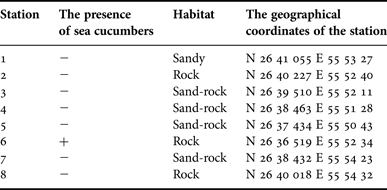
Hengam Island is situated in the Persian Gulf waters, 44 km from Qeshm Island (Figure 1). Sea cucumber samples were collected from the intertidal zone of Hengam Island during two seasons (summer 2013 and winter 2012). Considering the accessibility of the shoreline, eight stations were selected along the intertidal zone of Hengam Island based on their exclusive geomorphic and habitat features (Table 1). The samples were transferred to the laboratory for photographing and for the extraction of their ossicles. In order to extract the ossicles, a small piece of the dorsal and abdominal skin of the samples was placed into the 10% sodium hypochlorite for almost 30 min (Hickman, Reference Hickman1998). One drop of liquid was spread on the slide using a pipette. then, the ossicles were examined under the microscope and identified using valid identification keys (Samyn et al., Reference Samyn, Vanden Spiegel and Massin2006; Purcell et al., Reference Purcell, Samyn and Conand2012).
Sampling site of sea cucumbers in the tidal areas of Hengam Island.

Sampling stations for sea cucumbers and substrate type at Hengam Island.
Presence, +; Absence, −.
RESULTS
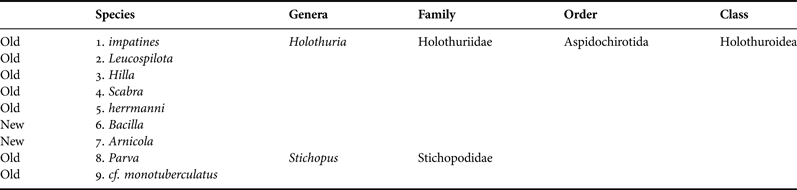
Based on the obtained results at the inter-tidal zone of Hengam Island (on the south coast of Hengam Island), two new species of sea cucumber belonging to the Holothuria genus, Holothuridae family, are described (Table 2).
Sea cucumber species identified intertidal and sub tidal of Hengam Island.
Species 1–5: Salarzade et al. 2013; 8: Mehrdost et al. Reference Mehrdost, Ehsnpour, Afkhami and Owfi2013; 9: Ehsanpour et al. Reference Ehsanpour, Afkhami, Bahri and Daryaei2012; 6, 7: current study.
SYSTEMATICS
Phylum ECHINODERMATA
Class HOLOTHUROIDEA
Order ASPIDOCHIROTIDA Grube, 1840
Family HOLOTHURIDAE Haeckel, 1886
Genus Holothuria (Selenkothuria) Deichmann, 1958
Holothuria (Selenkothuria) bacilla Cherbonnier, 1988
(Figure 2)
Holothuria (Thymiosicia) bacilla (Forskål, 1775): (A) ossicles of dorsal tegument; (B) ossicles of ventral tegument.
Holothuria bacilla is a small sea cucumber species with a fusiform body that narrows at the bottom, a very thin body surface and 20 tentacles around the mouth. The anus is terminal. Legs in the ventral part (trivium) are large and sturdy and those in the dorsal surface part (bivium) are smaller and scattered. Their colour is dark brown, which after stabilization in alcohol remains unchanged. Their spicules resemble slender bars, they have relatively tiny spines and no side cavities. These bars on the dorsal surface have more tiny spines and are often are flattened on two sides to compose false panels. The bar-like spicules on the abdominal legs are generally smaller and relatively flat. These species inhabit shallow waters and live under rock fragments. There is not much information about species distribution. They commonly live in shallow waters under boulders, which is exhibited by two specimens from Madagascar (Tulear, Nosy Be), reported by Samyn et al. (Reference Samyn, Vanden Spiegel and Massin2006). Here, examples of this species were found in the middle of a rocky shore (under rocks).
Phylum ECHINODERMATA
Class HOLOTHUROIDEA
Order ASPIDOCHIROTIDA Grube, 1840
Family HOLOTHURIDAE Haeckel, 1886
Genus Holothuria (Selenkothuria) Deichmann, 1958
Holothuria arenicola, Semper 1868
(Figure 3)
Holothuria arenicola (Semper 1868): (A) ossicles of dorsal tegument; (B) ossicles of ventral tegument; (C) ossicles of tentacle.
Holothuria arenicola is a species of the Holothuria genus of a medium to large size, with a relatively cylindrical body that has a trailing bottom and sometimes narrowing front part. Its body structure has an average thickness and is usually rough. The mouth is almost central and the anus is central or sub terminal. A living specimen's colour is grey/cream with two rows of dark spots on the dorsal surface, which is due to the small tentacles and papilla. Its colour after stabilization in alcohol commonly stays unchanged. The spicules are small and relatively abundant and can be seen as flat knobs with 3–5 pairs of rod-shaped, table-shaped, round or square holes, with four large holes in the centre and 4–12 smaller margin holes at the thin border of the disc. This species inhabit sandy bottoms, rocks, coral reefs, sandy beaches and rock-sand beaches in subtidal areas at depths of 0–7 m and is widespread from the western Indian Ocean to the Red Sea, the Persian Gulf, the Maldives, the Bay of Bengal and east to Hawaii. Examples of this species were found in the middle of a rocky shore (tidal pool).
DISCUSSION
When investigating a coastal strip of Hengam Island, two species of sea cucumbers were identified for the first time, distributed in the middle parts of the intertidal area, under rocks and in tidal pools. These two species were found at six of the stations on the rock shore of the south coast of the island, perhaps due to the flat or low slopes (6%) of the rock beds and the appropriate habitat conditions there. The eighth station on the east coast had a low slope (3%). The slope is weak and tidal power is dominant. Because this station was located on the eastern part of the island, it was exposed to the entrance flows of the Hormoz Strait to the Persian Gulf, which creates large waves – such conditions are unfavourable for the establishment and accumulation of sea cucumbers. The seventh station was located on the east coast where the stone/rock beds have a steep slope (17%) and it was exposed to the entrance flows from the Hormoz Strait to the Persian Gulf. Due to the shore structure and pressure caused by waves in this area, there is a lack of environmental tranquillity for sea cucumber species establishment. Differences in the bottom characteristics and in the intense behaviour of waves can be a contributing factor to the non-presence of sea cucumbers in the different habitats along Hengam Island's coastline. Holothuria arenicola species were reported by Izadi (Reference Izadi2008) and Fatemi et al. (Reference Fatemi, Mostafavi and Hamiz2011) from the Qeshm coast and by Price (Reference Price1983) and Heding (Reference Heding1940) from Iranian waters. In previous studies, Izadi (Reference Izadi2008) reported Holothuria bacilla species for the first time on the southern coastline of Qeshm – in studies by Price (Reference Price1983), this species has not been mentioned. A few previous surveys have been completed around Hengam Island, where six sea cucumber species were recorded by Salarzade et al. (Reference Salarzadeh, Afkhami, Ehsanpour, Mehvari and Darvish Bastami2012) at shallow waters of 5–15 m and where one species was recorded by Mehrdost et al. (Reference Mehrdost, Ehsnpour, Afkhami and Owfi2013) in the inter-tidal area (Table 2). However, Holothuria bacilla and Holothuria arenicola have not been reported in this area until now. Thus, this paper is the first to report a description of these species taken from Hengam Island (Persian Gulf). In conclusion, the collected specimens provide evidence that Holothuria bacilla and Holothuria arenicola are present in the Persian Gulf waters.