1. Introduction
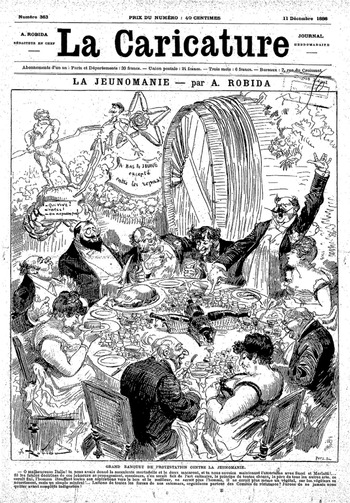
Oh, unhappy Italy! You gave us delicious mortadella and sweet macaroni, and now you send to us bitterness with Succi and Merlatti…. If these fasters’ fatal doctrines spread, sirs, what about the culinary art, the principle of all things, the father of all arts. It will be the end, a man stifling all aspirations towards the good and the better, will not be a man anymore. He will not be a vegetable either, since vegetables eat, but a simple mineral! Let us fight with all the strength of our stomachs, let us organize everywhere committees of resistance. Let us swear we will never quit each other before full indigestion. (Robida1886, 401)Footnote 1
These passionate words appeared in Paris, in December 1886, on the front page of the satirical French periodical, La Caricature, edited by the writer and cartoonist Albert Robida (1848-1926) (Alkon Reference Alkon1994),Footnote 2 as the caption to a picture of a banquet in protest against the so-called fasting mania (“jeûnomanie”), which many considered to have invaded the city in the autumn of that year (see Figure 1). Two Italian “hunger artists,” or “professional fasters,” Giovanni Succi and Stefano Merlatti, fasted in public for thirty and fifty days respectively, and their performances soon became, as in other European cities, a commodity to be exploited for amusement and profit (Bogdan Reference Bogdan1988).Footnote 3 Controversy about the causes of their impressive resistance to inanition was part of the marketing of their show, but it also gave rise to a long series of academic disputes that make their case particularly worthy of study.
In spite of their historical significance, the exploits of the hunger artists of the late nineteenth century still await further examination within the framework of the history of science, particularly in relation to recent trends in the history of nineteenth-century physiology, which stress heterogeneous practices, local contingencies, and the cultural and political dimensions of the discipline (Kremer Reference Kremer, Bowler and John2009). From the mid-nineteenth century onwards, fasting and inanition experiments were carried out with animals, which were usually deprived of food and drink until they died (Boddice Reference Boddice2011). Papers on the vital constants, blood and urine analysis, and quantitative results - using the kymograph and other sophisticated instruments - taken from pigs, dogs, cats or monkeys became regular practice, but faced opposition from antivivisectionists and critics of animal experimentation (Guerrini Reference Guerrini2003). Hunger artists thus presented a golden opportunity to extend the physiology of inanition to human beings. Since research in the area also generated huge public interest (from the daily press to international exhibitions and public shows), medical doctors had much to gain in terms of social visibility, even at the risk of discredit for their collaboration with such dubious characters as Succi and Merlatti.
Hunger artists’ profiles fit very well in the general scheme of nineteenth-century charlatans (Mathew Reference Ramsey1980; Golan Reference Golan2000; Brock Reference Brock2008; Podgorny Reference Podgorny2012). They had an itinerant existence, traveling from one marketplace to another. They usually dealt with exotic, controversial remedies, which helped them to resist inanition and often produced “miraculous” healing. Hunger artists also became tireless organizers of shows and performances at theaters, academies, and national and international exhibitions, and also simply on the streets. Ultimately, they easily crossed the borders between popular and learned cultures, and also between expertise and lay beliefs about food, digestion, hunger and inanition, so they aroused curiosity and scientific interest.
In the 1880s, hunger artists and the challenges they posed to “objective” explanations for their impressive public fasts became an attractive tool for physicians, who were struggling to preserve a physiology that opposed new trends in medical specialization, and embraced not just strict materialist and physicochemical explanations, but also mental, spiritual and even social factors (Turner Reference Turner1982; Kremer Reference Kremer, Bowler and John2009). In a period when medical doctors were looking to become the key voices of scientific expertise for the general public, and combating old stereotypes that viewed medicine with suspicion, debates on the causes of resistance to hunger strengthened their public visibility (Digby, Reference Digby2002). Moreover, in their attempt to establish themselves as new professionals, science popularizers exploited sensationalist topics to gain public attention, while, at the same time, drawing their own boundaries between a supposedly “objective” science on the one hand, and “pseudoscience,” “superstition” and simple fraud on the other.
Ultimately, performances by hunger artists strengthened their own prestige as “professionals” in the practice of fasting. It was a controversial practice, but at the same time it called upon the supervision of professional doctors to defend against the practitioners’ poor reputations as fraudulent charlatans. These oddities thus became relevant epistemological actors that warrant further analysis. It is within that framework that I shall briefly present the biographies of our two hunger artists, Succi and Merlatti, and describe their fasts in Paris from October to December 1886. I will then analyze how medical doctors and science popularizers appropriated those extravagant public events for their own professional purposes. Finally, I shall discuss Succi’s and Merlatti’s professional status as “useful” charlatans.
Albert Robida’s front page of La Caricature, 11-12-1886. A satirical banquet in protest against the fasting mania that, in Robida’s view, had invaded Paris that fall. On the top right, Succi is attacked with a fork: “Who is there? Succi! Do not pass! Down with the fast, except in between meals”. Gallica. Bibliothèque nationale de France

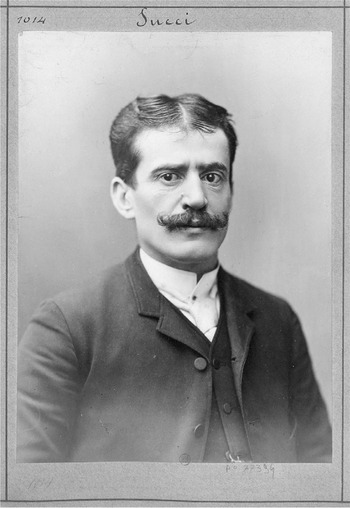
A portrait of Giovanni Succi (1900). Atelier Nadar. Photographe. Bibliothèque nationale de France, département Estampes et photographie, FT 4-NA-237 (4) Gallica. Bibliothèque nationale de France

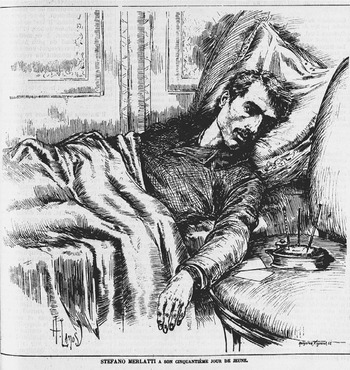
Stefano Merlatti at the end of his fast. From Le Voleur, 23 December 1886 (front page). Gallica. Bibliothèque nationale de France

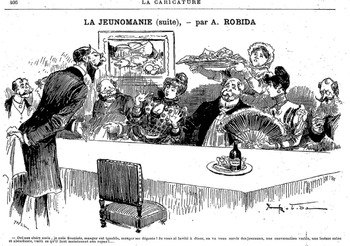
Albert Robida’s La Caricature, 11-12-1886, p. 406. Satirical meal with newspapers and journals against fasting. Note the bottle of Hunyadi Janos water on the table. Gallica. Bibliothèque nationale de France

2. A fasting contest
Although his full biography has yet to be written, the case of Giovanni Succi has been considerably studied in recent years (Nieto-Galan 2014). Succi was probably the most popular hunger artist of his late nineteenth-century generation (see Figure 2). He was born in the early 1850s,Footnote 4 in Cessenatico, near Forlì, in Italy. In the 1870s, after some college education and a job as a banker’s clerk in Rome, he travelled to Zanzibar, East Africa, as a commercial agent in the employ of an Italian-African Trade Company. He later went to Mozambique, the Comoro Islands, Madagascar, Natal and the Cape (“The Fasting Man” 1890, 516).Footnote 5 In Dar es Salaam, he ingested some plant extracts, and apparently experienced an “inner power” to resist inanition. In 1885, after an overseas trip, Succi returned to Rome (Martínez de Velasco Reference Martínez de Velasco1886, 182), where he spent short periods at two mental asylums with no clear diagnosis (Luciani Reference Luciani1889, 24). He then began his public fasts in Europe, and later in America,Footnote 6 making a good living from these itinerant performances. In the early years of the twentieth century, as happened to other hunger artists, his popularity waned. There is little evidence of his public activity in the years leading up to his death in 1918 (Succi Reference Succi1881; Gano Benedict Reference Gano1915, 16-18; Cenni Biografici 1897, Mitchell Reference Mitchell and Udoff1987, 242-243).
Even less is known about Stefano Merlatti’s biography (see Figure 3). He was born in the early 1860s – probably in 1864 - in Mondovì (Piedmont), near Turin (Italy), and as early as the age of twelve, he started combining his talents as a painter with his first fasting experiences at the Academy of Fine Arts, Turin. Before going to Paris, he had fasted for thirty-six days in London in 1885, while also continuing to work as a painter. Under the protection of the French doctor Phillipe Maréchal (1859-1926), Merlatti sought to imitate Succi’s success in the fasting business in Paris in 1886. There is some evidence that he died in 1890, only four years after the Parisian performance, probably due to the risks he continued to take in other fasts (Monin & Maréchal 1887, 100-143; “Mort de Merlatti” 1890, 1).Footnote 7
In early October 1886, Merlatti arrived in Paris to fast from 27 October to 15 December 1886, at the Salle du Zodiaque, on the 1st floor of the Grand Hôtel de Paris, next to Place de l’Opéra. He was supervised by a medical commission. Doctors Maréchal and Ernest Monin (1856-1929), pharmacist Edmond Vasseur, and science popularizer Victor Meunier (1817-1903) were among its members of (Monin & Maréchal Reference Monin and Phillippe1887, 149-50, 154). It was a very painful, daring fast that reached fifty days, beyond the accepted limit of human resistance to inanition (forty days being a kind of tacit frontier, beyond which life was normally put at serious risk) (Luciani Reference Luciani1889). Merlatti’s fast generated enormous interest and was extensively covered in the daily press (see Figure 4). Often suffering from acute stomach pain and frequent vomiting, he disregarded several warnings from the commission. On 26 October, just a day before the beginning of his performance, Merlatti ate a fatty goose, a 1 kg beef steak, vegetables, and two dozen walnuts. A committee supervised him day and night and agreed on a list of conditions: He could only drink filtered water; he had to obey the committee’s instructions; every morning he had to provide data on his weight, temperature, pulse, urine, and excrements; and in case of serious symptoms, and at Merlatti’s will, the committee could stop the fast.
Merlatti received frequent love letters from distinguished ladies and visits from prominent local and foreign doctors, painters, artists, politicians, writers and science popularizers (Monin & Maréchal Reference Monin and Phillippe1887, 123-127).Footnote 8 Visitors were charged ten francs to see how his physical condition had evolved during the fast. For instance, on 1 November he was watched by 600 people. Dr. Thomas Linn, correspondent for the New York Medical Journal, visited Merlatti on 14 November, on the nineteenth day of his fast. He wanted to compare this case with Dr. Henry Tanner’s famous forty-day fast at Clarendon Hall, New York, in 1880, which had become a source of inspiration and a challenge for European fasters (Gunn Reference Gunn1880). On 21 November, Dr. Oscar Jennings, the correspondent from The Lancet in London, visited Merlatti, while MP Charles Laisant gave a public éloge in his honor on the same day at the Salle de Conférences du Boulevard des Capuccines, and Dr. Jean-Pierre Bonnafont, from the Paris Academy of Medicine, observed him on 22 November. On 30 November, on the thirty-fifth day of his fast, apartment 93 of the Grand Hotel was akin to the “Faculty of Medicine” due to the high number of physicians, scientists, and professors from the École de Medicine who visited him that day (Monin & Maréchal Reference Monin and Phillippe1887, 225).Footnote 9
Merlatti also received several painters and photographers who wanted to record his performance for posterity. His signed pictures became successful commodities, as well as his advertisements in restaurants and other public places (Monin & Maréchal Reference Monin and Phillippe1887, 103-145). After the impressive achievement of reaching fifty days of fasting, a banquet with more than 100 guests was held at 7:15 p.m. in the Grand-Hôtel to celebrate the end of his performance. Diners addressed toasts and thanks to the daily press for their extensive coverage of the event. Merlatti remained seated throughout the whole meal, trying to ingest (not without serious pain) the first food after such a long period. A young lady even offered him milk from her breast (Monin & Maréchal Reference Monin and Phillippe1887, 141, 250-51). This was part of a standard ritual that contrasted with the austerity and crudeness of the fasting days and reinforced the public impact of the whole display.
Giovanni Succi’s fast in Paris was probably not his most successful performance in terms of economic gain and public success, especially compared with his earlier appearance in Milan and his future fasts in other European and American cities. In early November 1886, when Merlatti had completed his first two weeks of fasting, the already famous Succi arrived in Paris. Italian doctor Enrico Barberi-Borghini – a member of the medical commission from Succi’s previous fast in Milan (Chiverry Reference Chiverry1886) - introduced him to the Parisian academic circles. On 10 November, in the company of Succi, Barberi-Borghini arranged a public lecture on the most historic cases of fasting at the Société de géographie de Paris, to an audience of around 800 people, including a good number of medical doctors and journalists. Succi’s performance began some weeks later, on 12 December, in the ancient hall of the Cercle de la Presse (Rue Le Peletier), under the supervision of physicians, journalists and ‘curieux’ paying two francs per ticket (Figuier 1888, 402). Unlike Merlatti, he only fasted for thirty days as a precautionary strategy to avoid unnecessary risks and to keep up his energy for further performances after Paris. He walked through the city, rode a horse and practiced all sorts of exercise: swimming, fencing and gymnastics.
The success of Succi’s Paris fast was marred by a number of obstacles, including serious disagreements, a certain institutional indifference, and fierce competition from the young Merlatti. In fact, he attempted to strike a deal with the Académie de Médicine asking for scientific recognition of his fast, but was not willing to accept the strict control conditions suggested by its medical doctors (Luciani Reference Luciani1889, 24). Controversy also arose regarding his impresario, Mr. Lamperti, who would end up taking Succi to court for allegedly failing to honor the contractual conditions, which stated that Succi would be paid 15,000 francs provided he fasted for thirty consecutive days and drank only filtered, Vichy, or Hunyadi-János water.Footnote 10 Only once (on the first day of his fast), could he drink a few drops of his mysterious liquor, the chemical composition of which was unknown, but that supposedly numbed his stomach and helped him to resist inanition. Since Succi apparently drank his liquor on the eighth day of inanition, Lamperti refused to pay the agreed sum, and the court case would cause Succi a great deal of despair and disappointment.
Succi’s liquor was an important aspect of the self-construction of his own myth and adventures, but he never provided reliable information on the composition of the mysterious drug. He claimed to have discovered and prepared it during his trips to Africa, and described it as a plant extract and a narcotic for pain relief during the first days of fasting (Luciani Reference Luciani1890, 28-31). However, as was common in other cases of drug peddlers and charlatans, Succi sold and advertised the liquor during his fasts (Spillane Reference Spillane1998; Corfield Reference Corfield2009). He had already demonstrated its usefulness for fasting in earlier performances, but he also claimed that it could fight cholera, malaria, yellow fever and dysentery (Nieto-Galan 2014, 78).Footnote 11 Scientific papers associated Succi’s extract with laudanum or chloroform, while others suggested it contained cocaine, arsenic, or even osmazone (a nutritive meat extract), but no consensus was ever reached on its actual chemical composition (“Le secret de Succi” 1886, 165).
Controversy on the nature of ingested liquids was very common among hunger artists. There is evidence, for instance, of the case of the French faster Jacques Alexandre, who, after returning from the Franco-Prussian War, worked as a gardener in London. Obsessed with the idea of beating Succi, or at least imitating him, he used an old family herbal recipe that apparently also provided strong resistance to inanition (Monin & Maréchal Reference Monin and Phillippe1887, 54-56).Footnote 12 As historian Christopher Hamlin discussed some years ago, in the nineteenth century, the lack of expert knowledge among chemists and doctors regarding the chemical and bacteriological composition of water left room for Quakers and charlatans to speculate (Hamlin Reference Hamlin1990, 299-305). There was also no general consensus among professional chemists on a quantitative analysis of complex mixtures of organic matter. In spite of substantial progress in elementary organic analysis and the advances in structural nomenclature after Kekule’s elucidation of the structure of benzene in the early 1870s (Brock, Reference Brock1992, 239-266), the problem of the chemical composition and therapeutic properties of plant extracts would continue to be a topic in relation to future fasts. It became a serious chemical controversy, but also a golden opportunity for further commodification of hunger artists’ performances. As in many other cases, lack of consensus and even controversy among experts – in our case the lack of reliable chemical analysis together with disagreements and contrasting views among physiologists on the process of human inanition - meant an ongoing battle in the public sphere for social recognition and scientific authority, which went far beyond university chairs, experimental laboratories and clinical hospitals (Bucchi Reference Bucchi1998).
Succi fasted for thirty days. He weighed 61.3 kg when he began and 49.2 kg at the end (20.2% loss), whereas Merlatti weighed 56.4 kg, fasted for fifty days, and ended up with a weight of 44.8 kg (26% loss) (Langlois Reference Langlois1894, 653).Footnote 13 Merlatti appeared to have won the contest. His fast was much longer than Succi’s, involved far greater risks to his health, and he received a larger number of visits from important figures. However, the fleeting glory of the experience and the suffering he had faced produced a certain disenchantment in the young painter, and when his fast ended with a violent hemorrhage, the cruelty caused outcry in Parisian public opinion, as described in the press: “Many Parisians felt that the affair became, to a certain extent, cruel, and the quasi-suicidal spectacle close to barbarian. If there was still hope of obtaining scientific gain from this fast, this benefit brought us to dismiss all humanitarian considerations.” (“Après cinquante jours” 1886, 2).Footnote 14 Merlatti himself declared: “I would rather starve than fast for the glory; and, if a new display takes place, be sure that you will not see your humble and very hungry Stefano Merlatti on the chaise longue of the Grand-Hôtel anymore” (Monin & Maréchal Reference Monin and Phillippe1887, 145).Footnote 15
In the context of Charles Chossat’s (1796-1875) considerations in the 1840s, the Succi-Merlatti contest was viewed as a controversial public experiment to examine how long the human body could be resistant to inanition and questioning the nature of the liquids ingested during the fast. For decades, Chossat’s exhaustive experimentation on animals had provided standard data on how tissue decreases due to the lack of food ingestion, and how fats and muscles – but not the nervous system - are the most affected parts of the body. Similarly, during Succi’s earlier fast in Milan, Dr Luigi Bufalini, a professor at the 225 Faculty of Medicine in Turin, also referred to Chossat’s work, in which he had established 40% weight loss as the gateway to death. That loss was frequently achieved, depending on the species, around the fortieth day of fasting, which soon came to be viewed as the critical line that should never be crossed in experiments of this type (Chossat Reference Chossat1843; Dreifuss Reference Dreifuss1988; Monin & Maréchal Reference Monin and Phillippe1887, 69).
Merlatti’s suffering and pain when fasting beyond the forty-day limit gave doctors reasons for defining in detail the kind of symptoms that inanition causes. Bufalini, who had supervised an earlier Succi fast in Milan, listed them in 1886 as follows: stomach pain, insomnia, delirium, slow breathing, weak heartbeat, low temperature, muscular weakness, decrease in blood salt, decrease in red blood cells, liquid dregs, decrease in urine, stomach and bowel contraction. In spite of the frequent warnings from the medical commission, Merlatti’s resistance for fifty days was at least enough to convince the press and the Parisian public sphere.
The impact of Merlatti’s achievement of a fifty day fast, while supposedly only drinking filtered water, juxtaposed with the bitter criticism of Succi’s secret liquor and his relatively late arrival in the city, seemed to have damaged the latter’s public reputation (“To Fast Fifty Days” 1886, 5) Many questioned the chemical composition of Succi’s liquor and the mineral waters he drank during the fast, while Merlatti’s longer resistance to inanition without resorting to any “mysterious” liquid added to his heroism, and this was reflected in the press (Monin & Maréchal Reference Monin and Phillippe1887, 177).Footnote 16 Succi had enjoyed huge popularity with earlier fasts, but in Paris he seemed to have lost the battle to young Merlatti’s risks and passion. Nevertheless, Succi’s long-term experience of public fasts and the competition the two men would garner even more interest among doctors and science popularizers, as discussed in the following sections.
3. Medical controversies
Nineteenth-century physiology was not restricted to the confines of the laboratory or the hospital. Beyond academic circles, there is historical evidence that locality and contingency played an important role in the making of medical knowledge and that a pluralistic physiology arose through expository practices addressed at broader audiences (Kremer Reference Kremer, Bowler and John2009, 355). A new physiology was thus performed publicly in the marketplace, at exhibitions, galleries, museums, and popular lectures (Shinn & Whitley Reference Shinn and Richard1985; Secord Reference Secord2004; Fyfe & Lightman, Reference Fyfe and Bernard2007). In light of this publicity, expert academic papers and daily articles devoted to these fasts can be viewed as the result of genuine scientific interest, but also as a reaction to the extensive attention being devoted to these subjects by Parisian public opinion (L’Abbé Vallée Reference L’Abbé1887, 30).Footnote 17 As the cases that follow will demonstrate, prestigious physicians actively appropriated Succi’s and Merlatti’s fasts for their own medical purposes and research priorities, and for their professional prestige. These appropriations took place against the backdrop of a jungle of medical pluralism and competing medical schools, where new medical specialties and even heterodox practices such as spiritualism and other paranormal phenomena were challenging physiology as a homogeneous, united discipline (Monroe Reference Monroe2008).
It was Maréchal who first contacted Merlatti and convinced him to try to fast for fifty days. However, his reasons for engaging in that venture were probably not innocent. Maréchal had been educated at the Faculty of Medicine in Paris, but his public reputation came mainly from his role as President of the Society for the Protection of Animals (Société protéctrice des animaux). Given his public position against bullfighting and vivisection, hunger artists were a very useful way to pursue experimentation on inanition while avoiding animal torture (Gallois Reference Gallois1929, 6). In fact, the Succi-Merlatti contest and its impact in the public sphere was an ideal case for Maréchal’s agenda, which required alternative objects of scientific inquiry, in this case human beings willing to endure a long period of inanition and demanding public relevance and medical legitimation. Chossat’s canonical experiments on fasting in animals could now be extrapolated to human beings (Dreifuss Reference Dreifuss1988).
Another doctor who became involved was Ernest Monin, a young Parisian doctor and a member of Maréchal’s close circle, who had worked prolifically on public health and hygiene, and was widely known for his popular medical aphorisms (Progrés medical 1929, 6).Footnote 18 In spite of their controversial charlatan nature, Monin believed hunger artists like Succi and Merlatti to be ideal bridges between expert and popular medicine (Gallamand Reference Gallamand1929, 6). Many aspects of Monin’s conception of medicine tended towards the “peculiar.” He obtained his degree in 1877, and soon became a journalist-doctor widely known as “le chat noir,” as well as a hydropath and secretary of the Société française d’hygiène. His popular medicine included topics such as digestion, diabetes, breathing disorders, sexual hygiene, and clinical hydrology – with special attention paid to Hunyadi-Janos, the mineral water that Succi drank in his fast. It was precisely the charlatan, controversial nature of Succi’s and Merlatti’s fasts that helped Monin to gain public visibility.
Succi’s and Merlatti’s performances in Paris drew the attention of other, more established medical luminaries, such as Marcel Eugène Gley (1857-1930), Hippolyte Bernheim (1840-1919) and Paul Loye (1861–1890). Gley was an expert physiologist of the nervous system, a distinguished professor at the Collège de France (1908), and president of the Académie de Medicine (1907). In the 1880s, after studying several aspects of metabolism and the role of the thyroid glands, Gley discussed Succi’s and Merlatti’s resistance to inanition in depth. He questioned the “objectivity” of experiments on Succi in Milan and the kind of measurements made there (Gley Reference Gley1886), and defended the extrapolation to humans of all the tests that Chossat had introduced in the 1840s for animals (Gley Reference Gley1886, 723).Footnote 19 Gley perceived Succi as a sort of “aliené resistant,” whose time in asylums and endless imagination were part of his strategy for resistance to inanition. He was reluctant to admit that the composition of Succi’s liquor was a mystery, but accepted that mineral salts in waters like Vichy and Hunyadi-Janos could have played a role in his metabolism. However, Gley had no definite explanation for the persistence of Succi’s physical and intellectual forces during the fast (Gley Reference Gley1902).Footnote 20
In practice, Gley used Succi’s and Merlatti’s fasts as a tool to strengthen his opposition to strict materialism.Footnote 21 Gley edited the Journal de physiologie et de pathologie générale in collaboration with Charles Richet (1850–1935). In 1887, just one year after the Succi-Merlatti contest, Richet became professor of physiology at the Paris Faculty of Medicine, and also published on fasting and inanition in animals and human beings (Boddice, Reference Boddice2011). Like Gley, Richet viewed Succi’s and Meratti’s fasts in Paris as excellent examples for his experimental physiology, and also for his anti-materialist philosophy and his interest in extrasensory perception. His position was therefore in tune with Gley’s convictions, which favored the introduction of the “nervous system” as a flexible concept that might explain Succi’s and Merlatti’s resistance (Larrey, Reference Larrey1871).Footnote 22
Dr. Hyppolite Bernheim obtained a chair in clinical medicine in Nancy in 1879, and three years later, in 1882, began his experiments on suggestion (“à l’état de vielle”) (Semelagne, Reference Semelaigne1932, 230). He became the leader of the École de Nancy on hypnosis, and associated Succi’s and Merlatti’s fasting capacity with their power of autosuggestion. Bernheim thought that the hunger artists’ resistance was based on a sort of hypnotic dream, or willpower. Beyond animal experiments and materialist causes, he was open to a range of psychological explanations, and the École de Nancy had recently emphasized the fact that hypnotism could provide a convincing explanation for the partial suspension of vital functions (Monin & Maréchal Reference Monin and Phillippe1887, 37).Footnote 23 In Bernheim’s view: “Succi is a believer. Convinced by the power of his liquor, fanaticized by his faith in the efficiency of his beverage, he neutralizes his feeling of hunger by autosuggestion.” (Bernheim Reference Bernheim1886, 42).Footnote 24
In 1886, the year of Succi’s and Merlatti’s fast in Paris, Berheim published his treatise: De la suggestion et de son application à la thérapeutique, which became in practice the manifesto of his research school, later to be translated into German by Sigmund Freud in 1888, after his own early studies on hypnosis. In contrast to the nosological, morbid approach of Jean-Martin Charcot’s (1825-1893) Salpêtrière School, Bernheim believed that hypnotism was a sort of natural dream, which made the brain more susceptible to suggestion, and was therefore a useful therapeutic tool (Barrucand,Reference Barrucand1986). The example of Succi and Merlatti was therefore ideal for appropriation into Berheim’s extended battlefield for the scientific authority of his school, even beyond the restricted area of medical expertise.
Finally, the case of Dr. Paul Loye is of particular interest. Loye taught at the École des infirmières de la Salpêtrière, and was the prépatareur of the physiology laboratories at the Sorbonne in the 1880s. He bitterly questioned the credibility of the experiments with Succi and Merlatti in the context of contemporary debates on experimental physiology. As historian Richard Kremer described some years ago (Kremer Reference Kremer, Bowler and John2009, 180), animal experimentation, sophisticated physical apparatus and chemical analysis were the three main pillars of experimental physiology. But the study of hunger artists’ performances did not seem to fit either in Kremer’s pattern or in contemporary perceptions of the new experimental culture. Loye himself considered that, in Succi’s case, the possibility of fraud after so many visits and trips (riding horses, taking baths, fencing) could have influenced the whole experiment. In addition, he was critical of the presence of reputed names from science on Merlatti’s medical commission, asking “why provide the support of reputed names for a test that seems to be a vulgar mystification?” (Loye Reference Loye1886, 861)Footnote 25
Loye was famous for his studies on human consciousness after beheading, which appeared in his book La mort par décapitation (Loye Reference Loye1888), his aim being to demonstrate experimentally that the body’s motor activity rested in the brain and operated through the nervous system. For that purpose, he used a guillotine in his laboratory at the Sorbonne and beheaded hundreds of dogs and other animals, recording their movements afterwards. He concluded that parts of the body still worked for several minutes after decapitation as a reflex action (Cheung, Reference Cheung2013). Proud of his method, Loye considered that the only way to conduct a reliable experiment with Succi and Merlatti would have been for them to keep fasting until death; the rest was mere “theater,” fraud and charlatanry (Loye, Reference Loye1889). He therefore used the case of the hunger artists as a strategy through which to question the kind of experiments medical doctors and the control commission could perform with professional fasters when compared with his own research agenda on animal beheading. As in the other cases discussed in this section, the case of Succi and Merlatti served Loye’s own professional interest and strengthened his own experimental culture in the public sphere.
4. Science popularizers
Historians agree that the supposedly triumphant professionalization of science throughout the nineteenth century in practice never fully eliminated the blurred boundaries between expert and lay cultures. Amateurs, devotees, varied audiences at public lectures, and visitors to museums and international exhibitions provided a complex amalgam of historical actors who contributed to a dynamic circulation of knowledge in the public sphere (Secord Reference Secord2004; Fyfe & Lightman 2009). It was within that context that, in the last decades of the century, science popularizers emerged in different countries as new “professionals.” In France, and obviously in the urban Parisian context in which Succi and Merlatti put on their performances, science popularizers achieved considerable professional status and shared common traits: early scientific training, often followed by a period of disagreements and tensions with the established academic culture, before ultimately becoming authors and editors of popular science journals and books, popular lecturers and widely known characters in the daily press (Béguet Reference Béguet1990; Fox Reference Fox2012; Nieto-Galan Reference Nieto-Galan2016).
Paradoxically, however, the new generation of professional science writers often played on the fringes of heterodox knowledge – to draw the attention of their potential audiences - and orthodox science – which they supposedly had to transfer from academic experts to the general public (Treitel 2000, 128). From that perspective, the cases of Succi and Merlatti in Paris, with their controversial scientific status and their enormous impact in contemporary media, made them a desired object of such writers’ ambitions, which is the main motivation that brought distinguished names such as Louis Figuier (1819-1894), Willfrid de Fonvielle (1824–1914) and Victor Meunier, among others, to witness the Succi-Merlatti fasting contest and prolifically publish reports and articles on the event for the general public.
In 1860s, Louis Figuier had moved into science popularization as a full-time profession. Paradoxically, in spite of his committed stance against any kind of “pseudoscience,” he wrote about alchemy and its relation to modern science, as well as “spiritism,”Footnote 26 animal magnetism, and speculations about life after death. The tragic death of Figuier’s son in 1870 brought him to explore heterodox explanations for the mortality of the soul, and, in 1871, he published the best-seller: Le lendemain de la mort (1871). The book described the vitalistic tradition of the Montpelier medical school as a contemporary tool against radical materialism, which he perceived as a dangerous catalyzer of political anarchy and the loss of the moral order of the Christian tradition (Nieto-Galan Reference Nieto-Galan2012). Beyond Christian orthodoxy, Figuier even defended theosophy as a sort of spiritual union between religion, philosophy and science. Although he believed the hunger artists’ performances to lack scientific interest, he devoted much effort to commenting on the Succi-Merlatti contest (Figuier Reference Figuier1886, 402). Its visibility in the public sphere, the potential interest of this kind of controversial scientific event for his readers, his intellectual shift towards more “irrational” topics from the 1870s, and his continuous crusade against strict materialism, were convincing reasons to report on the hunger artists’ performances. In particular, he was a direct witness in Paris at the famous event of 1886.
In that ambiguous game between the “orthodox” and the “heterodox,” hunger artists served Figuier’s interests in drawing a line between “rational” and “irrational” knowledge, as part of his duty as a science popularizer. This was also in tune with his idea that both Succi and Merlatti were probably “heterodox” cases of psychological unbalance: “We do not claim, in short, that Succi and Merlatti are insane: they are however eccentric, nervous, brainless [men] who, supported by an exaggerated faith in their forces, bypass the feeling of hunger and resist inanition.” (Figuier Reference Figuier1886, 403).Footnote 27
Wilfrid de Fonvielle, another reputed popular science writer, also became interested in hunger artists’ performances.Footnote 28 An active militant of the 1848 Revolution, de Fonvielle attended Michael Faraday’s public lectures at the Royal Institution in London during his exile, and returned to France in 1859 in his attempt to become a professional science popularizer. In 1869, he travelled almost 100 km by balloon with Gaston Tissandier (1843-1899), another of the great names of science popularization in France (De Fonvielle Reference De Fonvielle1911; De Fonvielle et al Reference De Fonvielle, James, Camille and Gaston1870). De Fonvielle promoted a critical, skeptical image of Succi and Merlatti, and again placed both men’s performances on the fringes of pseudoscience and charlatanry, and in the world of mental and psychological distress.
This was part of Fonveille’s strategy to gain a public reputation as a popularizer, but, at the same time, he discredited Monin and Maréchal, and other medical doctors and relevant academic figures, for treating hunger artists as serious objects of scientific investigation. He viewed hunger artists as a moral calamity because of the indifference shown by the Parisian medical press, and as evidence that French medical science was “ill” (De Fonvielle 1887, 63).Footnote 29 De Fonvielle perceived the performances to be “secular” miracles, which in his view were a fraud. He held the Academy of Science, the Academy of Medicine, and even Bernheim’s Nancy School responsible for the legitimation of such “scandals,” which, in his opinion, were verging on charlatanism and freakishness (De Fonvielle Reference De Fonvielle1900, 297). His book Mort de faim (1886) was specifically a reaction against Succi’s and Merlatti’s fasts in Paris, and a fierce opposition to the “science” of fasting, which he considered a real threat at that time (De Fonvielle 1886, 3)Footnote 30 - a “pseudoscience” linked to suggestion, somnambulism, and spiritism (Sharp Reference Sharp1999).Footnote 31
Beyond his passionate rhetoric and his attempts to discredit a good part of the Parisian scientific expertise, de Fonvielle also sought to promote his own prestige and public acceptance as a popular science writer. Like Albert Robida at La Caricature, he ironically praised the satirical songs about Succi that circulated in Paris: “In the African deserts/not finding a restaurant/I had the stoic courage of grazing as a ruminant/herb was my food/and its juice made me so good/that I promised to nature/to become vegetarian/Succi’s faith/that Succi/it is an infallible juice/it gets rid of all worries” (De Fonvielle 1887, 64).Footnote 32
Finally, and perhaps not by chance, Victor Meunier, another reputed French science popularizer, was a member of the medical commission of Merlatti’s fast. His presence in the Parisian media helped gain him acceptance in a context of scientific expertise that he himself regarded with suspicion. In fact, Meunier felt that science popularization had to be independent from experts, and advocated a new scientific journalism, free from the control of the official scientific institutions.
From his socialist, leftist ideology, Meunier was against academic, “orthodox” science, and in favor of popular knowledge and the intellectual autonomy of the masses. In Scènes et types du monde savant (1889), he defended “heterodox” knowledge as a utilitarian science for the lower classes that, beyond entertainment, had to steer curiosity among simple readers (Glaser Reference Glaser1989).Footnote 33 Meunier dismissed the authority of the “princes de la science” at the Académie and the Museum, and, in the 1860s, he also supported the “weaker side,” Felix-Archimède Pouchet, in his famous controversy with the powerfully prestigious Louis Pasteur on spontaneous generation (Latour Reference Latour and Serres1995). In Meunier’s case, the weakness of some of the “scientific” reasons that explained Succi and Merlatti’s resistance to inanition played in favor of his own critical view of the established scientific culture of his time. From that perspective, Succi and Merlatti’s own attempts to gain social and expert recognition, together with more heterodox debates on the role of willpower, suggestion, and psychic pathologies that could explain their exceptional resistance, were closer to a popular scientific culture that Meunier aimed to spread in coherence with his political ideology. Meunier’s intellectual agenda of such a reputed form of popular science was close to that of the popular medicine program of doctors like Monin. Both men, Meunier and Monin, shared Merlatti’s fast, acted as official witnesses of the event, and, as occurred in other cases that have already been discussed – Figuier’s anti-materialism was close to the positions of the likes of Gley and Richet - they also appropriated the Succi-Merlatti contest for their own professional ambitions and intellectual priorities.
5. Conclusion: Professional charlatans
In 1922, Franz Kafka, in his short story Hungerkunstler (A Hunger Artist), reproduced in fictional terms his own experience as a witness of public fasts. The text reflected general concerns on the limits of resistance to inanition, and the strong influence of the audience on the success of those shows, which in his view, had begun to lose their appeal. In Kafka’s words:
The longest period of fasting was fixed by his impresario at forty days, beyond that term he was not allowed to go, not even in great cities, and there was good reason for it, too. Experience had proven that for about forty days the interest of the public could be stimulated by a steadily increasing pressure of advertisement, but after that the town began to lose interest, sympathetic support began notably to fall off; there were of course local variations as between one town and another or one country and another, but as a general rule forty days marked the limit. So on the fortieth day the flower-bedecked cage was opened, enthusiastic spectators filled the hall, a military band played, two doctors entered the cage to measure the results of the fast, which were announced through a megaphone, and finally two young ladies appeared, blissful at having been selected for the honor, to help the hunger artist down the few steps leading to a small table on which was spread a carefully chosen invalid repast. (Kafka, Reference Kafka and Crick1922, 58-59)
Kafka’s texts raised the issue of the epistemological status of these professional fasters in the public sphere. Though doctors believed forty days to be a “hard” physiological limit, beyond which it was dangerous to proceed, for Kafka’s character, it was simply an arbitrary limit fixed by the public’s attention span. Succi’s and Merlatti’s contest revealed that science and public spectacle were not separate spheres, and one could easily blend into the other – especially in the struggle for “professional authority.”
The 1920s were hard times for hunger artists as a public attraction. Something that had once seemed so perfectly ingrained in the culture of fairs, freak shows and itinerant entertainment for the urban masses of the late nineteenth century, was now perceived as an old fashioned, outmoded ritual that could not compete with more spectacular amusements such as cinema, electrical wonders of light and color at international exhibitions, roller coasters and other mechanical fun (Nieto-Galan Reference Nieto-Galan2016). From the medical point of view, new specialties had opened new avenues for study and experimentation with hunger, beyond the old ambition of a unified physiology. Therefore, the world of hunger artists had faded by the time Kafka wrote his short story, a tale that ended by replacing the exhausted caged hunger artist with a young circus panther, which would probably arouse much greater curiosity among a new audience with radically different expectations from that of the golden 1880s (Kafka Reference Kafka and Crick2012; Mitchell Reference Mitchell and Udoff1987).
On the fringes of spectacle and academia, and with no clear closure for their numerous controversies, performances and medical supervisions were mutually beneficial for hunger artists’ and doctors’ professional interests. Once doctors entered the public sphere, they probably ran the risk of weakening their professional status, but gained public visibility and the capacity to attract new patients (Digby Reference Digby2002). In addition, hunger artists also gained some extra credibility. The Succi-Merlatti contest in itself contributed to the public visibility of these fasters as potential charlatans, but also as professionals of the art on their itinerant journeys. The lack of expert consensus on the limits of human inanition, and the uncertain composition of the ingested liquors, extended the battlefield for scientific authority and recognition to the public sphere and provided our fasters with a genuine reputation, somewhere between the ringmasters of a freak show and the object of serious scientific inquiry. In Paris in 1886, Succi and Merlatti became experimental objects though which to overcome the limitations and controversies regarding animal research, and steered debates in a context of medical pluralism and a fierce struggle for scientific authority. They also became powerful weapons in the battle to define the hazy contemporary boundaries between academic, “orthodox” knowledge and “heterodox” practices, in a context in which physiology was also struggling to remain a unifying discipline. From their controversial status as potential charlatans, they also provide interesting insight into the ways in which science popularizers constructed an image of orthodox knowledge, and into the popular beliefs associated with such performances (Gooldin Reference Gooldin2003, 34-36).
As had occurred elsewhere, public fasting also became a ritual of self-discipline and control that could even be taken as a metaphor: the body as a machine of inputs and outputs turned into a symbol of a society that required economic and political management, guidance and social control. The physiological models of the processes of the human body were extrapolated for economic, industrial and political uses (Hagner Reference Hagner and Cahan2003, 67). The working body became a “human motor,” and its physiological laws could be extended to the laws of thermodynamics and political economy (Rabinach Reference Rabinach1992; Turner Reference Turner1982). Thus our charlatans also became a useful basis for questioning the minimum number of calories that the working classes had to ingest, and added extra cases to the potential therapeutics of diet, which was often associated with longevity (Perrussel Reference Perrussel1886, 220-21).Footnote 34 The moral value of frugality and the critics of the unnecessary amount of food ingested by humans heightened the interest in hunger artists when their daring experiences of inanition appeared in the public sphere.
Inanition and resistance to the feeling of hunger reinforced the value of self-discipline. In a city full of social tension, public fasting could be used as an efficient way to question food standards, and to speculate on the minimum amount of food and calories that were needed to fuel the nation’s workforce. Perhaps this was one of the crucial reasons that such shows were allowed to go on and on, in other cities, and for them to be welcomed in such traditionally bourgeois places as science pavilions, theatres and restaurants. In the atmosphere of a Parisian bourgeois restaurant, Robida satirically described the public skepticism about the fasting mania of 1886 with the following words in La Caricature: “Yes, my dear friends, I am a Succist, eating is ignoble, I hate eating. I invite you to have dinner, we will serve you newspapers, a varied conversation, a healthy and rich reading, that is what you need for a meal.” (Robida Reference Robida1886, 406).Footnote 35
Newspapers and journals had flooded the Parisian public sphere with Succi and Merlatti, and steered such rich debates on the causes of resistance to inanition and the quest for professionalization and scientific authority. Their cases provide convincing evidence that the history of nineteenth-century physiology is much more complicated than a simple narrative of progress against “unscientific” charlatans (Hagner Reference Hagner and Cahan2003, 57).
Acknowledgements
Preliminary versions of this paper have been presented at the “Seminario de Epistemología Histórica”, UNED, Madrid, 28-11-2013; the British Society for the History of Science Conference, Saint Andrews (Scotland), 3-6 July 2014, at the session: “New Sites and Practices in Late Nineteenth-Century Physiology”; and at the History of Science Society, Annual Meeting, Chicago, 6-9 November, 2014. I am indebted to Irina Podgorny, Daniel Gethmann, Richard Kremer, Elizabeth Neswald, Fernando Vidal, Javier Moscoso, David Teira, Oliver Hochadel and Daniele Cozzoli for their generous discussions and constructive criticism of my work on hunger artists. Comments of two anonymous referees were also crucial to improve the first version of this manuscript. This research has been funded by the Spanish Ministry of Economy and Competitiveness (MINECO) (HAR2012-36204-C02-02; HAR2015-66364-C2-1-P), by the Government of Catalonia (Generalitat de Catalunya), SGR research group “Science, Technology and Medicine (18th-20th centuries)” (2017 SGR 1138), and thanks to my Icrea-Acadèmia research prize (2009 and 2018).
Agustí Nieto-Galan is Professor of History of Science at the Universitat Autònoma de Barcelona (UAB), and director of the Institut d’Història de la Ciència (IHC) at the UAB. He has written widely on the history of chemistry and natural dyestuffs, the history of popularization of science (18th-20th centuries) and on science and power in the 20th century. His last two books are The Politics of Chemistry (Cambridge University Press, 2019) and Tóxicos invisibles (Icaria, 2020, edited with Ximo Guillem-Llobat).