INTRODUCTION
Our language choices, whether conscious or unconscious, can have a profound influence on how others perceive, evaluate, and treat us. Indeed, research on the social evaluation of speech styles, or language attitudes, shows that the use of particular languages, accents (i.e. language varieties marked by a particular pronunciation), and dialects (i.e. language varieties marked by a specific grammar and vocabulary, in addition to pronunciation) can have significant communicative and other social consequences for users of those forms, including traits attributed, behavioral cooperativeness, discrimination, and even physical aggression, among others (Giles Reference Giles1970; Giles & Watson Reference Giles and Watson2013). Language attitudes are socialized early in life (Day Reference Day, Ryan and Giles1982) and an important agent of this socialization is the media (Gluszek & Hansen Reference Gluszek, Hansen, Giles and Watson2013). The media may be implicated in the formation and maintenance of language attitudes by helping shape what viewers come to believe are the prototypical features (e.g. traits, roles) associated with different linguistic groups and increasing the accessibility of stereotype-consistent information in long-term memory (Mastro Reference Mastro, Nabi and Oliver2009). Indeed, empirical research has repeatedly demonstrated the influence of exposure to television imagery on viewers’ social perceptions, including their stereotypes (Morgan Reference Morgan, Nabi and Oliver2009; Mastro & Tukachinksy Reference Mastro, Tukachinsky and Scharrer2013). Examining language portrayals in the media, then, is of both social and theoretical importance.
Past sociolinguistic research has examined a wide range of issues related to language use in the media, including TV and language change (Stuart-Smith Reference Stuart-Smith, Llamas, Mullany and Stockwell2007; Stuart-Smith, Pryce, Timmins, & Gunter Reference Stuart-Smith, Pryce, Timmins and Gunter2013), social change and language on TV (Coupland Reference Coupland, Junod and Maillat2010), language in the cinema (Androutsopoulos Reference Androutsopoulos2012), stylized performance on TV (Gibson & Bell Reference Gibson and Bell2010), language in the news media (Bell Reference Bell1991), and the relevance of the media to language in society more generally (Androutsopoulos Reference Androutsopoulos2014), among others. However, research documenting the ways in which different linguistic groups are portrayed in the media remains scant, focusing almost exclusively on children's programming (Dobrow & Gidney Reference Dobrow and Gidney1998; Lippi-Green Reference Lippi-Green2012; but see Mastro & Behm-Morawitz Reference Mastro and Behm-Morawitz2005). Although this research suggests that media portrayals of language in children's programming are stereotypical in nature, whether or not language portrayals in the broader media landscape reflect pervasive societal stereotypes remains an empirical question. Towards that end, the present study content analyzed accent portrayals on American primetime television. To the best of our knowledge, this is the first empirical attempt to document language portrayals on this media landscape. In the sections that follow, we first provide a brief overview of the language attitudes literature, focusing on the social meanings associated with standard and nonstandard language varieties. Next, we discuss the role of media in the socialization of language attitudes, addressing the ways that language portrayals in the media may contribute to both the formation and maintenance of language-based stereotypes. Then, we contextualize the current study, present our results, and discuss their social and theoretical implications.
Language attitudes: Social meanings of standard and nonstandard language varieties
Language attitudes have been theorized to result from two sequential cognitive processes: categorization and stereotyping (Lambert Reference Lambert1967; Ryan Reference Ryan1983; for discussion of different language attitude models, see Giles & Marlow Reference Giles and Marlow2011). First, listeners use linguistic cues, such as a speaker's accent, to make an inference about speakers’ social group membership(s) (e.g. ethnicity, social class). Second, they attribute to speakers stereotypic traits associated with those inferred group memberships. In other words, language attitudes reflect people's stereotypes about different linguistic groups.
Past research on language attitudes has focused primarily on documenting the social meanings surrounding so-called ‘standard’ and ‘nonstandard’ language varieties (Garrett Reference Garrett2010; Giles & Watson Reference Giles and Watson2013). In this research field, standard varieties are those that adhere to codified norms defining ‘correct’ spoken and written usage in terms of grammar, vocabulary, and pronunciation, whereas nonstandard varieties are those that depart from such codified norms in some way (e.g. pronunciation; St. Clair Reference St. Clair, Ryan and Giles1982; Milroy & Milroy Reference Milroy and Milroy1985). In this article we deal only with pronunciation (i.e. accents). Examples of standard accents in this sense include Standard American English (SAE) or ‘General American’ in the US and British Received Pronunciation (RP) in the UK, whereas examples of nonstandard accents include most regional (e.g. American Southern English) and ethnic (e.g. African-American Vernacular English (AAVE)) accents, as well as most foreign accents (e.g. Spanish accent in the US).
This research shows that language attitudes are organized along two primarily evaluative dimensions—status (e.g. intelligent) and solidarity (e.g. pleasant)—and that standard and nonstandard varieties elicit different evaluations along these dimensions (Garrett Reference Garrett2010; Giles & Watson Reference Giles and Watson2013; see also Fiske, Cuddy, Glick, & Xu Reference Fiske, Cuddy, Glick and Xu2002). Status attributions are based primarily on perceptions of socioeconomic status (Woolard Reference Woolard1985). Consequently, because standard varieties tend to be associated with dominant socioeconomic groups within a given society, standard speakers are typically evaluated more favorably on the status dimension than nonstandard speakers (Fuertes, Gottdiener, Martin, Gilbert, & Giles Reference Fuertes, Gottdiener, Martin, Gilbert; and Giles2012). The tendency to attribute more status to standard speakers has been documented worldwide and cross-culturally, across different social strata and linguistic groups (Giles & Watson Reference Giles and Watson2013). Indeed, nonstandard speakers often consensually accept the negative status evaluations assigned to them by others (e.g. Dragojevic, Berglund, & Blauvelt Reference Dragojevic, Berglund and Blauvelt2015) and may, in some cases, even exaggerate them, reflecting what has been termed the ‘minority group reaction’ (Lambert, Hodgson, Gardner, & Fillenbaum Reference Lambert, Hodgson, Gardner; and Fillenbaum1960) and ‘linguistic insecurity’ (Labov Reference Labov2006). The high status typically afforded standard speakers is further reinforced by pervasive societal acceptance of the standard language ideology, or the belief that the standard variety is inherently the ‘best’ and ‘most correct’ way of using language (Milroy & Milroy Reference Milroy and Milroy1985; Silverstein Reference Silverstein, Brenneis and Macaulay1996; Milroy Reference Milroy2001). Notions of linguistic correctness are purely ideological in nature and not based on linguistic fact, as linguists have repeatedly demonstrated that all varieties are equally capable of performing their speakers’ required communicative functions.
Solidarity attributions, by contrast, tend to reflect ingroup loyalty (for a discussion, see Dragojevic, Giles, & Watson Reference Dragojevic, Giles, Watson, Giles and Watson2013). Language is an important symbol of social identity, and use of the ingroup style can enhance feelings of solidarity within one's own linguistic community (Giles, Bourhis, & Taylor Reference Giles, Bourhis, Taylor and Giles1977). Indeed, failure to use the ingroup variety in the speech community in which it is the speech norm can result in social marginalization (Milroy & Milroy Reference Milroy and Milroy1985; Woolard Reference Woolard1985; Hogg, D'Agata, & Abrams Reference Hogg, D'Agata; and Abrams1989). Accordingly, people tend to attribute more solidarity to members of their own linguistic community, particularly when that community is characterized by high or increasing vitality (see ethnolinguistic vitality: Giles & Johnson Reference Giles and Johnson1987). Vitality is a measure of a particular group's ‘strength’ in society and consists of the group's demographic representation (e.g. number and distribution), institutional support (e.g. government policies, media representation), and status (e.g. economic, social, political power). In this regard, despite being downgraded on the status dimension, nonstandard varieties can possess covert prestige, with users of those forms sometimes attributed more solidarity by members of their own linguistic community (Powesland & Giles Reference Powesland and Giles1975; Luhman Reference Luhman1990).
Beyond these ‘mere’ evaluations, nonstandard speakers are often disadvantaged vis-à-vis standard speakers in more applied types of social decision-making that can have significant real-world consequences. These socially meaningful outcomes include: discrimination in the workplace (Lippi-Green Reference Lippi-Green1994) and housing (Purnell, Isdardi, & Baugh Reference Purnell, Isdardi and Baugh1999); perceptions of suitability for high-status employment (Giles, Wilson, & Conway Reference Giles, Wilson and Conway1981); judgments of persuasiveness (Giles, Williams, Mackie, & Rosselli Reference Giles, Williams, Mackie; and Rosselli1995); behavioral cooperativeness (Giles & Farrar Reference Giles and Farrar1979); and even attributions of guilt and criminality in simulated courtroom trials (e.g. Dixon, Mahoney, & Cocks Reference Dixon, Mahoney; and Cocks2002; Dixon & Mahoney Reference Dixon and Mahoney2004). In this respect, language attitudes are not just mental output that resides in people's minds, but can also be socially meaningful input that exerts a considerable influence on people's behavior (Giles & Coupland Reference Giles and Coupland1991).
Language attitude socialization and the role of the media
The social meanings associated with different language styles are not a response to intrinsic differences between those styles, but rather reflect social perceptions (i.e. stereotypes) of the speakers who use those styles (for a discussion, see Giles & Niedzielski Reference Giles, Niedzielski, Bauer and Trudgill1998; Edwards Reference Edwards1999, Reference Edwards2009). In other words, language attitudes are learned.
Language attitude socialization begins early in life (see Bradac & Giles Reference Bradac and Giles1991), probably as soon as children acquire the ability to perceptually discriminate between different language varieties (Day Reference Day, Ryan and Giles1982; Kinzler, Shutts, & Correll Reference Kinzler, Shutts; and Correll2010). For example, between the ages of three and five, both black and white children in the US show a clear preference on the status dimension for SAE over AAVE (Rosenthal Reference Rosenthal1974). In Hawaii, five-year-old children show a slight preference for their own local variety of Hawaiian Creole English (HCE) over SAE on the status dimension; in contrast, seven-year-olds show an overwhelming preference for SAE (Day Reference Day1980). Similarly, whereas seven-year-old British children show a preference for the Welsh accent over Received Pronunciation (RP, i.e. Standard British English) in terms of status, nine-year-olds do not differentiate between the two, and ten-year-olds show a clear preference for RP (Giles, Harrison, Creber, Smith, & Freeman Reference Giles, Harrison, Creber, Smith; and Freeman1983). Together, this research suggests that language attitudes that privilege standard over nonstandard varieties on the status dimensions are already well developed by the ages of nine and ten, and may begin forming as early as age three.
Language-based stereotypes may be socialized in a number of ways, and through a variety of agents. Most obviously, language attitude socialization may occur during face-to-face and mediated interactions with other individuals. For instance, people may be explicitly directed to speak a certain way or be criticized for using a particular language variety. Indeed, language criticism appears to be common. For example, Marlow & Giles (Reference Marlow and Giles2010) found that Hawaiian speakers were often criticized in their day-to-day lives for their use of HCE in a wide array of settings, including peer-to-peer, family, and work-related interactions.
Another important agent of language attitude socialization is the media (Gluszek & Hansen Reference Gluszek, Hansen, Giles and Watson2013; see also, Jaworski, Thurlow, Lawson, & Ylänne-McEwen Reference Jaworski, Thurlow, Lawson and Ylänne-McEwen2003). Media consumption is ubiquitous. Among American adults, television time alone (excluding other screen time such as tablets, computers, etc.) averages five hours a day, and similar trends have been reported in other countries worldwide (Nielsen 2010). According to cultivation theory (Signorielli & Morgan Reference Signorielli and Morgan1990; Shrum Reference Shrum1995; Gerbner, Gross, Morgan, Signorielli, & Shanahan Reference Gerbner, Gross, Morgan, Signorielli, Shanahan, Bryant and Zillman2002; Morgan Reference Morgan, Nabi and Oliver2009), repeated, long-term exposure to television's stable set of selective messages shifts viewers’ social perceptions towards a television version of reality, regardless of its accuracy. In this respect, television is identified as an important socializing agent, providing knowledge about the social world and shaping (i.e. cultivating) viewers’ social and cultural constructions. Consistent with this theoretical framework, empirical research has repeatedly demonstrated that heavy television viewers are more likely than light viewers to report perceptions consistent with television's version of reality, including perceptions of law enforcement, crime, danger, and mistrust (Gerbner & Gross Reference Gerbner and Gross1976; see Morgan Reference Morgan, Nabi and Oliver2009). With regard to stereotypes, this work has also shown that repeated exposure to portrayals of different social groups on television can contribute to the formation and maintenance of stereotypes (for a discussion, see Mastro Reference Mastro, Nabi and Oliver2009).
Despite its extensive application, cultivation theory has been criticized for its lack of specificity in terms of how cultivation effects occur (Hawkins & Pingree Reference Hawkins, Pingree, Signorielli and Morgan1990; Potter Reference Potter1991; Shrum & O'Guinn Reference Shrum and O'Guinn1993; Shrum Reference Shrum1996). However, research on social cognition, more broadly, helps to elucidate these processes and explicate the mechanisms underlying the potential effects of media representations on the formation and maintenance of language-based stereotypes. Stereotypes represent shared knowledge about some social group, including beliefs and theories about the group's attributes (Hilton & von Hippel Reference Hilton and von Hippel1996; Mackie, Hamilton, Susskind, & Rosselli Reference Mackie, Hamilton, Susskind, Rosselli, Macrae, Stangor and Hewstone1996; Stangor & Schaller Reference Stangor, Schaller, Macrae, Stangor and Hewstone1996). Stereotypes are mentally represented in long-term, semantic memory as types of cognitive networks that contain linkages between social category labels and people's knowledge about those categories (Stangor & Lange Reference Stangor and Lange1994). This knowledge may include (a) attributes believed to be prototypical of the category, as well as (b) exemplars, or concrete instances of particular individuals from that category (Hilton & von Hippol Reference Hogg, D'Agata; and Abrams1996; Bodenhausen, Kang, & Peery Reference Bodenhausen, Kang, Peery, Fiske and Macrae2012). For example, a person's stereotypes about Southern-accented speakers may be represented in long-term, semantic memory as a cognitive network containing linkages between the social category label ‘Southerners’, attributes believed to be prototypical of Southerners (e.g. friendly) and concrete instances of Southerners (e.g. the actor Matthew McConaughey). The media may influence both the formation and maintenance of such cognitive networks.
First, media exposure may contribute to the formation of language-based stereotypes by helping shape what viewers come to believe are the prototypical features (e.g. roles, traits) associated with different linguistic groups (see Mastro Reference Mastro, Nabi and Oliver2009). People are remarkably good at unconsciously detecting covariation between elements in the environment (e.g. a media character's accent and role), and even a few exposures to a given set of covarying elements may be sufficient to initiate a cognitive link between those elements in long-term memory, thereby promoting stereotype formation (Lewicki Reference Lewicki1986; Hill, Lewicki, Czyzewska, & Schuller Reference Hill, Lewicki, Czyzewska and Schuller1990; for a discussion, see Hilton & von Hippel Reference Hilton and von Hippel1996). Once encoded, such cognitive associations tend to persist and become stronger, even in the absence of supporting evidence (Hill et al. Reference Hill, Lewicki, Czyzewska and Schuller1990). In this respect, the media can help shape what viewers come to believe are the prototypical traits held by speakers of certain language varieties, as well as provide viewers with concrete exemplars in the form of media characters who use those varieties. The media may be especially influential in this regard among viewers whose real-world experiences with the target group are limited (Hawkins & Pingree Reference Hawkins, Pingree, Signorielli and Morgan1990). Indeed, for many viewers, and particularly young children, television may be the first, and sometimes only, exposure to a particular linguistic group.
Second, the media may contribute to the maintenance of existing language-based stereotypes by increasing their accessibility in long-term memory (Mastro, Behm-Morawitz, & Ortiz Reference Mastro, Behm-Morawitz and Ortiz2007; Mastro Reference Mastro, Nabi and Oliver2009). Cognitive networks, such as stereotypes, are more likely to be activated and used when they are mentally accessible. Constructs are more accessible when they are frequently and recently activated; over time, frequent activation can make constructs chronically accessible (for a discussion, see Roskos-Ewoldsen & Roskos-Ewoldsen Reference Roskos-Ewoldsen, Roskos-Ewoldsen, Nabi and Oliver2009). Once activated, stereotypes bias subsequent information processing in ways that promote their own survival (for a discussion of such biases, see von Hippel, Sekaquaptewa, & Vargas Reference von Hippel, Sekaquaptewa and Vargas1995). Within this framework, then, repeated exposure to stereotypical media images may contribute to the maintenance of language-based stereotypes by increasing their accessibility in long-term memory and, thus, promoting their use. Consequently, certain minority groups may actively avoid watching programs they anticipate might reflect negative images of their ingroup (e.g. Abrams & Giles Reference Abrams and Giles2007).
The argument that the media may contribute to the formation and maintenance of language-based stereotypes is predicated on the assumption that media portrayals of language are, in fact, stereotypical in nature. Past research offers some evidence in support of this assumption. For example, Lippi-Green (Reference Lippi-Green2012) examined accent portrayals in Disney movies and found that foreign-accented characters tended to be portrayed in more negative roles than SAE characters. Relatedly, Dobrow & Gidney (Reference Dobrow and Gidney1998) examined children's animated programming on cable and network television and found that villains were more likely to be depicted speaking with foreign than native accents. Taken together, then, this research provides some initial evidence that foreign-accented characters tend to be portrayed more negatively than native-accented characters. This research, however, has focused solely on children's programming. Whether or not depictions of language in the broader media landscape reflect pervasive societal stereotypes remains an unanswered empirical question. Because media portrayals of language can have important consequences for language attitude socialization as noted above, examining portrayals of language in the media, then, is of both social and theoretical importance.
THE PRESENT STUDY
The present comprehensive content analysis documents accent representations on American primetime television. Based on previous research, we focused our analysis on portrayals of the Standard American (SA) accent—a generalized Midwestern accent often characterized as ‘accentless’, due to its lack of stigmatized regional and ethnic features (Milroy Reference Milroy2001)—and three accent clusters: (i) Nonstandard American (NSA), including all regional and ethnic accents native to the US (e.g. Southern accent); (ii) Foreign-Anglo (FA), including all non-American, Anglo accents (e.g. British, Australian); and (iii) Foreign-Other (FO), including all other non-Anglo, foreign accents (e.g. Spanish, Japanese). Whereas the NSA and FO clusters are composed of only nonstandard accents, the FA cluster is composed of both standard (e.g. British RP) and nonstandard accents (e.g. regional British accents). These four accent groups were chosen because past research suggests that naïve listeners can reliably differentiate between them from differences in pronunciation alone and because each is associated with different stereotypes (Clopper & Pisoni, Reference Clopper and Pisoni2004, Reference Clopper and Pisoni2007; Shuck Reference Shuck2006; Fuertes et al. Reference Fuertes, Gottdiener, Martin, Gilbert; and Giles2012; Lippi-Green Reference Lippi-Green2012; Giles & Watson Reference Giles and Watson2013). We expected the four different accent groups to be portrayed differently on American primetime television, both in terms of the distribution of their representations, as well as the nature of those representations.
Distribution of portrayals
Scholars have argued that media representations reflect the interests of elites and reproduce beliefs conducive to those elites (Morgan & Shanahan Reference Nabi and Shanahan1997; Reid, Giles, & Abrams Reference Reid, Giles; and Abrams2004). From this perspective, then, the media is both a mirror of existing intergroup relations in society, as well as a causal agent of them. Accordingly, groups who have power and influence in the real world also tend to have power and influence in the media.
One indicator of a group's power and influence in the media is its sheer presence on media programming. Giles and colleagues (Reference Giles, Bourhis, Taylor and Giles1977) argued that a group's presence or absence in the media reflects and influences the group's level of institutional support which, along with demographic representation and status, is an indicator of the group's vitality, or strength in society (Abrams, Eveland, & Giles Reference Abrams, Eveland and Giles2003). That is, groups that are more powerful and influential in society also tend to appear more frequently in the media which, in turn, further bolsters their power and influence (see Harwood & Anderson Reference Gluszek and Anderson2002). Indeed, past research has repeatedly shown that nondominant groups not only appear less frequently in the media than dominant groups, but also tend to be under-represented relative to real-world population statistics (e.g. Mastro & Behm-Morawitz Reference Mastro and Behm-Morawitz2005; for a discussion see Mastro Reference Mastro, Nabi and Oliver2009).
Within the framework above, this apparent erasure of nondominant groups from the television landscape implicitly undermines their power and influence in society by rendering them invisible. With regard to language, anecdotal evidence similarly suggests that dominant linguistic groups tend to be portrayed more frequently than nondominant groups on the television landscape. For example, Ahrens (Reference Ahrens2004) describes how Telemundo—a Spanish language television network in the US with a majority Mexican-heritage viewership—coaches actors starring in its popular telenovelas to speak in a ‘neutral’ (read Mexican) accent, rather than their native regional and national (e.g. Colombian, Peruvian) accents of Spanish. In other words, the network has attempted to erase (cf. Irvine & Gal Reference Irvine, Gal and Kroskrity2000) linguistic variability from their telenovelas by rendering it virtually invisible, whilst simultaneously promoting a particular Spanish accent (i.e. a Mexican accent), a move that has attracted criticism from some Latin American nations.
Another indicator of a group's power and influence in the media is its role centrality. In any given media program, characters vary in their importance and, thus, the amount of time they appear on the screen. Whereas main characters tend to be central to the storyline and appear on the screen often, supporting and background characters tend to serve more peripheral roles and appear on the screen intermittently or only briefly. Accordingly, a character's role centrality in a given media program is one indicator of that character's relative presence on the program. Consequently, to the extent that media presence reflects a group's power and influence in society and that the media mirrors existing intergroup relations, more powerful groups are likely to occupy more central roles in media programming.
As noted earlier, standard-accented speakers tend to have more power and influence in society than nonstandard-accented speakers (Giles & Watson Reference Giles and Watson2013). Standard-accented speakers tend to be members of dominant socioeconomic and ethnic groups and, thus, hold greater material, social, and political resources. The high status typically afforded standard-accented speakers is further reinforced by pervasive societal acceptance of the standard language ideology, which itself is promoted by social institutions that standard speakers disproportionately control, including the government, education, and media (Lippi-Green Reference Lippi-Green1994, Reference Lippi-Green2012). Ideological discourse surrounding standardization not only links standard accents with valued qualities within a given culture, but also often labels nonstandard speakers as social deviants (St. Clair Reference St. Clair, Ryan and Giles1982). In turn, standard accents come to be indexically associated with symbolic and economic value, affording standard speakers a form of linguistic capital (cf. Bourdieu Reference Bourdieu1991) that nonstandard speakers lack (for a discussion, see Dragojevic et al. Reference Dragojevic, Giles, Watson, Giles and Watson2013).
Accordingly, to the extent that (a) the media mirrors existing intergroup relations, (b) frequency and role centrality are indicators of a group's power and influence in the media, and (c) SA-accented speakers have more power and influence in American society than other linguistic groups (e.g. Lippi-Green Reference Lippi-Green2012), we expected SA-accented media characters to be portrayed both more frequently and in more central roles in media programming than NSA, FA, and FO accented characters. Stated formally:
H1: SA characters will appear on primetime television more frequently than all other groups.
H2: SA characters will appear in main roles more frequently than all other groups.
Nature of portrayals
In addition to differences in the distribution of media portrayals, we also expected the nature of media portrayals to vary as a function of media characters’ accents, in ways consistent with pervasive stereotypes. Scholars have argued that media portrayals of language tend to be neither random nor accidental, but rather systematic and strategic (e.g. Lippi-Green Reference Lippi-Green2012). Our group identities are often marked through language (Giles Reference Giles and Giles2012). Indeed, linguistic variation, such as accent, can be a more potent cue to intergroup categorization than visual cues such as race/ethnicity (Kinzler et al. Reference Kinzler, Shutts; and Correll2010; Rakić, Steffens, & Mummendey Reference Rakić, Steffens and Mummendey2011) and can have profound influences on impression formation, as described earlier. Accordingly, accents can function in the media as ‘mental shortcuts’ for character construction, whereby certain behaviors and motivations need not be laboriously demonstrated through characters’ actions (Lippi-Green Reference Lippi-Green2012). Rather, viewers themselves can implicitly provide this information based on their existing stereotypes. Like laypeople, actors and media producers are well aware of the social indexicality of accents. Indeed, actors often strategically manipulate their accents to convey certain personas on screen (see Gluszek & Hansen Reference Gluszek, Hansen, Giles and Watson2013; Lippi-Green Reference Lippi-Green2012) and, to aid them in this endeavor, experts, classes, and instruction manuals are readily available (e.g. Herman & Herman Reference Herman and Herman1997). Consequently, and assuming that language is indeed used as a tool for character construction in the media (Lippi-Green Reference Lippi-Green2012), we expected media characters’ personality traits to vary based on their accent in ways consistent with pervasive societal stereotypes of those accents.
As noted earlier, in the US, SA speakers tend to be attributed more status than speakers of various regional and ethnic American accents, as well as foreign accents (Fuertes et al. Reference Fuertes, Gottdiener, Martin, Gilbert; and Giles2012). Not all foreign accents, however, are equally denigrated on the status dimension. Compared to SA, Americans tend to evaluate FO accents less favorably (Gluszek & Hansen Reference Gluszek, Hansen, Giles and Watson2013), but FA accents equally, and sometimes even more, favorably (Stewart, Ryan, & Giles Reference Stewart, Ryan; and Giles1985). Expecting American primetime television to reflect these stereotypes, we predicted that:
H3: SA and FA characters will be portrayed more favorably on status-related traits than NSA and FO characters.
With regard to solidarity, past research on language attitudes has shown that people tend to attribute more solidarity to ingroup than outgroup members (e.g. Luhman Reference Luhman1990; Shuck Reference Shuck2004, Reference Shuck2006). Accordingly, given that the target audience of American primetime television is American society writ large, we expected characters with native (i.e. American) accents to be portrayed more favorably on the solidarity dimension than foreign-accented (e.g. Spanish, British) characters. Stated formally:
H4: SA and NSA characters will be portrayed more favorably on solidarity-related traits than FA and FO characters.
We were also interested in whether media characters’ appearance would vary based on their accent. Although past research has implicated physical attractiveness as a component of people's language attitudes (e.g. Lambert et al. Reference Lambert, Hodgson, Gardner; and Fillenbaum1960), research on this dimension has been scant. However, the few studies that have examined the link between language use and ratings of physical attractiveness suggest that the latter is rated similarly to status, wherein varieties that are rated high on status also tend to be rated high on physical attractiveness. Consistent with this generalization, Giles (Reference Giles1971) found that English and Welsh listener judges both rated RP speakers higher on status and ‘good looks’ than regional-accented speakers (e.g. Welsh-accented) (see also Cheyne Reference Cheyne1970). Similarly, Lambert and colleagues (Reference Lambert, Hodgson, Gardner; and Fillenbaum1960) found that Anglophone and Francophone Canadians both attributed higher status to English speakers and rated them higher on ‘good looks’, compared to French speakers. Given that SA and FA accents tend to be attributed higher status than NSA and FO accents in the US, as noted above, we also expected these accents to be imbued with notions of high physical attractiveness. Stated formally:
H5: SA and FA characters will be depicted as more physically attractive than NSA and FO characters.
METHOD
Sample
A one-week composite of current primetime television (8–11pm PST) across nine broadcast and cable networks (ABC, AMC, CBS, CW, FOX, NBC, USA, TBS, and TNT) was randomly constructed over a ten-week sampling period from September to December 2013. To determine the units in the population (i.e. programs on primetime television), a complete list of programs appearing on each of the selected networks during the regular 2013–2014 television season was compiled. This inventory of shows was identified through the network's websites and corroborated using TV listing resources (e.g. TV Guide, cable listings, etc.). All scripted and reality entertainment programs were included. Special events, sports, and news were excluded.
A simple random sample without replacement, based on day, time, and program length was applied (across the ten-week sampling frame) to create a representative week of primetime television. The constructed week contained one episode of every scripted entertainment program within the specified population, randomly sampled during the ten-week timeframe. Creating a composite week of this nature is appropriate for a number of reasons. First, it can reduce bias that may be introduced if a complete calendar week of programming were used (Riffe, Lacy, & Fico Reference Riffe, Lacy and Fico2005), thus providing a more representative set of episodes. For example, regular programming during notable sporting events or seasons (e.g. Super Bowl, Olympics) is commonly halted across networks and replaced with movies or other atypical content owing to the large draw in viewership for these events. Second, it provides a manageable set of content to examine, which would otherwise be too large to analyze (Krippendorff Reference Krippendorff2004). Third, the sample of shows can be generalized to the population (Neuendorf Reference Neuendorf2002). The final sample consisted of eighty-nine programs (for a list of included programs, see the appendix).
Coder training
Coders were six female undergraduate students, who were split into two groups. The first group of coders (four students) coded each character's role and attributes, as well as conducted the first phase of accent coding (described below). Coder training for this group consisted of two, 1.5 hour sessions per week (alongside weekly assignments) over a thirteen-week period. The second group of coders (two students) conducted the second phase of accent coding (described below). This group of coders received separate training for one hour per week (alongside weekly assignments) over the same thirteen-week period. All coders were trained using primetime programming from outside the actual sample. Each variable of interest was defined in a comprehensive codebook and exemplar media characters who best embodied the different variables (e.g. low vs. high intelligence, SA vs. FA accent) were provided for coders as reference points. Given that we were interested in the potential effects of accent portrayals in the media on naïve viewers, it was crucial that our coders categorized each character's accent in a manner similar to how most laypeople would categorize the character's accent. Consequently, although coders received training on the (stereotypical) linguistic features associated with each accent group and were provided with audio samples of speech produced by the different accent groups to aid in identification, they were intentionally not trained linguists. At the end of the thirteen-week training period, traditionally acceptable levels of reliability were achieved for all variables of interest, based on Krippendorff's alpha (Krippendorff Reference Krippendorff2004). Reliabilities were reassessed with programs from the actual sample, using an overlap of 17% of the shows (n = 15). Only variables with reliabilities of .70 or higher were included in the analyses.
Coding
Coding was conducted at the character level. A character was defined as someone who is physically present in the show and has at least two lines of script. A total of 1,252 characters were identified in this manner. Each character was coded for role, attributes, and accent, in that order.
Role
Each character's role was coded as main, minor, or background (Krippendorff's alpha = .85). Main characters were defined as recurring, regular characters who consistently appear on the show. Minor characters were defined as infrequent, semiregular, or one-time characters who play a supporting role in the show, but do not consistently appear in the show. Background characters were defined as noncentral characters with at least two dialogue of script who would not be expected to appear in more than one episode.
Attributes
To assess status-, solidarity-, and appearance-based features associated with primetime TV characters, we included several items. First, to gauge depictions of status, each character was rated on the extent to which they appeared intelligent (i.e. smart; able to acquire and apply knowledge and skills), articulate (i.e. able to express ideas clearly and effectively in speech or writing), motivated (i.e. driven, inspired to action), and praised (i.e. admired, commended, celebrated, complimented). Next, to gauge depictions of solidarity, each character was rated on the extent to which they appeared charismatic (i.e. skilled in exercising compelling charm and inspiring devotion in others), kind (i.e. friendly, generous, and considerate), and likeable (i.e. agreeable and enjoyable to others). Finally, to determine the appearance characteristics associated with TV characters, each character's attractiveness (i.e. physically appealing) and body mass was rated. All items except body mass were evaluated on a five-point scale (5 = most favorable). Body mass was rated using Stunkard, Sørensen, & Schulsinger's (Reference Stunkard, Sørensen, Schulsinger and Kety1983) nine-point obesity and thinness visual scale ranging from emaciated to obese, with higher scores indicating greater body mass. All status and appearance items achieved acceptable levels of reliability (i.e. ≥ .70), based on Krippendorff's alpha: intelligent (.92), articulate (.81), motivated (.81), praised (.89), attractive (.70), body mass (.88). However, of the three solidarity items, only likeability achieved an acceptable level of reliability (Krippendorff's alpha = .78). Accordingly, charismatic and kind were excluded from the analyses.
Accent
Coders were instructed to code each character's accent based on the character's predominant style (as in Lippi-Green Reference Lippi-Green2012). In other words, if characters shifted between accents, or used an accent inconsistently, their style was coded based on the accent they used most often. In cases where an actor was clearly contriving an accent, coders were instructed to make a decision as to what accent was most likely intended to be portrayed and, thus, would most likely be inferred by naïve viewers.
Accent coding proceeded in two phases. In phase one, the four students who coded each character's role and attributes (see above) classified each character's accent as either SA or ‘non-SA’ (Krippendorff's alpha = .75). SA was defined as a generalized, Midwestern accent, often described as ‘accentless’ due to its lack of stigmatized regional or ethnic features (as mentioned earlier). A non-SA accent was defined as any accent that has distinctive regional, ethnic, or foreign features. Because all coders spoke with a Californian accent, which approximates SA or ‘General American’ (cf. Clopper & Pisoni Reference Clopper and Pisoni2004; Clopper, Levi, & Pisoni Reference Clopper, Levi; and Pisoni2006), they were instructed to mark as non-SA all characters who spoke with an accent different from their own.
In phase two, characters initially identified as non-SA in phase one were further classified as either NSA, FA, or FO (Krippendorff's alpha = .89) by a different group of two coders who had received additional training on coding accents (see above). NSA was defined as any regional or ethnic accent native to the US. FA was defined as any Anglo, non-American accent. FO was defined as any non-Anglo, non-American accent. For each accent of the three non-SA accent clusters, coders were given a list of common accents falling within that cluster, as well as information on the (stereotypical) linguistic features associated with those accents. In addition, coders were provided with audio samples of speech produced in those accents to aid identification.
This two-phase coding procedure was adopted for several reasons. First, for practical purposes, it allowed us to provide more extensive training to a subset of our coders on how to classify non-SA accents, thus improving reliability. Second, it minimized the likelihood that coders’ categorization of media characters into the three non-SA accent clusters (NSA, FA, FO) would bias their ratings of characters’ attributes (e.g. intelligence), given that (a) these two tasks were performed by a different group of coders, and (b) attribute rating preceded accent classification.
RESULTS
Distribution and role
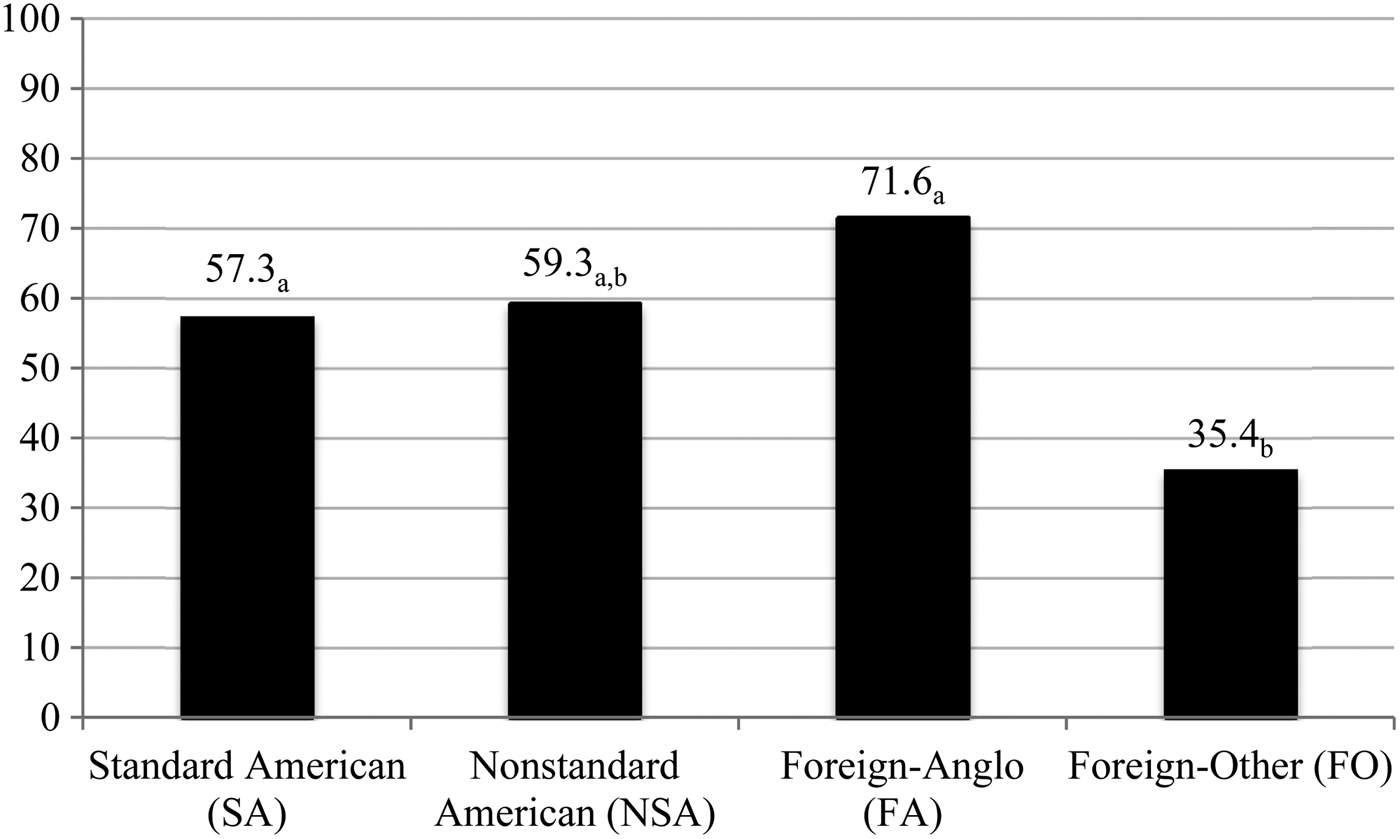
1,252 characters were identified. Consistent with H1, SA characters appeared on primetime television more frequently (84.3%) than NSA (6.5%), FA (5.4%), and FO (3.8%) characters (χ2(3) = 2353.40, p < .001). A comparison of these observed frequencies and expected frequencies extrapolated from estimated demographics is covered in the discussion section below. There was also an association between characters’ accent and role ((χ2(6) = 22.63, p < .01). Follow-up comparisons (Bonferroni adjustment) showed that SA (57.3%) and FA characters (71.6%) were both more likely to appear in main roles than FO characters (35.4%) (see Figure 1). Thus, H2 was partially supported.
Percentage of main characters within each accent group. Percentages with different subscripts are significantly different (p < .05, Bonferroni adjustment).

The nature of portrayals
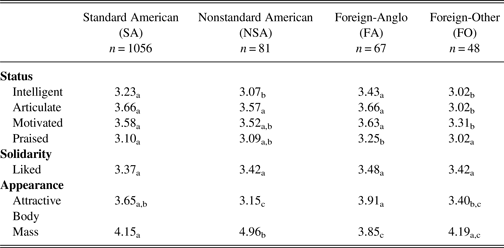
The effects of accent on status, solidarity, and appearance attributes were analyzed using analysis of variance (ANOVA). When variances were heterogeneous, Welch's F statistic was used (see Tabachnick & Fidell Reference Tabachnick and Fidell2007). Due to unequal sample sizes across the four accent groups, significant omnibus tests were followed by Hochberg's GT2 tests (when variances were homogenous) or Games-Howell tests (when variances were heterogeneous). Means are displayed in Table 1.
Characters’ status, solidarity, and appearance attributes by accent group.i
i Within each row, means that do not share a common subscript are significantly different (p < .05). (Hochberg's GT2 tests when variances were homogenous; Games-Howell tests when variances were heterogeneous).
Status
Accent had an effect on intelligence (F W(3,114.53) = 7.74, p < .001, ηp2 = .02). Games-Howell tests showed that SA (M = 3.23) and FA (M = 3.43) characters were portrayed as more intelligent than NSA (M = 3.07) and FO characters (M = 3.02). Accent had an effect on articulacy (F(3,1245) = 21.04, p < .01, ηp2 = .05). Hochberg's GT2 tests showed that FO characters (M = 3.02) were portrayed as less articulate than all other groups (M SA = 3.66; M NSA = 3.57; M FA = 3.66). Accent had an effect on motivation (F W(3,114.81) = 4.38, p < .01, ηp2 = .01). Games-Howell tests showed that SA (M = 3.58) and FA (M = 3.63) characters were portrayed as more motivated than FO characters (M = 3.31). Accent had an effect on praise (F W(3,112.18) = 2.89, p < .05, ηp2 = .01). Games-Howell tests showed that FA characters (M = 3.25) were more praised than SA (M = 3.10) and FO characters (M = 3.02). Thus, H3 was largely supported.
Solidarity
Accent had no effect on likability ratings (F < 1)—all groups were portrayed as equally likeable (M SA = 3.37, M FA = 3.48, M NSA = 3.42, M FO = 3.42). Thus, H4 was not supported.
Appearance
Accent had an effect on attractiveness (F(3,1247) = 13.90, p < .001, ηp2 = .03). Hochberg's GT2 tests showed that SA characters were portrayed as more attractive (M = 3.65) than NSA characters (M = 3.15). Additionally, FA characters were portrayed as more attractive (M = 3.91) than NSA characters (M = 3.15) and FO characters (M = 3.40). Accent had an effect on body mass (F W(3,115.56) = 9.29, p < .001, ηp2 = .03). Games-Howell tests showed that NSA characters were portrayed with heavier body mass (M = 4.96) than all other groups (M SA = 4.15; M FA = 3.85; M FO = 4.19). Additionally, SA characters were portrayed with heavier body mass than FA characters.
DISCUSSION
The present study analyzed accent portrayals on American primetime television. Based on past research, we focused our analysis on portrayals of the Standard American (SA) accent and three accent clusters: (i) Nonstandard American (NSA), including all regional and ethnic accents native to the US; (ii) Foreign-Anglo (FA), including all non-American, Anglo accents; and (iii) Foreign-Other (FO), including all other non-Anglo, foreign accents. Past research suggests that naïve listeners can reliably differentiate between these four accent groups from differences in pronunciation alone and that each is associated with different stereotypes (Shuck Reference Shuck2006; Fuertes et al. Reference Fuertes, Gottdiener, Martin, Gilbert; and Giles2012; Lippi-Green Reference Lippi-Green2012; Giles & Watson Reference Giles and Watson2013).
Our findings indicate that media portrayals of these four accent clusters are biased, largely reflecting pervasive accent-based stereotypes in American society. Such biased representation is evident both in terms of the distribution of accent portrayals, as well as the nature of those portrayals. We discuss each below.
Distribution of portrayals
SA characters constituted the overwhelming majority of characters on American primetime television (84.3%), greatly outnumbering NSA (6.5%), FA (5.4%), and FO (3.8%) characters. SA characters (along with FA characters) were also more likely to appear in main roles than FO characters, further bolstering their relative presence on television. The relative distribution of different accent groups on television can also be compared to their real-world distribution to determine whether they are over- or under-represented in the media. Although no official statistics exist on the number of people who speak with different accents in the US, estimates can be made using population data about groups likely to use different accents. Foreign-born persons from Anglo countries—that is, potential FA-accented Americans—constitute approximately 0.5% of the US population (Pew Hispanic Center 2011), making this group over-represented on television (i.e. 5.4% of media characters). Foreign-born persons from non-Anglo countries—that is, potential FO-accented Americans—make up about 12.4% of the US population (Pew Hispanic Center 2011), making this group under-represented on television (i.e. 3.8% of media characters).
An estimate of the number of NSA-accented individuals in the US is more difficult to make, given that this accent cluster consists of both regional (e.g. Southern, Northern) and ethnic accents (e.g. African-American Vernacular English). However, given that few Americans (laypeople and scholars alike) would dispute the claim that the majority of people in the Southern region of the US are NSA speakers and that the population of this region alone constitutes approximately 37% of the country's total population (US Census Bureau 2015), we can state with a high degree of confidence that NSA speakers—who constituted only 6.5% of media characters—are under-represented on American primetime television. By extension, then, it becomes clear that SA speakers—who constituted 84.3% of all media characters—are grossly over-represented in the media. In sum, then, whereas SA and FA speakers are over-represented on primetime television, NSA and FO speakers are effectively silenced, by virtue of their relative absence and gross under-representation on the media landscape (see Jaworski Reference Jaworski1993, Reference Jaworski1997, Reference Jaworski2005).
A group's sheer presence in the media is important because it is an indicator of the level of public support for that group in society and, thus, its vitality, or strength (Giles et al. Reference Giles, Bourhis, Taylor and Giles1977). Within this framework, then, the over-representation of SA and FA speakers in the media serves to bolster these groups’ power and influence in society, whereas the under-representation of NSA and FO speakers further marginalizes these groups and renders them invisible. Such biased distribution of different accent groups on television also implicitly perpetuates the standard language ideology (Lippi-Green Reference Lippi-Green1994, Reference Lippi-Green2012). By systematically over-representing standard and under-representing (most) nonstandard speakers, the media reinforces not only the belief that the standard accent is the ‘best’ form of speech, but also that it is the norm—that is, the dominant and natural form that anyone can easily obtain through proper training, hard work, and education. This, in turn, promotes ideological discourse that equates linguistic differences with personal differences, wherein those who so ‘insistently’ choose not to adhere to the standard are often thought to be lacking in mental capacity or suffer from some inherent flaw in character (for a discussion, see Silverstein Reference Silverstein, Brenneis and Macaulay1996), further subordinating them to the linguistic elite.
Nature of portrayals
In addition to differences in distribution, the nature of media portrayals also varied as a function of characters’ accents. In terms of status, SA and FA characters were portrayed as more intelligent than NSA characters, as well as more intelligent, articulate, and motivated than FO characters. Additionally, FA characters were more praised than FO and SA characters. Taken together, these results point to an accent-based status hierarchy on American television: SA and FA accents are portrayed most favorably, followed by NSA accents, and finally FO accents, which are portrayed least favorably (cf. Giles & Powesland Reference Giles and Powesland1975). These findings are consistent with past research on language attitudes, which has repeatedly demonstrated that standard-accented speakers tend to be evaluated more favorably on status-related traits than speakers of various regional and ethnic native accents, as well as foreign accents (Fuertes et al. Reference Fuertes, Gottdiener, Martin, Gilbert; and Giles2012). Importantly, however, not all foreign accents are equally denigrated. As noted earlier, compared to SA, Americans tend to evaluate FA accents equally, and sometimes even more, favorably (e.g. Stewart et al. Reference Stewart, Ryan; and Giles1985). By contrast, FO accents tend to be particularly stigmatized in the US, with speakers of those forms often characterized as incomprehensible ‘others’ (e.g. Shuck Reference Shuck2004, Reference Shuck2006; Subtirelu Reference Subtirelu2015). Given the findings above, it appears that media representations largely mirror, and arguably perpetuate, these broad, as well as nuanced associations.
With regards to solidarity, we found no differences in portrayals as a function of characters’ accent. Given that people typically attribute more solidarity to ingroup than outgroup members (Giles & Watson Reference Giles and Watson2013), we expected native-accented (i.e. American) characters to be portrayed more favorably on solidarity-related traits than foreign-accented (e.g. Spanish, British) characters. Although our results provide no support for this hypothesis, we would caution against the conclusion that such bias does not exist in the media. Indeed, the apparent absence of such bias may simply reflect a methodological artifact. Namely, although we had included several items to assess portrayals of solidarity (e.g. charismatic, kind) in the media, only one of those items (i.e. likeable) achieved an acceptable level of reliability for inclusion in our analyses. In other words, although all four accent groups appear to be portrayed as equally likeable, it is possible that they differ on other solidarity-related traits. Future research should examine this possibility.
Media characters’ appearance also varied as a function of their accents. SA and FA characters were portrayed as more attractive and as having slimmer body types than NSA characters. In addition, FA characters were portrayed as more attractive than FO characters and as having slimmer body types than SA characters. Similar to status, these findings point to an accent-based attractiveness hierarchy on television: SA and FA accents are portrayed most favorably, followed by FO accents, and finally NSA accents, which are portrayed least favorably. These findings are consistent with past research on language attitudes, which shows that ratings of physical attractiveness typically mirror ratings of status (e.g. Lambert et al. Reference Lambert, Hodgson, Gardner; and Fillenbaum1960; Giles Reference Giles1971)—that is, speakers who are upgraded on the status dimension also tend to be rated as more physically attractive. The present study revealed one notable exception to this pattern—namely, whereas FO characters were depicted least favorably on status-related traits, NSA characters were depicted as least physically attractive. In other words, although FO and NSA characters were consistently denigrated relative to SA and FA speakers, their relative standing varied based on the dimension of evaluation. This finding suggests that, in addition to status and solidarity, physical attractiveness may be an important and distinct dimension of evaluation that warrants attention in future language attitudes research.
Taken together, these results provide strong evidence that accent portrayals on American primetime television are biased. In general, SA characters are portrayed as having more status (e.g. intelligent, articulate, motivated) and as being more physically attractive than all other groups. One notable exception to this pattern are FA characters, who are consistently portrayed equally, and sometimes more favorably (e.g. praised), than SA characters. Given that the media may be an important agent of language attitude socialization (Gluszek & Hansen Reference Gluszek, Hansen, Giles and Watson2013), these findings have important implications for the formation and maintenance of accent-based stereotypes.
First, as mentioned earlier, exposure to such stereotypical portrayals can contribute to the formation of accent-based stereotypes by helping shape what viewers come to believe are the prototypical features (e.g. roles, traits) associated with different accents, as well as provide viewers with concrete exemplars of media characters who use those accents (cf. Mastro Reference Mastro, Nabi and Oliver2009). As already discussed, this socializing effect is likely to be particularly pronounced for viewers whose real-world contact with the target group is limited (Hawkins & Pingree Reference Hawkins, Pingree, Signorielli and Morgan1990). In the case of accents, the media may be the first, and sometimes only, exposure to a particular accent, for many viewers, particularly young children. Accordingly, media portrayals of accent may be an especially important, and sometimes primary, agent of language attitude socialization. Second, repeated, long-term exposure to such stereotypical portrayals can contribute to the maintenance of accent-based stereotypes by reinforcing stereotypical associations and making stereotype-consistent information more accessible in long-term memory (Mastro et al. Reference Mastro, Behm-Morawitz and Ortiz2007; Mastro Reference Mastro, Nabi and Oliver2009).
In turn, accent portrayals in the media, as well as the stereotypes they may socialize, can have important implications for viewers’ identities. According to social identity theory (Tajfel & Turner Reference Tajfel, Turner, Worchel and Austin1986), people have an intrinsic motivation to maintain a positive self-concept. Because part of the self-concept derives from one's social group memberships, people are motivated to create and maintain positive social identities in an effort to enhance their self-esteem. One way in which people can achieve a positive social identity is through favorable social comparisons that render their ingroup positively distinct from relevant outgroups on evaluative dimensions of importance. Media representations of different groups may be an important source of information for those comparisons (Mastro & Atwell Seate Reference Mastro, Seate and Giles2012). First, the sheer presence of a group in the media becomes important because it reflects the group's level of public support and relative strength in society. Second, the nature of group portrayals becomes important because it ostensibly reflects the defining features of those groups. Within this framework, then, the findings of the present study suggest that SA and FA speakers are likely to come away from the media with a positive sense of self, whereas NSA and FO speakers are likely to come away with a negative sense of self.
Admittedly, however, viewers are not passive, but rather motivated consumers of media messages (Katz, Gurevitch, & Haas Reference Katz, Gurevitch and Haas1973; Rubin Reference Rubin, Nabi and Oliver2009). In addition to individual level motivations (e.g. enjoyment, excitement, companionship), Harwood (Reference Harwood1997) argued that people engage with the media also to gratify their social identity needs. In other words, people may selectively seek out and expose themselves to media images that confirm or maintain a positive social identity. Within this framework then, the possibility arises that NSA and FO viewers may selectively seek out positive and avoid negative media portrayals of their group (see Abrams & Giles Reference Abrams and Giles2007). To what extent viewers base their media preferences on language-based concerns remains an important avenue for future research. Even so, given the paucity of nonstandard-accented characters in the media, we would argue that nonstandard-accented speakers’ ability to selectively expose themselves to positive images of their group would be difficult, if not impossible, to consistently maintain (cf. Reid et al. Reference Reid, Giles; and Abrams2004).
This study has several limitations. First, our analysis focused on media portrayals of four broad accent clusters (e.g. FO), rather than specific accents (e.g. Chinese, Japanese, Korean). This choice was motivated by the fact that we were interested in the potential effects of media portrayals on naïve viewers. Whereas past research has shown that naïve listeners can reliably discriminate between these four accent clusters, their ability to discriminate between specific accents within these clusters, particularly foreign ones, is limited (e.g. Lindemann Reference Lindemann2003; Clopper & Pisoni Reference Clopper and Pisoni2004, Reference Clopper and Pisoni2007). In other words, although portrayals may vary considerably for different accent groups within each cluster, such variation is unlikely to have an appreciable effect on most viewers’ social perceptions due to their limited ability to perceptually discriminate between those accents in the first place. Second, our sample consisted of scripted entertainment programs on American primetime television. Accordingly, our findings are limited to this media landscape. Although other studies have found similar patterns of bias on children's programming, including Disney movies (Lippi-Green Reference Lippi-Green2012) and network cartoons (Dobrow & Gidney Reference Dobrow and Gidney1998), the degree to which such biases extend to other types of media programming remains an important empirical question. For example, the over-representation of standard-accented speakers on primetime television may be even more pronounced on national news media (cf. Lippi-Green Reference Lippi-Green1994). Third, even within scripted entertainment programs on primetime television, different types of programs (e.g. crime dramas, cartoons, sitcoms) may exhibit different biases in terms of accent-based portrayals. Given that viewers are active, motivated consumers of media programming and that different programs attract different types of audiences, examining program-specific portrayals is an important direction for future research. In addition, exploring the discursive dimensions of co-viewers watching television together could yield intriguing data. Fourth, our findings are limited to American media. Future research should examine whether similar patterns emerge on media in different cultures. Although there are literally hundreds of studies examining language attitudes worldwide (Giles & Watson Reference Giles and Watson2013), research on language portrayals in the media remains in its infancy. Given that the media may be an important, and in some cases primary, agent in the socialization of language attitudes, cross-cultural analyses of language portrayals in the media represents an important direction for future research.
CONCLUSION
The current study's findings indicate that accent portrayals in this media landscape are biased, reflecting pervasive accent-based stereotypes in American society. Whereas SA and FA speakers are over-represented in the media relative to their real-world distribution, NSA and FO speakers are under-represented. In essence, nonstandard-accented speakers—including those who speak with regional and ethnic accents native to the US, as well as those who speak with non-Anglo foreign accents—effectively become silenced, simply by virtue of their relative erasure from the television landscape (cf. Irvine & Gal Reference Irvine, Gal and Kroskrity2000). Moreover, when these groups ARE rarely heard on television, they tend to be portrayed less favorably on status-related traits (e.g. intelligence) and physical appearance, compared to SA and FA speakers. These findings are both socially and theoretically important because they provide insight into the potential influence of media consumption on consumers’ social perceptions of different linguistic groups.
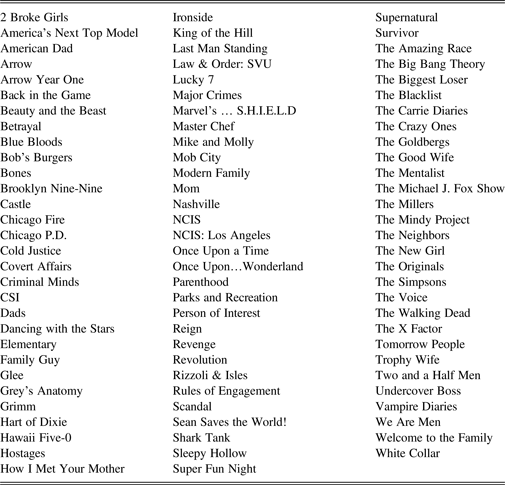
Programs included in the sample (N = 89)