In this day and age, it has become increasingly difficult to publish the details of solitary cases. In many ways this is a pity, since oftentimes the most important insights can be drawn from such experiences. Such is the situation with the information to be derived from the details of the patient described by the group working at Hôpital Necker-Enfants Malades in Paris, France, and published in the current issue of the journal.
Reference Moreau de Bellaing, Bonnet and Houyel1
They describe their experience with a neonate suspected of having VACTERL syndrome, but subsequently shown to have anomalous origin of the left pulmonary artery from the descending aorta, itself a very rare finding.
Reference Loomba, Aiello and Tretter2
In the title of their report, they suggest that their patient exhibited an “undescribed phenotypic association”, namely the association with “heterotaxy syndrome”. This begs the question as to how we should now define “heterotaxy syndrome”. The justification for considering their patient to be described in this fashion devolved on the presence of left bronchial isomerism, coupled with the fact that the liver was located in the midline, in absence of the spleen and in presence of intestinal malrotation.
Reference Moreau de Bellaing, Bonnet and Houyel1
The heart itself, however, apart from the anomalous origin of the left pulmonary artery, was anatomically normal. How, then, are we supposed to describe the segmental make-up of the heart? If we are to take the suggestion of the Parisian investigators at face value, and presume that the neonate did, indeed, have “heterotaxy syndrome”, then should we be using this information as the starting point of cardiac description? If so, which term should we then use to describe the arrangement of the atrial appendages?
As the Parisian group indicate, the definitions suggested by The International Society for Nomenclature of Paediatric and Congenital Heart Disease have now been incorporated into the eleventh iteration of the International Classification of Disease published by the World Health Organisation.
Reference Franklin, Béland and Colan3
In this system, “heterotaxy” is defined as “a congenital malformation in which the thoraco-abdominal organs demonstrate abnormal arrangement across the left-right axis of the body”. This definition is derived from an earlier publication from members of The International Society for Nomenclature of Paediatric and Congenital Heart Disease.
Reference Jacobs, Anderson and Weinberg4
Assessing their findings on the basis of this definition, and since there was left bronchial isomerism in their patient, and the spleen was absent in presence of a midline liver and intestinal malrotation, then the diagnosis of “heterotaxy syndrome” is certainly justified. But as the authors point out, with regard to the heart, “right and left isomerisms are identified as variants of heterotaxy”. They proceed by emphasising that “heterotaxy does not include normal and mirror-imaged arrangements of the internal organs”. This is, indeed, the case, at least for congenital cardiologists. As was stated in the initial definition offered by The International Society for Nomenclature of Paediatric and Congenital Heart Disease “by convention, in congenital cardiology, heterotaxy syndrome does not include patients with complete mirror-imaged arrangement of the internal organs along the left-right axis also known as “total mirror imagery” or “situs inversus totalis”. We are not told, however, on whose convention this dictate was established. In this regard, we were surprised, when producing a recent work on this topic,
Reference Anderson, Spicer and Loomba5
to be informed during the process of peer-review, that the “convention” seemingly accepted in congenital cardiology was not shared by all. As was pointed out by one of our referees, “developmental biologists continue to interpret heterotaxy on the basis of the original approach taken by Geoffroy St Hilaire, namely any arrangement of the organs that is other than normal”. In fact, we now discover that this statement is not strictly true. Isidore Geoffroy St Hilaire was the son of Etienne Geoffroy St Hilaire. Father and son were both distinguished zoologists and naturalists. Isidore, at the turn of the nineteenth century, continued to develop the concepts established by his father, culminating in the publication of three volumes between 1832 and 1836. The essence of his work was summarised in an anonymous review published in 1839.
6
It was when we contemplated the unassailable logic of this stance, as adopted by our referee, who remains anonymous, that we began to appreciate the deficiency that now remains in the current definition provided in the 11th iteration of the International Classification of Disease.
Reference Franklin, Béland and Colan3
Thus, the Parisian authors have shown that, in their patient, there was usual arrangement of the atrial appendages. Hence, the heart itself was not “heterotaxic”. And yet, without question, the lungs and abdominal organs demonstrated an “abnormal arrangement across the left-right axis of the body”. In this regard, therefore, as our colleagues from Paris correctly argue, the patient, when considered as an overall individual, possessed the features of “heterotaxy”. How are we to resolve this logical conundrum? The Parisian authors have themselves provided the answer. As they concluded, “all these considerations are in favor of an analytic approach based on accurate description of bronchi, abdominal organs and cardiac features independently, including the venous and arterial connections”. This, indeed, was also the conclusion we had reached in our own review.
Reference Anderson, Spicer and Loomba5
We stated “potential problems are removed when analysis starts with description of atrial arrangement, taking care to describe any disharmonies with either the broncho-pulmonary patterns or the arrangement of the abdominal organs”.
The statement of our colleagues from Paris,
Reference Moreau de Bellaing, Bonnet and Houyel1
combined with our own earlier approval of this approach,
Reference Anderson, Spicer and Loomba5
serves to emphasise the importance of taking note of the findings in each and every individual patient. In contrast to their seeming acceptance of current conventional wisdom, however, we would suggest that their experience reveals that the term “heterotaxy”, as defined by The International Society for Nomenclature of Paediatric and Congenital Heart Disease, is less than adequate. Indeed, an argument can now be made that the term is redundant. The definition is at the least inconsistent, since mirror-imaged atrial arrangement is currently excluded as part of the “heterotaxy syndrome”. As we have emphasised, mirror-imagery, or “situs inversus” as it is often called, is perhaps the most obvious “abnormal arrangement across the left-right axis of the body”. Indeed, if we examine the approach taken by Isidore Geoffroy St Hilaire, we find that he introduced “heterotaxy” to describe a certain grouping of congenital malformations. The translation offered by our anonymous author of 1839 for the specific passage relative to the definition reads “a great number of organs may here deviate from the specific type without the performance of their functions being in any way impeded. In man, and in all the higher orders of animals which are symmetrically formed, this anomaly is confined to transposition of the viscera; but in some of the inferior beings which are unsymmetrical, all the organs of the body are transposed”.
6
The authority who introduced the term “heterotaxy”, therefore, chose mirror-imagery as its most obvious example. On this basis, it is surely illogical to exclude mirror-imagery from the category of “heterotaxy”. But this semantic objection is no more than a play on words. Much more significant is the emphasis made by the Parisian authors of the need to describe each system of bodily organs in its own right, a notion which, as we have shown, has our own full support.
Reference Anderson, Spicer and Loomba5
How then, in the setting they describe, are we to determine atrial arrangement?
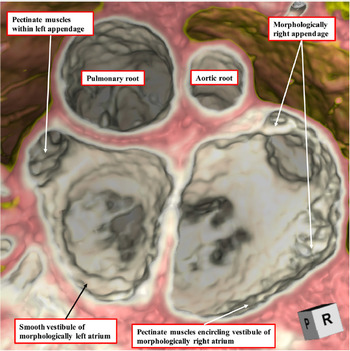
It is now universally acknowledged that identification of atrial arrangement is the starting point for ongoing segmental description. It remains our opinion that the extent of the pectinate muscles within the atrial appendages, as judged relative to the circumferences of the atrioventricular junctions, always permits the distinction between the lateralised and isomeric arrangements (Fig 1).
Reference Uemura, Ho and Devine7,Reference Tremblay, Loomba and Frommelt8
The Parisian authors are disingenuous when they discuss the previous studies that provided the basis for our ongoing opinion. Thus, they stated that “some anatomical studies claimed that atrial appendages were uniformly isomeric in the setting of heterotaxy”. This is not correct. In the anatomical studies to which reference is made,
Reference Uemura, Ho and Devine7,Reference Tremblay, Loomba and Frommelt8
the hearts used for analysis were selected specifically because the intracardiac findings were indicative of so-called “visceral heterotaxy”. Had they chosen, the Parisian authors could have cited our analysis of the autopsy experience at Children’s Hospital of Pittsburgh, which showed that patients frequently were to be found with usual atrial arrangement in the setting of splenic malformations, at the time considered indicative of “heterotaxy”.
Reference Anderson, Devine, Anderson, Debich and Zuberbuhler9
We have long been aware that the findings of thoracic isomerism, or abdominal heterotaxy, are not always good guides to cardiac isomerism.
Figure 1.
The image is a short axis view of the atrioventricular junctions as viewed from the atrial aspect in a neonate with double outlet right ventricle. It shows how, by assessing the extent of the pectinate muscles within the walls of the atrial appendages relative to the vestibules of the right and left atrial chambers, it is possible to distinguish the morphologically right from the morphologically left atrium.
Here then is the rub. According to Jesus, as documented by Saint Mark, we should “render to Caesar the things which are Caesar’s”.
10
If we translate this statement into the realm of cardiac anatomy, we can presume that diagnosis of congenital cardiac malformations should start with the heart, and specifically with the determination of atrial arrangement. The Parisian authors point to the definition of “heterotaxy” as provided by Stella Van Praagh.
Reference Van Praagh, Keane, Lock and Fyler11
We, too, have been guided by the teachings of the Van Praaghs. In particular, we are guided by their principle known as the “morphological method”.
Reference Van Praagh, David, Wright and Van Praagh12
Stated briefly, this means that one variable entity should not be defined on the basis of another variable. Instead, the most constant component of any segment should be used for its definition. It remains the fact, therefore, that it is the extent of the pectinate muscles within the atrial appendages that remains the most constant atrial feature (Fig 1). It was this feature that was shown to be constant in the references cited by the group from Paris, recognising that the hearts undergoing analysis had all exhibited the cardiac features anticipated for so-called “heterotaxy”.
Reference Uemura, Ho and Devine7,Reference Tremblay, Loomba and Frommelt8
With increasing experience, it is becoming evident that the feature can readily be demonstrated in the clinical setting using computed tomography (Fig 1). The arguments put forward by the Parisians to question this premise do not withstand rigorous scrutiny, the more so since one of their cited references is from our own group.
Reference Loomba, Pelech, Shah and Anderson13
In summary, we applaud their conclusion that “the still pending controversies about heterotaxy should be resolved by the accurate description of each thoracic and abdominal organ independently, including the segments of the heart and the venous and arterial connections”. As we have shown, we proposed an almost identical approach in one of our own recent reviews. We submit, nonetheless, as already stated, that acceptance of this recommendation must mean that the term “heterotaxy”, as currently employed, is redundant. We accept that it is essential to distinguish the finding of bodily mirror-imagery from the arrangement currently defined as representing “heterotaxy”. It is equally important to distinguish between the two subsets currently grouped together as parts of “heterotaxy”. In terms of the heart, these subsets can now accurately be described, and segregated, on the basis of right versus left isomerism of the atrial appendages. In terms of bodily arrangement, therefore, it is more accurate now simply to distinguish between the four patterns of the usual and mirror-imaged arrangements, along with the two isomeric subsets. It is analysis in this fashion, recognising that all systems may not be in harmony, that now sets the scene for accurate description of each of the cardiac components, including the crucial venoatrial connections.






 You have
Access
In this day and age, it has become increasingly difficult to publish the details of solitary cases. In many ways this is a pity, since oftentimes the most important insights can be drawn from such experiences. Such is the situation with the information to be derived from the details of the patient described by the group working at Hôpital Necker-Enfants Malades in Paris, France, and published in the current issue of the journal. Reference Moreau de Bellaing, Bonnet and Houyel1 They describe their experience with a neonate suspected of having VACTERL syndrome, but subsequently shown to have anomalous origin of the left pulmonary artery from the descending aorta, itself a very rare finding. Reference Loomba, Aiello and Tretter2 In the title of their report, they suggest that their patient exhibited an “undescribed phenotypic association”, namely the association with “heterotaxy syndrome”. This begs the question as to how we should now define “heterotaxy syndrome”. The justification for considering their patient to be described in this fashion devolved on the presence of left bronchial isomerism, coupled with the fact that the liver was located in the midline, in absence of the spleen and in presence of intestinal malrotation. Reference Moreau de Bellaing, Bonnet and Houyel1 The heart itself, however, apart from the anomalous origin of the left pulmonary artery, was anatomically normal. How, then, are we supposed to describe the segmental make-up of the heart? If we are to take the suggestion of the Parisian investigators at face value, and presume that the neonate did, indeed, have “heterotaxy syndrome”, then should we be using this information as the starting point of cardiac description? If so, which term should we then use to describe the arrangement of the atrial appendages?
As the Parisian group indicate, the definitions suggested by The International Society for Nomenclature of Paediatric and Congenital Heart Disease have now been incorporated into the eleventh iteration of the International Classification of Disease published by the World Health Organisation. Reference Franklin, Béland and Colan3 In this system, “heterotaxy” is defined as “a congenital malformation in which the thoraco-abdominal organs demonstrate abnormal arrangement across the left-right axis of the body”. This definition is derived from an earlier publication from members of The International Society for Nomenclature of Paediatric and Congenital Heart Disease. Reference Jacobs, Anderson and Weinberg4 Assessing their findings on the basis of this definition, and since there was left bronchial isomerism in their patient, and the spleen was absent in presence of a midline liver and intestinal malrotation, then the diagnosis of “heterotaxy syndrome” is certainly justified. But as the authors point out, with regard to the heart, “right and left isomerisms are identified as variants of heterotaxy”. They proceed by emphasising that “heterotaxy does not include normal and mirror-imaged arrangements of the internal organs”. This is, indeed, the case, at least for congenital cardiologists. As was stated in the initial definition offered by The International Society for Nomenclature of Paediatric and Congenital Heart Disease “by convention, in congenital cardiology, heterotaxy syndrome does not include patients with complete mirror-imaged arrangement of the internal organs along the left-right axis also known as “total mirror imagery” or “situs inversus totalis”. We are not told, however, on whose convention this dictate was established. In this regard, we were surprised, when producing a recent work on this topic, Reference Anderson, Spicer and Loomba5 to be informed during the process of peer-review, that the “convention” seemingly accepted in congenital cardiology was not shared by all. As was pointed out by one of our referees, “developmental biologists continue to interpret heterotaxy on the basis of the original approach taken by Geoffroy St Hilaire, namely any arrangement of the organs that is other than normal”. In fact, we now discover that this statement is not strictly true. Isidore Geoffroy St Hilaire was the son of Etienne Geoffroy St Hilaire. Father and son were both distinguished zoologists and naturalists. Isidore, at the turn of the nineteenth century, continued to develop the concepts established by his father, culminating in the publication of three volumes between 1832 and 1836. The essence of his work was summarised in an anonymous review published in 1839. 6 It was when we contemplated the unassailable logic of this stance, as adopted by our referee, who remains anonymous, that we began to appreciate the deficiency that now remains in the current definition provided in the 11th iteration of the International Classification of Disease. Reference Franklin, Béland and Colan3
Thus, the Parisian authors have shown that, in their patient, there was usual arrangement of the atrial appendages. Hence, the heart itself was not “heterotaxic”. And yet, without question, the lungs and abdominal organs demonstrated an “abnormal arrangement across the left-right axis of the body”. In this regard, therefore, as our colleagues from Paris correctly argue, the patient, when considered as an overall individual, possessed the features of “heterotaxy”. How are we to resolve this logical conundrum? The Parisian authors have themselves provided the answer. As they concluded, “all these considerations are in favor of an analytic approach based on accurate description of bronchi, abdominal organs and cardiac features independently, including the venous and arterial connections”. This, indeed, was also the conclusion we had reached in our own review. Reference Anderson, Spicer and Loomba5 We stated “potential problems are removed when analysis starts with description of atrial arrangement, taking care to describe any disharmonies with either the broncho-pulmonary patterns or the arrangement of the abdominal organs”.
The statement of our colleagues from Paris, Reference Moreau de Bellaing, Bonnet and Houyel1 combined with our own earlier approval of this approach, Reference Anderson, Spicer and Loomba5 serves to emphasise the importance of taking note of the findings in each and every individual patient. In contrast to their seeming acceptance of current conventional wisdom, however, we would suggest that their experience reveals that the term “heterotaxy”, as defined by The International Society for Nomenclature of Paediatric and Congenital Heart Disease, is less than adequate. Indeed, an argument can now be made that the term is redundant. The definition is at the least inconsistent, since mirror-imaged atrial arrangement is currently excluded as part of the “heterotaxy syndrome”. As we have emphasised, mirror-imagery, or “situs inversus” as it is often called, is perhaps the most obvious “abnormal arrangement across the left-right axis of the body”. Indeed, if we examine the approach taken by Isidore Geoffroy St Hilaire, we find that he introduced “heterotaxy” to describe a certain grouping of congenital malformations. The translation offered by our anonymous author of 1839 for the specific passage relative to the definition reads “a great number of organs may here deviate from the specific type without the performance of their functions being in any way impeded. In man, and in all the higher orders of animals which are symmetrically formed, this anomaly is confined to transposition of the viscera; but in some of the inferior beings which are unsymmetrical, all the organs of the body are transposed”. 6 The authority who introduced the term “heterotaxy”, therefore, chose mirror-imagery as its most obvious example. On this basis, it is surely illogical to exclude mirror-imagery from the category of “heterotaxy”. But this semantic objection is no more than a play on words. Much more significant is the emphasis made by the Parisian authors of the need to describe each system of bodily organs in its own right, a notion which, as we have shown, has our own full support. Reference Anderson, Spicer and Loomba5 How then, in the setting they describe, are we to determine atrial arrangement?
It is now universally acknowledged that identification of atrial arrangement is the starting point for ongoing segmental description. It remains our opinion that the extent of the pectinate muscles within the atrial appendages, as judged relative to the circumferences of the atrioventricular junctions, always permits the distinction between the lateralised and isomeric arrangements (Fig 1). Reference Uemura, Ho and Devine7,Reference Tremblay, Loomba and Frommelt8 The Parisian authors are disingenuous when they discuss the previous studies that provided the basis for our ongoing opinion. Thus, they stated that “some anatomical studies claimed that atrial appendages were uniformly isomeric in the setting of heterotaxy”. This is not correct. In the anatomical studies to which reference is made, Reference Uemura, Ho and Devine7,Reference Tremblay, Loomba and Frommelt8 the hearts used for analysis were selected specifically because the intracardiac findings were indicative of so-called “visceral heterotaxy”. Had they chosen, the Parisian authors could have cited our analysis of the autopsy experience at Children’s Hospital of Pittsburgh, which showed that patients frequently were to be found with usual atrial arrangement in the setting of splenic malformations, at the time considered indicative of “heterotaxy”. Reference Anderson, Devine, Anderson, Debich and Zuberbuhler9 We have long been aware that the findings of thoracic isomerism, or abdominal heterotaxy, are not always good guides to cardiac isomerism.
The image is a short axis view of the atrioventricular junctions as viewed from the atrial aspect in a neonate with double outlet right ventricle. It shows how, by assessing the extent of the pectinate muscles within the walls of the atrial appendages relative to the vestibules of the right and left atrial chambers, it is possible to distinguish the morphologically right from the morphologically left atrium.
Here then is the rub. According to Jesus, as documented by Saint Mark, we should “render to Caesar the things which are Caesar’s”. 10 If we translate this statement into the realm of cardiac anatomy, we can presume that diagnosis of congenital cardiac malformations should start with the heart, and specifically with the determination of atrial arrangement. The Parisian authors point to the definition of “heterotaxy” as provided by Stella Van Praagh. Reference Van Praagh, Keane, Lock and Fyler11 We, too, have been guided by the teachings of the Van Praaghs. In particular, we are guided by their principle known as the “morphological method”. Reference Van Praagh, David, Wright and Van Praagh12 Stated briefly, this means that one variable entity should not be defined on the basis of another variable. Instead, the most constant component of any segment should be used for its definition. It remains the fact, therefore, that it is the extent of the pectinate muscles within the atrial appendages that remains the most constant atrial feature (Fig 1). It was this feature that was shown to be constant in the references cited by the group from Paris, recognising that the hearts undergoing analysis had all exhibited the cardiac features anticipated for so-called “heterotaxy”. Reference Uemura, Ho and Devine7,Reference Tremblay, Loomba and Frommelt8 With increasing experience, it is becoming evident that the feature can readily be demonstrated in the clinical setting using computed tomography (Fig 1). The arguments put forward by the Parisians to question this premise do not withstand rigorous scrutiny, the more so since one of their cited references is from our own group. Reference Loomba, Pelech, Shah and Anderson13
In summary, we applaud their conclusion that “the still pending controversies about heterotaxy should be resolved by the accurate description of each thoracic and abdominal organ independently, including the segments of the heart and the venous and arterial connections”. As we have shown, we proposed an almost identical approach in one of our own recent reviews. We submit, nonetheless, as already stated, that acceptance of this recommendation must mean that the term “heterotaxy”, as currently employed, is redundant. We accept that it is essential to distinguish the finding of bodily mirror-imagery from the arrangement currently defined as representing “heterotaxy”. It is equally important to distinguish between the two subsets currently grouped together as parts of “heterotaxy”. In terms of the heart, these subsets can now accurately be described, and segregated, on the basis of right versus left isomerism of the atrial appendages. In terms of bodily arrangement, therefore, it is more accurate now simply to distinguish between the four patterns of the usual and mirror-imaged arrangements, along with the two isomeric subsets. It is analysis in this fashion, recognising that all systems may not be in harmony, that now sets the scene for accurate description of each of the cardiac components, including the crucial venoatrial connections.
Acknowledgements
None.
Financial support
This research received no specific grant from any funding agency, commercial, or not-for-profit sectors.
Conflicts of interest
None.
Ethical standards
The authors assert that all procedures contributing to this work comply with the ethical standards of the relevant national guidelines on human experimentation and with the Helsinki Declaration of 1975, as revised in 2008.