Introduction
Grass production represents a significant role in the Danish agricultural sector. Twenty percent of the total agricultural land in Denmark is cultivated with grasses or designated as permanent grassland (Statbank Denmark, 2014a). The main purpose of grass production is to supply the ruminant livestock industry with high quality forage, due to a large production of dairy products. In 2013, 5 million tons of dairy products were produced (Statbank Denmark, 2014b). A comparison of statistical data showing the annual consumption of grass for livestock production, and the annual grass production (harvested grass), however, shows an excess production of averagely 12% of the total grass production in the period 2006–2012 (Statbank Denmark, 2014c, d).
The majority of the established conventional biogas plants in Denmark use animal manure as their primary process feedstock. Additionally, co-digestion of plant biomass and organic industrial wastes in biogas plants has been well demonstrated and practiced due to the improvement in obtainable methane (CH4) yields. This use of co-digestion substrates is especially important in Denmark where the high moisture- and nitrogen-containing animal manures (i.e., pig and cattle) are predominant as the primary anaerobic digestion substrates. Typical substrates for co-digestion in Denmark have usually been organic industrial waste streams; yet the use of such biomass is becoming increasingly restricted due to limited availability. Energy crops, such as maize and beets, also represent resources that are used as co-digestates. Madsen and Larsen (Reference Madsen and Larsen2011) assess that energy crops (maize and beets) cultivated on 1000 ha in Denmark were consumed for biogas production in the country. In addition, 11,000 ha of maize crop are cultivated in the Southern Denmark region and exported specifically to biogas producers in Northern Germany. The demand for maize for biogas production in Germany has increased significantly during the last years due to a favorable feed-in tariff for electricity produced from biogas promoted by the German Act on Renewable Energy Source (EEG). In Southern Denmark, this caused the financial gain for cultivating maize for export to the German biogas sector to be higher than for cultivating feedstuff crops for the local livestock production.
By means of an improved scheme for financial support for biogas producers, the Danish Parliament is aiming at expanding the Danish biogas sector by targeting the use of 50% of the available manure by 2020 (The Danish Ministry of Climate Energy and Buildings, 2012; Jacobsen et al., Reference Jacobsen, Laugesen, Dubgaard and Bojesen2013). Only 8% of the locally available animal manure in Denmark was consumed for biogas production in 2013 (Jacobsen et al., Reference Jacobsen, Laugesen, Dubgaard and Bojesen2013). The adoption of this scheme, however, led to the concern that it could initiate an uncritical cultivation of energy crops used as co-substrates in biogas production causing the environmental and climate related benefits from biogas production to be reduced or eliminated. This resulted in restrictions in the financial scheme limiting the quantity of purposely grown energy crops that can be used in biogas plants: by the year 2020, only 12% of the total input substrates can consist of purposely grown energy crops (The Danish Energy Agency, 2012). Also in Germany, a political concern for the intensive use of energy crops emerged. In 2014, the EEG was amended causing significant impacts on the German biogas sector via several changes in the frame conditions for the biogas producers. One of the main changes was the withdrawing of the possibilities of receiving financial benefits for biogas production based on energy crops (EurObserv'ER 2014). Thus, a shift in the current situation where energy crops are widely used, towards an increasing use of organic residues for biogas production is anticipated.
Considering the framework conditions for the development of the biogas sector in Denmark and Germany, it can be expected that an increasing demand for alternative biomass types for co-digestion in manure based biogas plants will emerge. Especially, in the Region of Southern Denmark where it is intended to locate 12 out of 28 new joint biogas plants planned for establishment in Denmark (The Danish Energy Agency, 2014). Excess grass from agricultural grass production could potentially meet part of this demand, whereby the agricultural sector could thus serve as a supplier of substrates for renewable energy production in the region. Alternatively, excess production of grass could substitute part of the intensive production of maize cultivated for export to Northern Germany.
The objective of this study is to map and estimate the potential yields of excess grass that can be obtained from grass production in the Region of Southern Denmark. Based on this, it is aimed to evaluate if the potential excess grass yields are of a proportion relevant for utilizing in the regional biogas sector. In order to do this, the following questions of concern related to the topic were investigated:
-
• How much grass is cultivated in the Region of Southern Denmark and how is the production distributed?
-
• How much forage grass is needed for animal husbandry in the region and how is the demand distributed?
-
• Are there any quantities of grass produced in the region not needed for animal husbandry (excess grass production) and how is it distributed?
-
• What are the potentials of utilizing any excess grass as co-substrate in the future biogas plants in the region?
-
• Are the quantities of excess grass of significance for replacing the maize crops exported to Northern Germany?
These questions were furthermore investigated for two additional cases: a sensitive and an intensive scenario. This was done in order to evaluate if changing the current management strategy of the grasslands (conservative scenario) has any significant impact on the potential yields of excess grass that can be obtained.
Data and methods
The work in this study consists mainly of a spatial analysis, but also literature studies and analysis of statistical records. The data applied in the study are presented in the section ‘Data’, while the preparation of the data is explained in the section ‘Data preparation’. The spatial analysis (presented in the section ‘Spatial analysis’) was performed in order to estimate the potential obtainable biomass yields from grass areas in the Region of Southern Denmark, by assigning them with relevant climatological and geological characteristics. The section ‘Definition of biomass yields and quality’ presents the values related to biomass yields and quality applied in this work (identified via literature studies) which combined with the spatial analysis were used to estimate the gross production of grass in the region. In the section ‘Estimation of the demand for forage grass’, the approach used for estimating the grass forage demand in the region is explained, while the estimations of the net grass production and the methane potential are explained in the sections ‘Estimation of the surplus production of agricultural grass’ and ‘Estimation of the methane potential’. Finally, the approach used for evaluating the potential of using excess grass in the regional biogas sector, or as an alternative to the export of maize, is presented in the sections ‘Assessing the potential of utilizing surplus grass in the regional biogas sector’ and ‘Assessment of the potential for substituting maize for export’.
Data
The data applied in this study consist of geo-datasets, statistical data and data found via literature studies. All the applied data and values are presented in the following sections.
Administrative units
The Danish Geodata Agency (2013) provided a geo-dataset, digitally showing the administrative geographical boundaries in Denmark. These were applied in order to frame the area of focus in this study; the Region of Southern Denmark.
Grassland
Geo-datasets from the Danish Ministry of Food, Agriculture and Fisheries provided information about the crops cultivated in Denmark. All fields and cultivated crop types in Denmark are registered digitally. The dataset contains information about three categories of grass cultivated in Denmark: fields with rotational grassland, field permanently covered with grass and fields with grass where the farmers receive financial support for managing them extensively (environmental grassland) (Ministry of Food, Agriculture and Fisheries of Denmark, 2014a). For each category, the specific grass field types are defined.
Nature protection
Areas considered to contain very valuable nature types are protected according to §3 in the Danish Act of Nature Conservation (Danish Ministry of the Environment, 2013). These nature types are lakes, water streams, heathland, bogs, salt marshes, fresh water meadows and dry grasslands. The conditions of these nature types cannot be changed, however, the areas can be used as before they were subject to the Nature Conservation Act. This means that some agricultural areas are subject to the act, but the agricultural use remains. All areas subject to the act are registered and mapped digitally by the Danish Natural Environment Portal (2013).
Climate: precipitation and evaporation
The Danish Meteorological Institute provides the dataset ‘Climate Grid Denmark’ (Scharling, Reference Scharling2012) which contain information about the observed daily and monthly values of precipitation, and the accumulated potential evaporation from year 1989 to 2010. The precipitation values are presented in a 10 × 10 km2 grid, while the potential evaporation is presented in a 20 × 20 km2 grid.
Ground water levels
The uppermost groundwater levels in Denmark have been monitored from year 1991 to 2010 and a dataset with the resolution of 500 × 500 m2 has been developed by The Geological Survey of Denmark and Greenland (2011).
Soil types
Aarhus University (Dansk Jordbrugsforskning, 1979) has registered the different soil types in Denmark. The upper soil layer is categorized into eight different categories and mapped for approximately 80% of Denmark.
Livestock production
Data showing the numbers of cattle, sheep and goats registered in the region in 2012 were purchased from the Knowledge Centre for Agriculture (2013a). The cattle are registered on a municipal level according to breed, age, gender and whether they are beef cattle or dairy cattle. The registrations of sheep and goats are defined as mother animals or other animals. No detailed registrations of horses were identified. On a regional level, however, the number of horses has been registered since 2006 by Statistics Denmark (Statbank Denmark, 2014e) and the number of horses registered in the region in 2012 was applied in this study.
Grass yields
Every year the Ministry of Food Agriculture and Fisheries of Denmark publishes guidelines for the use of fertilizer on agricultural land (Danish Plant Directorate, 2013).These guidelines are used by the farmers and contain standards for the quantities of fertilizer that can be applied on the fields, depending on the cultivated crop type, crop yields obtained in the previous year, the soil type, if they are irrigated and the soil concentration of nitrogen measured in the current year. The grass yields are specified in feed units (FUs) obtainable per ha which is calculated based on the size, weight and total solids (TS) content of the bales (silage or hay) obtained from the fields. It is therefore assumed that potential losses of grass during the harvest process are taken into account. However, losses related to transport and under storage are not assumed to be included in the values. One FU is defined as the net energy value in 1 kg barley (Sundstöl, Reference Sundstöl1993). For grass of good forage quality, one FU usually corresponds to 1.1–1.3 kg TS (Knowledge Centre for Agriculture, 2002).
Data preparation
All analysis and preparation of geo-datasets was conducted by using ESRI ArcMap 10.2.1® software. All geo-datasets were projected to the coordinate system ETRS89 UTM zone 32N. The geo-dataset with registrations of fields with permanent grassland and environmental grassland was merged into one dataset and referred to as ‘permanent grassland’. Fields of permanent or rotational grassland located within or intersecting the administrative area of the Region of Southern Denmark were selected and used to create two new datasets containing the fields with permanent grassland and the fields with rotational grassland in the Region of Southern Denmark. The registrations of rotational and permanent grassland fields were manually sorted based on descriptions of the specific grass fields in order to exclude areas where the grass is produced for commercial purposes (e.g., turf grass) or used for outdoor pig farming.
Spatial analysis
A spatial analysis was performed in order to assess the potential obtainable biomass yields from grass fields in the Region of Southern Denmark, by assigning them with the relevant legislative, climatological and geological attributes. The different steps of the analysis are presented in the following subsections.
Nature protection
As described in the section ‘Data protection’ parts of the agricultural land in Denmark are subject to the Act of Nature Conservation (Danish Ministry of the Environment, 2013). In order to identify the grass fields assigned to contain valuable nature types, a spatial identity analysis was conducted, computing a geometric intersection of the grass fields covered by areas subject to the Act of Nature Conservation. The grass fields were thereby split into smaller fragments (shapes) corresponding to the parts within or outside a conservation area. The new units were assigned with the attribute of the overlapping conservation area or with ‘NULL’ if they were not overlapped. This process was done in order to ensure that the shapes subject to conservation status could be defined anytime. The area of each new shape was finally calculated.
Climatological and geological attributes
In order to assess the potential yield that can be achieved from the different grass fields, the relevant climatological and geological attributes (described in sections ‘Climate: precipitation and evaporation’, ‘Ground water levels’ and ‘Soil types’) were assigned to the shapes.
For each shape, the soil type, the ground water level, the annual potential average evaporation and the annual average precipitation in the growth season (April–October) were identified as illustrated in Figure 1. Each shape was assigned with the specific attributes from each of the applied datasets.
Pictorial presentation of the method applied for assigning the grass fields in the Region of Southern Denmark with attributes from the relevant geo-datasets.

Definition of biomass yields and quality
The values related to the biomass yields and quality applied in this work are presented and explained in the following sections. The values were used to assess the total potential of produced grass, when considering relevant factors such as loss under storage, the intensity level when managing the grass fields and the possible differences in the quality of the grass.
Annual yields
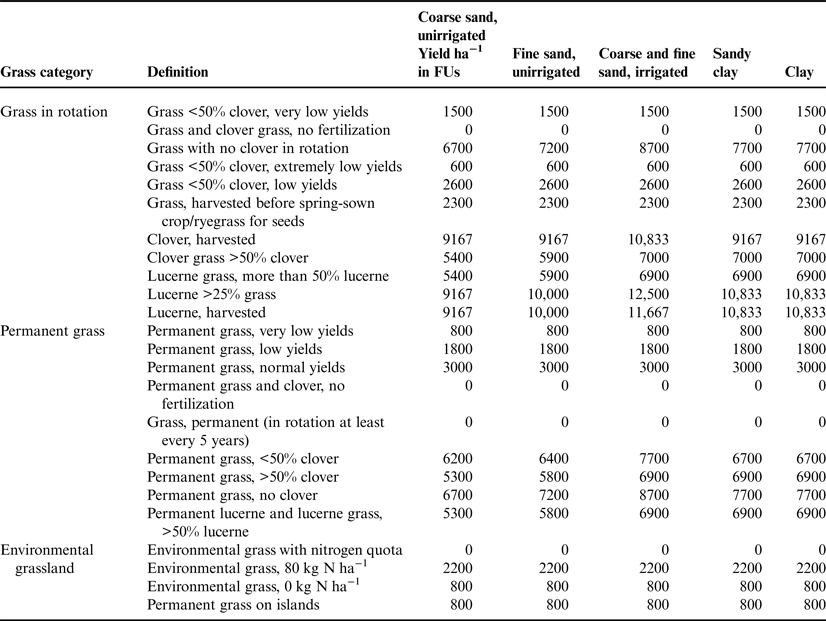
The guidelines for obtainable grass yields from the Ministry of Food Agriculture and Fisheries (Danish Plant Directorate, 2013) were applied as base values for estimating the potential yields that can be obtained from rotational and permanent grassland. The yields are presented in Appendix A. The climatological and geological attributes assigned to the fields (as explained in the section ‘Spatial analysis’) were used to define the yield for each field, as illustrated in Figure 2. All areas with rotational grass were assumed to be irrigated. Permanent grass areas with a ground water level less than 1 m beneath the soil surface were assumed to have yields as if they were irrigated, due to the influence of the high ground water level. In order to evaluate if the precipitation on the permanent grass areas is sufficient to substitute the need for irrigation, the potential evaporation from the areas were applied. The average annual seasonal excess precipitation available for the grass crops was estimated for all shapes by subtracting the average annual seasonal potential evaporation from the average annual seasonal precipitation. Areas with an average excess quantity of precipitation of minimum 400 mm in the growth season (April–October) during the years 1989–2010 were assumed to obtain yields as if they were irrigated.
Pictorial presentation of how the grass yields were defined for the different types of grass fields based on their climatological and geological attributes.

Yields per harvest and biomass quality
It is reported that ≈40% of the annual yield of grass is obtained from the first harvest of the fields (Knowledge Centre for Agriculture, 2002). The date of the first harvest will impact the actual yield, but is usually planned so the forage value (kg TS per FU) of the grass will match the requirements of the consuming ruminants. The harvest frequency during the growth season is expected to vary depending on the field type and the total annual obtainable yield. On high yielding rotational grass fields, it can be necessary to harvest three to five times per season to maintain a high forage value of the grass. Low yielding permanent grass fields of minor significance in the farmers forage production, might only be harvested once (late in the season) in accordance with the national legislation for good agricultural practices (Ministry of Food, Agriculture and Fisheries of Denmark, 2014b). The obtainable yields for the subsequent cuts are expected to decline during the season, but variations can appear due to the weather conditions (Laursen and Petersen, Reference Laursen and Petersen2010).
The quality of the grass (in terms of forage value and methane yields) is impacted by the date of the first cut, but also by the harvest frequency and dating during the season (Knowledge Centre for Agriculture, 2002; Prochnow et al., Reference Prochnow, Heiermann, Plöchl, Linke, Idler, Amon and Hobbs2009). Maturing of the grass has been reported to impact both the forage value and the methane potential negatively (Rinne et al., Reference Rinne, Jaakkola and Huhtanen1997; McEniry and O'Kiely, Reference McEniry and O'Kiely2013). The specific harvest strategy of the grassland in the region cannot be identified for each grass field, thus the exact yield and quality of the grass from each harvest is also unidentified. However, it is expected that high yielding fields are harvested more frequent than the more extensively permanent grass fields. As the specific biomass yields applied in this study are specified in annual FUs per ha (the energetic value) assumptions for the harvest strategy on the different field types had to be conducted in order to estimate the biomass quantities in TS.
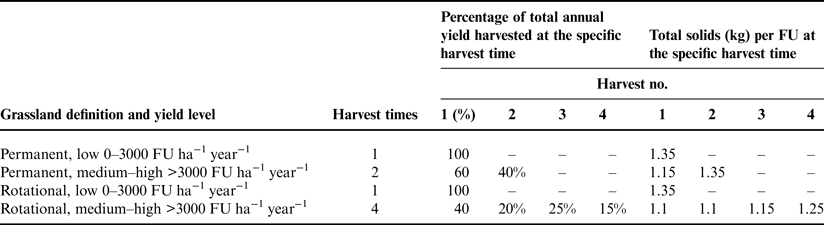
The assumptions for the harvest frequency for the specific fields were based on the values for the obtainable yields on the different field types. Grass fields with yields <3000 FU ha−1 year−1 were defined as low yielding fields, since they were assumed to be harvested only once per season. Grass fields with yields >3000 FU ha−1 year−1 were defined as medium to high yielding fields and were assumed to be harvested two to four times per season. By using a forecasting tool developed by the Knowledge Centre for Agriculture (Nielsen and Søegaard, Reference Nielsen and Søegaard2014), the expected feed value (FU per ha) per harvest was assessed. Based on this forecast and results from harvest trials in Denmark (Laursen and Petersen, Reference Laursen and Petersen2010) assumptions for the obtainable FU yields per harvest and the forage quality (kg TS FU−1) of the harvested grass were developed. The specific assumptions are presented in Table 1.
Assumptions for the harvest frequency, harvest yields and biomass quality.

FU, feed units.
Changing the management strategy – a sensitive or an intensive scenario
The yields identified for the grass fields (as illustrated in Fig. 2) are based directly on the standards from the Ministry of Food Agriculture and Fisheries (Danish Plant Directorate, 2013). Since it is considered to reflect the current management strategy and obtainable grass yields, it is therefore referred to as a conservative scenario.
A sensitive scenario for the management strategy of the grassland
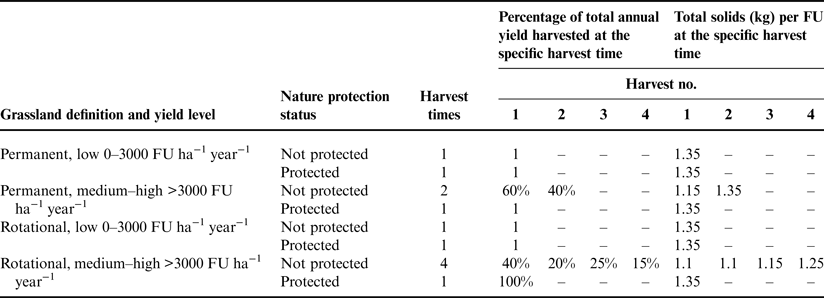
In order to reflect how the yields can be impacted a with more sensitive management strategy of the grassland, a sensitive scenario was developed based on the same assumptions as in the conservative scenario, except for all grass areas located within a nature protection area. In the sensitive scenario, it is assumed that all grass areas located within a nature protection area are managed in the same manners as grass fields receiving subsidies for sensitive management (environmental grass), reducing the yields to 600–2200 FU (Appendix A). Due to the low yields, it is also assumed that the harvested frequencies on these fields are changed into being harvested only once per season. The specific assumptions for the sensitive scenario are presented in Table 2.
Assumptions for the harvest frequency, harvest yields and biomass quality in the sensitive scenario.

FU, feed units.
An intensive scenario for the management strategy of the grassland
A scenario reflecting an intensified management strategy was also developed. Recent studies from Aarhus University (Sørensen, Reference Sørensen2014) showed that fields cultivated with festulolium grass and fertilized with 425 kg N ha−1, yielded up to 22 t TS ha−1. The nitrate leach from the fields was furthermore found to be less than on unfertilized clover grass fields. This yield is more than 35% higher than the highest yields found in the guidelines from the Ministry of Food Agriculture and Fisheries (Danish Plant Directorate, 2013), while the corresponding level of fertilization with nitrogen is ≈25% higher. The Knowledge Centre for Agriculture (2012) also found increased yields of different grass and clover crops, when applying up to 461 kg N ha−1. The obtained yields for ryegrass, fescue and festulolium were ≈20–30% higher than the yields obtained when applying the level of nitrogen as recommended by the guidelines from the Ministry of Food Agriculture and Fisheries (Danish Plant Directorate, 2013).
Based on these trials, it can be argued that the biomass yields on grassland can be significantly improved when increasing the level of fertilization, compared with what is recommended by the Ministry of Food Agriculture and Fisheries. The guidelines which determine the level of nitrogen that can be applied on the fields derives from the implementation of the Nitrates Directive from the European Union (European Commission, 1991). The aim of the directive is to prevent nitrate from agricultural sources polluting ground and surface waters. The directive requires that there is equilibrium between the nitrogen supply and the nitrogen withdrawal by crops. If higher yields of grass can be obtained by changing management strategy, while still ensuring and documenting equilibrium between the nitrate supply and withdrawal, this could potentially allow for increases in the grass productivity. The intensive scenario reflects this argument, by assuming an increase in the field specific yields from the guidelines of 25% induced by higher levels of nitrogen fertilization. The yields for fields within nature protection areas were, however, kept constant at the level found in the guidelines, as it is assumed that an intensified management strategy cannot be implemented (due to the rules in the Nature Conservation Act stating that the conditions of these areas may not be changed, but must remain as before they were subject to the Act (Danish Ministry of the Environment, 2013)).
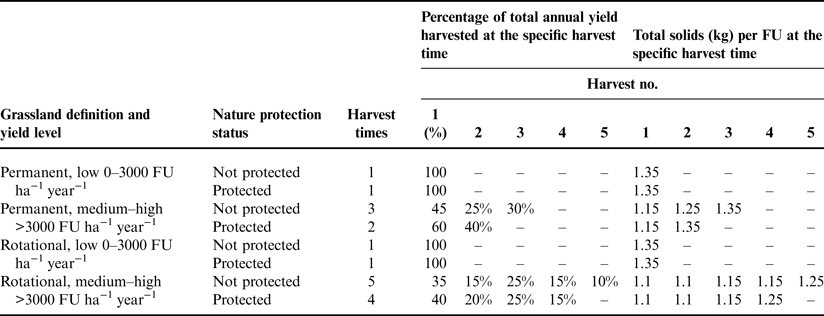
The specific assumptions for the intensive scenario are presented in Table 3.
Assumptions for the harvest frequency, harvest yields and biomass quality in the intensive scenario.

FU, feed units.
Potential grass losses
As described in the section ‘Grass yields’, potential losses of grass under the harvesting process (field losses) are assumed to be taken into account in the applied values for obtainable grass yields. Regardless of the application of the grass produced in the Region of Southern Denmark, further losses are, however, unavoidable under the transport, storage and while handling the biomass at the end use location. The Livestock Knowledge Transfer Management Team (2001) reports that on average 25% of the TS are lost during these processes: ensiling being the main reason for the losses. Egg et al. (Reference Egg, Egg, Coble and Engler1993), however, found that well managed ensiling processes are able to conserve more than 90% of the energy content of crops. Hay making is also a used storage method, but is very dependent on the weather conditions. If the hay is dried and stored well, losses are reported to be minimal (Knowledge Centre for Agriculture, 2013b). It is expected that both storage systems are applied in the region, but the extent cannot be documented. To reflect the potential losses under transport, storage and on farm management of the grass, an average loss of 20% of the forage value was applied in this study. This is below the average loss of 25% found by the Livestock Knowledge Transfer Management Team (2001); however, this figure includes field losses which are assumed to be already included in the applied values for the obtainable yields. Field losses are estimated to be from 2 to 12% of the total losses, thus the average of 5% is deducted from the total value for losses, resulting in an applied value of 20% losses in this study.
The total gross grass production
The obtainable grass yield (in FUs) per grass field were estimated by multiplying the field sizes with the specific grass yield per hectare identified for the field type (as explained in the section ‘Annual yields’) in the concerned scenario. In order to assess the sensitivity of the results with respect to changes in the obtainable grass yields per hectare (caused by, e.g., varying climatological conditions), the specific yields in each scenario were furthermore reduced and increased by respectively 10%. The yields in the guidelines from the Danish Ministry of Food, Agriculture and Fisheries were thereby considered to represent the average obtainable yields and are thus referred to as the ‘average yields’. The potential grass losses were then estimated and deducted from the estimated yields (as described in the section ‘Changing the management strategy—a sensitive or an intensive scenario’) and finally, the total grass production was summarized on municipal and regional levels.
Estimation of the demand for forage grass
The demand for feed consisting of grass was estimated for animal husbandry in the region. Records from the Danish Dairy Management system (used by farmers and consultants) were applied for estimating the total demand for grass for cattle production (Knowledge Centre for Agriculture, 2013b). In this system, different feed types are weighed on a daily basis for comparison with the dairy production. These records were available for two typical breeds of heifers and dairy cows in Danish livestock production: Holstein Friesian and Jersey cattle. For heifers and dairy cows of a different breed, the average of the records for the two breeds was applied. The demand of feed consisting of grass for the production of sheep, goats and horses in the region was estimated based on feeding standards from the Danish Agricultural Advisory (Hansen, Reference Hansen2001). As no detailed registrations regarding the breed, age, weight, etc. are defined for horses, an average value of the recommended food supply for maintenance of horses with a weight ranging from 200 to 700 kg was applied for all horses.
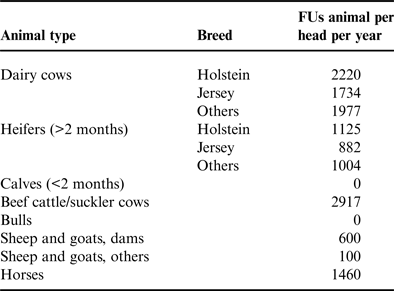
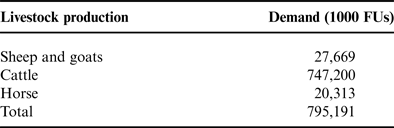
The total demand for forage grass in cattle, sheep and goat production was estimated on municipal levels by multiplying the records of the specific animal types and breeds in the municipalities (presented in the section ‘Livestock production’) with their corresponding grass forage demands (Table 4).
The grass forage demand in FUs for the different categories of ruminants.

FU, feed units.
As the registration of horses was only found on a regional level, the demand from horse production on municipal level could not be estimated by the same approach. In order to approximate the demand on municipal level, the regional demand and the percentage of the total regional grassland located in each municipality was applied. It is expected that the extent of horse breeding depends on the presence of available grassland for forage production and grazing purposes in the municipalities. The municipal shares (percentage) of total regional grassland were assumed to reflect the extent of horse breeding in the municipalities. Based on this, the municipal demand for forage grass for horse breeding was derived by using the percentage of grassland in the respective municipalities as the factor determining the municipal share of the regional demand for forage grass.
The total forage grass demand was finally estimated on a municipal level by summarizing the municipal demands from cattle, sheep, goats and horses.
Estimation of the surplus production of agricultural grass
The potential surplus production on a municipal level was calculated by subtracting the demand for grass in livestock production from the gross production of grass from rotational grassland and permanent grassland production. The grass excess yields were hereafter recalculated as ton TS by using the scenario specific assumptions presented in Tables 1–3 and the sections ‘Yields per harvest and biomass quality’ and ‘Changing the management strategy – a sensitive or an intensive scenario’.
Estimation of the methane potential
Biomass from grassland has been demonstrated to be a suitable substrate for anaerobic digestion (Lehtomäki et al., Reference Lehtomäki, Huttunen, Lehtinen and Rintala2008; Prochnow et al., Reference Prochnow, Heiermann, Plöchl, Linke, Idler, Amon and Hobbs2009; Asam et al., Reference Asam, Poulsen, Nizami, Rafique, Kiely and Murphy2011). The methane yields obtainable from anaerobic digestion of grass have been found to vary significantly in the literature. Braun et al. (Reference Braun, Weiland and Wellinger2010) report yields ranging from 298 to 467 Nm3 t−1 volatile solids for grass, while 290–390 Nm3 for clover grass. Different stages of maturity of the harvested grass is one factor causing variation in the methane yields (McEniry and O'Kiely, Reference McEniry and O'Kiely2013), but also the grass species, storage method and the digestion technologies are influencing factors (Prochnow et al., Reference Prochnow, Heiermann, Plöchl, Linke, Idler, Amon and Hobbs2009; Nizami and Murphy, Reference Nizami and Murphy2010; Nizami et al., Reference Nizami, Orozco, Groom, Dieterich and Murphy2012). The obtainable harvest yields applied in this study are specified in FUs, complicating a direct relation to the methane yields found in the literature. Although the grass yields in FUs can be estimated as the equivalent quantities in volatile TS, it can be argued that the results will be attached with a significant uncertainty, as the quality of the grass will be based only on assumptions used for estimating the quantities of TS (presented in the sections ‘Yields per harvest and biomass quality’ and ‘Changing the management strategy—a sensitive or an intensive scenario’). Larsen et al. (Reference Larsen, Stefanek and Møller2010) studied the relationship between the forage value and the methane potential in grass, and found that there is no clear relationship, especially for grass with a low forage value. The yields were found to vary from 0.21 to 0.60 Nm3 CH4 FU−1, with an average of 0.44 Nm3 CH4 FU−1 (90 days retention time). Based on these findings, it was inferred that without specific knowledge of the quality of the grass there will be uncertainties in the estimations of the methane yield. However, to avoid increasing the uncertainty arising when converting the values specified in FUs into total volatile solids, it was decided to apply the average yield found by Larsen et al. (Reference Larsen, Stefanek and Møller2010). The yield was, however, reduced by 10% (0.40 Nm3 CH4 FU−1) due to the fact that most Danish biogas plants operate with shorter retention times than the 90 days applied in their study.
Assessing the potential of utilizing surplus grass in the regional biogas sector
Jacobsen et al. (Reference Jacobsen, Laugesen, Dubgaard and Bojesen2013) conducted an analysis of 18 biogas plants planned to be established in Denmark, with respect to capacity, input of substrates and investment costs. They found that 82% of the input substrates in plants digesting less than 1000 t substrates per day are expected to be manure or bedding material, while the remaining input will consist of industrial waste, energy crops or other substrates. Based on this allocation of substrates in future biogas plants, and the assumption that the share of industrial waste, energy crops and other substrates are replaced by the excess grass produced in the Region of Southern Denmark, the number of potential new manure based plants could be estimated. The number of biogas plants was estimated on both regional and municipal levels. The biogas plants were assumed to annually digest 200,000 t biomass (wet based), which corresponds to a daily intake of ≈550 t biomass from which 18% hence is assumed to be grass silage.
Assessment of the potential for substituting maize for export
In the case of the Region of Southern Denmark, utilization of excess grass is not only relevant as a co-digestate in the regional biogas plants, but also as a substitute to the maize exported to the biogas producers in Northern Germany. As presented in the introduction, Madsen and Larsen (Reference Madsen and Larsen2011) assess that 11,000 ha of maize crop cultivated in the Southern Denmark region are exported specifically for biogas production in Germany. By estimating the value of this maize in methane equivalents, it was assessed how big a proportion of the maize that could be substituted by methane produced from anaerobic digestion of surplus grass. Based on studies from Larsen et al. (Reference Larsen, Stefanek and Møller2010), it was thus assumed that yields of 3880 Nm3 CH4 can be obtained per hectare of maize crop.
Results and discussion
The results obtained in this study are presented and discussed in the following sections. As an introduction, the distribution and area of rotational and permanent grassland on a municipal level is presented and discussed in the section ‘Grassland and grass production in the Region of Southern Denmark’ together with the results for the estimated gross production of grass in the region. The estimated demand for grass as forage in livestock production is presented and discussed in the section ‘Forage grass demand’, while the scenario dependent balances between produced grass and forage grass demand are presented and discussed in the section ‘Balances between produced grass and forage grass demand on municipal level’. The perspectives of utilizing surplus grass production for biogas production in the Region of Southern Denmark are finally presented and discussed in the section ‘Perspectives for biogas production in the Region of Southern Denmark’.
Grassland and grass production in the Region of Southern Denmark
Figure 3 shows the total area in hectares of rotational and permanent grassland on a municipal level in 2012. It shows that the municipalities along the west coast and in the south of Jutland have the greatest area of grassland. The total area of grassland per municipality varies considerably in a range from 12,000 to more than 27,000 ha. In total, 173,000 ha are utilized for grass production, corresponding to 14% of the total area of the region. The percentage of municipal area covered by rotational or permanent grassland (Fig. 4) shows the same tendency, with most grassland being located along the west coast and in the southern part of Jutland. The distribution and area of rotational grassland will change on an annual basis in accordance with the farms crop rotation system. Variations in the distribution and area of permanent grassland must also be expected, as fields registered as permanent grassland in less than 5 years can be included in crop rotation again. Regional statistics on the area of grassland in the Region of Southern Denmark are available for the period of 2006–2014 (Statbank Denmark, 2014a). The average area of grassland in this period is ≈175,800 ha and the standard variation is ≈13,000. The area of grassland in 2012 is therefore not considered to represent an extreme case, compared with the period of 2006–2012.
Hectares of rotational and permanent grassland on municipal level in the Region of Southern Denmark.

The percentage of total municipal area covered by rotational or permanent grassland in the Region of Southern Denmark.

Table 5 shows the estimated annual gross production of grass in the region for the sensitive, conservative and intensive scenario and the sensitivity of the results in respect to variations in the actual obtainable grass yields per hectare. In the conservative scenario, a total gross production ranging from ≈750 to 906 million FU were estimated, corresponding to 25–31% of the total national grass production in 2014 (Statbank Denmark, 2014d). In the sensitive scenario, it is assumed that all fields within nature protection areas are managed in a sensitive manner causing a decrease in the gross production with more than ≈20–43 million FU. This indicates that these areas play a noteworthy role in the current forage production. In the intensive scenario, a gross production ranging from 914 to 1117 million FU was estimated, which is ≈23% more than in the conservative scenario. Although only fields not located within nature protection areas were assumed to have an increased yield in the intensive scenario, the total production is significantly increased. Decreasing the average yields by 10% in the intensive scenario results in a total gross production ≈10% higher than in the conservative scenario, thus the impact of increased nitrogen fertilization is still significant.
The annual gross production of grass from rotational and permanent grassland in the Region of Southern Denmark.

FU, feed units.
From the perspectives of the environment and nature it is not desirable to intensify the cultivation of the agricultural land. Despite the research from Aarhus University (presented in the section ‘Changing the management strategy—a sensitive or an intensive scenario’) implying that the potential link between increased nitrate leaches due to increased fertilization can be decoupled, the impacts of intensification should be considered carefully. As emphasized by Matson et al. (Reference Matson, Parton, Power and Swift1997), agricultural intensification can have local negative consequences such as increased erosion, reduced soil fertility and declining biodiversity; but also negative regional and global consequences such as ground water pollution, eutrophication of rivers and lakes and impacts on atmospheric constituents and climate. Thus, the consequences of intensifying agricultural production of grass could cause severe damage to the ecosystems at all levels. The trade-off between causing negative environmental impacts and preventing climate changes, due to the production of renewable energy, should be considered prudently before implementing an intensive management strategy for grass production. If the potential link between increased negative environmental impacts and intensified agricultural management can be decoupled (as implied by researchers by Aarhus University), the importance of an increased production of renewable energy should not be undervalued, as the estimated gross production of grass obtainable in the intensive scenario was found to be significantly higher than the other scenarios, while also robust to changes in the actual obtainable yields.
The results for the gross production of grass are sensitive to changes in the development of the areas designated to grass production. The actual potential production of surplus grass will furthermore be influenced by the efficiency of the harvest, transport and storage processes. Badly managed storage can reduce the potential significantly, while improved systems minimizing the losses of biomass under harvest and transport of the grass could result in increases in the actual obtainable yields.
Forage grass demand
The annual demand for grass as feedstock for livestock production in the Region of Southern Denmark is illustrated in Figure 5. The highest demands are estimated for the municipalities along the west coast of Jutland. The demand for grass is considerably lower in the municipalities of eastern Jutland and Funen. Assessing the demand for grass per square kilometer on a municipal level (Fig. 6) shows the same tendency.
The annual forage grass demand per municipality in feed units per year.

The annual forage grass demand per km2 of the municipal area in 1000 FUs per year.

The total regional demand for forage grass is presented in Table 6. Ninety-four percent of the total demand originates from cattle production, while only 6% of the demand originates from the production of sheep, goats and horses. This indicates that the total demand will be very sensitive for any changes in the structure of the cattle production. The national livestock production has in the period 1995–2013 decreased by 24% (Eurostat, 2015). A decrease in livestock production in this period is also found for the large producers of livestock in Europe, such as France (8%), Germany (20%), the UK (18%), Italy (16%) and Poland (22%). For Europe in total the decrease was found to be 12% (Eurostat, 2015). The production of livestock thus seems to be decreasing, however the development is difficult to forecast as it will depend on several factors related to the export of dairy and beef products to the international market and national consumption. Nevertheless, changes in the production of cattle should be considered when assessing the future demand for forage grass.
The estimated annual demand for forage grass in livestock production in the Region of Southern Denmark based on records of animals from 2012.

FU, feed units.
The results for the demand for forage grass for horse breeding on municipal levels are detached with an uncertainty with respect to the actual demand for forage grass. The forage demand originating from horse breeding could not be identified on a municipal level, but was derived from the municipal shares of grasslands. As the demand for forage grass for horse breeding only represents 2.5% of the total demand, it is not considered that the uncertainty can cause major changes in the results.
It should furthermore be considered that the fodder composition applied on the individual farms might deviate from the assumptions used in this study. The composition of grass in the diets of the ruminants can vary depending on, e.g., the feeding traditions and the price fluctuations of other types of feedstock.
Balances between produced grass and forage grass demand on municipal level
The total regional demand for forage grass does not exceed the estimated gross production (presented in Table 5) when assuming that the obtainable yields per hectare correspond to the average yields or when the average yields are increased by 10%. However, when reducing the average yields of grass per hectare by 10% the regional demand for forage grass exceed the estimated gross production of grass by 88 and 45 million FU in, the sensitive and conservative scenario, respectively. This indicates that the potential yield of surplus grass on a regional level will be quite sensitive to changes in the actual productivity of the grass crops. In areas where the forage demand exceeds the gross production, it is assumed that fodder demand is covered by other feedstock (such as maize, wheat or imported soya and rapeseed products). It can be argued that this forage demand in reality is covered by excess grass production from other areas; this is, however, not considered to be the general case, as it could result in long transport distances and require detailed planning among the farmers. Nevertheless, the actual yields of the excess grass production in the municipalities would change and reduce the yields of excess grass.
The annual net production of grass in the conservative scenario on municipal level, estimated when applying the average yields, is illustrated in Figure 7.
The annual net production of grass in t TS per year on municipal level estimated for the conservative scenario when assuming average grass yields.

Ten of the 22 municipalities were found to have a negative net production of grass in the conservative scenario. Three municipalities in Southern Jutland were estimated to have a negative net production, ranging from ≈2700 to 31,000 t TS, whereas the net production in the rest of the municipalities was positive ranging from ≈1100 to 29,300 t TS. In total, a positive net production of grass of ≈53,800 t TS was estimated for Southern Jutland. On Funen, the majority of the municipalities were estimated to have a negative net production of grass, ranging from ≈300 to 9700 t TS. For the municipalities with a positive net production, the yields were estimated to range from ≈1500 to 5300 t total. In total, a deficit of more than 20.700 t TS was estimated for Funen.
The annual net production of grass in the sensitive scenario on municipal level, estimated when applying the average yields, is illustrated in Figure 8.
The annual net production of grass in t TS per year on municipal level estimated for the sensitive scenario when assuming average grass yields.

In the sensitive scenario, a pattern similar to the conservative scenario was found. A positive net production of grass was found in 12 out of 22 municipalities. As in the conservative scenario, three municipalities in Southern Jutland were found to have a negative net production of grass, however, the deficit was found to be higher ranging from ≈9400 to 33,800 t TS. For the remaining municipalities in Southern Jutland, a quite varying positive net production, ranging from ≈300 to 25,900 t TS was found. In total, a positive net production of ≈31,300 t TS was estimated for Southern Jutland, which is a reduction of almost 40% compared with the yield in the conservative scenario. On Funen, the majority of the municipalities were estimated to have a negative net production, while the remaining municipalities had low ranging positive net production of grass (≈1400–4800 t TS). Looking isolated at Funen, this results in a negative total net production of ≈23,800 t TS grass, which is an increase of more than 3000 t TS grass compared with the conservative scenario.
The annual net production of grass estimated in the intensive scenario on a municipal level, estimated when applying the average yields, is illustrated in Figure 9.
The annual net production of grass in t TS per year on municipal level estimated for the intensive scenario when assuming average grass yields.

In the intensive scenario, only six municipalities in the region were estimated to have negative net production of grass; five of them located in Funen. Four municipalities in Southern Jutland were estimated to have a positive net production of more than 30,000 t TS, ranging from ≈35,000 to 59,400 t TS. In total, a positive net production of ≈267,500 t TS was estimated for Southern Jutland, which is almost five times more than in the conservative scenario. Also for Funen, the intensified scenario results in increased levels of excess grass production. The number of municipalities with a negative net production of grass was reduced by two compared with the conservative scenario. The deficit in the municipalities with a negative net production also decreased, ranging from 500 to 7300 t TS. In total, a positive net production of grass of ≈6700 t TS was estimated for Funen in the intensive scenario.
Perspectives for biogas production in the Region of Southern Denmark
The possibilities of utilizing excess grass production for energy production will depend on several parameters. The acquisition of the excess grass can represent a limiting effect on the actual quantities that can be utilized for bioenergy production in the region. The obtainable yields from the specific fields can be too low for being worth harvesting and collecting from the farmer's point of view (e.g., the cuts late in the growth season) or the quality of the grass can be too poor to be utilized as forage. Furthermore, logistical challenges will be related to collecting and transporting the grass to biogas facilities, if only small quantities can be collected from each farm at different periods. Intensified utilization of the rotational grasslands, as assumed in the intensive scenario, enables the possibility that the quantities of grass produced in these fields are sufficient to cover the majority of the demand for forage grass, leaving most permanent grassland available for bioenergy production and grazing purposes. This could simplify the challenges related to acquisition and logistics as the most efficient harvest schedule and transport routes could be planned in accordance with the distribution of the grass fields and the local infrastructure. Intensification of the agricultural grass production is, however, associated with severe negative effects for the ecosystems at local, regional and global levels (Matson et al., Reference Matson, Parton, Power and Swift1997). It should therefore be considered if the logistical benefits justifies for the potential damage intensification can cause.
Utilization as co-substrate in animal manure based biogas plants in the region
If the Danish biogas sector is to expand according to the Energy Agreement of 2012 (The Danish Ministry of Climate Energy and Buildings, 2012) by targeting the use of 50% of the available manure by 2020, alternative co-substrates for the new biogas plants are a necessity to improve the obtainable methane (CH4) yields. Table 7 shows the number of manure based biogas plants on a regional level where the annual yields of excess grass could serve as sole co-substrate, depending on the obtainable grass yields per hectare.
The number of manure based biogas plants on regional level where the yields of excess grass could serve as sole co-substrate.

From a regional point of view, these figures indicate that the utilization of excess grass production could play a significant role in the future biogas sector, as the grass quantities potentially are sufficient to serve as sole co-substrate in 2–16 biogas plants (with a capacity of digesting 200,000 t biomass annually).
Figure 10 shows the number of biogas plants on a municipal level in which excess grass production could serve as co-substrate when assuming that the average grass yields per hectare can be obtained.
The number of manure based biogas plants on municipal level where the yields of excess grass could serve as co-substrate. The biogas plants are assumed to digest a total of 200,000 t biomass per year from which 18% is grass silage. The average grass yields were applied.

In eight municipalities, there is no potential for utilizing excess grass for biogas production in either of the scenarios, as the demand for forage grass exceeds the gross production of grass or the quantities of excess grass are too low to assume that they are of any significance as co-substrate. Seven of these municipalities are at Funen, while only one is in Southern Jutland.
Assuming that the management strategy of grassland in the Region of Southern Denmark corresponds to the sensitive scenario, the results indicate rather limited possibilites for producing quantites of excess grass that are suffient to fully cover the demand for co-substrates in future biogas plants. Nevertheless, seven municipalities are estimated to have a excess production which partly could serve as co-substrate for one biogas plant (covering at least 10% of the demand for co-substrate). In the conservative scenario, the potential for utilizing excess grass for biogas production are more significant. Two municipalities have an excess production corresponding to the full demand for co-substrate in at least one biogas plants, while six municipalities are estimated to have an excess production that partly could cover the demand for co-substrate in one biogas plant. In the intensive scenario, an excess production which is sufficent to cover the full demand for co-substrate in at least two biogas plants is estimated for two municipalities. An excess production sufficient to fully cover the demand for co-substrate in at least one biogas plant was estimated for an additional two municipalities. The excess production in the remaining municipalities (except one) was estimated to partly cover the demand in one biogas plant. Looking at the distribution of the potential biogas plants which could be supplied with excess grass shows that the possibilities on Funen are rather limited compared with Southern Jutland, even when assuming a intensified management strategy of the grasslands.
Although the municipal results represent smaller units than the results estimated on a regional level, challenges related to the logistics of acquisition and transport can still impact the obtainable yields significantly. The actual location of future biogas plants is an essential factor that impacts the economic and energetic balance. As the primary feedstock in new biogas plants is expected to be animal manure, it is likely that new biogas plants will be located in areas with a high concentration of animal husbandry. The demand for forage in such areas will be correspondingly high, reducing the possibilities of significant quantities of excess forage production to be present in the immediate area. Thus, the concept of utilizing excess production of forage grass as co-substrate in manure based biogas plants can be agued to contradict itself. Despite the fact that the transport distances can be argued to be smaller than when evaluating the results estimated on a regional level, it still might not be feasible to harvest and collect the grass considering the energy and economic investments in the supply chain.
There is also a possibility to utilize any excess production of forage grass in the exsisting biogas plants in the region, where it potentially could replace the use of energy crops. Currently, the biogas sector in the Region of Southern Denmark consists of nine farm scale and six centralized biogas plants. The exact capacity and substrate allocation of the biogas plants could not be documented, however, it is evaluated that none of the plants has a capacity of more than 1000 t biomass per day. Assuming that the proportion of substrates used in the 15 biogas plants reflects the proportions assumed for future biogas plants in this study, the potential surplus grass production in the conservative scenario could substitute the co-substrates applied in 3–8 of the biogas plants. However, no matter where the potential excess grass is assumed to be applied, further research investigating the energetic and economic feasibility of the acquisition and use of excess grass is required in order to evaluate the practical possibilities of utilizing the grass for bioenergy production.
Substituting maize for export
In the case of the Region of Southern Denmark, utilization of excess grass is not only an interesting path of development for the local biogas plants, but also as an alternative to maize as an export substrate for the biomass sector in Northern Germany. As presented in the section ‘Assessment of the potential for substituting maize for export’, Madsen and Larsen (Reference Madsen and Larsen2011) assess that 11,000 ha of maize crop cultivated in the Southern Denmark region are exported specifically for biogas production in Germany. By estimating the value of this maize in methane equivalents, it was assessed that a significant share could be annually substituted by methane produced from the production of surplus grass.
Table 8 shows the potential total methane production from 11,000 ha maize crops and the potential total methane production from the scenario specific quantities of excess grass. When assuming that average yields of grass can be obtained, the total potential methane yield in the sensitive and conservative scenarios could substitute ≈78 and 87% respectively of the methane potential from the exported maize. Reducing the grass yields by 10% leaves a quantity of surplus grass to substitute respectively ≈31 and 50% of the methane potential from the maize in the sensitive and conservative scenario. The methane production of the grass quantities obtainable in the intensive scenario could cover 100% of the methane potential from the maize, and leave a surplus potential of ≈20–90 million Nm3 CH4 depending on the obtainable grass yields. The methane production when increasing the obtainable grass yields by 10% in the sensitive and conservative scenario is also estimated to cover 100% of the methane potential from the maize, while leaving a surplus potential of methane of ≈11–17 million Nm3 CH4. An actual substitution of the maize would, however, require that the grass is a substrate just as attractive as maize for the German biogas producers. Operational complications related to the use of grass (Prochnow et al., Reference Prochnow, Heiermann, Plöchl, Linke, Idler, Amon and Hobbs2009; Thamsiriroj and Murphy, Reference Thamsiriroj and Murphy2010) and the costs of the grass crops will strongly influence the actual possibilities of substituting the export of maize with grass.
The scenario specific potential methane yields from anaerobic digestion of excess grass, compared with the potential methane yields obtainable from 11,000 ha of maize crops (exported to the biogas sector in Northern Germany).

Intensifying grass production with the purpose of producing larger quantities of methane will require that more energy is invested in the cultivation and acquisition processes; in particular the fertilization processes, but also for transport and storage of the additionally obtainable grass. Manure and digestate contain high contents of water, thus the energy costs of transporting the fertilizer to the fields can be high. Meyer et al. (Reference Meyer, Raju., Kucheryavskiy and Holm-Nielsen2015) found that 22–33% of the energy cost related to the acquisition of grass from semi-natural grassland was related to the transport of fertilizer. The energy costs related to additional application of fertilizer assumed for the intensive scenario should therefore be considered when assessing the results. More research on the energy balances of utilizing surplus grass for anaerobic digestion are needed in order to evaluate what energy investments are required for the cultivation and acquisition processes.
The possibilities of enhancing the agricultural sector's role for sustainable development
Replacing the use of maize for biogas production with excess grass could reduce the area currently cultivated with maize, or minimize the area needed for energy crop cultivation in the future. This could help to reduce the negative impacts associated with the intensive cultivation of the energy crops, as it could moderate the competition with the use of land for food and feed production. The use of excess grass thus enables a more sustainable pathway for the future development of the biogas sector in the Region of Southern Denmark and Northern Germany. The agricultural sector could furthermore enhance a more sustainable approach in its production by enabling the use of excess grass production in biogas production. Anaerobic digestion of animal manure has been documented to create a range of benefits for the environment and climate (Pugesgaard et al., Reference Pugesgaard, Olesen, Jørgensen and Dalgaard2004; Holm-Nielsen et al., Reference Holm-Nielsen, Al Seadi and Oleskowicz-Popiel2009). Especially, the application of digestate as crop fertilizer allows for better utilization and recycling of nutrients (Jørgensen, Reference Jørgensen2009), thus nutrient leaching could be reduced. Accessible yields of excess grass sufficient to serve as co-substrate for manure based biogas plants, could provide incentives for the establishment of new plants in the region and thereby an increase in the share of manure being digested anaerobically. Despite the political aims and means for increasing the use of animal manure in anaerobic digestion plants to 50%, such a development requires economic feasibility of the biogas plants. Thus, co-substrates for boosting methane production must be available. The utilization of excess grass or other agricultural residues are of significant importance in this context if the use of energy crops should be kept at a minimum as implied by both the Danish and German energy policies. A significant negative attitude towards the increasing presence of maize fields in the regional landscape has furthermore been found in the populations of Southern Denmark and Northern Germany. The fear of ‘maize jungles’ dominating the landscape and threatening the biological diversity has created this unfortunate attitude towards the agricultural sector, which has already received attention due to its high emissions of greenhouse gases and negative environmental impacts. Strengthening the agricultural sector's role as a supplier of substrates (in terms of residues) for renewable energy production could address these issues, due to its involvement in reducing greenhouse gas emissions while minimizing the negative environmental impacts facilitated by the use of the digestate as fertilizer.
Conclusion
An excess production of grass which potentially could be utilized for biogas production was estimated for several of the municipalities in the Region of Southern Denmark. The excess production was, however, found to be quite sensitive to the management practice of the grass fields and the productivity of the grass. On a regional level, the grass yields for the sensitive and conservative scenarios were found to be sufficient to serve as a sole co-substrate in 2–8 biogas plants using animal manure as the primary feedstock. The intensive scenario was estimated to have significantly higher grass yields than the sensitive and conservative scenarios. The yields were assessed to be sufficient to serve as a sole co-substrate in 8–16 biogas plants using animal manure as primary feedstock, or to substitute more than 100% of the maize crop exported to Northern Germany. On a regional level, the balance between produced grass and forage grass demand in the sensitive and conservative scenario were, however, found to be sensitive to decreases in the obtainable grass yields per hectare. The reliability of grass as a substrate for the regional biogas production will thus be sensitive to factors impacting the productivity of the grass. In the intensive scenario, however, the balance between produced grass and forage grass demand was found to be more robust to changes in the grass yields per hectare and a positive net production was estimated even when reducing the yields by 10%.
The environmental impacts of using increased levels of fertilizer, as implied in the intensive scenario, should nevertheless be assessed carefully in order to ensure that the ecosystems are not increasingly being burdened. If the acquisition of surplus grass (which is supposed to represent a residual resource) requires that the ecosystems are burdened to a greater extent than currently, the increased production of renewable energy from anaerobic digestion of the grass is not considered to justify this intensification. Yet, accessible yields of excess grass sufficient to serve as co-substrate for manure based biogas plants, could provide incentives for the establishment of new plants in the region and thereby an increase in the share of manure being digested anaerobically. This could help extrapolate the environmental and climate related benefits associated with the use of digested animal manure as fertilizer on agricultural land.
Acknowledgements
The scientific work behind this paper has been made possible through financial support from the European Union, the European Regional Development Fund (EFRU), via the Interreg 4A program of Southern Denmark—Schleswig—K.E.R.N.
Appendix A The guidelines for obtainable grass yields from the Ministry of Food Agriculture and Fisheries (Danish Plant Directorate, 2013) are presented in Table A1.
Grass yields in FUs per hectare of grassland. Edited and translated from the Ministry of Food Agriculture and Fisheries (Danish Plant Directorate, 2013).