In recent years, remarkable progress has been made with regard to innovative medicines against serious diseases. Yet, national health systems are subject to increasing pressure as a result of very high-cost new therapeutics and constrained healthcare budget, negatively affecting patients’ access. As a consequence, considerable efforts have been exerted for the development of viable and effective approaches to balance timely access to innovative pharmaceuticals and sustainability of healthcare systems.
The Italian pharmaceutical context has gathered significant experience in facing this challenge. With the aim of ensuring timely access to innovation for all citizens, Italy developed a variety of instruments and tools, namely monitoring registries, Managed Entry Agreements (MEAs), and algorithms for the innovation reward, useful for both regulatory and health technology assessment purposes.
This study focuses on AIFA Monitoring Registries System, with the purpose of describing its aims and functioning, as well as its applications in the context of HTA approaches and MEAs.
THE ITALIAN PHARMACEUTICAL CONTEXT
The Italian National Health Service (Servizio Sanitario Nazionale or SSN), established in 1978 on a Beveridge model, is organized in three tiers of responsibilities: the Central Government; twenty-one Regions (Regioni) and 195 Local Health Units (Aziende Sanitarie Locali—or ASLs) (Reference Folino-Gallo, Montilla, Bruzzone and Martini1).
The Central Government is responsible for framing and promulgating laws, financing and setting the budget of the SSN, and allocating budget resources among Regions. As to pharmaceutical care, essential medicines are fully reimbursed by SSN for all resident citizens both in out-patient and in-patient settings: over 75 percent of pharmaceutical expenditure is publicly funded (Reference Martini, Folino-Gallo and Montilla2).
The Italian Medicines Agency (Agenzia Italiana del Farmaco—AIFA), founded on July 2004, is the main national authority responsible for pharmaceutical regulation and HTA in Italy. AIFA's institutional commitment is oriented toward the entire life cycle of a pharmaceutical product: from pre-authorization to registration; postmarketing surveillance and pharmacovigilance activity; inspection and certification; economic strategy and pharmaceutical policy, including pricing and reimbursement of ethical medicines through a negotiation process; monitoring and governance of public pharmaceutical expenditure, and postmarketing assessment and HTA (3).
THE AIFA MONITORING REGISTRIES SYSTEM
The AIFA Monitoring Registries system has been operational in Italy since 2005, primarily to improve early access to innovative therapies, guarantee the sustainability and affordability of therapies, collect epidemiological data and monitor the appropriate usage of several therapeutics. The initial regulatory experience was gathered through Cancer Drugs Registry.
Based on this first experience, the monitoring scope has been extended to include a wider variety of therapeutic areas: cardiology, dermatology, diabetology, inflammatory diseases, neurodegenerative disorders, oncology, ophthalmology, rheumatology, respiratory, and neurological diseases.
In general, monitored drugs are high-cost medicines, many of which are biotech products, often registered through a European centralized authorization procedure. The common characteristic is the high level of uncertainty with regard to: effectiveness, safety, appropriate use in real world, cost-efficacy, and budget impact issues.
Monitoring registries enable standardized procedures for computerized management of each treatment phase—patient eligibility, supply, dispensing, follow-up—and allows the analysis of consumption data, together with payback or other financial mechanisms in the case of MEAs application. Potentially, the Monitoring Registries could be linked to other available healthcare databases, through the general demographic information, respecting privacy and protecting personal data.
For each monitored drug, access to SSN reimbursed treatment is dependent on the issuing of a prescription by specialist centers, following registration and upload of clinical data of the eligible patient in the Web-based system. The prescriber is required to fill in a patient-based electronic request for each precise dose of the treatment administration. This request is automatically submitted by e-mail to the hospital pharmacy, which formally and practically dispenses the requested drug. The fully automated workflow allows the prescriber to track and monitor several parameters such as: therapeutic drug indication, patient benefit in comparison to data collected by trials, potential risk of adverse reactions, drugs interactions and therapy cost. The Web-system also checks eligibility criteria for correct use. As a result, whenever these criteria are not met, the data recording is interrupted and a detailed text alert about the inappropriateness of the request is visualized.
Currently, seventy-six medicines are monitored through the system, corresponding to fifty-eight therapeutic indications; individual treatments recorded are more than 515,000, for a population of approximately 505,000 patients. Various categories of regulatory, clinical, and administrative actors are involved with different profiles of access to data: AIFA, twenty-one Regions, more than 1,000 connected hospitals, over 25,000 clinicians, over 1,500 pharmacists, and 32 pharmaceutical companies. The implementation of each product-specific Monitoring Registry is supported by a contribution from the manufacturer of the monitored drug.
THE 2013 NEW PLATFORM
In 2012, the AIFA Monitoring Registries system officially became part of the SSN Information Technology (IT) system to encourage not only appropriateness of use of pharmaceuticals but also more administrative activity efficiency, with specific reference to the use of monitoring registries for MEAs’ application and monitoring of their financial effects (Law n. 135/2012).
As a consequence, in 2013 the AIFA Monitoring Registries system entered the implementation phase of the new information system, designed to enable full integration of all AIFA-IT systems through the creation of a Knowledge Management System, to optimize overall efficiency of processes. In the new Web platform, Registries are characterized by a cross-architecture, modular and flexible, enabling improved quality of data recording and enhanced data analysis performances.
The most significant features of the new Registries platform are: unique information/demographic form for each patient to be used for different registries of the system, improvement of data privacy protection, standardized eligibility criteria within treatments for the same therapeutic indication, automatic check of consistency and quality data (e.g., on eligibility criteria and clinical data for continuing treatment, at re-evaluation and follow-up), daily and total treatment dosages automatically calculated and dynamically checked, and reporting about drug interactions in case of concomitant medications monitored by Registries.
Further improvements and development of the system, also resulting from consultations with Regions, local health departments, scientific societies, and pharmaceutical companies, are in the planning stage and will include: unique pathology form analysis of outcomes of drugs within the same disease; enhanced real time analysis by SAS visual reporting; a hierarchical accreditation system for access to Registries designed on two levels, that is, (i) a users’ accreditation level, in which top regional representatives grant access to health managers and the latter enable physicians and pharmacists and (ii) a registries’ accreditation level, in which regional representatives select health departments and centers to be granted access.
THE APPLICATION OF MANAGED ENTRY AGREEMENTS (MEAs)
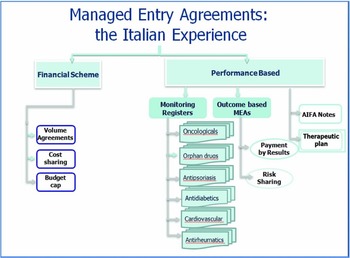
In the past decade, MEAs—with a taxonomy based both on financial schemes and performance based agreements (Figure 1)—have been widely implemented in Italy to foster access to new medicines with a high level of uncertainty at launch (Reference Ferrario and Kanavos4). These arrangements negotiate risk-sharing between AIFA and the single pharmaceutical company. MEAs can be based on different models of conditioned reimbursement: Cost Sharing (CS) - provides a discount on price of first courses of therapy for all patients eligible for treatment, as identified by the Summary of Product Characteristics; Risk Sharing (RS) - compared with the previous, the discount applies only to “nonresponders”; and Payment by Result (PbR) - extends the terms of the RS, providing for full refund from the pharmaceutical company on all “nonresponders” (100 percent of treatment failures) (Reference Garrison, Towse and Briggs5).
The use of MEAs in the Italian pharmaceutical context.

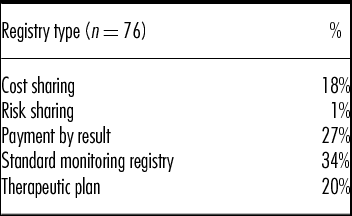
Standard Monitoring and Therapeutic Plan Registries account, respectively, for 34 percent and 20 percent of the overall seventy-six currently monitored pharmaceuticals. Particularly, Therapeutic Plan registries collect patient data from written documents, the therapeutic plans, in which diagnosis and treatment are reported exclusively by specialized health care centers identified at regional level. Based on therapeutic plans, the general practitioner is allowed to prescribe the medicine to be delivered by the community pharmacist to the patient free of charge. This tool guarantees the reimbursement of certain medicines for the authorized therapeutic indications only under close specialists monitoring.
The overall percentage of registries aimed at allowing the application of MEAs is 46 percent (Table 1). Unlike CS (18 percent) and RS (1 percent) agreements, which are less often used, PbR agreements are the most frequently used schemes (27 percent), especially for medicinal products whose risk-benefit ratio presents a greater degree of uncertainty. In this context of conditional reimbursement agreements, requiring the use of an evolving evidence base, being the payment linked to the health outcome, AIFA Monitoring Registries play a crucial and fundamental role (Reference Siviero6).
Monitoring Registries Typology and MEAs Distribution

n, number of pharmaceuticals monitored by Registries.
THE APPLICATION IN HTA ACTIVITIES
Data collected by Registries with pharmacovigilance data and other economic information allow the re-assessing of pharmaceuticals’ value and related decisions. In its HTA pathway, AIFA performs the re-evaluation of the risk-benefit ratio combined with the cost-effectiveness profile, by using data from Registries. After a prespecified period, usually 24 months, the pricing and reimbursement agreement is indeed reassessed, also comparing results, in terms of efficacy and safety, expected at the moment of the decision, with real practice outcomes (effectiveness) and other economic data. This activity eventually determines a reconsideration of the original reimbursement and pricing decision and a new negotiation with the pharmaceutical industry is conducted (Reference Siviero6).
FUTURE DEVELOPMENTS AND CONCLUSION
From an evolutionary perspective, AIFA Monitoring Registries could be conceived as common generators of evidence from real world clinical practice, representing an opportunity and a starting point for new cooperation between patients, academia, regulators, HTAs, payers, and industry, encouraging synergy and strategic interactions for allowing data collection, and improving patient access to therapeutics.
The following further potentialities of monitoring registries are worth mentioning: contribution in establishing integrated healthcare approaches and pathway management, based on standardized measurements of clinical outcomes; access to collected data for research purposes systematic, developing standards for data capture and data exchange with appropriate privacy and ethical controls; contribution to the definition of innovative pathways to ensure timely access to new technologies (e.g., adaptive approaches); development of creative approaches through the use of e-health tools for improving adherence, promoting self-management, and collecting patient-reported adverse events and outcomes.
AIFA's responsibility with regard to both regulatory and HTA, as well as Pricing and Reimbursement activities at national level, facilitates the alignment between regulatory and HTA decisions. In this context, the use of regulatory tools such as monitoring registries could contribute to responding to the need of ensuring timely access to innovative therapies (Reference Russo, Mennini, Siviero and Rasi7–Reference Garattini and Casadei9).
CONFLICTS OF INTEREST
Montilla, Xoxi, Russo, and Pani have nothing to disclose. Cicchetti declared as circumstance at submission time is a member of the Price and Reimbursement Committee of AIFA.