‘If not for you’, as Bob Dylan once famously sang alongside George Harrison, ‘I couldn't even see the floor’. If not for the nation state, so I will argue in this deliberately provocative and opinionated piece, we archaeologists wouldn't even find this floor, let alone excavate, record, study and protect its contents. The truth is that, instead of the usual bashing around, what the nation state really needs now is some defending and reinforcement. The ‘nation’ part of the compound term has admittedly long suffered bad press, and justifiably so, as can attest the papers assembled in this issue of Archaeological dialogues. Interfering xenophobic or separatist agendas are undoubtedly condemnable for their practical and political implications – but they are also relatively easy to identify and to monitor. After all, this strand of nationalism which draws on historical monuments and narratives to construct identities, and then uses the past to impose or to exclude, has been around for over two centuries in both benign and more brutish guises: surely practising and reflexive archaeologists will have learned by now to recognize its rhetoric and expose its implications?
It is in fact the other component of the nation state compound, the ‘state’, that is at issue here, and that requires our urgent and focused attention. The framework it provides is indeed one we archaeologists would be well advised to uphold and to defend. If only to expose any excessive nationalist contents – and for so much more besides – we need to ensure that there exists a viable and visible state around, with its regulations, procedures, oversight and, yes, if it proves unavoidable, its lumbering bureaucracy. Our fellow citizens’ recognition and appreciation of their shared historical and archaeological heritage depend on it, and so do the various practical, conceptual and ethical conditions necessary for archaeology to thrive. Leaving aside, then, its sometimes debatable contents, it is first and foremost as a context that the nation state needs to be cherished. Much like the depositional context that links sediments, features and finds meaningfully together, so does this present-day practical and conceptual context for the exercise of archaeology prove to be both precious and vulnerable. Immune as it may be to material decay or destructive constructions, this archaeological context clearly has to be protected against various vested interests and near-sighted ideologies seeking to erode or undermine its bedrock – this being the ‘state’ component of the nation state.
Indeed, can we begin today to conjecture what the dearth of the state might look like? The form of absenteeism relevant to us here is not the violent, anarchic or retrograde ruination currently prevailing in Syria, parts of Iraq, Libya or Somalia – although there too we will find some lessons to learn.Footnote 1 What concerns us at present is rather the more subtle, calculated, seemingly measured and consensual retrenchment currently experimented with in some Western democracies on economic-cum-ideological grounds. As far as archaeology writ large is concerned, this syndrome applies notably to university-based academic research and teaching, where the so-called ‘knowledge economy’ makes of students cash-paying customers and recasts contributions to knowledge as deliverables. Of more relevance to us here, this withdrawal also impacts severely on archaeological heritage management, and especially on this strand known as ‘preventive’, ‘contract’ or ‘developer-funded’ archaeology – namely those archaeological operations which are undertaken ahead of infrastructure and construction works, and which account nowadays for the vast majority of archaeological activity throughout the developed world (D'Andrea and Guermandi Reference D'Andrea and Guermandi2008; Demoule Reference Demoule2007; Reference Demoule2012; Carver Reference Carver2011; Schlanger Reference Schlanger2012b; Guermandi and Salas Rossenbach Reference Guermandi and Salas Rossenbach2013, among others). While state-related tinkering is attested, with various degrees of intensity, foresight and dedication, in such countries as Spain, Sweden, France and Japan – each of course with its different histories, outlooks and prospects – it is without any contest the United Kingdom, and specifically England, that offers the most instructive example of all.
The English patient
Indeed the English system of archaeological heritage management epitomizes to the full the ‘capitalist’ model of the spectrum proposed by Kristian Kristiansen in his ‘Contract archaeology in Europe. An experiment in diversity’ (Kristiansen Reference Kristiansen2009). This English system has, of course, a rich and diversified history behind it, to which justice can hardly be done within the confines of this paper.Footnote 2 Focusing on the topic under discussion, namely the state as an archaeological context, it is undeniable that several of the heritage management practices deployed there during the last decades of the twentieth century, and again over the past 10 years or so and until this very moment, have been both radical and unprecedented, and could well represent a harbinger of things to come. Passing through changing legislations and guidelines (the Planning Policy Guidance notes 15 and 16, the short-lived Planning for the Historic Environment (PPS5), and, as of 2012, the National Planning Policy Framework (NPPF)) and a spate of institutional restructurings involving English Heritage (see below), rough-ridden by a long-drawn-out financial crisis itself exacerbated by manifold relentlessly imposed austerity measures, the English archaeological heritage management system is currently being trimmed and pared to its limits, verging inexorably towards what the Council for British Archaeology has heart-wrenchingly termed its ‘unsustainable decline’ (Council for British Archaeology 2015).
It was during the twilight days of Margaret Thatcher's government that the current system was put in place. Since 1990, archaeology has become a ‘material consideration’ in the planning process, so that, following the ‘polluter-pays’ principle, builders and developers throughout the country have to demonstrate that they are aware of any ‘heritage assets’ above or below ground potentially threatened by their construction projects, and consequently that they take measures in order not to adversely affect the ‘significance’ of these assets. One perceived advantage here, if not the main one, was that any costs incurred for taking care of heritage were to be directly borne by the developers, rather than the state and its tax-paying citizens. The system's champions did not consider, or dismissed as irrelevant, two points. First, that developers would seek to avoid as best they could, or at least minimize, any archaeology-related expenditures. Second, that they would quite smoothly shift these costs onwards to their private or public customers. In any case, the system has been predicated since its conception on a distinction and complementarity between two major archaeological functions: the ‘contractors’, who undertake archaeological operations on behalf of the developers, and the ‘curators’, who instruct and oversee them.
Contactors, to begin with them, are archaeological units or operators that are commissioned by the construction and infrastructure industry to deal with archaeological remains and heritage issues on their behalf. While some of these units are strongly related to universities or academic bodies with developed research agendas, and several have obtained charitable status which earmarks a proportion of their potential income for outreach and training activities, they all engage in competitive commercial tendering, involving the desktop evaluation, survey, detection, assessment and eventual ‘preservation by record’ (i.e. excavation and post-excavation studies) of archaeological remains likely to be impacted by the developer's building and infrastructure projects. Quite independently of the outstanding commitment manifested by many archaeological contractors across the land, and the massive scale of the work accomplished, the 25 years’ perspective now available on the contract-archaeology ‘market’ in England rather suggests that it is
a. fragmented, with numerous units of various dimensions, from several hundreds in size to isolated consultants and cottage-industry specialists;
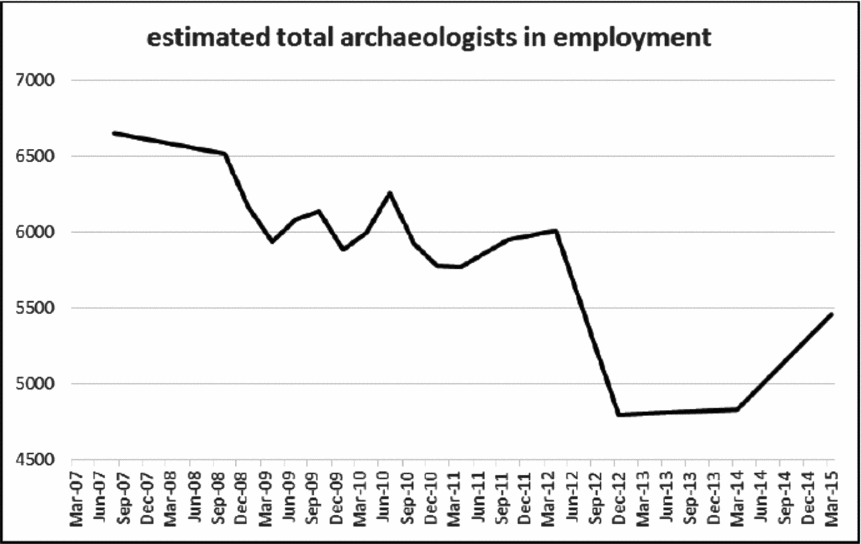
b. vulnerable, with major losses of personnel and skills following the economic crisis of 2007–8 and subsequent austerity (see figure 1);
c. employee-unfriendly, with a low-paid and often itinerant, short-term, high-turnover workforce; and
d. poorly regulated, with no statutory minima for archaeological intervention and knowledge production, and no professional licensing or capacity requirements – and with, as we will just now consider, an alarming reduction in local and national monitoring ability.Footnote 3
Estimated total archaeologists in employment in England (March 2007–March 2015). Aitchison (Reference Aitchison2015, 16).

While contractors are commissioned by developers to minimize or mitigate adverse impacts on archaeological remains – or indeed, put differently, to ‘decontaminate’ their property from eventual heritage encumbrances as quickly and as cheaply as possible – they crucially depend on the effective presence of curators, the other component of the system. Operating at local or national levels, curators (also known as archaeological officers or advisers) are those who formulate, represent and oversee the implementation of heritage management policies as well as quality-control issues (on which see a comparative perspective in Willems and Van den Dries (Reference Willems and van den Dries2007)). Without curators providing proactive control and guidance, vast tracts of archaeological remains will be irredeemably lost under the crunching bulldozers and the concrete mixers. Indeed, even more to the point, ‘if not for curators’ (as goes the song), developers will be under little or no compulsion to call upon archaeological contractors at all: soon enough, with the latter gradually liquidated, there will simply remain too few professional skills and human resources around to study those vestiges fortunate enough to survive the development onslaught. In this respect, the fact that recent appeals to bolster local archaeological advisers have emanated from educational charities such as the Council for British Archaeology, as well as professional associations, pressure groups and commercial units – which we might normally expect to be weary of tightened regulations – is symptomatic of the growing malaise.Footnote 4
Curators under cure
As indicated, curators (in the broad sense) are present in England at both local and national levels, with a somewhat complex distinction and complementarity between them. Potential gaps or grey areas in terms of competencies and responsibilities are likely to increase in the near future, for example if new revenue-seeking initiatives gather pace (see below). What is, however, patent is that all levels of archaeological heritage management, and especially the curators’ side of the equation, suffer alarmingly from the deliberate financial and organizational retrenchment of the state.
In England, the management of archaeological assets across the land (all but the c.5 per cent already designated at national level) lies firmly at the door of local authorities. This is, of course, well in line with a much broader and deeper-running movement towards decentralization and the empowerment of local communities – a movement whose initial good intentions have rather been reduced of late, notably upon the 2011 Localism Bill, to the cynical heaping of added responsibilities onto well-meaning but overstretched and out-of-depth local bodies.Footnote 5 So far as archaeology is concerned, professional curators or officers are (or should be) an integral element of the local planning authority (LPA) setup, part of the process which receives, screens, authorizes and monitors planning applications with material archaeological and heritage considerations (as assessed and documented for the developers by their contracted archaeological operators). Alongside their conservation colleagues, archaeology officers are engaged in the management of the local historical environment records (HERs, formerly known as sites and monuments records), an updated multilayered database which geo-localizes and characterizes archaeological, historical and heritage occurrences. They also liaise with resource centres and museums serving as depositories of finds and records, and contribute to public outreach and awareness. Even in times of plenty, this replication of functions by cells averaging 2.1 professional archaeologists across narrowly circumscribed administrative areas is not without its challenges. Much as the HERs, for example, constitute an indispensable tool for developers and archaeologists alike in their planning and research decisions, the fact that there are by recent count no less than 87 such distinct databases to consult (operated by county councils, district councils or unitary authorities across the land), each with their own management structures and personnel, cannot really serve the coherence and efficiency of the system.Footnote 6
The outlook darkens manifold if we take into account the 2008 financial crisis, the subsequent recession and the draconian austerity measures imposed since throughout the country. With variations across areas and sectors, overall local government funding has been slashed by more than 40 per cent over the past five years, and more cuts are already scheduled. With any initial leeway long gone, these are now front-line public services (social and health care, education, infrastructure and, as we have just been reminded at our cost, flood control measures) that are being brought to their knees, including, in the cultural sector, public libraries, arts venues, museums . . . and archaeological and historical assets.Footnote 7 Strapped-for-cash local authorities are increasingly tempted to shed what they see as ‘non-essential’ luxuries, including archaeological and conservation advisers. The 2015 report on ‘Archaeological local authority staff resources’ shows that, since 2006, numbers of archaeological advisers to local authorities in England have dropped by 23 per cent, and those of conservation specialists by 35 per cent – with even worse figures in the South West region and, ineluctably, the North.Footnote 8 The situation is made even less tenable by the slight increase in planning applications over the past couple of years, leaving fewer archaeologists to cope with an increased workload. Those made redundant or shifted to other duties are often the senior, higher-salaried professionals with local experience – leading to a loss of skills that can hardly be compensated by the hasty outsourcing of services to commercial consultants and makeshift advisers. Clearly, this dearth of competent archaeological officers puts more and more sites and historical assets at risk from ongoing construction projects (and flood-induced damage). At the same time, stressed local authorities increasingly realize that the maintenance of an updated historic environment record, the provision of archaeological archives and actions of public outreach are not in fact explicit statutory obligations in the 2012 National Planning Policy Framework (with its ‘presumption in favour of sustainable development’ rather than ‘in favour of conservation of heritage’). Some LPAs have already frozen their HERs or are about to, while others are now charging fees – some cost-related and others plainly exorbitant – for their consultation.Footnote 9
English Heritage Trust: Historic England Inc
What, then, at national level? Can the state actually trim down or withdraw also from its own structures and procedures? Can its own bodies be made to depend on fees charged for archaeological services? Apparently so, if the recent avatars of English Heritage are anything to go by. English Heritage is the working name of the Historic Building and Monuments Commission for England (HBMCE), created by the National Heritage Act of 1983 to gradually take over the functions of such bodies as the Ancient Monument Board, the Historic Building Council, and the Royal Commission on the Historical Monuments of England. Following recent spells of ruthless financial restrictions and staff redundancies – with a 32 per cent budget slashing in 2010 alone – English Heritage has been split as of 1 April 2015 into two distinct entities: English Heritage Trust (henceforth EHT) and Historic England (henceforth HE).Footnote 10
The newly created EHT, which retains the name English Heritage, is a charity entrusted with managing some 400 or so historic properties that are part of the state-owned national collection and are open to the public. Set to draw its revenues from entrance fees, catering and merchandizing, EHT has to achieve self-funding in seven years’ time. The lump sum of 80 My£ it has been granted to this end is, however, already substantially earmarked for long-overdue conservation work, leaving a trickle for routine maintenance and indeed for development. Moreover, uncertainty clearly looms once this period of government support expires, especially if revenues from visitors prove more modest than optimistically expected. In order to ensure its survival beyond 2023, will EHT have to close down those monuments that are costly to maintain and do not generate revenues – or will it refuse to add such dead weight to its portfolio? Will it be forced to dispense with (or to outsource) its in-house heritage and archaeology expertise, retaining only gatekeepers, communication experts and accountants? Conversely, even if assurances are given that the properties it manages are not be privatized, will EHT be able to fend off pressure from increasingly starved local authorities and district councils now clamouring for their own share, if not overall control, of the more lucrative assets?
It is of even greater concern that issues of funding and organization loom high also on the agenda of Historic England, the other creation of 1 April 2015. Described on its website as ‘the public body that champions and protects England's historic environment’, HE's major tasks, as inherited from English Heritage, are to maintain and increase the national heritage list of designated sites and monuments, to monitor the state of designated heritage at risk, and above all to provide statutory planning and conservation advice to central government and local authorities. Just how much clout and room for manoeuvre this professional expert body is likely to secure remains to be seen. Variously designated as an ‘executive non-departmental public body of the British Government’, ‘expert advisor’, or ‘arms’ length body’, HE is attached (like English Heritage before it) to the Department for Culture, Media and Sport, from which it receives its annual grant-in-aid, amounting in 2015–16 to 88 MY £. Barely eight months after coming into being, however, HE has already seen its grant truncated by 10 per cent over the coming four years. This latest measure was announced on 25 November 2015, as part of the government's Comprehensive Spending Review, which sets the British public-sector budget until 2020. Historic England's press release in response is worth quoting here:
The Department for Culture, Media and Sport has today confirmed it will receive a 5% real terms cut to its funding. The Secretary of State has said this is an excellent settlement in the context of the Spending Review. Historic England, an Arm's Length Body of DCMS, will receive a cut of approximately £2.2m to its baseline by 2020, representing approximately 10% in real terms over the four financial years from 2016/17. Responding to this news, Duncan Wilson, Chief Executive of Historic England, said: ‘The government has recognised the significance of Historic England's role in caring for our spectacular historic environment, and we are grateful for this. We fully appreciate that we have been given some protection in comparison to many other public sector bodies. We can't afford to lose the momentum that the launch of Historic England has created. A 10% cut is not an insignificant challenge, and other aspects of today's news will create further challenges for us as we care for the historic environment during a time of change. But public recognition and support for our mission is high, and we intend to press on with vital initiatives to increase our impact’.Footnote 11
Clearly, HE is wont to put a brave face on things – ‘receiving cuts’ rather than suffering them, drawing comfort from the fact it could have been worse, that the government deep down actually recognizes . . ., that the public obviously supports . . . and so forth.
Enhanced advisory services
Not only has the newly created HE seen its budget substantially reduced, but it has also been enticed since its inception with the mirage of financial autonomy: ‘The Spending Review and Autumn Statement makes [sic] permanent the operational and financial freedoms for national museums announced at Spending Review 2013, which will be extended to include . . . Historic England and the Churches Conservation Trust. This will support these bodies to move towards greater financial self-reliance and sustainability’ (HM Treasury 2015). Whether or not this foisted freedom to fend for oneself, float or sink, actually featured in the consultations leading to HE's creation, it was clearly in the air very soon thereafter. In its founding corporate action plan, HE indicates that it ‘will seek to increase its resilience and ability to champion historic places by developing non-UK government sources of income. These will include introduction of charged-for Enhanced Advisory Services’, expected to ‘generate an income . . . of £1.6 million by 2017/18, enabling greater organisational resilience’.Footnote 12
These great expectations are still a long way away, but some details on the scheme can be gathered on HE's website and attached documents. On top of the existing ‘free (taxpayer-funded)’ planning and listing advice it provides as part of its statutory remit, HE now proposes a range of new charged-for enhanced advisory services, which are designed to ‘speed up projects and reduce risk’, while ‘offer(ing) greater speed, clarity and engagement from Historic England’. Four such services are available: (1) ‘Fast-track listing’ (‘in a quicker and guaranteed timeframe’), (2) ‘Listing enhancement’ (‘fast-track within 12 weeks’), (3) ‘Extended pre-application advice’ (‘reduces the risk of an application for consent being refused by the decision-making body’), and, last but not least, (4) ‘Listing screening service’ (‘Reduce uncertainty early in the development process. Find out whether an area of land contains structures that could merit consideration for listing’). This last ‘listing screening service’ is a new, pay-only service specifically tailored for HE's targeted customers, the developers. As part of the service, HE experts will survey the land in question and assess the likelihood of any heritage assets present warranting statutory listing as well as local designation. HE will not, however, identify or consider any below-ground archaeological potential, including schedulable assets, on which advice is to be obtained from the local planning authority. Finally, HE indicates that results of the screening service will be disseminated through HERs and other relevant public channels.Footnote 13
Before considering this move from an archaeological standpoint, the views of its expected customers, the construction and development sectors, is worth recording. Recognizing that these are early days and that fine tuning is still ongoing, their focus is, as it should be, on issues of cost and organization. In its proposals, HE mentions fees of some £3,000 to £8,000 per dossier, but also indicates that billing will be based on staff time spent on the dossier, as well as travel, administration and overheads. So, ask the developers’ consultants, will the dedicated HE staff be senior enough for the job, but at the same time not unnecessarily costly salary-wise? Will regional variations (e.g. London salaries) be factored in? What part of the time spent on a paid-for service will be included in the free statutory advice? Another worry concerns the relations between national and local planning authorities. How can we ensure, ask the consultants, good coordination between these levels? Why pay for enhanced services that can (sometimes) be obtained free of charge from the LPAs? Conversely, in most cases, why have to pay twice? Should we not anticipate unwelcome costs, uncertainty and delays, working with ‘public organisations now operating on a more commercial footing and unused to dealing with each other in this way’? Lastly, the outcomes of the screening service are a matter of concern. From the developer's perspective, the aim is to reduce the risk of planning applications being refused, but is there not an added danger that these proactive paid-for services might, on the contrary, lead to the faster statutory designation of more and more heritage assets? And if further work is required for assessment, will it be free of charge or billed – or will HE reimburse the developers? Moreover, is the outcome of an enhanced screening service a private document, like LPA pre-application advice, or is it a public one, which could then reach the hands of heritage interest groups? After all, sums up Grant Lock from NLP consulting, ‘an applicant or developer doing “the right thing” in asking for advice “up-front” may find themselves having unwittingly provided financial support for those wanting to frustrate the development they intend to bring forward’.Footnote 14
With this ‘cunning plan’, HE has thus cornered itself into a crossfire between development and conservation: being the statutory body that ‘champions’ England's heritage, is it not – or should it not be – at the forefront of those ‘wanting to frustrate developments’ when the need arises? Moreover, this scheme puts HE on a potential collision course with LPAs, who seemingly offer developers similar pre-application services (and who, as all agree, urgently need some resources to survive), and also with archaeological contactors and operators across the land, who might feel that their niche market is being tampered with. True, HE has noted that below-ground archaeological potential will be outside its remit, and specifically left to LPAs and contractors to deal with. But not only is this arrangement quite inefficient (potentially requiring two separate assessments on the same plot of land), it also hardly serves scientific knowledge and understanding by artificially separating standing and buried heritage assets. In any case, for this enhanced scheme to prove profitable, over 300 such dossiers (at an average bill of £5,000 each) will be needed to reach the 1.6MY£ targeted in HE's initial action plan – and quite a few more to cover the 10 per cent budget cuts since announced in the November spending review. Whether any ‘resilience’ or ‘self-reliance and sustainability’ will ever ensue, this ‘freedom to raise revenues’ explicitly imposed on HE for the coming four years risks inflicting considerable damage to its standing as a statutory public service provider. The professionals concerned are all undoubtedly well-meaning and alert, and there seems as yet little risk of seeing watered-down or complacent reports being produced to ensure clientele loyalty. But the very fact that statutory advice is being bought and sold is bound to raise questions. Will not ‘fast track’ necessarily imply slow track, leading to a dual system where the well off get better and speedier services from a body that might seem, as a result, to be no longer impartial and incorruptible? Is it not the case that the ‘free (taxpayer-funded)’ statutory services will inevitably appear to be slower and less efficient, if only because HE's senior and higher-paid lead officers will be deployed as a function of their billing-hours potential, and not of their specific expertise or the scientific or heritage priorities of the dossiers being assessed? Even if we are spared all or most of these damaging side effects, there remains a lasting risk that, alongside its reduced scope for action, it is the very integrity and raison d’être of Historic England that will go into unsustainable decline.
Conclusions: is there any alternative?
Observing the system in its unfolding details, local actors, professionals and institutions are well aware that the situation is hardly tenable, with fewer resources and capacities to share between increasingly stressed commercial contractors, local government archaeologists and national bodies. The main solution proposed now with renewed urgency is to radically reshape archaeological services and functions at a larger spatial and functional scale, and in the process curb or tone down some deeply ingrained individualist, stand-alone tendencies in favour a genuinely shared, coordinated approach based on trust, solidarity and common purpose. Following early criticisms of PPG16 and the 2003 APPAG report, nowadays also RESCUE, the CBA, the IFA, the Society of Antiquaries and others all see the need (concerning HERs, for example) to upgrade data and management structures, and to pool hitherto fragmented and redundant resources at regional or sub-regional levels.Footnote 15 Likewise, many consider that individual LPA services should be encouraged to regroup into wider coherent entities which would maintain a register of quality-approved archaeological contractors in regional franchises, where adequate control mechanisms, conservation, documentation and archive services, long-term research initiatives, scientific publications and community involvement and outreach actions could all be programmed, provided for, shared and enriched together.
Taking a broader look, in line with the theme of this paper, it seems clear that this predicament cannot really be about money, or lack of it. In case we have forgotten that Britain remains among the world's wealthiest nations (fifth in nominal GDP ranking), the Chancellor of the Exchequer has timeously reminded us that it is ‘brilliant at culture too. One of the best investments we can make as a nation’ – he pursues in his 2015 spending review statement – ‘is in our extraordinary arts, museums, heritage, media and sport. £1 billion a year in grants adds a quarter of a trillion pounds to our economy – not a bad return. So, deep cuts in the small budget of the Department of Culture, Media and Sport are a false economy’.Footnote 16 Undeniably they are – so it must be for some other reasons, mustn't it, that these deep cuts are nonetheless carried out, slowly bleeding culture and heritage to their death. Beyond the economy, indeed, it is an ideologically motivated disengagement of the nation state that we have been observing throughout these pages, with England as our exemplary case study. The process there began in the 1990s with PPG16, and reaches now a point where the current government would rather be ‘fully relieved’ of taking care of core historic environmental or wider cultural services, and manifestly drags its feet at even recognizing that ‘final responsibility towards the core protection of culture and heritage rests with it’ (Council for British Archaeology 2015). Is this kind of neoliberal disengagement from collective responsibilities, enforceable frameworks and statutory obligations a premonition of things to come?Footnote 17 Given the current tribulations of Historic England, kept at arm's length as far as its capacity and clout are concerned, and at the same time steered towards the bear's embrace of ‘liberating’ commercialism, should we anticipate the gradual emergence of the corporate state or the laissez-faire state? Granted, I have focused here excessively on a single example, with too little scope for counter-cases, nuances or mitigating circumstances – let alone any convincing or workable solutions. Still, it is in order to invite further dialogue, in the spirit of this journal, that I would like to posit here a concluding cri-de-coeur: there is no alternative to the nation state!