Introduction
Mirtazapine is an antidepressant introduced in 1996 with a unique pharmacological profile. It is a potent antagonist of central α 2-adrenergic autoreceptors and heteroreceptors and also of both serotonin 5-hydroxytryptamine-2 (5-HT2) and 5-HT3 receptors (Kent, Reference Lin, Hsu, Lin and Lane2000).
Mirtazapine is indicated in the treatment of major depressive disorder (Thase et al. Reference Tosti, Misciali, Piraccini, Peluso and Bardazzi2010). Mirtazapine can be of particular benefit for those patients who do not respond satisfactorily to an initial selective serotonin re-uptake inhibitors (SSRI) trial (Watanabi et al. Reference Watanabe, Omori, Nakagawa, Cipriani, Barbui, Churchill and Furukawa2011). A recent review found mirtazapine to have a faster onset of antidepressant action than SSRIs (Watanabe et al. Reference Watanabe, Omori, Nakagawa, Cipriani, Barbui, Churchill and Furukawa2011). One of the most common adverse effects of mirtazapine is increased appetite and subsequent weight gain (Chiu & Li, Reference Chiu and Li2011). The most recent British National Formulary did not list alopecia as an adverse effect of mirtazapine treatment (British National Formulary, 2014).
Hair loss is a recognised adverse effect of other qpsychotropic agents, such as sodium valproate (Taylor et al. Reference Thase, Nierenberg, Vrijland, van Oers, Schutte and Simmons2012), but not mirtazapine. It is estimated that 12–19% of patients taking lithium developed hair thinning (Llau et al. Reference Mercke, Sheng, Khan and Lippmann1995). In addition, 6% of patients on carbamazepine and 28% of patients on high dose valproic acid developed alopecia (Mercke et al. Reference Schneider, Schmidt-Ullrich and Paus2000).
On the other hand, drug-induced changes in hair colour are rare and the mechanisms underlying its process are less clear. The most noted medications to cause such a distressing adverse effect are chloroquine and cancer chemotherapeutic agents (Bublin et al. Reference Bublin and Thompson1992). Chloroquine 500 mg daily was recently linked to a case of hair depigmentation (Donovan et al. Reference Donovan and Price2010).
Case report
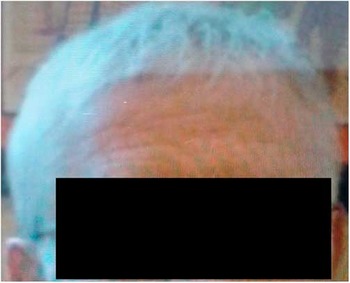
We report the case of a 54-year-old male employed married patient who developed a major depressive episode which responded poorly to a trial of escitalopram despite consistently taking a 20 mg dose for 8 weeks. A switch was made to mirtazapine, whose dose was gradually increased to 45 mg daily over 2 months. He was compliant with the 45 mg dosage of mirtazapine for 5 weeks, the response in terms of mood improvement was partial. By week 5 the patient noticed that his hair was falling out (see Fig. 1). Comprehensive haematological, biochemical, and endocrinological investigations were unremarkable. No other plausible medical cause of alopecia was found. He was reluctant to discontinue mirtazapine and elected to take it for further 2 weeks. However, his hair continued to fall out ‘in lumps’ from his scalp (see Fig. 1). He also noted that hair growth in his body was systematically slowing. His beard did not require shaving as frequently as it used to. He would only need to shave it on weekly basis rather than every 2 days before commencement on mirtazapine. Moreover, he noticed that his hair colour was changing from dark brown into grey (see Fig. 2). This was particularly distressing for him and he agreed for mirtazapine treatment to be discontinued.
Hair falling out following 5 weeks mirtazapine treatment.

Hair discolouration following 7 weeks mirtazapine treatment.

Mirtazapine was stopped, and a switch to duloxetine was warranted. Three weeks after mirtazapine was stopped, the hair stopped falling out. By week 12, the hair colour was restored back to its dark brown colour again (see Fig. 3).
Hair 12 weeks after mirtazapine was stopped.

Discussion
The mechanism of drug-induced alopecia is becoming clearer recently (Tosti et al. Reference Frum, Eccleston and Meidan1994; van den Bemt et al. Reference van den Bemt, Brodie-Meijer, Krijnen and Nieboer1999). Drug-induced alopecia is usually diffuse and reversible. The hair follicles go through four main stages as they grow, namely anagen stage: where growth and differentiation occur, catagen stage: for regression and apoptosis, telogen stage: when the follicle rests, and exogen stage: with ultimate release of the old hair follicle (Schneider et al. Reference Taylor, Paton and Kapur2009), at least one of the stages that hair follicles go through is usually influenced by the drug in question (van den Bemt et al. Reference van den Bemt, Brodie-Meijer, Krijnen and Nieboer1999). These hair follicle growth cycles are disturbed by abrupt cessation of the metabolically active anagen phase, disruption of the catagen transitional phase or premature induction of the resting telogen phase. For instance, cytotoxic agents disrupt the anagen phase by acutely damaging the rapidly dividing hair matrix cells. On the other hand, anticoagulants precipitate the hair follicles into premature talogen phase causing early hair follicle rest (Tosti et al. Reference Frum, Eccleston and Meidan1994).
In our case, the alopecia was reversible as mirtazapine treatment was interrupted and complete hair regrowth occurred. There was clear temporal relationship between experiencing hair loss and commencing mirtazapine treatment. No other more likely medical reason to explain such experience was established. Our case is similar to the case reported by Lin et al. (Reference Llau, Viraben and Montastruc2010). Their patient noticed loss of hair 6 weeks following mirtazapine treatment initiation, comparable to our patient in terms of time-frame. She regained hair growth within 1 month after discontinuation of mirtazapine, whereas our patient needed 10 weeks to experience hair regrowth. Notably our patient started at the lower dose of 15 mg daily (rather than starting at 30 mg daily as reported by Lin et al.).
The change in hair colour from dark brown to grey was dramatic and distressing in our patient as he commenced taking mirtazapine. A noticeable restoration of the hair colour occurred by week 10 of mirtazapine cessation. The patient has no past history of hair or skin discolouration. There was no indication that a medical condition could have caused such change. To our knowledge, this is the first case report of a mirtazapine-induced hair discolouration. In aging human hair follicles hair greying results from increased melanocyte dysfunction and apoptosis (Van Neste et al. Reference Van Neste and Tobin2004). It may be difficult to determine how exactly mirtazapine led to hair loss and discolouration in our patient. However, further focused pharmacological research will likely elucidate the mechanisms involved.
Other ingredients in mirtazapine tablets could arguably be responsible for the observed adverse effects. Commonly used fillers in mirtazapine tablets, such as lactose monohydrate, pre-gelatinised maize starch, silica colloidal anhydrous, croscarmellose sodium, or magnesium stearate were not linked in the literature to hair changes.
The film coating of mirtazapine tablets also contains macrogol 8000, titanium dioxide (E171), red iron oxide (E172), yellow iron oxide (E172), and talc which are not known to cause hair changes.
Notably, the filler hydroxypropyl methylcellulose has been used pharmacologically to enhance hydrocortisone permeation into human hair follicles (Frum et al. Reference Kent2008), however, it is unclear as to how this may have influenced the hair loss and discolouration reported by our patient.
Clinicians need to be mindful of adverse effects mirtazapine may have on hair. These can easily be missed but can be quite distressing for patients who are already debilitated by their deteriorating mental health.
The standards of this study are of a case report with understandable difficulties in generalisation of its findings. However, it can provide avenues for further research, particularly on the effect antidepressants have on hair colour.
Acknowledgements
The authors would like to thank the patient for providing consent for the case report and the photographs to be published. The authors particularly thank Mrs Emma Smyth, community mental health nurse in Louth-Meath Mental Health Services for help with this case report. The authors also thank the reviewers for their useful comments.
Financial Support
None.
Conflicts of Interest
None.
Ethical Standards
Fully informed written consent was kindly provided by the patient. The authors assert that all procedures contributing to this work comply with the ethical standards of the relevant national and institutional committee on human experimentation with the Helsinki Declaration of 1975, as revised in 2008. The authors assert that ethical approval for publication of this case report has been provided by their local Research Ethics Committee (REC).