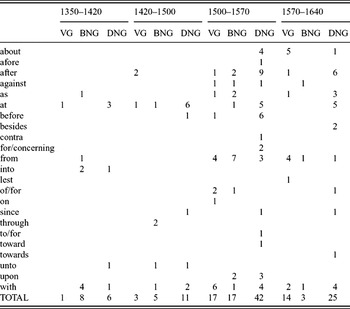
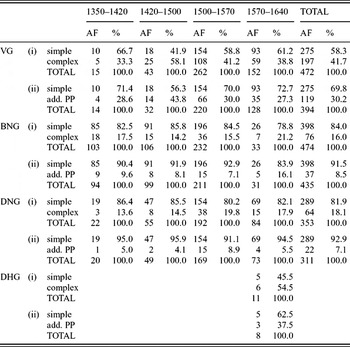
1 Introduction: the English gerund
One of the intriguing features of English and a challenge for syntacticians as well as historical linguists is the English gerund. From a synchronic point of view, the gerund is best characterised as a (de)verbal form in -ing whose external syntactic behaviour is that of a noun, but whose internal syntax varies between that of a noun and that of a verb (Lees Reference Lees1966; Ross Reference Ross and Fujimura1973; Declerck Reference Declerck1991a; Langacker Reference Langacker1991; Pullum Reference Pullum1991; Heyvaert Reference Heyvaert2003, Reference Heyvaert, Achard and Kemmer2004, Reference Heyvaert2006; Hudson Reference Hudson2007: ch.4). On the one hand, the structure of which the gerund is the head can serve as prepositional complement or as an argument to a verb, and therefore has, roughly, the syntactic distribution of an ordinary NP. Thus, in (1a) his worrying functions as the subject of a copular clause, while in (1b) resigning is governed by the preposition of.Footnote 2
- (1)
(a) Wasn't his worrying proof that he was wrong? (CB)
(b) That was good enough for George, and all thought of resigning was cast aside. (CB)
On the other hand, looking at how the gerund combines with its own arguments and modifiers, two types can be discerned. The nominal gerund is characterised by its ability to combine with adjectives and determiners, and by its common co-occurrence with of-phrases serving as the notional equivalent of verbal arguments. The verbal gerund, by contrast, can combine with adverbs, auxiliaries, ordinary objects, and common-case subjects. Thus, while mocking in (2a) takes a possessive determiner (his), an adjective (casual), and an of-phrase equivalent to a direct object (of the old left), visiting in (2b) takes a common-case subject (them), a verbal negator (not), a direct object (you), and an adverb (anymore).
- (2)
(a) Both his old comrades were irritated by his casual mocking of the old left (CB)
(b) You're not so bothered about them not visiting you anymore. (CB)
In typological terms, the variation between the two types of gerund can be linked to the crosslinguistically attested continuum between action nominals and nominalised clauses (Comrie Reference Comrie1976; Comrie & Thompson Reference Comrie, Thompson and Shopen1985; Koptjevskaja-Tamm Reference Koptjevskaja-Tamm1993). An action nominal, such as refusal in (3a), has as its head a ‘lexically derived noun’. In contrast, a nominalised clause, such as the that-clause in (3b), contains ‘no evidence in favour of viewing its head as a lexical noun’ – in other words, in nominalised clauses the head is a verbal form and it is the clause as a whole that is nominalised (Comrie & Thompson Reference Comrie, Thompson and Shopen1985: 391–2).
- (3)
(a) Sir Edwin's refusal to communicate directly with his wife continued. (CB)
(b) The King of Thebes discovered that he had lived his life under a curse. (CB)
As for the English gerund, nominal gerunds can be situated closest to the action nominal end of the continuum, whereas verbal gerunds take a more intermediate position.
Assuming a historical perspective, the synchronic variation between nominal and verbal gerunds reflects diachronic change. Nominal gerunds existed well before verbal gerunds. The latter emerged only through a long-drawn-out process involving the gradual reconfiguration of the structure of a noun phrase into that of a nonfinite clause. This process of verbalisation and the changes concomitant to it have already received due attention in the diachronic literature (Jespersen Reference Jespersen1940: 108–50; Einenkel Reference Einenkel1914; Dal Reference Dal1952; Mustanoja Reference Mustanoja1960: 566–78; Visser Reference Visser1963–73: 1165–1217; Emonds Reference Emonds, Kachru and Lees1973; Tajima Reference Tajima1985, Reference Tajima1996, Reference Tajima, Embleton, Joseph and Niederehe1999; Donner Reference Donner1986; Jack Reference Jack1988; Houston Reference Houston, Fasold and Schiffrin1989; Van der Wurff Reference Van der Wurff and van Marle1993; Fanego Reference Fanego1996a, Reference Fanego1998, Reference Fanego2004; Miller Reference Miller2002; Kranich Reference Kranich, Johnston, von Mengden and Thim2006).Footnote 3 The extant literature thus agrees on the following course of events. Old English morphology possessed a derivational mechanism that added -ing or -ung to verbal stems to create deverbal nominalisations – or gerunds, as illustrated in (4a). The behaviour of these Old English gerunds was noun-like in all respects. From Late Middle English onwards, however, gerunds with verbal features began slipping into the language. As (4b) shows, these mostly took the form of constructions with a nongenitive subject or object, and were especially used following prepositions. The process of verbalisation came into full swing in the Modern English period, when verbal gerunds became a truly indispensable part of English grammar. During this period the frequency of verbal gerunds rose dramatically, and, as shown in (4c), verbal gerunds spread beyond their predominantly prepositional use. In addition, as illustrated in (4d–e), the same period saw some further innovations in the internal syntax of the gerund, such as the introduction of passive and perfective gerunds, and the increased use of ‘hybrid’ gerunds, which combined nominal with verbal features. The latter have again disappeared in the course of the nineteenth century – with the notable exception of verbal gerunds with genitive subjects, as in (4f). The result of these various developments is the situation as it stands today.
- (4)
(a) ðurh ðæra sacerda blawunge toburston ða weallas. (c.1000, quoted from Visser Reference Visser1963–73: 1165)
‘through the blowing of the priests, the walls broke down’
(b) Sain Jon was . . . bisi In ordaining of priestes, and clerkes, And in casting kirc werkes (c.1300, quoted from Tajima Reference Tajima1985: 76)
(c) They come so to purpose, that hee can not refraine telling them. (1561, quoted from Fanego Reference Fanego1996b: 38)
(d) . . . whose pillow she kissed a thousand times for having borne the print of that beloved head. (1580–1, quoted from Tajima Reference Tajima, Embleton, Joseph and Niederehe1999: 269)
(e) which . . . may very much contribute to . . . the driving Barbarity out of our Streets. (1711, quoted from Visser Reference Visser1963–73: 1214)
(f) But there was no question of our taking the exam in it. (CB)
The picture becomes more troubled when we turn from the superficial description of diachronic developments to the underlying causes. If there is anything on which the existing literature agrees, it is that the verbalisation of the gerund must result from a complex interaction between different factors. Roughly, two types of causes can be distinguished: mechanisms of change explaining where, when, and how verbal gerunds first slipped into the language, and the driving forces that explain the success of the new form. Among the mechanisms accounting for the appearance of verbal gerunds, at least the following elements appear to have played their part. Superficial ambiguities sanctioning both nominal and verbal readings may have allowed reanalysis (Visser Reference Visser1963–73: 1191; Jack Reference Jack1988; Fanego Reference Fanego2004). Which gerund constructions first saw verbal features was then determined by the locus of reanalysis initially and, as the change spread, by a ‘hierarchy of relative nominality’ (Fanego Reference Fanego2004: 38). That is, verbal features appeared first in gerund constructions without overt determiner, later in constructions with a possessive determiner or genitive phrase serving as subject, and later still in gerund constructions introduced by an article (Fanego Reference Fanego2004). In addition, the emergence of verbal gerunds seems to have been marked by French and Latin influence (Donner Reference Donner1986; Jack Reference Jack1988; but see Jespersen Reference Jespersen1940: 90; Miller Reference Miller2002: 337–8; and especially Kranich Reference Kranich, Johnston, von Mengden and Thim2006 for a critical view). And there is the plausible but hard to verify role of present participles, whose formal identity with the gerund from Late Middle English onwards must have given ample occasion for confusion between the two construction types (see Houston Reference Houston, Fasold and Schiffrin1989 and more tentatively Fanego Reference Fanego1998), even if a direct role in the first appearance of verbal gerunds is unlikely (Jack Reference Jack1988: 27).
None of this tells us why verbal gerunds were as successful as they were and managed to develop from a quirk of grammar into a major clause type. For the success of verbal gerunds, the literature provides only one explanation. Einenkel (Reference Einenkel1914) and Jack (Reference Jack1988) suggest that the reason for success lies in the failure of the English infinitive to combine with prepositions other than to, implying that the verbal gerund fills a syntactic gap. Jack writes:
[I]n its absence from use in prepositional phrases the infinitive lacked a syntactic property of nouns, and accordingly there was a gap in the range of syntactic patterns in which the infinitive functioned as a nominal form of the verb. The development of the gerund filled this gap, by providing a nominal form of the verb that could freely be used following prepositions; and, as Einenkel . . . argued, it seems likely that the development of the gerund was either initiated or promoted by pressure to remove this syntactic gap. (1988: 61–2)
Although this view is certainly in line with the early association of verbal gerunds with prepositional uses, it is also problematic in at least two respects. A first shortcoming in Einenkel and Jack's account is pointed out by Fanego (Reference Fanego1996a, Reference Fanego2004). Fanego recognises that the inability of the infinitive to combine with prepositions created some kind of gap, but in her view this gap could be filled by nominal as well as verbal gerunds. Thus she states that:
[I]t seems likely that the great expansion in the use of prepositions in the course of the Middle English period . . . gave rise to a situation in which a form of the verb capable of being used prepositionally was often called for: the gerund may have served to fill this gap. But this process, as I see it, could have been independent of whether the gerund was syntactically nominal or verbal, for in sequences like WiÞouten doying of any harme . . . or in casting kirc werkes . . . the advantage of the gerund over the infinitive does not depend on the nature of its object (i.e. of-phrase or noun phrase), but rather on its ability to occur in a syntactic position from which the infinitive was excluded. (2004: 16–17)
A second problem is what precisely is to be understood by the idea of ‘pressure to remove a syntactic gap’? The notion of a gap leads straight into the thorny issue of the extent to which language change is driven by functional considerations. The careful position to take in the matter is to be sceptical (see, for example, Harris & Campbell Reference Harris and Campbell1995; Croft Reference Croft2000; Heine & Kuteva Reference Heine and Kuteva2005; and more extremely, Lass Reference Lass1998), but then again the possibility of functionally driven language change is not to be abandoned lightly (García Reference García1999; Haspelmath Reference Haspelmath1999; Hawkins Reference Hawkins2004). In this respect, the history of the gerund provides a relatively straightforward test-case for functional claims outside the realm of theoretical debate. In all likelihood, the pressures referred to by Einenkel and Jack did not by themselves cause the verbalisation of the gerund, yet they may, on a functional view of language change, have provided the incentive to seize the opportunities that arose by fully exploiting verbal gerunds when they came along as the more or less accidental result of other factors. However, as long as the evidence is restricted to the finding that verbal gerunds most commonly occurred with prepositions, the notion of gap-filling will remain difficult to assess.
2 The present approach: goals and methodology
The purpose of this article is to come to a better understanding of the factors that have furthered the use of verbal gerunds. The central assumption I will follow is that functional motivation for change is first and foremost to be sought in the functional organisation of synchronic usage. Consequently, in examining the factors that promoted the use of verbal gerunds, verbal gerunds should not be studied in isolation, but against the background of their interaction with nominal gerund constructions. The main questions in this investigation relate back to the problems emerging from the preceding discussion: is there any indication that the gerund was used to fill a syntactic gap or, more generally, that the rise of verbal gerunds was somehow functionally motivated? And, if so, how did verbal gerunds relate to nominal gerunds in this? As I will show, the second question can be answered conclusively, and gives us a number of important clues to answering the first.
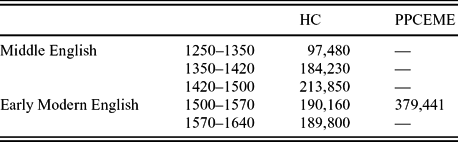
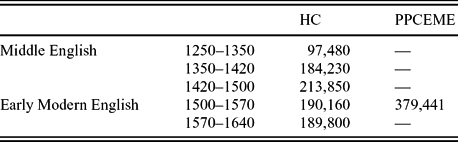
To address these issues, corpus material has been investigated covering the emergence of verbal gerunds through the course of much of the Middle English period and into the Early Modern period. The primary corpus used is the Helsinki Corpus (HC), which has been searched for all forms ending in -ing, -yng, -inge, and -ynge. The periods covered are 1250–1350, 1350–1420, and 1420–1500 for Middle English, and 1500–70 and 1570–1640 for Early Modern English. For the period 1500–70, the data have been further extended with the supplements to the Helsinki Corpus (Penn1 and Penn2) found in the Penn–Helsinki Parsed Corpus of Early Modern English (PPCEME). The data searched are summarised in table 1, with numbers of words of running text given per subperiod and per source (based on Kytö Reference Kytö1996 and Kroch, Santorini & Delfs Reference Kroch, Santorini and Delfs2004). Additional examples have been drawn from other sources as well, for which see footnote 2 above.
Data used
To come to grips with the rise of verbal gerunds, as well as with the relation of verbal to nominal gerund constructions, three main types of gerund construction have been distinguished, depending on the expression of the patient argument role and the determiner preceding the gerund. The three types are represented in (5):
- (5)
(a) I shall teach him a lesson, for filching hens or cocks (1552–63, HC)
(b) That we fall not into disordering of ourselves by anger. (1559, OED)
(c) He defouleth the whole faith of his testimony, by the falsifying of one part. (a.1555, OED)
The gerund construction in (5a) is verbal: it has no overt determiner and has a genuine argument expressed by means of a noun phrase. The constructions in (5b–c), by contrast, are nominal: both have a notional argument expressed by means of an of-phrase. The two constructions still differ, however, in that (5b) has no overt determiner, whereas (5c) is marked by a definite article. These two types will be referred to here as bare and definite nominal gerunds respectively.Footnote 4
Regarding the research questions, it will be shown that the three gerund types interacted in various ways, and that the issue of whether verbal gerunds filled a syntactic gap is therefore considerably more complex than might at first sight be expected. Not only verbal gerunds but also the two nominal types are historically associated with prepositional uses. The development of such uses, moreover, was phased, in that some combinations of a preposition with a gerund construction developed later than others. This means that the idea of verbal gerunds filling in for the infinitive with prepositions is an oversimplification, at once too narrow and too general. The idea is too narrow because the historical boom in prepositional uses is not exclusive to verbal gerund constructions (as hinted by Fanego Reference Fanego1996a, Reference Fanego2004). It is too general because, even if it is still plausible that the inability of the infinitive to combine with prepositions left room for the development of the prepositional combinations with gerunds, there is no evidence for functional pressure that promoted the use of gerunds with just any preposition.
Still, there is evidence for functional pressures in other respects. First, the three gerund constructions differentiated functionally among themselves in a number of ways: the sets of prepositions that the three types associated with differed, the gerund constructions themselves differed in semantic and discourse-functional terms due to the presence or absence of a definite article, and they differed in terms of their internal syntactic flexibility due to their reliance on verbal or nominal means of expression. Second, where competition obtained, the winning variant appears to have been selected on functional grounds (cf. Haspelmath's 1999 notion of ‘diachronic adaptation’). In particular, the historical loss of bare nominal gerunds may be functionally motivated by the fact that, discourse-functionally, bare nominal gerunds most closely resembled verbal gerunds, while in terms of internal syntactic flexibility verbal gerunds had the advantage over bare nominal gerunds. Third, all in all, the ultimate distribution of gerunds following prepositions is roughly complementary to that of infinitives, suggesting that the gap in the infinitive's syntagmatic options did co-determine the outcome of the development of the gerund. Thus, various historical developments in gerundial usage have resulted in a division of labour between nominal gerunds, verbal gerunds, and infinitives that approximates to the ideal of the isomorphic principle, ‘one form one meaning’.
The remainder of this article is organised as follows. Section 3 sets out to describe in more detail what historical changes have in fact taken place, focusing not only on the emergence of verbal gerunds, but also on what happened to the nominal gerund constructions in the course of the late Middle and Early Modern periods. Section 4, which contains the bulk of the argument, digs more deeply into the precise relation between the different types of gerund constructions, showing in which ways they are functionally distinct and in which ways they are likely to overlap and compete. Section 5 then summarises the findings and reconsiders the central issue of whether – and if so, in what sense – developments in the gerund were steered by functional motivations.
3 The broader picture: developments in verbal and nominal gerunds
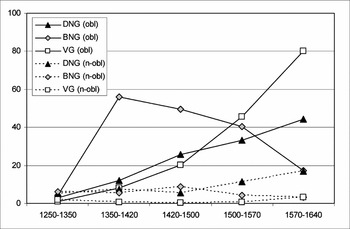
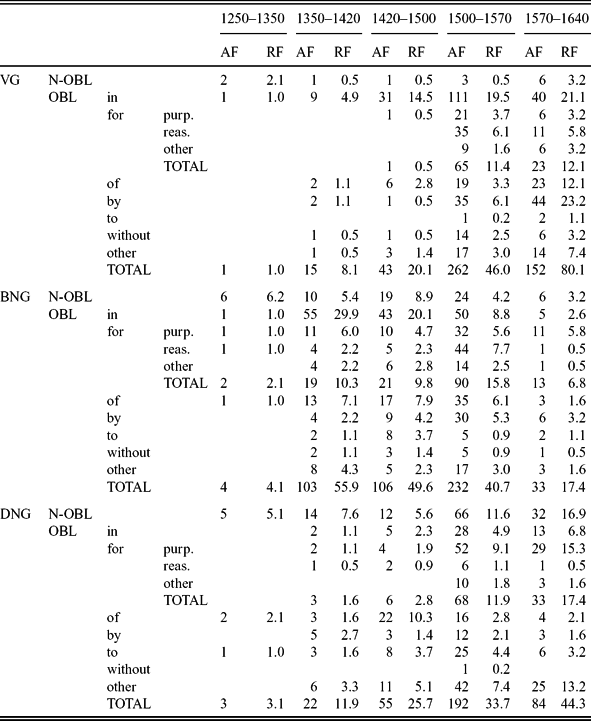
Throughout the Middle and Early Modern periods, gerund constructions had been undergoing change in the form of shifting frequencies of use. The purpose of this section is to document the major shifts in usage, by comparing the three types of gerund construction, and to give a rough approximation of their distribution over different syntactic environments over time. Figure 1 charts the use of different gerund constructions over the five subperiods of the corpus data, distinguishing uses with preceding preposition from uses without (i.e. oblique and nonoblique respectively) (see also appendices A1 and A2).
Verbal gerunds (VG), bare nominal gerunds (BNG), and definite nominal gerunds (DNG) in oblique (obl) and nonoblique (n-obl) environments (frequencies per 100,000 words)

To start from the familiar, as can be seen from figure 1, verbal gerunds first appeared in the Middle English period and came to be associated with prepositional environments. The oldest period of the corpus data examined, 1250–1350, contains two unambiguously verbal instances, given here in (6a–b), and one reasonably convincing example, given in (6c).Footnote 5 Note that the only example in which the verbal gerund follows a preposition is (6b), which is a direct translation of a Latin gerund form in the Vulgate Bible (in custodiendo sermones tuos, i.e. ‘in guarding your words’). This indicates that the association with prepositional uses need not go back to the earliest stages of the verbalisation of the gerund. However, as is further apparent, from the earliest subperiod onwards verbal gerunds become steadily more frequent, and whatever environment first saw the use of verbal gerunds, it is clearly the prepositional uses that are responsible for the pattern's spectacular rise in frequency in subsequent periods.
- (6)
(a) Ac þer ne is non zuo propre ase þis word / ‘þet art.’ þet zuo propreliche. zuo ssortliche. Zuo cleuiyndelyche. zuo sotilliche / þe names nemneþ / ine zuo moche / ase onderstondinge him may strechche.
‘But there is no name so fitting as this expression, “that are”, which so fittingly, so concisely, so convincingly, so truly gives the name in as far as understanding him (i.e. God) may stretch.’ (1340, HC)
(b) In what þynge amendeþ þe ʒenge man his waie in keping þy wordes?
‘In which way does the young man correct his way of life? – In keeping your words.’ (c.1350, HC)
(c) Þe heuen þat is edefied as cite, of wham takyng part is in þat ich þing.
‘Heaven, which is built as a city, participation of which is in that same thing.’ (c.1350, HC)
Less familiar are the developments in nominal gerunds. Tajima (Reference Tajima1985: 60–73) gives valuable figures but without relative frequencies and without distinctions between syntactic environments. As shown by figure 1, bare nominal gerunds occur marginally before 1350; around the end of the fourteenth century their frequency increases dramatically, but the trend breaks off abruptly and from the fifteenth century onwards the pattern again recedes (to disappear almost completely later on; see Fanego Reference Fanego2004). Significantly, the changes affecting bare nominal gerunds – in particular the surge in frequency after 1350 – are again specific to those uses where the gerund follows a preposition, other uses remaining fairly stable throughout. Two early examples are given in (7), illustrating both the oblique and nonoblique uses.
- (7)
(a) For longing of þe niʒttegale, Þis foweles murie singeþ.
‘For longing for the nightingale, these birds sing happily.’ (?a.1300, HC)
(b) Hwan he was king, þer mouthe men se Þe moste ioie þat mouhte be Buttinge with sharpe speres, Skirming with taleuaces þat men beres, Wrastling with laddes, putting of ston, Harping and piping ful god won
‘When he was king, you could there see the greatest merriment possible: thrusting with sharp spears, fencing with shields carried by men, wrestling with young men, putting the stone, playing the harp and the pipe a good deal’ (c.1300, HC)
Definite gerunds, too, become more frequent in the course of the period examined. The increase is less abrupt than for bare nominal gerunds, continues throughout the Middle and Early Modern periods, and more or less parallels the rise of verbal gerunds. Although a simultaneous increase can be noted in nonoblique environments after 1500, the main environment of change is once more formed by the uses following prepositions. Two early examples are given in (8), again illustrating use in oblique and nonoblique environments.
- (8)
(a) Ac huanne he heþ longe ymyned / and he heþ / alle his uelþes ykest out: þanne uint he pays / and reste / and solas / and blisse / zuo þet him þingþ þet al þe wordle by an helle to þe lokinge of þe ilke clyernesse / and of þe ilke pays: þet he uint ine his herte.
‘And when he has long been digging and has cast out all his impurities, then he finds peace and rest and solace and bliss, so that he believes all the world to be a hell compared to the beholding of that same brightness and that same peace that he finds in his heart.’ (1340, HC)
(b) Þe shewynge of þin wordes aliʒteþ me, & ʒeueþ vnderstondyng to litel.
‘The revelation of your words enlightens me and gives understanding to the young.’ (c.1350, HC)
Taken together, the developments in the gerund show convincingly that prepositional environments were involved in all major changes affecting the gerund in the course of the Late Middle and Early Modern periods. However, since the frequencies of all three gerund types rose spectacularly, the original idea that prepositional environments promoted verbal gerunds (Einenkel Reference Einenkel1914; Jack Reference Jack1988) is either too specific or as yet insufficiently supported by the data. Indeed, if any gap-filling occurred, it seems on the basis of figure 1 that Fanego (Reference Fanego1996a, Reference Fanego2004) is basically correct in assuming that both nominal and verbal gerunds would qualify to substitute for the infinitive. This conclusion aside, the findings raise more questions than they answer. There is the issue of what happened to bare nominal gerunds, which represent the first gerund construction to rise in frequency but began dropping out of use again soon after. A related problem is why no fewer than three types of gerund construction undergo such significant changes. Neither of these issues can be resolved on the basis of the description offered so far, which glosses over the variety of concrete uses to which the combination of a preposition and a gerund could in actual fact be put, and further ignores any potential differences between gerund constructions that might be significant to understanding the changes they underwent.
4 Functional differentiation
Having highlighted the broad similarity between the three gerund types – their historical association with prepositional environments – we may now turn to what distinguishes the three constructions. The focus is on the gerunds in oblique environments, since these are the constructions that undergo significant changes in the course of the period examined. Section 4.1 addresses in general terms the discourse-functional properties of the three gerund constructions, specifically focusing on the functioning of gerund constructions as NPs in discourse. Against this background, section 4.2 then returns to the use of the gerund constructions with prepositions. It is first shown that different gerund constructions have collocational preferences in terms of the combinations they form with specific prepositions. These combinatorial patterns are then examined more closely, investigating how each prepositional pattern interacts with the discourse-functional properties of the distinct gerund constructions. Section 4.3, finally, examines the three gerund constructions from a different perspective, highlighting the differences brought about by the nominal or verbal syntax of gerund constructions. As the discussion will show, while there is a degree of overlap in the range of application of different gerund constructions, the constructions also differ in important ways. A proper understanding of these differences is crucial to any evaluation of the major changes affecting the gerund in Middle and Early Modern English.
4.1 Discourse-functional differences
One important difference between gerund constructions relates to their functioning as NPs in discourse, with the presence or absence of a definite article serving as the primary distinctive feature. As argued by Heyvaert (Reference Heyvaert, Achard and Kemmer2004, Reference De Smet2006) for Present-day English, determiners with the gerund preserve their ordinary functioning. It would be surprising if anything else were the case in older stages of the language (De Smet forthcoming). It may further be assumed for Late Middle and Early Modern English that the function of the definite article itself does not differ radically from its present-day function (as described, for instance, by Hawkins Reference Hawkins1978 or Langacker Reference Langacker1991: 98). While this assumption clearly awaits further investigation, the historical differences that have so far been noted in reference grammars pertain to very specific lexico-grammatical environments and do not suggest any fundamental change in the function of the definite article (Raumolin-Brunberg Reference Raumolin-Brunberg1991: 173–84; Fischer Reference Fischer and Blake1992: 219; Rissanen Reference Rissanen and Lass1999: 191–5; see also the quantitative evidence in De Smet forthcoming). In what follows, I will therefore examine in more detail how the use of the definite article interacts with the referential properties of different gerund constructions.
Let us start by observing that examples of gerund constructions with other determiners than the or ZERO indeed suggest that the determiner slot functions with gerunds much as it does with other noncount nouns. For instance, the gerund construction a teching of anoþer þan it-self with the indefinite article a in (9a) marks an indefinite, nonspecific instance of a type of situation in the same way as a myrour marks an indefinite, nonspecific instance of a type of thing. Along similar lines, the gerund construction this feyghtyng with that knyght with proximal this in (9b) marks a specific situation that is construed by the speaker (Sir Lancelot) as immediately accessible to the addressee (the three cowardly knights) in the situation of discourse.
- (9)
(a) ʒif a foule spot be in þi bodily visage, þe iʒe of þe same visage may not see þat spotte, ne wite wher it is, wiþ-outyn a myrour or a teching of anoþer þan it-self: riʒt so it is goostly.
‘If a physical face has a stain, the eyes of that face cannot see that stain, nor know where it is without a mirror or a remark by another; just so it is with your spiritual face (i.e. the soul).’ (?a.1400, HC)
(b) and [sir Launcelot] sygh by the moonelyght three knyghtes com rydyng aftir that one man, and all three laysshynge on hym at onys with swerdys . . . ‘Truly,’ seyde sir Launcelot, ‘yondir one knyght shall I helpe . . .’ And therewith he toke his harneys and wente oute . . . downe to the four knyghtes. And than sir Launcelot seyde on hyght, ‘Turne you, knyghtis, unto me, and leve this feyghtyng with that knyght!’ (a.1470, PPCME)
The working of the definite article is particularly easy to see in definitely marked gerund constructions without further internal modification, as in the examples in (10). As a marker of retrievability (cf. Hawkins Reference Hawkins1978; Langacker Reference Langacker1991; Givón Reference Givón1992), the definite article here signals that the addressee has mental access to the referent of an NP on the basis of previous knowledge and/or the information given in the NP itself. The referent may be accessible through explicit mentioning in the previous discourse, as with the reading in (10b), or through an inferential relation and world knowledge, as with þe falling in (10a) (pushing a rider off his horse naturally involves the rider's falling), or the prickynge in (10c) (needles characteristically prick).
- (10)
(a) Anoþer launce in honde he hent – Aʒein þe prince of Tyre he went. He smoot hym þorouʒ þe breest þare, And out of sadel ouere croupe hym bare, And J sigge, for soþe þing, He braak his nek in þe fallyng.
‘He seized another lance in his hande and went against the prince of Tyre. He pierced him through the breast there and pushed him out of the saddle and over the horse's back, And I sigh, for in truth, he broke his neck in the fall.’ (?a.1300, HC)
(b) And when he came to the ende, he began it afresh and read it ouer again. And in the reading he made no maner hast (1555, PPCEME)
(c) Whether it were by fortune, or some other constellacion Sodenlye the neele [i.e. ‘needle’] Hodge found by the prickynge And drew it out of his bottocke where he felt it stickynge (c.1553–63, PPCEME)
Although their behaviour is more intricate and varied than that of the gerund types in (9) and (10) above, definite nominal, bare nominal, and verbal gerunds too can be seen to fulfil specific functions in discourse. Definite nominal gerunds, like the definitely marked gerunds in (10), can be used to refer to a specific event that is accessible to the addressee on the basis of previous discourse, as in (11a), or the situation of discourse, as in (11b).
- (11)
(a) Bowʒes of dyuers trees hij kytten, And to her horses tales knytten. To Darrie ward alle hij fareþ; Þe bowʒes þe dust heiʒe arereþ. Of þe draweyng of bowʒes and stykke Þe eyre bicom trouble and þicke, Þat to Darries folk it ferde, Als on hem com þe myddelerde.
‘They cut off twigs of many trees, and tied them to their horses’ tails. They all rode against Darius, and the twigs made the dust fly up high. Because of the drawing of the twigs and branches, the air became so troubled and thick with dust, that Darius’ men got frightened as though the whole world were coming upon them.’ (?a.1300, HC)
(b) My lorde the cause of the sendyng of this man in so great haste unto you, is, be cause that and [i.e. ‘both’] the Kyngs majestie and you shall thynke it convenient to have hym to be brought to the Towre there to be more streyghtlye examyned and to be put to torture (1538, PPCEME)
At the same time, definite nominal gerunds can also rely on other strategies of identification than the anaphoric or exophoric ties illustrated in (10) and (11). In particular, definite nominal gerunds instantiate so-called reference point constructions (Langacker Reference Langacker, Simonsen and Endresen2001: 35–6; Willemse Reference Willemse2005: 264–6), which provide mental access to one entity through another entity. In definite nominal gerunds, the entity identified or accessed is the event designated by the gerund, and the entity leading to identification or access – the reference point – is the event participant marked by the of-phrase. The relation between a reference point and the target of identification is one of ‘forward bridging’ (Willemse Reference Willemse2005, Reference Willemse2006). For example, because commissions can be granted, the availability in discourse of a referential set of commissions in (12a) gives easy mental access to an event of granting. Similarly for (12b), because a dinner needs to be furnished, the presence of a referent dinner in discourse gives access to an event of furnishing.
- (12)
(a) AN ACT FOR THE GRAUNTING FORTH OF CO∼MYSSIONS FOR SEWERS (1488–91, HC)
(b) The ij day of October was bered [i.e. ‘buried’] the nobull duke of Norffok at a plasse callyd Fremyngham chyrche; and ther was a goodly hersse of wax as I have sene in thes days, with a dosen of banerrolles of ys progene, . . . and mony mornars, and a gret dolle [i.e. ‘lamentation’], and after gret dener. For the furnishing of which dinner were killed forty great oxen and a hundred sheep (1553–9, PPCEME)
While the definite nominal gerunds in (11) and (12) have specific referents that can be located in space and time, definite nominal gerunds can also be used generically, referring not to a specific instance of an event but to a kind of event. Normally, generic NPs are treated as proper names naming a commonly known kind, and as such they require no definite article in English (Carlson Reference Carlson1977; Davidse Reference Davidse1999; Heyvaert Reference Heyvaert2006). However, in a ‘generic text’ – i.e. a text whose participants interact on a generic rather than an episodic level – the ordinary mechanisms of referential tracking can be imposed on generic referents (Behrens Reference Behrens2005: 317–23). The example in (13) illustrates this point: the drinking of wine is used generically but can nevertheless receive definite marking because it is simultaneously an accessible participant in a (generic) text about wine and its properties. Note, incidentally, that the same mechanism explains why the drinking of wine can also be tracked anaphorically by the pronoun it further down the discourse.
(13) Plato in the .ij. booke de legibus, forbiddeth all children wine yt are vnder .xij. houres old, for that inte∼t yt they should not be driuen therwith into madnesse, he suffreth them that are full growen in age, to vse it, bicause it is a remedie against ye grieuousenesse of age, and driueth away sorowes, & swageth the hardnesse of maners, the age of springoldes [i.e. ‘youths’] or of growing children, is hote and full of muche bloude, contrarywise the olde age is colde, and wanteth bloud, therefore the drinking of wine is profitable for olde men, but to them that are in growing, it is exceeding hurtfull (1568, PPCEME)
This special character of generic texts interacts with the properties of definite nominal gerunds as reference point constructions. For instance, þe takyng of þe nede in (14a) marks an event of taking that is generic yet also accessible through its argument þe nede, which in turn functions as a participant in a generic text about sensuality. Arguably, the reference point construction may itself function as a minimal generic text:Footnote 6 in (14b), the generic NP the bredyng, chesinge, and kepyng, of them does not figure in a larger generic text, but definite marking is justified by the relation of forward bridging between horses and the kinds of actions associated with them.Footnote 7
- (14)
(a) For þis same miʒt [i.e. sensuality] is it þat gruchiþ when þe body lackyþ þe needful þinges vnto it, and þat in þe takyng of þe nede stereþ us to take more þan nediþ in fedyng and forþeryng of oure lustys. (?a.1400, HC)
(b) In his [i.e. Virgil's] Georgikes lorde what pleasaunt varietie there is: the diuers graynes, herbes, and flowres that be there described, that, reding therin, hit semeth to a man to be in a delectable gardeine or paradise . . . who, delitynge in good horsis, shall nat be therto more enflamed, reding there of the bredyng, chesinge, and kepyng, of them? (1531, PPCEME)
In contrast to definite nominal gerunds, bare nominal gerunds can be predicted to behave as noncount nouns without determiner. The expectation, then, is for bare nominal gerunds to be either generic or indefinite. Generic uses are illustrated by dredyng of our Lord in (15a), and wryting of letteres in (15b).
- (15)
(a) His name is holy & dredeful, þe biginnyng of wisdome is dredyng of our Lord. (c.1350)
(b) Here regneth Artharxerses, þe vi kyng in Perse, . . . vndir whom Esdras repayred þe lawe þat was brent be hem of Chalde, whech Esdras broute in new maner of wryting of letteres, þat were more esy for to write and more esi for to pronounce (a.1464, PPCME)
Purely indefinite readings appear to be more exceptional, yet in some contexts they provide a plausible interpretation of a given gerund construction. Thus, grete hyndryng and anyntysement of the same cite in (16a) and great shooting of the guns in (16b) each mark a specific but newly introduced situation.
- (16)
(a) assessyng and levy was made amonge the sayde Bysshoppis tenantis of ij dymes as a cite or a burgh by hym self, . . . and the money so assessed and made levy kepte and yet kepeth to the use of the said Bishop to grete hyndryng and anyntysement [i.e. ‘destruction’] of the same cite (c.1428, HC)
(b) The ij day of January the king of Spain's ambassadors landed at Tower wharf. During whose landing there was great shooting of the guns. (1553–9, PPCEME)
More common, however – and especially typical of oblique uses – are bare nominal gerunds that are ambiguous or even indeterminate between a generic and an indefinite reading. Such instances conform to Behrens’ (2005: 293) hypothesis that the distinction between a generic and a nongeneric interpretation may in some environments have very low salience. For example, heryng of holy bokys and heryng of holy sermownys in (17a) can be conceived of as kinds of activities, generically construed means to the achievement of contemplation, but they may also refer to an indefinite homogeneous and unbounded series of occasions of hearing holy books and sermons. Similarly, resceiuynge of yistes in (17b) may have to be read as referring simply to a kind of activity deemed dangerous by the speaker, or to any indefinite nonspecific instantiation of that kind of activity.
- (17)
(a) Thus, thorw heryng of holy bokys & thorw heryng of holy sermownys, sche euyr encresyd in contemplacyon & holy meditacyon. (c.1450, PPCME)
(b) Firthermore I wolde thou were war of resceiuynge of yistes [i.e. ‘guests’] by way of hospitalite anempst wommen of deuocyon, religious or other, for ofte-sithes amonge gode ben medled badde (a.1450, PPCME)
Next to generic and indefinite uses, whose occurrence is predictable from the nominal nature of the construction, bare nominal gerunds also engage in uses that are neither generic nor indefinite. Thus, smytyng of Malcus here in (18a) refers to a specific – and, it follows, nongeneric – event that needs no introducing in the discourse, as it constitutes common knowledge to a fourteenth-century English audience. Along similar lines, delyverynge off hym unto me in (18b) is unlikely to have generic reference or, if specific, to introduce a new text participant; instead, it refers to a specific instance of an event with which the addressee can be supposed familiar.
- (18)
(a) And here þese blynde heretykes wanton wyt as ydiotes, whan þei seyn þat Petur synnede not in smytyng of Malcus here
‘And here these blind heretics lack sense as idiots, when they say that Peter did not sin in cutting off Malcus’ ear’ (c.1400, PPCME)
(b) These two off the garde declared unto mr. shreffe thatt they weare commaunded by the councelle to delyver me unto hym, and he to sende me unto Newgate, saynge, ‘Syr, if it please yow we wyll carye hym thether.’ . . . Then the shreffe sayde sharpely unto them, ‘Whatt! do you thynke that I wyll nott do the councelles commaundementt? Yow are discharged by delyveryng off hym unto me.’ (a.1561, PPCEME)
Having specific reference, uses of the type in (18) resemble definite nominal gerunds with specific reference, yet they differ from the latter in being typically controlled. In each example the implied agent of the gerund form is identical to a participant in the matrix clause – the subject Petur in (18a) and the subject yow in (18b).Footnote 8 This restriction does not apply to definite nominal gerunds – witness the examples in (11) above or (19) below.
(19) Nowe vppon the reporte made by the Lord Chauncelour and the other Lordes to the kinge of all their whole discourse had with Sir Thomas Moore, The kinge was so higlye offended with him, that he plainely told them he was fully determined that thaforesaid parliament bill should vndoubtedly proceede forth against him. To whom the Lord Chauncelour and the rest of the Lords saide that they perceaved the lordes of the vpper hous so precisely bente to heare him, in his owne defence, make awneswere himself, that if he were not put oute of the bill, it wold without faile be vtterlye an overthrow of all. But, for all this, needes wold the kinge haue his owne will therein; or els he said that at the passinge thereof, he wold be personally present himself. (1555, PPCEME)
The observed difference in control behaviour can be related to the function of the definite article (for a more detailed account, see De Smet forthcoming). Because the definite article signals that the referent of an NP can be construed on the basis of previous knowledge and/or the information given in the NP itself, the interpretation of the NP draws less heavily on the immediate linguistic context in which it is employed. If an interpreter is capable of construing a sufficiently accurate mental image of the event referred to simply by (re)activating information already available to him/her there is no need to recover additional information from the immediate linguistic environment through a control relationship. Thus, in (19) above the reader homes in on the referent of the passinge thereof by activating the commonsensical relation between a parliamentary bill and its being passed, and by recalling whatever information is already available on the bill in question. This is sufficient for the reader to figure out that the implied agent of passinge is the parliament, without searching the gerund's matrix clause for a controller, which indeed is not there.
In contrast to this, referential identification of the events in bare nominal gerund constructions as in (18) above depends on the identification of a controller in the matrix clause. This use can be thought of as a syntacticised version of the way bare nominal gerunds (and bare abstract nouns) are normally interpreted in discourse. Specifically, examples as in (20) (and (17) above), which allow both a generic and an indefinite reading,Footnote 9 tend to imply control on the indefinite reading. For example, kepyng of þi body fro outrageous colde or hete in (20a) can be interpreted generically as one of many kinds of doynges, and on this interpretation the gerund is noncontrolled (cf. Heyvaert Reference Heyvaert2006); but if attributed an indefinite nonspecific interpretation (meaning ‘any future occasion of keeping your body from outrageous cold or heat’), the main clause subject þou takes up the function of controller. The same interpretative pattern is illustrated with vndewe makyng, medlyng, or contrefetyng of Romeney in (20b), while gruching in (20c) shows that the observations extend to bare gerunds without of-argument.Footnote 10 A possible explanation for this interpretative effect is that an indefinitely marked referent is construed as not previously accessible to the addressee, so that an interpreter, in assembling a maximally enriched representation of that referent, cannot but draw on the immediate syntactic relations in which the referential NP is found – a strategy that may be reinforced by a parallel speaker strategy of introducing a referent in the context of the other referents it is most saliently related to.
- (20)
(a) For in alle þin oþer doynges þou schalt haue discrecion, as in etyng & in drynkyng, & in slepyng, & in kepyng of þi body fro outrageous colde or hete, & in longe preiing or redyng, or in comounyng in speche wiþ þin euen Crysten. In alle þees schalt þou kepe discrecion, þat þei be nouþer to mochel ne to lityl. (?a.1400, HC)
(b) hit was late ordeynid & proclamyd, for the good & eese of al þe peple, þat no coupere, fre ne foreyn, ne none oþer man shold wiþin þis Citee rase ne gumme [i.e. ‘add flavour’], or in eny other wyse medle with vndewe makyng, medlyng, or contrefetyng of Romeney [i.e. a sweet red wine] (1419, HC)
(c) þat es godis wille, þat ye foliz yure ordir, and luue til yure prome, and do with-uten gruching þat yu es cumandid. (a.1425, HC)
‘It is God's will that you follow your vows, and love your neighbour, and do without complaining what you are ordered to do.’
The categories used to describe the functioning of bare and definite nominal gerund constructions can be extended to the description of verbal gerunds, in which case the most relevant property of verbal gerunds is that they broadly resemble bare nominal gerunds. Like bare nominal gerunds, verbal gerunds can be used generically. For instance, þis psalme seying (with fronted object) in (21a) describes the kind of action that can be used to measure a particular length of time, while making good common lawes for the hole Realme and obseruing priuate discipline in (21b) are portrayed as the kinds of activities that can avert disaster.
- (21)
(a) put hem togeder, and sette hem ouer the fyer, and lete hem sethen þe space of þis psalme seying, ‘Miserere mei, Deus.’ (1470–1500, PPCME)
(b) The remedie of this, doth not stand onelie, in making good common lawes for the hole Realme, but also, – and perchance cheiflie – in obseruing priuate discipline euerie man carefullie in his own house (1563–8, PPCEME)
While purely indefinite examples are hard to come by, verbal gerunds do participate in the ambiguity patterns also found for bare nominal gerunds. Thus, swech oþer synnes vsyng (with fronted object) in (22a) can be interpreted generically as one of various ways of breaking God's commandments, but can also be read as indefinite and nonspecific, referring to an unspecified set of occasions of sinning that inevitably meant the addressee's breach of God's commandments. Similarly, using the same in (22b) can be taken to generically describe the kind of crime for which twenty marks is to be forfeited, or it can refer to any as yet unspecified instance of that crime.
- (22)
(a) Þu brekyst þe comawndmentys of God thorw sweryng, lying, detraccyon, & bakbytyng, & swech oþer synnes vsyng. (c.1450, PPCME)
(b) And that noman undre the degre of an Erle were in his apparell any Furr of Sables or black Jenett∼ upon payne to forfeit the same apparell And for using the same to forfeit for ev∼y tyme so offending xx mark∼. (1514–15, PPCEME)
Finally, verbal gerunds are also found in uses with specific reference, with the subject of the gerund obligatorily controlled by an element of the matrix clause. Indeed, this use is decidedly more prominent in verbal gerunds than in bare nominal gerunds, and accounts for the majority of instances of verbal gerunds in the corpus data. Examples are given in (23).
- (23)
(a) And al be it so that it was greet peril to myne enemys to do me a vileynye in takynge vengeance upon me, yet tooken they noon heede of the peril, but fulfilleden hir wikked wyl and hir corage. (c.1390, PPCME)
(b) Plumton is now owner of it, a man of fair land: and lately augmentid by wedding the doughter and heir generale of the Babthorpes. (1535–43, PPCEME)
In conclusion, the three gerund constructions each have their own profile in terms of referential properties and the way they function in discourse. The major difference between gerund types stems from the presence or absence of a definite article, which sets apart definite nominal gerunds on the one hand from bare nominal and verbal gerunds on the other. The difference primarily manifests itself in definite gerunds with specific reference, which freely occur without an additional control relationship between the gerund and some participant in the matrix clause. In such uses, definite nominal gerunds draw on accessible knowledge on the part of the speaker for the identification of the event they refer to. Bare nominal and verbal gerunds have seemingly similar uses, but identification of their referent typically depends on a control relationship.
These differences apart, there is also a degree of overlap between the different gerund constructions, so that in a number of environments the three types could be used more or less interchangeably. This is particularly clear for bare nominal and verbal gerunds, whose functional potential appears nearly identical, even if in actual usage they diverge somewhat in the functions they preferentially fulfil. Further, all three gerund types can be used to express generic reference – albeit that in the case of definite nominal gerunds, this referential possibility is typically dependent on the generic character of the surrounding discourse. The corpus data testify to this functional overlap by showing occasional instances of variation between the gerund constructions used in parallel environments. Thus, (24a–b) illustrate variation between bare nominal and verbal gerunds; (24c) between bare nominal and definite nominal gerunds. In (24a), both gerunds belong to the controlled type; in (24b–c) the different gerunds are all generic. As will be shown in the following sections, both differences and similarities between gerund constructions have played their part in historical developments.
- (24)
(a) Afterward, in getynge of youre richesses and in usynge hem, ye shul alwey have thre thynges in youre herte (that is to seyn, oure Lord God, conscience, and good name). (c.1390, PPCME)
(b) Now been ther generale signes of gentillesse, as eschewynge of vice and ribaudye and servage of synne, . . . and usynge vertu, curteisye, and clennesse (c.1390, PPCME)
(c) But to knowyng of God þat is soþnesse, ne maiʒt þou not comen but þorw knowynge of þi-self . . .. To þe knowyng of þy-self maiʒt þou comen wiþ ofte þenkynge; to þe knowyng of God: wiþ clen contemplacion. (c.1390, PPCME)
4.2 Distributional differences
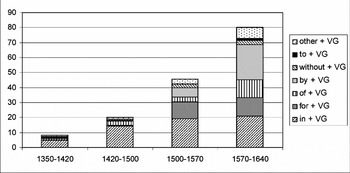
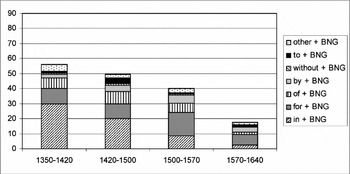
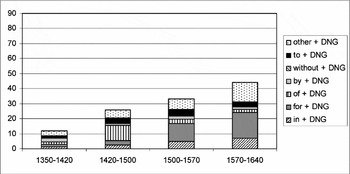
A second dimension on which the three gerund types must be compared is their distribution over the set of available prepositions. In this spirit, figures 2, 3 and 4 show the usage frequencies from 1350 to 1640 of the three gerund types in oblique environments, but this time differentiating between the six most common prepositions combining with gerunds: in, for, of, by, to, and without (see also appendix A1). This further breaking down of the data is a reminder that the major shifts in frequency of the three gerund types, already discussed in section 3, are in actual fact produced by the emergence and/or disappearance of a variety of more specific patterns, each with their own meaning and function. To come to a better understanding of the general changes affecting gerundial usage, it is therefore necessary to investigate the histories of the more specific combinations in which the different gerund constructions occur.
Prepositions with verbal gerunds (VG) (frequencies per 100,000 words)

Prepositions with bare nominal gerunds (BNG) (frequencies per 100,000 words)

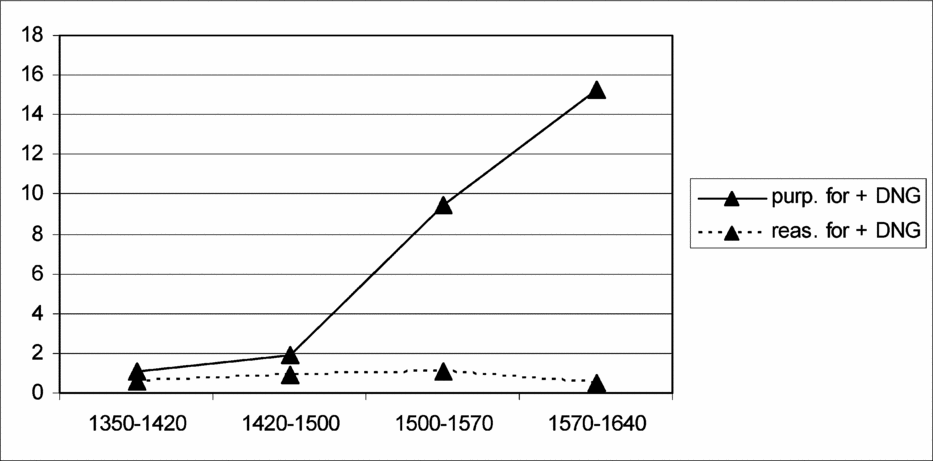
Prepositions with definite nominal gerunds (DNG) (frequencies per 100,000 words)

In interpreting figures 2, 3, and 4, one must be aware of the fact that figures are sometimes distorted by the idiosyncrasies of a single text in the corpus, often through repetitious use of a single formulaic expression. This is most clearly the case for the frequency of definite nominal gerunds with of in the subperiod 1420–1500, where a single text (The cyrurgie of Guy de Chauliac) provides more than half of all instances for the period (typically in headings of the type of þe wasshinge of butter). To a lesser extent, the same text may also somewhat exaggerate the figures for verbal gerunds with in for the same period. Another clear case of misrepresentation involves the frequency of verbal and especially bare nominal gerunds with for in the subperiod 1500–70. Here two texts provide a disproportionately high number of instances, again due to formulaic or semi-formulaic uses (the texts are The diary of Henry Machyn and the Act agaynst wearing of costly apparrell, which has been included in the PPCEME in two slightly different versions). With these qualifications in mind, it is possible to observe a number of tendencies in the data.
To begin with, it is evident from figures 2 through 4 that the three gerund types have somewhat different collocational preferences and, from a diachronic point of view, have each followed a distinct course of development. Thus verbal gerunds (figure 2) strongly collocate with the preposition in, so much so that the initial increase of verbal gerunds is in fact largely due to the extension of this single pattern. It is not until the Early Modern period that verbal gerunds spread to use with other prepositions and the bias towards use with in disappears. The new prepositions that verbal gerunds spread to are first of, then for, then by and without. With to, verbal gerunds remain almost entirely absent.
Bare nominal gerunds (figure 3) show the same strong association with in as verbal gerunds, but other combinations too are relatively current from the start, most notably the combinations with for and of. The decline of bare nominal gerunds sets in after 1350 with the preposition in. With other prepositions – of, by, for, and to – bare nominal gerunds are at this point still on the increase or at least stable. In these last environments, decay sets in first with of and to (after 1500), then also with by, and for (after 1570). The combination of a bare nominal gerund with without remains marginal and is, if anything, not on the increase after 1500.
Finally, the rise of definite nominal gerunds (figure 4) is primarily due to use in combination with for and a number of prepositions outside the group of the most frequent six (most prominently, these include after, before, and at – see appendix A2). A slight but steady increase with the preposition in further contributes to the rise of definite nominal gerunds. It is also worth noting that from 1420 onwards, definite nominal gerunds are the gerund type most strongly associated with the preposition to. Usage with by is marginal but relatively stable throughout, and the same goes for of. Apart from a single instance in the subperiod 1500–70, definite nominal gerunds do not combine at all with without.
While it is difficult to interpret these findings at face value, they already throw some light on the interaction between the three gerund types, as they are suggestive of areas of competition and of functional differentiation. In what follows, the interaction between gerund types is closely examined, focusing first on the rivalry between bare nominal and verbal gerunds (section 4.2.1) and then turning to the status of definite nominal gerunds as a construction relatively isolated from the ongoing competition between the other two types (section 4.2.2).
4.2.1 Bare nominal and verbal gerunds: the rivals
The data in figures 2 and 3 are suggestive of competition between verbal and bare nominal gerunds, with the former ousting the latter. Most strikingly, the fact that the decline of bare nominal gerunds begins in the patterns with in puts obvious suspicion on the verbal gerund, which saw its initial rise mainly in uses with in. Less spectacular but equally telling is the competition in uses with of and by, where verbal gerunds may again carry responsibility for the decline of bare nominal gerunds, first with of after 1500, then with by after 1570. These findings are not entirely surprising, since a replacement of bare nominal by verbal gerunds is well in line with the overall discourse-functional similarity between the two types (see section 4.1 above). However, the replacement hypothesis receives its strongest support from the fact that nearly all of the various uses of verbal gerunds – with in but also with by, of, for, and without – have equivalents with bare nominal gerunds. This implies that replacement of bare nominal gerunds by verbal gerunds can be held responsible for the rise of verbal gerunds in general. In order to demonstrate this, it is essential to look more closely into each of the recurrent combinations of a preposition and a bare nominal or verbal gerund, so as to verify to what extent they fulfil similar functions.
Combinations of bare nominal or verbal gerunds with the preposition in can be seen to function similarly, despite certain usage preferences. Use of the pattern clusters between two extremes. On the one hand, gerunds with in can be used as adverbial adjuncts expressing a relation of manner, means, or accompanying circumstance (and sometimes with a shade of purpose). Used in this function, the gerund is typically controlled, and it may refer to a specific event. The meaning of the preposition in here is relatively far removed from its original spatial sense, and replacement of the gerund by an ordinary NP is difficult.Footnote 11 The examples in (25) show that the use is found both with bare nominal (25a, c) and verbal gerunds (25b–c).
- (25)
(a) Neuerþeles, ʒif I schal soþlier sey, a soule is more bleendid in felyng of it for habundaunce of goostly liʒt, þen for any derknes or wantyng of bodely liʒtte. (?a.1400, HC)
(b) & the heremyte asked him what he was. And the monstre answerde him & seyde he was a dedly creature . . . & duelled in þo desertes in purchacynge his sustynance (c.1400, PPCME)
(c) whiche glory and reno∼mee of name he [i.e. Joshua] obteyned in lyftyng his hondes & scute [i.e. ‘bolts’] in shotynge of sharpe & fyry arowes ayenst ye cyte of hay [i.e. Ai] (?1495, HC)
On the other hand, gerunds with in also occur as obligatory adjuncts or prepositional complements with a number of predicates. In this function, the gerund is unambiguously generic, and can usually be replaced by an ordinary NP without affecting the meaning of in or upsetting the syntax of the clause as a whole. Examples are given in (26), with (26a–b) illustrating the pattern with a bare nominal gerund, and (26c) with a verbal gerund.
- (26)
(a) But in translating of wordis equiuok, that is, that hath manie significacions vndur oo lettre, mai liʒtli be pereil (a.1397, HC)
(b) For þe souerayne and þe Escencyalle Ioy es in þe lufe of Godd by hym-selfe and for hym-selfe, and þe secundarye es in comonynge [i.e. ‘meeting, conferring with’] and byhaldynge of Aungells and gastely creaturs. (c.1440, HC)
(c) Onely they that be called beneficiall, and do use the vertue of beneficence, whiche consisteth in counsaylinge and helpinge other with any assistence in tyme of nede, shall alway finde coadiutours and supportours of their gentyll courage. (1531, PPCEME)
Between these two extremes, a substantial group of instances falls into an intermediate category. These can mostly be described as adjuncts of respect, specifying in which respect the situation of the matrix clause holds true or takes place (cf. Quirk et al. Reference Quirk, Greenbaum, Leech and Svartvik1985: 483). Typically they are ambiguous between a controlled and a generic reading, and may alternatively lean closer to the group of adverbial clauses or to the group of prepositional complements. The pattern is illustrated in (27a–b) for bare nominal gerunds, and in (27c) for verbal gerunds.
- (27)
(a) Here take hede . . . how worþy we schal holde hym by manere of his leuynge and of his techynge. He myʒte not be vicious þat spende so his witte and þouʒt in expouninge of holy writte. (a.1387, PPCME)
(b) it be ordeyned by the seid auctorite that yf defaulte be in the Constables of eny Cite Borough or Hundred in makyng of due serche after open p∼clamacion made in this behalve, . . . that they and ev∼y of theym being in suche defaulte forfeite to the King xxtis. (1488–91, HC)
(c) one vertuous prelate dooth moche good in crystis chyrche / as well for his owne vertue & zelose obedyence vnto the lawe of god: as in ledynge other men to do the same (?1495, PPCME)
From the examples in (25)–(27) it is clear that considerable functional overlap existed between bare nominal and verbal gerunds in combination with the preposition in. This supports the idea that verbal gerunds ousted bare nominal gerunds in this environment. It should be pointed out, however, that replacement did not proceed evenly in the different uses found with in. As the above examples indicate, verbal gerunds with in first occurred in adverbials of means, manner, and accompanying circumstance, only spreading to adjuncts of respect at the end of the Middle English period, and to clear prepositional complement uses after 1500.
The combinations of by and without with bare nominal or verbal gerunds present a less complicated but similar picture. The preposition by begins to combine with bare nominal gerunds after 1350 to express an adverbial relation of means. The bare nominal gerund at this point typically allows an indefinite reading with an implication of control, but also a generic reading, as shown in (28a). Verbal gerunds begin to appear with by around 1500 and then quickly become more frequent. Like bare nominal gerunds, the verbal gerunds with by allow a generic reading alongside a controlled one, as in (28b), but especially after 1570, the controlled reading can be the only interpretative option left, as in (28c). In any case, seeing that in combination with by bare nominal gerunds had no functions that verbal gerunds could not fulfil, replacement of one by the other is again plausible.
- (28)
(a) & at þat selue tyme þe foure wardeyns schul chese oþere foure newe for þe ʒeer comynge, be settyng of foure gerlaundes [i.e. ‘wreaths’] (1389, HC)
(b) He hath then a busie worke I say, to bringe his flocke to a ryght fayth and then to confirme them in the same fayeth, Nowe castynge them downe with the lawe, and with threateninges of God for synne . . . Nowe weedinge them, by, tellinge them their faultes, and makynge them forsake synne. (1549, PPCEME)
(c) Sirra, quoth the Seruingman, you must come to my maister, you haue broken his Trunke all to peeces, by letting it fall. (1597, HC)
Used with without, bare nominal and verbal gerunds again show few or no differences. Both are typically used as controlled adverbial adjuncts expressing a relation of non-co-occurrence between the state of affairs in the main clause and the situation expressed by the gerund. Frequencies being low, the data do not directly reveal replacement of bare nominal by verbal gerunds (indeed, the oldest attested example with a verbal gerund precedes the earliest instance with a bare nominal gerund), but given the high currency in Middle English of without with gerunds having no modification, as in (29a), or having nominal modification, as in (29b), a nominal origin of the pattern is nevertheless plausible. The semantics of the pattern are constant, as the gerund constructions used are typically ambiguous or even indeterminate between an indefinite reading, with an implication of control, and a generic reading. This is illustrated for a bare nominal gerund with without in (29c), and for a verbal gerund in (29d). Note that the same semantic characterisation can be applied to (29a), and even to (29b), where the gerund, though certainly not generic, is clearly indefinite and similarly suggestive of a control relationship between its implied agent and a participant of the matrix clause. Once more, the functional similarity between bare nominal and verbal gerunds with without is evident.Footnote 12
- (29)
(a) Yef sho haue whreþid ani of hir sistirs, . . . hastelike with-vten dwellyng sal sho falle to her fete and aske hir for-gifnes (a.1425, PPCME)
(b) After þe deth of Hesider, regnede xxxiij Kynges, eche after oþere, in pees; and wiþout eny longe tariyng y shal tel ham alle, and how longe euery of ham regnede (c.1400, PPCME)
(c) to spened itt [i.e. worldly good] with-oute loue or vaynlikynge of itt, as reson askith, in worship of God, and helpe of thyne evyn cristyn. (c.1440, HC)
(d) þe Erl of Cornwaile & Igerne his wif setten alþer next þe kyng. and þe kyng saw þe fairenesse of þat lady. . .; and after, he made towarde here nyce semblant in lokyng and leiʒhyng. so at þe laste þe Erl perseuede þe priue lokyng and Laughing, . . . and arose vp fram þe table al in wraþ . . . and went þens. . . ., wiþouten takyng Leue of te Kyng. (c.1400, PPCME)
Combinations with of, too, show functional similarity across the variation between bare nominal and verbal gerunds. As illustrated in (30), bare nominal gerunds with of can be used as postmodifier to a noun (as in (30a)), complement to a complex preposition (as in (30c, e)), or prepositional complement to a verb or verbal idiom (as in (30b, d)). Referentially, bare nominal gerunds with of are predominantly generic (see (30a–b)), but occasionally they allow an indefinite reading, with or without an implication of control by an element of the matrix clause (see (30c–d) and (30e) respectively).
- (30)
(a) [He] cursed dredfulliche al þat doþ aʒenst þat statute of worschippynge of holy ymages. (a.1387, PPCME)
(b) Jhesus hadde seid [i.e. ‘spoken’] of his deth; but thei gessiden, that he seide of slepyng of sleep. (c.1395, PPCME)
(c) No man take þe valew of IIId. but if he pay, up peyn of lesing of a fynger, ne þe valew of VI d., up peyn of lesing of his hand (a.1464, PPCME)
(d) Thei were also accused of clipping of mony (a.1464, PPCME)
(e) And on þe same maner, wher anoþer man wolde bid þee gader þi miʒtes & þi wittes holiche wiþ-inne þi-self, & worschip God þere – þof al he sey ful wel & ful trewly, ʒe! . . . – ʒit for feerde of disseite & bodely conceyuyng [i.e. ‘interpreting’] of his wordes, me list not byd þee do so. (?a.1400, HC)
As they emerge, verbal gerunds with of map onto the uses of bare nominal gerunds, as illustrated in (31). In Middle English the first few verbal gerunds attested with of are generic and function as postmodifier to a noun or complement to a complex preposition. Later they also appear in the other environments and with nongeneric reference. As the examples clearly show, the lexico-grammatical environments in which verbal gerunds with of appear are often identical to the environments in which bare nominal gerunds were used earlier.
- (31)
(a) þat no maner persone, fre ne forein, be so hardy . . . to make, medle, or consent in any wyse, priue or appert, with any maner of brocage with-inne þis Cite, vp peyne of inprisonement of ther bodyes tuelfmoneth and a day, and makyng fyn to þe Chaumber (1418–9?, HC)
(b) sche knelyd on hyr knes þe tyme of tweyn Messys heryng (c.1450, PPCME)
(c) Speake not of winnyng me: for it shall neuer be so. (1552–3, PPCEME)
(d) Thus lay the poore Draper a long time in prison, in which space his Wife which before for dayntinesse would foule her fingers, nor turne her head aside, for feare of hurting the set of her neckenger, was glad to goe about and wash buckes at the Thames side, and to bee a chare-Woman in rich mens houses (1619, HC)
It should be pointed out that verbal gerunds did not replicate the entire functional range of bare nominal gerunds following of. Specifically, in one use bare nominal gerunds with of are strikingly at odds with verbal gerunds or even with the bare nominal gerunds following other prepositions. As shown in (32), some bare nominal gerunds with of clearly cannot be generic nor indefinite, but neither can they receive a controlled interpretation. Instances of this kind could be interpreted as double reference point constructions where the definite marking of the intermediate reference point (the gerund) can be omitted because its role as text participant is less prominent than that of the primary reference point and the eventual target of identification (but see example (i) in footnote 8 above, where this explanation cannot hold). In this use bare nominal gerunds have presumably been replaced by definite nominal gerunds rather than by verbal gerunds.
- (32)
(a) EXAMINED vpon þe first article he seide at þe tyme of makyng of þe certificat þe which was sent vnto þe kyng his felawe and he were in difference and discorde (1424–6, HC)
(b) This Robert began the priorie of blake chanons at Oseney by Oxford . . . Sum write that this was the occasion of making of it. [An account follows of what moved Robert to build a monastery at the spot in question.]
With for, finally, verbal gerunds once more share their various uses with bare nominal gerunds. Both bare nominal and verbal gerunds can be used with for to form adjuncts of purpose, as in (33). Referentially, bare nominal and verbal gerunds with purposive for often allow a generic reading next to a controlled reading (though in (33c) the generic reading has become unlikely). Akin to these purpose adjuncts are noun complements as in (34), which carry the same purposive flavour, typically with generic reference.
- (33)
(a) Preyer in it-self propirly is not elles bot a deuoute entent directe vnto God, for getyng of goodes & remowyng of yuelles. (?a.1400, HC)
(b) masons, and other worke menne call that patron [i.e. ‘model’], a centre, whereby they drawe the lines, for iust hewyng of stones for arches, vaultes, and chimneies (1551, PPCEME)
(c) and certain of them were for this time thought meet to passe, and to be redd; other, for avoyding tediousnes, to be omitted (1550–2, PPCEME)
- (34)
(a) The godlie counsels of Salomon and Iesus the sonne of Sirach, for sharpe kepinge in, and bridleinge of youth, are ment rather, for fatherlie correction, then masterlie beating (1563–8, PPCEME)
(b) Sir Jhon Williams, who was committed to the Flete for disobeying a commaundment gevin to him for not paying any pensions without making my counsel prevy, upon his submission was deliverid out of prison. (1550–2, PPCEME)
Both bare nominal and verbal gerunds can also be used with for to form adjuncts of reason, specifying the causal motivation of the situation or event in the main clause, as shown in (35). The causal use is somewhat later to develop than the purposive use, appearing only marginally in Middle English, and at that point, only with bare nominal gerunds, but it is certainly current in the Early Modern period, when the pattern is found both with bare nominal and verbal gerunds. Mostly, gerunds in this use allow both a generic and an indefinite controlled reading (see (35a, c)), but a controlled reading without indefinite reference is possible as well (see (35b, d)).
- (35)
(a) Þus fer inwardes comyn many; bot for greetnes of pyne þat þei fele and for lackyng of counforte þei go bak in beholdyng of bodely þinges, sekyng fleschly counfortes wiþ-outen, for lackyng of goostly þat þei haue not ʒit deseruyd (?a.1400, HC)
(b) Than suffyrd sche schamys & repreuys for weryng of hir white clothys (c.1450, PPCME)
(c) The xiij day of January ther was a man . . . hangyd, dran, and quartered, for conterffeytyng the quen's senett [i.e. ‘signet’]. (1553–9, PPCEME)
(d) Thus when they are cursed of God, they shall curse one another, curse the Lord for condemning them, curse their sinnes for accusing them, curse their parents for begetting them, and curse themselues, because they cannot helpe themselues. (1591, HC)
Finally, there are some more marginal uses with for. Among others, these include adjuncts expressing an apprehensive relation, where for can be paraphrased by ‘lest’ or ‘for fear of’, and topic-shifting disjuncts, where for can be paraphrased by ‘as to’. These too, however, appear to combine with bare nominal and verbal gerunds, as shown in (36) and (37) respectively.
- (36)
(a) For worchipyng of þe crosse he seide þat body þat hing on þe crosse schuld be worchipid, and noþing but he. (a.1464, PPCME)
(b) So ferforþ, þat neiþir of hem wole aʒeinseie oþere, for displesynge of eþer oþer in ony þing þat neþer of hem wole do, þouʒ it were fully deedli synne.
‘To such an extent that neither of them is willing to contradict the other, for fear of displeasing each other with respect to anything that either one wants to do, even if it were plain deadly sin.’ (a.1450, HC)
- (37)
(a) Nay, as for charming me, come hither if thou dare. (1552–3, PPCEME)
(b) I dare make none other comparison betwene them for offendinge the frendes of them both (1531, PPCEME)
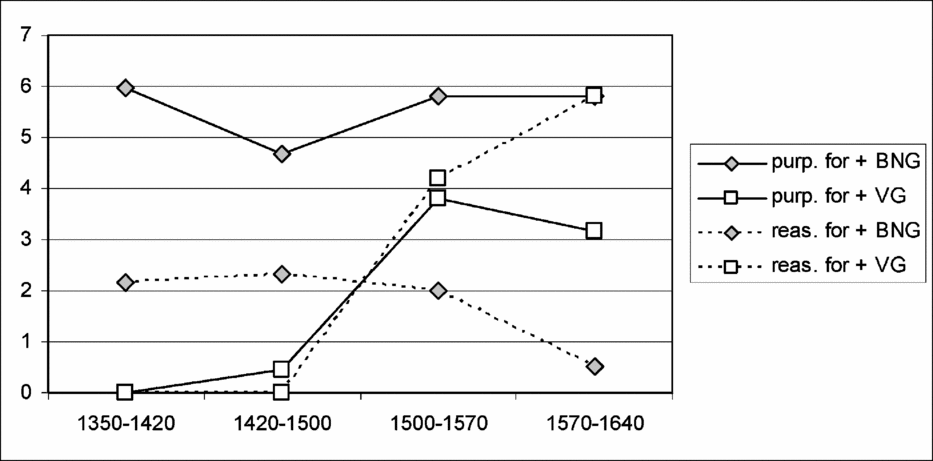
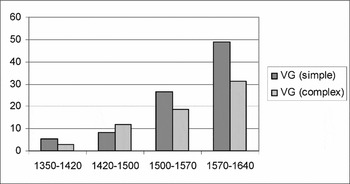
The examples in (33)–(37) above all point to a high degree of functional similarity between bare nominal and verbal gerunds. Replacement of bare nominal gerunds by verbal gerunds is not unequivocal, however. Figure 5 shows the frequency of the two major patterns with for – purpose and reason adjuncts – for bare nominal and verbal gerunds over the period 1350–1640.Footnote 13 Judging by their shifting frequencies, verbal gerunds are very likely to have replaced bare nominal gerunds with for as reason adjuncts, since the increase of one goes hand in hand with the decrease of the other. In the function of purpose adjuncts, however, the rise of verbal gerunds with for seems to have halted after 1570 and bare nominal gerunds remain relatively stable throughout the period examined. The hesitancy in the rise of verbal gerunds with purposive for may be due to competition with definite nominal gerunds in this environment or with the to-infinitive (see section 4.2.2 below).
Bare nominal (BNG) and verbal gerunds (VG) with for as purpose and reason adjuncts (frequencies per 100,000 words)
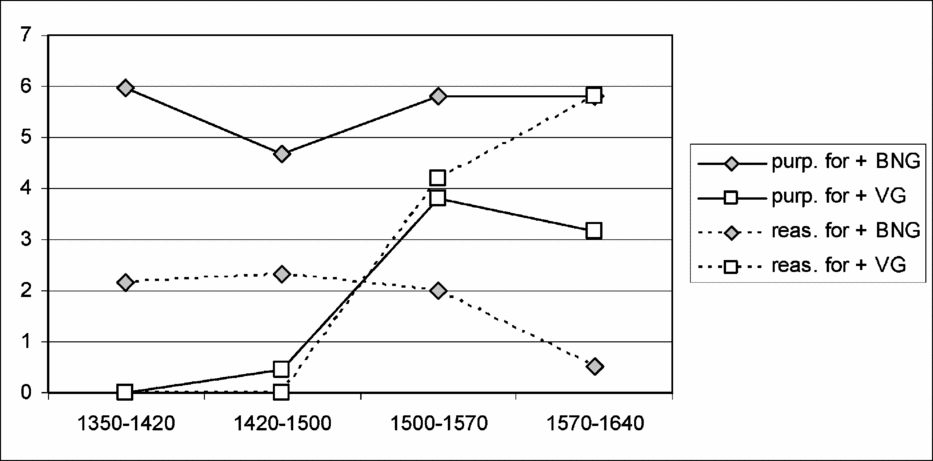
As the foregoing discussion has shown, the great majority of uses of the verbal gerund closely match uses of bare nominal gerunds. Thus, diachronically, the decrease of bare nominal gerunds in a number of environments matches an increase in the use of functionally equivalent verbal gerunds. This is most obvious for the different uses associated with the preposition in, but also applies to uses with by and of. Uses with without do not show an equally straightforward pattern of replacement, but it is nevertheless clear that without increasingly combined with verbal gerunds, while the functionally similar combination with a bare nominal gerund dwindled and disappeared. Combinations with for also show functional similarity across bare nominal and verbal gerunds, and even though purpose adjuncts with for continue to favour bare nominal gerunds into the first half of the seventeenth century, reason adjuncts with for once more show a clear pattern of replacement.
In conclusion, the data again do not straightforwardly support the claim that verbal gerunds were promoted by use in prepositional environments. Firstly, Middle English usage of the verbal gerund is marked by the emergence of a single prepositional pattern – the combination with in – with any extensions to other environments occurring only sporadically. The claim that verbal gerunds preferred prepositional environments, then, is certainly an overgeneralisation, at least as far as the initial development of the pattern is concerned. Secondly, the data indicate that verbal gerunds did not really fill any functional gap (at least not in terms of their ability to combine with prepositions). If anything, verbal gerunds were primarily used to replace other gerund constructions – bare nominal gerunds, specifically – rather than to fill in for a construction that did not previously exist.
4.2.2 Definite nominal gerunds: watching from the side?
As the previous section focused on the interaction between bare nominal and verbal gerunds, an important question has been ignored: what has been the part played by definite nominal gerunds? Given the higher degree of functional differentiation between definite nominal gerunds on the one hand and bare nominal and verbal gerunds on the other (see section 4.1 above), we might expect the use of definite nominal gerunds to be more indifferent to developments in the other two types. Indeed, it appears that definite nominal gerunds have developed a number of uses of their own that are dependent on the special semantics of the definite article and, as a result, more or less unique when set against the use of bare nominal and verbal gerunds. This suggests that the relation between definite nominal gerunds on the one hand and bare nominal and verbal gerunds on the other is for the most part one of functional differentiation rather than competition.
The use that is most evidently specific to definite nominal gerunds is that of temporal adverbials situating an event or situation in the matrix clause with respect to a temporal landmark. As pointed out above, more than the other two gerund types, definite nominal gerunds tend to co-occur with prepositions other than the most frequent six. Most prominently, these include temporal prepositions such as after, at, before, since, or upon. Definite nominal gerunds combine with these prepositions to express a temporal relation between the state of affairs in the main clause and some specific event that then serves as a temporal reference point vis-à-vis the state of affairs in the main clause. Definite nominal gerunds lend themselves well to this use due to the nature of the definite article, which marks an event as specific and accessible to the reader – and therefore ideally suited to serve as a temporal landmark in discourse. Consider the examples given in (38).
- (38)
(a) Also telle hem how I am oute of preson, and what adventure befelle me at the getynge of this swerde. (a.1470, HC)
(b) in whiche book ben comprised briefly . . . the historical Actes & wonderful dedes syth the fyrst makyng of heuen & erth vnto the begynnyng of the regne of kyng edward the fourth (1477–84, HC)
(c) if it shall appeare upon the measuring therof . . ., that there is more Corne or graine loded to be transported into the parties beyonde the Sea . . ., than it shalbe lefull . . . to cause the owner or conveyer therof unto the saide towne of Bristoll, to make sale of suche corne and graine (1542–3, PPCEME)
By contrast, being typically generic or indefinite, bare nominal gerunds – and verbal gerunds in their wake – do not favour use as temporal landmarks, which explains why bare nominal and verbal gerunds rarely co-occur with temporal prepositions in Middle and Early Modern English. Notice that, as repeatedly pointed out above, bare nominal and especially verbal gerunds can occasionally refer to a specific event without being necessarily indefinite, provided that the implied agent of the gerund is controlled by an element in the matrix clause. In such uses, the two gerund types do occasionally combine with members of the set of temporal prepositions, as shown in (39). As the use of controlled gerunds of this type became more current, they may have turned into a competitor for definite nominal gerunds. This, however, happened after the period under investigation.
- (39)
(a) Upon viewing of wich thinges there was devised tow fortes to be made upon the entry of the haven (1550–2, PPCEME)
(b) then, soone after, I tooke my Cotch and went to Linton, wher, I aftor salutinge my mother, praied, and so went to supper (1599–1601, HC)
A certain degree of functional differentiation is also apparent in combinations of definite nominal gerunds with the prepositions of, by and in. The semantic relations expressed by these prepositions are not strongly affected by the choice of gerund type, and it is true that, consequently, occasional examples show definite gerunds that closely correspond to uses with a bare nominal or verbal gerund. For example, in (40) the definite nominal gerund the turnynge of thi will is in fact coordinated with the functionally equivalent bare nominal gerund with-drawynge of thyne herte fro luste, both referring to a specific event whose implied agent is controlled by the subject of the matrix clause.
(40) Grace and the goodenes of oure lorde Ihesu Criste that he hath shewed to the, – in with-drawynge of thyne herte fro luste and from likynges of worldely vanite, and vse of flesshly synnes and in the turnynge of thi will enterely to his seruyce and his plesaunce, – bryngith into my herte much mater to loue hym in his mercy. (c.1440, HC)
However, in the majority of cases, the choice of a definite nominal gerund with of, by or in is, if not necessarily the only option available, at least clearly motivated by the functional properties of definite marking. This is most evident when the gerund refers to a specific noncontrolled event, as in the examples in (41), where a bare nominal or verbal gerund is virtually ruled out. In the extreme case, a definite nominal gerund may even have the effect of blocking a controlled interpretation. This is illustrated in (42), where inbreathing would be readily – but mistakenly – interpreted as being controlled by the highly agentive subject of the matrix clause, if it were not for the definite article, which marks the referent of the gerund as accessible through the alternative strategy of drawing on shared knowledge (the common ‘inbreather’ of ill breaths is man and not the air).
- (41)
(a) Charlys herynge of the subduynge of kynge Rycharde, sent into Engla∼de two of his houshold knyghtys, requyrynge kynge Henrye the. iiii. . . . to send home his doughter Isabell latelye maryed vnto kynge Rycharde (1516, PPCEME)
(b) through most Counties of this Realme Horstealinge is growen so co∼mon, as neither in Pastures or Closes nor hardlie in Stables the same are to be in safety from stealinge, whiche ensueth by the redye buyinge of the same, by Horscorsers and others in some open Fayres or Markett∼ farr distant from the Owner, and withe suche speede as the Owner cannot by pursuyte possiblie helpe the same (1588–9, HC)
(42) A man cannot finde a better remedie than this triacle [i.e. ‘ointment’] against the pestilence, which being also as it were a wild beast, bred of ye corruption of the ayre, leaping vpon men by the inbreathing of that ill breaths which destroyeth, wasteth, and maketh hauock not only of one man, but of whole tounes and Cities. (1568, PPCEME)
Sometimes the matrix clause provides a potential controller, but the event referred to by the gerund is also an accessible discourse participant that is highly prominent in the discourse. For example, in (43) the churning thereof is used in a text precisely about churning butter. It is a natural choice therefore to represent this action as retrievable through the definite strategy rather than the controlled strategy.
(43) if you churne your butter in the heate of Sommer it shall not be amisse, if during the time of your churning you place your Churn in a paile of cold water as deep as your Creame riseth in the Churne; and in the churning thereof let your stroakes goe slow, and be sure that your churne be cold when you put in your creame (1615, HC)
In yet other cases, the use of a definite gerund is simply triggered by coordination or structural parallelism with another definite NP. The motivation for definite marking, then, is the same for the gerund as for the coordinated or parallel NP. Thus, in (44), the redyng of historyes is construed parallel to the experyence of aduerse fortune, both being sources of insight in wysedome and polycye.
(44) He is / and euer hath ben reputed the wysest / whiche by the experyence of aduerse fortune hath byholden and seen the noble Cytees / maners / and variaunt condycions of the people of many dyuerse Regyons / For in hym is presupposed the lore of wysedome and polycye . . . / yet he is more fortunat / and may be reputed as wyse . . . that may by the redyng of historyes conteynyng dyuerse customes Condycyons / lawes & / Actes of sondry nacions come vnto the knowleche of and vnderstandynge of the same wysedom and polycye (1477–84, HC)
All in all, it appears that the choice of definite nominal gerunds with in, by, and of is motivated. This may explain why the use of these combinations – though marginal – remains stable throughout the period examined (see figure 4), despite the rise of verbal gerunds with the same prepositions.
A further group of definite nominal gerunds – the largest group, in fact – is found with the preposition for. Regarding these, it is striking to see that while for can express a variety of semantic relations, it nearly always designates a purpose or goal when used with definite nominal gerunds. Accordingly, the diachronic rise of definite nominal gerunds with for is entirely due to use with purposive for. This strong bias is demonstrated in figure 6, which compares the use of definite nominal gerunds with for as purpose adjuncts to their use as reason adjuncts. The preference for purposive uses distinguishes definite nominal gerunds with for from bare nominal and verbal gerunds, which are much more commonly used with for to form reason adjuncts (see figure 5 and the discussion in section 4.2.1 above). Predictably, when a reason adjunct with for contains a definite gerund, the latter refers to a specific and accessible event, contrasting with bare nominal and verbal gerunds along the by now familiar lines. An example is given in (45).
(45) after the sharpe and vehement contention, betwene him [i.e. Achilles] and Agamemnon, for the taking away of his concubine (1531, PPCEME)
More interesting are the purposive uses of for, where the choice between definite nominal gerunds on the one hand and bare nominal or verbal gerunds on the other appears to be organised differently. This is plausibly the one area where definite nominal gerunds have come closest to competing with bare nominal and verbal gerunds, and may in fact have partly replaced the other two types. Nevertheless, definite nominal gerunds are not entirely equivalent to the other two types. Start by observing that purpose adjuncts typically denote events that are still to be realised and that, being more or less hypothetical, are not easily conceived of as having precise spatio-temporal coordinates. In purpose adjuncts, then, the definite article does not mark specificity and accessibility in the strictest possible sense. That is, accessibility lies not so much in the interpreter's ability to home in on a specific occurrence of a situation with fixed spatio-temporal coordinates, as in the construal of a situation as a ‘common goal’. Basically, it is because a goal can be known and recognised as a goal among a larger group of people that it can also be accessible as shared knowledge in the communicative setting of discourse.
Definite nominal gerunds (DNG) with for as purpose and reason adjuncts (frequencies per 100,000 words)
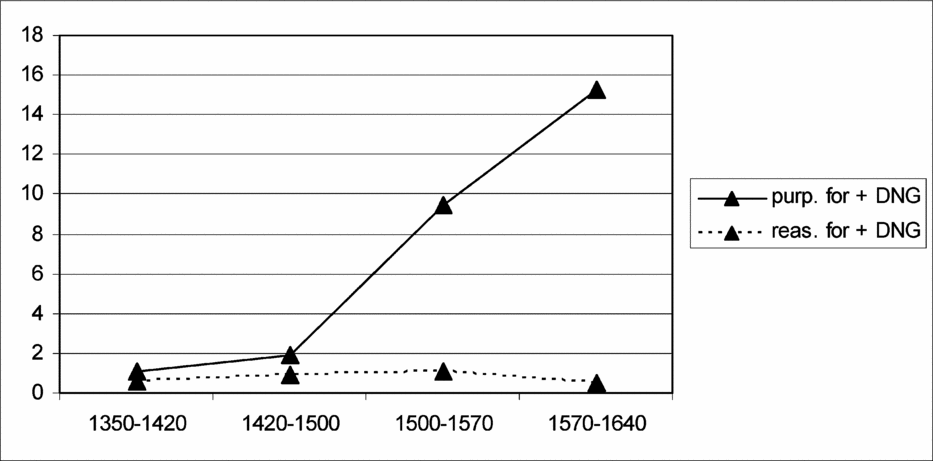
In its most distinctive manifestation, a common goal has the following characteristics: first, it benefits others than those who strive to achieve it, and, as a consequence, it carries an aura of general importance; second, it exists as a goal prior to any actions taken to achieve it and continues to exist afterwards; and third, just as it is not directly linked to the intentions or desires of a single agent, a single agent is not capable of realising it, but merely contributes to its achievement. The definite nominal gerunds in (46) are used with for to express common goals that fully answer the description given. For example, the edifiynge of theyr bretherne in (46a) is a goal whose validity is generally recognised, that benefits the bretherne more than the ploughmen, and that is presumably not achieved by the ploughmen's efforts alone. Likewise, the keepinge of our peace in (46b) benefits an entire county, is an ever-continuing task, and constitutes a responsibility that is shared by a variety of people and which can even be transferred from one authority to another, as indeed happens in the example. The extreme case is presented by (46c): as a goal, the disclosing of Nature potentially entails the enlightenment of all mankind, and certainly represents an ongoing process that feeds on all kinds of inuentions and experiments without ever being wholly completed. In fact, the preposition for here could be said to mark an abstract benefactive rather than a goal.
- (46)
(a) But they that wil be true ploughmen [i.e. preachers] muste worke faythfullye for Goddes sake, for the edifiynge of theyr bretherne. (1549, PPCEME)
(b) And where as we at this time have written aswell to the sheriffe of that our shire . . . as also to the justices of our peace within our said shire . . ., comaundinge and straitly chargeinge that as well the said sheriffe as the said justices endeavor them for the keepinge of our peace and entertainment of our subjectes in good quiet and restfullnes dureinge the time of our jorney into the partes beyond the sea (1520, PPCEME)
(c) so assuredly the search and stirre to make gold hath brought to light a great number of good and fruitfull inuentions and experiments, as well for the disclosing of Nature; as for the vse of mans life. (1605, HC)
In other examples, definite nominal gerunds combine with for to express goals that approach the prototype of the common goal but do not possess all of its features. For example, a man's keeping of his health in (47a) is not a goal to which a great number of people contribute or from which anyone benefits more than the person whose health is concerned. Still, good health will be commonly recognised as a valid goal for any individual person, and is certainly a goal whose achievement cannot depend solely on the choice between white wines and red and Clared wine, but which requires continuous attention and care. A different set of features of a common goal is highlighted in (47b): as a goal, the atcheving thereof clearly originates from the personal agenda of one man, this Cardinall, but its achievement requires scheming and intrigue, inevitably involving others, and the action taken towards its achievement (casting doubt on the acceptability of another marital candidate) can contribute to success only indirectly.Footnote 14
- (47)
(a) Smal white wines scoure and driue out the vncleannesse of the bodie as much as it is possible to be done by them, and red and Clared wine stoppe and hold backe, and fill the bodie full of ill humors, now which are most profitable to be taken most commonly of a man for the keeping of his health (1568, PPCEME)
(b) This Cardinall therefore . . . devised to allure the kinge . . . to cast fantasy to [i.e. ‘get enamoured of’] one of the Frenche kings Sisters: . . . And for the better atcheving thereof, requested Langland, Bishoppe of Lincolne, and ghostly father to the kinge, to put a scruple into his graces head, that itt was not lawfull for him to marry his brothers wife (1555, PPCEME)
The examples in (46)–(47) can be contrasted with bare nominal and verbal gerunds with purposive for, as in (48). Here, the goal designated by the gerund is immediately and exclusively linked to the desires and intentions of the controller in the matrix clause, and can be realised directly by the action described in the matrix clause (see also the examples in (33) above).
- (48)
(a) I am in a greet angonye howe js best fore me to sywe to hym fore rehauyng off my place. Þat goode lorde woot full lytell how moche harme he doothe me, and how lytell goode ore worshyp it dothe hym. (1472, HC)
(b) For besydes money, he looketh for meate and drinke for doinge his dame pleasure. (1567–8, PPCEME)
The contrast established between common goals and more direct or personal goals underscores the semantic impact of the definite article and implies that the choice between definite nominal gerunds and bare nominal or verbal gerunds is not arbitrary in the context of purposive for. Still, it is clear that conceptually the distinction may not be discrete (we can imagine intermediate cases), and that the choice of one variant over another may often be primarily a matter of construal (many goals might be presented as common goals if rhetorical purposes so demand). Especially in the Middle English period, bare nominal gerunds could combine with for to express goals that look suspiciously like common goals. Thus, putting a-wey of þis opyn & sclaunderouse deseyt in (49a) can easily be conceived of as a common goal (and is in fact coordinated with a definite nominal gerund). Conversely, in the Early Modern data definite nominal gerunds occasionally occur with for to designate goals showing very few of the features of common goals. For instance, the avoiding of singularity in (49b) may be thought of as a personal goal that contributes little to general well-being.
- (49)
(a) And noght only for exclusion & puttyng a-wey of þis opyn & sclaunderouse deseyt, . . . but also for þe redy remevyng of grete multitude of such wynes, deceyuablych contrefetyd and medlid on þe other syde of þe see, and broght hydir to selle, The peticion of þe Comons hath oftyn here-to-for requirid a couenable remedie (1419, HC)
(b) This Lord Chauncelour, albeit he was to god and the world well knowen of notable vertue . . . yeat, for the avoiding of singularity, wold he appeare none otherwise then other men in his apparell and other behaviour. (1555, PPCEME)
This hints at a certain degree of competition between definite nominal gerunds on the one hand and bare nominal and verbal gerunds on the other. It must be pointed out, however, that this view is only weakly corroborated by the quantitative data. There is no decrease in bare nominal and verbal gerunds concomitant to the marked increase of definite nominal gerunds with purposive for (compare figures 5 and 6 above). At the same time, compared to other environments, where the frequency of verbal gerunds continually increases for several centuries, it is remarkable that the rise of verbal gerunds with purposive for seems to peter out very soon after its inception. A blocking effect due to the use of definite nominal gerunds in the same environment is therefore not entirely inconceivable, but the blocking factor may also be the to-infinitive, which is also used to form purpose adjuncts, and more closely resembles bare nominal and verbal gerunds with for in being typically controlled and in expressing direct goals rather than common goals.
A few final words are in place concerning combinations of definite nominal gerunds with to. Of the three gerund types, it is definite nominal gerunds that most commonly combine with to, bare nominal gerunds being rare and verbal gerunds hardly occurring at all. In part, definite nominal gerunds are used with to just as with for to express a common goal. Thus, the definite nominal gerunds in (50) represent preconceived or pre-established, often socially relevant goals to which the action of the main clause more or less indirectly contributes. Note that as (50a) shows, common goals with to historically predate those with for and may therefore be thought of as a predecessor of the more frequent pattern.
- (50)
(a) Also y bequeth to þeMendyng of þe heye way be-twen Hillindon and Akton, xl.s. (1402, HC)
(b) For if ye bryng it to passe, that the yomanry be not able . . . to mary their daughters to the auoidyng of whoredome, I say ye plucke saluation from the people and vtterly distroy the realme. (1549, PPCEME)
In other cases the combination of to with a definite nominal gerund functions more as a complement than as an adjunct, yet the sense of a commonly recognised goal is still eminent. A clear example is given in (51), where the understanding of autors and the most swete and pleasant redinge of olde autours are construed (within a generic text; see section 4.1 above) as the ultimate gratification and actual goal of the strenuous process of learning grammar, and must therefore be thought of as the preset end-stage of grammar teaching.
(51) Grammer beinge but an introduction to the understanding of autors, if it be made to longe or exquisite to the lerner, hit in a maner mortifieth his corage: And by that time he cometh to the most swete and pleasant redinge of olde autours, the sparkes of feruent desire of lernynge is extincte with the burdone of grammer . . . (1531, PPCEME)
More marginally, definite nominal gerunds can also be used to specify a (typically undesirable) result, which is then presented as an accessible fact. An example is given in (52).
(52) so great haboundaunce of cappes and hattes redy wrought and made have been and daily be brought from the p∼ties of beyond the See into this Realme, and here have been and daylly bee uttred and sold . . . to the great Idelnesse enpov∼ysshyng and utter undoing of great multitude of the Kyngis naturall subjectis (1511–12, PPCEME)
It is difficult to assess to what degree definite nominal gerunds with to competed with bare nominal gerunds. In resultative uses as in (52) above, definite nominal gerunds are likely to have replaced bare nominal gerunds (despite a slight semantic difference – compare (16a) above). Otherwise, replacement is doubtful. In the entire data set, only two bare nominal gerunds with to function as purpose adjuncts, which is hardly enough to speak of replacement. At best, competition may have blocked any growth of the pattern – though again the main blocking factor may in actual fact have been the to-infinitive rather than the definite nominal gerund. The most important remaining use of bare nominal gerunds with to is that of prepositional complement, especially in idiomatic combinations where the purposive sense of to is largely absent, as in the examples in (53a–b). Disregarding the occasional intrusion of a definite nominal gerund, bare nominal gerunds appear to have survived in this use into Early Modern English – a fine illustration of which is the continued association of the idiom fall to with bare nominal gerunds up until the eighteenth century, as shown in (53c).
- (53)
(a) Schynyng eyn . . . qwan thei be of amenabyl gretnes, moyste and schynyng, thei sygnyffye gret nobylnes and gret ymagynacionnys off wysdam, dysposycion also to wrathe and to drynkyng off wyne (c.1450, HC)
(b) And out they goe, in a fustian fume, into the backe syde, where was a great Axiltrye [i.e. ‘axle’], and there fell to pitching of the barre [i.e. a game involving a heavy piece of wood that the contenders throw as far as possible] (1567–8, PPCEME)
(c) words could not vent half their rage; and they fell to pulling of caps, tearing of hair, and dragging the clothes off one another's backs (1749, CLMETEV)
To summarise, definite nominal gerunds do not engage in competition to the same extent as do bare nominal and verbal gerunds. This is evident from their distribution over the set of prepositions. Definite nominal gerunds have specialised into two major uses – that of temporal landmarks with prepositions such as after, at and so forth, and that of purpose adjuncts designating a ‘common goal’ with the prepositions for and to. In the former use, competition with bare nominal or verbal gerunds is as good as nonexistent, whereas in the latter use a certain degree of competition is possible but is only weakly apparent (if apparent at all) in the data. With other prepositions, definite nominal gerunds remain relatively marginal throughout the period examined. This is especially true for their use with the prepositions without, by, for (in its causal sense), and to (in nonpurposive prepositional complements), and, to a lesser extent, of and in. When definite gerunds are occasionally used with these prepositions, their use tends to be clearly motivated by the properties of the definite article. While it is not incorrect to state that definite nominal gerunds potentially overlap in use with other gerund types, they never become very current in such overlapping functions and at no point is there very straightforward quantitative evidence that definite nominal gerunds replaced or were replaced by another gerund type in any specific environment. All in all, then, definite nominal gerunds can be said to go their own way, more or less independently of the other two gerund types, specialising into their own distinct set of uses.
4.3 Syntactic differences
The preceding discussion has emphasised the similarity between bare nominal and verbal gerunds, which were in competition over the same environments, as opposed to definite nominal gerunds, which specialised into their own niche of language use. This implies that verbal gerunds did not fill a syntactic gap in any strong sense. The appearance of verbal gerunds did not bring about a dramatic innovation involving an entirely new set of expressive options suddenly available to users of English. Instead, the uses to which verbal gerunds were put were to a large extent established on or at least prefigured by the various uses of bare nominal gerunds. The question therefore remains of what drove the spectacular increase of verbal gerunds that began in the Middle English period and continued into Modern English?
An answer to this problem is suggested by a final functional difference between the three gerund types. While from a discourse-functional and distributional point of view verbal gerunds align themselves with bare nominal gerunds, they differ from the latter in terms of their internal syntax. This difference is reflected in the way the three gerund types are used, in that verbal gerunds display greater syntactic flexibility. That this is so is most obvious in later stages of the development of the gerund. For example, in Present-day English, there is no nominal alternative to the auxiliary being in (54a), the object complement responsible in (54b), or the subject complement a minimalist in (54c).
- (54)
(a) She showed no sign of being overwhelmed by the atmosphere of Schloss Langenbach. (CB)
(b) Only by returning it to the peasantry, he argued, only by making farmers responsible for marketing their own produce, would it be possible to ensure regular food supplies. (CB)
(c) I will have to get back to being a minimalist to retain such sanity as I have. (CB)
The syntactic configurations illustrated in (54) are attested only sparingly in the historical data. Nevertheless, the data show that from the very start the internal syntax of verbal gerunds was more flexible and more strongly favoured complex patterning than that of nominal gerunds – even when the syntactic potential of either construction type was in theory roughly identical.
This is demonstrated in figures 7 and 8. Figure 7 collapses the different subperiods of the corpus and categorises the three whole sets of verbal, bare nominal and definite gerunds into two distinct categories. The first category is that of ‘simple’ gerund constructions, which contain only a patient argument, either expressed as a bare NP (in the case of verbal gerunds) or as an of-phrase (in the case of nominal gerunds). The second category is that of ‘complex’ gerund constructions, which in addition to a patient argument contain some other modifier to the gerundial verb (e.g. an adjective, a prepositional phrase, a second nonsubject argument and so on). The examples in (55) illustrate the distinction between simple and complex gerund constructions.
Proportion of verbal (VG), bare nominal (BNG) and definite nominal gerunds (DNG) with simple and complex internal syntax

Proportion of verbal (VG), bare nominal (BNG) and definite nominal gerunds (DNG) with simple syntax or with additional PP

- (55)
(a) they would not obey hym, but refused and defendid the∼ by takynge sanctuarye (1556, PPCEME)
(b) I praye you, my Lordes, be good vnto vs, and lette vs not bee molested for dischargyng our Consciences truelye (1554, HC)
The same subcategorisation is repeated in figure 8, with the only difference that the set of complex gerund constructions has been reduced by only including those examples whose additional modifier is a prepositional phrase. The rationale for this reduction is that, of all possible extra modifiers, prepositional phrases are most likely to be acceptable in both nominal and verbal gerund constructions, as is illustrated in (56).Footnote 15 In this way, figure 8 indicates more reliably how simple and complex syntactic configurations correlate with the choice between nominal and verbal constructions.
- (56)
(a) The Lord kepe me from doyng this thing vnto my maister yat is the lordes anointed. (1549, PPCEME)
(b) Humfrey Boucher, base sunne to the late Lorde Berners, did much coste in translating of the priorie into a maner place (1535–43, PPCEME)
(c) what with the shotte & gorynge [i.e. ‘stabbing’] of their horses with the sharpe stakes, they stumbelyd one vpon another . . ., so yt in a short whyle a great multytude of horse & men were layde vpon the grounde. (1516, PPCEME)
Figures 7 and 8 reveal a clear preference for verbal means of expression when the gerund construction's internal syntax is more complex.Footnote 16 This tendency is not merely the result of the greater syntactic potential of verbal gerunds. As figure 8 shows, verbal means of expression are preferred in complex gerunds even when the nominal alternative is perfectly viable.
Interestingly, the observations in figures 7 and 8 extend to another area of gerundial usage. The same skewed distribution between simple and complex environments is found in the relation between definite nominal gerunds and definite hybrid gerunds. As defined here, definite hybrid gerunds combine a definite article with a verbally expressed object argument, as illustrated in (57).Footnote 17
- (57)
(a) Now they proceed to the Reading the Proofs. (1600, HC)
(b) First the childe is to be taught, how to call every letter, pronouncing each of them plainely, fully and distinctly; . . . More specially to bee carefull, for the right pronouncing the five vowels, in the first place, as a, e, i, o, u. (1627, HC)
What is important for our purposes is that, as the examples in (57) indicate, definite hybrid gerunds show the same variation between simple and complex internal syntax as other gerund types. Figure 9, then, gives the proportion of definite nominal and definite hybrid gerunds in simple and complex environments for the period 1570–1640 (see appendix B). Only one subperiod is represented, because definite hybrid gerunds only began to gain some currency in the Early Modern period. The result is evident: the use of definite hybrid gerunds conforms to the tendency for complex syntax to associate with verbal means of expression.Footnote 18
Proportion of definite nominal (DNG) and definite hybrid gerunds (DHG) with simple and complex internal syntax in 1570–1640

Taken together, figures 7 through 9 hint at the possible functional motivations behind the rise of verbal gerunds (and, by extension, definite hybrid gerunds). Knowing that verbal gerunds grew proportionately more frequent over time, it can be deduced that the use of verbal gerunds has brought about an increase in the use of gerund constructions with more complex internal patterning (see also appendix B). If we interpret this overall trend as the manifestation of an underlying functional motivation, the emergence of verbal gerunds can be seen as at least in part driven by the need for syntactically more versatile means of expression. Some interesting evidence in favour of this view comes from a diachronic shift in the proportion of simple to complex constructions in verbal gerunds. Figure 10 tracks the frequency of verbal gerunds with simple and complex internal syntax, revealing that whereas the increase in verbal gerunds between 1500 and 1640 is felt in roughly equal measure in complex and in simple gerund constructions, the initial rise in the frequency of verbal gerunds between 1350 and 1500 seems to be mostly due to verbal gerunds with complex internal syntax.Footnote 19 This suggests that the original impetus for the emergence of verbal gerunds may have lain in the drive for greater syntactic flexibility.
Simple and complex verbal gerunds from 1350 to 1640 (frequencies per 100,000 words)

This is not all there is to it, however. Recall that the preference for verbal gerunds over nominal gerunds is not confined to complex syntactic configurations that can only be expressed verbally. It is clear that in all complex environments speakers prefer to code the patient of a gerund by means of a bare noun phrase rather than an of-phrase, regardless of whether a nominal alternative is available or not. As such, the tendencies observed in gerundial usage are reminiscent of Rohdenburg's (Reference Rohdenburg1996) ‘cognitive complexity principle’, which states that ‘In the case of more or less explicit grammatical options the more explicit one(s) will tend to be favored in cognitively more complex environments’ (1996: 151). Indeed, although Rohdenburg primarily associates explicitness with formal weight,Footnote 20 a number of arguments suggest that despite the greater formal weight of the of-phrase, bare noun phrases represent the more explicit option. First, given that in all clausal environments patient arguments are expressed by means of a bare noun phrase, the bare noun phrase is by far the more canonical way of coding the patient. Second, being a prepositional phrase, an of-phrase is less explicit in marking the difference in syntactic and semantic status between an argument and a nonargument – a difference that becomes increasingly relevant exactly in expressions that contain both arguments and nonarguments, and in which the difference between a prepositional phrase and a bare noun phrase can be seen as an iconic reflex of degrees of semantic ‘closeness’ to the action denoted by the verb. Third, of-phrases, unlike bare noun phrases, can be ambiguous between a patient interpretation and an agent interpretation (cf. Jespersen Reference Jespersen1940: 102), as is illustrated in (58).
(58) it shoulde bee harde for him to brynge his purpose to passe, without the gathering and great assemble of people and in maner of open warre (1514–18, PPCEME)
If the assumption is correct that bare noun phrases are more explicit than of-phrases in marking the patient of a verb, this has the important consequence that, compared to their nominal counterparts, verbal gerunds appear at once to offer a more economic (i.e. shorter) and a more iconic (i.e. more explicit) way of saying the same thing (cf. Haiman Reference Haiman1983). In other words, economic and iconic motivations converge in the verbal gerund, giving it a plausible functional advantage over its nominal competitors.
5 Conclusions
The history of the English gerund cannot be understood without a close understanding of the functioning of the entire system of gerund constructions. Use of the three major gerund types examined in this article is organised along two major divisions. On the one hand, verbal gerunds – and definite hybrid gerunds – contrast with bare and definite nominal gerunds in allowing greater syntactic flexibility (section 4.3). On the other hand, bare nominal and verbal gerunds resemble each other in the way they function in discourse, as opposed to definite nominal gerunds (section 4.1). These discourse-functional properties of gerund types interact with the concrete uses to which they are put, as is revealed by the distribution of the gerund types over the set of available prepositions. Definite nominal gerunds have specialised into a set of uses that are uniquely motivated by the semantic import of the definite article (section 4.2.2). Bare nominal and verbal gerunds compete with one another over the same set of environments (section 4.2.1).
Together, functional differentiation and overlap between the different gerund constructions can explain some of the historical developments witnessed in the use of the gerund. The competition between bare nominal and verbal gerunds, along with the greater syntactic flexibility of verbal gerunds, can account for the loss of bare nominal gerunds and the concomitant rise of verbal gerunds. In turn, the functional specialisation of definite nominal gerunds can account for the rise of definite nominal gerunds alongside verbal gerunds.
Regarding the question of whether the gerund filled a syntactic gap, a nuanced answer must be formulated. It is not correct to say that verbal gerunds substituted for the infinitive in prepositional environments because they presented the only clausal structure that could combine with prepositions. The use of verbal gerunds is clearly anticipated by the use of bare nominal gerunds, and the rise of verbal gerunds consists more in a large-scale replacement of bare nominal gerunds than in the filling of a grammatical void. Still, developments in gerundial usage are not unmotivated from a functional perspective. First, there is the dramatic rise of bare nominal gerunds halfway through the Middle English period, which, in speed and scope, is unparalleled by any later development in the gerund. This may reflect the fact that at that time the assumed prepositional gap was indeed still a gap. Second, there is the rise of verbal gerunds. Because the unique syntactic flexibility of the verbal gerund is likely to have played its part in furthering the construction, verbal gerunds too filled a kind of gap, in that they provided a more flexible means of expression, at once iconic and economic, in an area of grammar where it was hitherto unavailable. The gap, then, lay in internal rather than external syntax – that is, in internal syntactic flexibility rather than in external combinatorial potential.
In other ways, too, developments in the gerund are functionally motivated. We can see that gerund constructions only gained frequency in those areas where they somehow came in useful. This is best illustrated by definite nominal gerunds, which remained marginal in those uses where they could not sufficiently distinguish themselves from bare nominal or verbal gerunds, but prospered in uses where the semantic import of the definite article was most fully and uniquely felt. The result is a division of labour between the different constructions, largely following the isomorphic principle of ‘one meaning one form’.
Going one step further, it may be argued that a similar complementary relationship is maintained between the three gerund constructions and the infinitive. It is certainly reasonable to assume that the spectacular rise in gerundial usage in prepositional environments was possible only because of the absence of the infinitive in those environments. But effects may also be witnessed on a smaller scale. Particularly conspicuous is the absence of purpose adjuncts formed by to with bare nominal or verbal gerunds and the somewhat half-hearted use of bare nominal and verbal gerunds with purposive for. The reluctance of bare nominal and verbal gerunds to combine with purposive to and for may result from a blocking effect due to the use of definite nominal gerunds with the same prepositions. However, since the latter are typically employed to express common goals, it is more likely that any blocking effect results from the to-infinitive, whose purposive semantics and control behaviour more closely resemble that of bare nominal and verbal gerunds than do the characteristics of purposive definite nominal gerunds.
In all these cases, functional motivation takes the form of motivated decisions made by language users on the basis of what synchronic grammar has to offer (García Reference García1999; Haspelmath Reference Haspelmath1999; Hawkins Reference Hawkins2004). That is, if a new form did not differ substantially from a more common older form, the older form has been maintained, but if a new form had a unique functional advantage, it has come either to replace or to complement the older form. In this respect, the history of the gerund indicates that functionally driven language change is in fact possible, provided that it is implemented through repeated motivated choices in synchronic usage.
Appendix
Verbal (VG), bare nominal (BNG), and definite nominal gerunds (DNG) in oblique (OBL) and nonoblique (N-OBL) environments and their distribution over different prepositions, with absolute (AF) and relative frequencies per 100,000 words (RF)
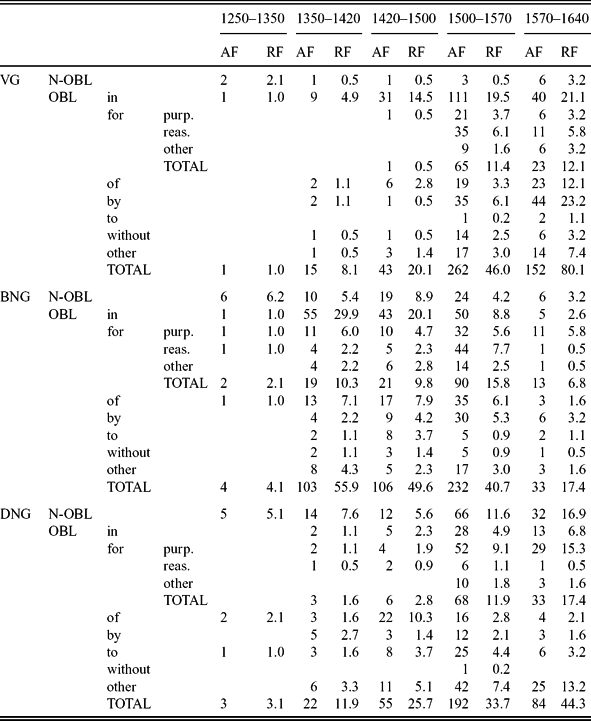
Verbal (VG), bare nominal (BNG), and definite nominal gerunds (DNG) with other prepositions than the most frequent six (absolute frequencies)

Verbal (VG), bare nominal (BNG), definite nominal (DNG), and definite hybrid gerunds (DHG) with (i) simple vs complex syntax and (ii) simple syntax vs with additional PP, in absolute frequencies (AF) and percentages (%)