How easy it is to listen to Winterreise anachronistically: to hear as impressionistic Wilhelm Müller’s and Franz Schubert’s evocations of a desolate winter landscape; to treat the cycle’s strange, increasingly fantastical obsessions – the weathervane, the old man’s head, the crow, the mock suns – as the obscure, mythic creations of a symbolist; to find in its wandering subject and his stark, fractured narrative the origins of modernist and existentialist alienation. How difficult it is to imagine Winterreise in its first performance: not in the concert hall, not with a grand piano, not with a trained voice (and certainly not with a baritone – the voice type that has made the strongest claim for the cycle in recent years); but in Franz von Schober’s apartment, with a tiny audience (perhaps only two members), performed on a slender fortepiano and with a light, modest tenor by Schubert himself.Footnote 1 Winterreise still moves us, still haunts us, and does so despite the two centuries of changing styles, tastes, politics and performance practices that have displaced us so radically from its origins.Footnote 2
Steeped in Ian Bostridge’s Winterreise – a virtuosic, multiplatform performance spanning three media: print (his new book, Schubert’s Winter’s Journey: Anatomy of an Obsession (2015)), film (the re-release of his dramatization of the cycle, accompanied by Julius Drake and directed by David Alden (1997)) and audio recording (the re-release of his studio recording, accompanied by Leif Ove Andsnes (2004)) – I lately find myself meditating on this perpetual ricochet between past and present.Footnote 3 Indeed, this ricochet seems to be a persistent source of tension in Bostridge’s interpretations of Schubert’s great cycle: his writings meander through the centuries, pursuing Winterreise and its reception history from multiple temporal perspectives; his introduction to the recordings embraces anachronism, calling Schubert ‘an expressionist, an absurdist, an existentialist avant la lettre’; and his unique performance style negotiates past and present tastes (intimacy and exhibitionism, naturalism and mannerism, formality and familiarity) in ways that few other singers can manage.
In the introduction to his book, Bostridge grants himself this historical license: he seeks to ‘set [Winterreise] in its historical context, but also find new and unexpected connections, both contemporary and long dead – literary, visual, psychological, scientific, and political’ (p. xiii). This ambitious project – ‘to explain, to justify, to contexualise and embroider’ Schubert’s cycle (p. xii) – distinguishes Bostridge’s book from the two other major English-language books on Winterreise: in historical musicology, Susan Youens’s Retracing a Winter’s Journey: Franz Schubert’s ‘Winterreise’, preceded by her indispensable introduction to Dover’s facsimile of the autograph score; and, in music theory and analysis, Lauri Suurpää’s Death in ‘Winterreise’: Musico-Poetic Association in Schubert’s Song Cycle.Footnote 4
Freed from the disciplinary rigors of musicology and theory, but supported by his training as a historian (DPhil, Oxford), Bostridge’s idiosyncratic (often fruitful, occasionally incautious) methodology treats Winterreise as a prism through which diverse histories, experiences and impressions are refracted. Each song receives its own chapter, prefaced by an original translation of Müller’s poem. Thus ‘Frühlingstraum’, with its descriptions of Eisblumen, prompts an extended investigation into the topos of the snowflake, drawing upon the history of science (Johannes Kepler, Immanuel Kant, Johann Wolfgang von Goethe, Wilson Bentley) and literature (Charlotte Brontë, Arthur Schopenhauer, Thomas Mann). Likewise, Bostridge’s chapter on ‘Letzte Hoffnung’ begins with a close reading of e.e. cummings’s poem ‘loneliness/a leaf falls’, then (by way of those disorienting off-beat accents that pervade Schubert’s accompaniment) digresses into the history of probability, statistics and normalcy, all of which were coming of age in the early nineteenth century; a postscript to the chapter offers ‘a scientific explanation for why … leaves fall from trees’ (p. 365). Readers will differ in their tolerance for such diversions, some of which are quite far-flung and tangential. (‘Auf dem Flusse’ prompts a somewhat embarrassing introduction to glaciers, global warming and the Ice Age.) To the sympathetic reader, however, their value will lie in linking the microscopic (Müller’s Eisblumen) with the macroscopic (crystals and the theory of life), the historical (winter temperatures in Vienna in the 1820s) with the contemporary (concerns about climate change). Performers seeking avenues into Müller’s verses will be especially well served. As Bostridge argues, ‘living a piece as complex and resonant as Winterreise means engaging with it in all sorts of ways: understanding what it might mean for us now, as a message in a bottle afloat in the cultural ocean in 1828. How does it relate to our current concerns? How does it connect with us, however unexpectedly?’ (p. 218) Clearly, this is as much Bostridge’s Winterreise as it is Schubert’s. The book’s subtitle – Anatomy of an Obsession – seems to suggest as much, possibly referring to both the cycle’s representation of obsession as well as Bostridge’s own obsession with Schubert’s work.
Bostridge’s political readings of Winterreise are among his most successful. Noting Wilhelm Müller’s youthful participation in the uprisings against Napoleon, Schubert’s proximity to subversive activities under the Metternich regime and Die Winterreise’s first printed appearance in the Taschenbuch Urania (a ‘suspect publication’, under scrutiny by government censors (p. 236)), Bostridge finds ‘political undercurrents which swirl beneath Winterreise’s Biedermeier surface’ (p. 31) – and does so with the cycle’s very first word. Fremd, notes Bostridge, aptly describes the political identities of Müller, Schubert and their contemporaries: ‘To live as a German in Dessau, or in Vienna, or in Lübeck in the 1820s was to live as a Fremdling, with a sense that national borders did not coincide with linguistic realities or cultural yearnings, a sense that to be a German nationalist was to be in opposition to the established order, to be at odds with authority. It was an experience of alienation (Entfremdung)’ (p. 30). Wintertime might also serve as an apt metaphor for the political chill, or the ‘frozen peace’, that befell Vienna after the heat of Napoleonic wars; in Bostridge’s imaginings, the ‘German-speaking world was under a spell a little like that which the White Witch casts in The Lion, the Witch, and the Wardrobe: always winter and never Christmas’ (p. 75). These are tentative (and, to this reviewer, quite compelling) speculations, but Bostridge does have at least one bold assertion to make about Winterreise’s political allegory. In the tenth song, ‘Rast’, the traveller finds rest in the ‘cramped house of a charcoal burner’. As Bostridge persuasively argues, the charcoal burner refers to the carbonari, the secret society of Italian revolutionaries whose uprisings in 1820–21 threatened the dominion of the Hapsburgs. Such a reading offers new insight into the repressed fierceness expressed in the song’s final stanza: ‘You too my heart, in battle and storm/So wild and so daring,/You feel in the stillness for the first time your worm/Stirring with hot pang’. (In performance, Bostridge punches out the word Kampf, perhaps highlighting its revolutionary implications.)
Bostridge’s political readings of Winterreise extend well past the Metternich era. In the chapter on ‘Gefrorne Tränen’, Bostridge reprints Anton von Werner’s famous painting Billet outside Paris, 24 October 1870 (1894), depicting Prussian soldiers on break from their duties for an impromptu performance of art song (Schubert’s ‘Am Meer’, according to Werner’s notes). The juxtapositions are striking: ‘On the one hand the image of war: muddy boots and uniforms, the notion of Prussian militarism placed at the heart of the German national mission, as means in the first place but also, ultimately, as value system; on the other hand, the notion of Bildung, of cultivation, of personal expression through quiet music, with the apotheosis of sensitivity’ (pp. 81–2). In a humbling deflation of Romanticism’s transcendental aspirations for music, Bostridge writes, ‘lieder singers today are the inheritors of this history, in both its positive and its negative aspects; we cannot escape it, nor should we wish to; we can, instead, seek to understand it’ (p. 82). German nationalism – its varied antecedents in the nineteenth century, its brutal consequents in the twentieth – has been negotiated by and through lieder, with not even Winterreise escaping unscathed.
The thorniest song in this reception history is, of course, ‘Der Lindenbaum’. Bostridge’s exhilarating chapter on the song begins with a tour of some notable linden trees in German culture (from Walther von der Vogelweide’s Under der linden to Goethe’s Die Leiden des jungen Werthers) and society (the Tanzlinde and the Dorflinde, ‘symbols of community and, indeed, of Germanness’ (p. 119)). Next up is Schubert’s ‘Lindenbaum’, widely disseminated in nineteenth-century songbooks and popular culture through Friedrich Silcher’s sanitized arrangement (all sweet nostalgia – no more cold winds, no more minor mode). The extent of its dissemination, of its saturation into German culture, is evidenced by Thomas Mann’s choice to use the song as a prominent leitmotive throughout The Magic Mountain (1924) – the subject of Bostridge’s next digression. Mann’s novel, writes Bostridge, suggests that ‘to grapple with death is the business of life and art; but that, at the same time, a “sympathy with death” can all too easily become pathological’ (p. 131). ‘Der Lindenbaum’, a favourite song of protagonist Hans Castorp, emblemizes Romantic Germanness – not just in its elevation of ‘profound art’ and ‘intimations of the folkloric’, but also in the sadism of its ‘death obsession’, famously critiqued by historian Gordon A. Craig (pp. 126, 131).Footnote 5 At the end of the novel, Castorp sings ‘Der Lindenbaum’ as he marches onto the battlefields of the First World War. Schubert’s song, by this point, symbolizes ‘[Mann’s] nation’s unhealthy sympathy with death and immersion in the past’ (p. 140). All of this raises some uncomfortable questions: To whom does Winterreise belong? With what are listeners complicit if they find themselves, through the beauty of Schubert’s music, relishing depictions of suffering and death or waxing nostalgic under his Lindenbaum? What sins of Romanticism do performances of this cycle perpetuate?
It is easier, I suppose, to sidestep these questions by attempting to appreciate Winterreise on its own terms, something Bostridge (despite his penchant for digression and aside) is amply capable of doing. A central concern of his book, after all, is the character and temperament of the cycle’s unnamed protagonist. For example, this gem of a paragraph (from the chapter on ‘Erstarrung’) beautifully summarizes the circular logic of the wanderer’s emotional torment:
There is something about the frozenness of our wanderer’s heart in which he finds both comfort and terror. It has the immobility, the impermeability, that the bereaved seek: the bereaved who do not want to forget the departed, the dead, but must hence, paradoxically, cling to the pain of bereavement. … He wants to be cold because only coldness preserves him from the disappointment of fulfilled desire. (p. 105)
Bostridge also spends a great deal of energy mining Müller’s poetry for clues about the wanderer’s backstory and the impetus for his journey. From little titbits – ‘Das Mädchen sprach von Liebe,/Die Mutter gar von Eh’’ (in ‘Gute Nacht’) and ‘Ihr Kind ist eine reiche Braut’ (in ‘Die Wetterfahne’) – Bostridge builds more speculative hypotheses about his cryptic subject, drawing inferences from the potential archetypes of the Byronic hero (‘a tragic figure the roots of whose predicament are never satisfactorily revealed’ (p. 9)) and the ‘house tutor’ (made infamous in Jean-Jacques Rousseau’s Julie, ou la nouvelle Héloïse (1761)). But such details are few and far between, and ‘the stinginess with information [becomes] a vital part of the way we become implicated in our protagonist’s fate, a piece of poetical legerdemain. We are drawn in by an obsessively confessional soul, apparently an emotional exhibitionist, who won’t give us the facts; but this allows us to supply the facts of our own lives, and make him our mirror’ (p. 11). In order to decipher its mystery and obscurity, we must make Müller’s Die Winterreise into our own. There is scarcely a mask to hide behind.
In performance, Bostridge’s wanderer alternates extreme, exquisite fragility with swaggered, sarcastic bravado. Has there ever been a more heartbreaking performance of the word ‘matt’ in ‘Das Wirtshaus’? It is a confession of weakness, a collapse of pretension, an exhausted plea for recognition and sympathy: tight /m/ to wide open /a/, no vibrato, fading ever so gently into a brief silence (Audio Example 1).Footnote 6 Bostridge adopts a similarly delicate, fragile timbre when his wanderer poses existential questions to himself and the world around him: addressing the snow in ‘Wasserflut’, he asks, ‘where does your path lead?’; addressing his heart in ‘Auf dem Flusse’, he asks, ‘do you recognize your image [in the frozen river]?’; to the titular figure of ‘Der Leiermann’, he asks, ‘should I go with you?’ (Audio Example 2). In these and other moments, Bostridge drops his vocal support, letting Schubert’s melodies instead drift into a dreamy space of heady resonance. Baritones performing this cycle often use the weight of their voice to bring a gruff world-weariness to the role. But Bostridge, his voice at times impossibly light, instead casts him as a brutalized but still innately gentle, naïve soul.
This temperament is complicated by the wanderer’s frequent tirades, which, in Bostridge’s reading, sound like elaborate posturing – bravado concealing an inner tenderness. The wanderer’s chief tool for emotional deflection is sarcasm: hear how Bostridge dismissively swings his voice through the wanderer’s first confession of madness (‘Die Wetterfahne’), or how a cheeky, self-deprecating vocal slide inflects what could have otherwise been a sincere question about snowflakes (‘Frühlingstraum’), or how he adopts a snidely nasal voice in the wanderer’s description of the fiery sky (‘Der stürmische Morgen’) (Audio Example 3). These are refreshing glimpses of humour in an otherwise bleak cycle; as Bostridge writes, ‘The absurd, the comical should never be resisted in Winterreise’ (p. 180).
Other outbursts emerge not from a position of anger or bitterness but of desperation, a characterization that emerges from some precariously uncontrolled vocal flailing. For example, in ‘Der Wegweiser’, Bostridge makes no attempt to hide Schubert’s odd declamation of the line ‘und suche Ruh’, barking out the unaccented word ‘und’ with abandon (Audio Example 4). His book explains: ‘Those repeated, plangent high notes [high G’s] are on the word “und” and the unwieldy emphasis on what would otherwise be an unimportant word gives the cry an added desperation’ (p. 403). Nor does Bostridge prettify the rhythmic complexities of ‘Rückblick’ and ‘Letzte Hoffnung’; indeed, accompanist Leif Ove Andsnes seems to be working at cross-purposes with his singer, making their collective task even more difficult by (for instance) overstressing the off-beats in ‘Rückblick’ (Audio Example 5). Thus foregrounded, the challenges of this song – including, as Bostridge writes, the ‘difficulty of spitting [words] out’, the ‘graphic picture of pursuit’ between voice and piano, the ‘breathlessness of expression’ (p. 190) – generate a precarious performance that mirrors the instability of the cycle’s protagonist.
Other examples of precarious performance seem to be the result of Bostridge’s vocal limitations. In particular, ‘Die Post’ stretches his vocal limits. The relentlessly repeated exclamations – ‘mein Herz!’ ‘mein Herz!’ – never quite land, wobbling too far from their target pitch and incongruously breaking from the prevailing timbre. The low register of ‘Im Dorfe’ also proves inhibiting. Bostridge struggles to project over the piano (also sitting in a low register), and his legato gives way to breathy declamation. In addition to these issues, Bostridge sings with a number of tics likely to irk voice pedagogues: he sometimes adds an /n/ before words that begin with an alveolar stop (like /d/ and /t/); he rushes through diphthongs, lingering on the second vowel too long; he clips unaccented final syllables of some words, withholding their vowel (the schwa, or /ə/) and instead humming their end consonant. More egregious is an overarching inconsistency of tone and timbre – heavy then light, dark then bright, resonant then thin, supported then (most dangerously of all!) unsupported. Bostridge’s voice is capable of an astonishing variety of colours, and he uses them to inflect (or inflict?) his words with great specificity. But the great lied singers (including Dietrich Fischer-Dieskau and Peter Schreier, both cited by Bostridge as early influences) manage to negotiate these declamatory inflections within a prevailing legato. Finally, Bostridge has a tendency to ‘scoop’, approaching a note by sliding upward to its pitch. The occasional vocal slide is a valuable expressive device, of course, but too many scoops will corrupt and sentimentalize a melody. The repeated notes in ‘Der Lindenbaum’ suffer especially from this overindulgence (Audio Example 6).
Such critiques adopt the stilted norms of classical vocal training and pedagogy, but Bostridge is something of an outsider (a Fremdling, if you like) from this tradition, having never studied music in a college or conservatory. This is not to say that he is an amateur or dilettante (his substantial body of music criticism, compiled in A Singer’s Notebook, demonstrates a masterful command of literature, history and vocal tradition), but rather that his approach to singing is deeply personal and idiosyncratic, unfiltered by convention.Footnote 7 His colloquial approach partially derives from the vocal techniques and singing styles idiomatic to popular music, an influence Bostridge acknowledges in his writings. (‘I’ve often reimagined ‘Der Leiermann’ as a sort of Bob Dylan song, best delivered outside the classical norms of singing’, he writes.) In an important chapter on ‘Der Leiermann’, Bostridge grapples with the constraints of taste, style and convention:
Styles of singing are convention-bound; they are heard by listeners as ‘natural’ or ‘mannered’ only within a context. The simple classical delivery of a folksong by a ‘trained’ voice may sound uptight and artificial to an audience used to hearing ‘Barbara Allen’ or ‘O Waly Waly’ in the nasal twang that has become associated with an ‘authentic’ voice. Crossing boundaries is perilous, and on the whole, opera singers sound as wrong in pop music as pop singers do in German song. Prejudice is at work here, and we are usually well advised to shed our aesthetic prejudices; nevertheless, the mysterious constraints of style, so difficult to catalogue and so essential (occasionally) to break, do crucial work in forming an engaged response to vocal music. We need the genres and subgenres of vocal music – classical, opera, ‘art song’, Wagner, Puccini, rap, scat, soul, country – to sound different. At the same time, seepage across the boundaries – respectful borrowings and outrageous thefts – does essential work in keeping any art form alive. (pp. 472–3)
Thesis, antithesis, synthesis: excessively conforming to a style can be stifling; excessively breaking from a style can be bewildering; but a happy medium surely exists between these two extremes. Bostridge continues:
Admiring vocalism across the border – from Bob Dylan to Billie Holiday to Frank Sinatra – I have always thought that, in principle, one should be influenced by these extraordinary singers and their compelling way of bending melody to words and vice versa. Classical song and popular song should not be so far apart; they share a lot both in their subject matter and in their aesthetic of intimacy. Mostly, however, the influence has to be a subliminal one, for only then can it avoid self-consciousness or a certain archness. (p. 473)
The many idiosyncrasies of Bostridge’s performance style – crooning (singing unsupported or ‘off the voice’, as pedagogues might say), sliding up to and between pitches, clipping final syllables, favouring declamation over legato – might be anathematic to classical performance but are natural to other, more popular singing methods. Intriguingly, this informal, conversational approach to singing might bring us more in line (in spirit, at least) with early nineteenth-century performance practices and aesthetics. As Schubert’s friend Leopold Sonnleithner wrote in his manifesto on Schubertian performance practice from 1860, ‘singers with merely a good voice and a natural singing style have had great success with these songs [Die schöne Müllerin]; for example, [Ludwig] Tietze and [Johanna] Lutz, neither of whom could claim a true knowledge of singing or higher aesthetics’.Footnote 8 Using vocal techniques that emulate popular traditions (Sonnleithner’s ‘natural singing style’), Bostridge’s performance style offers a possible contemporary analogue to the eighteenth- and nineteenth-century ideals of the Volkston – a style that, in the famous words of J.A.P. Schulz, presents the ‘appearance of the familiar’ (Schein des Bekannten).Footnote 9
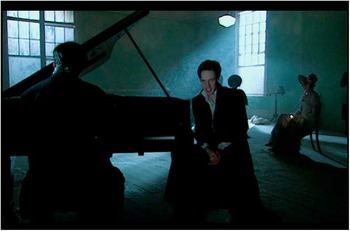
In a similar fashion, Bostridge’s filmed performance of Winterreise (produced for Channel 4 in 1997) strips away the potentially alienating conventions of modern recital culture for a more personal, more intimate performance. Bostridge wears a casual nineteenth-century costume instead of a tuxedo, sings on the set of an abandoned and dilapidated psychiatric hospital instead of a fancy recital hall, and directs his gaze not at a room of well-dressed, ticketed audience members but at you, the viewer. The directness of Bostridge’s stare, the depth of his sunken eyes, can be unnerving, producing an intense, uncomfortable intimacy (Figure 1). Recital performances of Winterreise inevitably have an exhibitionist streak: behold the singer and his great suffering! But through the (wholly artificial) privacy of the television screen, Bostridge’s wanderer adopts a confessional tone, singing even more softly and lightly than on the studio recording, discussed above. His questionings and pleadings, directed at the viewer, await your response. Performed for an intimate group of friends in the privacy of an apartment, Schubert’s first run-through of the cycle must have felt something like this.
Ian Bostridge in Winterreise, directed by David Alden. Warner Classics 620418 (2015), used with permission.

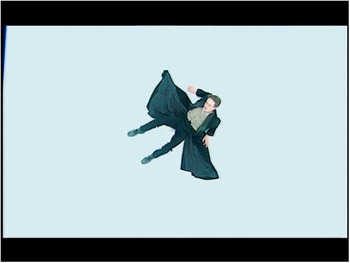
Managing the production is David Alden, the opera director on the vanguard of Regietheater in England. He gives Bostridge a limited number of props to use (a chair, a knife, some kindling that stands in for the Lindenbaum) and wide, empty spaces to play in (first that dilapidated hospital room, then an empty white void, finally returning to a cleaner, more refined version of the opening set, all designed by Ian MacNeil). Accompanist Julius Drake occasionally joins Bostridge onscreen, as does a family in period costume – ghosts, perhaps, or hallucinations (Figure 2)? But mostly Bostridge sings alone and remains still, while the handheld camera – its shakiness suggesting the persona of the viewer – moves around him. Alden’s staging of ‘Die Krähe’ is exemplary in this respect. Bostridge’s black costume blankets a white void, and the camera circles him from above (Figure 3). The crow is the camera, and the camera is the viewer: it is with us (not some invisible bird in the sky, not some mythical harbinger of death) that Bostridge’s wanderer pleads. We are implicated in his suffering. We are given the chance to alleviate it (‘Krähe, wunderliches Tier,/Willst mich nicht verlassen?’), yet we watch on.
Ian Bostridge, Julius Drake, and others in Winterreise, directed by David Alden. Warner Classics 620418 (2015), used with permission.

Ian Bostridge in Winterreise, directed by David Alden. Warner Classics 620418 (2015), used with permission.

There is much to admire in David Alden’s restrained directorial approach (especially when contrasted with David Weigl’s 1994 film – that’s the one with Brigitte Fassbaender, dressed as a nun). How befuddling, then, to watch the DVD’s ‘making of’ featurette Over the Top with Franz and learn that Alden’s film was only a partial realization of his original – ill-informed, inappropriate, even offensive – conception. The documentary includes excerpts from some excruciatingly awkward coachings, in which Alden encourages Bostridge and Drake to make their performances more gothic, more horrific, more violent, more freakish – in short, more ‘mad’. At one point, Alden demonstrates a line from ‘Gute Nacht’ by widening his eyes and sneering his face.
‘But now you look like a sort of mass murderer’, smirks Drake, barely concealing his scepticism here and throughout the documentary.
‘Well, yes, I think he’s sort of like that’, replies Alden. (Wait – what?)
To his immense credit, Bostridge resists these and other suggestions (including caressing a gun, adopting a contorted posture, and writhing on the floor with a knife). The finished product is a satisfying compromise of contradictory visions: Alden, urging a more ‘expressionistic’ (his word) performance; and Bostridge and Drake, defending Schubert’s score from the onslaught of absurdities.
This artistic struggle exemplifies many problems in the contemporary performance of Winterreise – the difficulty of empathizing with the cycle’s unabashedly Romantic sensibilities; the impossibility of remembering the lost world of house concerts, poetry readings, subversive secret societies and radical politics from which it emerged. We seek to sing, to play, to hear the suffering at the heart of Winterreise in a visceral manner, thereby avoiding the Romantic artificialities and contrivances so alien to modern modes of expression. In Over the Top with Franz, Alden and MacNeil grapple with these issues in a very frank and revealing way.
Working on his set design, MacNeil says, ‘I fear the cliché of the rather beautiful if slightly derelict room with someone playing the piano and someone singing’. (But, of course, that’s how Winterreise was first performed.) He continues, ‘How do we stop it from being boring? How do we stop the image [from] looking Romantic and banal?’ (But, of course, Winterreise is Romantic – not expressionist, not absurdist, not modernist, at least not in any twentieth-century understanding of those terms.)
Alden responds to MacNeil: ‘You mean [the problem is that] it’s music written in 1826 or something, and by its nature it’s rather beautiful in a way? Well, that’s tough. Schubert is beautiful’.
Yes, he certainly is. Through all of Winterreise’s sufferings and obsessions, its cryptic symbolism and sordid politics, how easy it is to forget that.