1. Introduction
In order to achieve societal objectives, such as prosperity and security, societies organise and govern themselves according to certain norms and rules. Two conditions are necessary for the organisation of societies to be sustainable. First, the society must be able to monitor to a sufficient degree whether the societal norms and rules are being adhered to. Second, discipline requires that there is some form of credible deterrent mechanism that can be activated if deviation is detected. Thus, the monitoring and enforcement of societal rules is an important part of a sustainable organisation of societies.
Societal enforcement systems consist of informal and formal enforcement arrangements. The informal enforcement is based on adherence to informal norms guiding the behaviour of individuals and also on a combination of self-enforcement, and dispersed and decentralised implementation. The formal enforcement system is implemented through formally constituted institutions characterised by explicitness of rules and consequences, and embodied in a number of tangible ways, such as monitoring authorities, a prosecution sector, executive organisations, and a variety of ceremonial displays and rituals.Reference North1, Reference Redmond2 In this paper we examine two types of enforcement systems, one formal and one informal, to study the determinants of different enforcement systems and their implications for society development. As a representative example for the informal enforcement system we study the religious enforcement system (RES),3 and as a representative example for the formal enforcement system we study the secular enforcement system (SES).4
Both the RES and the SES aim at monitoring and enforcing societal rules. However, they differ with respect to the underlying enforcement framework and with respect to their implications for societies’ development. The RES monitors and implements rules through a belief that the norms to which society adheres are divine and sanctioned by a supernatural power. In contrast, the monitoring and enforcement activities of the SES are implemented through a formal legal enforcement sector and an administrative infrastructure set up by humans based on the available knowledge and resources.
These differences between the two types of enforcement systems lead to differences in maintenance costs and in norm/rule adjustment costs. Together with the characteristics of the society these costs determine the societies’ choice of a particular enforcement system and have implications for that society's development.
The present paper examines the determinants of societies’ choice between two types of enforcement systems: the RES and the SES, and their implications for society development. More specifically, we address the following questions: what is the difference in the efficiency between the RES and the SES? What determines the choice between the RES and the SES? What are their implications for the development of society and for intra- and inter-societal conflicts?
2. The RES and SES: A comparative assessment
2.1. Assessment Framework
Several alternative theories have been put forward to explain the enforcement system choice or, as it is known in the literature, the institutional choice.Reference Chaves5, Reference Kingston and Caballero6 The theories of transactions cost economics (TCE) and class conflict (CC) are of particular importance for understanding societies’ choice between the RES and SES and their implications for development and conflicts. TCE argues that competitive pressures will push out inefficient forms of organisation and only the efficient enforcement forms, which ‘minimise the transactions costs’ of governing the society, will survive in the long-run. According to TCE, the basic cause of enforcement system change is an exogenous change in the determinants of transaction costs (e.g. enforcement, technology).Reference Alchian7 TCE predicts that as long as a more efficient enforcement system is attainable, it will sooner or later be adopted by the society.
The classical CC literature, in line with Karl Marx and Max Weber, implies that any institutional change of societies is a result of conflicting interests that arise between different classes over the division of resources, income and wealth, which may involve conflicts and may inflict harm. In the recent literature of political economy, this theory was refined and generalised to account for wider political and economic contexts (known as the theory of collective-choice), whereby the institutional choice is perceived as a centralised political process in which individuals and organisations engage in bargaining to change these rules for their own benefit.Reference Libecap8, Reference Ostrom9 According to this theory, the change of the enforcement system depends on the relative ‘economic’ size of the competing interest groups/classes and may or may not lead to an improvement of the enforcement system even in the presence of a more efficient alternative.Reference Aoki10
2.2. Implementation Mechanism
Following Chaves,Reference Chaves5 who puts religion in a wider societal context and considers its role with respect to secularism, we define RES ‘as a social structure that attempts to enforce its order and reach its ends by controlling the access of individuals to some desired goods, where the legitimating of that control includes some supernatural component, however weak’ (Ref. 5, pp 755–756).
Hence, the RES is an enforcement system based primarily on beliefs. The structure and motivation of norms within the RES is built around the supernatural component, as the monitoring, the collection of information, and the implementation of sanctions (and rewards) with the objective to enforce the societal norms is perceived to be implemented by a supernatural power (the God). Depending on the type of religion, the supernatural power is assumed to punish or reward after the death of individuals (e.g. Christianity, Islam) or through other spiritual forms (e.g. Scientology).Reference Choudhury11 Those individuals who do not obey religious norms are believed to be sanctioned while the honest members of society are believed to be rewarded by the supernatural power, i.e. a dishonest behaviour leads to damnation and an honest behaviour to salvation.Reference McCleary12
From a societal perspective, the main advantage of the RES is that its implementation costs are relatively low, because the monitoring and punishment (rewards) for breaching (respecting) the rules are ‘outsourced’ to an external power. The only costs of the RES are related to promotion (information transmission) of religious norms within the society/community. These costs include the building of churches, temples, religious symbols, the time spent in attending religious ceremonies, religious contributions, and so on.
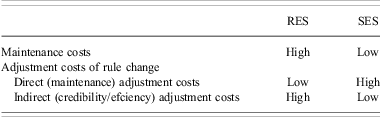
In contrast, the SES relies on contemporaneous monitoring and implementation of sanctions and rewards. It imposes sanctions directly on non-obeying individuals. This requires setting up an extensive legal enforcement sector (e.g. police, courts, prisons, legislative authority) able to monitor obedience, collect information and implement the sanctions and rewards. This implies that usually the system maintenance costs are comparably high under the SES, because the society must maintain an administrative infrastructure (legal enforcement sector) supporting the enforcement system. Thus, the maintenance costs are lower under the RES than under the SES for a given set of enforcement rules/norms (Table 1).
Maintenance and adjustment costs under the RES and SES

2.3. Efficiency
A further important determinant of the choice of an enforcement system is its efficiency in rules enforcement. Under the RES, the ability to enforce rules depends on the intensity of beliefs among society members. If beliefs are strong, then the individuals are more likely to obey the religious norms imposed by the society. The beliefs deter dishonest behaviour, because the individuals will tend to avoid a potential punishment from the supernatural power. In the opposite case, with weak beliefs, the religious norms will most often be disobeyed, because individuals are not constrained by the existence of potential sanctions in the case of dishonest behaviour. Hence, the credibility of the RES among believers plays a key role in attaining a high belief rate and thus ensuring the enforceability of religious norms.
The SES is based on contemporaneous implementation of sanctions and rewards. The efficiency of the SES depends on the ability of the formal legal enforcement sector to detect the breach of the rules and to implement sanctions. A well-functioning formal legal enforcement sector leads to a high detection rate and hence discourages dishonest behaviour among individuals. However, the legal enforcement sector is subject to the ‘agency problem’ (principal–agent problem). The enforcement of rules depends on the oversight of the society over the bureaucrats (agents), who administer the legal enforcement sector (principal). Variation in the intensity of the oversight creates opportunities and incentives for bureaucrats to deviate from the intentions or preferences of the society (e.g. through the collusive behaviour between bureaucrats and rule breakers, corruption, low power incentives of bureaucrats) implying that, in certain circumstances, the SES may lead to low enforceability of rules. This further implies that the efficiency of the SES may or may not be higher than the efficiency of the RES (or vice versa), which depends on the society's ability to build an efficient legal enforcement sector for implementing the rules.
2.4. Technological Change and Development
Exogenous shocks in external environment, such as new technologies, innovations, globalisation and climate change, may change both the needs for the enforcement of rules (demand for institutions) and the enforcement possibilities (supply of institutions). According to TCE, societies adjust their enforcement systems to accommodate the new needs and possibilities by changing the initial rules or by including new rules within those to which society adheres.Reference North1
The alteration of rules within a given enforcement system implies two types of adjustment costs: direct and indirect. The direct adjustment costs include actual costs induced by the adaptation of the enforcement system needed to be undertaken in order to implement the new/adjusted rules within the system (e.g. the change in maintenance costs, information costs, lobbying and bargaining costs). The indirect adjustment costs include the side-effects that the rule adjustment may inflict on the efficiency (credibility) of the enforcement system (on its ability to enforce rules). The indirect costs can be either negative or positive. For example, if the enforcement system adjustment improves the enforcement efficiency (credibility), then actually the side-effect is a benefit (i.e. negative adjustment costs).
The RES and the SES differ in terms of their capacity and flexibility to adjust the existing rules, because the two types of adjustment costs vary strongly between the two systems (Table 1). Under the RES the indirect adjustment costs are high, while under the SES the direct adjustment costs are more important. Under the RES the adjustment of rules may induce an indirect effect leading to a credibility loss of the enforcement system. Under the SES, the adjustment of rules alters the direct costs. In particular, the enforcement system maintenance costs are affected because the adaptation/extension of rules in SES may require the adjustment of the size of the legal enforcement sector. These differences in the adjustment costs have important implications for the development of societies by determining the capacity and the flexibility to adjust the rules within the two enforcement systems.
Under the RES the direct adjustment costs include the lobbying and bargaining costs for new religious norms, and the costs of informing society members about changes in the norms. The direct costs are relatively minor because the RES is not based on an enforcement sector, which would need to be adapted/extended with the norm adjustment (i.e. there are no maintenance costs). More significant are the indirect adjustment costs under the RES. They involve a credibility loss of the enforcement, because the RES is based on the idea that a supernatural power implements sanctions and rewards. Depending on the type of religion, sanctions are imposed after the death or through other spiritual manners. The asymmetry of information, however, makes it difficult to prove the existence of the supernatural power and the execution of rewards and sanctions, because they are not observable. The inability to validate the accuracy of religious norms and the inability to check for the implementation of sanctions and rewards makes the system dependent on beliefs. The norms need to be made credible within the society in order to create strong beliefs and to make them effective. This implies that a frequent adjustment of norms would damage the RES's credibility and its effectiveness declines. For example, if in one period the religion adheres to a given set of societal norms, while in the next period it adjusts/extends the set of the allowed rules, this would create incentives for individuals to deviate from respecting the norms, because they may expect future adjustments of norms in their favour, implying a reduced risk of being sanctioned by the supernatural power. Moreover, a frequent adjustment of norms brings uncertainty among believers. More people will question the existence of God if the ‘truth’ about him changes often. Thus, a frequent adjustment of religious norms reduces the intensity of belief and the number of believers.
The high indirect adjustment costs reduce the possibility to adjust the RES and make the system non-adaptive and rigid with respect to changing societal needs and developments.13 As a result, societies implementing the RES have a tendency to reject new economic and social developments, because their adoption in general implies a change or extension of the set of norms initially allowed leading to a decline in the credibility and the enforcement efficiency of the RES. To prevent credibility loss, religion-based societies tend to oppose and constrain new developments taking place in the society.14, 15
Under the SES, the direct adjustment costs of rule change/extension affect the size and the structure of the legal enforcement sector (i.e. the maintenance costs), but there are also the lobbying and bargaining costs for new rules and the costs of informing society about changes in the rules. Particularly important are the costs of adjusting the legal enforcement sector. The adjustment of rules requires the adaptation/extension of the system of monitoring, information collection, and the implementation of sanctions (and rewards). For example, in the case of an extension or/and a qualitative change of rules, the legal enforcement sector needs structural adjustment either through its expansion or through a restructuring of the enforcement mechanism. Both types of alterations affect the costs of the SES to the society. The indirect adjustment costs of the SES include the efficiency (credibility) change induced by the adaption of the legal enforcement system. In turn, the efficiency of the SES depends on the ability to implement the new/changed rules within the system; i.e. on the efficiency of the legal enforcement sector to enforce the new/changed rules. In general, under the SES, the indirect costs are relatively minor relative to indirect costs under the RES and could be positive or negative.16 As long as the society has sufficient resources available to cover the direct adjustment costs of the rule change/extension within the SES, the indirect costs are small or non-existent in the SES (Table 1).
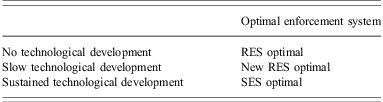
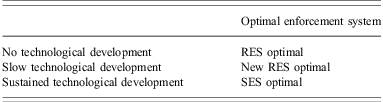
The costs inherent to the RES imply that it is less suitable for, and hence is less likely to be implemented in, dynamic, volatile and innovative societies. Instead, it is more likely to emerge in and sustain rigid, static and stable environments with well defined and persistent social and economic interactions.17 In such societies, the RES can well guide individuals’ behaviour without frequent adjustment of rules. On the other hand, if the RES is implemented in a dynamic environment, it may require frequent changes of rules leading to credibility loss of the system and hence low enforcement efficiency.
In contrast, its adjustment flexibility makes the SES more suitable to emerge in economically and socially dynamic, volatile and innovative societies with sufficient resources to finance a formal enforcement system. The adjustment of secular rules to accommodate new economic and social developments and innovations does not necessarily reduce the credibility of the system. Conditional on the resources available, the SES credibility change is neutral to the rule change,18 which makes it sustainable also in dynamically growing societies and more flexible in accommodating the societal demand for rule adjustments.
3. The Rise and Fall of Enforcement Institutions
In light of these differences between the enforcement systems, the following questions naturally arise: when do societies opt for a particular enforcement system, when do they switch from one enforcement system to another, and what are the implications for the development and stability of society?
We analyse the enforcement system choice by adopting a stylised approach starting from societies in their early stage of development with low productivity, limited resources and under autarky. In this setup we derive the optimal enforcement system. In Sections 3.2 and 3.3 we relax the initial assumptions by considering two extensions: (i) technological development; and (ii) interaction between societies. We investigate how these two extensions affect the choice of the optimal enforcement system and their subsequent impact on development.
3.1. Autarky
In their early stage of development societies have low productivity, limited resources and no/limited interactions with other societies (autarky). The early ancient agrarian economies resemble most closely this type of environment. These ancient societies did not create sufficient surpluses for implementing, financing and maintaining a formal legal enforcement sector. Their rudimentary technology and transportation system as well as a low accumulation of knowledge made the SES expensive and hence unattractive at that time. Relative to the available resources, the RES was the most cost efficient system. Additionally, the early ancient societies were characterised by a relatively stable social and economic environment. Social and economic structures were organised along self-sufficient types of households and communities. Usually, the communities were organised in social classes with well-defined obligations and rights. Trade was minimal, with the barter system (conducted mostly at a local/community level) dominating market transactions of goods.19 Interactions between societies were limited and had virtually no effect on the economic and social setup of the society. Technological development and innovation did not play a major role in the economy and society. Such a stable and static environment did not demand a frequent adaptation of the rules of behaviour and thus represented a sustainable environment for the RES.
3.2. Technological Development
Next, we examine the impact of an exogenous technological improvement, which increases the production possibilities of the economy. Technological development has wide social and economic implications. First, technological advancement creates new economic opportunities within the society. New technological advances stimulate the emergence of new production techniques/tools and the supply and demand of new commodities and services. In a society in its early stage of development this particularly affects the agricultural sector by boosting farm household productivity (e.g. by the introduction of new farming techniques, the development of new production tools, and/or improvement in yields). An indirect consequence is the emergence of new sectors specialised in the supply of technology-intensive products. Among other things, technological advancement increases economic prosperity and creates household/individual level production surpluses. The availability of surpluses intensifies interactions and exchanges within communities. The possibility to exchange goods and services further creates gains from specialisation because of the possibility to exchange excess/deficit production. A further important implication of the technological advancement is the fact that it may generate societal reorganisation. In particular, specialisation may lead to the formation of a new class system according to the production specialisation of individuals (e.g. craft specialisation). Different social groups may emerge depending on the specialised activities that they perform within the community.Reference Finley20
Such profound structural changes in the society may necessitate an adjustment of the enforcement system. The exploitation of new economic and social opportunities arising from technological progress may be constrained, creating large opportunity costs if they are not supported within the enforcement system. They may not emerge either because the new economic and social activities may be in contradiction with the initial norms of behaviour or because, if not enforced, individuals may not have an incentive to undertake them because of an inability to realise the gains. In such circumstances there will arise a need for enforcement system change. According to TCE theory, a system change is optimal and will occur when the productivity gains from a new system can compensate for the costs of system change. An adaptation of the existing RES to accommodate new societal needs within the enforcement system leads to high indirect adjustment costs. It causes a decrease of the RES's credibility and hence enforcement efficiency. Another option would be the adoption of the SES, which however is conditional on resource availability to finance the legal enforcement sector. For the moment we assume that a technology-induced productivity increase does not generate sufficient resources to finance the SES.
If the SES is not a feasible option, then the optimal path of institutional change tends to favour the replacement of the existing RES with a new RES or with a new denomination of the existing RES. Such an institutional change, a move from the existing RES to a new RES (denomination), was often observed in the ancient period and in the Middle Ages; for example Judaism evolved to Christianity and further to Islam.Reference Al Azm21 Similarly, intra-religion adjustments were observed: e.g. in Christianity the reformed Protestants split away from the orthodox Roman Catholic Church; similar development occurred in the Islam, for example, with the separation between Sunni and Shi'ite denominations. All these transitions show the common feature of an absolute refusal of the opposing religion (or denominations) and the introduction of a new/adjusted religion (or denomination) still based on the belief in an external (supernatural) power as the legitimate source of the new/adjusted norms.
A side-effect of the inter-intra-RES change is the potential for eruption of intra-societal conflicts. The conflicts could be a result of two driving forces: (i) the classical ‘class conflict’ and (ii) the conflict over the protection of the RES credibility.
First, the classical Marxist CC theory and its modern version collective-choice theory imply that a societal organisation change may imply frictions and confrontations, if it involves redistribution of wealth. The source of conflict is the heterogeneity of society, which may be stratified along many dimensions such as more productive versus less productive individuals, current generation versus future generations; ‘upper’ class versus ‘lower’ class, and so on. Due to societal heterogeneity, different members of a society may prefer different adjustments in institutions depending on the wealth distributional effects of the system change. This heterogeneity of interests is a potential source of confrontation among the societal groups, and was often the case in history.Reference Dahrendorf22–Reference Smith24 Moreover the system change may not occur in the presence of heterogeneity of interests. The transition to a new RES (denomination) is conditional on the emergence of a sufficiently strong group benefiting from the new system and ‘powerful’ enough to introduce its own rules over the opposing vested interests.
Second, the introduction of a new RES may stimulate certain religious groups to undertake actions aimed at protecting the credibility of their own (existing and/or new) RES (denomination). As discussed in Section 2, it follows that when two or more RES coexist, they reciprocally harm their credibility. For the existing RES, it is costly to adjust its norms or to accept the implementation of a new parallel system, because it is at the expense of its credibility. At the same time, the newly emerged RES (denomination) needs to build its own credibility in order to enforce its efficiency. For the new RES it is desirable to weaken the existing RES because this has an adverse effect on the latter's credibility. In principle, both the existing and the new RES (denomination) compete for a belief of the same nature (the belief in an external power) but differ in the type of norms they offer and want to enforce. If both RESs were to be implemented in a society, their efficiency will be mutually reduced as individuals could arbitrary move between them, and individuals would face a higher uncertainty of belief. One type of action that may be conducive to building the credibility of a RES is to induce a situation where the opposing RES (denomination) is perceived as an inferior choice by individuals in terms of guiding their (social and economic) life. This can include various types of actions spanning from propaganda to persecution but also by creating a situation of instability and insecurity among the members of the competing RES undertaken with the aim to eliminate or reduce the importance of the opposing RES.
A continuous and sustained expansion of new technologies further increases the production possibilities of the economy, fostering gains from specialisation and from intra-societal trade. Such a sustained growth-induced higher availability of resources may alter the enforcement equilibrium. The society under continuous technological development experiences growth of new economic and social activities leading to profound changes in economic and social institutions. Such structural changes require continuous adaptation of the enforcement system to accommodate new societal developments. Implementing RES in this dynamic environment creates high opportunity costs and the society will fail to benefit from economic and social changes. The inflexibility of the RES makes it unsuitable in an environment with constantly changing enforcement needs. Preserving and adapting the RES will lead to a continuous decline of its credibility and low enforcement efficiency. The sustained growth in resource availability may allow society to reorganise its enforcement system by switching to a more expensive but a more flexible SES. Although the SES has high direct adjustment costs (i.e. has high maintenance costs of the rule change), its advantage is low indirect adjustments costs (i.e. low efficiency/credibility loss to rule change). The reverse holds for the RES which has low direct but high indirect adjustment costs. This difference between the two systems makes the SES more suitable for adoption in dynamic growth-driven resource-abundant societies.
Over the last millennium, a gradual secularisation of societies (a general trend from the RES to the SES) can be observed in many regions around the world.Reference Dobbelaere25 With expanding technology, innovations and rising productivity, the RES was unable to secure the full benefits arising from the new economic and social developments. At the same time, economic growth and increasing productivity allowed for the financing of a legal enforcement sector specialised in the enforcement of rules. According to TCE theory, a system change is optimal and will occur when the productivity gains from a new system can compensate for the costs of the RES replacement, the SES set-up costs and the maintenance costs of the legal enforcement sector.Reference Weber26 However, it is difficult to identify and predict the exact time of transition from RES to SES for a given society. The timing associated with the system change depends on the particularities of each RES and on the characteristics of a particular society. Each type of RES is associated with different rules and thus implies different benefits to society as well as different costs of withdrawing it from enforcement of social and economic activities.Reference Platteau27 Additionally, the timing and the magnitude of the shift to the SES depends on the set-up costs of the SES and on the resource availability for financing the legal enforcement sector. Differences in the relative costs and benefits of the SES and RES may explain why certain regions have moved faster to the SES (e.g. Europe) while others are still predominantly implementing the RES (Middle-East, Africa).
Moreover, according to the collective-choice theory, under certain circumstances, particularly if the vested interests (the religious conservative groups) are strong, the institutional improvement may not occur even if individuals are rational and/or if a more efficient SES is attainable (contrary to TCE). Some regions may be stalled in low equilibrium by continuing to implement the RES for a long period, whereas other regions may move faster to SES and thus enhance their development. The transition to the SES is conditional on the emergence of sufficiently strong reformist groups benefiting from the new system and ‘powerful’ enough to introduce their own rules over the opposing vested interests. The formation of the reformist group or groups depends on the perception and the expectation of individuals about the potential benefits from the system change. For example, expectations about the growth and stability/instability under the SES may affect individuals’ preference for the SES and hence may affect the transition to the SES.
The transition from RES to SES normally takes a long time and is accompanied by multiple types of impact on the society. In particular, the adoption of the SES has huge implications for economic growth and may create strong divergences in the development with respect to the RES.Reference Acemoglu28 Regions implementing the SES have the potential for development, but this is conditional on the introduction of an efficient legal enforcement sector. Regions implementing the RES tend to stay underdeveloped, because the RES is not conducive to development. Instead, it constrains dynamic changes taking place in the society.
Similar to the RES–RES enforcement system change discussed above, the transition from RES to SES may also be accompanied by conflicts either due to classical ‘class conflict’ and/or due to conflict over the protection of the credibility of the outgoing RES.
A shift from the RES to the SES leads to a redistribution of wealth between the reformists, who would benefit from the new developments, and the conservative groups who may lose by the change. According to classical CC theory, the interaction between groups may be a cause of frictions and confrontations because it involves redistribution of wealth. The potential gains from the new developments provide an impulse to the reformist group to pressurise for structural adjustments to the enforcement system. The RES is unable to secure gains to them because of its inflexibility in accommodating norms' adjustment. At the same time, the conservative groups lose from the SES, because it shifts the control of economic and social activities away from the RES to the SES. These contradicting interests are potential sources of confrontation between the two societal interest groups.Reference Dahrendorf22, Reference Smith24
Second, the introduction of the SES may stimulate religious groups to undertake actions aimed at protecting the credibility of the RES. Such action may be of various types, including religious confrontations and conflicts. As discussed in Section 2, the adjustment of norms, including the implementation of a new enforcement system (SES or a new RES), is costly for the RES because it endangers the credibility and the enforceability of its norms. The introduction of the SES may affect each type of RES differently, which depends on the magnitude of the RES involvement in regulating social and economic activities.29 In the case of a comprehensive RES, which regulates all main societal activities, the emergence of an alternative enforcement system, such as the SES, will likely intersect with the interest of the RES and thus the RES credibility loss is imminent and hence requires the uptake of measures to protect the credibility. One type of action that may be help to preserve the credibility of the RES is to induce a situation where the SES will be perceived as an irrational choice by individuals in terms of serving as an enforcement system. Other types of action may span from propaganda to persecution, creating a situation of instability and insecurity within the SES.
3.3. Trade30
In this section we examine the impact of inter-societal interactions. Inter-societal interactions may result, for example, from technological improvement in transportation and communication. Trade may bring two dimensions to institutional settings: (i) the inter-societal technological spill-overs and gains from trade and globalisation and (ii) inter-societal enforcement system heterogeneity.
If there is a development gap between societies, technology spill-over may take place from the more developed society to the laggard one. The technological diffusion may be materialised in technological advancement and economic progress particularly in the laggard society. Additionally, gains from trade and globalisation may enhance inter-societal interactions and may foster economic progress in both societies. Both effects further enhance the need to adjust the enforcement system as they induce economic and social changes in the society. The internationally induced structural changes in the society have similar implications for the enforcement system choice as the intra-societal induced structural changes discussed in the previous section, but their impact is additional to the impact of the latter.31 The gains from inter-societal interactions may strengthen the economic and social pressures for enforcement system change.
The literature on trans-national institutional cross-effects argues that the heterogeneity in enforcement systems between trading societies adds a stress factor on their enforcement system.Reference Campbell32, Reference Streeck33 In addition to intra-societal conflicts, inter-societal conflicts may also emerge. The cause of intra-societal conflict is similar to the case of autarky discussed in the previous section. The inter-societal tensions arise when different societies relying on different institutional frameworks attempt to interact with each other, e.g. through trade. The interactions between societies require certain rules (analogous to rules for a society's members). Assuming that societies have the optimal institutional setting under autarky, the more different are the rules and norms of the interacting societies, the less likely they will be willing to adopt the rules and norms of the interaction (trading) partner. As a result, tensions and conflicts may arise between societies. On the one hand, because of comparative advantages, the societies involved in the inter-societal transactions would gain from interaction (trade). However, because of the costly adjustment of the enforcement system, none of the societies is willing to deviate from its equilibrium institutional setup, i.e. to adopt the trading partner's rules. In the stage of development were the RES is the optimal choice in all societies, the heterogeneity between societies may degenerate into an inter-societal conflict, if a society attempts to impose its RES over the other society's RES to exhaust the gains from trade. This is a class-type conflict, because it leads to wealth redistribution between societies, which affects heterogeneous interest groups differently. Inter-societal conflict over the protection of credibility of the RES may also emerge because the availability of an alternative RES in other societies threatens the credibility of the domestically implemented RES. Their credibility is mutually adversely affected, which potentially stimulates actions from both sides to harm the credibility of the RES available in the other society with the purpose of protecting the own RES credibility among one's own believers. This may, among others things, lead to inter-societal (inter-religious) conflicts and frictions (e.g. crusades).
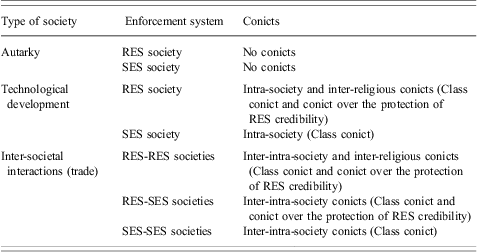
Next, consider a continuous and sustained expansion of new technologies and globalisation, where the SES may be an attainable choice as an enforcement system in some or in all societies. The inter-societal interactions bring forward global variation between the enforcement systems. For example, societies may implement a different enforcement system (RES versus SES) because they find themselves in different stages of development. This variation in enforcement systems may lead to diffusion of institution knowledge between societies but may also represent an additional source of conflict between societies when the inter-societal interactions take place between heterogeneous societies, e.g. between a SES-based society and a RES-based society (SES-RES), because both sources of conflict are present: the classical ‘class conflict’ and the conflict over the protection of the RES credibility. This result is similar to the previously discussed intra-society RES-SES conflict but it is international in nature (i.e. it is inter-societal). The inter-societal wealth redistribution caused by enforcement system change aimed at capturing the gains from trade may result in inter-societal ‘class conflict’. In the second case, the societies implementing the RES may tend to harm the societies implementing the SES in order to protect the credibility of their system (Table 3).
On the other hand, the conflict between homogeneous SES-SES societies may only be caused by wealth redistribution resulting from classical CC theory. An attempt to replace the enforcement system of a society's SES with an SES of the other society may lead to wealth redistribution between interest groups and societies, and potentially erupt in inter-society class confrontations. Inter-societal conflict over the protection of credibility (efficiency) is irrelevant and will not emerge in SES-SES societies, because the credibility (efficiency) of the domestically implemented SES does not depend on the type of the enforcement system implemented in other societies. The credibility of the SES depends solely on the productivity of the own formal legal enforcement sector (Table 3).
4. Conflicts between Enforcement Systems and the Scope for Policy
At the beginning of the third millennium, several regions around the world, particularly in the Middle East and Africa, still rely predominantly on the RES for enforcing societal rules. These societies are experiencing significant outside pressure due to globalisation, the existence of unexploited economic opportunities and technological knowledge available in developed regions. The insights from the previous sections suggest that the unsuitability of the RES in open and dynamic environments makes the RES societies socially unstable and vulnerable to upheavals.
These findings suggest that in the short- to medium-term future the sources for intra-/inter-societal conflicts will continue to exist due to socio-economic growth and prosperity of SES-based societies, and due to increasing worldwide globalisation. Second, the intra-/inter-societal conflicts to protect the credibility of the RES will continue be present because the credibility of the RES is threatened by pressures to introduce the SES and by the existence of the SES in other societies.
The first type of conflict (CC) can be partially mitigated by designing welfare-maximising policies in several ways. First, policy may engage in designing global institutions for inter-societal interactions. Second, policy can offer compensatory transfers for the interacting societies. Given that societies are different, the gains from interactions and globalisation are likely to be asymmetric. Some societies gain more from mutual interactions and globalisation than others. What is important, however, is that the total gains are positive. The policy's role would be to redistribute the aggregate gains from interactions between the interacting societies according to their relative gains/losses.
The second source of conflict (protection of credibility) is more complicated. The policy would need to address the underlying motives driving the conflict. An indirect policy would be the promotion of growth and stability in countries with the SES. This would affect individuals’ expectations about the SES, reduce support for the RES and hence for conflicts.
However, in the long run, with further progress of technologies and worldwide globalisation, one may expect that more adaptive and flexible enforcement systems implemented by the formal legal enforcement sector will replace the RES.34 According to TCE, competitive pressures will push out the inefficient forms of organisation and only the most efficient institutional forms will survive in the long-run. Maintaining the RES will lead to a continuously rising opportunity cost to society, which is unsustainable in the long run.
Our findings largely contradict the traditional views about the causes of societal conflicts, which were developed during the last few decades. According to the traditional view, inter-religion conflicts are expected to increase in the future.Reference Abanes35, Reference Jurgensmeyer36 HuntingtonReference Huntington37 argues that in the post-Cold War world the primary axis of conflict will be along cultural and religious lines. Barker and Muck38 argue that globalisation has fundamentally changed the nature of international interactions and has eliminated geographic proximity as a necessary condition for the development of religious conflict, thus making religious conflicts a global confrontation. Others argue that the regional and demographic distribution between Islam and Christianity is rapidly changing, thus potentially being a generator of inter-religious conflicts.Reference Jenkins39–Reference Johnson, Nichiporuk and Jenkins41 Jenkins argues that these wars maybe be fought with much more high-tech weapons. He argues that ‘the next crusade will be fought with nuclear weapons and anthrax’ (Ref. 39, p. 189).
Although in the short to medium run our results are in line with this traditional view, our findings suggest that in the long run the scope for inter-religious conflicts will decline. First, already the nature of conflicts where religion is involved is rather one-sided, with religion defending its historical position against secular and reformist interest groups. With few exceptions, most of the current conflicts are not inter-religious conflicts. The majority of religious conflicts around the world have a defensive nature, where conservative religious interest groups are defending their positions against intruders who attempt to introduce the more flexible SES. Moreover, these conflicts tend to be located in regions where the RES dominates and, as discussed in the previous sections, the actions of conservative groups protecting the RES credibility also have implications beyond the RES-societies.
The declining importance of inter-religious conflicts is evident in a longer historical perspective. The development-driven introduction of SES and the continuous withdrawal of the RES reduce the power of religious interest groups and thus reduces religious conflicts and tensions.
Second, the economic and political pressures to push out the RES from serving as an enforcement system will grow over time. The RES has a limited ability to ensure stability and economic benefits/profits to individuals in the presence of growing technological development, innovations, and globalisation. Thus, the interest of individuals to protect the existing RES or to introduce a new RES which, based on our findings, is unable to deliver definite benefits, will decline in future. This will further reduce the likelihood that there will arise conflicts over the introduction or defence of an existing RES. This indirectly implies that in the long run there is no need for a specific policy to address RES-SES conflicts and tensions. A sustainable policy would be to implement policies promoting long-run growth and prosperity in the SES, because a rising disparity between the RES and the SES-based societies will increase the pressure to reform the RES systems.
5. Conclusions
The main contribution of this paper is to provide a stylised framework for analysing the determinants and implications of different enforcement systems. Using the example of the RES and SES, we identify fundamental differences between different enforcement systems in terms of their flexibility of rule adjustment and in terms of maintenance and adjustment costs. The enforceability of the RES, which is based on beliefs, relies mainly on credibility. As a result, it has comparatively high indirect adjustment costs of rule change, because a frequent adjustment of rules would reduce the credibility and hence the enforceability of the RES norms. On the other hand, the RES is less costly to be implemented, because the monitoring of the rules’ implementation and the punishment (reward) for breaking (respecting) the rules are ‘outsourced’ to an external supernatural power.
In contrast, the SES is comparatively flexible with respect to adjusting rules, as it has comparatively low indirect adjustment costs of rule change. However, the SES relies on the contemporaneous implementation of sanctions and rewards. For this reason the SES has relatively high maintenance costs because society must finance a formal legal enforcement sector.
The example of the RES and the SES allows us to draw the following conclusions. (i) The rigidity-credibility characteristics of the RES make it likely to emerge and be sustained in rigid, conservative and stable environments with well defined and stable social and economic interactions (Table 2). Additionally, the RES is suitable to be implemented in low-resource societies, because its maintenance costs are low. (ii) The SES is likely to emerge and be sustained in economically and socially dynamic, expanding and innovative societies because it is less costly to adjust it to new societal needs thanks to its relatively low indirect adjustment costs (Table 2). However, the SES is more costly in terms of maintenance and hence is attainable only in wealthy societies. (iii) The use of the RES in dynamic environments (new technologies/innovations and worldwide globalisation) will constrain development and lead to conflicts and instability. Under the RES conflicts and instability may emerge for two reasons: because of ‘class’ conflict over the redistribution of wealth, and because of conflict over the protection of the RES credibility; whereas in the SES societies only the former source of conflict is present (Table 3). (iv) Interactions between RES-RES societies are susceptible to inter-religious conflicts in both stable and dynamic environments because of variation in RES type and because the gains from trade may stimulate conflict over the protection of RES credibility and class conflict, respectively (Table 3). (v) The economic and political pressures to push out the RES from serving as an enforcement system will grow in the long run because the RES has a declining ability to ensure stability and the economic benefits/profits from the newly available economic and social opportunities. This will reduce the scope for future religious conflicts. This is in contradiction with the traditional view on societal conflicts as discussed extensively in the professional literature over the last few decades.
Enforcement system equilibrium
Type and source of conflicts under different enforcement and trade equilibriums
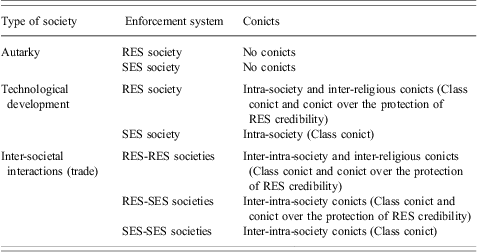
Note: Inter-religious conflict is defined as a confrontation between two or more religions to impose own rules or/and to protect its credibility with the aim to govern and enforce the economic and social activities in the society.
Pavel Ciaian is a researcher at the DG Joint Research Center (IPTS) of the European Commission and an associated researcher at the Centre for Institutions and Economic Performance at the Catholic University of Leuven and the Economics and Econometrics Research Institute (EERI) in Brussels. He received a PhD degree in Economics from the Catholic University of Leuven.
Jan Pokrivcak is an associate professor of international economics and public policy at the Department of Economics of the Slovenská Pol'nohospodárska Univerzita (SPU) in Nitra and an associated researcher at the Economics and Econometrics Research Institute (EERI) in Brussels. He obtained PhD and MS degrees from Cornell University and SPU.
d'Artis Kancs is a researcher at the DG Joint Research Center (IPTS) of the European Commission and an associated researcher at the Centre for Institutions and Economic Performance at the Catholic University of Leuven and the Economics and Econometrics Research Institute (EERI) in Brussels. He received a PhD degree from the London School of Economics and Political Science.