Introduction
During the past decade, ionic liquids (ILs) have attracted great interest as safe electrolytes for high-energy-density lithium batteries.Reference Sakaebe and Matsumoto1 Among known materials, lithium metal offers the largest specific capacity (up to 3860 mA h g−1) as a negative electrode. Unfortunately, serious safety issues surrounding lithium-metal batteries need to be resolved before they can be more widely utilized, especially for challenging applications, such as electric vehicles (EVs). Indeed, the use of highly energetic metallic lithium may lead to dendrite formation when non-uniform Li-plating occurs, resulting in dangerous short circuits.Reference Dollé, Sannier, Beaudoin, Trentin and Tarascon2 The highly flammable organic solvents commonly used in lithium batteries, such as alkyl carbonates, are recognized as the main cause of thermal runaway (i.e., a combination of highly exothermal reactions) in the case of short circuits, local heating, or in abuse conditions, such as overcharging. Uncontrolled thermal reactions in high-energy density Li batteries may obviously lead to explosions and fire. Hence, the quest for a nonflammable electrolyte system becomes crucial. ILs, entirely composed of ions and in the liquid state at ambient temperature (also see the Introductory article in this issue), are excellent candidates for alternative electrolytes and/or electrolyte components, based on their extraordinary properties, including nonflammability, negligible vapor pressure, good thermal and electrochemical stability, high ionic conductivity, and, in some cases, hydrophobicity.Reference Welton3 One of the major issues concerning the use of ILs in such systems is compatibility with the lithium metal anode (i.e., poor stability toward reduction). This can be overcome by the use of tailored ILs, such as those based on pyrrolidinium, piperidinium, and tetra-alkyl ammonium cations, having no double bonds or acidic protons reacting with lithium.Reference MacFarlane, Huang and Forsyth4
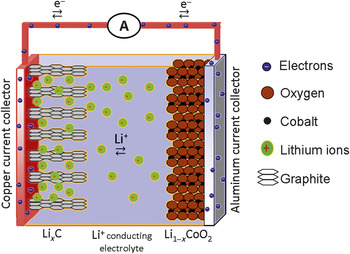
Nowadays, the most mature battery technology based on lithium is related to the so called lithium-ion configuration,Reference Scrosati and Garche5 wherein the lithium metal is replaced by carbon materials. In its most conventional structure, a lithium-ion battery contains a graphite anode, a cathode formed by a lithium metal oxide (LiMO2,) (e.g., LiCoO2), and an electrolyte consisting of a solution of a lithium salt (e.g., LiPF6) in mixed organic solvents (e.g., ethylene carbonate-dimethyl carbonate [EC-DMC]) embedded in a separator felt, such as glass fiber mats.Reference van Schalkwijk and Scrosati6Figure 1 shows a typical lithium-ion battery configuration operating on the following process:
 $$y{\rm{C}}\,{\rm{ + }}\,{\rm{LiMO}}_{\rm{2}} \mathbin{\lower.3ex\hbox{$\buildrel\textstyle\rightarrow\over {\smash{\leftarrow}\vphantom{_{\vbox to.5ex{\vss}}}}$}} {\rm{Li}}_x {\rm{C}}_y \,{\rm{ + }}\,{\rm{Li}}_{{\rm{(1 - }}x{\rm{)}}} {\rm{MO}}_{\rm{2}} {\rm{,}}\,x\,{\rm{\~}}\,{\rm{0}}{\rm{.5,}}\,y\,{\rm{ = }}\,{\rm{6,}}\,{\rm{voltage}}\,{\rm{\~3}}{\rm{.7}}\,{\rm{V,}}$$
which involves the reversible extraction and insertion of lithium ions between the two electrodes with concomitant removal and addition of electrons.
Schematic representation and principles of functioning of a common lithium-ion battery.

The presence of graphitized carbon anode materials in the present Li-ion batteries has restricted the use of ILs in such systems. This is because unstable formation of a solid-electrolyte interface (SEI) layer on graphite occurs. The widely investigated class of ILs based on saturated, cyclic, quaternary ammonium cations and on bis(trifluoromethanesulfonyl)imide (TFSI) anion is generally prone to side reactions, such as cation intercalation, leading to the exfoliation of the graphite layer and to IL decomposition during the first reduction. This becomes a source of extremely large, irreversible capacity.Reference Sakaebe, Matsumoto and Tatsumi7 Considerable effort has been focused on obtaining a stable SEI layer through which lithium ions can diffuse at a high rate in IL-containing lithium-ion batteries. Besides acting on the chemical nature of both IL cation and anion to control their final properties, another strategy consists of the inclusion of film-forming additives, such as vinylene carbonate or ethylene carbonate.Reference Wang, Zaghib, Guerfi, Bazito, Torresi and Dahn8 Also, the possibility of forming IL-alkyl carbonate mixed electrolytes, with the relative amount varying over a wide range of composition, has been considered.Reference Guerfi, Dontigny, Charest, Petitclerc, Lagacé, Vijh and Zaghib9 Hybrid electrolytes based on mixtures of ILs and carbonate solvents can favor the formation of a stable SEI and reduce the viscosity with respect to pure IL solutions while retaining less flammability.Reference Lane, Best, MacFarlane, Forsyth, Bayley and Hollenkamp10,Reference Larush, Borgel, Markevich, Haik, Zinigrad, Aurbach, Semrau and Schmidt11
Further improvements, in terms of safety and reliability, can be achieved by moving from liquid solutions to polymer electrolytes (PEs).Reference Fuller, Breda and Carlin12–Reference Zhu, Cheng and Yang16 Despite many favorable properties related to the nature of PEs, among which is negligible electrolyte leakage, practical batteries based on polymer electrolytes are currently confined to a small number of niche applications. Problems delaying their development include low conductivity of most solid PEs at ambient temperature and reactivity with the lithium metal electrode in solvent plasticized polymer systems. From this viewpoint, polymer electrolytes, resulting from a polymer matrix together with an IL, represent an attractive strategy, since they combine the mechanical and chemical stability of the polymer component with the intrinsic good conductivity, nonflammable nature, and high thermal stability of the IL component.
In this article, the most recent, appealing applications of IL compounds, mainly aimed at facing safety concerns in both lithium-metal and lithium-ion batteries, is critically reviewed, spanning from their use as a liquid electrolyte component to the formation of IL-based polymer systems.
Liquid electrolyte solutions containing ionic liquids
ILs as “solvents” for lithium salt
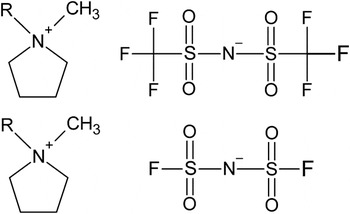
ILs based on N-alkyl-N-methyl-pyrrolidinium (PYR1x, where the subscripts indicate the number of carbons in the side chains on nitrogen), and bis(trifluoromethanesulfonyl)imide (TFSI) or bis(fluoromethanesulfonyl)imide (FSI) as the anion have been successfully proposed for application in lithium batteries because of their sub-ambient melting temperature, high room temperature conductivity, and suitable electrochemical stability.Reference MacFarlane, Sun, Forsyth, Meakin and Amini17–Reference Paillard, Zhou, Henderson, Appetecchi, Montanino and Passerini20 The structures of such ILs are shown in Figure 2. LiX/PYR1xX (X = FSI or TFSI, x = propyl, n-butyl) mixtures have been extensively investigated, showing good cycling reversibility into lithiumReference Kim, Appetecchi, Montanino, Alessandrini and Passerini21 and graphiteReference Appetecchi, Montanino, Balducci, Lux, Winter and Passerini22–Reference Sugimoto, Atsumi, Kikuta, Ishiko, Kono and Ishikawa25 anodes, and LiCoO2 cathodes.Reference Matsumoto, Sakaebe, Tatsumi, Kikuta, Ishiko and Kono26
Structure of ionic liquids widely proposed for application in lithium batteries (R = propyl, n-butyl).

Even though cyclability of the lithium-metal electrode in LiX-IL electrolytes has been claimed, the overall number of lithium plating-stripping cycles is, in most cases, limited to a few dozen cycles. This has been ascribed to the poor interfacial stability of the LiX-IL electrolyte in contact with metallic lithium. Howlett et al. suggested anion decomposition to be the reason for the limited stability of N-methyl-N-propylpyrrolidinium bis(trifluoromethanesulfonyl)imide (PYR13TFSI).Reference Howlett, Izgorodina, Forsyth and MacFarlane27 Recently, Passerini et al. demonstrated that high purity N-alkyl-N-methylpyrrolidinium TFSI ILs tested under anhydrous conditions in the absence of reactive gas traces were electrochemically stable at potentials compatible with the lithium-metal deposition.Reference Randstroem, Appetecchi, Lagergren, Moreno and Passerini28,Reference Randstroem, Montanino, Appetecchi, Lagergren, Moreno and Passerini29 In particular, the PYR14TFSI IL was shown to have an extremely low cathodic decomposition limit. Mixtures of this IL with LiTFSI were also found to be electrochemically stable to allow lithium-metal deposition.Reference Holzapfel, Jost and Novak30 However, although these have many favorable features,Reference Henderson and Passerini31 one main issue related to the transport properties and affecting the overall conductivity of these mixtures still limits their use in battery applications. The conductivity of these mixtures is connected to their viscosity, which, in turn, is dominated by the radius of the ions forming the IL.
The use of a lighter anion such as bis(fluorosulfonyl)imide (FSI) is thus highly desirable. Ishikawa and co-workersReference Ishikawa, Sugimoto, Kikuta, Ishiko and Kono32 first reported new IL systems based on the FSI anion as having very good ionic conductivity even at sub-ambient temperatures. Interestingly, lab-scale manufacturing of a “green” and safe lithium-ion battery prototype adopting the LiTFSI-PYR14FSI liquid electrolyte and Li4Ti5O12/LiFePO4 as anode/cathode materials has been developed.Reference Kim, Jeong, Xue, Balducci, Winter, Passerini, Alessandrini and Appetecchi33 The feasibility of this system for low-mid rate applications, such as renewable energy storage, was demonstrated. Electrolytes formed by dissolving LiTFSI in FSI-based ILs have been reported to allow reversible lithium insertion/deinsertion in graphite electrodes.Reference Zhou, Henderson, Appetecchi, Montanino and Passerini19 Unfortunately, the high cost, due to the more difficult purification of the FSI anion with respect to TFSI, prevents the usage of the FSI-based ILs on a larger scale.
In this respect, the strategy of combining different ILs formed by two anions has been pursued. In order to combine, in a synergistic way, the favorable properties of PYR14TFSI and its mixtures with lithium salts—having an overall stability window exceeding 5.5 V18—with those of PYR13FSI—exhibiting low viscosity and high conductivity (1.8 mS cm−1) also at low temperatures (−5°C)19—ternary PYR13FSI/PYR14TFSI/LiX mixtures were investigated, with LiX being lithium hexafluorophosphate (LiPF6) or LiTFSI.Reference Appetecchi, Montanino, Balducci, Lux, Winter and Passerini22 The attractive performance of these mixtures as electrolytes for lithium intercalation in graphite was reported. Also, the ternary mixtures showed higher ionic conductivities than the corresponding binary IL-LiX systems.Reference Appetecchi, Montanino, Balducci, Lux, Winter and Passerini22
Forsyth et al. proposed similar composite electrolytes in order to develop a low-melting temperature and high-fluidity IL for lithium-battery applications.Reference Bayley, Best, MacFarlane and Forsyth34 Particular attention was devoted to thermal and transport properties of the binary PYR13FSI/PYR13TFSI. It was concluded that a systematic investigation of the composition on the addition of the lithium salt can potentially improve the transport properties at room temperature but, more importantly, also greatly expand the temperature range of the liquid, providing a practical electrolyte with both low and high temperature stability.
To achieve new IL structures having no acidic protons and enhanced electrochemical stability, Fernicola et al. originally proposed PYR24TFSI/LiTFSI electrolyte solutions, wherein the IL cation differs from most conventional examples by the length of the side chains.Reference Fernicola, Croce, Scrosati, Watanabe and Ohno35 These systems showed long-term chemical stability toward lithium-metal electrodes with a lithium transference number, defined as the fraction of electric current carried by the lithium cation with respect to the overall current flow throughout the cell, equal to 0.4. The PYR24TFSI/LiTFSI solution was successfully adopted as the electrolyte in a new, very promising type of lithium-ion cell based on the combination of a surface-stabilized Sn–C anode with a LiFePO4 cathode.Reference Hassoun, Fernicola, Navarra, Panero and Scrosati36
A clear understanding of the influence of the IL structure on the properties of the electrolyte solution is not easy and requires multidisciplinary studies. As an example, Martinelli et al. investigated ionic conductivity and phase behavior as a function of composition in three LiTFSI-doped pyrrolidinium-based ILs (i.e., PYR14TFSI, PYR24TFSI, and PYR23TFSI).Reference Martinelli, Matic, Jacobsson, Borjesson, Fernicola and Scrosati37 It was found that the addition of LiTFSI to the pure ILs increases the glass transition temperature, decreases the melting temperature and the heat of fusion, and suppresses crystallization in PYR23TFSI and PYR24TFSI. The latter resulted in larger temperature windows of the liquid phase and, consequently, in wider temperature ranges for practical applications.
IL-based electrolytes with organic, molecular solvent additives
Although entirely composed of ions, ILs are not perfectly dissociated molten salts, often suffering from some degree of ion association.Reference Fraser, Izgorodina, Forsyth, Scott and MacFarlane38 In the case of IL lithium electrolytes containing the common TFSI anion, there may be up to four anions coordinated to each lithium ion. The resulting net negatively charged clustering contributes to the limited performance of lithium cells containing IL electrolytes, mainly in terms of low cycling rate, as the ion mobility is severely hindered by both the size and charge of the cluster. In addition, the migration contribution opposes diffusion in the overall mobility of the complex ion. Through the addition of traditional organic solvent diluents, a reduction in viscosity with a corresponding increase in conductivity as well as a breakup of ion clusters may be achieved.Reference Hardwick, Holzapfel, Wokaun and Novak39 Such enhancement would result in more favorable lithium electrochemistry, while potentially maintaining the “safe” aspect that ILs provide.Reference Choi, Eo, MacFarlane, Forsyth, Cha and Kim40 Although numerous studies have investigated ILs in the presence of a cosolvent, a detailed understanding of their behavior has not been entirely developed.Reference Nama, Kumar, Pregosin, Geldbach and Dyson41
Forsyth and co-workers investigated a range of conventional solvents (i.e., tetrahydrofuran, vinylene carbonate [VC], ethylene carbonate, and toluene) to elucidate their effect on the transport properties of a PYR13TFSI/LiTFSI electrolyte solution.Reference Bayley, Lane, Rocher, Clare, Best, MacFarlane and Forsyth42 They clearly demonstrated that the transport properties can be tuned by the addition of reasonably small amounts of a carefully selected neutral organic molecule.
Another reason for using organic carbonate solvents as additives in common IL electrolytes is related to their film-forming ability on graphite anodes. VC has been proposed to promote the formation of stable SEI on carbonaceous materials in pyrrolidinium-based solutions.Reference Appetecchi, Montanino, Balducci, Lux, Winter and Passerini22,Reference Lewandowski and Swiderska-Mocek43 Recently, Mastragostino and co-workers published the first data on the dynamic functioning of a safe lithium-ion battery, consisting of a PYR14TFSI/LiTFSI—VC 10 wt% electrolyte and graphite/LiFePO4 as anode/cathode materials, for power-assisted hybrid electric vehicle applications.Reference Damen, Lazzari and Mastragostino44
Mixtures of ILs and standard electrolyte solutions
It has been recognized that the presence of ILs in standard electrolytes may contribute to increased electrochemical and thermal stabilities and reduce the overall flammability of the solutions. However, there is no a priori knowledge regarding which IL system may be relevant and suitable as an additive, and a great deal of screening work is required in which large matrices of combinations should be studied.Reference Larush, Borgel, Markevich, Haik, Zinigrad, Aurbach, Semrau and Schmidt11
In order to make the best choice of the electrolyte composition for use in a practical Li-ion battery, flammability, conductivity, and viscosity of the electrolyte should be taken into account as critical requirements. Guerfi et al. demonstrated that mixed electrolytes, based on ethylene carbonate-diethylene carbonate (EC-DEC) 1M LiPF6 and 1-ethyl-3-methylimidazolium bis(trifluoromethanesulfonyl)imide (EMI TFSI), can improve performance without compromising safety.Reference Guerfi, Dontigny, Charest, Petitclerc, Lagacé, Vijh and Zaghib9 An optimum range for viscosity and ionic conductivity was found to be between 30% and 40% IL in the organic electrolyte. By adding IL, the performance of the graphite anode was also improved, and lithium intercalation occurred successfully, despite the utilization of IL based on TFSI anion.Reference Guerfi, Dontigny, Charest, Petitclerc, Lagacé, Vijh and Zaghib9
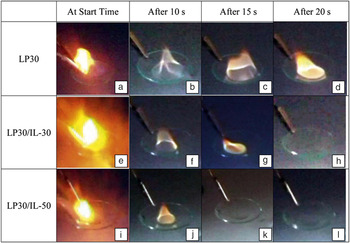
Many other works aimed at determining the electrochemical and thermal stability of IL-carbonate mixtures are reported in the literature.Reference Lombardo, Brutti, Navarra, Panero and Reale45–Reference Arbizzani, Gabrielli and Mastragostino47 An elegant way to evaluate the flammability of liquid electrolytes consists of self-extinguishing time evaluations.Reference Xu, Ding, Zhang, Allen and Jow48 An example of such tests is depicted in Figure 3. Clearly, by increasing the amount of IL in the sample, the flame extinguishing time decreases significantly, thus highly improving safety. This effect is due to the nonflammable nature of pure IL (i.e., PYR14TFSI).
Pictures of the flammability performances of LP30 (i.e., commercial EC-DMC/LiPF6 1M electrolyte from Merck) at (a) starting time, (b) after 10 s, (c) after 15 s, and (d) after 20 s; of LP30/PYR14TFSI 70/30 wt/wt at (e) starting time, (f) after 10 s, (g) after 15 s, and (h) after 20 s; and of LP30/PYR14TFSI 50/50 wt/wt at (i) starting time, (j) after 10 s, (k) after 15 s, and (l) after 20 s.Reference Lombardo, Brutti, Navarra, Panero and Reale45 Note: EC-DMC, ethylene carbonate-dimethyl carbonate; PYR14TFSI, N-methyl-N-butylpyrrolidinium bis(trifluoromethanesulfonyl)imide. Reprinted with permission from Reference 45. © 2013, Elsevier.

Polymer electrolyte membranes containing ionic liquids
Dry (molecular solvent free) solid, flexible polymer electrolytes suitable for high energy density lithium-metal batteries are highly desirable. Despite more than 20 years of research devoted to optimizing such materials, they still suffer from low room temperature ionic conductivities (<10–4 S cm–1).Reference Tarascon and Armand49
With the aim of combining the favorable properties of polymer electrolytes and ILs, in terms of safety and reliability, the realization of IL-containing PEs has been investigated.Reference Shin, Henderson and Passerini50–Reference Shin, Henderson, Appetecchi, Alessandrini and Passerini52 The results of these studies showed that the addition of ILs to conventional polymer electrolytes, such as those based on poly(ethylene oxide) (PEO), dramatically increases ionic conductivity, without negative effects on mechanical stability. Recently, Appetecchi et al. developed rechargeable, all solid-state, solvent-free, Li/LiFePO4 polymer batteries incorporating PYR14TFSI IL.Reference Appetecchi, Kim, Montanino, Alessandrini and Passerini53 Interestingly, it was demonstrated that the use of such an IL in PEO/LiX polymer electrolytes allows for a reduction in the operative temperature of lithium-metal polymer batteries down to room temperature without depleting the chemical/electrochemical properties. These PEs were also found to greatly enhance the safety of the battery under thermal, mechanical, and electrical abuse and misuse conditions.Reference Balducci, Jeong, Kim, Passerini, Winter, Schmuck, Appetecchi, Marcilla, Mecerreyes, Barsukov, Khomenko, Cantero, De Meatza, Holzapfel and Tran54
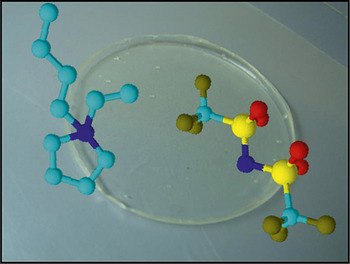
Other types of PEs combining ILs and suitable polymer matrices are the so-called gelled systems, prepared by solvent casting techniques.Reference Fuller, Breda and Carlin12,Reference Fuller, Breda and Carlin55 The most interesting examples are based on poly(vinylidene fluoride-co-hexafluoropropylene) copolymer (PVdF-HFP).Reference Scrosati and Garche5,Reference Kim, Park, Choi and Lee56 The highly chemical and anodically stable PVdF-HFP matrix, capable of trapping large amounts of liquid solutions while retaining sufficient mechanical integrity for film processing, can be successfully combined with safe, non-volatile IL electrolytes. To promote transport properties and reduce the electrode/electrolyte impedance, fluidity-promoting and film-forming organic additives were considered in IL/PVdF-HFP/LiX systems.Reference Sirisopanaporn, Fernicola and Scrosati57–Reference Sivakkumar, MacFarlane, Forsyth and Kim59 Scrosati et al. proposed gel-type polymer electrolytes formed by immobilizing LiTFSI/PYR24TFSI electrolyte solution containing EC/PC/DMC molecular solvents into the PVdF-HFP matrix.Reference Navarra, Manzi, Lombardo, Panero and Scrosati60 The addition of the organic solvent mixture resulted in very high conductivity values, on the order of 10–3–10–2 S cm–1, over a wide range of temperatures. A picture representing the successful combination of PYR24TFSI IL and a PVdF-HFP copolymer, resulting in self-standing, flexible membranes, is shown in Figure 4.
An image qualitatively representing the poly(vinylidene fluoride-co-hexafluoropropylene) (PVdF-HFP)-based electrolyte membrane incorporating the N-ethyl-N-butylpyrrolidinium bis(trifluoromethanesulfonyl)imide (PYR24TFSI) ionic liquid, here shown through its molecular structure (blue: nitrogen; cyan: methyl or methylene group; red: oxygen; yellow: sulfur; dark green: fluorine).

Conclusions
Although lithium and lithium-ion cells have tremendous potential, the flammability of the organic electrolyte hinders their consideration for large-scale applications, where the battery is expected to operate over a wide temperature range without compromising safety. To combat flammability, highly stable ionic liquids (ILs) have been widely investigated as electrolytes. Significant studies, both fundamental and applicative, face the use of ILs in lithium-based electrochemical devices. Successful approaches to solve ion diffusion and transport limitations related to the viscosity of ILs have been proposed and reviewed in the present article. IL-based battery prototypes have been demonstrated, delivering performances similar to those achieved with conventional organic electrolytes, with small constraints related to very high current density rates still to be overcome. Safety tests performed on small-scale cells have confirmed the high tolerance of IL-based lithium battery chemistries under thermal, mechanical, and electrical abuse and misuse conditions. Safety characteristics need to be validated for larger scale batteries, requiring the efforts of both academic and industrial research groups.
Acknowledgments
The author wishes to thank Profs. Stefania Panero and Bruno Scrosati for their guidance. Fruitful collaborations with Profs. Steve Greenbaum, Aleksandar Matic, and Hiroyuki Ohno addressing the research in the field of ILs for lithium batteries and contributing to informing the author on this topic are also acknowledged.