

Introduction
Links between diet and cardiovascular disease and the large number of health ailments associated with metabolic syndrome are well established (Riccardi and Rivellese Reference Riccardi and Rivellese2000; Ebbesson and others Reference Ebbesson, Adler, Risica, Ebbesson, Yeh, Go, Doolittle, Ehlert, Swenson and Robbins2005; Ramsden and others Reference Ramsden, Faurot, Carrera–Bastos, Cordain, De Lorgeril and Sperling2009). Over the past 100 years, the diets of societies in North America and elsewhere in the world have moved toward a so–called ‘western diet’, which describes a diet composed primarily of highly–processed ‘factory foods’ characterised by high levels of sugars, low levels of fiber, low levels of omega–3 (n–3) and high levels of omega–6 (n–6) and saturated fatty acids (FA)(Cordain and others Reference Cordain, Eaton, Sebastian, Mann, Lindeberg, Watkins, O'Keefe and Brand–Miller2005; Ramsden and others Reference Ramsden, Faurot, Carrera–Bastos, Cordain, De Lorgeril and Sperling2009). This ‘nutrition transition’ has been identified as playing a central role in the epidemic nature of numerous health challenges (Popkin Reference Popkin2004; Cordain and others Reference Cordain, Eaton, Sebastian, Mann, Lindeberg, Watkins, O'Keefe and Brand–Miller2005). Climate change, transport of contaminants and the tainting of the global food supply system have increased the vulnerability of the Arctic. The traditional food ways of Arctic peoples, for example, are known to support health in a variety of biophysical and psychosocial dimensions (Bjerregaard and others Reference Bjerregaard, Young, Dewailly and Ebbesson2004; Samson and Pretty Reference Samson and Pretty2006; Loring and Gerlach Reference Loring and Gerlach2009; Loring and others Reference Loring, Duffy and Murray2010). Studies show that many of these northern societies have had historically low incidence of obesity, diabetes, cancer and cardiovascular disease (Bang and others Reference Bang, Dyerberg and Nielsen1971; Dyerberg and others Reference Dyerberg, Bang and Hjorne1975; Lanier and others Reference Lanier, Kelly, Maxwell, McEvoy and Homan2006; Martinsen and others Reference Martinsen, Jorgensen, Bjerregaard, Krasnik, Carstensen and Borch–Johnsen2006; Mozaffarian and Rimm Reference Mozaffarian and Rimm2006). As these populations continue to effect a transition to a more ‘western diet’, however, a substantial increase in risk factors and disease prevalence ensues (Kuhnlein and others Reference Kuhnlein, Receveur, Soueida and Egeland2004; Ebbesson and others Reference Ebbesson, Adler, Risica, Ebbesson, Yeh, Go, Doolittle, Ehlert, Swenson and Robbins2005; Ramsden and others Reference Ramsden, Faurot, Carrera–Bastos, Cordain, De Lorgeril and Sperling2009).
Numerous health benefits can be attributed to a diet rich in omega–3 fatty acids and polyphenolic compounds offered from indigenous foods (Storlien and others Reference Storlien, Kraegen, Chisholm, Ford, Bruce and Pascoe1987; Adler and others Reference Adler, Boyko, Schraer and Murphy1994; McGrath–Hanna and others Reference McGrath–Hanna, Greene, Tavernier and Bult–Ito2003; Sonne and others Reference Sonne, Fonfara, Dietz, Kirkegaard, Letcher, Shahmiri, Andersen and Moller2007; Loring and others Reference Loring, Duffy and Murray2010). Fish and sea mammals are a rich source of omega–3 fatty acids, namely eicosapentaenoic acid (EPA; 20:5n–3) and docosahexaenoic acid (DHA; 22:6n–3). A group of Greenlandic Eskimos that subsist on an indigenous diet made up primarily of fish and sea mammals, high in omega–3 fatty acids, display a remarkably low prevalence of cardiovascular disease. The researchers attributed these findings to the active antithrombotic activity of omega–3 fatty acids (Bang and others Reference Bang, Dyerberg and Nielsen1971; Dyerberg and others Reference Dyerberg, Bang and Hjorne1975).
Several studies have shown that diets high in EPA and DHA display a marked increase in the incorporation of EPA and DHA into the membranes of cells involved in inflammation (Calder and others Reference Calder, Yaqoob, Thies, Wallace and Miles2002; Trebble and others Reference Trebble, Arden, Stroud, Wootton, Burdge, Miles, Ballinger, Thompson and Calder2003). Arachidonic acid (AA; 20:4n–6) in the cell wall is cleaved by phospholipase A2 to form eicosanoids, which are modulators of inflammation and immunity. Eicosanoids include prostaglandins (PG), thromboxanes (TX), leukotrienes (LT), lipoxins, hydroperoxy–eicosatetraenoic acids and hydroxyeicosatetraenoic acids (HETE). EPA and DHA compete with AA for incorporation into cell membranes. Omega–3 and omega–6 fatty acids pathways share the same enzymes leading to the synthesis of LTs and PGs (Simopoulos Reference Simopoulos2002), but EPA and DHA reduce the generation of inflammation by forming less active eicosanoid products. In addition, dietary fish oil leads to a decrease in overall PG synthesis, and studies have shown that supplementing with omega–3 fatty acids or fish oil has an immunosuppressant effect (Ciubotaru and others Reference Ciubotaru, Lee and Wander2003; Trebble and others Reference Trebble, Arden, Stroud, Wootton, Burdge, Miles, Ballinger, Thompson and Calder2003). In contrast, diets high in saturated fatty acids, such as palmitic acid (PA), and omega–6 fatty acids are associated with cardiovascular disease, insulin resistance, and metabolic syndrome (Ebbesson and others Reference Ebbesson, Adler, Risica, Ebbesson, Yeh, Go, Doolittle, Ehlert, Swenson and Robbins2005; Ramsden and others Reference Ramsden, Faurot, Carrera–Bastos, Cordain, De Lorgeril and Sperling2009).
In this study we used sled dogs as an Arctic sentinel for monitoring the effect of a changing diet on lipid profiles in subsistence fed sled dogs in villages along the Yukon River of Alaska. The residents of these remote, rural communities live a subsistence lifestyle and uphold traditional cultural and spiritual values. Most of these villages are small settlements, established on or near rivers to facilitate travel and to gather their food supply. The diets of both the people and their sled dogs are often quite similar, comprised of a variety of wild game, fish and marine mammals. Salmon is the primary food source for people and sled dogs throughout the year (McGrath–Hanna and others Reference McGrath–Hanna, Greene, Tavernier and Bult–Ito2003; Wolfe Reference Wolfe2004). Sled dog mushing is both a popular sport and a fundamental part of rural life, used for trapping, packing and transportation. Sled dogs are unique research models with potential to provide a proxy for studying and observing environmental health impacts (Dunlap and others Reference Dunlap, Reynolds, Bowers and Duffy2007). In northern climates, sled dogs are exposed to the same environmental conditions as their human counterparts (Korytko Reference Korytko, Casey, Bush and Quimby1999). They can be found all over the Arctic, in relatively large numbers of genetically similar animals that have been raised, exercised, and housed in similar conditions. Dogs in general have become an accepted medical model for aging, immune function, toxicology and cognitive disorders because they share many biochemical and physiological pathways with humans (Strasser and others Reference Strasser, Niedermuller, Hofecker and Laber1993; Adams and others Reference Adams, Chan, Callahan, Siwak, Tapp, Ikeda–Douglas, Atkinson, Head, Cotman and Milgram2000; Greeley and others Reference Greeley, Ballam, Harrison, Kealy, Lawler and Segre2001; Milgram and others Reference Milgram, Zicker, Head, Muggenburg, Murphey, Ikeda–Douglas and Cotman2002; Sonne and others Reference Sonne, Fonfara, Dietz, Kirkegaard, Letcher, Shahmiri, Andersen and Moller2007).
In the pilot research reported here, plasma lipid profiles were assessed in subsistence fed sled dogs along the Yukon River, to test the hypothesis that sled dogs, with the village subsistence diet, would have higher omega–3 fatty acid levels than commercially fed sled dogs. Six lipids were quantified and correlated with location along the river (EPA, DHA, AA, PA (palmitic acid), linoleic acid (LA; 18:3n–6), and α–linolenic acid (αLA; 18:3n–3). The later two fatty acids were analysed in addition to the aforementioned lipids because they are considered the ‘essential’ omega–6 and omega–3 fatty acid, respectively. While omega 3 and 6 fatty acids cannot be made in humans and dogs, LA and αLA, plant–derived 18 carbon fatty acids, can be converted, albeit somewhat constrained, to either AA or EPA. The western diet is believed to be a primary cause of the increase in age related diseases in the Arctic, partly due to increasing omega–6 and saturated fatty acids composition. The replacement of foods high in omega–3 fatty acids with those high in omega–6 fatty acids has had devastating metabolic effects (McLaughlin and others Reference McLaughlin, Middaugh, Utermohle, Asay, Fenaughty and Eberhart–Phillips2004). The aim of this study was to measure plasma lipid composition in subsistence fed animals from four villages along the Yukon River and one commercially fed control group to determine whether differences in baseline FA and THg values exist between sites and whether values are correlated. The type and amount of lipids in the diet has a tremendous impact on immune function and contaminant accumulation. This stresses the need for monitoring changes in biomarkers as a result of diet and location. Furthermore, this study illustrates the uniqueness of sled dogs as a model for a changing nutritional and environmental milieu.
Material and methods
Animals
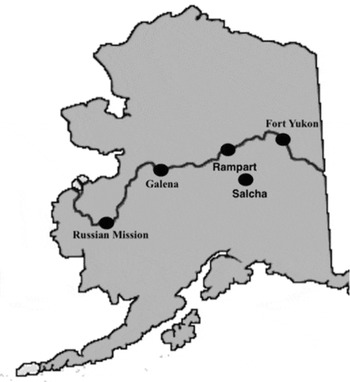
Alaskan huskies, Canis lupis familiaris raised in 4 villages along the Yukon River in Alaska and a reference kennels located in Salsha, Alaska (65°N) were used as test subjects (Fig. 1). The Institutional Animal Use and Care Committee at the University of Alaska Fairbanks approved this study (#04–16). There were 12 dogs sampled at each site, including the reference kennel. The village dogs were in or around Russian Mission (62°N), Galena (64°N), Rampart (65°N), and Fort Yukon (66°N). The dogs that were used in this study were typical racing sled dogs with similar lineage, sex and age range. All dogs ranged from 1 to 8 years of age with the majority of the dogs within the peak racing years of 2 to 5. Each kennel had an even sex distribution, with Galena, Rampart, and Salcha having slightly more females. Housing arrangements varied from kennel to kennel, but most of the dogs were tethered with 2 m chains with access to shelter, water and food (Dunlap and others Reference Dunlap, Reynolds, Bowers and Duffy2007).
Map of Alaska with sample locations along the Yukon River.

Diet
A 2 month diet recall was administered to each village kennel owner. Village dogs were primarily maintained on subsistence diets, which included black bear, moose, pike, and salmon. Some diets were supplemented with donated leftovers from the community and commercial feed within the past 2 months. However, more than 90% of the food source in all villages in the past 2 months was seasonal cooked salmon from local salmon runs. Local salmon runs for Galena, Rampart and Fort Yukon comprise chum salmon, while salmon for Russian Mission is mostly silver salmon. The time of year for sampling was chosen based on the availability and reliance on local salmon runs. Dogs in the reference kennel in Salcha, Alaska were maintained on a meat based commercial dog food (Purina Pro Plan) that was devoid of fish, fish oil or fish by products. The kennel owner determined the amount of food that was fed to each dog individually, but most dogs were maintained at an ideal body condition. This is defined as easily palpable ribs and vertebral spinal processes, with a slight depression between the wings of the ileum (Laflamme Reference Laflamme1997; Reynolds and others Reference Reynolds, Reinhart, Carey, Simmerman, Frank and Kallfelz1999). On the sampling day, dogs were fed at least 12 hours prior to blood collection to ensure that the dogs were in a post–absorptive state
Blood sampling
All dogs were bled between 11:30 and 16:00, between 26 August and 7 October 2006. Blood was drawn by venipuncture from the cephalic into vacutainer vials containing EDTA. Blood samples were centrifuged at 2500 X g for 10 min on site, transferred into freezer vials, flash frozen in liquid nitrogen and stored at –70°C until they were analysed.
Fatty acid analysis
Samples were prepared using the method of Masood and others (Masood and others Reference Masood, Stark and Salem2005). Briefly, 100 μL of plasma and 1,9 mL of stock solution (1,7 mL methanol, 100 μL acetyl chloride and 100 μL of the internal standard solution (containing 5 μg of C23:0 methyl ester) were combined in screw–capped glass tubes. The tubes were capped and heated at 100°C for 60 min. The tubes were allowed to cool to room temperature. Hexane (0.75 mL) was added and the upper organic phase collected. This extraction procedure was repeated twice. The combined hexane solution was evaporated under nitrogen to dryness and the dry residue was then redissolved in 60 μL of hexane. Derivatised samples (1 μL) was injected into a gas chromatograph coupled to a flame ionization detector (FID) from Agilent Technology (HP6890 series, Germany). Analyses were carried out in a split mode (1/10) on a DB–23 capillary column (60 m × 0.25 mm, 0.25 μm film thickness, Agilent J&W Scientific). The helium velocity was set up at 50 cm/s (determined at 50°C) The GC oven was programmed as follow: 50°C held for 1 min increased to 175°C at 25°C/min, increased to 230°C/min at 4°C/min and held 10 min. The total runtime was 29.7 min.
Lipid profiles were also compared to an existing data set for total mercury (Hg) in the hair of the same cohort of dogs (Dunlap and others Reference Dunlap, Reynolds, Bowers and Duffy2007).
Statistical analysis
Samples were analysed using SAS statistical software (version 9.1). Analysis of variance was used to evaluate the effects of sampling location on the measured index. Significant differences between sampling sites was determined using Tukey's studentized range test. Linear regression models were performed using all combinations of variables to determine any correlation between variables. Differences were considered significant at P ≤ 0.05.
Results and discussion
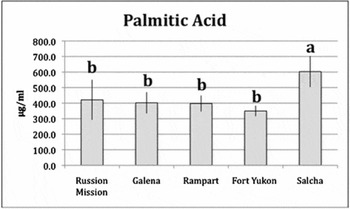
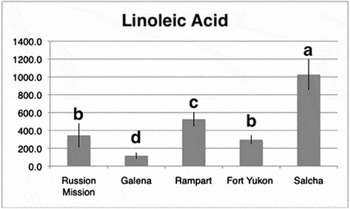
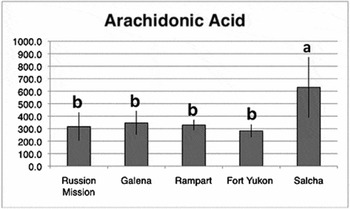
A hypothesis was that sled dogs maintained on a commercially available diet would have higher plasma saturated and omega–6 fatty acids and lower omega–3 fatty acid concentrations than their subsistence fed counterparts. For the most part this held true. Palmitic acid is one of the most abundant saturated fatty acid from plant and animal sources used in processed foods (Beare–Rogers and others Reference Beare–Rogers, Dieffenbacher and Holm2001). Plasma concentrations of PA were indeed, higher in the control kennel compared to the village sled dogs, which did not differ significantly based on location (Fig. 2; 350–421 vs. 603). The omega–6 fatty acids measured, LA and AA, were also higher in the commercially fed reference diet (Figs. 3, 4). Linoleic acid is an essential fatty acid found in many vegetable oils and a precursor to AA. AA is found in high concentrations in many meat sources including dairy and eggs. Eicosanoids, such as prostaglandins and leukotrienes are derived from AA in lipid membranes. This makes AA and its precursor LA important immune mediators that have a heavy presence in the lipid membranes (Philpott and Ferguson Reference Philpott and Ferguson2004).
Means and standard deviation of plasma palmitic acid concentrations in subsistence fed Yukon River village sled dogs. Salcha sled dogs are the commercially fed control population. Villages with different letters are statistically different (p ≤ 0.05).

Means and standard deviation of plasma linoleic acid concentrations in subsistence fed Yukon River village sled dogs and Salcha sled dogs. Village letters see Fig. 2.

Means and standard deviation of plasma arachidonic acid concentrations in subsistence fed Yukon River village sled dogs and Salcha sled dogs. Village letters see Fig. 2.

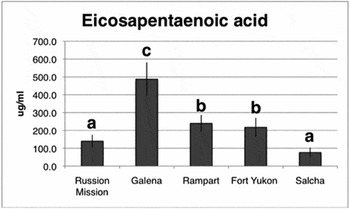
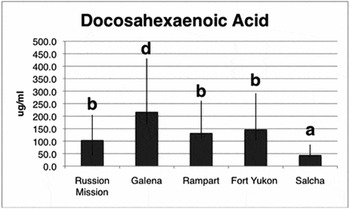
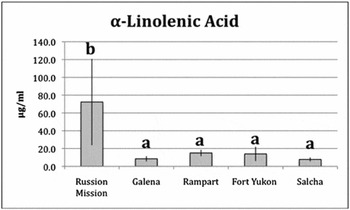
Salmon is a rich source of the highly recommended omega–3 fatty acids, EPA and DHA. Both are potent immune mediators that elicit their benefits by lowering inflammation. In addition to lending to membrane fluidity, EPA and DHA compete with AA for incorporation into the cell membrane and give rise to an immuno-suppressant class of eicosanoids (Ciubotaru and others Reference Ciubotaru, Lee and Wander2003; Philpott and Ferguson Reference Philpott and Ferguson2004). Village sled dogs maintained primarily on salmon displayed significantly higher plasma levels of EPA and DHA than the control kennel (Figs. 5, 6). The essential omega–3 fatty acid, αLA, did not display the same pattern; Russian Mission, with much variation (SD = 48.5) was the only kennel to differ significantly from the other kennels (Fig. 7). αLA is common in many vegetable oils and salmon is not a significant source of this fatty acid. Though EPA and DHA can be made from αLA, their synthesis is limited.
Means and standard deviation of plasma eicosapentanoic acid concentrations in subsistence fed Yukon River village sled dogs and Salcha sled dogs. Village letters see Fig. 2.

Means and standard deviation of plasma docosahexanoic acid concentrations in subsistence fed Yukon River village sled dogs and Salcha sled dogs. Village letters see Fig. 2.

Means and standard deviation of plasma α–linolenic acid concentrations in subsistence fed Yukon River village sled dogs and Salcha sled dogs. Village letters see Fig. 2.

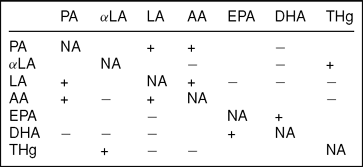
In this study, many of the fatty acids analysed correlated with lipids that were typical for their food source. For instance, EPA and DHA, abundant in fish, were positively correlated with each other and with levels in subsistence fed dogs while being negatively correlated with LA, AA, and PA, which are typically rich in western diets. Not unexpectedly, the essential fatty acid αLA was negatively correlated AA. Since fish are not a high source of αLA, the negative correlation with DHA is not surprising (Table 1).
Correlations between mean fatty acids between villages and compared to the reference kennel (Salcha, AK). Included in the table is previously published total mercury concentration (THg)(Dunlap and others 2007). Significant (p ≤ 0.05) positive correlations are represented with a plus sign (+), negative correlations with a minus (–). Spaces left blank did not have a significant correlation.
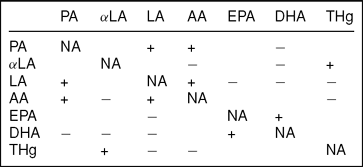
Previously published mercury concentrations in these same sled dogs displayed an interesting trend in total mercury, decreasing significantly upriver from the mouth (from west to east) (Dunlap and others Reference Dunlap, Reynolds, Bowers and Duffy2007). Using these data, some interesting correlation between lipid concentrations and total mercury were detected. For example, mercury was positively correlated with the fatty acid αLA, not typically found in significant concentrations in fish. A more predictable result was the negative correlation between mercury and both omega–6 fatty acids, LA and AA, which are associated with a western diet. More interestingly, total mercury was not correlated with EPA and DHA (Table 1). Although a correlation with the long chain omega–3 fatty acids and mercury may be expected, lipid concentration is likely to vary greatly based on species consumed and migratory distance.
Overall the trends in lipid concentrations observed in village sled dogs were reflective of the local diet. Animals maintained on subsistence foods display an ideal lipid profile, high in omega–3 s and low in PA and omega–6 fatty acids. Others have demonstrated (Foran and others Reference Foran, Good, Carpenter, Hamilton, Knuth and Schwager2005; Jewett and Duffy Reference Jewett and Duffy2007) and we have supported this (Dunlap and others Reference Dunlap, Reynolds, Bowers and Duffy2007) that wild salmon have relatively low contaminant concentrations. THg analysis of food provides an effective and economical method for monitoring contaminants. For Alaska, Loring and others (Reference Loring, Duffy and Murray2010) showed that risk of contaminant ingestion from consuming wild salmon on coronary heart disease was minimal. While it is extremely difficult to establish cause and effect relationships between contaminant exposure and overall health due to a myriad of influences and cumulative effects (Loring and Gerlach Reference Loring and Gerlach2009), lipid profiles in village sled dogs provide an additional marker and indicator of the effects of the complex vulnerability and threats to rural Arctic people, their food supplies and the ecosystem.
While subsistence foods and related activities have been shown to provide substantial health benefits, most notably omega–3 s (Samson and Pretty Reference Samson and Pretty2006; Bersamin and others Reference Bersamin, Zidenberg–Cherr, Stern and Luick2007), there are also continuing risks associated with climate change, industrialisation, and the widespread distribution of chemicals in the environment. For example, the Environmental Protection Agency has estimated that coal–fired power plants are the source of about 40% of anthropogenic mercury emissions in the United States and worldwide; these represent an estimated 25% of anthropogenic mercury emissions (Hightower Reference Hightower2008). Elemental mercury emitted from power plants can reside in the atmosphere for 6 months to 2 years, and can travel from one hemisphere to another before being deposited on the Earth's surface. Watersheds throughout the circumpolar north are expected to be impacted by global atmospheric transport from the industrialisation of China and India (Lu and others Reference Lu, Schroeder, Barrie and Steffen2001; Dalla Valle and others Reference Dalla Valle, Codato and Marcomini2007), so regional and multi–species monitoring of nutrients and biomarkers is needed for effective assessment and planning (Burger and Gochfeld Reference Burger and Gochfeld2007; Ginsberg and Toal Reference Ginsberg and Toal2009; Loring and others Reference Loring, Duffy and Murray2010).
In polar regions there is a growing need to move to multi–species and community–based biomonitoring approaches. This research adds support to the importance and need for locally, and regionally, scaled monitoring of surrogate species in polar regions because the risk/benefit ratio may vary considerably across species and location (Ginsberg and Toal Reference Ginsberg and Toal2009; Loring and others Reference Loring, Duffy and Murray2010; Loring and Gerlach Reference Loring and Gerlach2010). The data presented here suggest that species, migratory location (sampling site) or prey species mixture must be considered in risk–benefit advisories.
Health and nutrition is a complex, social and environmental phenomenon, with omega–3 fatty acids and contaminants just two variables in a complex set of biophysical, sociocultural, and economic components that influence both individual and community health (Krieger Reference Krieger2005; Loring and Gerlach Reference Loring and Gerlach2009; Loring and Gerlach Reference Loring and Gerlach2010). For example, Loring and others (Reference Loring, Duffy and Murray2010) have shown that salmon generally have a very good risk/health benefit ratio across the Yukon watershed. While dogs are not impacted by alcoholism or similar behaviour situations, they do exhibit cancer, obesity, type–2 diabetes and metabolic syndrome so they serve as indicators with fewer confounding factors. More monitoring and biomarker development in dogs is needed to improve our understanding of the risk/benefit relationship of nutrients like omega–3 s and methylmercury (or other organic toxins) in the extreme environment associated with northern food system. Other variables in sled dog diets in Russian Mission have the potential to influence the biomarkers that make it difficult to comprehend without further information. The uncertainty revealed here is an opportunity to understand the differences between Russian Mission and the other Yukon villages in relations to EPA and DHA.
The Yukon River system provides an ideal setting for a naturalistic survey and investigation of health biomarkers as climate change impacts Alaska. Communities along northern river systems will be increasingly impacted by climate change, which should be viewed as a phenomenon that exacerbates many other threats to food security (disease, fire, drought, contaminant transport and bioavailability)(Dalla Valle and others Reference Dalla Valle, Codato and Marcomini2007; Loring and Gerlach Reference Loring and Gerlach2010). The direct impacts may be dwarfed over time by their indirect effects on the availability of subsistence species and the quality of their nutrients (Brashares Reference Brashares2010). Intensive, long term monitoring of sentinel species such as sled dogs is an important approach to observing the synergies among threats to the subsistence lifestyles of northern communities. The use of sled dogs, a traditional and accepted medical model species, allows a monitoring programme to be conducted from the perspective of the consumer. More and better science and monitoring can go far to support our ecosystem based approach in the Yukon River basin and to assist resource managers in recognising the natural variability and food insecurity of the Yukon System (Loring and Gerlach Reference Loring and Gerlach2010)
Acknowledgments
We are grateful for the assistance and support of Pile Driver Kennels, Ryan Housler, Paddy Nolner, Linda Johnson, Joshua Cadzow, Joee Redington, Ami Gjestson, and Scott Campbell. We would like to thank Anna Godduhn for helpful discussion. This research was funded, in part, by the Department of Chemistry and Biochemistry, UAF and Nestle–Purina, St. Louis, MO. Partial funding came from USDA #2005–34495–16519. Lawrence K. Duffy was supported, in part, by NINDS/NIMH/NCRR grant U54 NS41069 and NSF grant OCE 0525275.