Despite the significance of understanding memory processes among maltreated children, there is a lack of consensus on how the experience of trauma may exert its effect on memory, if at all (Howe, Cicchetti, Toth, & Cerrito, Reference Howe, Cicchetti, Toth and Cerrito2004; Howe, Toth, & Cicchetti, Reference Howe, Toth, Cicchetti, Cicchetti and Cohen2006). Some contend that traumatic experiences, as distinctive and emotionally salient events, enhance memory for the trauma (e.g., Howe, Courage, & Peterson, Reference Howe, Courage and Peterson1994, 1995). Alternatively, evidence of altered brain structure in response to prolonged stress (e.g., Bremner & Narayan, Reference Bremner and Narayan1998; DeBellis et al., Reference DeBellis, Keshavan, Casey, Clark, Giedd and Boring1999; Sapolsky, Reference Sapolsky1992) and impaired memory performance among adults who were traumatized as children (e.g., Henderson, Hargreaves, Gregory, & Williams, Reference Henderson, Hargreaves, Gregory and Williams2002) suggest that trauma may have an adverse effect on memory. Relatedly, there is debate as to whether children who have experienced the trauma of maltreatment are more or less susceptible to false memories and suggestibility. Although some evidence among nontraumatized children implies that stress may increase the likelihood of memory contamination through suggestion (e.g., Bugental, Blue, Cortez, Fleck, & Rodriguez, Reference Bugental, Blue, Cortez, Fleck and Rodriguez1992), research with maltreated children thus far has not supported a link between trauma and false memory (e.g., Goodman, Bottoms, Rudy, Davis, & Schwartz-Kenny, Reference Goodman, Bottoms, Rudy, Davis and Schwartz-Kenny2001; Howe et al., Reference Howe, Cicchetti, Toth and Cerrito2004). One possible explanation for these inconsistencies is that trauma alone may not be sufficient to explain true and false memory among maltreated children. Therefore, others have suggested that the impact of stress upon memory should be assessed in relation to other sequelae of maltreatment that may be related to memory, such as psychopathology (e.g., Goodman, Reference Goodman2005; Greenhoot, McCloskey & Glisky, Reference Greenhoot, McCloskey and Glisky2005).
In this article, we begin by reviewing what is known about trauma and memory. We then discuss the role of the self as an organizing schema for memory and review the impact of maltreatment on self-development. Finally, we highlight dissociation as a self-system psychopathology and examine the relation of dissociation to memory. In light of the literature reviewed, we detail the specific aims of this investigation, which are (a) to address significant gaps in the literature with respect to self-referent semantic memory and false recall among maltreated children and (b) to assess the relation of maltreatment and true and false schema to dissociation.
Memory and Trauma
In attempting to clarify how trauma might affect memory, many researchers have focused on examining memory for a traumatic event, whereas few have investigated memory processes that are unrelated to the trauma among traumatized and nontraumatized populations (Toth & Cicchetti, Reference Toth and Cicchetti1998). For example, several studies have assessed memory for analog traumas, where evidence supports the notion that increased levels of stress generally lead to better memory for the event (for reviews, see Howe Reference Howe1998, Reference Howe2000). However, despite the high level of emotionality and stress that might accompany recollections of unanticipated emergency room procedures (Howe et al., Reference Howe, Courage and Peterson1994, Reference Howe, Courage and Peterson1995) or hospital experiences that involve genital touching (e.g., Goodman & Quas, Reference Goodman, Quas, Stein, Ornstein, Tversky and Brainerd1997), it is unclear whether the intensity of these emotions is comparable to that which accompanies the experience of physical or sexual abuse, or the experience of chronic neglect. Thus, although these studies provide important information regarding the relationship between stress and memory, further research is needed among populations of maltreated children.
In contrast, few studies have focused upon memory for nontrauma-related information among those who have been maltreated, and even fewer have examined these memory processes among children (Eisen, Qin, Goodman, & Davis, Reference Eisen, Qin, Goodman and Davis2002). In fact, much of our knowledge is derived from studies of memory functioning among adults who report abuse histories, where findings on memory performance have been inconsistent. On the one hand, evidence that maltreated adults experience hyperarousal that may generalize beyond stressful situations (Carlson, Furby, Armstrong, & Shales, Reference Carlson, Furby, Armstrong and Shales1997) provides support for the notion that maltreatment may lead to enhancement in memory performance. On the other hand, examination of autobiographical memory and general cognitive processing among adults suggests that the experience of trauma is associated with poorer memory for autobiographical events (Henderson et al., Reference Henderson, Hargreaves, Gregory and Williams2002; McNally, Lasko, Macklin, & Pitman, Reference McNally, Lasko, Macklin and Pitman1995).
Researchers have only recently begun to investigate memory functioning for nontrauma-related stimuli among maltreated children and adolescents, particularly with a focus on autobiographical memory (e.g., deDecker, Hermans, Raes, & Eelen, Reference deDecker, Hermans, Raes and Eelen2003; Johnson, Greenhoot, Glisky, & McCloskey, Reference Johnson, Greenhoot, Glisky and McCloskey2005). For example, Johnson and colleagues (2005) examined the relative effects of childhood abuse, current exposure to family violence, and depressive symptomatology upon autobiographical memories among adolescents. Results indicated that recent family violence was associated with the tendency to recall general memories (in contrast to memories of a specific time and place), shorter length of memory narratives, and lower rates of negative memories, whereas abuse in childhood was related to the need for an increased number of experimenter prompts to elicit memories. It remains uncertain, however, whether depression was a result, cause, or correlate of these differences in memory. In addition, it is unclear how basic memory processes, self-system processes (e.g., processes related to the development of a coherent self) and/or psychopathology might account for this effect.
Before we are able to elucidate maltreatment's effect on autobiographical memory, it is essential that we understand how basic memory processes are affected by the self, as well as how basic memory processes can mediate autobiographical memory (Howe, Courage, & Edison, Reference Howe, Courage and Edison2003). With respect to basic memory functioning, that is memory for neutral, nontrauma-related stimuli, very few investigations among maltreated and nonmaltreated children currently exist (Howe et al., Reference Howe, Cicchetti, Toth and Cerrito2004; Porter, Lawson, & Bigler, Reference Porter, Lawson and Bigler2005).Footnote 1 In a foundational study, Howe and colleagues (2004) utilized Deese–Roediger–McDermott lists (Deese, Reference Deese1959; Roediger & McDermott, Reference Roediger and McDermott1995) to assess true and false memory processes among children 5–12 years of age. Recall and recognition measures revealed no differences between maltreated and nonmaltreated children's semantic memory functioning for neutral stimuli. Therefore, despite empirical evidence suggesting that maltreatment leads to differences in autobiographical memory processes, the extant research does not support alterations in basic memory functioning. Nonetheless, it is essential to increase our knowledge of these basic processes, especially with regard to memory that is self-referent and emotionally valenced.
Although research on memory for neutral stimuli was a necessary first step toward a comprehensive analysis of basic memory functioning among maltreated children, there is a missing link in the memory literature between semantic memory for neutral information and autobiographical memories recalled in response to emotion-evoking prompts. Specifically, there is a paucity of research on how self-related semantic memory processes are affected by maltreatment. Such research is critical to inform our understanding of autobiographical memory because episodic memory depends, in part, upon the development of a coherent self to which memories of specific life experiences can be tied (Howe et al., Reference Howe, Courage and Edison2003; Nelson & Fivush, Reference Nelson and Fivush2004). Accordingly, examining the mechanisms through which deviations in self-system processes among maltreated children may affect memory is crucial to understanding how trauma might interfere with memory processes.
Memory and the Self
Research on information processing consistently demonstrates support for the self-as-schema model in adults (see Greenwald & Banaji, Reference Greenwald and Banaji1989; Markus, Reference Markus1977; Rogers, Reference Rogers, Cantor and Kihlstrom1981; Rogers, Kuiper, & Kirker, Reference Rogers, Kuiper and Kirker1977); that is, the self-functions as a prototype containing a collection of features that the person views as self-descriptive. The self-schema is then stored in long-term memory and both facilitates and biases the processing of personally relevant information. For example, in applying Craik and Lockhart's (Reference Craik and Lockhart1972) depth of processing paradigm to the understanding of self-schema, Rogers and colleagues (1977) demonstrated that adjectives that are processed under self-referent conditions are better remembered than semantically or structurally encoded words; therefore, the self serves as a deep encoding structure. Moreover, this self-schema effect is present early in childhood (Hammen & Zupan, Reference Hammen and Zupan1984). Thus, the self is a salient organizing schema that allows for information related to the self to be better remembered than that which is unrelated to the self.
Maltreatment and the Self
Unfortunately, child maltreatment has a deleterious impact on many aspects of self-system functioning (Cicchetti, Reference Cicchetti1991; Harter, Reference Harter, Damon and Eisenberg1998). Developmentally, the earliest evidence for self-system deviation among maltreated children emerges in response to viewing the self at 18 months of age. Although maltreatment does not appear to impede the development of visual self-recognition, a marker of the presence of a cognitive self, maltreated toddlers are more likely to show negative emotion when viewing the self than are nonmaltreated toddlers (Schneider-Rosen & Cicchetti, Reference Schneider-Rosen and Cicchetti1991). In addition, maltreated preschoolers demonstrate less internal state language (Beeghly & Cicchetti, Reference Beeghly and Cicchetti1994), and examination of their narratives reveals that maltreated preschoolers have more negative representations of the self (Toth, Cicchetti, Macfie, Maughan, & Vanmeenen, Reference Toth, Cicchetti, Macfie, Maughan and Vanmeenen2000). Indeed, maltreated children may not have received the parental support necessary to develop a sense of the self as worthy, leading to a sense of inner badness (Harter, Reference Harter, Damon and Eisenberg1998).
Research among school-age maltreated children provides further evidence for self-system deviation. Maltreated children are consistently rated by teachers as having low self-esteem, and demonstrate less positive self-concepts than do nonmaltreated children (Ayoub et al., Reference Ayoub, O'Connor, Rappolt-Schlichtmann, Fischer, Rogosch and Toth2006; Bolger, Patterson, & Kupersmidt, Reference Bolger, Patterson and Kupersmidt1998; Cicchetti & Rogosch, Reference Cicchetti, Rogosch, Maughan, Toth and Bruce1997; Egeland, Sroufe, & Erickson, Reference Egeland, Sroufe and Erickson1983). There is also evidence that younger maltreated children overestimate their own sense of competence and peer acceptance (Black, Dubowitz, & Harrington, Reference Black, Dubowitz and Harrington1994; Vondra, Barnett, & Cicchetti, Reference Vondra, Barnett and Cicchetti1989) and have inflated levels of perceived self-efficacy in conflictual peer interactions compared to young nonmaltreated children (Kim & Cicchetti, Reference Craik and Lockhart2003). Some have suggested that younger maltreated children may be engaging in defensive processing to increase their sense of personal control and competence (Vondra et al., Reference Vondra, Barnett and Cicchetti1989); however, as children get older, this inflated self-esteem tends to decline and become more consistent with teacher reports. Finally, the development of more complex disturbances in self-functioning may emerge as maltreated children move onto adolescence. For example, research supports a connection between affective splitting of self-representations and chronic sexual abuse among adolescent girls (Calverley, Fischer, & Ayoub, Reference Calverley, Fischer and Ayoub1994).
Given the extensive theoretical and empirical support for self-system impairments among maltreated children, it is important to assess how the experience of maltreatment might alter memory for self-referent information. According to Howe and Courage (Reference Howe and Courage1997), when the self becomes a viable cognitive entity with recognizable features, the encoding of such features into a functional memory trace becomes possible. However, events can remain depersonalized if features of the self are not sampled and encoded. How might memory be affected if the self is not well integrated such that one does not have a coherent set of features describing the self? This question is particularly relevant to child maltreatment, where the risk for the development of dissociation is high (Macfie, Cicchetti, & Toth, Reference Macfie, Cicchetti and Toth2001a, Reference Macfie, Cicchetti and Toth2001b; Ogawa, Sroufe, Weinfield, Carlson, & Egeland, Reference Ogawa, Sroufe, Weinfield, Carlson and Egeland1997; Putnam, Reference Putnam, Sameroff, Lewis and Miller2000).
Dissociation
Dissociation may be conceptualized as the opposite of an integrated self (Ogawa et al., Reference Ogawa, Sroufe, Weinfield, Carlson and Egeland1997), and refers to a disruption in the normal integration of memories, perception, and identity (American Psychiatric Association, 1994). Dissociation has been described as a failure of information processing in the face of trauma (Bower & Sivers, Reference Bower and Sivers1998), as a psychological mechanism that aids an individual's ability to cope with extreme stressors (for a review, see Cordon, Pipe, Sayfan, Melinder, & Goodman, Reference Cordon, Pipe, Sayfan, Melinder and Goodman2004), and as a combination of both failed information processing and defensive processes (Liotti, Reference Liotti, Solomon and George1999) as dissociation may become an automatic and unconscious response to stress that may generalize over time (Post et al., Reference Post, Weiss, Li, Smith, Zhang and Xing1998). Dissociation is particularly relevant to the study of maltreated children given evidence that young children are likely to rely on dissociation as a coping mechanism to avoid feeling the extreme negative emotion that accompanies a traumatic experience (Putnam, Reference Putnam, Cicchetti and Cohen1995, Reference Putnam1997, Reference Putnam, Sameroff, Lewis and Miller2000). Moreover, infants with disorganized attachment, emerging from atypical early interactions with the primary caregiver (Main & Hesse, Reference Main, Hesse, Greenberg, Cicchetti and Cummings1990), are especially vulnerable to dissociation, particularly if these children's later experiences are traumatic and chronic (Liotti, Reference Liotti1992; Ogawa et al., Reference Ogawa, Sroufe, Weinfield, Carlson and Egeland1997). In light of the preponderance of disorganized attachment that has been reported among samples of maltreated infants (up to 80–90%; e.g., Barnett, Ganiban, & Cicchetti, Reference Barnett, Ganiban and Cicchetti1999; Carlson, Cicchetti, Barnett, & Braunwald, Reference Carlson, Cicchetti, Barnett and Braunwald1989; Lyons-Ruth, Repacholi, McLeod, & Silva, Reference Lyons-Ruth, Repacholi, McLeod and Silva1991), maltreated children are certainly at risk for the development of dissociative symptomatology (Macfie et al., Reference Macfie, Cicchetti and Toth2001a, Reference Macfie, Cicchetti and Toth2001b).
With respect to memory, some individuals experience temporary dissociative states during and immediately after a traumatic event (e.g., Dancu, Riggs, Heart-Ikeda, Shoyer, & Foa, Reference Dancu, Riggs, Hearst-Ikeda, Shoyer and Foa1996), which may lead to isolated memories for the event. If these memories are not integrated into the self, then the memory for the trauma will be less accessible to conscious recollection (Marmar, Weiss, Metzler, & Delucchi, Reference Marmar, Weiss, Metzler and Delucchi1996). In adults, a number of memory impairments have been linked with dissociation, including episodes of time loss, recall delays for abuse-related information, total memory loss for the traumatic event, and gaps in autobiographical memory (Goodman et al., Reference Goodman, Bottoms, Rudy, Davis and Schwartz-Kenny2001; Henderson et al., Reference Henderson, Hargreaves, Gregory and Williams2002; Putnam, Reference Putnam1997, Reference Putnam, Sameroff, Lewis and Miller2000). Despite research among adults indicating a connection between dissociation and poor memory for the trauma, research among children has failed to support such an association. For example, studies among maltreated children have shown that higher dissociation scores are related to more detailed memories of abuse (Eisen et al., Reference Eisen, Qin, Goodman and Davis2002), as well as to the expression of more negative emotion when asked about the abuse (Sayfan et al., Reference Sayfan, Mitchell, Goodman, Eisen, Qin and Davis2002). However, as Foa and Riggs (Reference Foa, Riggs and Pynoos1994) point out, there may be important differences between the manner in which maltreated children remember trauma-related and nontrauma-related information. Thus, it is important to assess the role of dissociation in maltreated children's memory for nontrauma-related stimuli.
Dissociation has also been linked to the presence of false memory (for review, see Kihlstrom, Reference Kihlstrom, Nolen-Hoeksema, Cannon and Widiger2005). Among adults, dissociation has been correlated with false positives in recognition memory tests (Merchelbach, Muris, Horselenberg, & Stougie, Reference Merchelbach, Muris, Horselenberg and Stougie2000), interrogative suggestibility (Merchelbach, Muris, Rassin, & Horselenberg, Reference Merchelbach, Muris, Rassin and Horselenberg2000), and the creation of pseudomemories (Hyman & Billings, Reference Hyman and Billings1998). Although associations between false memory and dissociation have been found among adults, no such relationships have been found among children (Eisen et al., Reference Eisen, Qin, Goodman and Davis2002). Furthermore, speculation that child maltreatment is related to a tendency to generate false memories has received no empirical support to date (Howe et al., Reference Howe, Cicchetti, Toth and Cerrito2004). However, no study has examined false memories for self-relevant information among maltreated children, nor has the relationship between maltreatment and false recall on dissociation been concurrently examined.
The Present Investigation
Despite our knowledge of self-system deviations among maltreated children and the role of the self as an organizing schema for memory, research has not yet explored the relationship between aspects of self-system function and dysfunction with true and false recall among maltreated children. Thus, based upon our extant knowledge of trauma, memory, and the self, and to address the significant gaps in the literature identified above, we aimed to examine the following in this investigation:
1. To ascertain whether basic depth of processing self-schema effects (where information encoded under self-referent conditions is better recalled than that encoded under nonself-referent conditions) operate the same or differently among children who have been abused, neglected, and nonmaltreated.
2. To ascertain whether the frequency and affective valence of false recall differs as a function of maltreatment experience.
3. To determine whether abused, neglected, and nonmaltreated children differ in the affective valence of their self-schema, and how maltreatment and self-schema might be related to dissociation, a measure of self-system disintegration. Specifically, we expected that abused children would have the most negative self-schemas in relation to nonmaltreated children. Because there has been speculation that positive self-representations among maltreated children are associated with defensive processes, we anticipated that valence of self-schemas would be related to dissociation differently between those who have been abused, neglected and nonmaltreated.
4. To determine whether abused, neglected, and nonmaltreated children differ in the affective valence of their false schema, and how maltreatment and false schema might be related to dissociation.
To address these hypotheses, the study design is organized into two major categories of analyses (recall and schema). In each of these categories both true and false processes are examined. With respect to the recall analyses, aspects of true recall (including the depth of processing effect) are assessed in relation to maltreatment. This is followed by an analysis of children's false recall. Next, to examine aspects of schema, children are classified into positive and negative self-schema groups based upon their pattern of true recall. The valence of children's self-schema and their maltreatment status are examined in relation to dissociative symptoms. Finally, children are classified into positive and negative false-schema groups based upon their pattern of false recall, and the valence of children's false schema and maltreatment status are also examined in relation to dissociation.
Method
Participants
Participants in this study consisted of 168 maltreated children (104 boys, 64 girls) and 116 nonmaltreated children (68 boys, 48 girls). Children attended a research program in upstate New York that was designed to provide maltreated and nonmaltreated children from low socioeconomic status (SES) families a recreational experience in which children's behavior could be observed in an ecologically valid context (for a description of the camp context, see Cicchetti & Manly, Reference Cicchetti, Manly, Brody and Sigel1990). Children were between the ages of 7.0 and 14.1 years (average age = 9.99, SD = 1.57).
Maltreated children participating in this investigation were recruited from those reported to the local Department of Human Services (DHS) because of concerns associated with child maltreatment. Determination of maltreatment status was primarily based upon examination of Child Protective Services (CPS) and Preventive Services records at DHS, for which parents provided consent. Families' maltreatment history also was investigated through maternal interviews, during which research assistants inquired about a history of abusive and/or neglectful acts. Utilizing the Maltreatment Classification System (MCS; Barnett, Manly, & Cicchetti, Reference Barnett, Manly, Cicchetti, Cicchetti and Toth1993), the presence or absence of four subtypes of maltreatment was determined for each child. A total of 52.5% of the children had experienced emotional maltreatment, 63.7% neglect, 34.6% physical abuse, and 14% sexual abuse. Comorbidity of subtypes of maltreatment is common and has been well documented (Barnett et al., Reference Barnett, Manly, Cicchetti, Cicchetti and Toth1993; Cicchetti & Barnett, Reference Cicchetti, Barnett, Grove and Cicchetti1991); in the present study subtype comorbidity occurred for 57% of the sample.
A primary subtype classification was determined for each child based upon a hierarchy that assesses the degree to which a particular experience of maltreatment violates social norms (Manly, Cicchetti, & Barnett, Reference Manly, Cicchetti and Barnett1994). Sexual abuse is conceptualized as the most serious deviation from societal standards; therefore, any children who were sexually abused received this as their primary subtype designation. Next in the hierarchy is physical abuse, followed by neglect, and then emotional maltreatment. No maltreated children in this investigation exclusively experienced emotional maltreatment; therefore, no child received emotional maltreatment as their primary subtype designation. Primary subtype effects were further conceptualized as acts of commission (e.g., sexual abuse and physical abuse) versus acts of omission (e.g., neglect), based upon the knowledge that these experiences may exert differential impacts upon children's development (Shields & Cicchetti, Reference Shields and Cicchetti1998, Reference Shields and Cicchetti2001; Smetana et al., Reference Smetana, Toth, Cicchetti, Bruce, Kane and Daddis1999). Thus, any child who experienced physical or sexual abuse, regardless of concomitant neglect, was classified into the abused group (N = 76). The remaining maltreated children (N = 92) were neglected. The presence of subtype comorbidity between abusing and neglecting families was significantly different, with 73.9% of the abusing group having experienced at least two subtypes of maltreatment, compared to 40.7% of the neglecting group, χ2 (1, N = 168) = 20.12, p < .001; this difference is consistent with the hierarchical criteria used to distinguish between groups.
For demographic comparability to the maltreatment sample, low-SES nonmaltreated families were recruited from families receiving public assistance in the form of Temporary Assistance to Needy Families. Comparison families also participated in maternal interviews to inquire about a history of maltreatment (Cicchetti, Toth, & Manly, Reference Cicchetti, Toth and Manly2002). Informed consent and child assent were obtained for participation in research and parental permission allowed researchers to examine CPS records. Nonmaltreatment status was confirmed by maternal interview and an absence of CPS or Preventive Services records for the family.
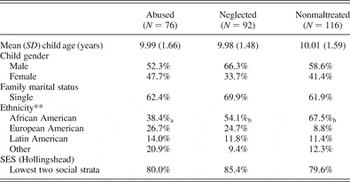
Abusing, neglecting, and nonmaltreating families did not differ on a number of important demographic characteristics (see Table 1). The three groups were equivalent in child age, F (2, 284) = .29, p = .75, child gender, χ2 (2) = 3.61, p = .164, and family marital status, χ2 (2) = 1.53, p = .46. In addition, the abusing, neglecting, and nonmaltreating families had comparable scores on the Hollingshead (Reference Hollingshead1975) Four-Factor Index of Social Status, with 80% of the families in the abusing group, 85.4% of the families in the neglecting group, and 79.6% of the families in the nonmaltreated group falling in the two lowest social strata, χ2 (2) = 3.02, p = .22. The groups did significantly differ, however, on ethnicity, χ2 (6) = 22.85, p < .01, such that 67.5% of the nonmaltreating group comprised African American children, in comparison to 38.4% of the abused and 54.1% of the neglected children. To determine whether ethnicity was related to any of our dependent variables a series of correlational analyses was conducted. No significant relationships emerged; therefore, ethnicity was not considered further in the analyses.
Demographic characteristics for abused, neglected, and nonmaltreated children

Note: Values with different letter subscripts indicate significant group differences. See text for explanation.
** p < .01 (two tailed).
Procedure
Data for the current investigation were collected during a 6-week recreational program where research was conducted. Children were assigned to same-age, same-gender groups of peers and were supervised by adult counselors who were unaware of the children's maltreatment status and of the research hypotheses. Children attended the summer camp for 1 of the 6 weeks, and were observed for approximately 35 total hours during the week. During the program, children were interviewed by trained research staff, who were also unaware of child maltreatment status or study hypotheses, to obtain assessments relevant to memory and self-representation. In addition, the counselors completed assessment instruments at the conclusion of their time with the children.
Measures
MCS
Dimensions of family maltreatment were determined by trained coders using the MCS (Barnett et al., Reference Barnett, Manly, Cicchetti, Cicchetti and Toth1993). Rather than relying on child protective agency designation, reports of the children's experiences, as documented in child protective and preventive records, were used for coding. Utilizing the well-validated MCS (e.g., Bolger et al., Reference Bolger, Patterson and Kupersmidt1998; Dubowitz et al., Reference Dubowitz, Pitts, Litrownik, Cox, Runyan and Black2005; English, Bangdiwala, & Runyan, Reference English, Bangdiwala and Runyan2005; Manly, Reference Manly2005; Manly et al., Reference Manly, Cicchetti and Barnett1994), coders classified children's maltreatment experiences according to subtype(s). The MCS contains operational definitions of each subtype, and these definitions were utilized to determine the presence or absence of each subtype; multiple subtypes could be coded for each report.
Maltreatment subtype categories included sexual abuse, physical abuse, physical neglect, and emotional maltreatment. The presence of sexual abuse was coded when any sexual contact or attempted sexual conduct occurred between the child and an adult. These behaviors range from exposure to inappropriate sexual activities to forced intercourse. Physical abuse was determined by injuries that had been inflicted upon a child by nonaccidental means. These incidents could range from excessive corporal punishment leading to bruising, to permanently disfiguring injuries. Physical neglect was coded “when the primary caregiver failed to meet a child's needs for food, clothing, shelter, medical, dental, or mental health care, education, hygiene, or physical safety” (Manly, Kim, Rogosch, & Cicchetti, Reference Manly, Kim, Rogosch and Cicchetti2001). Typical neglect incidents included leaving young children at home alone, maintaining unsanitary living conditions, and providing inadequate nourishment. Emotional maltreatment was coded for chronic or extreme neglect or disregard of children's emotional needs. This includes the need for acceptance and self-esteem, psychological security, and age-appropriate autonomy. Examples of emotionally maltreating events included serious threats to injure a child, exposure to violent acts among family members, and abandonment by primary caregivers. (See Barnett et al., Reference Barnett, Manly, Cicchetti, Cicchetti and Toth1993, for a detailed description of the nosological system used to code incidents of maltreatment.) Coding of DHS records for maltreatment subtype was conducted by trained research assistants and PhD level psychologists, among whom adequate interrater reliability was achieved (weighted κ = .78–1.0).
Children's self-schema task/depth of processing (CST)
Children's representational models provide schemas that may guide attention and memory; these internalized cognitive structures may facilitate the encoding, storage, and retrieval of personally relevant information (Baldwin, Reference Baldwin1992; Bowlby, Reference Bowlby1969; Bretherton, Reference Bretherton1985, Reference Bretherton, Gunnar and Sroufe1991; Fiske & Taylor, Reference Fiske and Taylor1991; Hammen & Zupan, Reference Hammen and Zupan1984). Children's encoding of and memory for self-referent attribute words was assessed through the CST, a measure that was developed and validated by Hammen and Zupan (Reference Hammen and Zupan1984) to assess children's processing of self-referent adjectives. Forty-four words (22 positive, 22 negative adjectives), with word frequency and length equalized, were verbally and visually presented one at a time to the children. Words were presented under one of two encoding conditions: structural (“Is this a long word?”) or self-referent (“Is this word like you?”). Children's yes or no response was recorded for each item. An unexpected incidental recall period immediately followed. Children were asked to recite as many of the previously presented words as possible, in any order.
The encoding conditions were randomized so that all words were presented equally under structural and self-referent instructions. Furthermore, the task involved two versions that were administered to children to counterbalance the encoding condition asked about each word. Thus, children were presented with a list that contained four groups of 11 words: positive structural, positive self-referent, negative structural, and negative self-referent. One word from each of these groups was presented as one of the first two or last two words; these four words were then excluded from analysis to minimize primacy and recency memory effects.
Child Behavior Checklist Teacher Report Form (CBCL-TRF) and dissociation subscale
Counselors who were unaware of children's maltreatment status or of the study hypotheses used the TRF (Achenbach, Reference Achenbach1991) to rate children's behaviors after approximately 35 hr of observation. Children were observed in groups of eight same-gender children and three counselors. Each child was rated by two counselors. The TRF is a well-validated instrument that includes 118 items rated for frequency of occurrence. Ogawa and colleagues (1997) constructed a subscale to assess dissociative symptoms in childhood and adolescence based on 12 TRF items, similar to those assessed by Putnam's Child Dissociative Checklist (Putnam, Helmers, & Trickett, Reference Putnam, Helmers and Trickett1993; see Appendix A). Individual child scores for dissociative symptomatology reflected the sum of the average of three counselor's scores for each of the 12 items. Interrater reliabilities (intraclass correlations) ranged from .66 to .84.
Results
Data reduction
For each participant, the number of words recalled as a function of task instructions (self-referent or structural) and rating (yes or no) was calculated, excluding the four buffer items (Hammen & Zupan, Reference Hammen and Zupan1984). Noting that yes-rated words are generally better recalled than no-rated words (Craik & Tulving, Reference Craik and Tulving1975; Hammen & Zupan, Reference Hammen and Zupan1984; Rogers, Reference Rogers, Cantor and Kihlstrom1981), the recall data were transformed into proportion scores (e.g., number of yes-rated words recalled under the self-referent condition/number of yes-rated words in that rating task; number of yes-rated words recalled under the structural condition/number of yes-rated words in that rating task; number of no-rated words recalled under the self-referent condition/number of no-rated words in that rating task; number of no-rated words recalled under the structural condition/number of no-rated words in that rating task). These proportion scores were created for both positive and negative stimuli, resulting in eight total proportion scores. In addition, to reflect the relative negativity of self-schema, a summary score was calculated for each participant as the proportion of yes-rated negative self-referent words recalled minus the proportion of yes-rated positive self-referent words recalled. Based on this negativity index score, children were divided into two groups: a positive schema group (those with index scores < 0) and a negative schema group (those with index scores ≥ 0) (Hammen & Zupan, Reference Hammen and Zupan1984; Rudolph, Hammen, & Burge, Reference Rudolph, Hammen and Burge1995). Finally, a separate negativity index score was created for children's recall of structurally encoded words, using the proportion of yes-rated negative structural words recalled minus the proportion of yes-rated positive structural words recalled. Children were again divided into two groups: a positive structural schema group (index scores < 0) and a negative structural schema group (index scores > 0). Of the 284 children who completed the CST measure, 9 did not provide any recall items. Because there were no differences by maltreatment subtype among those who did not provide recall, χ2 (2) = .1, p = .95, these nine children were dropped from further analyses.
Given the normative developmental changes in self-understanding and self-evaluation that are associated with the transition from middle to late childhood (Harter, Reference Harter, Cicchetti and Cohen2006), age group was evaluated as an independent variable in all analyses. Age grouping followed Hammen and Zupan (Reference Hammen and Zupan1984), and Rudolph et al. (Reference Rudolph, Hammen and Burge1995), such that children ages 7–9 (n = 147, mean age = 8.73, SD = 0.77) were compared to children ages 10–14 (n = 137, mean age = 11.34, SD = 0.99). The 10-year cut point allowed the sample to be divided somewhat evenly, and it also roughly marks the end of concrete-operational thinking (Piaget, Reference Piaget1962). In addition, from a conceptual, self-development perspective, this age grouping is consistent with that of Vondra et al. (Reference Vondra, Barnett and Cicchetti1989), where maltreated children demonstrated a shift in self-perceptions at approximately the age of 9–10 years.
Memory: Depth of processing analyses (true recall)
To assess our first hypothesis regarding whether basic depth of processing self-schema effects (whether children used the self-referenced instructions to facilitate incidental recall) operate the same or differently among children who have been abused, neglected, and maltreated, an Instruction (Self-Referent/Structural) × Rating (Yes/No) repeated-measures analysis of variance (ANOVA) on proportion scores was conducted with subtype (abused/neglected/nonmaltreated) and age group (young/old) as between-subjects variables.Footnote 2 A significant main effect of instructional task emerged, F (1, 240) = 26.84, p < .001, ηp2 = .10, such that children's recall was greater under self-referent instructions (M = 1.79, SD = 1.48) than under structural conditions (M = 1.31, SD = 1.15).Footnote 3 This main effect was qualified by a significant Instruction Task × Rating interaction, F (1, 240) = 8.52, p < .01, ηp2 = .03. Subsequent analysis within each rating revealed that the instruction effect was relatively more pronounced for yes-rated words, F (1, 246) = 26.05, p < .001, than for no-rated words, F (1, 246) = 4.31, p < .05. Examination of the between-subjects effects revealed a significant main effect of age group, F (1, 240) = 10.22, p < .01, ηp2 = .04, such that the older children recalled a greater proportion of words (M = 0.17, SD = 0.09) than did the younger children (M = 0.13, SD = 0.09), which is consistent with that of Hammen and Zupan (Reference Hammen and Zupan1984). However, the interactions of age with instruction task and rating were nonsignificant. No significant differences emerged as a function of maltreatment subtype, F (2, 240) = .43, ns; therefore, the experience of maltreatment did not have an impact on children's ability to use self-schema to facilitate recall, nor did it impact children's average recall performance.
Memory: False recall
To elaborate further on the findings regarding those words that were correctly remembered during the incidental recall task, additional analyses were conducted on those words that children reported during incidental recall that were not presented during the encoding phase. That is, we were interested in ascertaining whether there were differences in the quantity and affective valence of children's false recall as a function of their maltreatment history. The total number of incorrectly recalled words (words that were not presented during the encoding condition) was calculated, and the affective valence of each falsely recalled word was classified as positive, negative, or neutral. Proportion scores were derived for positive and negative false memory (i.e., number of positive false words/total false words recalled). Overall, 40.8% of children recalled at least one word that was not presented during the encoding phase.
To evaluate our second hypothesis, a chi-square analysis of the occurrence of false recall among abused, neglected and nonmaltreated children was conducted, revealing a null effect of subtype on the presence/absence of false recall, χ2 (2, N = 274) = 1.24, ns. To examine differences in the frequency of false recall, a univariate ANOVA was conducted on the total number of falsely recalled words, with subtype and age group as the independent variables among those children where false recall was present. The main effect of subtype was nonsignificant, F (2, 104) = .36, ns, as was main effect of age, F (1, 104) = .82, ns, and the Subtype × Age Group interaction, F (2, 104) = .96, ns.
Next, a repeated-measures ANOVA was conducted on proportion scores of positive and negative false recall among those children where false recall was present. Specifically, the valence of false recall (positive/negative) served as the within-subjects factor, with subtype (abused/neglected/nonmaltreated) and age group (older/younger) as the between-subjects variables. A significant multivariate Valence × Subtype × Age Group interaction emerged, F (2, 104) = 5.24, p < .01, ηp2 = .09.
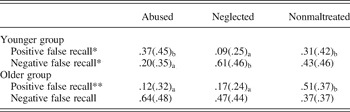
Subsequently, repeated-measures analyses were conducted within each age group to evaluate the Valence × Subtype interaction. Among the young group, a significant Valence × Subtype interaction emerged, F (2, 64) = 5.80, p < .01, ηp2 = .13. Simple effects analyses within each of the two levels of valence were conducted, revealing a significant main effect of subtype upon the proportion of positive words falsely recalled, F (2, 65) = 3.02, p = .05, ηp2 = .09, and the proportion of negative words falsely recalled, F (2, 64) = 4.45, p < .05, ηp2 = .12. Bonferroni corrected post hoc analyses indicated that younger neglected children demonstrated marginally less positive false recall than the abused children. In addition, the younger neglected children demonstrated significantly more negative false recall than did the abused children (see Table 2).
Proportion of positive and negative false memory: Means (standard deviations) for abused, neglected, and nonmaltreated children
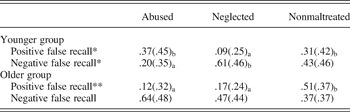
Note: Values with different subscript letters indicates significant group differences. See text for explanation.
* p < .05.
** p < .01 (two tailed).
For the older children, a significant Valence × Subtype interaction emerged, F (2, 40) = 3.63, p < .05, ηp2 = .15. Simple effects analyses within each of the two levels of valence were conducted, revealing a significant effect of subtype upon the proportion of positive false recall, F (2, 40) = 6.37, p < .01, ηp2 = .24; however, there was no effect of subtype upon the proportion of negative false recall, F (2, 39) = .18, ns. Subsequent post hoc analyses, Bonferroni corrected, revealed that neglected children and abused children each evidenced significantly lower proportions of positive false recall than did the nonmaltreated children (Table 2).
Self-schema, maltreatment, and dissociative symptomatology
Next, we were interested in assessing the relationship between maltreatment experiences and the valence of children's self-schema. Separate chi-square analyses were conducted with the younger and older age groups. For the younger group, subtype was not significantly related to valence of self-schema (positive or negative), χ2 (2, N = 141) = 1.78, ns, nor was this relationship significant for the older group, χ2 (2, N = 134) = 1.35, ns.
We then tested the hypothesis that children's processing of self-relevant information would be associated with their dissociative symptomatology, and that this relationship might differ by subtype of maltreatment experienced or age. Because prior research has reported differences in children's coping styles under conditions of extreme or chronic stress (e.g., Crick & Zahn-Waxler, Reference Crick and Zahn-Waxler2003; Masten, Best, & Garmezy, Reference Masten, Best and Garmezy1990), and has indicated inconsistent findings regarding the relation between gender and dissociation, suggesting both positive (e.g., Putnam, Hornstein, & Peterson, Reference Putnam, Hornstein and Peterson1996) and null effects (e.g., Macfie et al., Reference Macfie, Cicchetti and Toth2001a), gender was entered as a covariate in all dissociation analyses.
A univariate ANOVA was conducted upon dissociation scores where maltreatment subtype (abused/neglected/nonmaltreated), valence of self-schema (positive/negative), and age group (young/old) served as the independent variables with gender as a covariate. A significant three-way interaction of Subtype × Schema × Age Group emerged, F (2, 256) = 7.44, p = .001, ηp2 = .06. Gender was a significant covariate, such that males displayed higher dissociative symptoms (M = 3.67, SD = 2.9) than females (M = 2.49, SD = 2.8), F (1, 256) = 11.29, p < .01. Subsequently, separate univariate analyses of Subtype × Schema upon dissociation, were conducted within the younger and older groups of children.
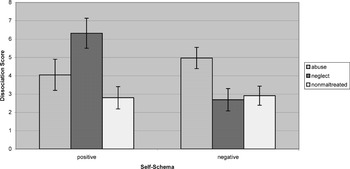
Among the younger group, the interaction of Subtype × Schema was significant, F (2, 131) = 5.98, p < .01, ηp2 = .08. Gender was not a significant covariate, F (1, 131) = 2.39, ns. Simple effects analyses of the Subtype × Schema interaction revealed that the manner in which the valence of self-schema related to dissociation differed as a function of maltreatment subtype. Among the younger children with positive self-schemas, the neglected children evidenced higher dissociation scores (M = 6.32, SD = 4.5) than the nonmaltreated children (M = 2.80, SD = 2.7, p < .05), and marginally higher dissociation scores than the abused children (M = 4.05, SD = 1.84, p = .056, ηp2 = .13). In contrast, among those children with negative self-schemas, the abused children demonstrated higher dissociation scores (M = 4.97, SD = 3.6) than did the neglected children (M = 2.69, SD = 2.7, p < .01), and the nonmaltreated children (M = 2.91, SD = 2.79, p < .01, ηp2 = .19; Figure 1.
Subtype × Self-Schema interaction: mean dissociation scores for the younger group. [A color version of this figure can be viewed online at www.journals.cambridge.org]

Within the older group, a parallel univariate ANOVA was performed upon dissociation scores, with maltreatment subtype and self-schema as the independent variables, and gender as the covariate. Unlike the case for the younger group, there was not a significant interaction effect of subtype and schema, F (2, 124) = 1.77, ns, nor was there a main effect for subtype F (2, 124) = 1.85, ns, or self-schema, F (1, 124) = .75, ns. Gender was a significant covariate, F (1, 124) = 12.43, p = .001, such that males demonstrated more dissociative symptoms (M = 3.22, SD = 2.4) than females (M = 1.78, SD = 2.3).
To ensure that the interaction effect of valence of schema and maltreatment subtype upon children's dissociative symptoms was specific to the self, an additional univariate analysis was conducted where valence of self-schema was replaced by valence of structural schema as a dependent variable. That is, a univariate ANOVA was run upon dissociation scores, where maltreatment subtype, valence of structural schema, and age group served as the independent variables, with gender as the covariate. Confirming that the self-schema effects noted in our previous set of analyses were specific to self-processes, the three-way interaction of structural Schema × Subtype × Age was nonsignificant, F (2, 256) = .68, ns. Similarly, the main effect of structural schema was nonsignificant, F (1, 256) = .12, ns. Consistent with the prior analysis, the main effect of subytpe upon dissociation remained significant, F (2, 256) = 3.35, p < .05, ηp2 = .03. Bonferroni corrected post hoc comparisons revealed that abused children demonstrated higher dissociation scores (M = 4.02, SD = 3.02) than did the nonmaltreated children (M = 2.55, SD = 2.57).
False schema, maltreatment, and dissociation
In addition, we were interested in assessing the relationship between maltreatment experiences and children's false schema. Therefore, to reflect the relative negativity of false schema, a summary score was calculated for each participant as the proportion of negative words falsely recalled minus the proportion of positive words falsely recalled. Based on this false recall negativity index score, children were divided into two groups: a positive false schema group (those with index scores < 0) and a negative false schema group (those with index scores ≥ 0). Consistent with the analysis of valence of self-schema by maltreatments subtype, separate chi-square analyses were conducted with the younger and older age groups among those children where false recall was present. For the younger group, maltreatment subtype was significantly related to valence of false schema (positive or negative), χ2 (2, N = 67) = 7.50, p < .05, such that 68.4% of the young neglected children demonstrated negative false schema, in comparison to 25.0% of the abused group and 42.9% of the nonmaltreated group. Post hoc chi-square analyses indicated that the abused and neglected groups differed significantly in relation to the valence of their false schema, χ 2 (1, N = 39) = 7.39, p < .01, whereas comparisons between abused and nonmaltreated children, and neglected and nonmaltreated children were nonsignificant. Among the older group, subtype was not significantly related to valence of false schema, χ2 (2, N = 43) = 2.12, ns.
Following the same analytic technique for the prior analyses, we conducted a univariate analysis of variance of maltreatment subtype, valence of false schema, and age group upon dissociation scores, with gender as the covariate, among those children who displayed false recall. However, the three way interaction of Subtype × False Schema × Age Group was nonsignificant, F (2, 94) = 2.08, ns. In addition, gender was a nonsignificant covariate, F (1, 94) = .80, ns.
Discussion
The results of the current study enhance our understanding of the role of cognitive and self-system processes in the association between maltreatment and true and false recall. The investigation advances our current knowledge regarding the manner in which the experience of trauma affects basic memory processes by examining memory for self-referent and emotionally valenced stimuli. In addition, the concurrent examination of dissociation and false recall for self-referent stimuli addresses a significant gap in the false memory literature among maltreated children.
Memory: True and false recall
Consistent with data on typically and atypically developing children (Hammen & Zupan, Reference Hammen and Zupan1984; Rudolph et al., Reference Rudolph, Hammen and Burge1995), abused, neglected, and nonmaltreated children all displayed the depth of processing self-schema effect such that words encoded under self-referent conditions were better remembered than were words encoded under structural conditions. Because words that were yes rated under self-encoding may be conceptualized as consistent with one's self-concept, the finding that all children demonstrated superior recall for words rated as self-referent provides evidence that the self-serves as an organizing schema for memory and may be used to facilitate recall. Comparison of the younger and older groups of children also was consistent with the normative data, such that the self-schema effect is stronger for older children who likely have more elaborate and stable self-representations.
These findings are also concordant with several other studies of cognitive processes among maltreated children, where maltreatment does not appear to impede or adversely effect the development of basic cognitive skills (e.g., recall and recognition memory for neutral stimuli, Howe et al., Reference Howe, Cicchetti, Toth and Cerrito2004; emergence of visual self-recognition, Schnieder-Rosen & Cicchetti, Reference Cicchetti1991; development of play maturity, Valentino, Cicchetti, Toth, & Rogosch, Reference Valentino, Cicchetti, Toth and Rogosch2006). However, when social or emotional factors have concurrently been examined with these cognitive processes, affective differences were observed between maltreated and nonmaltreated children (Rieder & Cicchetti, Reference Rieder and Cicchetti1989; Schneider-Rosen & Cicchetti, Reference Schneider-Rosen and Cicchetti1991; Valentino et al., Reference Valentino, Cicchetti, Toth and Rogosch2006). It should be noted, however, that children's recall performance was quite low overall; therefore, it is possible that floor effects in recall could account for nonsignificant differences in memory performance among abused, neglected and nonmaltreated children.
To extend our knowledge regarding false memory processes among maltreated children, we examined children's false recall of words not presented. Consistent with prior research, no differences emerged in the occurrence or total amount of false recall among abused, neglected, and nonmaltreated children (Howe et al., Reference Howe, Cicchetti, Toth and Cerrito2004). Thus, our findings support the notion that experience of maltreatment does not render children more or less susceptible to false recall.
Although abused, neglected, and nonmaltreated children did not differ in the overall frequency of false recall, differences emerged between maltreatment subtypes with respect to the affective valence of their false recall. Among the younger group, the neglected children demonstrated a greater proportion of negative false recall and less positive false recall than did the abused children. Among the older group, both abused and neglected children demonstrated less positive false recall than did the nonmaltreated children. Assuming that children are more likely to recall words that are related to their self-concepts, the finding that young neglected children have more negative and less positive false recall is consistent with research that has demonstrated that neglected children have a paucity of positive self-representations (Toth, Cicchetti, Macfie, & Emde, Reference Toth, Cicchetti, Macfie and Emde1997). Furthermore, the low rates of positive false recall among the neglected and abused older children is in accordance with research indicating that as maltreated children develop, both abused and neglected children are at heightened risk for low self-esteem (e.g., Cicchetti & Rogosch, Reference Cicchetti and Rogosch1997; Egeland et al., Reference Egeland, Sroufe and Erickson1983; Toth, Manly, & Cicchetti, Reference Toth, Manly and Cicchetti1992).
Schema
Abused, neglected, and nonmaltreated children did not differ in the affective valence of the self-referent words that were recalled and, as such, did not differ in the valence of their self-schema. These findings were contrary to our expectations, given prior research on self-representations among maltreated children that has indicated that abused children have a particularly high level of negative self-representations in relation to nonmaltreated children (Toth et al., Reference Toth, Cicchetti, Macfie and Emde1997). Nonetheless, the lack of differences in the valence of children's self-schema is consistent with research that has found comparable rates of positive self-representations among maltreated and nonmaltreated preschoolers (Toth et al., Reference Toth, Cicchetti, Macfie and Emde1997).
Schema and dissociation
To examine the potential role of defensive self-processing, we sought to elucidate the relationship between positive and negative self-schemas and dissociation (a marker of self-pathology or disintegration) among the abused, neglected, and nonmaltreated children. It is of interest that the significant interaction effect of age, subtype, and self-schema upon dissociative symptomatology reveals that positive and negative self-schemas are related to self-integration differently among children who have experienced different subtypes of maltreatment, and that this effect differs by age. Within the younger group only, negative self-schemas are associated with increased self-pathology among the abused children. In contrast, positive self-schemas are related to increased dissociation for the younger neglected children. The nonsignificant interaction effect of subtype and structural schema upon dissociation corroborates that the interaction of schema and maltreatment subtype upon children's symptomatology was specific to self-representations. Among those children who have experienced abuse, it is understandable that those with negative self-representations would evidence the most self-pathology as evidenced by high dissociative symptomatology. However, among the younger neglected children, it seems that positive self-schemas are related to self-pathology; therefore, it is possible that these positives self-schemas may be defensive and more consistent with a “false self.”
This association between positive self-representations and dissociation is consistent with speculation by Toth and colleagues (1997) that positive self-representations may be reflective of different self-processes for maltreated and nonmaltreated children. Although positive self-representations among nonmaltreated children may indicate healthy self-system functioning, maltreated children's positive self-representations may reflect “defensive” self-processes. This notion was supported by Toth and colleagues' findings that positive self-representations were less correlated to the child behavior variables than were the negative self-representations (Toth et al., Reference Toth, Cicchetti, Macfie and Emde1997). Therefore, in the current study, it is possible that the lack of differences noted in the valence of self-schema among abused, neglected and nonmaltreated children is also reflective of defensive self-processing among the maltreated children. Through defensive avoidance of the negative aspects of the self, neglected children, in particular, may demonstrate a positive self-schema that is inconsistent with their “true self.”
How might we reconcile the relation between positive self-schema and increased dissociation among younger neglected children with our prior results that indicated that the younger neglected children also display increased negative false recall. One possibility may be that the words presented under self-referent instructions are more susceptible to defensive processing during encoding than are words that were not on the list. In other words, because the falsely recalled words were never encoded under self-referent instructions, they might be less available for defensive processing. Therefore, the negative false recall of the younger neglected children may be more reflective of the true self, and their positive self-schema may be indicative of defensive processing. The significant association between positive self-schema and dissociation within the young neglected group supports this interpretation. It should be noted, however, that this interpretation is one of many possibilities, warranting the need for further research in this area.
The finding that neglected children who have positive self-schema are at heightened risk for dissociative symptomatology is consistent with prior research indicating that neglect in infancy is associated with later dissociation (Ogawa et al., Reference Ogawa, Sroufe, Weinfield, Carlson and Egeland1997). Unfortunately, the vast majority of research on dissociation and child maltreatment has focused almost exclusively on sexual and/or physical abuse in comparison to nonmaltreated children, and has not assessed neglect (for a review, see Macfie et al., Reference Macfie, Cicchetti and Toth2001a). Additional research is necessary to explore the link between neglect and the development of dissociative symptomatology.
Among the older children, the subtype by schema effect was not significant. In light of the developmental changes associated with both self-development and dissociation, our lack of findings among the older children was not surprising. For example, several investigations have described behaviors that are consistent with a “false self” among maltreated infants and preschoolers (Crittenden & DiLalla, Reference Crittenden and DiLalla1988; Koenig, Cicchetti, & Rogosch, Reference Koenig, Cicchetti and Rogosch2000). In addition, research with young school age children supports the presence of exaggerated and overinflated perceptions of self-competence in maltreated children (e.g., Kim & Cicchetti, Reference Kim and Cicchetti2003; Vondra et al., Reference Vondra, Barnett and Cicchetti1989). However, consistent with the age grouping and findings of the current investigation, Vondra and colleagues noted a shift in maltreated children's self-perceptions around ages 9–10 such that maltreated children no longer demonstrated an exaggerated sense of self. Instead, maltreated children may be at increased risk for the emergence of personality disorders as they begin to grapple with the developmental tasks of adolescence, including identify formation and personality consolidation (Rogosch & Cicchetti, Reference Rogosch and Cicchetti2004, Reference Rogosch and Cicchetti2005).
Developmental changes in dissociation may also account for the lack of findings among the older sample of children. Cross-sectional data suggest that dissociation may normatively decrease during the school-age years, as older children demonstrate less dissociation than do younger children (Putnam, Reference Putnam1997; Putnam et al., Reference Putnam, Helmers and Trickett1993). This attenuation of symptomatology may, in part, preclude the detection of differences in the relationship between self-schema and dissociation among the older abused, neglected and nonmaltreated children.
In light of purported links between false memory and dissociation, and between maltreatment and false memory, we examined the relationship among maltreatment subtype, false schema, and age in predicting dissociative symptoms. No significant effects emerged from this analysis. It is possible that by limiting this analysis to those children who demonstrated false recall, we did not have sufficient power to detect significant relations between maltreatment, false schema, and dissociation.
Limitations, Future Research Directions, and Clinical Implications
A number of limitations of the current investigation must be considered. The use of an observational rating scale to assess dissociative symptomatology may have restricted the range of dissociative experiences to those that are associated with predominately externalizing behaviors. In addition, the use of a checklist measure that was not explicitly designed to assess dissociation raises the possibility that other aspects of children's behavior apart from dissociative symptoms are being assessed. It should also be noted that these checklist items, derived from the TRF of the CBCL, were intended for teacher rating based on observation of the child's behaviors over the previous 2 months, whereas children's behaviors were rated in this investigation after an intensive 35 hr of observation within 1 week's duration. In future investigations, it would be ideal to also include child self-report measures that have been standardized to measure dissociation to gain a more comprehensive assessment of both internalizing and externalizing dissociative symptoms.
Other limitations of this investigation are that the duration of visual presentation of stimuli and time interval between stimulus presentation were not controlled, nor was reaction time to response assessed. Future research should examine latency to response during the CST paradigm so that reaction time differences as a function of word valence, task instructions, and maltreatment groups could be determined. In addition, consideration of the maturity of children's language skills may prove to be important for understanding the relationship between maltreatment and basic memory processes.
Future research might also consider evaluating additional dimensions of child maltreatment beyond subtype. The inclusion of factors such as chronicity and/or severity of maltreatment might shed further light on the association between maltreatment, self-schema, and dissociation.
Finally, the findings of this investigation possess important implications for clinical intervention. Specifically, the lack of differences in the affective valence of self-schema among abused, neglected, and nonmaltreated children may increase the chances for self-pathology among maltreated children to go unnoticed. Neglected children were identified as at particular risk given that neglected children who demonstrated positive self-schemas also evidenced the most dissociative symptoms. Therefore, it is essential for assessments of maltreated children to include the consideration of potential false self-behavior that may be masking underlying psychopathology and self-system disturbance. Moreover, as monies available to local governments are increasingly absorbed by rising costs associated with Medicaid, resources available to address the needs of maltreated children are shrinking. As a result, services are being directed toward children considered to be most at risk, typically thought to be victims of physical or sexual abuse. Our current findings highlight the danger inherent in failing to provide for the needs of children who have been victimized by neglect.
Appendix A: CBCL Items for the Dissociation Scale
These items are excerpted from Ogawa et al. (Reference Ogawa, Sroufe, Weinfield, Carlson and Egeland1997).
1. Acts too young for his/her age
8. Can't concentrate, can't pay attention for long
13. Confused or seems to be in a fog
17. Daydreams or gets lost in his/her thoughts
18. Deliberately harms self or attempts suicide
36. Gets hurt a lot, accident prone
40. Hears sounds or voices that aren't there
76. Explosive and unpredictable behavior
78. Inattentive, easily distracted
80. Stares blankly
87. Sudden changes in mood or feelings
91. Talks about killing self
Appendix B: Children's Self-Schema Task Stimuli
1. quiet
2. curious
3. healthy
4. nobody
5. brave
6. sad
7. lively
8. afraid
9. cheerful
10. friendly
11. terrible
12. strange
13. funny
14. interesting
15. awful
16. helpful
17. nervous
18. foolish
19. popular
20. bad
21. proud
22. loser
23. scared
24. sleepy
25. ugly
26. smart
27. happy
28. tired
29. angry
30. clever
31. nice
32. unhappy
33. hurt
34. leader
35. winner
36. lonely
37. lucky
38. exciting
39. boring
40. free
41. alone
42. attractive
43. bold
44. anxious