Nearly all studies of seed-size selection discuss trends as if they are in absolute terms, even though granivores' seed-size preferences are relative to the sizes of seeds presented to them. Many authors also interpret size selection from other studies in absolute terms. For example, Blate et al. (Reference Blate, Peart and Leighton1998) discussed several studies in which granivores preferred large seeds relative to those offered. Research by these authors found a granivore preference for small seeds relative to those offered. This was interpreted as a contradiction. However, most seeds in this study were fairly large and the relatively small seeds (20–70 mg) that were preferred were still larger than the relatively large seeds that were preferred from the aforementioned studies (Podolsky and Price, Reference Podolsky and Price1990: 5.2 mg; Mittelbach and Gross, Reference Mittelbach and Gross1984: 2.4–6.9 mg).
Optimal foraging theory predicts that granivores will choose seeds according to their ratio of food value to handling time (Pyke et al., Reference Pyke, Pulliam and Charnov1977) and granivore seed selection has been shown to follow this pattern (Vickery, Reference Vickery1984). Often seeds of a certain size are optimal (Davidson, Reference Davidson1977; Pulliam, Reference Pulliam1985; Kerley and Erasmus, Reference Kerley and Erasmus1991; Phelan and Baker, Reference Phelan and Baker1992) and granivore species of similar size commonly show similar seed-size preferences (Ivan and Swihart, Reference Ivan and Swihart2000). In herbaceous communities, for mammals, birds and sometimes ants, it is relatively large seeds that are closest to optimal size and therefore preferred (Reader, Reference Reader1993; Howe and Brown, Reference Howe and Brown2000; Mittelbach and Gross, Reference Mittelbach and Gross1984; Azcarate et al., Reference Azcarate, Arqueros, Sanchez and Peco2005; Pérez et al., Reference Pérez, Weisz, Lau and Bulla2006). The preference for relatively large seeds often breaks down in woody communities where average seed size is much larger than in herbaceous communities (Baker, Reference Baker1972; Moles et al., Reference Moles, Ackerly, Tweddle, Dickie, Smith, Leishman, Mayfield, Pitman, Wood and Westoby2007) and the larger seeds may be too big for optimal foraging by vertebrates (Pulliam, Reference Pulliam1985). This is particularly true where granivores are of similar size to those commonly present in herbaceous communities (Mendoza and Dirzo, Reference Mendoza and Dirzo2007). In forest communities, relatively small or intermediate-sized seeds are often preferred over larger seeds (Osunkoya, Reference Osunkoya1994; Blate et al., Reference Blate, Peart and Leighton1998; Moles et al., Reference Moles, Warton and Westoby2003; Mendoza and Dirzo, Reference Mendoza and Dirzo2007) with preferences commonly dependent on granivore body size (Ivan and Swihart, Reference Ivan and Swihart2000; Mendoza and Dirzo, Reference Mendoza and Dirzo2007).
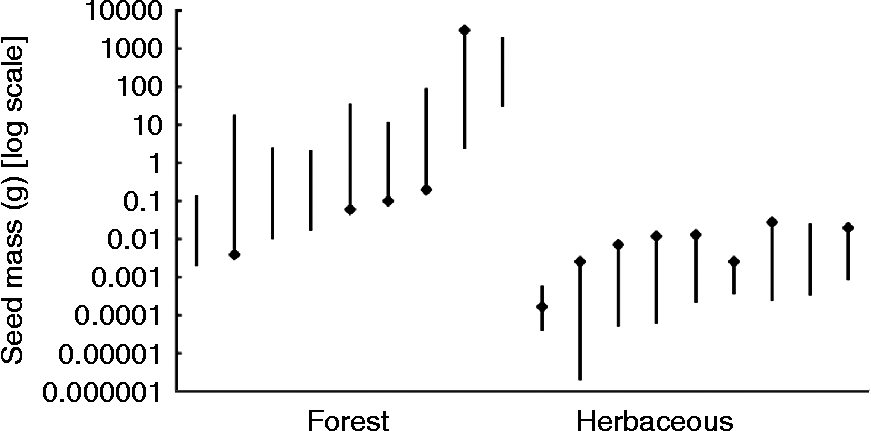
To assess relative and absolute seed-size preferences of vertebrates, the present author compiled data from published granivory studies in herbaceous and woody communities. Studies were used that statistically evaluated seed-size preference for a minimum of five species of seeds. Of the 18 studies used, 14 evaluated preference by vertebrates and four did not distinguish vertebrate from invertebrate predation, but used total predation. However, for the four studies that used total predation, vertebrates were expected to be the dominant granivores. The compiled data show that the difference in size selection between herbaceous and woody communities is not contradictory, since the smaller seeds of forest communities and larger seeds of herbaceous communities are often of similar size (Fig. 1). While there is no single preferred seed size for all vertebrate granivores, preferred sizes from many plant communities tend to converge over a relatively small range of seed sizes. This is likely the result of vertebrate granivores that also tend to converge over a relatively small range of sizes. The range of preferred seed masses is also similar to the global mean seed mass (Moles et al., Reference Moles, Ackerly, Tweddle, Dickie, Smith, Leishman, Mayfield, Pitman, Wood and Westoby2007), which may have implications for the evolution of seed and vertebrate granivore sizes (Hulme, Reference Hulme1998b).
Seed mass ranges and vertebrate granivore seed mass preferences of seeds presented in granivory studies of nine forest and nine herbaceous communities. Each line represents the range of seed masses offered for each seed predation study. ♦ = indicates when a seed mass preference occurred by either vertebrate or all granivores combined at the high, low or intermediate part of the seed mass range. Forest data, from left to right, from Kollmann et al. (Reference Kollmann, Coomes and White1998), Nepstad et al. (Reference Nepstad, Uhl, Pereira and da Silva1996), Hau (Reference Hau1997), Holl and Lulow (Reference Holl and Lulow1997), Osunkoya (Reference Osunkoya1994), Blate et al. (Reference Blate, Peart and Leighton1998), Mendoza and Dirzo (Reference Mendoza and Dirzo2007), Boman and Casper (Reference Boman and Casper1995) and Moles and Drake (Reference Moles and Drake1999). Herbaceous data, from left to right, from Marone et al. (Reference Marone, Rossi and Lopez De Casenave1998), Guo et al. (Reference Guo, Thompson, Valone and Brown1995), Mittelbach and Gross (1984); Reader (Reference Reader1993), Pérez et al. (Reference Pérez, Weisz, Lau and Bulla2006), Hulme (Reference Hulme1998a), Kelrick et al. (Reference Kelrick, MacMahon, Parameter and Sisson1986), Munoz and Cavieres (Reference Munoz and Cavieres2006) and Booman et al. (Reference Booman, Laterra, Comparatore and Murillo2009).

Additionally, levels of toxins and chemicals which impact palatability (Smith, Reference Smith1987; Henderson, Reference Henderson1990; Kollmann et al., Reference Kollmann, Coomes and White1998) often increase with increasing seed size (Osunkoya, Reference Osunkoya1994; Moles et al., Reference Moles, Warton and Westoby2003) as does seed coat thickness and seed coat hardness (Fenner, Reference Fenner1983; Pulliam, Reference Pulliam1985; Osunkoya, Reference Osunkoya1994). These characteristics increase handling time and are inversely related to seed predation rates (Hau, Reference Hau1997; Blate et al., Reference Blate, Peart and Leighton1998; Rodgerson, Reference Rodgerson1998; Howe et al., Reference Howe, Zorn-Arnold, Sullivan and Brown2006) making some larger seeds in woody communities unavailable to granivores.
Optimal foraging theory has been underutilized in many seed-preference studies. Granivores do not simply choose large or small seeds but rather, choose seeds which maximize their net rate of energy intake (Kerley and Erasmus, Reference Kerley and Erasmus1991; Phelan and Baker, Reference Phelan and Baker1992). Applying this well-supported theory to interpretation of seed-preference studies will aid in understanding the underlying reasons for preferences and advance our knowledge of granivory.
Acknowledgements
I thank B. Pinno and two reviewers for improving earlier versions of this manuscript. This work was supported by the National Sciences and Engineering Research Council of Canada.