Implications
Dairy cows were fed different levels of lucerne silage as a replacement for grass and maize silages to determine the effect on animal performance, milk quality and diet digestibility. There was no effect of varying levels of inclusion of lucerne on animal performance, although intake was reduced and diet digestibility lowest at the highest level of inclusion of lucerne. Milk content of polyunsaturated fatty acids increased with the inclusion of lucerne. Lucerne offers an alternative to grass and maize silages in the diet of dairy cows, and may reduce the reliance on purchased protein feeds such as soya bean meal.
Introduction
In the United Kingdom, grass silage is the traditional forage in the winter ration of dairy cows, with an increasing combination of grass and maize silages (March et al., Reference March, Haskell, Chagunda, Langford and Roberts2014), particularly in central and southern regions. Grass silage has a low to moderate CP content with a mean value of 133 g/kg dry matter (DM) (s.d. 24.4; Yan and Agnew, Reference Yan and Agnew2004), whereas maize silage has a low CP value of approximately 68 to 105 g/kg DM (Brito and Broderick, Reference Brito and Broderick2006; Hassanat et al., Reference Hassanat, Gervais, Julien, Massé, Lettat, Chouinard, Petit and Benchaar2013; Hart et al., Reference Hart, Huntington, Wilkinson, Bartram and Sinclair2015). Feeding grass silage on its own or in combination with maize silage to high-yielding dairy cows, therefore requires supplementation with purchased protein feeds to meet the cows metabolisable protein requirements (Thomas, Reference Thomas2004). Increased global demand for supplementary protein sources such as soya bean meal in association with fluctuations in its price and availability (FAO, 2013) has increased interest in higher protein, home grown forages in the diet of UK dairy cows. Forage legumes such as red clover, forage peas, beans and lucerne are of particular interest in this context because of their high protein content and low fertiliser requirements (Steinshamn, Reference Steinshamn2010). Lucerne has an added advantage of a large tap root making it more drought resistant and therefore better able to withstand potential changes in the UK climate (Wheeler and Reynolds, Reference Wheeler and Reynolds2013).
Lucerne is the most widely cultivated legume in the world (FAO, 2013) and may be grazed, preserved as hay or ensiled. It is popular in many parts of the United States and Europe where its high protein content complements the low content found in maize silage (Brito and Broderick, Reference Brito and Broderick2006; Broderick et al., Reference Broderick, Koegel, Walgenbach and Kraus2007). Studies in the United States have shown that compared with other legumes such as red clover, lucerne silage results in an increase in DM intake, milk yield and milk fat and protein levels in dairy cows (Broderick et al., Reference Broderick, Koegel, Walgenbach and Kraus2007). Feeding mixtures of lucerne and maize silage can result in an increase in DM intake, milk yield and protein content compared with lucerne alone (Hassanat et al., Reference Hassanat, Gervais, Julien, Massé, Lettat, Chouinard, Petit and Benchaar2013), similar to that commonly seen when mixtures of grass and maize silage are fed compared with grass silage alone (e.g. Kliem et al., Reference Kliem, Morgan, Humphries, Shingfield and Givens2008). When compared with grass silage alone, feeding lucerne silage also results in an increased DM intake that has been attributed to the greater rate of digestion of the digestible fibre fraction and greater outflow rate from the rumen, despite lucerne generally having a lower apparent digestibility of fibre than grass silage (Hoffman et al., Reference Hoffman, Combs and Casler1998; Broderick et al., Reference Broderick, Brito and Colmenero2002). A further advantage of the inclusion of legumes in the diet of dairy cows is the increase in the proportion of the nutritionally beneficial α-linolenic acid in milk compared with grass or maize silage, particularly when red clover-based diets are fed (Dewhurst et al., Reference Dewhurst, Evans, Scollan, Moorby, Merry and Wilkins2009; Steinshamn, Reference Steinshamn2010), although less work has been conducted on the potential effect of lucerne silage compared with either grass silage or maize silage.
Despite the potential advantages of lucerne in the diet of high-yielding dairy cows compared with grass or maize silage-based rations, it has received relatively little commercial uptake in the United Kingdom. The objectives of the study were to determine the effect of rate of inclusion of lucerne silage as a replacement for grass and maize silage on the intake, performance, milk fatty acid (FA) profile and apparent whole-tract digestibility in high-yielding dairy cows.
Material and methods
All the procedures involving animals were conducted in accordance with the UK Animals (Scientific Procedures) Act 1986.
Animals, forages, diets and experimental procedure
In total, 20 Holstein-Friesian multiparous dairy cows that were (mean±standard error) 61 (±6.3) days post calving, yielding 42 (±0.9) kg of milk/day and weighing 653 (±14.1) kg at the beginning of the study were used. Based on recordings taken in the week before commencing the study, animals were randomly allocated to one of four treatments according to calving date, milk yield and live weight. The experiment began on 18 November 2013 and lasted for 16 weeks.
The lucerne silage (Medicago sativa v. Daisy) was mown at approximately early bloom, wilted for 48 h and harvested using a precision chop, self-propelled forage harvester on 3 June 2013, and ensiled in a roofed, concrete clamp with an additive (Axcool Gold, Biotal, Cardiff, UK; 2 l/tonne). The grass silage was a first cut composed predominately of Lolium perenne, mown at a leafy growth stage, wilted for 24 h and harvested on 3 June 2013 using a precision chop, self-propelled forage harvester and ensiled in a roofed, concrete clamp with an additive (Axcool Gold, Biotal, Cardiff, UK; 2 l/tonne). The maize silage (Zea mays v. Adept) was established in May 2013 and harvested on 25 October 2013 at ~300 g DM/kg using a self-propelled forage harvester, and ensiled in a concrete clamp without an additive.
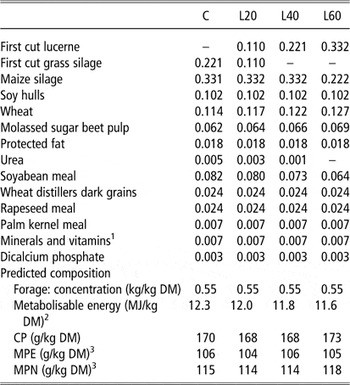
Cows were allocated to one of four dietary treatments in each of four periods of 4 weeks duration. Dietary treatments were composed of 0.55 : 0.45 forage to concentrates (DM basis), and within the forage component the proportion of each of the three forages were (DM basis): control (C)=0.4 : 0.6 grass : maize silage; L20=0.2 : 0.2 : 0.6 lucerne : grass : maize silage; L40=0.4 : 0.6 lucerne : maize silage; and L60=0.6 : 0.4 lucerne : maize silage. All cows were fed a total mixed ration (TMR) formulated to be isonitrogenous, with a similar metabolisable protein-rumen energy limited (MPE) content of ~105 g/kg DM and metabolisable protein-rumen nitrogen limited (MPN) of 116 g/kg DM according to Thomas (Reference Thomas2004) (Table 1). To achieve this, the content of soya bean meal and feed grade urea were decreased as the content of lucerne in the diet increased. The forages and straight feeds were mixed using a commercial forage mixer (HiSpec, County Carlow, Ireland) calibrated to ±1 kg, and fed through roughage intake feeders (Insentec B.V., Marknesse, The Netherlands) fitted with an automatic animal identification and forage weighing system calibrated to ±0.1 kg. Feed was offered daily at 0800 h at ~1.05 of ad libitum intake, with refusals collected twice weekly on a Tuesday and Friday.
Diet composition (kg/kg DM) and predicted nutrient supply for a control diet (C) based on grass and maize silage (40 : 60 forage DM basis); 20 : 20 : 20 grass : lucerne : maize silage (L20); 40 : 60 lucerne : maize silage (L40); and 60 : 40 lucerne : maize silage (L60)

DM=dry matter; MPE=metabolisable protein-rumen energy limited; MPN=metabolisable protein-rumen nitrogen limited.
1 Mineral/vitamin premix (Rumenco Ltd, Staffordshire, UK). Major minerals (g/kg): Ca, 200; P, 30; and Mg, 80; trace minerals (mg/kg): Cu, 1500; Zn, 6000; Mn, 4000; I, 400; Co, 80; and Se, 30; vitamins (mg/kg): retinol, 300; cholecalciferol, 7.5; all rac α-tocopherol acetate, 3600; B12, 2.5; and biotin, 135.
2 Assuming a metabolisable energy for lucerne of 8.6 MJ/kg DM (Thomas, Reference Thomas2004).
3 Thomas (Reference Thomas2004).
The cows were housed in the same portion of a building containing cubicles fitted with foam mats. The cubicles were scraped twice daily, bedded twice weekly with sawdust and limed weekly. All cows had continual access to water, and were milked twice daily at approximately 0600 and 1600 h. Forage samples were taken weekly, oven dried at 100°C and the ratio of lucerne : grass : maize silage adjusted to the desired level on a DM basis. Samples of each of the four TMR’s and three forages were taken daily during the final week of each period and stored at −20°C for subsequent analysis. Milk yield was recorded at each milking with samples taken on four occasions during the final week of each period (twice in the morning and twice in the evening) for subsequent analysis of fat, protein and lactose. Additional samples were collected on two occasions (once in the morning and once in the evening) for FA analysis. Cows were weighed and condition scored (Lowman et al., Reference Lowman, Scott and Somerville1976) after the evening milking at the start of the study and then at the end of each period. Blood samples were taken over 2 days during the final week of each period by venepuncture at 0700, 0900, 1100 and 1300 h, spun at 1200×g for 10 min, the plasma separated and stored at −20°C before subsequent analysis. Whole-tract digestibility was estimated using acid insoluble ash as an internal marker by collecting faecal grab samples from 12 cows at 1000 and 1600 h for 6 consecutive days during the final week of each period. Samples were stored at –20°C before analysis.
Chemical analysis
Forage and TMR samples were bulked within each period and a sub-sample analysed according to AOAC (Reference Arndt, Powell, Aguerre and Wattiaux2000) for DM (934.01), CP (988.05) and ash (942.05), whereas NDF and ADF were analysed according to Van Soest et al. (Reference Van Soest, Robertson and Lewis1991) with the use of a heat-stable α-amylase (Sigma, Gillingham, UK), and expressed exclusive of residual ash. The metabolisable energy content of the forages was determined by near IR reflectance spectroscopy (Sciantec Analytical, Selby, UK) using a system approved by the UK advisory services (Offer et al., Reference Offer, Cottrill and Thomas1996), whereas starch and neutral cellulase digestibility were determined as per Hart et al. (Reference Hart, Huntington, Wilkinson, Bartram and Sinclair2015). Milk samples were analysed using a Milkoscan minor spectrophotometer (Foss Ltd, Denmark) calibrated by the methods of AOAC (Reference Arndt, Powell, Aguerre and Wattiaux2000). Plasma samples were analysed for β-hydroxybutyrate (3-OHB), glucose, total protein and urea (kit catalogue no. AM 1015, RB 1007, GL1611, TP7970 and UR221, respectively; Randox Laboratories, County Antrim, UK) using a Cobas Miras Plus autoanalyser (ABX Diagnostics, Bedfordshire, UK). Faecal samples were bulked for each cow within days and sampling times and analysed for acid insoluble ash (Van Keulen and Young, Reference Van Keulen and Young1977), ash, NDF, ADF and nitrogen (N). Hemicellulose was calculated as the difference between NDF and ADF. Fatty acid methyl esters (FAME) in hexane were prepared from milk fat by the method of Feng et al. (Reference Feng, Lock and Garnsworthy2004) and from feeds by the method of Jenkins (Reference Jenkins2010). Individual FAME were determined by GLC (Hewlett Packard 6890, Wokingham, UK) fitted with a CP-Sil 88 column (100 m×0.25 mm i.d.×0.2 μm film, Agilent Technologies, Santa Clara, California, USA) as described previously by Lock et al. (Reference Lock, Teles, Perfield, Bauman and Sinclair2006).
Statistical analysis
Data were analysed by ANOVA as a Latin square design using Genstat 15th edition (VSN Int. Ltd, Oxford, UK). The model used was: Y ijk =µ+T i +P j +A k +E ijk , where Y ijk is the observation, µ the overall mean, T i the treatment, P j the period, A k the animal and E ijk the residual error. Blood data were analysed using repeated measures ANOVA. Results are presented as treatment means with a SED, with post-hoc analysis using Tukey’s test at a 5% level of significance.
Results
Feed analysis
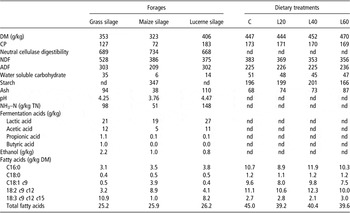
All three silages had a DM content above 300 g/kg, with lucerne silage having the highest value at 406 g/kg, some 83 g DM/kg higher than the maize silage, which had the lowest value, with the grass silage having an intermediate content (Table 2). Similarly, the lucerne silage had the highest CP, pH and NH3–N content of the three forages, and the maize silage the lowest. Grass silage had the highest content of NDF, some 142 and 153 g/kg DM higher than the maize or lucerne silages, respectively. The FA content of the three forages was similar at ~26 g/kg DM, with maize silage being highest in 18:2 c9 c12, contributing 0.34 of the total FA, whereas 18:3 c9 c12 c15 was the predominant FA in both the lucerne and grass silages, contributing 0.31 and 0.43 of the total FA, respectively. The DM of the TMR diets was highest in L60, which had the greatest inclusion of lucerne (L60), whereas the CP content of the four diets was similar at ~171 g/kg DM. The mean NDF content of the four rations was 365 g/kg DM, being highest in C and lowest in L40. The FA content and composition of the four rations was similar, with a mean content of 41 mg/kg DM, with C18:2 c9 c12 being the predominant FA, contributing on average 0.27 of the total FA content.
Chemical composition (g/kg DM) of forages and diets that contained (forage DM basis) 40 : 60 grass : maize silage (C); 20 : 20 : 20 grass : lucerne : maize silage (L20); 40 : 60 lucerne : maize silage (L40); and 60 : 40 lucerne : maize silage (L60)

DM=dry matter; TN=total nitrogen.
Animal performance
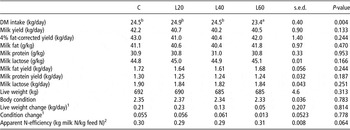
Total DM intake averaged 24.3 kg/day and was lower (P<0.01) in cows when fed L60 than of the other three treatments (Table 3). In contrast, there was no effect (P>0.05) of dietary treatment on milk yield, 4% fat-corrected milk yield, milk fat or protein content, which averaged 40.9 kg/day, 41.6 kg/day, 41.0 g/kg and 30.9 g/kg, respectively. There was also no effect (P>0.05) of dietary treatment on mean live weight, live weight change, body condition or body condition change, although numerically animals receiving L60 had the lowest live weight and body condition change. The apparent efficiency of dietary protein use for milk production tended (P=0.06) to be higher in cows when fed L60 than L40 or L20.
Milk performance, live weight and body condition of dairy cows fed diets that contained (forage DM basis) 40 : 60 grass : maize silage (C); 20 : 20 : 20 grass : lucerne : maize silage (L20); 40 : 60 lucerne : maize silage (L40); and 60 : 40 lucerne : maize silage (L60)

DM=dry matter.
a,bMeans within a row with a different superscript differ (P<0.05).
1 Over the 28-day period.
2 N-milk=milk protein output (g/day)/6.38.
Milk FA
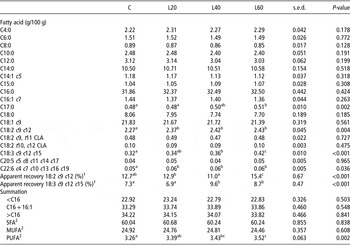
There was no effect (P>0.05) of dietary treatment on milk fat content of C4:0–C18:0, C18:1 c9, C18:2 c9, t11 CLA, C18:2, t10, c12 CLA, C20:0, C20:5 c5 c8 c11 c14 c17 or C22:6 c4 c7 c10 c13 c16 c19 (Table 4). In contrast, milk C17:0 was higher (P<0.01) in cows when receiving L60 than C or L20. Milk fat concentration of both C18:2 c9 c12 and C18:3 c9 c12 c15 increased with rate of inclusion of lucerne in the ration, being highest in cows fed L60 and lowest in C (P<0.05). There was no effect of dietary treatment on FA of a chain length less than C16 (indicative of de novo synthesis), >C16 (indicative of uptake from the diet) or C16:0 and C16:1. There was also no effect of dietary treatment on total milk fat content of saturated or monounsaturated FAs, but polyunsaturated fatty acid (PUFA) content was higher (P<0.05) in cows when fed L60 compared with C or L20.
Milk fatty acid profile of dairy cows fed diets that contained (forage DM basis) 40 : 60 grass : maize silage (C); 20 : 20 : 20 grass : lucerne : maize silage (L20); 40 : 60 lucerne : maize silage (L40); and 60 : 40 lucerne : maize silage (L60)

DM=dry matter.
a,b,cMeans within a row with a different superscript differ (P<0.05).
1 From feed to milk.
2 Saturated fatty acid (SFA) are defined as fatty acids with no double bonds, monosaturated fatty acid (MUFA) are defined as fatty acids with one double bond and polyunsaturated fatty acids (PUFA) are defined as fatty acids with more than one double bond.
Plasma metabolite concentrations
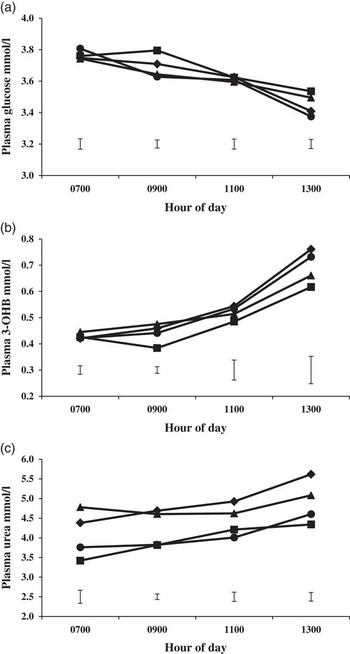
There was no effect (P>0.05) of dietary treatment on mean concentration of plasma glucose at any of the time points, with values decreasing during the day (Figure 1a). In contrast, plasma 3-OHB concentrations were lower (P<0.01) in cows when receiving C, particularly at 0900, 1100 and 1300 h (Figure 1b). Plasma urea concentrations were lowest (P<0.001) in cows when receiving C or L20, and increased with rate of inclusion of lucerne, being highest when receiving L60. Plasma urea concentrations also increased with time post-feeding, being consistently lower in cows when receiving C or L20 than L40 or L60 at all time points (Figure 1c). There was no effect (P>0.05) of dietary treatment on plasma total protein, which averaged 95.6 g/l.
Plasma glucose (a) β-hydroxybutyrate (3-OHB) (b) and urea concentrations (c) in dairy cows fed diets that contained (forage dry matter (DM) basis) 40 : 60 grass to maize silage (Control (C) ■); 20 : 20 : 20 grass : lucerne : maize silage (L20 ●); 40 : 60 lucerne : maize silage (L40 ▲); and 60 : 40 lucerne : maize silage (L60 ♦). Error bars indicate s.e.d.

Apparent whole-tract digestibility
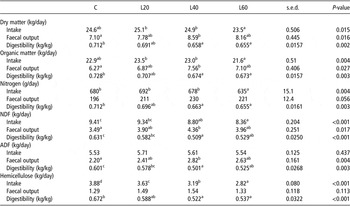
The DM intake of cows selected for the digestibility study was similar to the mean for the whole study, with cows receiving L60 consuming 1.6 and 1.4 kg DM/day less (P<0.05) than those receiving L20 or L40, respectively (Table 5). In contrast, faecal DM output was lowest in cows receiving the grass silage : maize diet (C), with the consequence that apparent DM digestibility was higher in cows receiving this treatment than in those receiving L40 or L60 (P<0.05). Intake, faecal output and apparent digestibility of organic matter (OM) followed a similar pattern to DM, with the highest apparent digestibility of OM in cows receiving C and lowest in those receiving L40 or L60. Intake of N was similar in cows when receiving C, L20 or L40, but was ~48 g/day lower (P<0.01) in cows receiving L60. In contrast, N output was similar (P>0.05) across treatments, with a mean value of 214 g/day, with the consequence that the highest apparent digestibility of N was recorded in cows when receiving C, and the lowest when fed L60 (P<0.01). Intake of NDF was lower in cows when receiving L40 or L60 compared with C (P<0.05), whereas faecal output was higher in L40 compared with C (P<0.05). As a consequence, the digestibility of NDF was lowest in cows when fed L40 or L60, and highest when fed C (P<0.05). The intake of ADF averaged 5.60 kg/day, and did not differ (P>0.05) between treatments. In contrast, faecal output of ADF was higher and consequently digestibility was lower (P<0.05) in cows when fed L40 compared with C, with L20 and L60 having intermediate values. Intake of hemicellulose decreased with increasing proportion of lucerne in the ration (P<0.001), as did digestibility, which was higher in cows when fed C than when fed L40 or L60 (P<0.05), with L20 having an intermediate value.
DigestibilityFootnote 1 of DM, OM, N and fibre in dairy cows fed diets that contained (forage DM basis) 40 : 60 grass to maize silage (C); 20 : 20 : 20 grass to lucerne to maize silage (L20); 40 : 60 lucerne to maize silage (L40) and 60 : 40 lucerne to maize silage (L60)

DM=dry matter; OM=organic matter; N=nitrogen.
a,b,c,dMeans within a row with a different superscript differ (P<0.05).
1 Measured using 12 cows.
Discussion
Feed analysis and animal performance
The dietary treatments employed in the current study were chosen to allow a comparison of the partial and total replacement of first cut perennial ryegrass silage with first cut lucerne silage (C v. L20 v. L40), and for the partial replacement of maize silage with lucerne (L40 v. L60) on intake, performance, milk quality and apparent digestibility. The lucerne, grass and maize silages used all had high DM contents, with CP values that reflected commercial targets (NRC, 2001; Yan and Agnew, Reference Yan and Agnew2004). Fibre levels in the lucerne silage were also similar to that reported by Brito and Broderick (Reference Brito and Broderick2006) and Hassanat et al. (Reference Hassanat, Gervais, Julien, Massé, Lettat, Chouinard, Petit and Benchaar2013), but lower than that used by Dewhurst et al. (Reference Dewhurst, Delaby, Moloney, Boland and Lewis2003a and 2003Reference Dewhurst, Fisher, Tweed and Wilkinsb). Total DM intake in the current study was lowest in cows when fed the highest rate of inclusion of lucerne (L60), but similar in the three other treatments. Compared with feeding ryegrass grass silage as the sole forage, Broderick et al. (Reference Broderick, Brito and Colmenero2002) and Dewhurst et al. (Reference Dewhurst, Delaby, Moloney, Boland and Lewis2003a and 2003Reference Dewhurst, Fisher, Tweed and Wilkinsb) reported that lucerne resulted in an increase in DM intake, an effect that was attributed to an increased rumen passage rate combined with a rapid rate of degradation of the potentially degradable fibre (Steinsham, Reference Steinshamn2010). In the current study, however, the grass silage was always fed in combination with maize silage, and such mixtures have consistently been shown to result in an increase in forage DM intake when compared with grass silage as the sole forage (Kliem et al., Reference Kliem, Morgan, Humphries, Shingfield and Givens2008). Interestingly, substituting lucerne for maize silage from 0.4 of the forage DM (L40) to 0.6 (L60) in the current study decreased DM intake. Arndt et al. (2015) reported no significant difference in total DM intake when lucerne silage sequentially replaced maize silage in the diet of dairy cows. In contrast, Brito et al. (Reference Brito, Broderick and Reynal2006) reported a quadratic response in intake as lucerne replaced maize silage, with a maximal value at a ratio of approximately 50 : 50, although decreases in intake were only observed at the extreme inclusion rates.
Despite the reduction in intake at the highest rate of inclusion of lucerne, there was no effect on milk yield, which averaged 40.9 kg/day across all four treatments, and the current findings provide little support for the replacement of good quality first cut grass with lucerne to improve milk yield in diets based on maize silage when fed to high-yielding dairy cows. Feeding diets containing lucerne as the sole forage result in a higher milk yield than those containing grass silage in some (e.g. Hoffman et al., Reference Hoffman, Combs and Casler1998; Broderick et al., Reference Broderick, Brito and Colmenero2002), but not all (Dewhurst et al., 2003Reference Dewhurst, Delaby, Moloney, Boland and Lewisa and 2003Reference Dewhurst, Fisher, Tweed and Wilkinsb) studies. Similar to the effects on DM intake, the combination of grass silage and maize silage generally results in an increase in milk yield (Kliem et al., Reference Kliem, Morgan, Humphries, Shingfield and Givens2008), and as all treatments that contained grass silage in the current study also contained maize silage, this prevented a direct comparison of lucerne with grass silage. In studies that have replaced lucerne silage with maize silage there is no consistent effect on milk yield (Brito and Broderick, Reference Brito and Broderick2006; Hassanat et al., Reference Hassanat, Gervais, Julien, Massé, Lettat, Chouinard, Petit and Benchaar2013; Arndt et al., 2015). Despite the lack of an effect of treatment on milk yield or component output in the current study, the inclusion of lucerne resulted in a reduction in the amount of supplementary protein, such that cows offered L60 consumed 0.51 kg DM less soya bean meal (P<0.001) and 0.12 kg less feed grade urea per day (P<0.001) than those offered C, thereby decreasing the reliance on purchased feed. Any economic justification for lucerne would, however, also have to include the relative costs of growing and ensiling compared with other forages, which would vary for individual farms depending on the suitability of the soil and climate.
Brito and Broderick (Reference Brito and Broderick2006) and Hassanat et al. (Reference Hassanat, Gervais, Julien, Massé, Lettat, Chouinard, Petit and Benchaar2013) reported a linear decrease in milk fat content and yield as maize progressively replaced lucerne silage. Increased intake of starch as a result of increasing the proportion of maize in the ration has been suggested to lower ruminal pH and result in biohydrogenation intermediaries such as C18:2 t10, c12 CLA being absorbed, which have been shown to be potent inhibitors of de novo fat synthesis (Bauman et al., Reference Bauman, Harvatine and Lock2011; Hussein et al., Reference Hussein, Harvatine, Weerasinghe, Sinclair and Bauman2013). There was, however, no difference between treatments in the current study in milk fat content or the concentration of C18:2 t10, c12 CLA in milk, possibly owing to the comparatively small differences in dietary starch concentration and the similarity in dietary 18:2 c9 c12 concentration, which is required for the ruminal production of C18:2 t10, c12 CLA (Bauman et al., Reference Bauman, Harvatine and Lock2011). In general, replacing grass silage with lucerne silage has been shown to have little effect on milk protein content (Dewhurst et al., Reference Dewhurst, Delaby, Moloney, Boland and Lewis2003a), a finding similar to that reported here. In contrast, increasing maize silage in the diet has often been shown to increase milk protein content (Hassanat et al., Reference Hassanat, Gervais, Julien, Massé, Lettat, Chouinard, Petit and Benchaar2013; Arndt et al., 2015), an effect that has been associated with an increased supply of rumen fermentable energy and flow of microbial protein to the duodenum. The differences in inclusion rate of maize silage in the current study may not, however, have been large enough to produce an effect.
Milk FA composition and blood metabolites
In general, milk FA content reflected dietary source, with only small differences between treatments, a finding in agreement with others who have compared ryegrass or timothy grass silages with lucerne (Orozco-Hernández et al., Reference Orozco-Hernández, Brisson and Girard1997; Dewhurst et al., Reference Dewhurst, Delaby, Moloney, Boland and Lewis2003a). Milk FA content of C18:3 c9 c12 c15 was low across all treatments, but was increased following the inclusion of lucerne despite the highest dietary concentration of this FA being recorded in the grass silage, a finding in agreement with Orozco-Hernández et al. (Reference Orozco-Hernández, Brisson and Girard1997). Indeed, the apparent recovery of C18:3 c9 c12 c15 was highest when either of the two diets that did not contain grass silage (L40 and L60) were fed, although recovery rates were generally higher for all dietary treatments than has been reported elsewhere (Dewhurst et al., Reference Dewhurst, Delaby, Moloney, Boland and Lewis2003a). A lower extent of ruminal biohydrogenation of C18:3 c9 c12 c15 in lucerne compared with grass silage-based diets has previously been reported in dairy cows (Dewhurst et al., Reference Dewhurst, Fisher, Tweed and Wilkins2003b). The higher rumen outflow rate of lucerne (Hoffman et al., Reference Hoffman, Combs and Casler1998; Dewhurst et al., Reference Dewhurst, Fisher, Tweed and Wilkins2003b) would reduce the time available for biohydrogenation in the rumen and therefore increase duodenal supply, although it is possible that the PUFA in lucerne are inherently more resistant to biohydrogenation than grass silage. Feeding other legumes such as red clover is also associated with a substantial increase in milk PUFA content, which has been suggested to be owing to encapsulation of the lipid which is complexed within protein-bound phenol (Lee et al., Reference Lee, Theobald, Gordon, Leyland, Tweed, Fychan and Scollan2014). This is, however, unlikely to explain the current results as lucerne is generally low in polyphenol oxidase. Milk C18:2 c9 c12 values were in the same range as that reported by others for grass and maize silage-based rations (Hart et al., Reference Hart, Huntington, Wilkinson, Bartram and Sinclair2015), and increased with inclusion level of lucerne, despite the highest concentration of this FA in the maize silage. The net result of these changes was a small but significant increase in the milk content of PUFA with inclusion level of lucerne.
All four diets used in the current study were formulated to have a similar content of CP and MPE and to be in excess of MPN, which was achieved by balancing the higher protein content in lucerne compared with grass or maize silage with soya bean meal and feed grade urea. Despite this, plasma urea concentrations were higher at all time points during the day with the highest inclusion rate of lucerne (L60), although all values were within the recommended physiological range (Ward et al., Reference Ward, Murray, White and Rees1995). Others have also reported increased blood urea concentrations with lucerne compared with grass silage-based diets, although often no account was made for the higher CP content in the lucerne (Orozco-Hernández et al., Reference Orozco-Hernández, Brisson and Girard1997; Dewhurst et al., Reference Dewhurst, Delaby, Moloney, Boland and Lewis2003a), limiting the interpretation of the results. The rate of degradation of CP in lucerne silage is generally higher than grass silage (NRC, 2001), which may have limited the ability of rumen microbes to efficiently capture degradable N. Increasing the inclusion rate of lucerne was also associated with an increase in plasma 3-OHB concentrations, which reflect the lower DM intake in cows fed the highest inclusion rate of lucerne (L60), and the numerically lower rate of gain of live weight and body condition score on this treatment. Alternatively, differences in plasma 3-OHB may reflect a greater production of butyric acid in the rumen, as increased inclusion rates of lucerne have been associated with a greater ruminal concentration of butyrate (Hassanat et al., Reference Hassanat, Gervais, Julien, Massé, Lettat, Chouinard, Petit and Benchaar2013).
Apparent whole-tract digestibility
In the current study, the digestibility of DM, OM, NDF and ADF were similar to others that have evaluated the effect of grass, lucerne or maize silage-based diets (Hoffman et al., Reference Hoffman, Combs and Casler1998; Sinclair et al., Reference Sinclair, Blake, Griffin and Jones2012), although the mean digestibility of NDF and ADF was higher than has been reported in some other studies (e.g. Broderick et al., Reference Broderick, Koegel, Walgenbach and Kraus2007; Arndt et al., 2015). Several studies have reported a decrease in whole-tract apparent DM and OM digestibility when lucerne has replaced grass silage in the diet (Orozco-Hernández et al., Reference Orozco-Hernández, Brisson and Girard1997; Broderick et al., Reference Broderick, Brito and Colmenero2002; Dewhurst et al., Reference Dewhurst, Delaby, Moloney, Boland and Lewis2003a), a finding in agreement with the current study where both DM and OM digestibility decreased as the rate of inclusion of lucerne silage increased. There was, however, no difference in apparent digestibility when lucerne replaced maize silage (L40 and L60). Arndt et al. (2015) also reported no significant effect of rate of inclusion of lucerne in maize silage-based diets that ranged from 20% to 80% lucerne (DM basis) on whole-tract DM, OM or N digestibility. The apparent digestibility of N in the current study decreased as lucerne replaced grass silage in the diet, a finding in agreement with Broderick et al. (Reference Broderick, Brito and Colmenero2002) who attributed this to the greater excretion of metabolic N owing to a substantially higher DM intake. In the current study, DM intake was similar in cows fed C, L20 or L40, and intake alone is unlikely to have contributed to a greater metabolic faecal N output. In general, feeding lucerne results in a greater rumen outflow rate (Hoffman et al., Reference Hoffman, Combs and Casler1998) and duodenal flow of indigestible fibre, and it is possible that this contributed to a greater sloughing of intestinal cells and reduced whole-tract digestibility. Alternatively, although the content of degradable N in lucerne is high as evidenced by the increased plasma urea concentrations in cows fed either of the two highest inclusion rates of lucerne, the protein which is not degraded in the rumen is less digestible than in the soya bean meal that it replaced.
The lower digestibility of fibre in the lucerne compared with the grass silage-based ration (C v. L40) agrees with a number of other studies that have investigated the effect of replacing perennial ryegrass silage with lucerne on fibre digestibility in dairy cows (Hoffman et al., Reference Hoffman, Combs and Casler1998; Broderick et al., Reference Broderick, Brito and Colmenero2002). In contrast to DM and OM digestibility, most studies that have replaced maize silage with lucerne silage have reported an increase in digestibility of NDF, ADF and hemicellulose (Brito and Broderick, Reference Brito and Broderick2006; Hassanat et al., Reference Hassanat, Gervais, Julien, Massé, Lettat, Chouinard, Petit and Benchaar2013; Arndt et al., 2015). In the current study, however, there was no effect of increasing the proportion of lucerne from L40 to L60 on the digestibility of any of the fibre components that were measured, although the difference in inclusion rate was considerably less than in other studies that have evaluated the effect of replacing maize silage with lucerne.
Conclusions
Compared with a good quality first cut grass silage, there was no benefit from the inclusion of lucerne at up to 0.6 of the forage component in maize silage-based rations on performance or milk quality, although feed rates of soya bean meal and feed grade urea were reduced. A high inclusion rate of lucerne was associated with a reduction in digestibility, and increased plasma concentrations of 3-OHB and urea. In contrast, milk content of PUFA were positively related to an increasing level of inclusion of lucerne, principally owing to an increase in linoleic and α-linolenic acids.
Acknowledgements
The authors would like to acknowledge the technical assistance of S. Wilson, G. Vince, A. Ali and to AHDB dairy for financial support.