Although at moments of extreme political crisis paradigmatic shifts may occur in the structure of a society, individuals caught up in the changes may not necessarily be able to comprehend the enormity, in ideological terms, of what is happening around them. There was an obvious danger that, following the election of any nationalist-oriented government in the Weimar Republic, Germany would seek to dominate the inter-national arena by engaging in traditional power politics. With right-wing parties demanding a revanchist foreign policy to throw off the alleged shackles of the loathed Versailles Treaty, the threats to European stability were clear. By way of contrast, the nationalist ideology that emerged triumphant in 1933 was little understood. Both inside Germany and abroad hopes were entertained that the extremist fringe of National Socialism would become attenuated; very few identified how the internal dynamics of the movement would generate a progressive radicalisation leading to annihilationist fanaticism.
At no time in the twentieth century was enterprise confronted with greater moral challenges than during the period of the Third Reich.Footnote 1 New research continues to offer insights into the way in which business elites reacted to the rise of National Socialism up to 1933, and then adjusted to the conditions imposed under the Hitler dictatorship. Studies of individual enterprises have analysed the complex set of interactions that developed between business and government in the Third Reich and the way in which this affected daily life in Germany and beyond.Footnote 2 The analysis of large organizations such as the Deutsche Bank or Allianz, and the people who served in them, reveals that there were cases of honourable conduct; far more frequently, however, cynical and opportunistic actions dominate the narrative. Perhaps such patterns of behaviour are to be expected regardless of the nature of the political regime in power. While National Socialism found willing recruits among the junior ranks, it seems that neither ideological adherence nor pursuit of profit especially motivated the senior managers and directors who sat on supervisory and management boards. Instead, a common theme emerges: the attempt to maintain entrepreneurial agency – some degree of freedom for managerial manoeuvre within the political and economic constraints brought about by the rise of the Third Reich.Footnote 3 Unlike the Bolsheviks in Russia, the National Socialists left intact the institutional framework and structures of a capitalist society. As Richard Overy has recently argued, the Nazi era needs to be contextualised: in terms of many day-to-day activities, the economy was not greatly different from what came before it or after it; equally, ‘economic policy was instrumentalised to comply with ideological imperatives right from the start’.Footnote 4 The price that business had to pay for the economic stability and growth that emerged was co-operation to a greater or lesser extent with the leadership's plans for discrimination, autarky and rearmament.Footnote 5
In the wake of the global depression and financial crisis whole sectors of Germany's economy – such as the finance industry – were already demoralised and on the defensive before Adolf Hitler took power. Under the Third Reich, bastions of private capitalism had every reason to feel still more vulnerable: Nazi ideologues bent on dismantling the liberal economy launched frequent attacks and threatened institutions with nationalisation or ‘socialisation’ – a case of the hegemony, rather than mere primacy, of politics over economics. Yet, in spite of the aggressive rhetoric, such threats were hardly ever carried out. Furthermore, the recent study by Buchheim and Scherner shows how German firms could even act against the wishes of the regime, over investment projects for example, without fear that they would suffer unbearable pressure or adverse consequences.Footnote 6 Perhaps the key, then, to understanding the position of enterprise in the Third Reich is that certain businesses could never know just how far threats against their interests would be carried out. In such circumstances, it is not difficult to conceive of corporate decision-making being gripped by a paramount need to ensure survival in the short term in the hope of better prospects in the future.Footnote 7 Consequently, assessments of actions taken or left untaken by individual firms in the Third Reich must always be set against the constraints generally imposed on business, and especially the ways in which the regime discriminated between different sets of commercial interests. One obvious basis for discrimination that Nazi ideologues were quick to point to was the distinction that could be made between foreign ownership and German ownership of companies. Unilever – formed when English and Dutch companies merged to create a dual-company structure in 1929 – was one of the earliest and most important examples of a genuinely multinational corporation. The history of the concern was first, and magisterially, set down in the pioneering study by Charles Wilson in 1954.Footnote 8 The dominance of Unilever's Dutch-owned progenitor companies in the German margarine industry before and after the First World War had already stirred up nationalistic feelings against foreign ownership well before Hitler came to power.Footnote 9 The fractured ten years that followed the creation of Unilever offer little other than some of the bleakest trading conditions imaginable: a world economic order that was collapsing and a crisis in international relations that grew ever more menacing. Consequently, as a member of the corporate elite, Unilever – the Anglo-Dutch multinational – appeared to be doubly vulnerable: not only did it symbolise liberal, international capitalism, it was also foreign-owned. On the ideological battlefield, Unilever's colours flew on one side, the swastika on the other.
While a burgeoning historiography has elucidated the nature of commercial and political interaction between German corporations and government in the Third Reich, historians have only recently begun to consider, or in some cases re-consider, the role of foreign-owned multinationals.Footnote 10 One example is the important study, by Lukas Straumann and Daniel Wildmann, of Swiss-owned chemical companies in the Third Reich.Footnote 11 In certain areas of business, therefore, it is possible to compare Unilever's policies with those of the Swiss firms. Similarly, the eminent historian Henry Ashby Turner Jr has analysed the position of the giant General Motors (GM) and Opel – its German subsidiary – during the Nazi era.Footnote 12 Turner's study provides an important insight into the Weltanschauung of multinational enterprise in the 1930s: leading GM executives maintained that an international business simply had to be managed without regard to the political beliefs of the countries in which it operated. Turner reasons that GM held such views because it was neither more nor less than a product of its time; senior executives, although certainly politically naïve, were not morally culpable because the values they held were commonplace and representative of the world in which they lived.Footnote 13
This instructive, if rather disquieting, thesis raises the possibility that other, perhaps most, leading business figures were also in want of a moral compass to guide them. In terms of size, organisational structures and operating conditions, the experience of GM in the 1930s was broadly analogous to that of Unilever. As the Third Reich became established, multinational firms contended with a politico-economic environment that was aligned to the requirements of a state that openly persecuted certain of its citizens and self-evidently deployed its resources to rearm and to prepare for war. Was the socio-cultural conditioning of the age so pervasive, therefore, that it rendered multinational enterprise barely able to recognise the pernicious effects of the politicisation of business life in Nazi Germany?
Indeed, the reason why a more comprehensive understanding of totalitarianism and the significance of the Hitler dictatorship did not emerge in prewar democracies remains a question of enduring historical interest. One approach is to consider the range of political and cultural influences that go to make up a ‘Feindbild’, or conceptualisation of the enemy.Footnote 14 Ideological perspectives that seek to interpret the external world are shaped by national culture; but the latter may, in part, be the product of various communities and transnational actors that the nation-state itself hosts.Footnote 15 By acting as a transmission mechanism for the flow of informed opinion across state borders, multinational enterprise, with foreign direct investments, is indicative of this phenomenon. In this as in other respects, multinationals occupied a strategically important position during the 1930s: they contributed in some measure to the shaping of how, in their ‘home’ country, external threats were perceived. This article seeks, therefore, to examine how Unilever responded to the challenges of political risk posed by the Third Reich – a ‘host’ country that occupied a particularly important place in the company's overall operations. More specifically, the intention is to analyse how Unilever weighed aspects of business activity that gave rise to moral and ethical issues against the need to survive commercially. A preliminary assessment may be made, thereby, of the company's perception and management of corporate responsibility in the Third Reich during the 1930s.
Securing ‘good will’
In the interwar years Unilever's foreign direct investments fell into different categories. Production in India, for example, was undertaken principally for defensive reasons: there were fears that revenue tariffs would allow local producers the opportunity to undercut the prices of the company's exports to that market.Footnote 16 In Germany during the 1930s it was rather a case of trying to secure some reasonable rate of return on investments in the face of trading conditions beset with economic and, increasingly, political difficulties. However promising the German market was in second half of 1920s, Unilever was inevitably affected by the global downturn in trade and caught up in the political and economic turmoil besetting the late Weimar Republic. Unilever's experience illustrates how, in economic conditions and policy at least, the takeover of power by the National Socialists did not mark a sharp turning point. One constant and all-important fact of economic life throughout most of the decade was foreign-exchange control. Under the Third Reich such controls became, in effect, a means to restructure the economy.Footnote 17 But well before 1933 exchange controls led, in varying proportions, to shortages of raw materials imported into Germany and, consequently, production problems for manufacturers. Additionally, for the subsidiaries of foreign-owned firms, exchange controls placed restrictions on the repatriation of profits to the parent company. Though firmly entrenched in Germany, it was as much a belief in the long-term potential that counteracted any desire within Unilever to ‘cut and run’ in the face of the deterioration in market conditions. At the end of 1931 Francis D'Arcy Cooper, the chairman, reported to his fellow directors on the difficulties. As these included a government decree ordering a reduction in prices by 10 per cent, as many unprofitable lines as possible were to be cut out. But, he urged, they had to keep on trading.Footnote 18 In March 1932 the company reviewed the position and decided that there was no question of ceasing operations and pulling out, or even of reducing production. Ways had to be found of disposing of surplus marks. This included capital expenditure on improving plant and factories – investments that would otherwise have been deferred because the return over the short term was not expected to meet the company's standards.Footnote 19
Unilever feared that to do anything other than this would be to risk alienating both the German government and public and inviting the German press to seize on bad news to launch attacks against the company. When the company warned that the inevitable consequence of the shortage of raw materials would be to restrict production, the response of the authorities was that employees could not be dismissed on those grounds.Footnote 20 Unilever felt that since it was so much in the public eye it could not afford to appear to be holding the nation to ransom in the hour of its difficulties. On the contrary, as one executive suggested, ‘The protection of our goodwill is a point of great importance.’Footnote 21 If adherence to this policy was how the company decided to react in broad terms to the German crisis up to 1933, building political goodwill became the leitmotif of Unilever's existence in Germany under the very different conditions of the Third Reich.
However, there is no evidence to suggest that Unilever executives, unlike some German industrialists, attempted to hedge their political bets in view of the rise of National Socialism. When the party suggested that Unilever should advertise in a Nazi newspaper and that the Berlin executives should have an interview with Hitler, London became very concerned about the effect of nationalist politics on the international nature of the company. Thus it was decided to do nothing to encourage national feelings in one country in case of repercussions in other countries.Footnote 22 Inevitably, therefore, the electoral success of National Socialism presented the company with new political challenges to add to existing economic difficulties.
Many who observed developments in Germany were deluded in hoping that Hitler, once in government, would rein in the more extreme elements of the Nazi movement. Similarly, it seemed that Unilever's management wanted to deny that the imminent demise of democracy should give too much cause for concern. During March 1933, reassuring messages from the Berlin office were conveyed to the directors in London; the stated purpose was to counteract rumours that had been disseminated by the British press regarding conditions in Germany. According to the Berlin executives, news of alleged atrocities were nothing but lies and biased reports of the worst kind. Instead, ‘peace and order’ ruled throughout Germany.Footnote 23 One of the directors of the Swiss chemical company Geigy reported on the political situation using almost identical language; even Jewish groups were among the numerous German organisations that succumbed to governmental coercion and wrote abroad in such terms at the end of March. As Peter Hayes has commented, this was to fall into a common Nazi trap of participating in a lesser evil on pain of promoting a greater one.Footnote 24 Curiously, Unilever's own affiliates did not seem to be benefiting from this peaceful order. Within weeks of the Machtergreifung a campaign of agitation against Sunlicht AG was engineered. The company was said to be foreign and to have one manager who was English and one who was a Jew.Footnote 25 Soon afterwards Unilever took measures with regard to Jewish staff; Mr Fabian, apparently the manager in question, left Germany and was put in charge of the Dutch soap business.Footnote 26 There was also a number of resignations of directors of Jewish descent from supervisory boards.Footnote 27 The company's reaction to antisemitic agitation and measures was broadly in line with how the oil majors – Shell and the Anglo-Persian – dealt with the pressure in 1933 on the Jewish members on the boards of their German subsidiaries.Footnote 28 This was also the case with two Swiss multinationals: Ciba's Berlin branch replaced its Jewish board directors and supervisory board members with Aryan Germans, while Geigy lodged a sworn declaration in February 1934, guaranteeing the Aryan origin of its shareholders in order to be allowed to sell dyes to the Nazi Party and for official purposes. On the other hand, it was not until 1937–8 that Roche, in Berlin, removed or transferred its Jewish supervisory board members and employees in order to be able to continue to operate in Germany. Similarly, Schering – the German pharmaceutical multinational – was one of the last companies in the Third Reich to remove Jews from senior positions.Footnote 29 The inclination to overlook the ugly realities of life in Germany did not diminish even after it became blatantly obvious that brutality and criminality were hallmarks of the regime – perhaps out of anxiety that the criminal behaviour would be directed against foreign-owned interests.
Prior to 1933, withdrawal from the German market would have involved an orderly disposal of assets; now, however, there was a lurking danger of expropriation in some form or other. The Unilever directors were faced with a dilemma: whether to admit publicly to the difficulties or to put on a brave face, particularly with the financial press. In debating the draft of his speech to the 1933 annual general meeting, the chairman, D'Arcy Cooper, reminded his colleagues that not only were the investments in Germany valued at up to £20 million, they also generated profits of about £2 million – ‘facts which made the position in Germany vital to our interests’. The directors felt that their scope for action was exceedingly limited. There was obviously no point in threatening the government; rather, in such a delicate situation the London management did not want to add to the difficulties being encountered in Berlin. There was a chance, too, that margarine prices might be allowed to rise; profits would then be improved. In spite of its importance, therefore, the directors decided that the question of business in Germany was not to be enlarged on at the AGM if at all possible. In something of a volte face, the multinational character of the company – in particular its Anglo-Dutch parentage – was to be downplayed. Urging the need for care in any effects produced, Paul Rykens signalled the approach that was to be taken henceforth: ‘In Germany we were a German firm.’Footnote 30
To demonstrate such a high level of assimilation required the company to become culturally and politically sensitive to the way in which it and its subsidiaries acted, how they marketed their brands and how they sold their products. It was not only in Europe that British multinationals practised the art of adapting to changing political circumstances for the sake of maintaining a market presence. In his study of the new realities that emerged with the coming of a nationalistic China, Robert Bickers reveals how British businesses ‘reflagged themselves’ in order to appear less foreign and more Chinese.Footnote 31 However, there is evidence that suggests that Unilever was sufficiently flexible to reverse this position when circumstances dictated it in 1939. According to van der Putten, the company paraded its international colours as the ostensible reason for trying to remain neutral and independent during the Sino-Japanese war.Footnote 32
The starting point for Unilever in the case of Germany was to try to reach some form of accommodation with the government and, if possible, with Hitler personally. Any foreign company that was dominant in domestically manufactured edible oils and industrial fats might hope to exercise some leverage. Indeed, the Nazi regime was equally interested in maintaining good relations with Unilever precisely because it was a multinational company with incomparable access to vital raw materials used in foodstuffs and other products that German consumers needed. The corollary of this was that such bargaining power was denied to any multinational enterprise that did not have some reasonable presence in the domestic market. The volume of production at the German subsidiary of the Ford Motor Company was tiny when measured against Opel's output. Simon Reich has commented that this made the subsidiary – Ford-Werke – disposable in the eyes of the Nazi regime: suffering badly from the effects of discrimination, the company was isolated and marginalised.Footnote 33 In contrast, the combination of the scale and nature of Unilever's production left the company in a potentially advantageous, but also very exposed, position from 1933. What company executives could not know was that the Führer was intent on ensuring an adequate supply in the coming years of both butter for the volk and guns for a vastly expanded Wehrmacht. The controls imposed in 1934 under Hjalmar Schacht's New Plan were an attempt to tackle the distortions in Germany's foreign trade balance caused, in particular, by the growing demand for imported raw materials. Nevertheless, at the end of the following year, the shortage of fats and meat became acute. This problem gave rise, in turn, to the establishment in 1936 of the Four Year Plan; the drive towards autarky was then intensified as the economy was restructured in order to prepare for war.Footnote 34
Rykens and D'Arcy Cooper first tried to see Hitler when, encouraged by Tennant, they visited Berlin in July 1933. They met influential figures including Wilhelm Keppler – Hitler's economic adviser based in the Reich Chancellery. As someone who had mobilised some support for the Nazis from among German industrialists, and who was entrusted with responsibilities related to raw material supplies, Keppler was not opposed to big business. Assurances were given that foreign capital was welcome as long as the effect was to employ German labour. Similarly, no objection would be made to the extension of business or to starting new ones, even in competition with local firms, so long as it entailed higher levels of employment; any new installation, therefore, would need to avoid making ones already existing in Germany superfluous. In an ominous portent of the radicalisation of antisemitic measures, a possible acquisition of the Hamburg-based Beiersdorf was discussed (see below).Footnote 35 Beiersdorf was well known for making Nivea cream – a consumer product with a mass market in central Europe. It was made clear that not the slightest objection would be raised against Unilever acquiring an existing Jewish business such as this and running it. But D'Arcy Cooper had to admit privately to the other directors that the general political situation in Germany was unsettled and that the company's position could only be described as bad.Footnote 36
By October the situation appeared to deteriorate further. Unilever received information that the German government was contemplating bringing the oils, margarine and soaps industries under one syndicate controlled by the ministry of food. It was believed that just two qualities of margarine would be allowed, with one selling organisation for the whole industry and with a limitation on profits. While this would have caused Unilever great harm, beyond it lay something far more serious – the danger that the ministry would commandeer all manufacturing. Facing these threats, the company's quest to see Hitler was renewed.
On 26 October 1933, Georg Schicht, chairing the directors’ management conference in London, was able to report that D'Arcy Cooper and Rykens had indeed met with Hitler. The latter assured them that there would be no discrimination between a foreign-owned company and German-owned one; in turn, it was made clear to the two Unilever directors that the German government was anxious that a supply of cheap margarine should be available for the poorer Germans. Confirmation of the discussion was soon received from Schmitt, the economics minister.Footnote 37
Towards the end of the year, D'Arcy Cooper felt sufficiently confident to observe that the position in Germany had improved considerably and that ‘The main thing was that we enjoyed the goodwill of the Government.’Footnote 38 Although it seems very unlikely that anyone knew what it would take to retain such goodwill, Unilever was determined to nurture it, once secured, through regular high-level contact. Difficulties over securing sufficient Devisen (foreign exchange) to pay for raw materials and threats to take over margarine distribution remained constant and, periodically, became acute. After one successful visit by Rykens in August 1934, the directors drew quite some satisfaction from the fact that they enjoyed good access to Keppler and Schacht whereas the leaders of the German margarine industry did not. Unilever thought itself to be on the best possible terms with the German government. No doubt this was because, in the opinion of Georg Schicht, the members of what he called the ‘Inner Council’ seemed to be imbued with the desire to run the country in a businesslike way.Footnote 39 When fresh threats emerged in October 1935 of the regulation by the authorities of the quality and price of margarine, Rykens felt able to declare that he had never considered Unilever's position very dangerous because Schacht and Keppler had always taken the company's viewpoint in its disagreements with the Reichsnährstand (Reich Food Estate). Keppler introduced Heinrich Schicht, Hendriks and Rykens to state secretary Herbert Backe (the ambitious deputy of Walther Darré, the minister of agriculture) who gave further reassurances. In dealing with ministers and officials alike, Rykens made no mistake about the source of power in the Third Reich: he noted the effect when reference was made to what he called the ‘Hitler Memorandum’ – the undertaking given to the company.Footnote 40
In late 1935 Rykens met two influential Reichswirtschaftministerium (Reich ministry of economics) officials: Helmuth Wohltat and Karl Blessing. Wohltat, already well known in business circles for his career in the oils and fats industry, became Göring's special trade assistant. Blessing, who joined the directorate of the Reichsbank in 1937, was an expert in the area of foreign exchange and raw materials. Following the meeting, Rykens was particularly anxious to confirm in writing how Unilever was calling on all the resources the business had at its disposal to help the German government solve the problem of obtaining raw materials for the manufacture of edible fats. All the company's energies were devoted to the matter because Unilever regarded its production facilities in Germany as part of the structure of the German economy; furthermore, Unilever believed that the principles explained by Hitler in the 1933 interview gave the company the right so to regard its position in German economic life. Rykens gratefully acknowledged that government departments had always helped in the process of observing the Führer's economic principles by correcting, before any prejudicial effects were felt, the misconceptions held by the firm's executives from time to time. At the same time, Unilever pointed out that the concessions that it had decided to make were only barely warrantable in relation to the firm's interests outside Germany.Footnote 41 In this respect, the Anglo-Dutch combine came to appreciate that it might be to its advantage to appear to be more than just a German firm when in Germany.
Nonetheless, the directors remained assiduous in trying to cultivate the Nazi leadership. In 1936, Hermann Göring's star was clearly in the ascendant. Georg and Franz Schicht met him on 13 May to promise that they would continue to work with the German authorities and local industrialists as they had up to that point. For his part Göring, pronouncing that he had become the supreme authority for all financial affairs, promised to receive and assist the Berlin directors whenever they asked for an interview. Heinrich Schicht, Hendriks and Rykens did just that when, in October 1936, they became concerned once again over how the political machinations of the regime were affecting the margarine industry. Göring, characteristically, used the meeting to boast about the wider powers he was acquiring under the Four Year Plan – just announced by Hitler at Nuremberg. Göring declared that the Unilever representatives had come at the right time: an elaboration of the Plan was being prepared for promulgation and, under this, the question of food supply was to be one of his chief concerns.Footnote 42
It seems likely that Unilever succeeded in retaining the goodwill of the regime throughout the decade. In spite of the growing threat to peace, the directors appeared to want to record only ‘good-news stories’, perhaps, as much as anything, to reassure themselves that their decisions had not been ill advised. In July 1937 D'Arcy Cooper felt able to assert, on the basis of conversations recently conducted between Rykens and high officials, that there were no signs that the government was war-minded and that the same applied to both the army and people. Likewise, in March 1938 Hendriks declared that a marked change in the outlook of the German people had become noticeable – confidence seemed to reign everywhere.Footnote 43 Rykens informed his colleagues in August 1938 that the impression he and Hendriks had formed on a recent visit to Germany was that the relationship of their business to the government was reasonably satisfactory.Footnote 44 Indeed, in what were to be final months of peace, the company made what must have seemed at the time to be a very smart move: Blessing accepted an offer to join the praesidium of Unilever NV from 1 May. The London directors were told that although he was not a Nazi in his politics, in his capacity as an expert Blessing was on excellent terms with the Reichswirtschaftmimisterium, and that it was with the full approval of the latter that he would be joining the NV organisation.Footnote 45
The problem of blocked profits
In achieving the objective of securing the goodwill of the German government – whatever the ideological complexion of that government – Unilever showed considerable agility in adapting to the politics of dictatorship. Like the Swiss chemical companies, a key concern during the 1930s was the safeguarding of investments although, contrary to expectations, foreign ownership seldom proved to be a disadvantage. In contrast to the Swiss multinationals, however, Unilever did not act with increasing self-confidence.Footnote 46 Ironically, the company's success in securing goodwill undoubtedly aggravated another problem: what to do with the profits that the business was generating in Germany. Unilever was certainly not alone among multinationals in having German subsidiaries facing the difficulty of being unable to repatriate funds; but the combine's profits were sufficiently large for the issue to dominate corporate decision-making processes throughout the 1930s. Some of the ideas behind Unilever's de rigueur investment strategy had already been outlined in 1932; these included buying various types of bonds, railway shares, residential property and steamers built in German shipyards. The most attractive option was considered to be loans to first-class debtors such as those to German states; Prussian treasury bills came into this category. A short-term loan of Rm 3 million was given to Olex, Anglo-Persian Oil Company's German subsidiary, at the beginning of 1933 and, towards the end of that year, the first instalment of an Rm 20 million long-term loan was granted to the Reichspost. But by the middle of 1934, doubts were expressed over whether to undertake further long-term investments. Selling marks for sterling on the markets, even at a prevailing discount of 36 per cent from nominal exchange rates, was thought preferable. The purchase of suitable businesses in Germany was also considered, and accepted, as an alternative investment outlet.
Consequently, by the end of the 1930s the portfolio comprised not only short- and long-term loans, standstill debts that had been taken over, bonds, stock exchange investments and property, but also a great array of German businesses. Unilever acquired an interest in or full ownership of companies concerned with shipping, clothing, food, paper and packaging, consumer goods, raw materials, multiple shops and banking. Furthermore, in 1934 a shipbuilding programme was started in German yards; several further programmes, accounting for about a quarter of all the marks frozen, were agreed over the following five years. In 1935, 300,000 tons of shipping were built for the company's account, of which 87,000 tons were sold. On returning from the handing over the Nigerian in Bremen in early 1936, D'Arcy Cooper commented that the vessel was a most successful one and was thought to be better than the two then being built on the Clyde.Footnote 47 Many of the ships commissioned were for use by Unilever subsidiaries; these included a number of whalers for the Southern Whaling and Sealing Company and trawlers.Footnote 48 Soon afterwards, Germany demanded a revision to the next programme under the scheme: the amount to be paid by the concern in foreign currency (at market rates) was to be increased from 27.5 per cent to 40 per cent. The balance was paid by a combination of raw materials – cotton and Congo palm oil via Unilever's United Africa Company – and blocked marks (either Kredit or Konversionskasse marks). Overall, it was calculated that the company would be getting its marks out of Germany at a discount of something like 50 per cent, which still compared favourably with selling the currency on the open market.Footnote 49
For Unilever, having to choose between various undesirable ways to dispose of marks, ordering ships had definite advantages: they were a form of investment that could be taken out of Germany, leaving, literally, under their own steam. That the payment arrangements would be in line with the dictates of Germany's foreign-exchange controls was also quite clear. In the opinion of Heinrich Schicht, it was important to accept the programme so that Unilever would be doing something in Germany to help the government, just as the latter had helped the company.Footnote 50 What was not discussed, however, was how exchange controls were allowing Germany's economy to be restructured for the purposes of rearmament – a purpose that was no longer concealed. Indeed, in this respect, the shipbuilding programmes helped to support the key, strategic industry of marine engineering: Bremen and its yards became a centre for U-boat construction.
In a report on the company's German marketable share investments, the portfolio was valued at some Rm 20 million. A decision was taken to reduce by half the holding of Daimler-Benz, since it was felt that the firm was at or near the peak of its prosperity. While the effect of rearmament on the fortunes of German firms is implied, the report does not reflect on the unpalatable concoction that this particular mix of business and politics had created. Without any hint of irony the authors noted that the holding in BMW had been left intact for the time being ‘in view of their important position in aeroplane production’.Footnote 51 With the outbreak of war just a matter of months away, the civilian populations of both Rotterdam and London were soon to become all too familiar with the products of this particular industry.
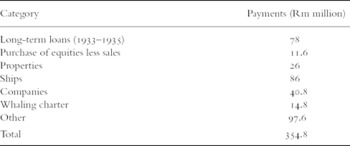
At the beginning of August 1939, Unilever's treasury drew up one of its regular schedules of special payments covering the whole period between 1933 and the first half of 1939. The schedule is summarised in Table 1.
Summary of Unilever treasury schedule of special payments, 1933–first half of 1939

Source: UARM, SD 3794, 2 Aug. 1939.
Unilever clearly had a finely tuned sense of where its interests and responsibilities lay when confronted with potentially risky commercial propositions. On the other hand, in some instances a reasonable business case could be made for taking up an offer or pursuing an opening for a firm that was up for sale. But racial ideology rather than market forces put many businesses ‘in play’ during the 1930s in Nazi Germany. Convention and common sense dictated that potential purchasers were obliged to scrutinise the accounts of the target company. However, not to go beyond this and enquire into the personal circumstances of the sellers was to strip out any moral dimension to the concept of ‘due diligence’.
‘Aryanisation’
As the economy of the Third Reich was restructured in preparation for aggression against Germany's neighbours, all sectors of industry and commerce were required to play some part in the rearmament drive or in fulfilling ideological objectives. Economic discrimination, therefore, characterised relations between government and business. One of the most barbaric manifestations of this policy was ‘aryanisation’ – the expropriation of Jewish assets, held in whatever form, and the exclusion of Jews from economic life in the Third Reich. For most of the 1930s the organisation of such asset transfers was left to private initiative. This is not to say, however, that by becoming involved in aryanisation business interests were necessarily presented with clear and unconstrained choices between actions that were morally responsible on the one side and criminally irresponsible on the other. In the case of Deutsche Bank, James considers that aryanisation imposed a ‘terrible moral burden’.Footnote 52 Utilising its unparalleled international contacts the bank helped the owners of Jewish banks to emigrate with a greater proportion of their assets safeguarded than would otherwise have been the case. Yet it was a cruel irony that actions that may have been motivated by genuine sympathy for business partners also facilitated the rapid fulfilment of a major Nazi objective. Similarly, Degussa – the German chemical company – while quick to buy up vulnerable Jewish businesses, was following a corporate strategy rather than acting out of political or racist zeal. Hayes finds that Degussa's aryanisation transactions, at least prior to 1938, were fair on the whole.Footnote 53
Clearly, as a foreign-based company, Unilever's position was not directly analogous to that of a major German bank – where both the institution and its personnel were directly subject to a variety of pressures and threats. Nonetheless, Unilever, too, had been brought into a condition that the German authorities could hope to exploit for the purposes of aryanisation. The concern naturally entertained plans for expansion; at the same time, it struggled to find ways to dispose of the large reserves of blocked marks that were accumulating. As various firms were brought forward to be taken over (as a result of the closing down of Jewish-owned businesses) temptation was laid at Unilever's door. But in the first years of the Third Reich, the businesses thereby made available were deemed to be incompatible with the overall structure of the concern. Then, in 1935, the directors were informed that some very sound businesses were being offered.
At this point the Unilever directors appear to have made no enquiries into what the humanitarian and welfare consequences were for those who suffered directly as a result of such discriminatory policies. Rather, what worried them about antisemitism was how it had the potential to harm ‘brand image’ – the extent to which the businesses concerned had become unpopular because of their Jewish ownership and, if so, how that unpopularity could be removed. Rykens reassured the directors that precedents already existed for making changes of ownership publicly known and that, in order to minimise the risks, Unilever would put its own people into the managements.Footnote 54
But by the following year the multinational had certainly become aware of some, at least, of the human costs involved in negotiating over firms that they euphemistically described as ‘non-Aryan’. One such business that clearly fitted well with Unilever's operations was Heinemann – a margarine producer based in Neuss. When the German firm was offered to Unilever for Rm 3 million, the latter considered making a counter-offer of Rm 2.5 million. However, simply entering into negotiations brought with it a risk of financial loss. Unilever accepted that, in that event of a sale falling through because of failure to secure the necessary consent from the German government, they would nonetheless have to pay Heinemann Rm 100,000: after offering to sell his business it would not have been possible for the Jewish proprietor to have returned to it.Footnote 55
In addition to providing a channel for the investment of surplus marks, aryanisation also potentially offered Unilever a way to increase access to vital resources. The concern remained determined to try to keep the goodwill of the German authorities and particularly those with influence over the distribution of raw materials. Sunlicht, the German soap subsidiary, was told by the Reich controller of fats that a purchase by them of a Breslau firm, Franz Tellmann, would be welcomed, since the attitude of other possible purchasers had been most unsatisfactory. Sunlicht's management seemed to interpret this – not unreasonably given the gangster-like inclinations of the regime – as a thinly veiled threat rather than a display of favouritism. They hoped that the London directors would understand that it was not very easy for them to refuse an offer which was actually such a good one, and that their position was rather a delicate one. Here, again, a comparison with Swiss chemical companies provides a valuable insight. Between 1933 and 1938, five aryanised firms were offered to Roche Berlin for purchase. After examining the proposals, Roche directors expressed the same kinds of reservations as their counterparts in Unilever; among the problems identified were financial weakness, complications arising from aryanisation, difficulties over integration and damage to reputation in the market place. In contrast to the British multinational, however, the Swiss companies clearly felt able to resist pressure to make purchases arising from aryanisation: just one firm was taken over – by Geigy, in the aftermath of Anschluss.Footnote 56
The proposition to buy Tellmann was, in any case, seen as a sound one, even though the firm's fat quota had been cut by 10 per cent because the business had not passed into Aryan ownership at the stated period. Although the land, buildings and stocks would be paid for, nothing would be paid for the remaining fat quota and there was even a chance that the cut in it might be restored. Moreover, since it was unlikely that they would receive official sanction for any other takeover, Sunlicht was worried that their market position would remain stationary while Henkel, their great rival, was establishing a footing in the hard soap trade through its interests in Dreiring.Footnote 57 The commercial imperative to buy Tellmann was clear and Unilever went ahead with transferring the funds.Footnote 58 By taking over firms like Heinemann and Tellmann, Unilever could therefore hope to gain competitive advantage for its products in German markets. Manufacturing processes could also be rationalised and costs reduced if, as a result of integrating the newly acquired companies, economies of scale could be achieved.
German exchange controls had forced Unilever, even before the Nazis came to power, to diversify in ways that it would not normally have considered. Similarly, the aryanised businesses that were taken over from late 1935 included those with activities that lay well outside the concern's core area of operations. Among those in which Unilever looked to take an interest were a chain of grocery shops, a hat manufacturer and a shoe manufacturer; the investments were recommended partly on the grounds that the firms already had Aryan managers who seemed to be efficient. In early 1936 funds were put aside in order to buy an interest in Elsa Cement, which had a factory in Westfalen. Unilever was aware that it was taking up a shareholding that the owners – the Sauer family – were disposing of, or had been forced to dispose of, because they were Jews.Footnote 59
To base a commercial strategy on apparently random purchases seemed to fly in the face of sound business principles and company practice. It prompted Lord Leverhulme to enquire, somewhat despairingly, whether all the accumulated funds were going to be used for purchasing what he called ‘outside’ businesses. He presumed that ‘when times became normal again the businesses would be disposed of”. D'Arcy Cooper, the chairman, replied that this was the intention.Footnote 60 Whether, given the divided world of the 1930s, such leading industrialists defined normality by reference to an essential, and universally applicable, set of political as well as economic freedoms is not altogether clear.
For the realisation that, by profiting from the forced disposal of Jewish-owned assets, Unilever could be seen as an accomplice – albeit an unwitting one – in the Nazi dictatorship's criminal activities, seems to have come late to the directors. Such sensitive and controversial issues were doubtless discussed but not formally recorded. However, any scruples that were entertained were not sufficiently weighty to force an end to Unilever's involvement in the aryanisation of German commercial life, even when it was evident that antisemitism had entered a more radical phase. In the immediate aftermath of Kristallnacht, Paul Rykens asked his fellow directors in London for approval to start negotiations in order to take an interest in the banking house of A.E. Wassermann. As recent scholarship has confirmed, among the Jewish businesses that were under most pressure from the outset of the Third Reich were those that dealt directly with German consumers such as shopkeepers and department-store owners; the aryanisation or liquidation of private banks – businesses regarded as central to the functioning of the economy – tended to take place later in the 1930s.Footnote 61 Participation in the purchase – by Unilever NV – was to be limited to 50 per cent. As Rykens wrote, ‘The fact that we are only sleeping partners will restrict not only our actual liability to this amount, but also our moral responsibility. The actual facts will only be disclosed to the Government Bank Controller, whereas for the outside world our participation will be given in the name of a third party.’Footnote 62 Accordingly, in 1939 Unilever contracted to transfer Rm 0.5 million in exchange for shares in Wassermann.Footnote 63
Conclusions
The intention in this essay is to locate the concept of corporate responsibility in an historical context by analysing some of the challenges that faced Unilever during the years leading up to the Second World War. No attempt has been made to construct a precise definition of responsibility: as attitudes and behavioural norms evolve over the long term, so assumptions about the wider role of business will change. Acting with responsibility or having the capacity, at least, to demonstrate publicly that this is the intention, has become a fashionable, almost obligatory, feature of corporate culture. Going well beyond questions of compliance with regulatory practices or codes of governance, corporate responsibility requires engagement with a spectrum of social and environmental issues. Some critics ridicule the very proposition that corporations are capable of being socially responsible, or that they emerge from the historical record with any credit when held to account morally – and not just financially – for their activities.Footnote 64 However, such arguments tend to be partial. Many profitable businesses have attempted in the course of their existence to exhibit a societal purpose that goes beyond just the enrichment of owners and shareholders. A self-imposed duty to carry out good works and espouse philanthropic causes has assumed several guises; benefactions and endowments have also sustained a panoply of educational, cultural and other charitable foundations. Unilever itself has always exemplified this tradition.
How, then, could such a multinational enterprise allow itself to be drawn into a position in the Third Reich where the moral and ethical reputation of the organisation and individuals who worked within it became compromised? It is necessary to make it clear in this context that periodisation is all-important: for Unilever, the outbreak of war marked a schism with what had gone before. Although the analysis of international affairs may be made more credible when located in an appropriate historical context, both analysis and context are always at risk of being overtaken by the onward march of events. In the 1920s it was scarcely conceivable that, before long, Europe would once again be plunged into war. Yet by the middle of the next decade this prospect, regarded with such dread in democratic societies, seemed increasingly likely if not inevitable. It was taken as axiomatic that modern war would give rise to unprecedented levels of destruction – especially for civilian populations rendered vulnerable by bombing. But for as long as peace prevailed, there seemed little that civilians could do and certainly few pressing reasons to interrupt the channels of business. Crucially, before 1939, few except the evil-intentioned seemed capable of imagining how war would also unleash racial annihilation.
Nevertheless, business life in the Third Reich required compliance with the increasingly stringent demands of the regime. This brought local management into regular and close contact with party agencies and governmental authorities, while main board directors based, in Unilever's case, in London became embroiled with the problems associated with foreign ownership of subsidiaries. In all these respects, the experience of Unilever mirrors that of German big business: in pursuing the concern's interests, executives did not allow themselves to see that all commercial decisions in the Third Reich had political consequences of some kind. Such naiveté and myopia could lead only in one direction. As historians of German enterprises have pointed out, businessmen who thought that they could protect and preserve their corporations by working within the political system ultimately became habituated, even inured, to the criminal behaviour of the regime and ended up contributing to the ruin of their country and much else besides. In many respects, unfortunately, we can only speculate on the motivation of German business leaders who endured the totalitarianism of the Third Reich: under such conditions very few indeed were prepared to express themselves openly.
However, that impediment did not apply universally. While there were severe restrictions on the movement of capital, the executives who represented multinational enterprise moved freely in and out of Germany. In this sense, entrepreneurial agency could be maintained. Given the extent of these connections and the evidence of conditions that were such an affront to civilised values, it is surprising to say the least that so few voices in big business were raised to question the integrity of corporate policy. It is almost as if there was an unspoken yet rigid code: politics was of no concern to business unless the policies of the former directly impinged on the interests of the latter. In combining narrow-mindedness, self-interest and political naiveté, it is possible to assert that corporate culture reflected the values of contemporary democratic societies. At the same time, therefore, multinational business was in some measure responsible for the failure to sound the alarm over the unique dangers inherent in the ideological claims of National Socialism.