Introduction
Research has identified that rescue and recovery workers engaged in disaster relief are at increased risk of developing mental health problems, such as post-traumatic stress disorder, depression, and anxiety,Reference Johal, Mounsey, Brannelly and Johnston 1 and are at increased risk of empathy exhaustion, burnout, compassion fatigue, or even vicarious traumatization.Reference Benedek, Fullerton and Ursano 2 , Reference Boscarino, Figley and Adams 3 The majority of the research in this field has focused on uniformed or “blue-light” response services in the immediate aftermath of disasters rather than longer term recovery work with other services that may be affected.
There is a lack of research exploring the impact on local workforces restoring public services such as health care workers, teachers, and social workers. These people are likely to be disaster survivors working through traumatic events, loss, and the impacts of other stressors. One study looking at disaster rehabilitation and construction workers involved in recovery work around two years after an earthquake found 43% of participants met diagnostic criteria for post-traumatic stress disorder.Reference Byrne, Lerias and Sullivan 4 Wang et alReference Ehring, Razik and Emmelkamp 5 undertook qualitative research with local government officials following the Sichuan earthquake in China and found a number of sources of stress. These included bereavement and grief, housing and financial difficulties, and work-family conflict.
It is expected that nurses, like other health professionals, play a significant role following a disaster. Nurses have been active participants in response and recovery efforts during disasters.Reference Wang, Chan, Shi and Wang 6 - Reference Palmer, Stephens, Fisher, Spain, Read and Notaras 8 While there has been an increasing amount of literature describing health services responses to disasters, this tends to focus on medical disaster team experience,Reference Wang, Chan, Shi and Wang 6 , Reference Kako, Ranse, Yamamoto and Arbon 9 experience of field hospitals,Reference Garner and Harrison 10 or understanding the hospital response.Reference Kreiss, Merin and Peleg 11 , Reference Cameron, Mitra and Fitzgerald 12 Research has looked at the preparedness, education, and training of nurses around disasters and core competencies have been developed;Reference Ardagh, Richardson and Robinson 13 , Reference Gebbie and Qureshi 14 however, there has been little research that explores the nurses’ own experiences during a disaster. Ranse and Lenson 15 used a qualitative approach (telephone interviews) to explore the role of nurses in the Black Saturday and Victorian bush fires in Australia, 2009. This research found that while nurses may think of their role at times of disaster in terms of emergency clinical care, their role in actuality consisted of four areas: (1) providing minimal clinical care; (2) being a psychosocial supporter; (3) coordinating care and resources; and (4) problem solving. This broad nursing role has also been found in research following the Wenchuan earthquake in China.Reference Ranse and Lenson 16
On September 4, 2010, a magnitude 7.1 earthquake struck the Canterbury region of New Zealand. The National Crisis Management Centre (Wellington, New Zealand) was activated and a State of Emergency was declared in Christchurch and the surrounding districts of Selwyn and Waimakariri (New Zealand). Although there was no loss of life, there were a number of serious injuries and significant damage to land, buildings, and infrastructure. Approximately six months later, on February 22, 2011, a magnitude 6.3 earthquake struck, which caused much greater damage and resulted in significant loss of life. One hundred and eighty-five people died as a result of the earthquake, making it the second deadliest natural disaster in New Zealand history. More than 7,500 people were injured. A national State of Emergency was declared and remained in effect until April 30, 2011.Reference Yang, Xiao, Cheng, Zhu and Arbon 17
These two major events, in association with more than 13,000 aftershocks of greater than magnitude 2.0 after September 2010, 18 exposed affected individuals and families to substantial and recurrent acute stress, as well as to substantial chronic stress imposed by the on-going human, economic, and social costs. The earthquakes resulted in significant detrimental effects across the social, natural, built, and economic environment. The loss of lives, homes, neighborhoods, businesses, jobs, livelihoods, and schools has had major implications for the health and well-being of affected individuals and communities requiring a collaborative response to support psychosocial recovery. 19 , Reference Potter, Becker, Johnston and Rossiter 20
A number of research papers have looked at mental health following the Canterbury earthquakes. Spittlehouse et alReference Crowe 21 found significantly lower scores on mental health, role-emotional, social functioning, and vitality scales of the SF-36v2 health survey compared to national data. There were no significant differences for physical health and the authors suggest that the residents may be experiencing more secondary stressors as opposed to primary stressors, supporting the work of Lock et al.Reference Spittlehouse, Joyce, Vierck, Schluter and Pearson 22 A number of research studies have been published looking at the response of the health care system following the Canterbury earthquakes,Reference Cameron, Mitra and Fitzgerald 12 experiences of emergency department staff,Reference Lock, Rubin, Murray, Rogers, Amlôt and Williams 23 and the experiences of general practitioners (GPs) following the disaster and into the recovery period.Reference Richardson, Ardagh, Grainger and Robinson 24 , Reference Johal, Mounsey, Tuohy and Johnston 25 This current study aimed to build on this body of knowledge and explored how nurses were coping with the dual challenge of personal and professional demands during the recovery process. Information on nurses’ roles in this major New Zealand disaster response contributes to the on-going recovery effort and enhances future planning activities.
Methods
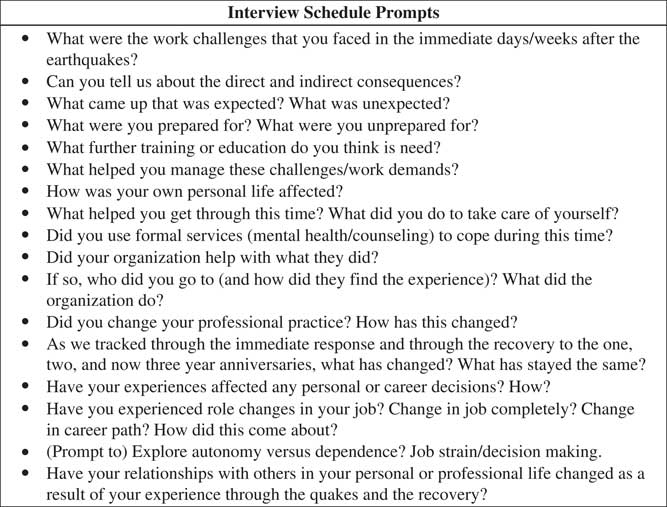
The research design used semi-structured, open-ended interviews to elicit extended answers to questions about the challenges nurses have faced during and following the earthquakes. The study was peer reviewed and judged to be of low risk. This review was recorded on the Massey University Ethics Committee (Wellington, New Zealand) low risk database after having met their set criteria, and participants were informed accordingly. The rationale for the semi-structured interview format was to enable the perspective of each nurse to be heard, with regards to what they had experienced during and since the disaster. The interview questions were based upon a similar format successfully used in a study of the role of primary care physicians in disaster response and recovery.Reference Richardson, Ardagh, Grainger and Robinson 24 , Reference Johal, Mounsey, Tuohy and Johnston 25 As this was a topic about which there is some theoretical guidance, but little known about this particular professional group in an extended earthquake disaster, a semi-structured interview that had been used in a similar context was judged to be a parsimonious and effective approach. The interviews were conducted by the corresponding author (a clinical psychologist) and explored a number of issues, though not necessarily in a sequential fashion, to ensure a free-flowing conversation. The aim was to facilitate the experience of a naturally exploratory discussion. The interview schedule prompts are shown in Figure 1.
Interview Schedule Prompts.

Interviews took place with 11 nurses from across the Christchurch area and included nurses from community-based services, secondary care, and residential homes. The inclusion criteria were that they were Registered Nurses who had been working in Christchurch between September 2010 and February 2011 (ie, during the period including the first two large earthquakes in the sequence). Convenience sampling was used to recruit the nurses with support from the Canterbury District Health Board (CDHB; Christchurch, New Zealand), who circulated details of the research, and through key informants who invited nurses to participate. The interviews were conducted in a private setting convenient for each nurse and were audio-taped with permission from each participant. The length of interviews ranged from 39 to 70 minutes.
An important aspect of qualitative research is the establishment of trust between the researcher and the interviewee. It has been argued by WildingReference Johal, Mounsey, Tuohy and Johnston 26 that if participants do not have trust in the interviewer and the process then the data could be of lesser quality. There is also the issue of ensuring anonymity of participants, especially in such a small community of Christchurch.Reference Wilding 27 To address these issues, each participant was provided with an outline of the purpose of the research, the process, and their rights within established guidelines for research involving human subjects prior to interviews being scheduled. Each participant signed a formal permission document consenting to participation in the research. All research participants were advised that their participation was voluntary and they had the right to withdraw at any time. No participants withdrew.
The majority of the interviewed nurses were female (91%) which is representative of the profession (92% of the nursing profession is femaleReference Miles and Huberman 28 ) and the age range was 49 to 64 years. At the time of the earthquakes, five of the nurses were working in a hospital setting, four were community-based, and two worked in residential care for older adults. The interviews took place in October and November 2013, approximately three years after the beginning of the earthquake sequence. This enabled the interviews to cover both the initial aftermath of the earthquakes and the ongoing recovery process. As the data were being collected, weekly meetings of the data collection and analysis team checked progress of the project, identifying major themes as they emerged. Data collection was stopped once 11 participant interviews had been reviewed as it was judged that saturation had been reached. 29
The transcribed interviews were analyzed and coded using a grounded theory approach.Reference Glaser and Strauss 30 The verbal narratives were listened to, to get an overview of the broad themes before the transcripts were read in detail, to identify and highlight phrases that exemplified these themes. The data went through several stages of coding and theme generation to understand what the participants saw as significant and important. These themes were checked through discussions within the research team. Exemplars used throughout this report are not suffixed with identifying characters, such as pseudonyms or numbers, to remove the likelihood of linking the exemplars to particular individuals and therefore reducing the risk of participant identification.Reference Bryant and Charmaz 31 Furthermore, the order of themes identified in tables represent a synthesis of both number of nurses who identified with each theme and the depth and breadth of experiences shared in relation to these themes.
Results
The data analysis identified that the nurses had faced a number of challenges both during the earthquake sequence and through the recovery process. These challenges were characterized as being practical, emotional, or professional. There was recognition of the intersection of home and work life and the challenge that this brought: “everybody was dealing with home and work and home and work and home and work.”
Practical Impact
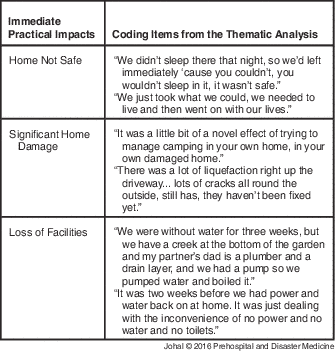
While the majority of the practical impacts followed the immediate aftermath of the earthquake, such as damaged homes and loss of facilities, some of the practical impacts were more long reaching. Table 1 includes codes and samples of participants’ responses for the immediate practical impacts.
Codes and Samples of Participants’ Responses – Immediate Practical Impacts

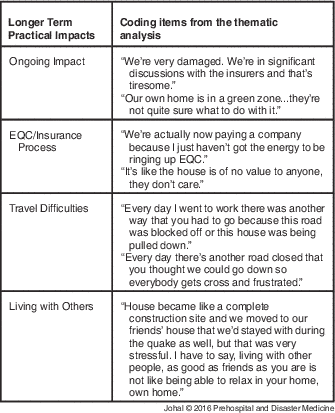
The longer term consequences of dealing with damaged homes, such as negotiating with the Earthquake Commission and/or insurers over repairs, were often a source of stress. The difficulties of travelling around Christchurch due to road damage also had an impact on participants. Table 2 also includes codes and samples of participants’ responses for the longer term practical impacts.
Codes and Samples of Participants’ Responses – Longer Term Practical Impacts

Abbreviation: EQC, the Earthquake Commission.
Emotional Impact
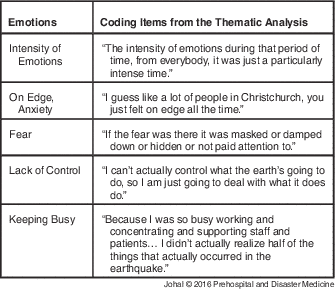
Many of these practical impacts produced emotional consequences. The nurses reflected on the broad range of emotions they had experienced during and since the earthquakes. These emotions included fear, guilt, pride, apathy, gratitude, relief, empathy, frustration, sadness, happiness, and anxiety. During the earthquakes, those nurses on duty cared for patients in whatever way they could; this included working in the hospital emergency department, evacuating wards, assessing conditions in residential homes, and working in the community. Their stories indicated that many put their own fears and concerns to the side to focus on the situation at hand, and for many, this act of keeping busy and focusing on others had helped them get through the experience. Table 3 includes codes and samples of participants’ responses about their emotions.
Codes and Samples of Participants’ Responses – Emotions

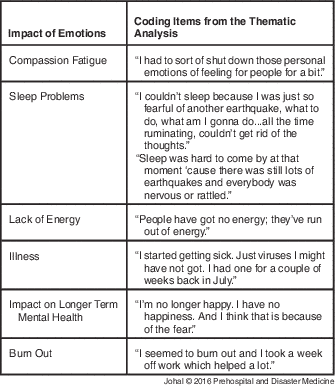
All of the nurses talked about high workloads and levels of stress in the weeks following the February earthquake as they dealt with the impact at home and at work. One consequence of this experience reported by three of the nurses was compassion fatigue or empathy exhaustion. The nurses talked about issues related to the recovery process, both from their own perspective and the impact on patients and people more generally. One aspect of this was the loss of energy that they felt and that they saw around them. One nurse felt that their health had been impacted by the stress and that they were more susceptible to infections with a consequence of this being increased absence from work. The interviews indicated long-term significant impact on mental well-being for at least one of the nurses, and two nurses explicitly acknowledged that they had been or were at risk of burnout. Table 4 includes codes and samples of participants’ responses about the impacts of emotion.
Codes and Samples of Participants’ Responses – Impact of Emotions

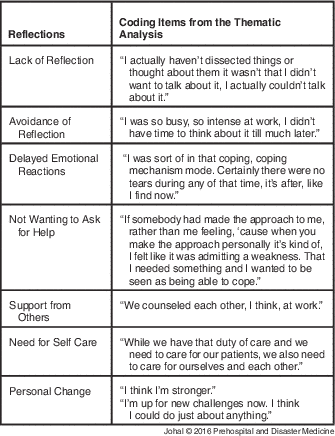
For at least five of the nurses, the research interview was the first time that they had reflected and thought about their experiences during the earthquakes. The nurses had used distraction techniques, such as focusing on others and keeping busy, to avoid dealing with their own emotions. Two had experienced delayed emotional reactions, as in the case of one nurse who travelled to Europe and when asked about the impact of the earthquake by a fellow passenger, burst into tears. Other nurses also mentioned that they were experiencing emotions now rather than at the time of the earthquakes. Two of the nurses had sought professional support in the form of counseling as well as seeking out informal support. Most commented that support from friends, family, and colleagues had been valuable. Nurses were aware of the potential impact on their well-being and actively took time out from work or engaged in coping behaviors such as exercise. However, the nurses appeared to focus on others to the detriment of themselves. One of the positive aspects was that the majority of the nurses felt that the earthquake had changed them for the better and that they had learned a great deal about themselves and their abilities. Table 5 includes codes and samples of participants’ responses on their reflections.
Codes and Samples of Participants’ Responses – Reflections

Professional Impact
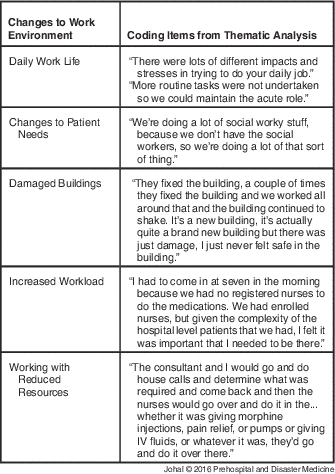
These personal challenges sat alongside difficulties in their working environments, which included higher workloads, staffing difficulties, and changes to roles. Nurses commented on the need to work differently due to reduced resources, such as working in unfamiliar environments due to damage and having to do more home visits. The nurses acknowledged that the earthquakes had changed the nature of their work in terms of actual day-to-day tasks and what patients now needed from them. Table 6 includes codes and samples of participants’ responses about their changes to work environment.
Codes and Samples of Participants’ Responses – Changes to Work Environment

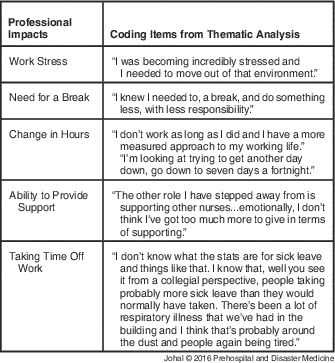
Six of the nurses consciously changed jobs as a result of the earthquakes or reduced their hours to improve their work-life balance. It was clear for some that work stress had had significant emotional impact reducing their physical capacity or emotional capacity to provide support to others. The impact of damage to buildings was also an issue for some as it impacted on their sense of personal safety while at work. Table 7 includes codes and samples of participants’ responses about professional impacts.
Codes and Samples of Participants’ Responses – Professional Impacts

Discussion
These nurse interviews show that they experience practical, emotional, and professional consequences as a result of the Canterbury earthquakes, and that these continued through into the post-impact recovery environment.
As well as feelings of being unsafe in their homes triggering short-term actions to re-order their lives to ensure security, the lasting impacts of home damage and the ongoing consequences of this were reported widely. These secondary stressors in traversing the complex insurance landscape needed to be navigated to one degree or another by all the nurses interviewed. For some, their efforts to complete these negotiations and assessments to rebuild their homes, or get paid out so they could move elsewhere, continued beyond the period these interviews took place. This placed considerable strain on these nurses. In this respect, these findings support Lock et al,Reference Spittlehouse, Joyce, Vierck, Schluter and Pearson 22 indicating that secondary stressors becoming an increasingly corrosive source of strife for those living in post-disaster environments the further away in time one moves from the index causal event. Moreover, the more practical daily living requirements of travel, for example to and from work and school, became tortuous and difficult to predict, as well as forced proximity to others in unfamiliar surroundings while living in makeshift arrangements. All these practical concerns continued to add to the burden of nurses who were also expected to be working to support others in their time of need.
As one might expect, this took an emotional toll for many. Although positive emotions such as gratitude, relief, and empathy were reported, often these were a reflection of having had time to process their own experience, but also being exposed to others, such as their patents or colleagues, who they perceived as having had a worse experience than themselves. This downward comparison strategy is widely accepted as a coping process for creating a more positive perception of one’s own personal reality.Reference Richards and Schwartz 32
Other emotions, such as fear and anxiety, were concurrently manifested in experiences such as sleep disturbance, fatigue, and increased physical and mental health symptomology. Though there was recognition of the need for support from others, and for increased use of effective self-care strategies, the nurses reported that they often defended against these primary fear emotions by avoiding reflection and through keeping busy. It may also be hypothesized that the reluctance to seek help also defended against the fear of exploring these primary fear emotions through a secondary anxiety of what might happen if they dwelled on these thoughts and feelings for too long.
As well as these practical and emotional impacts, the nurses reported the varied ways in which their professional lives and practices were affected by their earthquake experiences. Occupational stress increased as a result of daily work-life variations, increased workload, reduced resources available to carry out the necessary work, and changing patient needs. At the same time, these nurses also reported the amount of sick leave being taken in their working environments increasing, both as a result of this occupational stress along with stressful home lives, but also the physical environment of their work settings. These work environments and the ongoing repairs to them were stressful for some nurses, putting them in mind of the initial earthquakes and the effect they had on these buildings.
The lack of reflection on their experiences and emotional consequences, as a conscious coping strategy or otherwise, suggests that more emphasis is needed for nurses on self-care following disasters. Previous research by the authorsReference Richardson, Ardagh, Grainger and Robinson 24 , Reference Johal, Mounsey, Tuohy and Johnston 25 looked at GP’s experiences, with GPs reporting tensions between personal and professional lives. In comparison with the GP data, there was a sense that the nurses had not had the opportunity to reflect on their experiences in the same way GPs appeared to have. The nurses demonstrated more emotion during their interviews, both in terms of their current emotions and in relation to the emotions they experienced during the earthquakes themselves. There was a reluctance to be seen as asking for help and displaying vulnerability which echoes previous research following the Wenchuen earthquake.Reference Wills 33 There remains, however, the possibility that there could be a gender effect that confounds these findings, so that remains an issue that needs disentangling.
One of the consequences of experiencing these primary fear and anxiety emotions, yet avoiding addressing or processing these through busyness and avoiding opportunities for reflection and utilizing possible support sources, is an increased risk of empathy exhaustion, burnout, compassion fatigue, or even vicarious traumatization.Reference Benedek, Fullerton and Ursano 2 , Reference Boscarino, Figley and Adams 3 , Reference Yan, Turale, Stone and Petrini 34 Where in the occupational stress continuum these nurses’ experiences lie is unclear, but the fact that some of the nurses began to change their work roles, hours, and responsibilities seems to indicate that it verged on the more serious, impactful end of this range for some of the nurses at least. This is an area worthy of further investigation and a signal to occupational health services that nurses working in disaster situations may require tailored packages to ensure their health and well-being while continuing to work in a draining environment.
Limitations
This research reports on the challenges faced by a sample nurses following a specific disaster: the Canterbury earthquake sequence in 2010/2011 and the subsequent recovery process. Other disasters may result in different experiences and challenges for nurses. In terms of methodology used, DenscombeReference Sabo 35 discusses research which demonstrates how people respond differently depending on how they perceive the interviewer; the interviewer effect. In particular, the sex, age, and ethic (or in this case, regional) origins of the researcher may influence the amount and level of information that the respondent is willing to disclose. The authors of the current study aimed to minimize the impact of this by keeping the interviewer constant. However, each interviewee is different, and the influence of this interviewer effect cannot be ruled out. Furthermore, demand characteristics, when the interviewee’s responses are influenced by what s/he thinks the situation requires, also risk skewing the information that is provided at interview.Reference Denscombe 36 To guard against this, care was taken to make clear at the beginning of each interview what the purpose and topics were to seek to put the interviewee at ease.
Though the number of nurses interviewed was only 11, the authors are confident that saturation was reached with this sample. The themes extracted can confidently be assumed and could be considered to be commonplace and relatively exhaustive amongst nurses in this context of time and place.
Conclusion
The research findings indicate the challenges faced by nurses during the initial impact of the New Zealand earthquakes and during the longer term recovery process. Previous research has focused on those response and recovery workers who go into different environments to provide support and care,Reference Wang, Chan, Shi and Wang 6 whereas the situation in Canterbury was that the majority of support was provided by those who lived locally. This dual challenge of being personally affected by the disaster and providing care and support to others in the same situation brings a different perspective. The interviews reveal the nurses’ dedication and duty of care to their patients, with many nurses giving their professional responsibilities priority despite significant impact to their personal circumstances. There is a possibility that the nurses’ own personal recovery may have been delayed as they focused on being there for others. This research provides insights into the nurses’ experiences and points to the need for support for those working in a post-disaster environment.
Acknowledgements
The authors would like to take this opportunity to thank all the nurses who shared their stories with them and gave their time, and the Canterbury District Health Board who assisted with participant recruitment.