INTRODUCTION
It is widely reported that participating in social activities in old age contributes to well-being and to maintaining cognitive functioning (e.g., Kuiper et al., Reference Kuiper, Zuidersma, Oude Voshaar, Zuidema, van den Heuvel, Stolk and Smidt2015). Unfortunately, when older adults start to experience declines in their cognitive skills, they often disengage from activities that promote their well-being. This is a particular problem for older adults with amnestic mild cognitive impairment (aMCI), which is characterized by explicit memory deficits greater than expected according to one’s age (Albert et al., Reference Albert, DeKosky, Dickson, Dubois, Feldman, Fox and Phelps2011; Petersen, Reference Petersen2004), and is a likely precursor to dementia due to Alzheimer’s disease (AD). As explicit memory begins to decline, people with aMCI are vulnerable to withdrawal from social and leisure activities in part because of potential embarrassment around forgetting the names of friends and acquaintances (Parikh, Troyer, Maione, & Murphy, Reference Parikh, Troyer, Maione and Murphy2016).
Consistent with self-reported problems remembering names, people with aMCI show clear deficits on objective memory tests in which they have to learn and recall the associations between faces and names (Irish, Lawlor, Coen, & O’Mara, Reference Irish, Lawlor, Coen and O’Mara2011; Pike et al., Reference Moscovitch, Cabeza, Winocur and Nadel2012; Troyer et al., Reference Troyer, Murphy, Anderson, Craik, Moscovitch, Maione and Gao2012). Likely mechanisms behind this face–name memory deficit in aMCI include difficulty intentionally forming links between items (i.e., associative memory; De Jager, Blackwell, Budge, & Sahakian, Reference De Jager, Blackwell, Budge and Sahakian2005; Pike et al., Reference Moscovitch, Cabeza, Winocur and Nadel2012; Troyer et al., Reference Troyer, Murphy, Anderson, Craik, Moscovitch, Maione and Gao2012), rapid forgetting (Ally, Hussey, Ko, & Molitor, Reference Ally, Hussey, Ko and Molitor2013), and a reduced ability to subjectively reexperience detailed episodic memories (i.e., recollection; Koen & Yonelinas, Reference Koen and Yonelinas2014; Murphy, Troyer, Levine, & Moscovitch, Reference Murphy, Troyer, Levine and Moscovitch2008). These memory functions are all closely associated with the hippocampus and neighboring medial temporal lobe regions, and reduced performance on these memory tasks is associated with neuropathological changes in these structures in the early stages of AD (Troyer et al., Reference Troyer, Murphy, Anderson, Craik, Moscovitch, Maione and Gao2012).
Given the importance of maintaining a social world, considerable effort has been directed at developing methods to boost face–name associations for people with aMCI. Most methods focus on intensive training which is heavily reliant on explicit learning and memory skills that are in the process of declining for people with aMCI. For example, patients may be instructed to use visual imagery strategies, in which they identify salient visual face cues and associate them with phonological details around the name (e.g., Belleville et al., Reference Belleville, Gilbert, Fontaine, Gagnon, Ménard and Gauthier2006; Hampstead et al., Reference Hampstead, Sathian, Moore, Nalisnick and Stringer2008). They may also receive spaced retrieval training, involving repeated and intentional retrieval of the associated names over timed intervals (e.g., Jean et al., Reference Jean, Simard, Wiederkehr, Bergeron, Turgeon, Hudon and Van Reekum2010). These methods tend to require extensive training and instruction in strategy use from professionals, and they tend to work best for individuals at the earliest stages of cognitive decline (Camp et al., Reference Biss, Rowe, Weeks, Hasher and Murphy1993).
An alternate approach to interventions based on explicit memory is to harness implicit or automatic memory processes which remain relatively intact for both healthy older adults and individuals with aMCI (Baker, Bentham, & Kourtzi, Reference Baker, Bentham and Kourtzi2015; Lavoie & Faulkner, Reference Lavoie and Faulkner2008; Rowe, Murphy, Biss, Hasher, & Troyer, Reference Rowe, Murphy, Biss, Hasher and Troyer2019). The method we tested here is based on pilot data evidence, using a closely comparable paradigm, for a shift toward greater reliance on implicit memory in aMCI (Rowe et al., Reference Rowe, Murphy, Biss, Hasher and Troyer2019) coupled with evidence that reduced inhibitory control results in a broader range of attention for older than for younger adults (Hasher & Zacks, Reference Hasher, Zacks and Bower1988). In the healthy aging literature, previous research indicates that older adults tacitly learn and remember information presented as distraction (Rowe, Valderrama, Hasher, & Lenartowicz, Reference Rowe, Valderrama, Hasher and Lenartowicz2006). They have also been shown to spontaneously bind co-occurring target and distracting information and implicitly access this information to aid subsequently memory (Campbell, Hasher, & Thomas, Reference Campbell, Grady, Ng and Hasher2010; Campbell & Hasher, Reference Campbell and Hasher2018). Although the original associative binding work reporting this finding was done with irrelevant words superimposed on pictures relevant on a 1-back task, similar spontaneous binding by older adults has also been reported for distracting names superimposed on target faces (Weeks, Biss, Murphy, & Hasher, Reference Weeks, Biss, Murphy and Hasher2016).
Distraction has also been found to provide an opportunity for incidental rehearsal of information over a delay interval, an effect that actually eliminated forgetting, even without older adults’ awareness that the distraction was helpful (Biss, Ngo, Hasher, Campbell, & Rowe, Reference Benedict2013). Directly relevant to the present study, we recently demonstrated that incidental rehearsal cued by repetition of target–face and distractor–name pairs can help healthy older adults to remember face–name associations (Biss, Rowe, Weeks, Hasher, & Murphy, Reference Biss, Ngo, Hasher, Campbell and Rowe2018). In that study, younger and older adults studied face–name pairs and were cued to recall the name paired with each face on an immediate test and then again after a 25- to 30-min delay. Between the two memory tests, half of the face–name associations reappeared on an ostensibly unrelated 1-back task in which relevant faces were shown with distracting names, providing an opportunity for incidental rehearsal of these associations. When delayed memory for names was tested, healthy older adults showed reduced forgetting of the names that repeated as distraction, as well as higher estimates of recollection for these names on an associative recognition test. Younger adults did not benefit from this approach, that is, their recall and associative recognition performance were the same regardless of whether pairs had repeated. In combination with evidence that older adults hyper-bind and implicitly access prior knowledge of distraction (Campbell et al., Reference Campbell, Hasher and Thomas2010; Rowe et al., Reference Rowe, Valderrama, Hasher and Lenartowicz2006; Weeks et al., Reference Weeks, Biss, Murphy and Hasher2016), this work suggests that broadened attention toward distraction in older, but not younger adults, allowed older adults to incidentally rehearse face–name associations and retain them across a delay.
In the present study, we tested whether the benefits seen by healthy older adults in the Biss et al. (Reference Biss, Ngo, Hasher, Campbell and Rowe2018) procedure would extend to individuals diagnosed with aMCI. We included a group of age-, education-, and gender-matched older control participants selected from Biss et al. (Reference Biss, Ngo, Hasher, Campbell and Rowe2018) for comparison purposes. While the extent to which people with aMCI encode and bind distraction to target information for use on later explicit memory tests is unknown, there is evidence that individuals diagnosed with aMCI show enhanced implicit priming for distraction relative to healthy older adults (Rowe et al., Reference Rowe, Murphy, Biss, Hasher and Troyer2019). Thus, applying a paradigm thought to facilitate incidental rehearsal in older adults with age-normal memory may also aid face–name memory for people with aMCI.
We predicted that repeating relevant-face and distracting-name pairs would improve delayed cued recall of the names and reduce forgetting for people with aMCI. We also predicted improved memory for these repeated face–name pairs on a forced-choice recognition task in which participants had to choose which of four names had been associated with a given face. To further examine the potential basis of the effect, we estimated recollection and familiarity by asking participants to make remember/know judgments (Tulving, Reference Tulving1985). In our previous work, improvements to healthy older adults’ memory were observed on measures that are generally considered to rely on recollection (i.e., free recall, Biss et al., Reference Benedict2013; cued recall and remember responses on a recognition test; Biss et al., Reference Biss, Ngo, Hasher, Campbell and Rowe2018). However, given that aMCI is associated with disproportionate deficits on recollection measures (Koen & Yonelinas, Reference Koen and Yonelinas2014), it is possible that any putative benefits of incidental rehearsal will be dependent on familiarity. That is, people with aMCI may fail to show benefits on cued recall and recollection measures but may instead show enhanced familiarity estimates for incidentally rehearsed names. Finally, we conducted exploratory analyses to investigate whether performance on the administered neuropsychological tests is associated with a tendency to benefit from our procedure. If incidental rehearsal as distraction can aid memory for face–name associations in aMCI, this would provide a method by which deliberate memory can be improved via more incidental or implicit memory processes, without requiring intensive training of explicit memory strategies.
METHOD
Participants
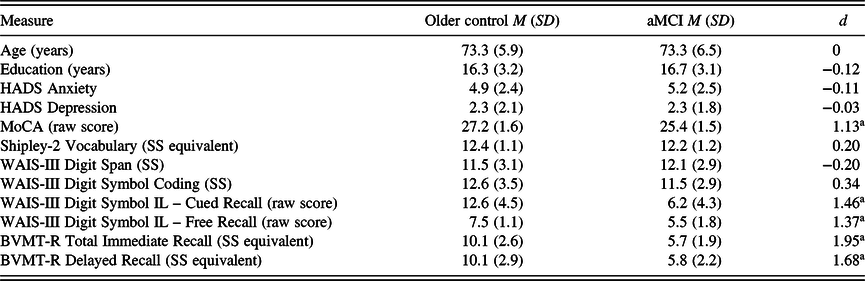
Eighteen older adults with aMCI (six males; age range = 65 to 86) were recruited from the MCI service at Baycrest Health Sciences and from advertisements for older people who were concerned about their memory (see Table 1 for demographic and test performance information). Participants were diagnosed with aMCI based the consensus of two clinical neuropsychologists (K.J.M. and R.K.B.), using the criteria from Albert et al. (Reference Albert, DeKosky, Dickson, Dubois, Feldman, Fox and Phelps2011).
Participant characteristics

Note. BVMT-R = Brief Visuospatial Memory Test – Revised (Benedict, Reference Belleville, Gilbert, Fontaine, Gagnon, Ménard and Gauthier1997); HADS = Hospital Anxiety and Depression Scale (Zigmond & Snaith, Reference Zigmond and Snaith1983); IL = incidental learning; MoCA = Montreal Cognitive Assessment (Nasreddine et al., Reference Nasreddine, Phillips, Bedirian, Charbonneau, Whitehead, Collin and Chertkow2005); Shipley-2 = Shipley Institute of Living Scale-2 (Shipley, Gruber, Martin, & Klein, Reference Shipley, Gruber, Martin and Klein2009); SS = Age-Corrected Scaled Score; WAIS-III = Wechsler Adult Intelligence Scale III (Wechsler, Reference Wechsler1997).
a p < .05.
Eighteen additional older adults (six males; age range = 66 to 85) served as age- and education-matched control participants. They were selected from a larger sample of participants described in Biss et al. (Reference Biss, Ngo, Hasher, Campbell and Rowe2018), by matching each control participant to an aMCI individual based on gender, age, and education (within 2 years).
The Research Ethics Board at Baycrest Health Sciences approved all study procedures. Informed consent was obtained from all participants. All participants were free of conditions (other than possible incipient AD) known to affect cognition (e.g., diabetes, stroke, traumatic brain injury, and depression). One control participant was aware of the connection between tasks, noting that the same names were repeated in the memory and 1-back tasks, and was replaced.
As can be seen in Table 1, there were no significant differences between older control and aMCI groups on measures of vocabulary knowledge, psychomotor speed and attention. Group differences were only observed for measures assessing memory performance, which was expected given the aMCI diagnosis.
Materials
Materials and procedure matched those used in Biss and colleagues (Reference Biss, Ngo, Hasher, Campbell and Rowe2018).
Face stimuli
Fifty-six colored photographs were selected from a database of diverse adult faces (Minear & Park, Reference Minear and Park2004), 24 of which were used in the face–name associative memory task, including two critical lists of 10 each and with four additional faces serving as primacy and recency buffers. Each critical list included four young, two middle-aged, and four older faces, with a balance of male and female faces. The two lists were matched for age of faces (M = 50.3 years, SD = 24.9; range 18–87) and were counterbalanced across participants in each group. Thirty-two additional faces were used as filler items in the 1-back task.
Name and word stimuli
Forty-four names were chosen from a database of popular baby names in the United States (Social Security Administration, 2013) and assigned to gender-appropriate faces. Names were selected to be similarly popular across different age cohorts, with average popularity matched for individuals born in the 1930s, 1950s, 1970s, and 1990s. Four lists containing 10 names each were counterbalanced, with each serving equally as often as a repeated, unrepeated, 1-back filler, or recognition lure list across participants. Critical lists were similar in terms of name popularity (name rank: M = 68.8, SD = 60.3), length (M = 5.3 letters, SD = 1.1), and number of syllables (M = 1.8, SD = 0.5). Four names were matched with the buffer items.
To serve as filler distractors in the 1-back task, 10 words and 10 nonwords were selected to match the name lists in length (words: M = 5.2 letters, SD = 1.0; nonwords: M = 5.4, SD = 1.3) and number of syllables (words: M = 1.6, SD = 0.5).
Procedure
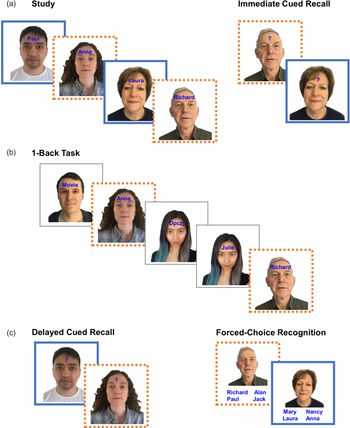
In the first phase, participants intentionally studied and recalled 24 face–name pairs over two successive study and test trials (see Figure 1 for a summary of the procedure). Each was studied for 3000 ms with an interstimulus interval (ISI) of 500 ms, with names appearing in bright blue font over the forehead of the face. During the self-paced test, the name was replaced with a question mark as a cue to recall the name and to guess if unsure. Primacy and recency buffers occurred in the first and last positions of each study and test trial. The 20 critical pairs occurred in a different randomized order on each study and test trial. No mention was made of delayed memory tests.
Study procedure. (a) Participants studied 24 face–name pairs over two study and cued recall trials. (b) After a 10-min filled interval, they completed a 1-back task in which they were instructed to detect consecutive faces and ignore superimposed words. Crucially, 10 face–name pairs from the initial study list (i.e., repeated pairs, shown with dashed lines) appeared as relevant-face and distracting-name pairs during this task among 32 new faces paired with new names, words, or nonwords. (c) Following an additional 10-min interval, memory for these 10 repeated pairs was compared with memory for the 10 pairs that had not reappeared in the 1-back task (i.e., unrepeated pairs, shown with an unbroken line), using face-cued recall and forced-choice recognition tests.

Participants completed neuropsychological tests for 10 min and then were given the 1-back task (see Supplementary Materials for the order of test administration). Face pictures appeared individually on the computer screen for 1500 ms with a 500-ms ISI, and distracting names, words, or nonwords were superimposed over the forehead. Participants were instructed to press the spacebar whenever consecutive faces were identical and to ignore the superimposed names, words, or nonwords. Ten pairs from the studied list occurred three times each in this phase. All other items also occurred three times. There were 126 trials including 20 with consecutive identical (i.e., 1-back) faces; critical repeated face–name pairs never occurred on these trials. The task began with six face-only buffer trials, followed by six face–word or face–nonword trials; 108 critical trials followed, with the 30 trials that included repeated face–name pairs intermixed with 30 trials with face–filler name pairs, 24 trials with face–word pairs, and 24 trials with face–nonword pairs. The task ended with six face–word or face–nonword buffer trials. A practice session of 16 faces, presented without distraction, was administered beforehand, with experimenter feedback and the opportunity to repeat the practice session if needed.
Additional neuropsychological tests were administered for 10 min. The delayed memory tests followed, representing a 25- to 30-min delay from immediate recall. For cued recall, each of the 24 original faces was shown individually and participants were asked to recall the correct name; responses were self-paced. Forced-choice recognition followed, with each face appearing with four names: the correct name, a repeated, an unrepeated, and a new name. Participants made their response out loud and then made an oral remember/know judgment, used to calculate estimates of recollection and familiarity (Yonelinas & Jacoby, Reference Yonelinas and Jacoby1995). Extensive instructions on the distinction between subjective remember and know experiences were provided prior to the recognition task, adapted from previous instructions used with aMCI participants (Carson, Rosenbaum, Moscovitch, & Murphy, Reference Carson, Rosenbaum, Moscovitch and Murphy2019). Instructions emphasized that “remember” responses should be associated with subjectively re-experiencing the event of seeing the name on the screen with that particular face or re-experiencing the thoughts or feelings triggered by seeing them together at encoding. Participants were instructed to say “know” if the name was accompanied by strong feelings of familiarity without triggering a unique thought from study. The experimenter verified understanding of these instructions before the task began, providing additional information if required; participants were also provided with a reminder sheet summarizing these instructions to reference during the task.
Following this task, a graded awareness questionnaire was administered, in which participants were asked whether they had noticed any connections across tasks in the experiment. As noted above, only one participant reported any awareness.
RESULTS
1-Back Task
1-back accuracy scores were not normally distributed; therefore, we used nonparametric Mann–Whitney tests to examine group differences. aMCI participants (Mdn = 93%) had lower accuracy in detecting face repetitions compared to older controls (Mdn = 100%, U = 84, z = 2.66, p = .007), although response times (aMCI: M = 693 ms, SD = 209 ms; control: M = 608 ms, SD = 120 ms) did not differ (t(34) = 1.49, p = .14).
Cued Recall
Immediate recall
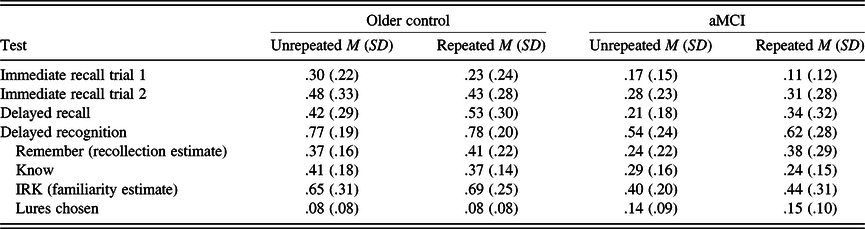
Cued recall performance on the two learning trials (see Table 2 for all memory performance scores) was analyzed using a group (older control, aMCI) × test time (immediate recall trial 1, trial 2) × name type (to-be-repeated as distraction, unrepeated) mixed analysis of variance (ANOVA), with the second and third variables tested within subjects. Fewer names were recalled by individuals with aMCI compared to control participants (F(1,34) = 4.19, p = .048, ηp2 = .11). There was a typical learning effect from trial 1 to trial 2 (F(1,34) = 33.35, p < .001, ηp2 = .50). The dummy variable of repeated versus unrepeated names was also significant (F(1,34) = 4.69, p = .047, ηp2 = .11). No other effects were significant (Fs < 2.78, ps > .06).
Cued recall and recognition performance

Note. Proportion of names recalled or recognized. IRK = independence remember/know procedure (Yonelinas & Jacoby, Reference Yonelinas and Jacoby1995).
Delayed recall
For a group × name type mixed ANOVA on delayed recall scores, only the main effects were reliable: Older controls recalled more names than older adults with aMCI (F(1,34) = 5.23, p = .029, ηp2 = .13) and names that had been repeated were better recalled than unrepeated names (F(1,34) = 14.37, p < .001, ηp2 = .30). This effect did not vary according to group (F < 1, p > .60).
Forgetting
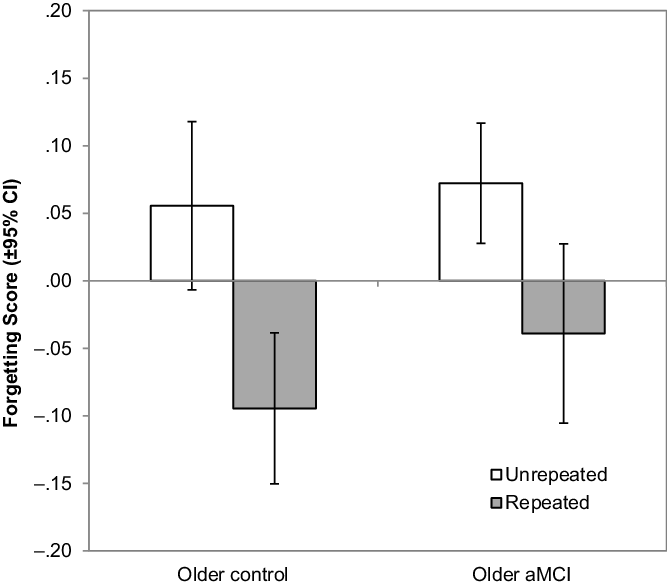
To explore the degree of forgetting shown by each group for the two types of items, we compared performance on the second learning trial with that on the delayed recall test in a test time × group × item type mixed ANOVA. Older control participants recalled more names overall (F(1,34) = 4.32, p = .045, ηp2 = .11), and repeated names generally had higher recall (F(1,34) = 4.93, p = .033, ηp2 = .13). The critical finding was a reliable interaction between test time and item type (F(1, 34) = 22.61, p < .001, ηp2 = .40). There was forgetting (i.e., a loss of .12, t(35) = 3.49, p = .001, d = 0.58) when face–name pairs were unrepeated, and a gain across the delay when they were repeated (gain of .09, t(35) = 3.16, p = .003, d = 0.53). No other effects were significant (Fs < 1.62, ps > .21). For each group, separate forgetting scores (i.e., number of names lost between the second learning trial and delayed cued recall) are shown in Figure 2 with 95% confidence intervals (CI) to indicate a significant change in recall across the delay. Examination of the 95% CI in Figure 2 shows that people with aMCI showed significant forgetting of unrepeated names (i.e., forgetting significantly greater than zero) but no reliable forgetting of repeated names over the delay. As was reported in a previous study (Biss et al., Reference Biss, Ngo, Hasher, Campbell and Rowe2018) and can be seen by examining the 95% CI in Figure 2, healthy older adults seemed to learn from the re-exposure, with a significant gain in names recalled over the delay (i.e., a forgetting score that was significantly below zero); they did not show reliable forgetting of unrepeated items.
Forgetting score, calculated as the change in number of names correctly recalled between the delayed and immediate cued recall tests. Positive scores indicate forgetting, whereas negative scores represent better cued recall on the delayed test. Error bars represent 95% confidence intervals.

Recognition
For all recognition analyses, a group × name type mixed ANOVA was used. Overall recognition was better among control compared to aMCI participants (F(1,34) = 8.25, p = .007, ηp2 = .20). No other effects were significant (Fs < 1.48, ps > .23). We also considered false recognitions and found no tendency to incorrectly choose repeated over unrepeated names as recognition lures and no interaction with group (Fs < 1).
Recollection
Recollection was taken as the proportion of names that were correctly recognized and reported as “remembered” (Yonelinas & Jacoby, Reference Yonelinas and Jacoby1995). Recollection scores did not differ between groups (F(1,34) = 1.30, p = .26). Recollection was higher for repeated compared to unrepeated names (F(1,34) = 6.79, p = .014, ηp2 = .17), a tendency that did not reliably differ across groups (F(1,34) = 1.70, p = .20).
Familiarity
Familiarity was estimated using the independence remember/know procedure [IRK; i.e., know/(1-remember); Yonelinas & Jacoby, Reference Yonelinas and Jacoby1995]. Older controls showed higher scores than aMCI participants (F(1,34) = 10.87, p = .002, ηp2 = .24). No other effects were significant (Fs < 1).
Association with neuropsychological test performance
As additional exploratory analyses, Pearson correlations were used to examine whether performance on administered neuropsychological tests across all participants was associated with individual differences in the benefit of repeating names as distraction, calculated as the difference between forgetting of repeated and unrepeated items. However, the benefit from distraction was unrelated to performance on any of the neuropsychological tests [i.e., Brief Visuospatial Memory Test – Revised Immediate and Delayed Recall (Benedict, Reference Benedict1997), Montreal Cognitive Assessment (Nasreddine et al., Reference Luo and Craik2005), Wechsler Adult Intelligence Scale III Digit-Symbol Coding, Digit-Symbol Incidental Learning, or Digit Span (Wechsler, Reference Wechsler1997); −.15 < rs < .19, ps > .28].
DISCUSSION
Consistent with prior evidence for face–name associative deficits (Irish et al., Reference Hampstead, Sathian, Moore, Nalisnick and Stringer2011; Pike et al., Reference Pike, Kinsella, Ong, Mullaly, Rand, Storey and Parsons2012; Troyer et al., Reference Troyer, Murphy, Anderson, Craik, Moscovitch, Maione and Gao2012), older adults with aMCI had poorer overall recall and recognition of face–name associations compared to older adults with age-normal memory. Nonetheless, people with aMCI were able to benefit from the opportunity to incidentally rehearse face–name associations, forgetting fewer of these repeated associations across the delay and recalling more of the repeated names on delayed recall. Moreover, recollection was improved for repeated names for people with aMCI, despite their overall deficits in recollection reported elsewhere (e.g., Koen & Yonelinas, Reference Koen and Yonelinas2014). Exploratory analyses did not suggest that memory performance on neuropsychological tests was related to the ability to benefit from incidental rehearsals.
Results suggest that, like healthy older adults (Biss et al., Reference Benedict2013; Campbell et al., Reference Campbell, Hasher and Thomas2010; Rowe et al., Reference Rowe, Valderrama, Hasher and Lenartowicz2006; Weeks et al., Reference Weeks, Biss, Murphy and Hasher2016), people with aMCI can benefit from conditions that encourage stimulus-driven processing to cue incidental rehearsal. It is unclear whether broadened attention to distraction was specifically responsible for the mnemonic benefit because an experimental condition in which faces were repeated in the 1-back task without the paired distracting names was not included. While it is possible that retrieval associated with re-exposure to the target face produced the effect, we note that younger adults tested previously in this paradigm showed no benefit from repetition of target faces and distracting names, a finding attributed to their ability to ignore distraction (Biss et al., Reference Biss, Ngo, Hasher, Campbell and Rowe2018). Given that parallel benefits were observed in older adults with and without aMCI, effects in both groups may reflect a normative, age-related shift toward less constrained processing of environmental information (Amer, Campbell, & Hasher, Reference Amer, Campbell and Hasher2016), associated with reduced efficiency of the frontoparietal cognitive control network (Campbell, Grady, Ng, & Hasher, Reference Campbell, Grady, Ng and Hasher2012). This may bolster explicit memory performance when rehearsal can be outsourced to cues in the environment, similar to the benefit of environment support in helping older individuals compensate for memory retrieval deficits (Craik, Reference Craik, Klix and Hagendorf1986; Luo & Craik, Reference Luo and Craik2008). It is possible that this shift toward broader attention and greater reliance on processing driven by the environment occurs independently of cognitive and neural changes due to early AD.
A remaining question is which sustained cognitive and neural processes can support the mnemonic boost to cued recall and recollection observed here for individuals with aMCI? We suggest that unintentional reminders may prompt covert reactivation of previously encoded associations. That is, they may function as a type of incidental spaced retrieval, which does not require overt, effortful memory search but involves a more automatic retrieval of the associations. At a neural level, the hippocampus is thought to mediate an initial unconscious stage of recollection, whereby a cue rapidly reactivates associated cortical representations (Moscovitch, Cabeza, Winocur, & Nadel, Reference Moscovitch, Cabeza, Winocur and Nadel2016). It is possible that this automatic retrieval function of the hippocampus is maintained in aMCI. In fact, neuroimaging studies have demonstrated hippocampal hyperactivity during memory tasks in individuals with aMCI, which is associated with a behavioral reliance on pattern completion, in which all related elements from the past are retrieved based on partial cues (Bakker et al., Reference Bakker, Krauss, Albert, Speck, Jones, Stark and Gallagher2012). Importantly, reactivation of associations via the pattern completion functions of the hippocampus can occur incidentally without explicit retrieval (Horner, Bisby, Bush, Lin, & Burgess, Reference Horner, Bisby, Bush, Lin and Burgess2015). It may be that despite overall explicit memory deficits, these intact or even hyperactive hippocampal functions in people with aMCI can support a rapid, unintentional recollection process. We hypothesize that this process was triggered by incidental repetitions of face–name pairs, producing a benefit to associative memory on cued recall and recollection, in a similar manner as environmental support has been suggested to aid retrieval in older adults (Craik, Reference Campbell, Hasher and Thomas1986; Luo & Craik, Reference Luo and Craik2008).
The passive mnemonic approach explored here differs from other methods to improve face–name memory, such as visual imagery or intentional spaced retrieval, which involve intensive training in internal, explicit memory strategies. This was a relatively low-intensity method to boost associative recall: Faces and their superimposed names were repeated only three times, with each presentation occurring for 1.5 s and were presented mixed in with many unrelated filler items, comprising less than one quarter of the trials for the 1-back task. A limitation inherent to implicit memory research is the inability to continuously monitor possible awareness of the re-occurrence of individual items. That is, it is possible that participants became aware of the repetition of face–name pairs during the 1-back task, using this as an intentional rehearsal opportunity, and then failed to report this information when administered the awareness questionnaire. Therefore, we cannot state for certain whether this effect relied on preserved implicit memory in aMCI. However, results did suggest that repetitions did not have to be intentionally attended or rehearsed to influence memory performance. It is possible that more frequent repetitions, spaced over longer periods of time, could promote longer-term retention of face–name associations. This type of unintentional and environmentally presented memory strategy may be particularly useful for people with more severe memory impairments (Camp et al., Reference Camp, Foss, Stevens, Reichard, McKitrick and Hanlon1993) such as those who have converted to dementia due to AD.
Based on the present sample of older adults with aMCI, memory for face–name associations can be improved by providing incidental rehearsal opportunities in which irrelevant items (i.e., names) are paired with previously associated targets (i.e., faces) in a seemingly unrelated task. Along with similar findings in healthy older adults (Biss et al., Reference Biss, Ngo, Hasher, Campbell and Rowe2013, Reference Biss, Rowe, Weeks, Hasher and Murphy2018; Campbell et al., Reference Campbell, Hasher and Thomas2010; Rowe et al., Reference Rowe, Valderrama, Hasher and Lenartowicz2006; Weeks et al., Reference Weeks, Biss, Murphy and Hasher2016), this line of research suggests that even if these reminders occur as incidental information in another task, they will still boost memory. The findings demonstrate the potential for the environmentally driven method used here to be developed as an intervention to boost memory for the names of people encountered in social situations, for example, for people hoping to make new friends as they move to assisted living or long-term care. Because the method can be applied passively without intensive training by professionals, it may be readily applied using technology. For example, paired names and faces of new friends and acquaintances may appear as incidental reminders while an individual with aMCI plays a game with other material as target information on a smartphone or tablet. A secondary outcome of successful intervention of this nature may be sustained or enhanced participation in social leisure activities among those experiencing mild cognitive decline—an important benefit given the association between social participation and reduced dementia risk (e.g., Kuiper et al., Reference Kuiper, Zuidersma, Oude Voshaar, Zuidema, van den Heuvel, Stolk and Smidt2015).
Acknowledgments
We thank Fathima Adamsahib, Hasina Barrie, Elizabeth Howard, Saira John, and Kristoffer Romero for their assistance with data collection.
CONFLICTS OF INTEREST
None.
FUNDING
This work was supported by an Alzheimer Society of Canada Post-Doctoral Award (R.K.B.); a grant from the Canadian Institutes of Health Research (L.H., grant number MOP89769); and the Morris Goldenberg Research Endowment (K.J.M.).
SUPPLEMENTARY MATERIAL
To view supplementary material for this article, please visit https://doi.org/10.1017/S1355617720000429