Introduction
The introduction of agricultural pests into a new area has become common with the rapid globalization of agricultural products trade and increasing levels of tourism (Pimentel et al., Reference Pimentel, McNairm, Janecka, Wightman, Simmonds, O'Connell, Wong, Russel, Zern, Aquino and Tsomondo2001). In most cases, because the new location is free from natural enemies, the population of introduced species rapidly increases (Torchin et al., Reference Torchin, Lafferty, Dobson, McKenzie and Kuris2003). Introduced agricultural pests often lead to serious damage in agricultural crops and are therefore generally called invasive pests. Classical biological control methods (i.e., the intentional introduction of natural predators from the original home range of targeted invasive pests) have resulted in a reduction in pest densities in some cases (Bellows, Reference Bellows2001). One of the most successful examples of classical biological control is the introduction of the parasitoid wasp Encarsia smithi (Silvestri) (Hymenoptera: Aphelinidae) to control the orange spiny whitefly (OSW) Aleurocanthus spiniferus (Quaintance) (Homoptera: Aleyrodidae) (Nakao & Funasaki, Reference Nakao and Funasaki1979; Marutani & Muniappan, Reference Marutani and Muniappan1991; van den Berg & Greenland, Reference van den Berg and Greenland1997).
OSW is a relatively new invasive pests and known as one of the most destructive towards citrus plants, not only by generally weakening plants due to sap loss (direct damage) but also through the production of honeydew, which subsequently promotes the growth of sooty mould that covers the leaf surface and negatively affects photosynthesis (indirect damage) (Marutani & Muniappan, Reference Marutani and Muniappan1991; van den Berg & Greenland, Reference van den Berg and Greenland1997; Muniappan et al., Reference Muniappan, Purea, Sengebau and Reddy2006). OSW has a wide host range, including citrus, rose, grapevine, flowering apple, peach, and pear (Peterson, Reference Peterson1957; Nakao & Funasaki, Reference Nakao and Funasaki1979). Although OSW's original home range is assumed to be China and South and Southeast Asia, its distribution range has significantly extended to non-native areas such as Japan (Kuwana, Reference Kuwana1934), the Caribbean islands (Gowdey, Reference Gowdey1922), Micronesia (Peterson, Reference Peterson1955; Nafus, Reference Nafus1988; Muniappan et al., Reference Muniappan, Marutani and Esguerra1992, Reference Muniappan, Purea, Sengebau and Reddy2006), Hawaii (Nakao & Funasaki, Reference Nakao and Funasaki1979), southern Africa (van den Berg & Greenland, Reference van den Berg and Greenland1997; van den Berg et al., Reference van den Berg, Höppner and Greenland2000), and Italy (Porcelli, Reference Porcelli2008).
E. smithi is well-known as the main endoparasitoid wasp of OSW (Flanders, Reference Flanders1969); additionally, it can parasitize species of Aleurocanthus (Schauff et al., Reference Schauff, Evans and Heraty1996; Heraty et al., Reference Heraty, Woolley and Polaszek2007b; Dubey & Ko, Reference Dubey and Ko2012) and, in fact, an introduced population of E. smithi had the ability to control citrus blackfly Aleurocanthu woglumi Ashby populations in Mexico (Flanders, Reference Flanders1969). E. smithi reproduces sexually and asexually; both diploid females and haploid males can be generated by mated females parasitizing the spiny whitefly or by hyperparasitism on conspecific or congeneric larva, but only haploid males can be asexually produced by hyperparasitism (Nguyen & Sailer, Reference Nguyen and Sailer1987). E. smithi can kill spiny whiteflies not only by parasitizing it but also by the host-feeding behaviour (Kishida et al., Reference Kishida, Kasai and Yoshiyasu2010). In addition, E. smithi dispersal ability after introduction is high; in Micronesia islands, parasitism by this wasp was detected at distances over 1 km from release sites within a year after the release of only 24–67 individuals (Marutani & Muniappan, Reference Marutani and Muniappan1991). These ecological factors suggest E. smithi could be an effective agent for classical biological control.
Twenty E. smithi individuals collected in China were released in a citrus orchard in Japan in 1925 to control OSW (Kuwana, Reference Kuwana1934). The wasp gradually established itself and spread to a considerable distance from the original release point (Kuwana, Reference Kuwana1934). In addition, the wasp was bred and released in other areas affected by the whitefly, following an initiative of the Japanese government. Field pupal parasitism averaged 65% and sometimes exceeded 90% (Kuwana, Reference Kuwana1934) and as a result, OSW has been almost completely eliminated, except for occasional outbreaks in limited regions (Ohgushi, Reference Ohgushi1969). Similar introductions were performed in Micronesia (Nafus, Reference Nafus1988; Marutani & Muniappan, Reference Marutani and Muniappan1991; Muniappan et al., Reference Muniappan, Marutani and Esguerra1992), Hawaii (Nakao & Funasaki, Reference Nakao and Funasaki1979), and southern Africa (van den Berg & Greenland, Reference van den Berg and Greenland1997). Within a year of release, it had almost eradicated OSW, eliminating the need for pesticide applications (e.g., Marutani & Muniappan, Reference Marutani and Muniappan1991; van den Berg & Greenland, Reference van den Berg and Greenland1997).
In recent decades, the tea spiny whitefly (TSW) Aleurocanthus camelliae (Kanmiya & Kasai) has affected tea production in East Asia. This species is phylogenetically close to OSW and until the recent publication of detailed ecological, morphological, and molecular phylogenetic studies the two species were considered as a single species (Kanmiya et al., Reference Kanmiya, Ueda, Kasai, Yamashita, Sato and Yoshiyasu2011). The damages caused by TSW include the reduction in tree vigour, caused by sap loss and sooty mould, and the reduction in harvesting efficiency due to flying adults disturbing farmworkers in tea plantations (Yamashita & Hayashida, Reference Yamashita and Hayashida2006). Known hosts of TSW are Theaceae plants including Camellia sinensis (L.) Kuntze, Camellia sasanqua Thunb., Cleyera japonica Thunb., Eurya japonica Thunb., and Illicium anisatum L., which does not overlap with OSW hosts. Kasai et al. (Reference Kasai, Yamashita and Yoshiyasu2010) recognized significant differences in host preference between OSW and TSW based on oviposition and larval feeding behaviour: OSW laid no eggs on Camellia leaves; TSW laid a few eggs on Citrus but no nymphs settled on the leaves. Therefore, the tea-infesting spiny whitefly, which had been previously described as OSW, should be identified as TSW (Uesugi & Sato, Reference Uesugi and Sato2011).
Damage to tea plantations due to TSW was initially observed in southern China in the 1950s and became serious in the 1980s (Xie, Reference Xie1995; Xuefen et al., Reference Xuefen, Jiaode, Guangyuan, Jianzhong and Migsen1997; Han & Cui, Reference Han and Cui2003). Subsequently, TSW also became an important pest in Taiwan (Hsiao & Shiau, Reference Hsiao and Shiau2004) and it was initially identified in Kyoto, Japan, in 2004 (Yamashita & Hayashida, Reference Yamashita and Hayashida2006). Although there was no intentional introduction of E. smithi in Japan, a high rate of parasitism by this wasp stabilized the whitefly population in some regions below the economic injury level (Yamashita, personal communication). However, the wasp has not become established in some of the regions invaded by TSW (e.g., Yakushima Island).
The origin of E. smithi parasitizing TSW in Japan is unclear. One hypothesis is that wasps from an existing population parasitizing OSW began to parasitize TSW; another advocates the wasp has immigrated to Japan following the invasion of TSW and is phylogenetically distinct from the existing population that parasitizes OSW. In the latter case, we should consider the risk of undesirable side effects, referred to as ‘non-target’ effects, associated with the use of the newly imported genetic group of E. smithi parasitizing TSW as a biological control agent (Follet & Duan, Reference Follet and Duan2000).
The purpose of this study was to investigate the genetic diversity of OSW and TSW, and their important natural enemy, E. smithi, to provide information for the implementation of biological control by the wasp. Molecular markers have proven to be useful for distinguishing cryptic diversity in whiteflies and in Aphelinidae wasps at the species and population levels (Hoy et al., Reference Hoy, Jeyaprakash, Morakote, Lo and Nguyen2000; Rajaei Shoorcheh et al., Reference Rajaei Shoorcheh, Kazemi, Manzari, Brown and Sarafrazi2008; De Leon et al., Reference De Leon, Neumann, Follett and Hollingsworth2010). They are also useful for determining both the source area and population structure of invasive species (Roderick & Navajas, Reference Roderick and Navajas2003; Cognato et al., Reference Cognato, Sun, Anducho-Reyes and Owen2005; Simon-Bouhet et al., Reference Simon-Bouhet, Garcia-Meunier and Viard2006; Kirk et al., Reference Kirk, Dorn and Mazzi2013) and for providing evidence to determine whether single or multiple sources of introduction occurred (Grapputo et al., Reference Grapputo, Boman, Lindstrom, Lyytinen and Mappes2005). In this study, we first investigated the genetic variation within the two species of spiny whiteflies and estimated their potential native area using a sequence fragment of the cytochrome C oxidase subunit I of mitochondrial DNA (mtCOI). We then investigated genetic variation through the characterization of mtCOI haplotypes and studied the genetic relationships among E. smithi, OSW, and TSW. Finally, we evaluated the genetic diversity of E. smithi using microsatellites to unveil the recent demographic events shaping the wasp's colonization after its introduction in Japan.
Materials and methods
Sample collection
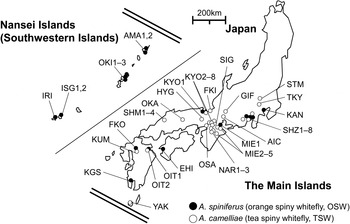
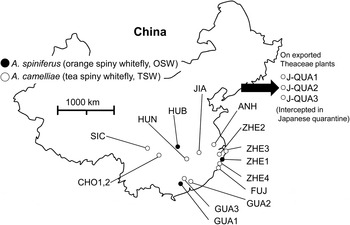
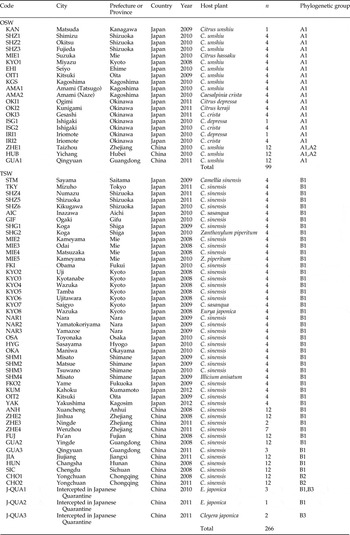
OSW and TSW adults and nymphs were collected from April 2008 to January 2012 in Japan and China (table 1, figs 1 and 2). OSW samples were collected from 21 localities in 11 prefectures (provinces) and TSW samples from 47 localities in 26 prefectures (provinces) (table 1). In Japan, TSW was initially identified in Uji city, Kyoto (KYO2) (table 1, fig. 1) in 2004 (Yamashita & Hayashida, Reference Yamashita and Hayashida2006), later expanding to neighbour regions within the Kyoto Prefecture (KYO3–KYO8), and to the prefectures of Mie (MIE2–MIE5), Nara (NAR1–NAR3), Osaka (OSA), Hyogo (HYG), Shiga (SHG), and Gifu (GIF) (table 1 and fig. 1). The cause for this expansion was attributed to host plants movement (Kasai et al., Reference Kasai, Yamashita and Yoshiyasu2010). OSW was collected from four species of Citrus (Citrus unshiu Markobich, Citrus hassaku Hort. Ex Tanaka, Citrus depressa Hayata, Citrus keraji var. kabuchii hort. ex Tanaka) and one Fabaceae (Caesalpinia crista L.). TSW was collected from four Theaceae (C. sinensis (L.), C. sasanqua, E. japonica, and C. japonica), one Illiciaceae (I. anisatum), and one Rutaceae (Zanthoxylum piperitum DC.) (table 1). Six TSW nymphs were collected from E. japonica and C. japonica intercepted in Japanese quarantine after being imported from China (table 1, fig. 2). All samples were stored in 99.5% ethanol at −20°C until genetic analysis.
Collection sites of the orange spiny whitefly and tea spiny whitefly individuals in Japan.

Collection sites of the orange spiny whitefly and tea spiny whitefly individuals in China.

Sampling location (including code) and year, host plant, and number (n) of Aleurocanthus spiniferus (orange spiny whitefly, OSW) and A. camelliae (tea spiny whitefly, TSW) individuals used in the mtCOI sequence analysis and their corresponding phylogenetic group.

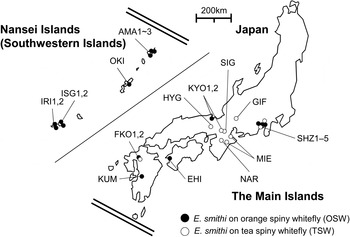
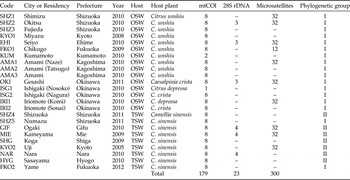
Samples of the parasitoid wasp E. smithi were obtained from leaves infected with OSW and TSW nymphs collected from 15 localities in seven prefectures and from nine localities in eight prefectures, respectively. Leaves were collected from May 2005 to September 2012 (table 2, fig. 3) and adult female wasps that emerged from the nymphs were placed in clear plastic boxes. Wasps were morphologically identified to the species level (Schauff et al., Reference Schauff, Evans and Heraty1996), and stored in 99.5% ethanol at −20°C until genetic analysis. Additionally, 21 individuals from six localities (Shizuoka, Ehime, Okinawa, Gifu, Mie, and Nara; table 2) were used to confirm species identification through the analysis of a partial nucleotide sequence of the D2 expansion region of the large subunit of ribosomal DNA (28S rDNA), which was suggested as the most suitable genetic region for taxonomic studies at species level in Encarsia spp. (Schmidt et al., Reference Schmidt, De Barro and Jamieson2011). Up to eight individuals collected in each locality were used in the mtCOI sequence analysis and up to 32 individuals from ten localities were used for microsatellite analysis (table 2).
Collection sites of Encarsia smithi individuals in Japan.

Sampling location (including code) and year, host (orange spiny whitefly, OSW, and tea spiny whitefly, TSW), host plant, and number (n) of E. smithi used in the mtCOI, 28S rDNA, and microsatellites analyses.

DNA extraction and polymerase chain reaction (PCR)
Total DNA was extracted from individual whiteflies (adults and nymphs) and wasps (adult females) according to the proteinase K method (Goka et al., Reference Goka, Okabe, Yoneda and Niwa2001).
To confirm E. smithi morphological identification, the partial nucleotide sequence of D2 was obtained by PCR amplification using the primers D2F (5′-CGG GTT GCT TGA GAG TGC AGC-3′, forward) and D2Ra (5′-CTC CTT GGT CCG TGT TTC-3′, reverse) (Schmidt et al. Reference Schmidt, De Barro and Jamieson2011). PCR was performed with a GeneAmp PCR System Model 9700 (Applied Biosystems, Foster City, CA, USA) in a total volume of 20 µl containing 0.5 µM of each primer, 0.2 mM of dNTP, 1 × Ex Taq buffer (2 mM MgCl2), 1 U of Ex Taq DNA polymerase (TaKaRa, Shiga, Japan), and 1 µl of DNA template. A negative control (de-ionized water instead of DNA template) was added to each reaction to confirm there was no contamination. The amplification profile used was: 5 min at 96°C, followed by 35 cycles of 1 min at 94°C, 1 min at 55°C, and 90 s at 72°C, and a final extension set of 5 min at 72°C.
PCR was also used to obtain the partial mtCOI nucleotide sequence using the following primers for each species: OSW: 5′-GTG TCC CAT TTA ATT AGT AGA GA-3′ (forward) and 5′-GAG CCA TAA TAA AAG ACT CCA TC-3′ (reverse) (Uesugi & Sato, Reference Uesugi and Sato2011); TSW: 5′-ATT TCA CAC TTA ATT AGG AGT GA-3′ (forward) and 5′-CTG CAC GAA ATA CAA CAA ATG C-3′ (reverse) (Uesugi & Sato, Reference Uesugi and Sato2011); E. smithi: 5′-TTG ATT TTT TGG TCA TCC AGA AGT-3′ (C1-J-2195, forward) and 5′-TCC AAT GCA CTA ATC TGC CAT ATT A-3′ (L2-N-3014, reverse) (Simon et al., Reference Simon, Frati, Crespi, Liu and Flook1994). All PCR mixtures were identical to the one used in the amplification of the D2 region of E. smithi as described above. A negative control (de-ionized water instead of DNA template) was also added to each of these reactions to confirm there was no contamination. The PCR profile used was: 5 min at 96°C, followed by 35 cycles of 30 s at 94°C, 1 min at 53°C, and 40 s at 72°C, with a final elongation step of 5 min at 72°C. PCR products were subjected to an agarose gel electrophoresis and those revealing a single band of the predicted size (ca. 900 bp) were purified by ExoSAP-IT (Affymetrix, Santa Clara, CA, USA). Sequencing was performed on an ABI 310 genetic analyzer (Applied Biosystems) using the ABI BigDye v.3.1 (Applied Biosystems) according to the manufacturers’ recommendations and using the same primers as in PCR.
Five microsatellite loci were amplified by PCR from individuals belonging to 10 populations of the parasitoid wasp using the primer pairs Es002, Es011, Es051, Es060, and Es083 and the profiles described by Uesugi & Sato (Reference Uesugi and Sato2013). PCR products were analyzed on an ABI 310 genetic analyzer (Applied Biosystems) and GeneMapper (Applied Biosystems) was used to identify the microsatellite genotypes within each sample.
Data analyses
All sequence data obtained in the present study were deposited in the DNA Data Bank of Japan (DDBJ) and their accession numbers are referred throughout the text. The D2 sequences obtained for E. smithi (589 bp) were checked for homology with E. smithi D2 sequences deposited in the DDBJ using the Basic Local Analysis Search Tool (BLAST, last accessed date: 3 October 2015) in order to confirm species morphological identification.
The 674 bp partial mtCOI sequences obtained for OSW and TSW were aligned in CLUSTAL W (Thompson et al., Reference Thompson, Higgins and Gibsion1994) using the default parameters and examined for variation. No insertions/deletions were found. A median-joining (MJ) network (Bandelt et al., Reference Bandelt, Forster and Röhl1999) was constructed for this gene in Network 4.611 (Fluxus Technology, Suffolk, UK) using the default settings. The best model of nucleotide substitution was selected using jModelTest 2.1.7 (Guindon & Gascuel, Reference Guindon and Gascuel2003; Darriba et al., Reference Darriba, Taboada, Doallo and Posada2012). Based on the Bayesian Information Criterion (BIC) results, the Hasegawa-Kishino-Yano (HKY) + Gamma distributed rates (G) model was selected for phylogenetic analyses. Trees were constructed using the maximum-likelihood (ML) and Bayesian inference (BI) algorithms in MEGA 6.06 (Tamura et al., Reference Tamura, Stecher, Peterson, Filipski and Kumar2013) and MrBayes 3.2 (Ronquist et al., Reference Ronquist, Teslenko, van der Mark, Ayres, Darling, Höhna, Larget, Liu, Suchard and Huelsenbeck2012), respectively. A mtCOI sequence of Aleurotrachelus camelliae Kuwana (Accession No. AB536801) (Kanmiya et al., Reference Kanmiya, Ueda, Kasai, Yamashita, Sato and Yoshiyasu2011) was used as outgroup. Bootstrapping with 1000 replicates and posterior probabilities assessed the degree of confidence assigned to nodes in ML and BI trees, respectively. A species delimitation analysis was performed by the Poisson-Tree-Process (PTP) on the bPTP web server of the Exelixis Lab (http://species.h-its.org/ptp/) using the default settings and a Bayesian implementation of the model (Zhang et al., Reference Zhang, Kapli, Pavlidis and Stamatakis2013), and based on ML and BI trees. Haplotype diversity (h: Nei & Tajima, Reference Nei and Tajima1981) was calculated for OSW and TSW, and for each putative phylogenetic group detected by the network analysis and the phylogenetic trees, as h = (1 – Σx i2) n/(n – 1), where Σx i is the frequency of the ith haplotype and n is the number of samples.
Evaluation of the variation of E. smithi mtCOI sequences (734 bp) and construction of ML and BI phylogenetic trees were performed as described for the whiteflies. A General Time Reversible (GTR) model + percentage of Invariable sites (I) model was selected by jModelTest 2.1.7. mtCOI sequences of Encarsia formosa Gahan (Accession No. AY264337) (Heraty et al., Reference Heraty, Woolley, Hopper, Hawks, Kim and Buffington2007a) and Marietta montana Myartseva and Ruíz-Cancino (Accession No. DQ350502) were used as outgroups.
Microsatellite data of E. smithi was checked for scoring errors and null alleles in each locus and within each population using Micro-Checker 2.2.3 (Brookfield, Reference Brookfield1996; van Oosterhout et al., Reference van Oosterhout, Hutchinson, Wills and Shipley2004). The number of alleles and expected heterozygosity of E. smithi were determined for each population using the five loci. FSTAT 2.9.3.2 (Goudet, Reference Goudet2001) was used to detect genotypic disequilibrium among microsatellite loci and to quantify the level of genetic differentiation (θ) among wasp populations within each host species. The 95% confidence intervals for θ were calculated from 1000 permutations of the genotypes. Pairwise genetic distances among wasp individuals were calculated using the method described by Smouse & Peakall (Reference Smouse and Peakall1999) using GENALEX 6 (Peakall & Smouse, Reference Peakall and Smouse2006). We then evaluated the genetic structure of the populations by performing a principal coordinates analysis (PCA) in GENALEX. To assess migration among populations of the wasp, we applied coalescent-based Markov Chain Monte Carlo (MCMC) simulations using the ML analysis implemented in Migrate-N 3.6 (Beerli, Reference Beerli2006). Migrate-N estimates mutation-scaled effective population size (Θ; Θ = 4N eμ, where N e is the effective population size and μ is the mutation rate per generation) in each population as well as mutation-scaled migration rates (M; M = m/μ, where m is the migration rate) between population pairs. We calculated the number of effective migrants per generation (N em; N em = ΘM/4) using the values estimated by Migrate-N. Simulations used ten short chains of 2 × 10⁴ steps and two long chains of 2 × 10⁵ steps, sampled every 20 steps following a burn-in of 1000 steps. To increase the efficiency of the MCMC, a heating scheme was applied using four chains with temperatures 1.00, 1.50, 3.00, and 1.00 × 10⁶. Default settings were used in the remaining run parameters.
Genetic structure was investigated through the Bayesian clustering method implemented in Structure 2.3 (Pritchard et al., Reference Pritchard, Stephens and Donnelli2000). We used a burn-in period of 1 × 10⁴ iterations and a MCMC run length of 1 × 10⁴ iterations. Ten runs were carried out for each K (K = 1 to 10 clusters) in order to quantify the amount of variation of the likelihood. K was determined in Structure Harvester 0.6.9.3 (Evanno et al., Reference Evanno, Regnaut and Goudet2005), which uses an ad hoc parameter (∆K) to estimate the rate of change of likelihood values between successive Ks.
Results
Genetic variation and haplotype distribution of OSW and TSW
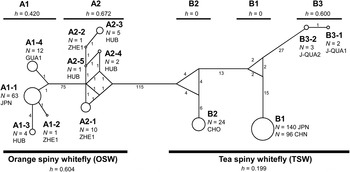
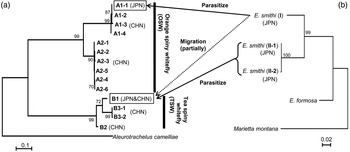
Mitochondrial COI sequence analyses revealed eight haplotypes in the 36 OSW individuals obtained from the three localities in China; in Japan, a single haplotype was found for the 63 OSW individuals infesting Citrus spp. and C. crista host plants in the 18 localities. Network analysis revealed two discontinuous phylogenetic groups separated by 75 mutations (fig. 4), and these two groups were also evidenced in the ML and BI phylogenetic trees (fig. 5a; only the ML tree is shown). The two phylogenetic groups, named A1 (Accession No. AB786715–AB786717) and A2 (Accession No. AB786718–AB786723) (table 1, figs 4 and 5a) were found in sympatry in the Chinese populations ZHE1 and HUB. Haplotype diversity (h) in A2 (0.671) was higher than in A1 (0.420) and moderately high in OSW (0.604) (fig. 4).
Median-joining (MJ) network based on the mtCOI sequences of the orange spiny whitefly (OSW) and tea spiny whitefly (TSW), in Japan (JPN) and China (CHN). A1 and A2, and B1, B2, and B3 are the putative phylogenetic groups obtained for OSW and TSW, respectively. N corresponds to the detected number of each haplotype. Collection site codes are described in Table 1. Haplotype diversities (h, Nei & Tajima, Reference Nei and Tajima1981) are shown for each species and for each phylogenetic group. Numbers of mutations between haplotypes are shown next to the lines.

Maximum likelihood trees based on mtCOI sequence data showing (a) the relationships between orange spiny whitefly and tea spiny whitefly phylogenetic groups from Japan and China, and (b) the relationships between the phylogenetic groups of the parasitoid wasp Encarsia smithi from Japan. Only bootstrap values above 70% are shown; scale bars indicate nucleotide substitutions per site.

In TSW, two haplotypes were detected in the 120 individuals from the 11 tea plantations in China; one was named haplotype B1 (Accession No. LC088497) and the other was named haplotype B2 (Accession No. AB786712) (table 1). Haplotype B1 was detected across a wide range in China, but haplotype B2 was only detected in Chongqing (populations CHO1 and CHO2). In Japan, a single mtCOI haplotype (B1) was observed for the 140 individuals from the 35 localities infecting any host plant (table 1). The individuals intercepted in the Japanese quarantine had three haplotypes: B1, and B3-1 and B3-2 (Accession No. AB786713–AB786714), which only differed by one-base substitution (table 1). Network analysis (fig. 4) revealed three phylogenetic groups within TSW corresponding to the three haplotypes (fig. 4). Phylogenetic analyses also revealed B1 and B3 were more closely related than B1 and B2 (fig. 5a). B1 and B2 showed no haplotype diversity (h = 0), whereas haplogroup B3 had a moderately high h (0.600); total haplotype diversity within TSW was low (0.199) (fig. 4).
Regarding the bPTP molecular species delimitation analyses, A1 and A2 were recognized as different putative species with high posterior probabilities in the ML (0.898 and 0.949, respectively) and BI (0.981 and 0.905, respectively) trees. B1, B2, and B3 were also recognized as different putative species with high posterior probabilities in both trees (0.989, 0.989, and 0.959 in the ML tree, and 1.00, 1.00, and 0.999 in the BI tree, respectively).
Genetic variation and phylogeny of E. smithi
We confirmed the species identification of E. smithi using the sequence data of D2. In the nine samples collected from OSW in Japan, a single diplotype (Accession No. LC088727) was detected. The sequence was identical to samples of E. smithi from Hawaii deposited in the DNA Data Bank of Japan (Accession No. AF254233) (Babcock et al., Reference Babcock, Heraty, De Barro, Driver and Schmidt2001). In the 12 samples parasitizing TSW in Japan, three diplotypes (Accession No. LC088728–LC088730) were detected, which were highly similar to E. smithi from the Truk Islands, Micronesia (Accession No. AF254234) (Babcock et al., Reference Babcock, Heraty, De Barro, Driver and Schmidt2001). Rate of nucleotide substitution between E. smithi D2 haplogroups I and II was 1.86–2.04% (11–12 substitutions per 589 bp).
A single haplotype was found for the mtCOI of the 107 E. smithi individuals parasitizing OSW in 15 localities in Japan (haplotype I, Accession No. AB786726) (table 2). Fifty-five E. smithi individuals parasitizing TSW in seven localities also showed a single haplotype (Accession No. AB786724), and one sample (population HYG) had an analogous haplotype with only one base substitution (Accession No. AB786725). These were named haplogroup II (table 2). Wasps of populations SHZ5 and FKO2 parasitizing TSW were identified within haplotype I (table 2). Rate of nucleotide substitution between mtCOI haplogroups I and II was 7.35% (54 substitutions per 734 bp). This differentiation was also evidenced in the ML phylogenetic tree of E. smithi displayed in fig. 5b, which showed a high bootstrap support for the node between haplotype I and haplogroup II (99%). A high posterior probability (1.00) was also obtained in the Bayesian tree (data not shown).
Microsatellite polymorphisms in E. smithi
Null alleles and possible stuttering in all loci and populations were not significant (P > 0.95), except in population FKO1 where null alleles might be present at loci Es002 and Es051, as suggested by the general excess of homozygotes for most alleles size classes (P < 0.05). In addition, significant genotypic disequilibrium was not detected between any pair of microsatellite loci within the phylogenetic groups (P > 0.05).
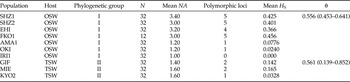
Indices of genetic diversity and differentiation of E. smithi are shown in table 3. Genetic differentiation (θ) among populations was significantly positive for populations within the same host (table 3). In haplotype I, the genetic diversity of microsatellites was different between populations from the main islands (SHZ1, SHZ2, EHI, and FKO1) and Nansei islands (AMA1, OKI, and IRI1). Populations from the main islands had relatively high heterozygosities and allelic diversity (table 3) and were clustered into a single group in the PCA (fig. 6); populations from the Nansei islands had low heterozygosities and allelic diversity (table 3) and appeared widely scattered in the PCA, also indicating that these populations had a higher level of genetic differentiation than populations from the main islands. Haplogroup II had low heterozygosity and allelic diversity, and a high level of genetic differentiation as revealed by the scattering of populations in the PCA diagram (fig. 6).
Principal coordinates analysis (PCA) of the genetic variation among the populations of Encarsia smithi parasitizing the orange spiny whitefly (OSW) and the tea spiny whitefly (TSW) in Japan, based on the five microsatellites loci.

Genetic diversity and differentiation of Encarsia smithi parasitizing the orange spiny whitefly (OSW) and the tea spiny whitefly (TSW) in Japan based on five microsatellites loci.

NA, number of alleles; H S, heterozygosity; θ, genetic differentiation; numbers in parentheses indicate 95% confidence intervals.
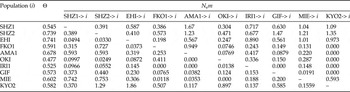
ML-based analysis using the program Migrate-N showed that gene flow was low among wasp populations. When M values were translated into effective migrants per generation (N em), the numbers of effective migrants per generation were below 1 in most population pairs (table 4), suggesting that either migration rate (m) or the effective population size (N e) decreased due to population division and/or genetic drift (Slatkin, Reference Slatkin1985).
Mutation-scaled effective population sizes (Θ; Θ = 4Neμ) and numbers of effective migrants per generation (N em; N em = ΘM/4) in the ten Encarsia smithi populations based on five microsatellites loci. See table 1 for population codes.

In the Bayesian clustering analysis using the Structure, the likelihood of individuals assignment increased from K = 1 (ln Pr (X|K) = −2365) to K = 5 (ln Pr (X|K) = −1363), and then plateaued until K = 10 (ln Pr (X|K) = −1313). Therefore, the highest likelihood was estimated to be at K = 5. Structure harvester showed that the highest values for the estimated likelihood of K were found at K = 2 and K = 5 (ΔK = 236.75, 3.82, 3.99, 18.78, 0.65, 0.16, 0.29, and 1.20 from K = 2 to K = 9, respectively). In K = 2, individuals within the SHZ1, SHZ2, EHI, FKO1, and AMA1 were almost all classified in the same cluster (fig. 7), which is in agreement with that obtained in the PCA analysis (fig. 6). In K = 5, individuals within the SHZ1, SHI2, EHI, and FKO1 populations were mostly classified into two or three clusters (fig. 7), although the assignment profiles largely differed between individuals within the same population. Population AMA1 and populations OKI and IRI1 mostly consisted of a single cluster with most individuals being assigned to the clusters; populations GIF, MIE, and KYO2 also mostly consisted of a single cluster, which was different from the ones detected in the wasps parasitizing OSW (fig. 7).
Estimated population structure of Encarsia smithi parasitizing the orange spiny whitefly (OSW) and the tea spiny whitefly (TSW) in Japan, based on the five microsatellites loci and using the program Structure 2.3 (K = 2 and K = 5). Thin vertical lines, partitioned into K coloured segments that represent the estimated membership clusters, represent individuals. Black lines separate the different populations.

Discussion
Phylogeny and haplotype diversity of the OSW
Native populations of invasive species generally preserve higher levels of genetic diversity than introduced populations (Malacrida et al., Reference Malacrida, Marinoni, Torti, Gomulski, Sebastiani, Bonvicini, Gasperi and Guglielmino1998; Bonizzoni et al., Reference Bonizzoni, Guglielmino, Smallridge, Gomulski, Malacrida and Gasperi2004; Dlugosch & Parker, Reference Dlugosch and Parker2008). The reduction in mitochondrial genetic diversity observed in introduced populations has been attributed to genetic bottlenecks originated by the recent human-aided expansions, which caused stochastic lineage survival and reduced the number of haplotypes (Kambhampati & Rai, Reference Kambhampati and Rai1991; Guillemaud et al., Reference Guillemaud, Pasteur and Rousset1997). Mitochondrial COI haplotype diversity in OSW populations from China was higher than that in populations from Japan. Therefore, China seems to be the source area of OSW with Japan being only recently invaded. In addition, this invasion was most likely a unique event, as multiple invasions would have resulted in several haplotypes (Grapputo et al., Reference Grapputo, Boman, Lindstrom, Lyytinen and Mappes2005). This is in agreement with the suggestion in old literature that OSW immigrated to Japan from somewhere south of the region based on OSW not being recognized in Japan before its first outbreak in the early 1900s (Kuwana, Reference Kuwana1934).
Phylogeny and haplotype diversity of TSW
All populations of TSW in Japan and most populations in China had a single fixed haplotype in mtCOI (haplotype B1), contrasting with the levels of genetic variation found for the Chinese populations of OSW. One explanation for this difference is the recent expansion of TSW to tea plantations in China from an unknown native region during which populations experienced a strong genetic bottleneck. This recent expansion is in agreement with field observations of whiteflies in China's tea plantations (Xie, Reference Xie1995; Xuefen et al., Reference Xuefen, Jiaode, Guangyuan, Jianzhong and Migsen1997; Han & Cui, Reference Han and Cui2003). Haplotype B2, which was only detected in the populations of Chongqing (CHO1 and CHO2), might be native to this region or have immigrated during a different invasion event, as the molecular species delimitation analyses evidenced an indisputably different phylogenetic history for B1 and B2.
Because haplotype B1 was detected in whiteflies infecting hosts in Japanese quarantine, the invasion pathway from China to Japan was probably the international trade of E. japonica and C. japonica. Because these plants are used in religious ceremonies held in Japanese shrines, TSW individuals originating in the founder populations introduced to shrines moved to the neighbouring tea plantations in Kyoto. The number of invasion events of TSW in Japan could not be estimated because the single haplotype (B1) was mostly fixed in the putative source area i.e., China.
Another phylogenetic group (haplogroup B3) was only detected on Theaceae plants in Japanese quarantine. Given its close phylogenetic relationships with haplotype B1 and B2, B3 might become a third invasive phylogenetic group in tea plantations in both China and Japan. To estimate the risk of invasion it will be necessary to study the feeding and oviposition behaviour of haplogroup B3 on host leaves and to continuously monitor populations for possible outbreaks in tea plantations.
Genetic variation of E. smithi and its relationships with the two species of spiny whiteflies
Although PCR amplification using the universal primers C1-J-2195 and L2-N-3014 has been inefficient for some species, it successfully amplified all E. smithi mtCOI in this study. Two phylogenetic groups (haplotype I and haplogroup II) were found in Japan and, in most cases, haplotype I and haplogroup II were associated with OSW and TSW, respectively. These results support the hypothesis that E. smithi parasitizing TSW did not originate from an existing population parasitizing OSW in Japan, instead arriving in this country following the invasion of TSW. In rare cases, haplotype I was parasitizing TSW in the populations SHZ5 and FKO2. This was probably due to the migration of haplotype I from an orange orchard to a tea plantation where the ecological niche was empty because haplogroup II had not immigrated. Because 27.9% of the SHZ5 population was parasitized by wasp pupae (Uesugi, unpublished data), E. smithi haplotype I is a potential biocontrol agent towards field populations of TSW and OSW.
Microsatellites usually reveal more recent demographic history, such as bottlenecks or expansion, than mtCOI (Selkoe & Toonen, Reference Selkoe and Toonen2006). The genetic structure of E. smithi detected by the microsatellites was largely affected by demographic events after their introduction in Japan. A higher level of genetic variation in haplotype I was detected in the populations from the main islands when compared with those of the Nansei islands in Japan, and populations from the main islands were genetically similar to each other. Presumably, E. smithi populations in the main islands originated from the populations introduced during the biological control programs initiated in 1925 by the Japanese government. In such programs, the release of as much genetic variation as possible into the new region is often encouraged to enhance the success rate (Simmonds, Reference Simmonds1963; Phillips et al., Reference Phillips, Baird, Iline, McNeill, Proffitt, Goldson and Kean2008). Therefore, the main island populations have preserved a high level of genetic variation and similar allelic frequencies throughout the years. Contrarily, the introduction of E. smithi in the Nainsei islands, which appears unintentional or performed on a private basis because there is no record concerning an organized introduction program, resulted in a genetic bottleneck and severely decreased genetic diversity in this region. Similarly, haplogroup II might have been unintentionally introduced to tea plantations in distant regions, along with the human-aided movement of TSW in Japan, experiencing severe genetic bottlenecks that resulted in a low level of genetic diversity and a high level of genetic differentiation between wasp populations.
In parasitoid wasps, the genetic differentiation associated with different host species was often reported as host specialization. Kankare et al. (Reference Kankare, van Nouhuys and Hanski2005) found two genetic groups of microsatellites in Cotesia melitaearum (Wilkinson), a parasitoid wasp of checkerspot butterflies, which were associated with two different host species (Melitaea cinxia (L.) and Euphydryas aurinia (Rottemburg)). They concluded that this data was one of the evidence of coevolution between the butterflies and the parasitoid wasps because of the reciprocal ecological dynamics occurring in this host-parasitoid system. Stireman et al. (Reference Stireman, Nason, Heard and Seehawer2006) also found two genetic lineages in the mtCOI of the parasitoid wasp Platygaster variabilis Fouts, 1924, which were associated with two genetically differentiated lineages of the goldenrod gall makers Rhopalomyia solidaginis (Loew) specializing in two species of sympatric host plants. They concluded that the two lineages of the parasitoid wasps had diversified sympatrically in association with the diversification of their hosts, based on the distribution and patterns of divergence showed by hosts and gall makers. Such host specialization of parasitoid wasps is also well-known in many species of the subfamily Aphidiinae (Starý, Reference Starý1981). However, the two phylogenetic groups of E. smithi (haplotype I and haplogroup II) did not result from their specialization in OSW and TSW, respectively, as this wasp can parasitize different species of Aleurocanthus whiteflies (Heraty et al., Reference Heraty, Woolley and Polaszek2007b; Dubey & Ko, Reference Dubey and Ko2012). In addition, haplotype I parasitized TSW field populations (table 2) and haplogroup II could sexually reproduce by parasitism on OSW in the laboratory (Uesugi et al., unpublished data). Hence, the host associations observed in the present study was most likely shaped by the recent introductions and expansion of haplogroup II along with human-aided movement of TSW in Japan and, in a near future, the two phylogenetic groups of wasps might have overlapping host species in Japan.
Implications for the control of TSW
Genetics should play a larger role in the development of invasive species management and control policies and in the defence against controlling agents (Allendorf & Lundquist, Reference Allendorf and Lundquist2003). Although the economic impact of OSW and TSW infections is becoming a serious worldwide problem, and their natural enemy E. smithi has proven to be an excellent agent to control them in field studies, little genetic information exists regarding their region of origin and phylogenetic diversity. Although our genetic analysis was limited to China and Japan, it has important implications for the control of these two invasive whitefly pests as follows.
First, a better understanding of the phylogenetic relationships within the two whitefly species will allow estimating the risk of invasion by other phylogenetic groups. For example, tobacco whitefly Bemisia tabaci (Gennadius) has several biotypes that differ in their invasive potential. Biotype Q has a tolerance of extreme temperatures (Bonato et al., Reference Bonato, Lurette, Vidal and Fargues2007) and insecticides (Horowitz et al., Reference Horowitz, Kontsedalov, Khasdan and Ishaaya2005; Tsagkarakou et al., Reference Tsagkarakou, Tsigenopoulos, Gorman, Lagnel and Bedford2007). Therefore, following the colonization by biotype B, the immigration of biotype Q caused additional problems for agriculture (Guirao et al., Reference Guirao, Beitia and Cenis1997; Palumbo et al., Reference Palumbo, Horowitz and Prabhaker2001; Nauen et al., Reference Nauen, Stumpf and Elbert2002). Determining whether the same problem can also occur in the two spiny whiteflies is necessary, and hence further studies regarding the ecological characteristics of the several phylogenetic groups, such as feeding behaviour and reproductive isolation, is required. In addition, colonization from multiple sources might mitigate the loss of genetic diversity in an invaded area and may result in novel selection challenges being encountered in the recently invaded area (Facon et al., Reference Facon, Genton, Shykoff, Jarne, Estoup and David2006; Dlugosch & Parker, Reference Dlugosch and Parker2008; Verhoeven et al., Reference Verhoeven, Macel, Wolfe and Biere2011); therefore, preventing additional invasions from occurring is desirable (Frankham, Reference Frankham2005).
Second, we should investigate the effective use of the two phylogenetic groups of the parasitoid wasp E. smithi for the biological control of TSW in Japan. Because the genetic diversity of haplogroup II was low in Japan, E. smithi's performance against TSW could be improved by releasing individuals obtained from the native range that would maximize its genetic diversity (Phillips et al., Reference Phillips, Baird, Iline, McNeill, Proffitt, Goldson and Kean2008). It is therefore necessary to study if the wasp's genetic diversity is linked to the ability to suppress pest populations and adapt to changes in host population dynamics (Hopper et al., Reference Hopper, Roush and Powell1993). In addition, we should consider any undesirable side effects on the ecosystem likely to be caused by haplogroup II. The wasp was not detected in parasitoid wasp surveys performed in tea plantations before TSW was introduced in Japan (Takagi, Reference Takagi1974). Therefore, haplogroup II was probably introduced to Japan following the invasion of TSW. For example, a negative effect on haplotype I can be caused by competition and hybridization, or a negative effect on minor species of spiny whiteflies such as Aleurocanthus cinnamomi Takahashi can occur by parasitism. The additional release of haplotype I parasitizing OSW, which preserves a high level of genetic variation, might also be effective for the control of TSW, as parasitism by both haplotype I and haplogroup II could have a synergistic effect and better suppress TSW populations in Japan.
Acknowledgements
This work was partly supported by a grant from the Research and Development Projects for Application in Promoting New Policy of Agriculture, Forestry and Fisheries (no. 21002, MAFF). We thank R. Omata, M. Satoh, S. Katagi, M. Mochizuki, S. Kaneko, H. Ichihashi, T. Mamiya, T. Ohno, K. Yamashita, Y. Yoshiyasu, A. Kasai, Y. Takewaka, D. Miyamoto, Y. Todokoro, S. Nomura, H. Morii, M. Tanaka, N. Sawamura, S. Kubota, K. Kanmiya, T. Yoshioka, H. Ohkuma, Y. Sakamaki, H. Yorozuya, and K. Matsuhira for collecting samples of whiteflies and wasps.