This article explores the antecedents of polychrome geometric patterns on textiles depicted in kiva murals at Awat'ovi and Kawaika'a (Smith Reference Smith1952), two fourteenth to fifteenth century masonry pueblos in northeastern Arizona, and at the contemporaneous adobe pueblo of Pottery Mound (Hibben Reference Hibben1975) in the Rio Grande Valley, New Mexico (Figure 1). These patterns appear similar to the quasirepresentational and geometric Sikyatki style decorating the yellow wares and polychrome ceramic vessels produced in the Southwest during the Pueblo IV (AD 900–1540) period. By describing the pattern structure of these textiles—that is, the organization and repetition of motifs by plane pattern symmetries (Washburn and Crowe Reference Washburn and Crowe1988)—I demonstrate how Mixteca-Puebla style patterns on Postclassic (AD 900–1520) Mesoamerican textiles, building friezes, clothing in codices, and designs on polychrome ceramic vessels are antecedent to the Sikyatki style textile and ceramic patterns.
Sites, traditions, geographical features, and States referenced in the text. 1) Awat'ovi 2) Kawaika'a 3) Sikyatki 4) Pottery Mound 5) Snaketown 6) Hidden House 7) Painted Cave 8) Tonto Ruin 9) Canyon Creek 10) Gila Cliff 11) Guasave 12) Culiacan 13) Chametla 14) Amapa 15) Cholula 16) Teotihuacan 17) Tula 18) Mitla 19) Zaachila 20) Yagul 21) Monte Alban.

Evidence of new textile fabric structures and costume styles, especially during the Pueblo IV period in the American Southwest, show clear lines of transmission from Mesoamerica (Johnson Reference Johnson1976; Kent Reference Kent1957, Reference Kent1983; Teague Reference Teague1992; Webster Reference Webster and Schaafsma2007). I argue that pattern structures entered the American Southwest from Mesoamerica on these new fabric structures (Teague Reference Teague1998:156–157, Reference Teague2006). The idea that textiles were the “parent” as well as the vehicle for the transmission of designs is not new; Holmes (Reference Holmes1888:251, Figure 354) noted how kiva walls were decorated with bands of figures “borrowed, like those of the pottery, from a textile source” and that much pottery design, such as that on Tusayan Black-on-white, was copied directly from textiles.
Previously, to explore this influx of new ideas, investigators focused on color and iconographical imagery (McGuire Reference McGuire, Glowacki and Keuren2011) that characterize ceramic material of the Pueblo IV period as found on Chihuahua Polychromes (Van Pool et al. Reference Vanpool, Vanpool, Phillips, Vanpool, Vanpool and Phillips2006), Salado Polychromes (Crown Reference Crown1994), White Mountain Redwares (Carlson Reference Carlson1970), and Hopi yellow wares (Adams Reference Adams1991). Hays-Gilpin and LeBlanc (Reference Hays-Gilpin, Le Blanc and Schaafsma2007:111) traced stylistic relationships to the designs on Fourmile Polychrome, Matsaki Polychrome, and Ramos Polychrome made in central Arizona and western and southern New Mexico. Carlson (Reference Carlson1970:114, 116) argued for origins in Chihuahua on a buff-colored ceramic tradition that spread northward, climaxing in the Hopi yellow wares. Adams (Reference Adams1991) proposed that the asymmetrical layouts and quasi-life forms on the Fourmile style were influenced by the Mixteca-Puebla style and other types from the west coast of Mexico.
From the perspective of Mesoamerica, the Sikyatki style appears to result from amalgamation and adaptation of many styles from multiple sources: the Central Valley, Cholula, the Valley of Oaxaca, and the West Coast. Trade and interaction networks that flourished between core states and periphery centers during the Classic and Postclassic provided the routes along which decorative ideas flowed (Foster Reference Foster, Schaafsma and Riley1999; Jimenez Betts Reference Jimenez Betts2017; Mathiowetz Reference Mathiowetz2011; Nelson et al. Reference Nelson, Canchola, Díaz and Minnis2015; Pohl Reference Pohl, Smith and Berdan2003). During the hegemony of Teotihuacan, people, goods, and ideas moved from the central valley into west Mexican highland and coastal centers and even further north (Carot and Hers Reference Carot and Hers2011). During the expansion of Tula, routes flourished along the Aztatlán network of the West Mexican coast. Most similar to the Sikyatki style is the polychrome figurative Mixteca-Puebla style produced during the Postclassic in the Cholula area.
The Mesoamerican Postclassic
After the demise of the Classic urban centers of Monte Alban and Teotihuacan, the political vacuum was filled by the rise of competing dynastic kingdoms: Toltec-Chichimecs in the Basin of Mexico, Tlaxcala, and Puebla; Tarascans to the west; and Mixtecs and Zapotecs to the south in the Valley of Oaxaca. Pohl (Reference Pohl, Johnson and Sharon1994a) has argued that political stability among these kingdoms was insured by a network of trade and royal marriage alliances. The ruling nobles lived in elaborate great-house palaces, the walls of which were ornamented with geometric mosaics, such as those at Mitla (Seler Reference Seler and Bowditch1904). Pohl suggests that these “greca” friezes represented patterns on textiles exchanged to cement these alliances (Pohl Reference Pohl, Johnson and Sharon1994a:11, Reference Pohl, Fields and Zamudio-Taylor2001:97). Similarly, Lind (Reference Lind1987) suggests that the designs on Mixteca-Puebla ceramic vessels symbolized these royal marriages and alliances. Notably, the same symmetries that structure designs on Mixteca-Puebla ceramic vessels, for example at Zaachila (Paddock Reference Paddock1966:Plates 18-20, 27, 30) and Yagul (Bernal and Gamino Reference Bernal and Gamino1974:Plate 15), structure the textile designs analyzed here.
The Aztatlán trading network (AD 900–1450) linked these kingdoms in the Valley of Oaxaca and the Central Valley with centers along the West Mexican coast in Nayarit, southern Sinaloa, and northern Jalisco (Kelley Reference Kelley, Foster and Gorenstein2000; Mathiowetz Reference Mathiowetz2013; Punzo Díaz et al. Reference Díaz, Luis, López and Hernández2017). Religious ideas flowed along these networks of interaction and trade and underwent transformations as they were adopted and then adapted to local circumstances. Although some ideas were radically changed, fundamental concepts were maintained (e.g., Washburn Reference Washburn2012). The many connections between central Mexico, the West Coast, and the American Southwest have been detailed in synthetic analyses (Fields and Zamudio-Taylor Reference Fields and Zamudio-Taylor2001; Foster and Gorenstein Reference Foster and Gorenstein2000; Mathien and McGuire Reference Mathien and McGuire1986; Riley Reference Riley2005; Smith and Berdan Reference Smith, Berdan, Smith and Berdan2003).
The Awat'ovi, Kawaika'a, and Pottery Mound kiva murals were painted during the Pueblo IV period that corresponds to the late Postclassic, when religious ideas and rituals moved north (Hibben Reference Hibben1967; James Reference James2000; Meighan Reference Meighan, Ekholm and Bernal1971; Riley Reference Riley2005; Schaafsma and Taube Reference Schaafsma, Taube, Quilter and Miller2006; Taube Reference Taube2004). Riley's (Reference Riley2005:95) analysis details how ideas about the Mexican deities (Quetzalcoatl, Tlaloc, Chalchihuitlicue) spread to the northern Southwest early in the fourteenth century via the west Mexican coast Aztatlán trade network. Schaafsma (Reference Schaafsma1992, Reference Schaafsma, Schaafsma and Riley1999) has identified a northward trail of depictions of katsina masks on petroglyphs from the Jornada Mogollon and the Hueco areas of Texas into the Rio Grande Valley. Early Hopi katsina flat tihus painted with minimal facial detail are similar to the painted flat wood figurine found in a cave in Guerrero, Mexico (Muller Reference Muller1935). The Flower World imagery that dominates the quasifigurative Mixteca-Puebla and Sikyatki styles (Hays-Gilpin and Hill Reference Hays-Gilpin and Hill1999; Hays-Gilpin et al. Reference Hays-Gilpin, Newsome, Sekaquaptewa, Hays-Gilpin and Schaafsma2010; Hill Reference Hill1992) has very old roots in early Mesoamerican religions (Taube Reference Taube2004, Reference Taube, Luján, Carrasco and Cué2006, Reference Taube, Vail and Hernández2010). Detailed compilations of archaeological evidence demonstrate that whole ritual complexes are shared between the two regions (Taube Reference Taube1986, Reference Taube, Clark and Pye2000, Reference Taube, Fields and Zamudio-Taylor2001). Two recent PhD dissertations overview the interaction networks that moved ideas and goods between Mexico and the American Southwest (Jimenez Betts Reference Jimenez Betts2017; Mathiowetz Reference Mathiowetz2011).
Ethnographic records confirm that rituals and material culture practiced and used today among many Southwestern puebloans have close parallels in Mesoamerican traditions. For example, masked dancers called urracas appear at mitotes, cycles of dance performances celebrated by the Cora, which correlate with the critical growing stages of corn. The dancers wear a “mask” that consists of a crown on the top of their head, covered with paper flowers of the directional colors. Strings of colored beads representing falling rain hang from handkerchief edges on the crown to cover their faces, thereby transforming them from human beings to representatives of deceased ancestors (the rain clouds; Coyle Reference Coyle2001). Similarly, masked katsina dancers represent deceased Hopis who return with their gift of rain. Song texts sung during Cora ceremonials (Preuss Reference Preuss and Schillern.d.) closely parallel the concepts imbedded in Hopi katsina songs (Sekaquaptewa et al. Reference Sekaquaptewa, Hill and Washburn2015; Washburn and Fast Reference Washburn and Fast2018) and support the argument that continuities in ritual concept and material representation have not only been transmitted but survived over millennia of contact and interaction.
Mixteca-Puebla Style
The Mixteca-Puebla concept (Vaillant Reference Vaillant1966) describes a distinctive pictorial style that developed following the demise of the Teotihuacan and Monte Alban traditions. It is characterized by a set of standardized geometric motifs, zoomorphic forms, and stylized deities and human personages (Meighan Reference Meighan1976). The figures and geometric motifs, closely juxtaposed in complex arrays and painted in bright, bold colors, make this style a recognizable marker of Postclassic activity (Covarrubias Reference Covarrubias1966:196, 296–297; Paddock Reference Paddock1966:Plates 18–29). It appears to be centered at Cholula but is found throughout the central Mexican highlands, the Valley of Oaxaca, and the west coast of Mexico from Guasave, Chametla, and Culiacan in Sinaloa south to Amapa in Nayarit and Tizapan in Jalisco (McCafferty Reference McCafferty, Kowalski and Kristan-Graham2007; Spores Reference Spores1984). Court artists used this style to illustrate the genealogies, alliances, and conquests of the royal families on codices as well as on ceramic vessels that were widely exchanged, gifted, and traded during the fourteenth century (Hernández Sánchez Reference Hernández Sánchez2010; Pohl Reference Pohl1994b; Williams Reference Williams2013). By the late Postclassic, it had evolved into the Aztec ceramic tradition (Vega-Sosa Reference Vega Sosa1984). Smith (Reference Smith, Smith and Berdan2003) has proposed that the widespread occurrence of this style was deliberately created and standardized as a pictographic iconographic system to facilitate communication among allied kingdoms (Blomster Reference Blomster2008; Pohl Reference Pohl, Smith and Berdan2003). Similarly, Pohl (Reference Pohl and Kowalski1999:177) suggested that the geometric fretwork on the lintels at Mitla is a form of narrative art designed to communicate national unity.
Sikyatki Style
Oral traditions are a reliable, verifiable source of the past of many Southwestern peoples (e.g., Bernardini Reference Bernardini2005; Carot and Hers Reference Carot and Hers2011). Fewkes's (Reference Fewkes1898) early documentation of these histories has preserved the genesis of the Sikyatki site and the distribution of the Sikyatki style. People of the Bear clan, who lived along the San Juan River in southern Utah, moved south and established Wàlpi, the first site on First Mesa in northeastern Arizona. Later, the Kokop or Firewood clan people living in the Rio Grande Valley in New Mexico moved west to First Mesa and established the site of Sikyatki. Nevertheless, the Bear clan inhabitants of Wàlpi viewed the Kokop clan people as intruders, and before the arrival of the Spanish, warriors from Wàlpi destroyed Sikyatki. Survivors fled to the site of Orayvi on Third Mesa as well as to the site of Awat'ovi on Antelope Mesa. Thus, oral tradition that preserved the origin of the Firewood clan people in the Rio Grande Valley and their later movement west to First Mesa clarifies why this style is found at both Pottery Mound, an Eastern Pueblo, and at Awat'ovi and Kawaika'a, Western Pueblos.
The Sikyatki style was described by Fewkes (Reference Fewkes1898, Reference Fewkes1919) on yellow ware ceramic vessels found at Sikyatki. Sikyatki transcribes as yellow house (sikya, yellow + ki, house), after the color of the sandstone mesa walls and the yellowish tinge of the water in the neighboring spring. The ceramic vessels decorated with this style from this period—Awatovi Black-on-yellow, Jeddito Black-on-yellow, and Sikyatki Polychrome—fire to a distinctive yellow surface. These ceramic materials, dating to circa AD 1375–1475 (Wilcox Reference Wilcox and Schaafsma2007:234), were used to date the murals because the rooms with murals do not have beams with tree-ring cutting dates. At Pottery Mound the kivas (#1, 2, 6, 7, 9, 10, 16) with Sikyatki-style mural depictions do not have tree-ring cutting dates. Only two early fifteenth century non-cutting dates from Kiva 6 had a Sikyatki style mural (Crotty Reference Crotty1995:Table 1). The situation is similarly imprecise at Awat'ovi, where no beam cutting dates exist from Room 3, Test 14, where all the Sikyatki-style murals were found. Non-cutting dates from adjacent Room 2 are from the late fourteenth century, and non-cutting dates from adjacent Room 4 are from the early fifteenth century (Crotty Reference Crotty1995:Table 1). Hays-Gilpin and LeBlanc (Reference Hays-Gilpin, Le Blanc and Schaafsma2007:122) concluded that the Awat'ovi murals were painted in the late 1400s or early 1500s, about the time that Pottery Mound was depopulated. They wondered whether a group from Pottery Mound moved to Awat'ovi. Adams and Lamotta (Reference Adams, Lamotta, VanPool, VanPool and Phillips2006) argue, however, that the Sikyatki style must have developed first on the Hopi mesas because it appears there in very large quantities on yellow wares made with local Antelope Mesa clays (Bishop et al. Reference Bishop, Canouts, De Atley, Quyawayma and Aikens1988).
Geometric Sikyatki-Style Designs at Awat'ovi, Kawaika'a, and Pottery Mound.

There are two stylistic varieties of the Sikyatki style in the Awat'ovi, Kawaika'a, and Pottery Mound murals: quasirepresentational and fully geometric. Both varieties use a standard set of colors to create complex designs of closely juxtaposed motifs. Both varieties are found on plastered layers on kiva walls interlayered with figurative murals that depict human and spirit beings engaged in ritual activities (Smith Reference Smith1952). Table 1 lists the geometric Sikyatki-style geometric patterns at Awat'ovi, Kawaika'a, and Pottery Mound.
The Sikyatki-style geometric patterns depicted in the murals appear to be textile designs. Some patterns are on clothing; others are broad panels of pattern that may represent wall hangings (Smith Reference Smith1952:Figures 45a, 86b) or blankets hung over rods from the kiva ceiling as depicted in one Pottery Mound mural (Hibben Reference Hibben1975:Figure 94). Wide-lined, simpler patterns on the kiva walls, from Awat'ovi (Smith Reference Smith1952:Figures 85a, c), Kawaika'a (Smith Reference Smith1952:Figures 74c, 91a), and Pottery Mound (Hibben Reference Hibben1975:Figure 95) may also represent textiles. Smith (Reference Smith1952:100, 288–289) concluded that the geometric patterns were blankets from Stephen's 1893 observation of blanket designs on kiva walls at Hano, First Mesa (Parsons Reference Parsons1936a:273) as well as from similar patterns on Pueblo III blankets from Painted Cave, Clear Creek, Montezuma Castle, Grand Gulch, and Walnut Canyon.
Teague (Reference Teague1992:54) has argued that after AD 1000–1100, new fabric structures (e.g., supplementary weft on plain weaves, gauze, complex twills), and new decorative techniques (e.g., tie-dye, negative resist, painting) were introduced into the Southwest, largely from cultures along the west coast of Mexico. They first appear in Hohokam sites on the Salt and Gila rivers and Sinagua sites along the Verde River, southern Arizona. After AD 1300 they appear further north on textiles in Salado sites including Tonto Ruin, Canyon Creek Ruin, and Gila Cliff dwellings (Haury Reference Haury1934; Kent Reference Kent1983).
Because trade for precious goods dominated the lines of contact between Southwest communities and Mesoamerican states during the Postclassic (Smith and Berdan Reference Smith, Berdan, Smith and Berdan2003), textiles may have served as the means of carrying these goods into the Southwest. Sahagún noted that pochteca merchants carried feathers, turquoise mosaics, ear pendants, textile capes, and other goods in wrapped bundles (Sahagún Reference Sahagún, Anderson and Dibble1950–1982:Book 9, Chapter 2, #13). In addition, textiles themselves may have served as imported goods, or may have been the clothing worn by traders or people moving into the Southwest.
Symmetry Analysis
Washburn and Crowe (Reference Washburn and Crowe1988) have described the analysis of repeated patterns by plane pattern symmetries with copious illustrations of patterns on cultural material for the express use of students of pattern who are not mathematicians. It is an objective, geometrically based descriptive system that enables accurate comparisons between data sets describing the pattern structure of designs, that is, the way motifs are regularly arranged and repeated by one of the symmetry motions. Here I describe briefly the motions and classes that pertain to this analysis.
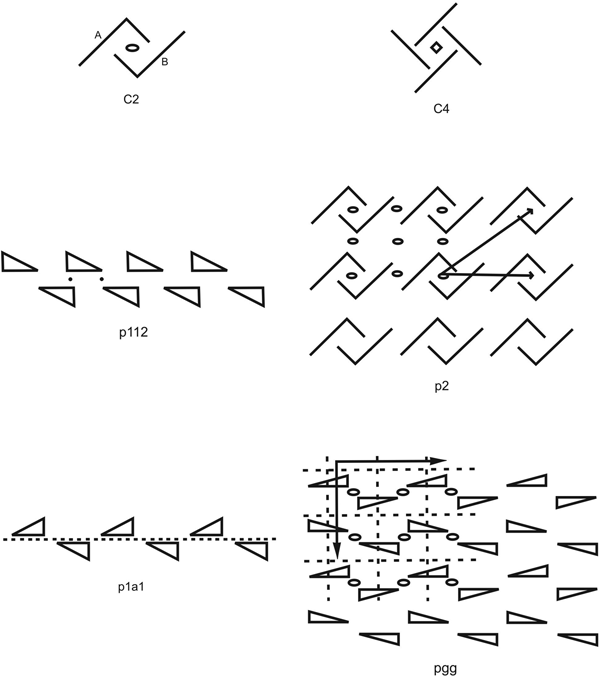
The approach involves identifying the finite (point), one-dimensional (line), or two-dimensional (all-over) axial frameworks, and within these layouts, identifying the geometric motions that repeat the motifs. Four geometric motions repeat designs in plane patterns: translation, rotation, mirror reflection, and glide reflection. Finite designs have motifs repeated around the single point axis by rotation or repeated across mirror reflection lines that pass through the point axis. One-dimensional designs have motifs repeated along a single line axis by seven motion classes: translation (p111), bifold rotation (p112), vertical mirror reflection (pm11), horizontal mirror reflection (p1m1), vertical and horizontal mirror reflection (pmm2), vertical mirror reflection, and bifold rotation (pma2) and glide reflection (p1a1). Two-dimensional patterns have motifs repeated in lattice frameworks using the same 4 motions in 17 motion classes. The motion classes for one-color designs are described by a nomenclature that indicates the absence (1) or presence of the motions: p for translation that all designs have; m for mirror reflection; 2, 3, 4, or 6 for rotation; a for glide reflection. When patterns are decorated with colors that alternate regularly on motifs of the same shape, designs with two or more color symmetries result. For two-color designs, the number of classes increases to 17 for one-dimensional designs and 46 for two-dimensional patterns.
Much research has revealed that patterns created by a cultural group generally are structured by only a few of the possible plane pattern symmetries (e.g., Washburn et al. Reference Washburn, Crowe and Ahlstrom2010). For the Southwestern and Mesoamerican textile and ceramic patterns analyzed here, six symmetries were predominantly used to regularly arrange and repeat the motifs (Figure 2). The motion of bifold (two-fold) rotation results finite designs (C2), in one-dimensional bands of design (p112), and two-dimensional patterns (p2). The motion of glide reflection repeats motifs along a line in one-dimension (p1a1) and in two-dimensions (pgg). The finite designs (C4 and C2) centered on blankets analyzed here were created by truncating two-dimensional patterns.
Six symmetry motions that structure textile patterns from the American Southwest and Mesoamerica: C2, C4, p112, p2, p1a1, pgg.

Three states of color are present on the textiles analyzed here: one-color, colored, and two-color. Colored designs have multiple colors but none that alternate consistently on motifs of the same shape. One-color designs have motifs of the same color that repeat on a background of a different color that does not have the same shape as the motif. Two-color patterns are those in which two motifs of the same shape alternate in color. Two-color patterns can also result when the background and motifs of the same shape alternate in color. In this textile sample, Southwestern textiles and ceramic vessels were either colored or one-color, one-dimensional designs until the Pueblo IV period when the two-color patterns on textiles and other media were introduced from Postclassic Mesoamerica.
The polychrome two-color nature of the Mixteca-Puebla and Sityatki styles is not duplicated in Southwestern ceramic vessels prior to Pueblo IV. Anasazi ceramic vessels of the Four Corners region were decorated with black motifs on a white background (Hays-Gilpin and van Hartesveldt Reference Hays-Gilpin and van Hatesveldt1998; Peckham Reference Peckham1990; Reid Reference Reid1982). In northern Arizona, vessels had black designs on orange or red clay backgrounds (Colton Reference Colton1956; Lucius and Breternitz Reference Lucius and Breternitz1992). In southern Arizona, Hohokam vessels were decorated with reddish designs on a cream slip (Gladwin et al. Reference Gladwin, Haury, Sayles and Gladwin1938). In southeastern Arizona vessels of the Babocomari, Dragoon, and San Simon traditions had reddish designs on an orange slip (Heckman et al. Reference Heckman, Montgomery and Whittlesey2000). In the Upper Gila-Salado area the Pinto and Gila Polychromes had one-color interior designs in black on a cream background and colored exterior designs of black and white designs on a red base (Doyel and Haury Reference Doyel and Haury1976). Even Pueblo IV period ceramic vessels (Colton Reference Colton1956; Smith Reference Smith1971) described as polychromes (Carlson Reference Carlson and Schroeder1982; Clarke Reference Clarke1935) are predominantly one-color designs. Designs on White Mountain Redwares of east central Arizona and western New Mexico–Wingate, Tularosa, Pinedale–and the Salado and Chihuahua Polychromes are only colored designs (Carlson Reference Carlson1970).
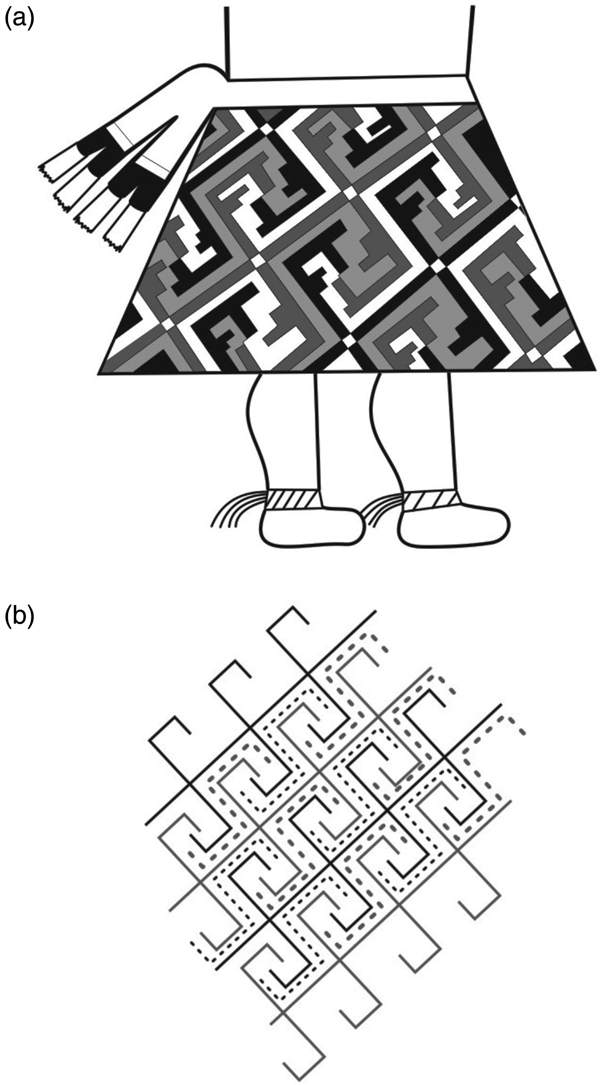
In contrast, the Pueblo IV geometric textile patterns illustrated in the murals are either perfectly symmetrical or irregular two-color patterns. I suggest that this use of two-color symmetries, as on the kilt at Pottery Mound (Figure 4a), indicates that some textiles were either brought into the area or executed locally by immigrant weavers from Mesoamerica. In contrast, textiles with pattern structure errors are copies of imported textiles made by local weavers who were in the process of learning the newly imported patterns and their structures (e.g., Figure 5). I exclude the possibility that the pattern structure identities between Mesoamerican and Southwestern examples were determined—that is, limited—by the fabric structures on which the patterns were fashioned. Research has revealed that although certain pattern structures may be facilitated by certain fabric structures, weaving technologies themselves do not limit patterns created (Washburn and Petitto Reference Washburn and Petitto1991). Furthermore, the new decorative techniques and their patterns were applied on all new fabric structures.
I begin with designs structured by bifold rotation in one-dimensional bands, p112. In Mesoamerica, designs with p112 symmetry prevailed on different media from the Formative to the Spanish conquest. For example, such designs appear on Chalchihuites ceramic vessels in Durango and Zacatecas (Kelley and Kelley Reference Kelley and Kelley1971), on Epoch IIIa ceramic vessels from Monte Alban (Caso and Bernal Reference Caso and Bernal1952), on textiles found in Cueva de Ejutla, Oaxaca (Moser Reference Moser, Flannery and Marcus1983), and on painted tomb (Bernal Reference Bernal and Willey1965) and palace (Seler Reference Seler and Bowditch1904) walls in the Valley of Oaxaca. This symmetry occurs in two-color formats on Paint Cloisonne bowls from Guasave (Ekholm Reference Ekholm1942), on painted ceramic vessels from Cholula (McCafferty Reference McCafferty2001), and painted wall friezes at sites in the Valley of Oaxaca (Sharp Reference Sharp1970; see also Washburn Reference Washburn, Huntington, Arnold and Minich2018:Table 8.1).
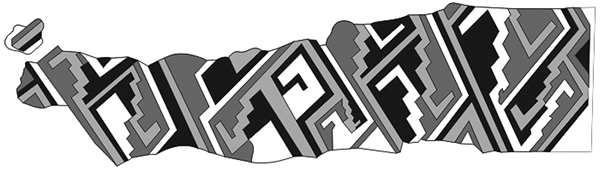
The p112 symmetry structures a one-color design on a ceramic bowl exterior (Smith Reference Smith1952:Figure 49b) and fragments of two wide-lined wall designs (Smith Reference Smith1952:Figures 85a, c) at Awat'ovi and one at Kawaika'a (Smith Reference Smith1952:Figure 74c; Figure 3). If, originally, the design on the Kawaika'a mural had been extended above the extant portion in gray, as suggested by the beginning of a design extension, this design would have been a one-color, two-dimensional p2 pattern (Figure 3) created by adding multiple rows of p112 bands of design.
Drawing of wall pattern. Test 5, Room 2, Kawaika'a. (Smith Reference Smith1952, Figure 74c). Shaded area is extant one-dimensional p112 design. If repeated as outlined above shaded area, it becomes a two-dimensional p2 design.

In Mesoamerica, the two-dimensional p2 pattern symmetry is found, for example, as a stone mosaic on a door and interior wall at Tomb 30, Yagul (Bernal Reference Bernal and Willey1965:Figure 14; Wicke Reference Wicke and Paddock1966; Figure 3), and on stone mosaic friezes at Mitla (Seler Reference Seler and Bowditch1904:Plates XXXI-XXXII). Because the color of the raised Mitla grecas originally alternated with a different color on the recessed same-shaped background, a frequent practice on frieze decorations in Mesoamerica (Boone Reference Boone1985), these friezes are two-color patterns (Holmes Reference Holmes1895-1897; Rabin Reference Rabin1970).
The same two-color p2 pattern structure is on a kilt in a Pottery Mound mural (Figure 4a). The schematic in Figure 4b shows that the four colors (red, yellow, black, white) alternate in two interlocking pairs of motifs—red and black pairs and yellow and white pairs in a two-color p 1b2 pattern. In contrast, patterns from Awat'ovi in the same four colors (red, yellow, black, white) are structured irregularly. The kilt in Figure 5 is irregular in both stepped motif shape and in the symmetrical arrangement of the four colors, making it only a colored design. The geometric wall design in Figure 6 from Room 218 displays irregularities in motif shape, positioning, and coloring. Close inspection shows that, if it had been rendered symmetrically, it would be the same pattern as the perfectly structured and two-color p 1b2 pattern on the kilt from Pottery Mound (Figure 4a). Is this evidence that the Sikyatki style was first developed by Mesoamerican weavers and painters living in sites such as Pottery Mound along the Rio Grande and only later taken west to Awat'ovi where it was locally copied?
(a) Drawing of kilt pattern. Kiva 1, layer 1, Pottery Mound. (Hibben Reference Hibben1975, Figure 72). Light gray = yellow; dark gray = red; black = black; white = white. Symmetry class p 1b2. (b) Schematic drawing of the two interlocking two-color pairs in Figure 4a. Black and red color pairs are indicated by solid black and light gray lines. Yellow and white color pairs are indicated by dotted light gray and black lines.

Drawing of figure with kilt. Test 14, Room 3, Awat'ovi (Smith Reference Smith1952, Figure 51d). Light gray = yellow; dark gray = red; black = black; white = white.

Drawing of wall pattern. Room 218, Awat'ovi (Smith Reference Smith1952, Figure 45a). Light gray = yellow; dark gray = red; black = black; white = white.

Perhaps more indicative of the Mesoamerican ancestry of textile patterns in the American Southwest are textile designs of the finite design classes C2 and C4 that are actually truncated versions of the two-dimensional pattern class pgg. The offset quartered (four-fold) layout (C4), in which four elements rotate around a center square, is a common pattern structure on Mesoamerican ceramic vessels and later on Hohokam ceramic vessels from southern Arizona. It is found as early as 750 BC–AD 450 on ceramic vessels in shaft tombs from the Valley of Atemajac, Jalisco (Galván Villegas Reference Galván Villegas1991:Plate 53), on Classic period Suchil Red/Brown vessels and Amaro Red/Brown ceramic vessels from the Zacatecas and Durango areas of Mexico (Kelley and Kelley Reference Kelley and Kelley1971:Plates 18–19, 32), and into the Postclassic in West coast Aztatlán complex material, for example at Amapa (Meighan Reference Meighan1976:Plate 136c). In southern Arizona at the Hohokam site of Snaketown the four-fold layout is prevalent as early as the Estrella Phase (AD 1–200) and continues throughout the sequence, becoming a popular design structure on Santa Cruz Red/Buff (AD 700–900) and Sacaton Red/Buff (AD 900–1100; Gladwin et al. Reference Gladwin, Haury, Sayles and Gladwin1938:Plates CLVIII, CLIX).
Importantly, both the textiles depicted in the murals as well as actual textiles found in archaeological sites in Arizona display a variety of irregular ways in which this offset four-fold layout has been executed. These differences and irregularities suggest that local weavers were learning/copying/experimenting with new pattern structures from textiles being introduced into the area. For example, the kilt depicted in a Kawaika'a mural (Figure 7a) appears to have four-fold, C4 symmetry around the center square. Nevertheless, the four offset extensions are not identical in shape or colors, making the design only an irregular colored finite C1 design.
(a) Drawing of figure with kilt. Test 5, Room1, Kawaika'a (Smith Reference Smith1952, Figure 67b). Light gray = light blue; dark gray = red; black = black; white = white. (b) Digitized blanket pattern. Kiva 12, layer 25, Pottery Mound. (Hibben Reference Hibben1975, Figure 96). (c) Schematic drawing of two-dimensional symmetry pgg. (after Kent Reference Kent1983, Figure 131).

Other textile designs appear to have a C4 structure, but this layout is reduced to C2 because only alternate extensions from the center square are identical, as on a blanket from a Pottery Mound mural (Figure 7b) and on the interlinked shirt from Tonto Ruins (Teague Reference Teague1998: Figure 3.22). This reduction in symmetry is found on a number of textiles from Arizona such as a painted blanket from Hidden House (Dixon Reference Dixon1956:Figure 7) and one from Painted Cave. (Haury Reference Haury1945:Plate 11). Inspection of the edges of the decorated area of these blankets reveals that these finite designs are truncated sections of two-dimensional patterns. Single, finite motifs can be repeated in two dimensions, resulting in two-dimensional patterns. Two kinds of patterns can result if C2 motifs are repeated in two directions. P2 patterns result if successive rows of bifold units all rotate in the same direction. Pgg patterns result if successive rows of bifold units rotate in alternate directions (Figure 7c). The extension of the pattern surrounding the center C2 unit on the Hidden House blanket results in such a pgg pattern (Kent Reference Kent1983:Figure 131).
This two-dimensional pgg pattern structure is found on ceramic vessels throughout the Southwest: on eleventh- to twelfth-century Sacaton Red-on-buff ceramic vessels from the Hohokam site of Snaketown, southern Arizona (Gladwin et al. Reference Gladwin, Haury, Sayles and Gladwin1938:Plate CXLIV), on Kayenta Black-on-white designs from northern Arizona (Beals et al. Reference Beals, Brainerd and Smith1945:Figure 41), on Tularosa Black-on-white vessels from the Upper Gila area of western New Mexico (Washburn Reference Washburn1977:Figure 238) and, in truncated form, on Tusayan Black-on-white jars from late fourteenth- to early fifteenth-century rooms from the Western Mound, the earliest inhabited section of Awat'ovi (Smith Reference Smith1971:Figures 105, 120–124).
In Mesoamerica, the pgg pattern structure was often used to decorate different media, as on Tabachines Red on Cream ceramic vessels from Atemajac, Jalisco (Galván Villegas Reference Galván Villegas1991: Figure 53), on Tuxcacuesco incised red ware from sites in Jalisco (Kelly Reference Kelly1945a, Reference Kelly1949), and on the stone mosaic friezes that decorate the Hall of Columns at Mitla (Seler Reference Seler and Bowditch1904:Plates XXXI–XXXII).
Several two-dimensional patterns on clothing in the murals that are essentially square crosshatch p4m patterns as in the Awat'ovi murals on a shirt (Smith Reference Smith1952:Figure 65c) and a shift (Smith Reference Smith1952:Figure 66c) and on a dress (Smith Reference Smith1952:Figure 67d) at Kawaika'a. The two-color state of the p4m structure, p 1c4mm, is found on a bird from Awat'ovi (Smith Reference Smith1952:Figure 89d) and a wall design at Kawaika'a (Smith Reference Smith1952:Figure 86b). A three-color version of the checkerboard design is found on a shirt at Pottery Mound (Hibben Reference Hibben1975:Figure 30). In Mesoamerica, the p4m pattern structure is commonly used to decorate clothing, as on figurines from Ixtlan del Rio, Nayarit and Chupicuaro, Michoacan (Townsend Reference Townsend1998:Figures 1, 15) and on figures depicted in the codices (see also Anawalt Reference Anawalt1992).
Discussion
This analysis has used similarities in finite and one- and two-dimensional symmetries that structure patterns on textiles and ceramic vessels to argue that the decorative geometric style known as Sikyatki in the northern Southwest is derived from patterns in wide use on different media in Mesoamerican cultures. From analysis of textiles illustrated in the Awat'ovi, Kawaika'a, and Pottery Mound murals, it appears that textiles from Mesoamerica were one means of transmission of pattern ideas into the American Southwest. Once in the Southwest, local weavers copied these patterns, often imperfectly, as is evident on irregular patterns on blankets, clothing, and other textiles illustrated in the murals.
The wide distribution of the Mixteca-Puebla style in Mesoamerica during the Postclassic (Kelley Reference Kelley, Foster and Gorenstein2000:140) correlates with the appearance of the Sikyatki style on ceramic vessels and murals in the American Southwest during the Pueblo IV period. The colorful polychromy, quasirealistic motif shapes, and their complex arrays in closely juxtaposed designs of the Mixteca-Puebla style most closely approximate these same stylistic characteristics found in the Sikyatki style. Objects decorated with the Mixteca-Puebla style most probably moved via the Aztatlán trade network along the west coast of Mexico into the American Southwest (Kelley Reference Kelley, Foster and Gorenstein2000; Smith and Berdan Reference Smith, Berdan, Smith and Berdan2003). Ceramic vessels with complex designs that combine geometric, naturalistic, and symbolic or “glyphic” elements (Meighan Reference Meighan, Ekholm and Bernal1971:763) from the sites of Chametla (Kelly Reference Kelly1938:Plate 1) and Culiacan (Kelly Reference Kelly1945b:Plates 1-2) are similar in motif and structure to the quasirepresentational designs on Sikyatki ceramic vessels. The black, white, red, pink, gray, and yellow colors on Sinaloa area ceramic vessels are among the same colors used to create the ceramic, mural, and kilt designs found at Kawaika'a and Awat'ovi.
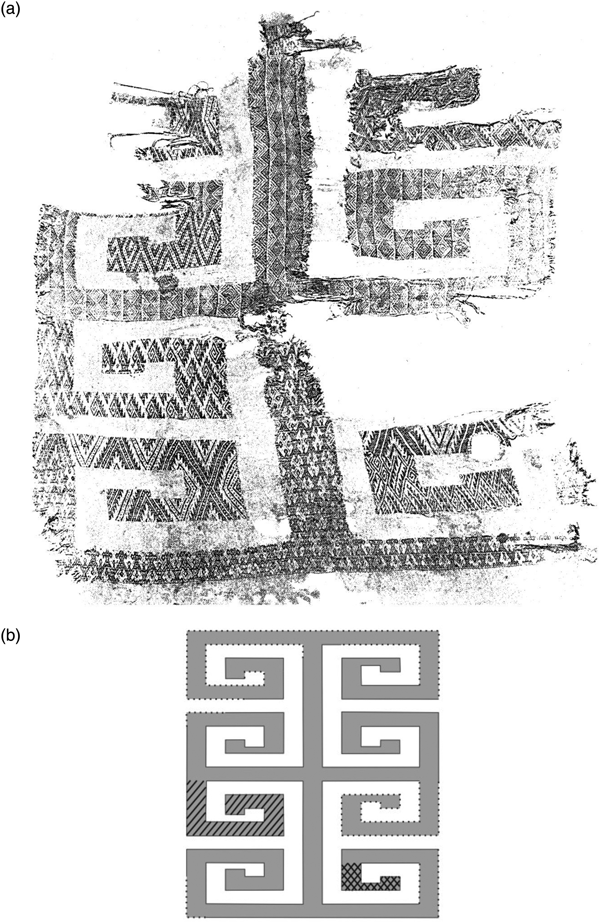
In addition to the Aztatlán coastal trade routes, goods also moved along the western flanks of the Sierra Madre. A burial shroud from a cave in the western Sierra Madre in Chihuahua (Figure 8a) is decorated with a number of patterns and pattern structures found on textiles in both Mesoamerica and the Southwest. In a schematic outline of the entire textile design (Figure 8b), the hatched section shows the location of a two-color, two-dimensional pgg’ pattern, and the crosshatched section shows the location of a one-color, two-dimensional pgg pattern found on many Southwestern Hohokam, Tusayan, and Upper Gila ceramic designs.
(a) Digitized Chihuahua textile (Mera 1975:Plate 1). (b) Schematic outline of patterned area of textile in Figure 8a. Hatched area on left is a two-color pgg 1 pattern. Crosshatched area on right is a one-color pgg pattern.

Kent (Reference Kent1957, Reference Kent1983) and Teague (Reference Teague1998) have extensively remarked on the transmission, survival, and modification of fabric structures over time and space between Mesoamerica and the American Southwest. Johnson (Reference Johnson1976) noted the survival of the weft-warp openwork fabric structure from examples in the Epiclassic from the Cenote at Chichen Itza, the Postclassic on a huipil fragment from a Durango cave associated with the Chalchihuites culture, and the twentieth century on a huipil from Choapan, Oaxaca. It is reasonable that patterns woven into and brocaded on these fabric structures would also have survived.
The Mixtec codices display clothing worn by members of the royal family, priests, and deities decorated with the same motifs organized by the same symmetries as those common to patterns on textiles and ceramic vessels in the Anasazi and Hohokam traditions. In the Codex Nuttall (Nuttall Reference Nuttall1975), which illustrates the activities of 8 Deer Jaguar Claw, the eleventh century ruler of the kingdom of Tilantongo in the Mixteca Alta, Lords and Ladies wear short capes and robes decorated with step fret designs organized by one-dimensional bifold rotation (p112) and one-dimensional glide reflection (p1a1) symmetries. On page 17, right column, second tier, reading from left to right: Lady Three Flint Elder wears a short cape decorated with a p112 step fret scroll band. She and Lord Five Flower, along with Lord Ten Grass and Lord Ten Rain, are conducting a bird and dog sacrifice. On page 25 in the upper left, Lord Five Alligator, wearing a cape decorated with a dotted step fret scroll organized by p112, is engaged in a ceremony with another male. In the center bottom of page 25, Lord Five Alligator who faces the three other members of the Council of Four at Tilantongo wears a short cape decorated with step frets in p1a1 symmetry. On page 65, first column, lower right, Lord #85, the deity 3 Wind, wears a wrapped robe decorated with dotted strep fret scrolls repeated in p1a1 symmetry.
The Aztecs conquered the Mixtecs and adopted many of their motifs and designs. In the Codex Mendoza, embroidered and plain cotton mantles offered as tribute from the provinces are often decorated with Mixteca-Puebla style step frets, angular spirals, and checkerboard patterns (Ross Reference Ross1978). Anawalt illustrates a page from a tribute tally that depicts a skirt decorated with step frets and a huipil decorated with stripes that represents the tribute of 400 skirts and 400 women's blouses given by Xilotepec (Anawalt Reference Anawalt1981:34, Codex Mendoza, Ex. 2r from Vol. 2, folio 31r). In the Florentine Codex Sahagún illustrates six Aztec skirt patterns that include bands of two-color p112’ step fret designs and checkerboard p4m patterns that are typical of the Mixteca-Puebla style (Sahagún Reference Sahagún, Anderson and Dibble1950–1982:Book 8, #73).
The lengthy transmission of knowledge about how to create specific fabric and pattern structures is also documented in ethnographies. Parsons (Reference Parsons1936b) observed that activities practiced by women in Mitla (weaving, cooking) have persisted beyond those engaged in by men (hunting, war). She observed Mitla women weaving “spotty designs said to be copied from the monuments” between the design stripes on a number of wrapped woolen skirts (Parsons Reference Parsons1936b:36). Huckert (Reference Huckert2002) described how imagery on contemporary Otomi textiles from Tlaxcala, central Mexico exhibits continuity to prehispanic examples. Cordry and Cordry (Reference Cordry and Cordry1968:Figure 42) purchased a wedding huipil in Pinotepa Nacional, Oaxaca, said to have been woven “some twenty-five years ago or more in San Esteban Atatlahuaca in the Mixteca Alta Tlaxiaco region, Oaxaca,” displaying a band of geometric elements in pg symmetry in the center panel that recalls a wall panel design at Mitla (Seler Reference Seler and Bowditch1904:Plate XXX1). Grove described a brocaded design on a prehispanic waist sash from Oxtotitlan Cave in Guerrero as “a type still worn by indigenous groups in southern Mexico” (Grove Reference Grove1970:28, Figure 32).
I submit that patterns on textiles are an excellent kind of data for the assessment of Mesoamerican-Southwestern contact. This preliminary symmetry analysis has revealed that shared colors, fabric structures, and pattern structures appear to have been transmitted together, as evidenced by the presence of the same symmetrical pattern structures from the Mixteca-Puebla style of Postclassic Mesoamerica and the Sikyatki style of the Pueblo IV period in the American Southwest. Because textiles in Mesoamerica and the Southwest shared pattern structures (symmetries) in addition to fabric structures, polychromy in design, and specific decorative motifs, these features occurring together on textiles suggest that weavers and/or textiles moved northward by trade and migration, especially during the post-AD 1000 period. The Southwestern textiles with mistakes in pattern symmetry suggest that local Southwestern weavers were learning how to copy textile patterns that were brought north from Mesoamerica.
Acknowledgments
Emory Sekaquaptewa, Helen Pollard, Chris Beekman, and Karl Taube offered valuable suggestions. Susan Ward prepared all figures and schematics except for Figures 5c and 6a that were digitized by Richard Sulsky.
Data Availability Statement
The symmetry analysis was undertaken on mural images illustrated in Smith Reference Smith1952 and Hibben Reference Hibben1975.