Introduction
Ovine genetic resources in India are a major source of livelihood for pastoralists and marginal farmers. Sheep contribute income to their keepers in terms of meat, hide and manure, in spite of being reared on minimum or no input especially under harsh agro climatic conditions (Arora et al., Reference Arora, Bhatia, Mishra, Jain and Prakash2011). Different types of sheep are distributed all over the southern agroclimatic zone of Tamil Nadu, adapting themselves to local soil condition, climate, rainfall, humidity and grazing facilities (Ganesakale and Rathnasabapathy, Reference Ganesakale and Rathnasabapathy1973). Pattanam is an important mutton-breed sheep and is popular among the farmers for its heavy body weight (Ravimurugan, Devendran and Joshi, Reference Ravimurugan, Devendran and Joshi2010a; Ravimurugan et al., Reference Ravimurugan, Kumaravelu, Devendran and Chellapandian2010b). Despite its economic importance and distinct identity, this breed is not included in the list of descript sheep breeds at the national level (Ministry of Agriculture, India, 2004, 2010), as it is not researched so far. Hence, this study has been made to document the habitat and distribution, physical traits and the existing management practices of Pattanam sheep of Tamil Nadu, India.
Materials and methods
A survey was conducted between June 2009 and May 2010, to document the habitat, distribution, physical traits, production and reproduction performances and the existing husbandry practices of Pattanam sheep of Tamil Nadu, India. The habitat and distribution of Pattanam sheep was ascertained by visiting a total of 15 blocks comprising 101 villages of Ramanathapuram, Sivagangai and Virudunagar district of southern Tamil Nadu, India. Morphological characters of Pattanam sheep such as colour of coat, muzzle, eye lashes, shape of ears, head, tail, hooves, udder and teats and the presence of wattles were noted as per the descriptors prepared based on the guidelines of Food and Agricultural Organization (FAO, 1986). Body measurements viz. body length (BL), height at withers (HAW), chest girth (CG), paunch girth (PG), face length (FL), ear length (EL) and tail length (TL) of 362 adult sheep were recorded with a standard measuring tape of 0.5 cm accuracy after the animals were allowed to stand squarely on an even ground. Body weight was taken with the help of 50 kg (200 g accuracy) circular spring balances. This was performed in the morning before the animals were let out for grazing. In the case of adult ewes, body weight was taken only in non-pregnant animals. Information on housing pattern, feeding and breeding practices, lamb care, marketing of animals and other husbandry practices adopted by the farmers were studied by observation and through a questionnaire provided by the National Bureau of Animal Genetic Resources (NBAGR), Karnal, Haryana, India. The data collected were subjected to standard statistical analysis and test of significance as per Snedecor and Cochran (Reference Snedecor and Cochran1989).
Results and discussion
Geographic distribution
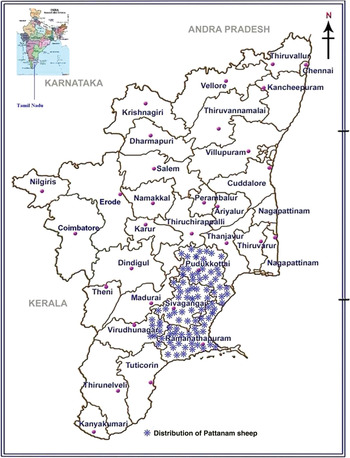
The survey revealed that Pattanam sheep were distributed in Paramakudi, Mudukulathur and Kamuthi taluks of Ramanathapuram district, and part of Karaikudi, Sivangangai, Manamadurai and Ilaiyankudi taluks of Sivagangai district and Aruppukottai and Thiruchuli taluks of Virudhunagar district (Figure 1). Pattanam sheep with true to type breed characters were present in Paramakudi and Mudukulathur taluks in Ramanathapuram district and Aruppukottai taluk in Virudhunagar district.
Distribution of Pattanam sheep of Tamil Nadu.

Climate and soil
The climate of breeding tract of Pattanam sheep was tropical in nature and the temperature ranging from 22.3 to 37.8 °C. The minimum and maximum relative humidity was 68 (range 62–83) and 75 (range 62–88) percent, respectively. The average annual rainfall was 827 mm and maximum rainfall was received from northeast monsoon (501.6 mm) season. The major soil types present in the breeding tract were black soil, red loam, lateritic, coastal alluvium, sandy loam and red soil clay. However, the major part of the breeding tract was covered with black cotton soil. The habitat of this breed lies in the southern agroclimatic zone of Tamil Nadu and located at 9°10′ and10°47′N latitude and 78°10′–79°15′E longitudes.
Origin
The origin of the Pattanam breed of sheep has no documentary evidence; however, the shepherds of the home tract of the sheep express conflict of opinion with regard to its origin. One school of thought is that this breed is a result of cross between Ramnad White and Nellore sheep and subsequent selection based on local preferences. By virtue of their name Pattanam was believed to be developed from a small hamlet Pattanam en route to Rameswaram. Another opinion which prevails in the area is that the breed is an offshoot of Nellore sheep which was brought to this area decades ago and was developed by selection as per the preferences of the local people.
Maridas (Reference Maridas2004) reported that the farmers developed a new breed, i.e. Pattanam by crossing Kilakarsal sheep of Tamil Nadu with Jodipi strain of Nellore sheep of Andhra Pradesh. Whereas Kumaravelu and Ravimurugan (Reference Kumaravelu and Ravimurugan2010) reported that migration was the predominant system of sheep production in Ramnathapuram district. The flocks migrate up to Ranipet (Vellore district), which is very near to Andhra Pradesh. The flock owners are always attracted by the larger size of Nellore rams and usually opt for crossing with ewes of Ramnad White, resulting in the production of cross-breds which are sturdier, have long legs and are best for migration. Thus, the breed requires to be characterized at molecular level. Molecular characterization is a powerful tool to consider the genetic variation existing within and among breeds and could be used to attempt reconstruction of the history of origin of Pattanam breed of sheep.
Breed characteristics
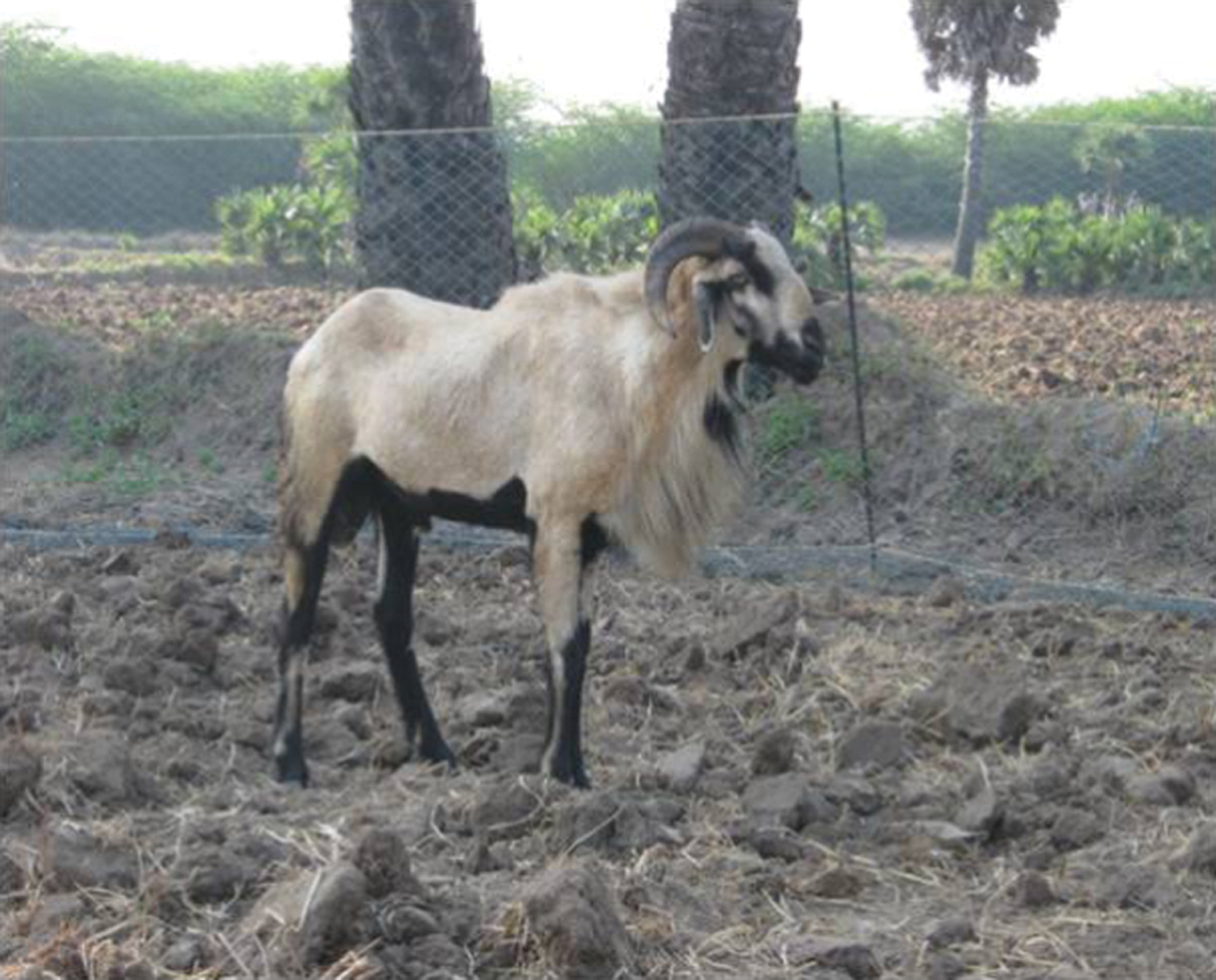
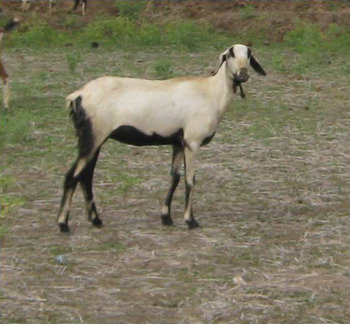
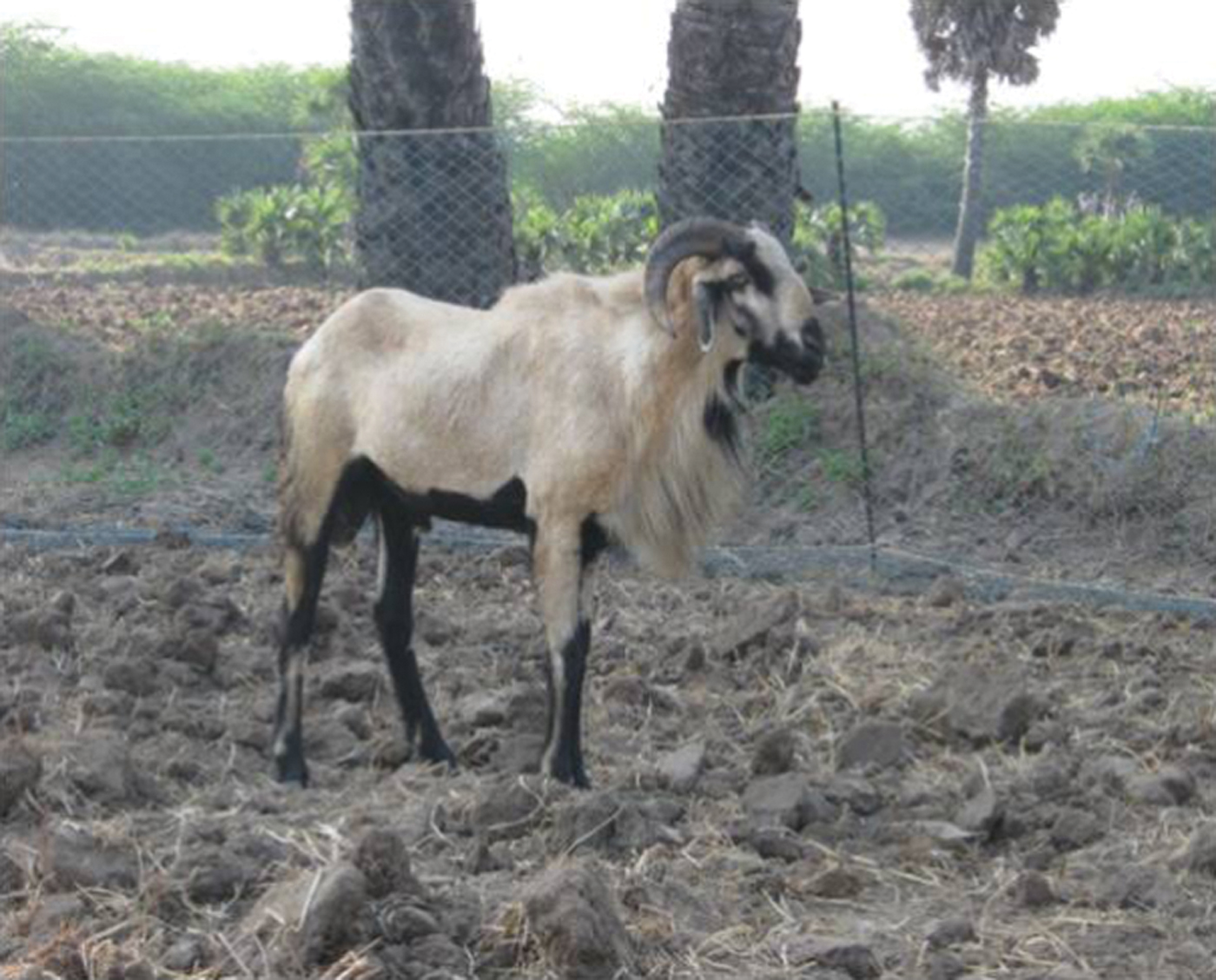
Pattanam sheep is a large-sized animal with a compact body. They are uniformly creamy white in colour with black colour in the ventral region from the inner side of the jowl extending up to the inguinal region resembling Jodipi strain of Nellore sheep, which is native of Andhra Pradesh state. Head is medium in length and its profile is straight in both sexes. Medium to broad forehead with slight Roman nose is not uncommon. Eye lashes and muzzle are black in colour and ears are medium in length and horizontal. The mean ear length in adult rams and ewes was 12.55 ± 0.70 and14.47 ± 0.19 cm, respectively. Rams possessed large, thick, twisted and highly corrugated horns (Figure 2), while a majority of the ewes were polled (Figure 3). Horns of the rams were grey coloured and directed backwards, inwards and upwards. The mean horn length in adult rams was 42.65 ± 0.15 cm. Legs are long and straight. Tail is medium in length. Wattles were absent in males and present in 5.2 percent of females.
Pattanam ram.
Pattanam ewe.

Coat was short, coarse and hairy and dull in appearance. Males had slightly longer hair at withers and very long hair in the neck and brisket region. Udder was small sized and its presence could clearly be noticed, without handling the ewes. Teats were small and directed slightly outward.
Body measurements
The means (±SE) of BL, HAW, CG, PG, FL and BW of Pattanam breed of sheep are presented in Table 1. All the biometric traits in adult rams were observed to be more compared with the ewes. The average BW in adult rams and ewes was 51.50 ± 1.20 and 36.95 ± 0.51 kg, respectively. The three principal body measurements of Pattanam sheep obtained in this study were higher than those reported for Kilakarsal (Ravimurugan, Devendran and Joshi, Reference Ravimurugan, Devendran and Joshi2010a; Ravimurugan et al., Reference Ravimurugan, Kumaravelu, Devendran and Chellapandian2010b), Ramnad White (Ravimurugan and Devendran, Reference Ravimurugan and Devendran2009) and Vembur (Chandran, Kandasamy and Panneerselvam, Reference Chandran, Kandasamy and Panneerselvam2009) the other sheep breeds seen in the same agroclimatic zone of Tamil Nadu. In adult Pattanam sheep, CG had the highest value (93.65 cm in rams and 78.34 cm in ewes) among body measurements followed by HAW and BL. This relationship was in agreement with those reported for Madras Red (Balasubramanyam and Kumarasamy, Reference Balasubramanyam and Kumarasamy2011) and Mecheri (Karunanithi et al., Reference Karunanithi, Purushothaman, Thiruvenkadan, Singh, Sadana and Murugan2005) sheep of Tamil Nadu. The HAW found in this study was higher than any other south Indian breeds viz. Nellore sheep studied by (Acharya, Reference Acharya1982). Hence, Pattanam sheep may be considered as the tallest among South Indian breeds. The BW and body measurement of Pattanam breed of sheep in the present study was higher than that of Jodipi strain of Nellore sheep. Acharya (Reference Acharya1982) reported that the BW of adult rams and ewes of Nellore sheep were 36.69 ± 2.56 and 30.00 ± 0.27 kg, respectively. The pooled means for BL, HAW and CG of Nellore rams were 68.31 ± 0.63, 76.46 ± 1.36 and 75.39 ± 1.74 cm and in ewes the values were 67.05 ± 0.22, 72.75 ± 0.24 and 72.78 ± 0.23 cm, respectively.
Means (±S.E.) for body measurements (cm) and BW (kg) of Pattanam sheep.

BL, body length; HAW, height at withers; CG, chest girth; PG, paunch girth; FL, face length; BW, body weight.
Population status
Pattanam sheep rams are extensively used for breeding purposes with other native breeds especially with Kilakarsal and Ramnad White. The total sheep population in the surveyed taluks was 2 85 000 (Ministry of Agriculture, India, 2004, 2010). Out of these about 78.2 percent were Pattanam sheep. Based on the sample survey the estimated population of Pattanam sheep in its breeding tract was 222 870. The present status of Pattanam sheep breed is secured.
Management practices
Pattanam breed of sheep were reared in both stationary and migratory/nomadic types of management. Stationary flocks were maintained on an extensive production system kept in open places enclosed with wire net. Some resourceful farmers adopt semi-intensive system of management by providing temporary shelter. In both systems of management, sheep were taken for grazing at 10.00 hours and back after sunsets for a distance of 8–10 km radius. They are allowed to graze extensively in common grazing land, fallow land and shrubs area for a period of 8–10 h. The major fodder trees and shrubs found in the areas were Karuvel (Acacia nilotica), Kudaivel (Acacia planifrons), Tamarind (Tamarindus indica), Neem (Azadirachta indica), Vagai (Albizia lebbeck), Banyan (Ficus bengalensis), Arasu (Ficus religiosa), Manjanathi (Morinda tomentosa), Velikaruvai (Prosopis juliflora) and Elanthai (Zizyphus mauritiana). The major native fodder grasses and weeds were Hariali (Cynodon dactylon), Nut grass (Cyperus rotundus), Emarginata (Merremia gangetica), Arisipullu (Digitaria cilliaris) and Saranai (Trianthema portulacastrum). The main cultivated cereals were Paddy (Oryza sativa), Cholam (Sorghum vulgare), Millet (Eleusine coracana) and Maize (Zee mays). Horse gram (Dolichos biflorus), green gram (Phaseolus trilobus), black gram (Phaseolus mungo), red gram (Cajanus cajan) and cowpea (Vigna unguiculata) were the main cultivated pulses.
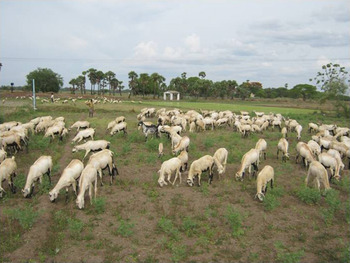
The average flock (stationary) size was 52 sheep heads (Figure 4). Of these 68 percent were adult ewes. The average age at first mating in rams and ewes ranged from 9 to 12 and 10 to 12 months, respectively. The age at first lambing ranged between 15 and 17 months. The breeding and lambing takes place throughout the year since rams always stay along with the ewes. Majority of ewes were bred in the month of September to November owing to availability of good quality fodder. Generally, two to three breeding rams were maintained for 100 ewes for natural mating. The breeding rams were used for two to three years in a flock and then either exchanged with other farmers or culled. The best males were selected based on breed characteristics, vigour and general appearance. Generally, castration of rams was not practiced.
Pattanam flock.

In general, the lambing was observed to be single. Lambing rate was 85 percent with an average lambing interval of about eight months. It was reported by the farmers during survey that on an average, the females produced seven lambs in their life span. Ram lambs were sold from the flock after weaning, i.e. around 2–3 months of age. Few male lambs were kept in the flock for breeding purpose. However, female culling was practiced only on the ground of health and production. Hair clipping was done once in a year in order to remove lice and other external parasites in the hair of sheep.
The sales of the ram lambs were made in the villages at the cost of INR 2000–2500 depending on the weight and appearance. The sheep were drenched with anti-helmintics in the months of January and July (i.e. twice a year) and vaccinated against Anthrax and Foot and Mouth diseases. In the years, where there is adequate rainfall, vaccination against enterotoxaemia is followed. It was learnt that anthrax is the commonest contagious disease prevailing in Ramanathapuram district.
Migration
During hot and dry periods three to five flocks are made into a single flock comprising 500 to up to 1000 sheep which are taken more than 180 km away from native villages in search of grazing for a period of 4 months. The flocks were rested during night hours in the event of penning. Some farmers follow nomadic type of grazing by taking the animals from one place to another. Mostly they are concentrated fallow lands and cultivable land for offering kidai (penning).
Conclusion
Pattanam sheep are extensively used for breeding purposes with other native breeds especially with Coimbatore, Kilakarsal and Ramnad White. Diversified population of sheep breeds of Tamil Nadu is being exploited because of market demand. Pattanam as crosses with comparatively more efficient offspring gives more productivity to the sheep farmer. Pattanam are widely distributed in many districts of Tamil Nadu and warrants additional detailed survey, evaluation and characterization.
Acknowledgements
The authors thank the Director, Centre for Animal Production Studies, Tamil Nadu Veterinary and Animal Sciences University, Tamil Nadu, India for providing all necessary facilities for carrying out the present study.
Statement of interest
The corresponding author is involved in exploiting the unexplored small ruminant breeds distributed in Tamil Nadu and their conservation.