Introduction
Cognitive impairment in geriatric depression is common, with characteristic deficits in speed of processing, attention/concentration, and executive functioning, with memory impairment receiving relatively less attention (Steffens and Potter, Reference Steffens and Potter2008). Yet, both epidemiological and clinical studies have identified an association between geriatric depression and later development of Alzheimer's disease (AD) and other dementias (Green et al., Reference Green2003; Steffens and Potter, Reference Steffens and Potter2008). The notion that geriatric depression may be either a risk factor or a prodrome for dementia (Jorm, Reference Jorm2001), particularly AD, should implicate memory as a distinctive cognitive domain where one would expect to see impairment among older depressed adults. In fact, there are studies that demonstrate that depressed elderly adults have impaired memory performance in addition to executive dysfunction, impaired attention, and slowed speed of information processing (Nebes et al., Reference Nebes2003; Sheline et al., Reference Sheline2006).
Recent studies have sought to focus on the occurrence and consequences of memory impairment in geriatric depression. In particular, there have been reports examining mild cognitive impairment (MCI) among older depressed adults (Park et al., Reference Park, Park and Jun2013). MCI, a condition thought to be a transitional state between normal cognition and AD or other dementias (Petersen et al., Reference Petersen, Smith, Waring, Ivnik, Tangalos and Kokmen1999), has become well recognized by clinicians and researchers, and in Diagnostic and Statistical Manual of Mental Disorders, Fifth Edition (DSM-5) is now captured as mild neurocognitive disorder (American Psychiatric Association, 2013). Studies of MCI vary depending on the type of cognitive impairment examined and include those that focus primarily on memory (“amnestic MCI” – aMCI) and those that include other cognitive domains (non-aMCI). Definitions of MCI rely on objective measures of cognitive impairment from standardized neuropsychological assessments. In initial longitudinal MCI studies, elderly adults with depression and other conditions known to affect cognition were excluded, hampering attempts to examine the individual and conjoint effects of depression and MCI on AD risk. In spite of this, a more recent MCI study in which depressive symptoms were examined has found that, compared with persons with MCI and no depression, those with MCI and coexisting depression at baseline had a higher risk of progression to dementia (Richard et al., Reference Richard2013).
Clinical studies of geriatric depression have also begun to examine effects of cognitive impairment and risk of AD and other dementias. In a previous study, we examined persistence of aMCI in a sample of older depressed patients remitted from depression one year after study entry. In an age- and education-adjusted logistic regression analysis, we found that aMCI at baseline was significantly associated with aMCI at one year, with an odds ratio (OR) of 4.03 (Lee et al. Reference Lee, Potter, Wagner, Welsh-Bohmer and Steffens2007). In the present study, we sought to extend these findings to examine the effects of aMCI on dementia risk in depressed and non-depressed elderly adults. We hypothesized that aMCI would be more prevalent in depressed than non-depressed participants. In addition, we hypothesized that among older depressed patients, compared with those without aMCI, those with aMCI would have increased risk of developing both dementia (all-cause) and AD.
Methods
Participants
Participants included 456 individuals enrolled in the National Institute of Mental Health (NIMH)-sponsored Neurocognitive Outcomes of Depression in the Elderly (NCODE) study at Duke University Medical Center (DUMC; Steffens et al., Reference Steffens2004).
All participants were at least 60 years of age at the time of baseline enrollment and included both depressed individuals and never-depressed controls. Depressed participants met DSM-IV criteria for major depression. Exclusion criteria for the NCODE study were: (1) another major psychiatric illness; (2) alcohol or drug abuse or dependence; and (3) clinically diagnosed primary neurological illness, including dementia (see below). Patients recruited into the NCODE study were referred from primary-care physicians, psychotherapists, or psychiatrists at Duke or in the community, and some were recruited from newspaper advertizing. Non-depressed controls were recruited from the Duke Center on Aging registry of elderly volunteers. All participants provided informed consent, and the study was approved by the Institutional Review Board at DUMC.
Procedures and measures
At baseline, a trained interviewer administered the Duke Depression Evaluation Schedule (DDES; Landerman et al., Reference Landerman, George, Campbell and Blazer1989), a computer-assisted standardized interview that assesses criteria for major depression as well as symptoms of mania, psychosis, anxiety, and substance abuse using the NIMH Diagnostic Interview Schedule (Robins et al., Reference Robins, Helzer, Croughan and Ratcliff1981). The DDES also contains questions on Instrumental Activities of Daily Living (IADL; Steffens et al., Reference Steffens1999). It was administered to both depressed and non-depressed study participants. The study's geriatric psychiatrist met with each patient and completed a comprehensive diagnostic interview to rule in major depression and rule out dementia as well as standardized clinical assessments of depression, including the Montgomery–Ǻsberg Depression Rating Scale (MADRS; Montgomery and Asberg, Reference Montgomery and Asberg1979), a ten-item measure of depression severity. All participants had an MADRS score of 15 or greater at study entry. Participants completed the neuropsychological testing either at study entry or at the two-week return visit (see details below). All participants in the present study had an MADRS score of 10 or greater at the time of neuropsychological testing. Patients were seen by the study's geriatric psychiatrist at least quarterly for clinical evaluation and MADRS assessment. During clinical visits, patients were treated for depression using a guideline-based somatic treatment algorithm. At baseline and annually, participants completed a neuropsychological test battery that assessed multiple domains of neurocognitive function. The battery in its entirety is discussed elsewhere (Steffens et al., Reference Steffens2004). Similar to our prior study (Lee et al., Reference Lee, Potter, Wagner, Welsh-Bohmer and Steffens2007), we used the following memory measures in the current study: (1) The Consortium to Establish a Registry for Alzheimer's Disease (CERAD) word-list learning, (2) delayed recall, (3) true positive recognition and (4) true negative recognition (Morris et al., Reference Morris1989); (5) Logical Memory I (immediate recall) and (6) Logical Memory II (delayed recall) from the Wechsler Memory Scale-Revised (WMS-R; Wechsler, Reference Wechsler1987); (7) the Benton Visual Retention Test-Revised (BVRT; Benton Reference Benton1974); and (8) delayed recall of CERAD Constructional Praxis drawings (Yuspeh et al., Reference Yuspeh, Vanderploeg and Kershaw1998). The Mini-Mental State Examination (MMSE; Folstein et al., Reference Folstein, Folstein and Fanjiang2001) was part of the neuropsychological battery and was used in the current study as a measure of global cognitive function.
Baseline cognitive screen to rule out dementia
The study's geriatric psychiatrists examined all participants, reviewed medical records, and conferred with referring physicians of all the patients, which was one level of exclusion for indications of progressive cognitive impairment. Patients were excluded if they had dementia or suspected dementia at baseline. In addition, individuals entering the NCODE study with a baseline MMSE score below 25 were followed through an acute (eight-week) phase of treatment to determine whether cognition improved. Participants whose MMSE scores remained below 25 were not followed longitudinally in the study. Thus, in the clinical judgment of the study's geriatric psychiatrist and by established study protocol, dementia was effectively excluded at or close to baseline in all elderly depressed NCODE participants.
Mild cognitive impairment
Our purpose in this study was to explore a definition of aMCI based on objective neuropsychological performance. To this end, aMCI was defined as a performance of 1.5 standard deviations (SD) or more below mean levels on two or more of the eight memory measures from the neuropsychological battery. Mean values and SDs were based on the published norms for each specific test. We sought to use all available memory testing; however, with eight tests there is a risk that a single low outlier performance may lead to a false positive diagnosis of aMCI. On the basis of clinical judgment, we set the criteria as two impaired tests to exclude a single low outlier performance.
Determination of apolipoprotein E (APOE) genotype
After signing informed consent forms for genetic testing, patients provided a blood sample for APOE genotyping. White blood cells were processed and APOE genotypes determined using a method described by Saunders et al. (Reference Saunders1993). The APOE variable was constructed as presence or absence of at least one APOE epsilon-4 (ε4) allele.
Diagnosis of dementia: consensus diagnostic conference
All participants were reviewed by a panel of experts, including geriatric psychiatrists, neuropsychologists, and a neurologist at an annual Consensus Diagnostic Conference (CDC) in which all available clinical material was reviewed and then a consensus cognitive diagnosis was assigned. The CDCs were held annually. Participants were reviewed by the CDC at least once, and they were brought to the CDC subsequently if there was a concern about possible cognitive impairment raised on review of neuropsychological testing or by the study psychiatrist. Details of the CDC have been reported previously (Steffens et al., Reference Steffens2004). While participants in the CDC were blinded to a formal assignment of aMCI or no aMCI based on our algorithm, they did have access to neuropsychological test performance.
The end point of the study was either an outcome of dementia or the last follow-up visit reviewed at consensus.
Analytic methods
The association between aMCI at baseline and dementia and AD at follow-up is done on bivariate level using a log-rank χ2 test comparing estimates of the Kaplan–Meier survival estimates of depressed participant with aMCI with those without aMCI at baseline. Cox proportional hazard models were constructed for multivariate level comparisons of hazard functions of the two groups at baseline. Age, education, and the presence or absence of APOE ε4 allele were included in initial models as covariates with the presence or absence of baseline aMCI. Neither education nor APOE genotype was significant, and these variables were removed from the final Cox models of dementia and AD.
Results
Sample characteristics
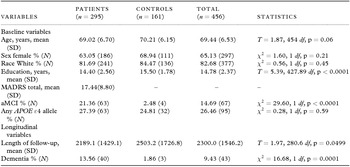
The sample consisted of 295 depressed participants and 161 controls. As shown in Table 1, the sample was largely female and Caucasian, with a mean age of 69.44 years. The average number of years of education was 14.78. Of the 456 participants, 359 had APOE genotype data, and of these, 63 (27.39%) depressed individuals had at least one ε4 allele, and 32 (24.91%) of controls had at least one ε4 allele.
Sample characteristics

Note: SD = Standard Deviation; MADRS = Montgomery–Åsberg Depression Rating Scale; aMCI = amnestic mild cognitive impairment; APOE = apolipoprotein E gene.
Among 295 depressed individuals, 63 (21.36%) met the NCODE criteria for aMCI. Among 161 non-depressed controls, four (2.48%) met aMCI criteria. We examined the impact of study dropouts and found that 31 (36.9%) of the 84 individuals who dropped out had aMCI at baseline, compared with 63 (21.5%) of the 293 individuals who did not drop out (χ2 = 8.275, df = 1, p = 0.0040). The remission rate over the course of follow-up was 71.2%, with 69.8% of those without baseline aMCI achieving remission, and 76.7% of those with aMCI achieving remission (a statistically non-significant difference).
Incident dementia
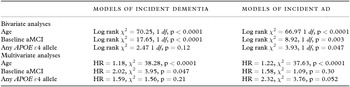
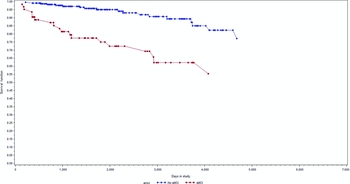
Over the course of the study (mean follow-up = 6.28 years), 43 individuals developed dementia, including 40 depressed (13.6%) and three (1.9%) control participants. As shown in Table 2, age and presence of baseline aMCI were associated with incident dementia. In the Kaplan–Meier survival estimate incident dementia, 19 of the 63 depressed individuals with MCI developed dementia compared with 21 depressed individuals of 232 without MCI who developed dementia (χ2 = 18.83, df = 1, p = 0.001). The Kaplan–Meier survival curve is shown in Figure 1. In survival analyses with Cox proportional hazard models, a model for dementia was fitted with aMCI, age, education, and APOE genotype. As education and APOE genotype were not significant, the final model included aMCI (hazard ratio [HR] = 2.44, χ2 = 5.31, df = 1, p = 0.02) and age (HR = 1.22, χ2 = 47.15, df = 1, p = 0.001). For those depressed participants who developed dementia, the mean time from study entry to diagnosis of dementia was 4.58 years (SD = 3.62 years).
Predictors of incident dementia and incident Alzheimer's disease (AD) among depressed participants

Note: aMCI = Amnestic mild cognitive impairment; APOE = apolipoprotein E gene; HR = hazard ratio.
Kaplan-Meier plot of time-to-dementia for groups of depressed patients, with and without amnestic mild cognitive impairment (aMCI)

Incident AD
There were 28 patients of incident AD out of 282 depressed individuals, while two incident patients of AD emerged from 160 controls (Fisher's exact p = 0.00025). Thirteen patients had some other type of incident dementia than AD and were excluded from the AD analysis.
In survival analyses from Table 2, aMCI, age, and APOE genotype were significant in the bivariate Kaplan–Meier survival estimates, while aMCI (HR = 2.44, χ2 = 5.31, df = 1, p = 0.02) and age (HR = 2.44, χ2 = 47.15, p < 0.0001) were significant in the multivariate Cox proportion hazards model after APOE genotype was removed from the model because it was not significant. For those depressed participants who developed AD, the mean time from study entry to diagnosis of AD was 4.40 years (SD = 3.54 years).
Discussion
In this study, we examined the association between aMCI during an acute episode of major depression in later life and later development of dementia and AD. aMCI was associated with increased risk of both dementia and AD. In multivariate analyses controlling for age and APOE genotype, aMCI was associated with incident all-cause dementia and incident AD.
Our findings are consistent with previous studies. Over the past two decades, several large epidemiological studies demonstrated a link between depression and incident AD (Kokmen et al., Reference Kokmen, Beard, Chandra, Offord, Schoenberg and Ballard1991; Speck et al., Reference Speck1995; Steffens et al., Reference Steffens, Plassman, Helms, Welsh-Bohmer, Saunders and Breitner1997). In addition, longitudinal clinic-based studies of geriatric depression have examined cognitive outcomes of depression, including dementia (Reding et al., Reference Reding, Haycox and Blass1985; Alexopoulos et al., Reference Alexopoulos, Meyers, Young, Mattis and Kakuma1993). In our depressed group, we found that 13.6% developed dementia. By comparison, in a prior longitudinal study of older depressed patients initially recruited as inpatients, the incidence of dementia was 24.6%, although the rate was much higher in those with baseline “reversible dementia” (43.5%) versus those without it (11.8%; Alexopoulos et al., Reference Alexopoulos, Meyers, Young, Mattis and Kakuma1993). In another longitudinal study, 10.1% of older depressed adults without a prior clinical diagnosis of dementia were subsequently assigned a diagnosis of dementia after a course of antidepressant treatment in which they remitted from depression (Bhalla et al., Reference Bhalla2009). In a recent meta-analysis, late-life depression was associated with a significant risk of all-cause dementia, AD, and vascular dementia (Diniz et al., Reference Diniz, Butters, Albert, Dew and Reynolds2013).
In addition to research in cohorts of older depressed adults, recent studies of individuals with MCI have examined the effects of depression on trajectories of cognitive decline and development of dementia and AD. Over a decade ago, an initial report by Modrego and Ferrandez (Reference Modrego and Ferrandez2004) of 114 patients with MCI demonstrated an increased risk of AD among those with depression as assessed by the Geriatric Depression Scale. A similar finding was reported by Gabryelewicz et al. (Reference Gabryelewicz2007) in a study of 105 individuals with MCI. More recently, in a cohort of 1,821 individuals with MCI, presence of any depression symptoms was associated with increased risk of depression and AD (Rosenberg et al., Reference Rosenberg, Mielke, Appleby, Oh, Geda and Lyketsos2013).
Burden of cerebrovascular disease may also play a role linking depression to later development of dementia. The link between late-onset depression and cerebrovascular disease (so-called “vascular depression”) is well established (Taylor et al., Reference Taylor, Steffens and Krishnan2006), and previous research has demonstrated an association between vascular white matter disease progression and development of dementia among older depressed patients (Steffens et al., Reference Steffens2007). While the present study did not focus on vascular disease visualized on neuroimaging, future studies should incorporate measures of cerebrovascular disease burden among the variables used in models of incident dementia.
Our findings may help inform mechanisms linking depression and dementia, particularly AD. As aMCI is thought to be a transitional state between normal cognitive function and AD, our finding that aMCI increased risk of development of both dementia and AD in bivariate analyses would suggest that depressed participants with aMCI may have early AD. This is consistent with several hypotheses linking depression and AD set forth by Jorm (Reference Jorm2001), who suggested the following: (1) Depression may be a prodromal state of AD; (2) cognitive and functional impairment associated with depression may unmask pre-clinical AD; and (3) biological factors related to depression, e.g. hypercortisolemia, may increase risk of AD through neurotoxic effects of glucocorticoids on the hippocampus. Previously, we demonstrated lower hippocampal volumes in geriatric depression (Steffens et al., Reference Steffens2000) and in incident dementia among older depressed individuals (Steffens et al., Reference Steffens2002). In addition, change in hippocampal volume was associated with subsequent cognitive decline in geriatric depression (Steffens et al., Reference Steffens, McQuoid, Payne and Potter2012).
The strengths of the study include a well-characterized clinical population with standardized neuropsychological assessment and determination of neurocognitive status by a multi-disciplinary group of experts. Limitations of the study include a relatively small sample of individuals with incident AD, although the number was not unexpected given the size of the sample of participants at study entry. Our narrow focus on aMCI as opposed to other forms of MCI could be viewed as a limitation, although our goal was to examine the relatively understudied role of memory impairment in development of dementia among older adults with depression. In future studies, it will be important to examine both non-aMCI and multi-domain MCI, e.g. characterized by both memory and executive impairment. Finally, our study has the potential confound that our independent variable (aMCI) might influence the definition of our dependent variable (consensus diagnosis of dementia or AD). On this point, it is important to note that neuropsychological testing was one aspect of a comprehensive assessment that included a clinical and medical history, other informant reports of cognition and functional performance, applicable medical records, and in some cases additional neurological evaluation and/or a clinical neuropsychological assessment. In addition, the majority of patients of dementia and AD had two or more neuropsychological testing visits prior to diagnosis such that baseline neuropsychological performance was not necessarily the most influential information contributing to consensus diagnosis. Thus, while baseline neuropsychological testing performance was available at the time of diagnosis, it is unlikely that these scores were overly influential in the diagnostic process.
In conclusion, low performance on memory tests among older depressed adults is likely a bad prognostic sign. There is still no consensus among clinicians as to when or even whether to order neuropsychological testing for acutely depressed older adults. Many clinicians were trained to delay cognitive testing so that any depression-related cognitive impairment might improve, perhaps obviating the need for cognitive testing at all. Our study would support obtaining cognitive testing at the time of presentation, at least for a subset of older depressed patients, e.g. those with subjective memory complaints or those with memory impairment detected on a general cognitive screen, e.g. the MMSE. Future studies will be needed to replicate our results and clarify the role and scope of cognitive testing among older depressed adults.
Conflict of interest
None.
Description of authors’ roles
Dr. Steffens collected the data and wrote the paper. Dr. Potter collected the data and assisted with writing the paper. Mr. McQuoid was responsible for carrying out the statistical analysis.
Acknowledgment
Support by grant R01MH054846 from the US National Institute for Mental Health.