I. INTRODUCTION
A safe, economical, and efficient hydrogen storage material is urgently needed for the future hydrogen economy.Reference Schlapbach and Züttel1 Metal hydrides are considered as having the greatest potential for hydrogen storage due to their superior properties in storage capacity and safety. Among metal hydrides, MgH2 has been the subject of intense study due to its low cost, low environmental impact, abundant resources, and high capacity for hydrogen storage (∼7.6 wt%).Reference Gao, Gu, Pan, Wang, Liu, Liang and Guo2 However, proper strategies are required to overcome the unfavorable thermodynamic and kinetic barriers for the formation of MgH2. The hydrogen desorption peak temperature of MgH2 is above 350 °C. A commonly successful method is to use various elementsReference Amama, Grant, Spowart, shamberger, Voevodin and Fisher3–Reference Ouyang, Cao, Wang, Liu, Sun, Zhang and Zhu5 or compoundsReference Li, Lin, Chou, Jiang and Zhan6–Reference Ma, Wang, Kang and Chen8 as the catalysts to enhance the hydrogen storage performance of MgH2. Zhou et al.Reference Zhou, Fang, Ren, Li and Lu9 added TiMn2 to MgH2, demonstrating a hydrogen absorption capacity of more than 4.5 wt% at 373 K within 240 min under 0.1 MPa hydrogen pressure. After mechanical milling with TiF3, MgH2 could absorb 3.8 wt% hydrogen at 423 K within 30 s under 2.0 MPa hydrogen pressure and release about 3.0 wt% hydrogen at 553 K within 25 min under 0.01 MPa hydrogen pressure.Reference Ma, Wang and Cheng10 Composites of 90 wt% MgH2–10 wt% MeSi2 (Me = Ti, Cr) were synthesized by Grigorova et al.,Reference Grigorova, Spassova, Spassov and Khristov11 which showed fast kinetics and hydrogen sorption capacity higher than 6 wt% within 60 min above 573 K. Zhang et al.Reference Zhang, Huang, Mao and Peng12 studied the synergistic effects of Ti and F co-doping on dehydrogenation properties of MgH2. In recent years, Ti has been usually used to improve the hydrogen storage properties of MgH2.
In our previous work, hydriding combustion synthesis (HCS) was used to synthesize Mg-based hydrogen storage materials.Reference Liu, Zhu and Li13 The HCS has the advantages of low energy consumption, high activity of the product, and short processing time, which is regarded as an innovative process for the preparation of Mg-based materials. We have prepared binary Mg–Ni and ternary Mg–La–Ni, Mg–Ni–Cu, Mg–Ni–C, and Mg–Ni–Fe composites by HCS, finding that the hydrogen storage properties are improved remarkably.Reference Liu, Zhu and Li13–Reference Zhu, Yang, Wei, Zhao and Li17 In this work, Ti was selected as the additive since it was reported to increase the hydriding and dehydriding rates of Mg by forming Ti hydride.Reference Shahi, Tiwari, Shaz and Srivastava18–Reference Pitt, Paskevicius, Webb, Sheppard, Buckley and Gray20 The method of HCS followed by mechanical milling was used to prepare the Ti-doped Mg95Ni5. The Mg:Ni:Ti atomic ratio of 95:5:2 (∼3.5 wt% of Ti in the Ti-doped Mg95Ni5) is regarded as a better proportion based on our previous works,Reference Liu, Zhu and Li13,Reference Gu, Zhu and Li15 which not only can significantly reduces the dehydriding temperature, but can also decreases the loss of hydrogen storage capacity. The de/hydrogenation properties of Ti-doped Mg95Ni5 and the catalytic effect of Ti were investigated.
II. EXPERIMENTAL
A. Preparation of Mg95Ni5 and Ti-doped Mg95Ni5 composites
The starting powders of Mg powder (99 wt% in purity and <74 μm in diameter; TangShan WeiHao Magnesium Powder Co., Ltd, Hebei, China), Ni powder (99 wt% in purity and 2–3 μm in diameter; JiangYou HeBao Nanomaterial Co., Ltd, Beijing, China), and Ti powder (99.9 wt% in purity and <74 μm in diameter; Aladdin, Shanghai, China) were commercially obtained.
Mg and Ni powders with an atomic ratio of 95:5 designated as Mg95Ni5 were homogenized by ultrasonic vibration in acetone for 60 min. After drying in air, the mixtures were used directly for HCS. During the HCS process, the sample was first heated to 853 K at 10 K/min under 2 MPa hydrogen pressure and held for 1 h. It was then cooled to 613 K and held for 4 h. Finally, the sample was cooled to room temperature. A mixture of Mg, Ni, and Ti powders with an atomic ratio of 95:5:2 (Mg95Ni5Ti2) was mechanically milled in a 100 mL stainless steel vial (ball to powder ratio of 20:1, at 400 rpm) for 5 h under 0.1 MPa argon pressure. The powder mixture was then handled by HCS. The HCS products of Mg95Ni5 and Mg95Ni5Ti2 were mechanically milled for 10 h under 0.1 MPa argon pressure with a ball to powder ratio of 30:1 at 400 rpm.
B. Characterization
The hydriding and dehydriding properties were measured by the volumetric method, using a gas reaction controller (Advance Materials Corporation, Pittsburgh). To prevent possible oxidation, the transfer of samples to the sample chamber was performed in a glove box under an argon atmosphere. Before hydriding measurements, the samples were dehydrided completely under vacuum by heating up to approximately 603 K at the heating rate of 20 K/min. Then, the hydriding kinetics at 473 K was measured under 3.0 MPa hydrogen pressure. The dehydriding kinetics at different temperatures of 493, 523, and 553 K were measured under 0.005 MPa hydrogen pressure.
X-ray diffraction (XRD; SmartLab TM, Rigaku, Tokyo, Japan) with Cu Kα radiation (45 kV and 35 mA) was used to characterize the phase structures of samples after HCS and mechanical milling. Scanning electron microscopy (SEM; JSM-6360LV, JEOL, Tokyo, Japan) and transmission electron microscopy (TEM; JEM-2100F, JEOL, Tokyo, Japan) were used to investigate the microstructures and surface morphologies of the composite powders.
III. RESULTS AND DISCUSSION
A. Structural characterization
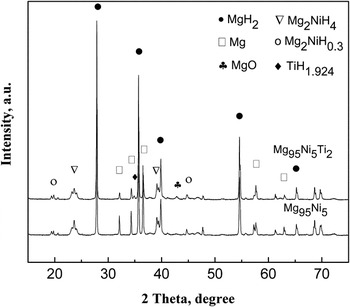
Figure 1 shows the XRD patterns of the HCS products of Mg95Ni5 and Mg95Ni5Ti2 before mechanical milling. Both samples have the phases of MgH2, Mg, Mg2NiH4 MgO, and Mg2NiH0.3. It shows that part of Mg was not fully hydrogenated during the HCS process. In the sample of Mg95Ni5Ti2, the characteristic peak of TiH1.924 corresponding to the (111) was detected at 2θ = 34.9°, indicating that Ti was also hydrogenated during the HCS process. The results of quantitative phase analysis by Rietveld method showed that the MgH2 contents in Mg95Ni5 and Mg95Ni5Ti2 are 63.1 and 75.6%, respectively. It can be seen that the hydrogenation degree of Mg is significantly improved with the addition of Ti, suggesting that Ti facilitates the hydrogenation of Mg.
XRD patterns of the HCS products of Mg95Ni5 and Mg95Ni5Ti2 before mechanical milling.

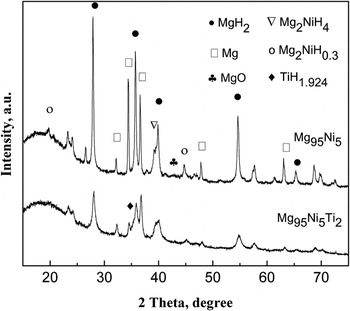
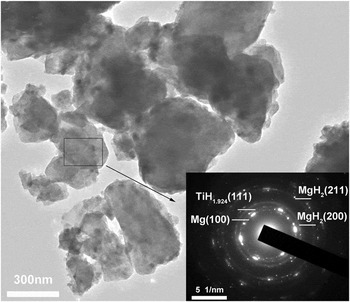
The XRD patterns of HCS products after mechanical milling are shown in Fig. 2. It can be seen that the diffraction peaks are broadened, indicating that the crystallites are refined during mechanical milling.Reference Pang, Liu, Zhang, Gao and Pang21,Reference Shahi, Bhatnagar, Pandey, Dixit and Srivastava22 The TEM of Mg95Ni5Ti2 powder after mechanical milling is shown in Fig. 3. The inset figure in Fig. 3 is the selected area electron diffraction (SAED) pattern. It can be seen that the particles are equiaxed with a particle size of 150–600 nm. The corresponding SAED pattern displays a distinguishable ring-like feature and diffraction spots, and the spots from inner to outer correspond to the plane reflections of Mg (100), TiH1.924 (111), MgH2 (200), and MgH2 (211). The result confirms the formation of TiH1.924 in the Mg95Ni5Ti2 composite.
XRD patterns of the HCS products of Mg95Ni5 and Mg95Ni5Ti2 after mechanical milling.

TEM image of Mg95Ni5Ti2 after mechanical milling; the inset is the SAED pattern.

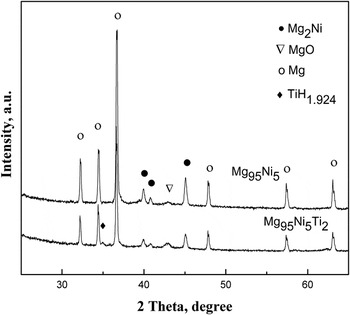
The phase structures of Mg95Ni5 and Mg95Ni5Ti2 after hydrogenation/dehydrogenation cycles are shown in Fig. 4. XRD analysis shows that both composites are composed of Mg, Mg2Ni, and MgO, indicating the complete dehydrogenation of the composites. It is noteworthy that the diffraction peak of TiH1.924 remains in the dehydrogenated Mg95Ni5Ti2 composite, which confirms that TiH1.924 is stable during hydrogenation/dehydrogenation.
XRD patterns of Mg95Ni5 and Mg95Ni5Ti2 after four cycles of hydrogenation/dehydrogenation.

B. Hydriding and dehydriding properties
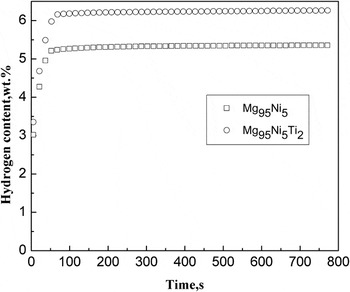
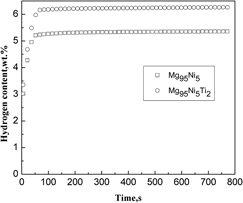
The hydrogen absorption curves of Mg95Ni5 and Mg95Ni5Ti2 at 473 K under 3.0 MPa hydrogen pressure are shown in Fig. 5. Both the samples have fast hydriding rates at 473 K, which reach their saturated hydrogen absorption capacity within 100 s. The saturated hydrogen absorption capacity of Mg95Ni5Ti2 within 80 s at 473 K is 6.26 wt%. Compared with the Mg95Ni5 (5.35 wt%) and commercial MgH2 powder with an average particle size of 2 μm (absorbs 4 wt% hydrogen in 3000 s at 573 K),Reference Zhu and Akiyama23 the hydrogen absorption performance of Mg95Ni5Ti2 is excellent. It is concluded that the addition of Ti has excellent catalytic effects on hydrogenation, which improves the hydrogen absorption capacity.
Isothermal hydrogenation curves of Mg95Ni5 and Mg95Ni5Ti2 at 473 K under 3.0 MPa hydrogen pressure.

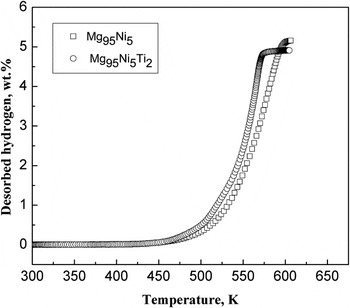
The catalytic effect of Ti on the hydrogen desorption properties of Mg95Ni5 was also investigated. Figure 6 shows the amount of hydrogen desorbed as a function of temperature of Mg95Ni5 and Mg95Ni5Ti2. It can be seen that Mg95Ni5Ti2 exhibits the faster dehydriding kinetics, which releases all the hydrogen below 576 K (∼603 K for Mg95Ni5). Besides, the dehydriding onset temperature is decreased from 493 K for Mg95Ni5 to 480 K for Mg95Ni5Ti2, which is also much lower than as-milled commercial MgH2 (∼573 K).Reference Huot, Liang, Boily, Neste and Schulz24
The amount of hydrogen desorbed as a function of temperature of Mg95Ni5 and Mg95Ni5Ti2. The heating rate is 20 K/min.

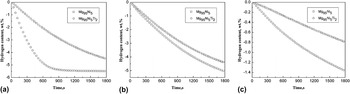
The isothermal hydrogen desorption kinetics of Mg95Ni5 and Mg95Ni5Ti2 at 493, 523, and 553 K under 0.005 MPa hydrogen pressure are shown in Fig. 7. As seen in Figs. 7(a) and 7(b), the hydrogen desorption capacity of 5.01 wt% can be reached at 523 K. However, Mg95Ni5 releases only 4.38 wt% hydrogen within the same time. Furthermore, at 553 K, Mg95Ni5Ti2 reaches its saturated hydrogen desorption capacity of 5.49 wt% within 900 s, displaying the excellent kinetics of dehydrogenation (2.89 wt% for Mg95Ni5). Even at the low temperature of 493 K, Mg95Ni5Ti2 can release 1.36 wt% more hydrogen (0.78 wt% for Mg95Ni5), which also confirms the excellent desorption kinetics. Thus, the addition of Ti has the high catalytic effects on the hydrogen desorption of Mg95Ni5, not only can it enhance the kinetics performance, but it can also improve the hydrogen desorption capacity.
Isothermal dehydrogenation curves of Mg95Ni5 and Mg95Ni5Ti2 at different temperatures under 0.005 MPa hydrogen pressure: (a) 553 K; (b) 523 K, and (c) 493 K.

C. Activation energy for dehydrogenation process
The experimental results demonstrate that the hydrogen storage properties of Mg95Ni5Ti2 are considerably enhanced compared with Mg95Ni5. To further understand the mechanism of the improved dehydrogenation kinetics, the Johnson–Mehl–Avrami (JMA) kinetic model was used to describe the hydrogen desorption.Reference Liu, Qin, Zhu, Cao, Shen and Li25,Reference Wronski, Carpenter, Czujko and Varin26 The equation of JMA model is as follows:
 $$\ln \left[ { - \ln (1 - \alpha )} \right] = n\ln t + n\ln k\quad {\rm{,}}$$
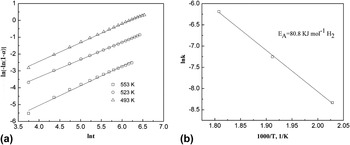
where α is the dehydriding transformed fraction at time t, k is the rate constant, and n is the Avrami exponent. The fitting curves of the experimental desorption data are shown in Fig. 8(a). The relative correlation coefficients of Mg95Ni5Ti2 are 0.998, 0.999, and 0.993 at temperatures of 493, 523, and 553 K, respectively. The values of the exponent n are in the range of 1.0–1.2, indicating that the nucleation of Mg occurs quickly and the growth is controlled by one-dimensional diffusion.Reference Pang, Liu, Zhang, Gao and Pang21
The fitting curves of (a) the experimental desorption data based on the kinetic equation and (b) Arrhenius plots of the dehydriding reaction rate for Mg95Ni5Ti2.

According to the kinetic model, different k values of the dehydrogenation curves at 493, 523, and 553 K were attained. Afterward, the activation energy for dehydrogenation was obtained with the help of the Arrhenius expression presented below:
 $$k = A{e^{{{ - {E_{\rm{a}}}} \mathord{\left/ {\vphantom {{ - {E_{\rm{a}}}} {RT}}} \right. \kern-\nulldelimiterspace} {RT}}}}\quad {\rm{,}}$$
where k is the dehydrogenation kinetic rate constant derived from the kinetic curves at different temperatures, A is the Arrhenius pre-exponential factor, and R is the gas constant. The desorption plot of ln (k) versus 1000/T is shown in Fig. 8(b). The activation energy (R 2 = 0.996) for dehydrogenation of Mg95Ni5Ti2 is calculated as 80.8 kJ mol−1 H2. Compared with Mg95Ni5 (116 kJ mol−1 H2)Reference Zhu, Liu, Yang, Gu, Li and Cai16 and the as-received commercial MgH2 (153 kJ mol−1 H2),Reference Choi, Lu, Sohn and Fang27 it is relatively low. The lower activation energy reveals that the dehydriding energy barrier of MgH2 could be reduced dramatically with the catalytic effects of Ti.
The catalytic mechanism of Ti additive on the hydrogen absorption/desorption performances of Mg95Ni5 is discussed as follows. As shown in Fig. 2, the average crystallite sizes of MgH2 in different samples after mechanical milling are estimated according to the Scherrer equation:
 $$D = {{K\lambda } \mathord{\left/ {\vphantom {{K\lambda } {\beta \cos \theta }}} \right. \kern-\nulldelimiterspace} {\beta \cos \theta }}\quad {\rm{,}}$$
where D is the crystallite size, K is the shape factor, typically 0.89, λ is the x-ray wave length of 0.154 nm, β is the full width at half maximum of the diffraction peak, and θ is the Bragg angle. The average crystallite sizes of MgH2 in Mg95Ni5 and Mg95Ni5Ti2 are calculated as 34.8 and 25.3 nm, respectively. The HCS product of Mg95Ni5 is brittle, being easily broken to small particles with the help of TiH1.924. It seems that TiH1.924 formed during the HCS process improves the efficiency of mechanical milling and is helpful to the refinement of the crystallite size of MgH2, resulting in greater surface area and grain boundary area and enhancing the Mg–H interface reaction kinetics.
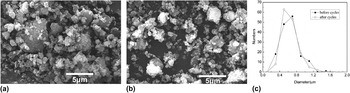
Additionally, as shown in Figs. 2 and 4, the titanium hydride is stable during mechanical milling and hydrogenation/dehydrogenation cycles. Therefore, it was thought to restrain the Mg particles from growth during hydrogenation/dehydrogenation cycles.Reference Song, Kwak, Lee, Song and Mumm28,Reference Song, Kwak, Shin, Lee and Kim29 The SEM images of Mg95Ni5Ti2 before and after four cycles of hydrogenation/dehydrogenation are shown in Fig. 9. The size distribution of samples based on SEM images is provided in Fig. 9(c). We can observe that the particle size of Mg95Ni5Ti2 after cycles is almost unchanged (about 0.4–0.6 μm), which should also be responsible for the improved hydrogen storage performance.
SEM images of Mg95Ni5Ti2 (a) before and (b) after hydrogenation/dehydrogenation cycles and (c) the size distribution of samples.

IV. CONCLUSIONS
The catalytic effects of Ti additive on hydrogen absorption/desorption kinetics of Mg95Ni5 were investigated. The Mg95Ni5Ti2 powder prepared by HCS was composed of MgH2, Mg, MgO, Mg2NiH4, Mg2NiH0.3, and TiH1.924. With the addition of Ti, the hydrogenation degree of Mg was significantly improved. The hydrogen absorption/desorption kinetics of Mg95Ni5 were remarkably improved with the addition of 2 at.% Ti, which transformed into TiH1.924 during the HCS process. Mg95Ni5Ti2 absorbed 6.26 wt% hydrogen within 100 s at 473 K and released 5.49 wt% hydrogen within 900 s at 553 K. The dehydrogenation activation energy of MgH2 was reduced from 116 kJ mol−1 H2 for Mg95Ni5 to 80.8 kJ mol−1 H2 for Mg95Ni5Ti2. The main catalytic effects are attributed to TiH1.924, which not only contributed to the crystallite refinement of MgH2 during mechanical milling but also restrained the Mg particles from growth during hydrogenation/dehydrogenation cycles.
ACKNOWLEDGMENTS
This work was supported by the National Natural Science Foundation of China (51471087, 51171079), Natural Science Foundation of the Jiangsu Higher Education Institutions of China (13KJA430003), Innovation Foundation for Graduate Students of Jiangsu Province (KYLX_0741, CXZZ13_0420), Qing Lan Project and the Priority Academic Program Development (PAPD) of Jiangsu Higher Education Institutions.