Introduction
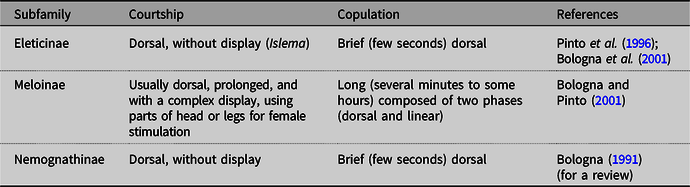
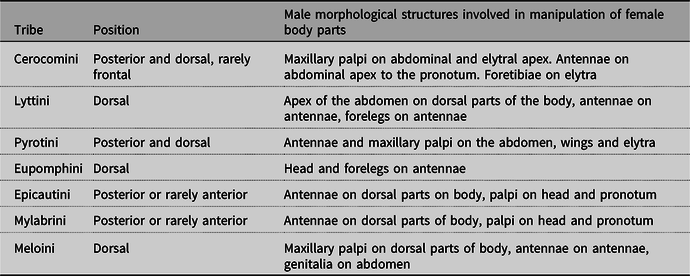
Sexual selection, crucially important in evolving sexual dimorphisms, was recognised by Darwin (Reference Darwin1871). This idea rests on a differential preference of the female for some behavioural or morphological character of the male. During the last century, numerous hypotheses have been proposed to explain it (Fisher Reference Fisher1930; Kodric-Brown and Brown Reference Kodric-Brown and Brown1984; Harvey and Bradbury Reference Harvey, Bradbury, Krebs and Davies1991; Anderson Reference Anderson1994; Payne and Krakauer Reference Payne and Krakauer1997; Barlow Reference Barlow1998). The Meloidae family, commonly known as blister beetles, includes about 120 genera grouped in three subfamilies (Bologna et al. Reference Bologna, Olivero, Pitzalis and Mariottini2008). Within the Meloidae family, sexual behaviour has been described for several genera (Selander Reference Selander1960, Reference Selander1964; Selander and Pinto Reference Selander and Pinto1967; Selander and Mathieu Reference Selander and Mathieu1969; Pinto and Selander Reference Pinto and Selander1970; Pinto Reference Pinto1975, Reference Pinto1980; McLain Reference McLain1982; Bologna and Marangoni Reference Bologna and Marangoni1986; Bologna Reference Bologna1991; Cooley Reference Cooley1995; Turco et al. Reference Turco, Di Giulio and Bologna2003; Turco and Bologna Reference Turco and Bologna2005), revealing different levels of specialisation and complexity among subfamilies (Table 1) and tribes (Table 2). For this reason, morphological and biological characters related to the insects’ sexual behaviour have been used in phylogenetic analyses (Selander Reference Selander1964; Selander and Mathieu Reference Selander and Mathieu1969; Pinto and Selander Reference Pinto and Selander1970; Pinto Reference Pinto1975, Reference Pinto1980; Adams and Selander Reference Adams and Selander1979; Bologna Reference Bologna1983; Bologna and Marangoni Reference Bologna and Marangoni1986; Bologna and Pinto Reference Bologna and Pinto2001).
General characters of sexual behaviour of the Meloidae subfamilies (Turco et al. Reference Turco, Di Giulio and Bologna2003).

Differences in male courtship behaviour of the Meloinae tribes (Turco et al. Reference Turco, Di Giulio and Bologna2003).

Selander and Mathieu (Reference Selander and Mathieu1969), Adams and Selander (Reference Adams and Selander1979), and Pinto (Reference Pinto1991) summarised the general features of sexual behaviour in Epicauta. According to these authors, male behaviour is divided into a preliminary or courtship phase and a genital or copulation phase. The preliminary phase is tactile, and it incorporates rapid and repeated contact with the female body, such as: an antennation activity, in which contact with the female is through its antennae; a palpation activity, in which contact with the female is through maxillary palpi contact; and a legs-rubbing activity, in which contact is made through foreleg rubbing (Pinto Reference Pinto1975, Reference Pinto1980, Reference Pinto1991; McLain Reference McLain1982; Pinto and Mayor Reference Pinto and Mayor1986). These individual acts of display represent each of the repeated actions carried out by the male during the preliminary phase of sexual behaviour. Moreover, the preliminary phase may regularly occur with display, regardless of female receptivity, or in some species, it occurs infrequently, usually only when the female is receptive. The behaviours vary in duration from a second to a minute or longer and may alternate with quiescent periods when the male is inactive. The position of the male during courtship varies considerably; every single event may be delivered from a fully mounted, partially mounted, or an unmounted position behind the female. The genital phase, in turn, occurs when the male attempts to insert the genitalia and copulate.
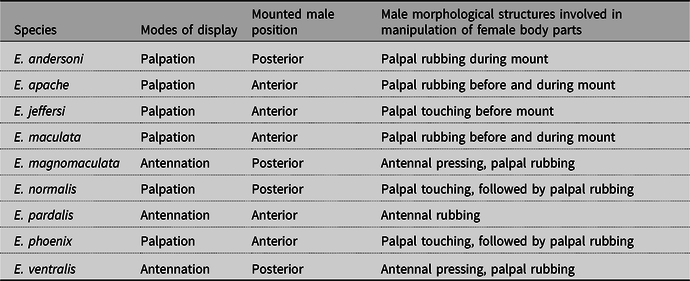
Pinto (Reference Pinto1991) observed and discussed the sexual behaviour of 60 species of the nominate subgenus, representing the 60% of the North American Epicauta (Epicautini). Behaviour in the Epicauta bispinosa Werner, E. costata (LeConte), E. maculata (Say), and E. vittata (Fabricius) species groups was documented earlier (Pinto Reference Pinto1973, Reference Pinto1975; Adams and Selander Reference Adams and Selander1979). Sexual behaviour in the Epicauta maculata species group is divided into courtship and copulation phases. At the same time, the courtship phase is divided into palpation (E. maculata (Say), E. apache Pinto, E. jeffersi Pinto, E. normalis Werner, and E. phoenix Werner) and antennation (E. pardalis LeConte, E. ventralis Werner, and E. magnomaculata Martin) species (Pinto Reference Pinto1980). The sexual activity of the palpating species consists of touching the apex of the female pygidium alternately or synchronously with the apex of segment III of the maxillary palpi. On the other hand, the sexual activity of the antennating species involves the synchronous pressing or rubbing of the antennae against the female abdomen or elytra (Pinto Reference Pinto1980).
Despite the extensive literature on North American Epicauta species, the sexual behaviour of the South American Epicauta is still almost unknown except for E. leopardina (Hagg-Rutenberg) and E. monachica (Berg) from the E. vittata species group (Adams and Selander Reference Adams and Selander1979) and E. floydwerneri Martinez from the E. caustica species group (Selander Reference Selander1981). Therefore, the aim of this study was to describe the previously unknown sexual behaviour of the South American blister beetle, E. atomaria (Germar, 1821), belonging to the E. maculata species group, providing information for future phylogenetic studies based on sexual behaviour.
Materials and methods
Insects
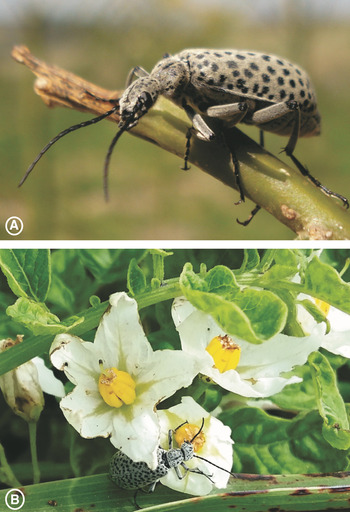
Twelve pairs of Epicauta atomaria adults were collected on Salpichroa origanifolia (Lamarck) (Solanaceae) host plant (Fig. 1) from low-lying roadsides next to grazed areas in Diamante, Entre Ríos, Argentina. The beetles were then transported to the laboratory for behavioural experiments. They were housed in transparent glass boxes (50 × 30 × 30 cm) lined at the bottom with pale brown blotting paper and topped with removable lids that were covered with 0.5-mm nylon mesh to allow ventilation. Daily care of the beetles in the laboratory involved cleaning the glass boxes, replacing the paper liner, and feeding the insects with fresh S. origanifolia maintained by water vaporisation. Specimens were kept for 3–4 weeks under controlled conditions at 27 ± 1 °C, 60% ± 10% relative humidity, and a 16:8-hour light:dark photoperiod, following procedures similar to those described by Selander (Reference Selander1986).
A and B, Epicauta atomaria adult on Salpichroa origanifolia (Lamarck) (Solanaceae).

Sexual behaviour assay
Sexual behaviour of E. atomaria was evaluated through video recordings of the 12 pairs (female + male) recorded with a Samsung digital camera (Smart Camera ST150F; Samsung, Seoul, Korea) for 20 minutes each pair. Insect couples (female + male) were placed in a transparent glass box (10 × 10 × 10 cm) lined on the bottom with white blotting paper and topped with a removable lid that was covered with 0.5-mm nylon mesh to allow ventilation. The tests were conducted in a room illuminated with white light at 27 ± 1 °C and 70% ± 5% relative humidity. The number of events and the duration of these events among the E. atomaria males during the three different courtship phases were compared using the Kruskal–Wallis test, followed by a Conover–Inman test for post hoc comparisons (Conover Reference Conover1999) at a 0.05 level of significance using InfoStat statistical software (Di Rienzo et al. Reference Di Rienzo, Casanoves, Balzarini, Gonzalez, Tablada and Robledo2011).
Results
Sexual behaviour of Epicauta atomaria
Courtship phase
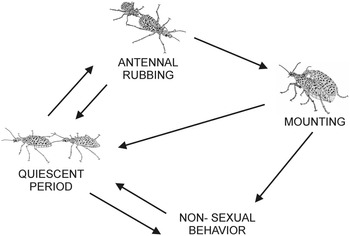
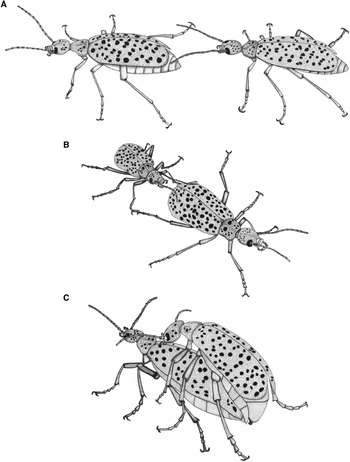
Courtship-phase behaviour in E. atomaria can be divided into a quiescent period, antennal rubbing, and mounting (Fig. 2). During the quiescent period, the male was positioned from an unmounted position directly behind or laterally in relation to the female, with its head in a prognathous position at the level of the female elytra (Fig. 3A). During antennal rubbing, the male touched the female elytra with his antennae, and the surface of antennal segments IV–VI made contact with female elytra surface. Antennae were placed parallel to one another and moved rapidly with synchronised repeated rubbing movements against the surface of the elytra. Antennae are held in parallel as they moved during antennal rubbing (Fig. 3B). The male rubbed the female elytra lightly from apex to base and vice versa for a few seconds. Male palpation played a minor role. Maxillary palpi were usually extended during display, and on a few occasions, it was observed that the male placed itself on the female elytra during antennal rubbing, lightly brushing them. The antennal rubbing behaviours ceased once the male began to mount. Palpi did not contact the female elytra during mounting.
Ethogram of male courtship in the South American Epicauta atomaria.

A, Epicauta atomaria male placed from an unmounted position directly behind the female with its head in prognathous position; B, E. atomaria antennae placed parallel each one to the other; C, E. atomaria male frequently mounts and attempts to insert the genitalia.

This event was followed by mounting, which comprised a short dorsal period (1–3 minutes) during which the male attempted to insert its genitalia (Fig. 3C) into the female genitalia. Although antennation activities may have accompanied mounting, they never occurred once the male was attempting to insert the aedeagus. If genital coupling did not occur, as in the majority of cases, the male either backed away and resumed courtship or decamped.
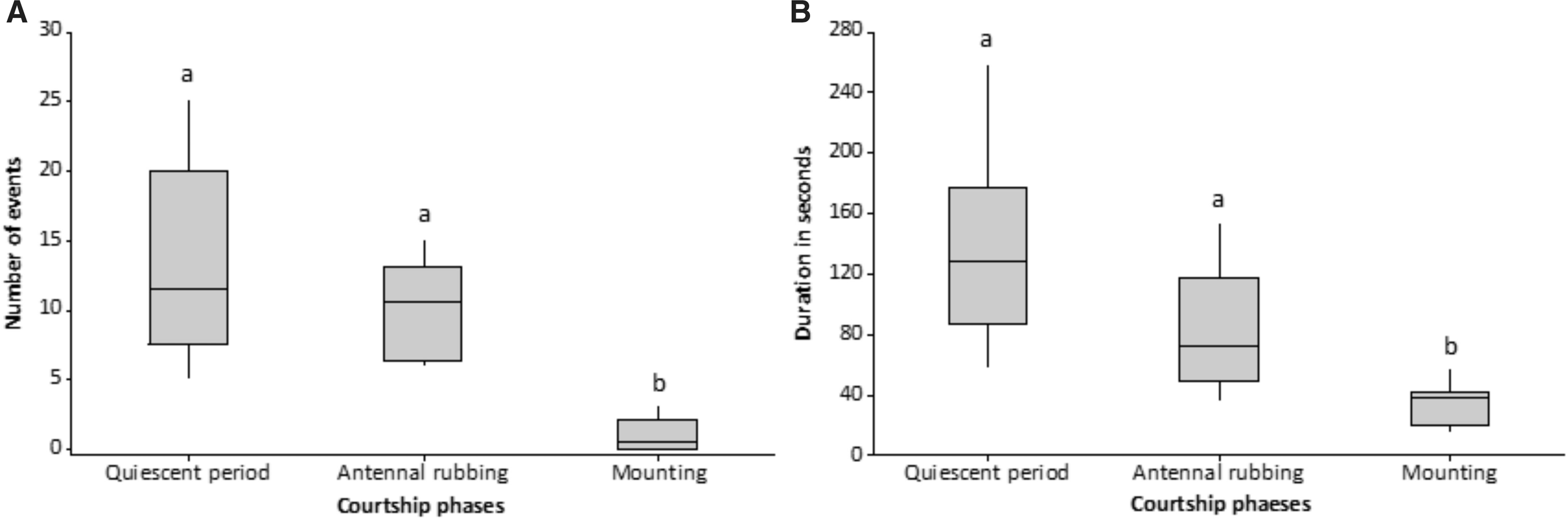
During the mounting period, the number of events carried out by males to females was low (median: 1 second, interquartile range: 0–3 seconds) and significantly less compared to the quiescent period and antennal rubbing period (median: 12 seconds, interquartile range: 8–20 seconds, and median duration: 11 seconds, interquartile range: 6–13 seconds, respectively). However, there were no significant time differences between the quiescent period and the antennal rubbing period (P < 0.05; Fig. 4A) in relation to the number of events.
A, Number of events; B, duration of different courtship phases in Epicauta atomaria males observed over a 20-minute period. The central line of each box represents the median, the height of the box shows the interquartile range, and the whiskers indicate the lowest and the highest values. The boxes with different letters represent significant differences between treatment groups (Kruskal–Wallis test followed by Conover–Inman post hoc comparisons, significant at P < 0.05 level, N = 12).

Moreover, in terms of duration, the mounting period was also short (median duration: 38.1 seconds, interquartile range: 20.0–41.4 seconds) and differed significantly compared to the quiescent period and antennal rubbing period (median: 129.0 seconds, interquartile range: 86.5–177.3 seconds, and median 72.3 seconds, interquartile range: 49.2–117.2 seconds, respectively). Nevertheless, as to duration, the differences between the quiescent period and the antennal rubbing were not significant (P < 0.05; Fig. 4B).
Copulation phase
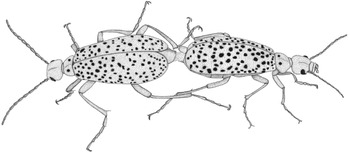
The copulation phase comprised a long linear period (several hours: 1–4 hours). Copulation rarely occurred immediately after mounting. It occurred typically after minutes of continuous genital probing in the area of the female gonopore. Finally, the male moved into an end-to-end position after inserting the aedeagus (Fig. 5).
Epicauta atomaria male placed end-to-end position after inserting the aedeagus.

Female behaviour and its effects on courtship
The female never actively courted the male, but her response to the male display could be negative or passive. When a negative response was provided, the female walked rapidly in the glass box and, occasionally, kicked the male with her pair of legs as the male attempted a courtship event or mounting. In a passive response, the female fed or was quiescent. The male often courted persistently, regardless of the female’s behaviour, although display was more common once the female was quiescent. The female frequently moved abruptly away from the male as the courtship event began. In most cases, the male followed the female and often mounted her as she walked.
Discussion
As with other meloids, sexual behaviour in Epicauta is divided into courtship and copulation phases (Selander and Mathieu Reference Selander and Mathieu1969; Pinto Reference Pinto1972, Reference Pinto1975, Reference Pinto1977, Reference Pinto1980, Reference Pinto1991; Adams and Selander Reference Adams and Selander1979; Selander Reference Selander1981). The spectrum of sexual behaviour in Epicauta ranges from the simplest behaviours, in which the male mounts the female and attempts to copulate, to extremely complex behavioural patterns that incorporate several acts of stereotypic display (Pinto Reference Pinto1991). In the North American E. maculata species group, sexual behaviour is performed from an unmounted position directly behind the female with two modes of courtship (Table 3; Pinto Reference Pinto1980). Aligning with our results, the sexual behaviour of South American E. atomaria fit well with the antennation model described by Pinto (Reference Pinto1980). The male approaches the female from behind with his head in prognathous position and his antennae parallel to one another and then rapidly rubs the surface of the female elytra (Fig. 3B).
Main differences in male courtship behaviour of the Epicauta maculata species group (Pinto Reference Pinto1980), except Epicauta atomaria (see references cited in the text for details).

Our research shows that the courtship behaviour exhibited by E. atomaria is divided into three separate behaviours: a quiescent period, antennal rubbing, and mounting (Figs. 2 and 3). Of these behaviours, males of E. atomaria spend significantly more time in the quiescent period and on antennal rubbing than on mounting (P < 0.05). This kind of behaviour is similar to that observed in E. pardalis, in which the quiescent period and the antennal rubbing (mean 69.3 ± 11.2 seconds) are the predominant activities undertaken during courtship compared to the mounting phase (mean 13.8 ± 2.3 seconds; Pinto Reference Pinto1980).
Moreover, we can highlight two different antennation displays between E. pardalis and E. atomaria. During antennal rubbing, the E. pardalis VI–XI antennal segments are curled into a semicircle, with the anterior surface making contact and rubbing repeatedly on the female elytra (Pinto Reference Pinto1980), whereas in E. atomaria, these antennomeres are placed parallel to one another during display, and the surface of antennal segments IV–VI makes contact with the female body. This kind of display can be considered as an intermediate condition of antennation between the antennating species proposed by Pinto (Reference Pinto1980). Another relevant difference between these two species is the position of legs during the mounting: similar to members of the E. bispinosa species group (Pinto Reference Pinto1980, Reference Pinto1991), E. atomaria keeps its legs on the ground, whereas, similar to members of the E. maculata species group and of the E. vittata species group (Pinto Reference Pinto1980, Reference Pinto1991), E. pardalis elevates the middle legs.
As noted above, the same antennation display performed by E. atomaria has been reported in E. pardalis, E. ventralis, and E. magnomaculata from the E. maculata species group. The same behaviour is present in the E. bispinosa and E. cinerea species groups and in some species of the E. sericans species group (E. atrata (Fabricius, 1775), and in E. fortis Werner, 1944). The only difference between them is that, in the E. maculata species group, the male approaches the female from behind with his antennae parallel to one another and presses (antennal pressing) or rubs (antennal rubbing) the female body (Pinto Reference Pinto1980). However, in the E. bispinosa species group, the male behaviour consists of alternate whipping of the female elytra with the antennae (Pinto Reference Pinto1975, Reference Pinto1991). In the E. cinerea species group and certain species of the E. sericans species group (E. atrata and E. fortis), the male strokes the female elytra or abdomen alternately with the antennae from an unmounted position and then mounts the female for the genital phase (Pinto Reference Pinto1991). Likewise, such behaviour has been reported in other genera of Meloinae: Pyrota Dejean, 1834 (Selander Reference Selander1964), Lytta Fabricius, 1775 (Selander Reference Selander1960), Mylabris Fabricius, 1775 (Bologna Reference Bologna1991), Meloe Linnaeus, 1758 (Pinto and Selander Reference Pinto and Selander1970; Bologna and Marangoni Reference Bologna and Marangoni1986), and Cerocoma Geoffroy, 1762 (Turco et al. Reference Turco, Di Giulio and Bologna2003).
In conclusion, we have identified two different modes of antennation between the antennal rubbing of E. pardalis and E. atomaria. To date, this is the first research to study the sexual behaviour of the South American E. atomaria. The interspecific differences found during courtship in species of the genus Epicauta provide additional information for future phylogenetic studies that already have been proposed, especially by Pinto (Reference Pinto1991) and Campos-Soldini and Roig-Juñent (Reference Campos-Soldini and Roig-Juñent2015).
Acknowledgements
The authors extend their sincerest thanks and appreciation to Alina Machnicki for the very useful comments and suggestions provided.