Nest site selection is critical for social insects since poor choices can heighten predation risks and result in reproductive failure (Franks et al. Reference FRANKS, PRATT, MALLON, BRITTON and STUMPER2002). Social bees vary in their nest site requirements and among the Apis bees in South Asia, Apis dorsata and A. florea nest in open combs, whereas Apis cerana nests in cavities (Crane Reference CRANE1999). Apis dorsata often nests in aggregations, and the large open nests can be about 1.5 m wide and are located in sites such as cliff faces or on the underside of branches of tall trees that are inaccessible to most predators except skilled fliers and climbers (Crane Reference CRANE1999, Seeley et al. Reference SEELEY, SEELEY and AKRATANAKUL1982). Apis dorsata, which is widely distributed in tropical and subtropical Asia, is an important source of honey and wax for local communities, and understanding its nesting biology would help in the management and conservation of this economically important species.
We surveyed trees occupied by Apis dorsata nests in two sites in the Nilgiri Biosphere Reserve in the Western Ghats of India, within the major flowering season in both forests (unpubl. data), and prior to the annual migration of A. dorsata in late June–July, during the south-west monsoon. The sites were Appankappu in the wetter Nilambur region of Kerala (latitude 11°27′ N, longitude 76°17′ E, altitude 300 m asl), which is covered with degraded wet evergreen forests, and Bedaguli (latitude 11°49′ N, longitude 77°11′ E, altitude1355 m asl) in the Chamraj Nagar region of Tamilnadu, which has moderately disturbed semi-evergreen forests and grasslands. Appankappu was surveyed in April 2008 and Bedaguli in May 2008. We tested the null hypothesis that nests of A. dorsata were randomly located with regard to tree species, tree height, girth and bark texture.
We used data from 100 plots of 10 × 10 m covering a total area of 1 ha in each study site. The plots were randomly placed in the forests at different distances and different directions from the focal villages of Appankappu and Bedaguli, over a radius of approximately 2–4 km. Within plots, all trees and lianas ≥10 cm dbh were measured at 1.3 m above ground level, and in trees with buttresses, the measurements were taken above the buttresses. The height (m) was measured using a clinometer. Inventoried plants were identified to species whenever possible. The canopy cover of each plot was measured using a densitometer and percentage values were arcsine transformed for analysis. Each 10 × 10-m plot was intensively searched for a colony of A. dorsata with the help of local indigenous honey hunters. If the nest was observed, the species of tree was identified. Only 93 of the 100 Appankappu plots had adequate forest cover (trees ≥10 cm dbh) and could be used for data analysis.
To see whether the colony sizes differed between sites, the distribution of nests per tree was tested using a Kolgomorov–Smirnov test. The heights (m) and dbh (≥10 cm) values of plants in both sites were compared using non-parametric Mann–Whitney U-test, to see whether the heights and dbh values of nesting and non-nesting trees differed significantly. A regression analysis was conducted between the dbh and height of trees with and without nests for each site and the data plotted to see whether the allometry for trees with Apis dorsata nests differed from that of trees without nests. Only trees above the minimum height of Apis dorsata nesting trees in each site were used in the analysis. These values were tested for normality and transformed if necessary. The height and dbh of trees were multiplied to get a measure of tree size and a logistic regression was performed between tree size and the probability of hosting nests coding 1 for trees with nests and 0 for trees without nests. A logistic regression was used to see whether tree cover (arcsine proportion) in each of the 10 × 10-m plots was associated with the likelihood of hosting nests. Pooled data from both sites was used for the analysis.
To see whether nesting substrate was important in choice of trees, the bark characteristics of each non-nesting tree species that occurred at densities ≥10 ha−1 and heights ≥20 m in Appankappu and ≥18 m in Bedaguli, and nesting trees was assessed using floras (Gamble Reference GAMBLE1935, Matthew Reference MATTHEW1983) and by personal observation and classified as ‘rough’ or ‘smooth’. A χ2 test was used to see whether there was an association between bark characteristics and the probability of hosting A. dorsata nests. Systat version 10, SPSS Inc (Chicago, USA) was used for the statistical tests.
Overall we recorded 1420 trees and lianas (≥10 cm dbh) from 72 species in Bedaguli and 623 trees and lianas from 58 species in Appankappu. Bedaguli had significantly higher species richness (Appankappu = 5.8, Bedaguli = 7.77: Mann–Whitney U-test U = 2350, P <0.0001), plant densities (Appankappu = 7.5, Bedaguli =14.4: U = 1381, P < 0.0001) but shorter trees per 0.01-ha plot (Appankappu = 17.3 m, Bedaguli = 15.3 m; U = 5918, P = 0.01) than Appankappu. The dbh values of the pooled data for both sites were not normally distributed (Wilk–Shapiro test = 0.704, n = 2043, P < 0.001) and were transformed into the natural logarithm (ln) for statistical analysis. Tree heights (≥10 cm dbh) did not significantly differ from normality (Wilk–Shapiro test = 0.984, n = 2043, ns), however when shorter trees (≤18 m height) were excluded, heights differed significantly from normality (Wilk–Shapiro test = 0.887, n = 761, P < 0.05). Therefore heights were ln-transformed to normalize the distribution and t-tests with pooled variances were used to compare the dbh and heights of trees with and without nests. The values were back-transformed with 95% confidence intervals for data presentation. In Appankappu, 24 nests were recorded on 11 trees belonging to six species. The shortest nesting tree was 20 m tall. A single Tetrameles nudiflora, which was the tallest tree (40 m) in the site, hosted 11 nests whereas eight of the nests were solitary. In Bedaguli, 16 trees from 11 species hosted 46 nests. A single 25-m-tall wild Mangifera indica tree hosted 10 nests. The shortest nesting tree in Bedaguli was 18 m tall.
When only trees above the minimum height of nesting trees were compared, Bedaguli had significantly more tree species (3.7 versus 2.4: Mann–Whitney U-test U = 2094, P < 0.0001), and individuals (5.6 versus 2.8, U = 1812, P < 0.0001) per 0.01-ha than Appankappu. Bedaguli had significantly higher numbers of Apis dorsata nests per 0.01-ha plot than Appankappu (Wilcoxon Signed Rank test = 2.24, P = 0.025), however, the distribution of colonies among trees did not significantly differ (Kolmogorov-Smirnov two-tailed test, k = 0.19, ns).
The mean heights (log) of nesting trees differed significantly from that of non-nesting trees in Appankappu (back-transformed height data, nesting trees: mean = 29 m, 95% CI = 23.7–34.2, non-nesting trees = 22.5 m, 95% CI = 22.0–22.9, t-test, t = 4.35, df = 302, P <0.0001) and Bedaguli (nesting trees, mean = 26.8 m, 95% CI = 24.2–29.3; non-nesting trees = 15 m, 95% CI = 14.7–15.3, t = 5.9, df = 1418, P < 0.0001). The mean dbh (log) also significantly differed in Appankappu (back-transformed dbh data, nesting trees: mean = 136.7 cm, 95% CI = 76.7–196.7, non-nesting trees = 44.8 cm, 95% CI = 42–47.7, t-test, t = 6.2, df = 302, P < 0.0001) and in Bedaguli (nesting trees, mean = 114.6 cm, 95% CI = 4.5–134.8; non-nesting trees = 29 cm, 95% CI = 28–30, t = 10.4, df = 1418, P < 0.0001).
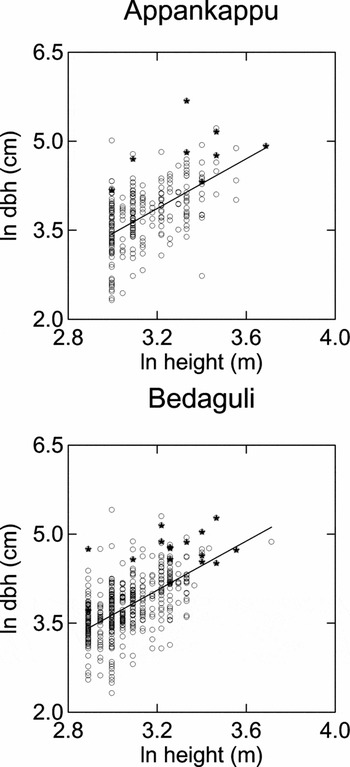
Log dbh increased significantly with log height among trees (≥20 m height) in Appankappu (y = −2.83 + 2.09x, n = 259, R2 = 0.31, P < 0.0001) and trees in Bedaguli (≥18 m height, y = −2.35 + 1.99x, n = 481, R2 = 0.33, P < 0.0001). The dbh values of nesting trees were generally higher than for non-nesting trees across the range of heights (Figure 1). Furthermore, the logistic regression indicated that trees that were shorter with smaller diameters were significantly less likely to host nests than larger trees (Log likelihood ratio = −63.1; y = −17.4 + 1.03x, t-ratio = −8.43, P <0.0001).
Relationship between ln height (m) and ln dbh (cm) of trees at Appankappu (all trees ≥20 m tall) and Bedaguli (all trees ≥18 m tall). Open circles = non-nesting trees; nesting trees are indicated with stars. Regression line is for all trees in each site.

The occurrence of Apis dorsata nests in the 10 × 10-m plots was negatively related to tree canopy cover (Log likelihood ratio = −62.0; y = 0.77 – 2.92x, t-ratio = −2.89, P = 0.004), suggesting that the nests were located on trees within plots with more open canopies.
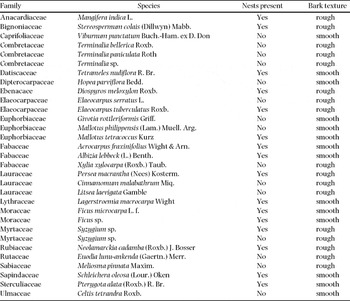
Out of 32 tall-tree species from 20 families recorded in both sites for which bark characteristics could be defined, 16 were Apis dorsata nesting trees and of these seven had rough and 9 had smooth bark. Of the 15 non-nesting tree species, 10 had rough and five had smooth bark (Table 1). There was no association between the bark characteristics of nesting and non-nesting trees (χ2 = 1.64, df = 1, ns). The trees belonging to the family Combretaceae did not host nests whereas Ficus trees appear to be preferred (Table 1).
Species of trees with Apis dorsata nests and abundant (densities ≥10 ha−1) tall trees in both sites (height at Appankappu ≥20 m and Bedaguli ≥18 m) with no recorded nests.

Our study shows that Apis dorsata nests were preferentially located on trees that were larger than average in two sites in the Nilgiri Biosphere Reserve, and were more isolated than the other trees. The differences between girth and height of nesting versus non-nesting trees indicates that nesting trees tend to have greater diameters than non-nesting trees above a certain height threshold. This could be because isolated trees might attain larger girth than trees growing in stands. There were no clear preferences based on taxonomic criteria or bark characteristics, although families such as the Combretaceae which tend to have a rough or peeling bark did not host a single nest. This supports that observation of Seeley et al. (Reference SEELEY, SEELEY and AKRATANAKUL1982) in Thailand that A. dorsata nested at heights of about 18 m on tall trees of particular families that did not branch for about 13 m. Tree architectural features such as spreading branches can increase the space for more nests to congregate; bark texture, especially smooth bark, seems also to be an important criterion for nest site selection, although the results from this study are inconclusive. This suggests that structural features and tree isolation, which probably ensured protection against predators, were the primary criteria used for locating nests. Apis dorsata nests face a range of predators, from birds to bears and humans (Crane Reference CRANE1999, Seeley et al. Reference SEELEY, SEELEY and AKRATANAKUL1982) and therefore nest location is crucial for the survival of colonies. Our findings, indicating the importance of particular nesting trees, may have profound implications for the conservation and management of A. dorsata at the landscape scale. Apis dorsata colonies migrate over distances of 100 km (Koeniger & Koeniger Reference KOENIGER and KOENIGER1980) and return to their original nest site (Paar et al. Reference PAAR, OLDROYD and KASTBERGER2000). Particular nesting sites such as large trees and cliffs are used year after year, and the loss of such trees and cliff faces may limit nest densities in the wild. Tall trees are more frequent in primary unlogged forests and intensive logging over the geographical range of A. dorsata in Asia removes many potential nesting sites (Laurance Reference LAURANCE2007).
ACKNOWLEDGEMENTS
The field work was funded by the Darwin Initiative (UK) titled ‘Bees, Biodiversity & Forest Livelihoods’ (no. 15/01, funded 2006–2009), and partnered by Keystone Foundation, University of East Anglia, Centre for Agri-Environmental Research at the University of Reading and Bees for Development. The Forest departments of Karnataka and Kerala provided research permits. We thank Mahadesh, Murugan, Saneesh, Sudhakar and Rajesh for help with fieldwork, Geetha Nayak for editorial comments and Shiny Mariam Rehel for plant identifications. The manuscript improved considerably with incisive suggestions by the editor.