

Introduction
Chronic suppurative otitis media (CSOM) is characterised by a chronic infection of the middle-ear cavity with a tympanic membrane perforation and persisting otorrhoea. It is a global health problem affecting 65–330 million people of which one quarter are children under five, and up to 91 per cent will develop permanent hearing loss.Reference Acuin1–Reference Jensen, Koch and Homøe3 Hearing loss in early life can cause irreversible deficits in speech and language acquisition, cognitive development and social-emotional function.Reference Kral and O'Donoghue4–Reference Olatoke, Ologe, Nwawolo and Saka6 Furthermore, CSOM carries the risk of intracranial complications such as meningitis, mastoiditis, brain abscesses and venous thrombosis, resulting in up to 28 000 mortalities annually.Reference Acuin1,Reference Dubey and Larawin7
The World Health Organization (WHO) defines CSOM prevalence exceeding four per cent of the population as a massive health problem requiring urgent attention.Reference Acuin1 Prevalence estimates of CSOM in sub-Saharan Africa range from less than one per cent to more than five per cent of the population.Reference Westerberg, Skowronski, Stewart, Stewart, Bernauer and Mudarikwa8–Reference Basanez, Nakku, Stangl and Wanna15 However, the number of studies on this is limited and there is great variability in methodology, disease definition and sampling strategy, making precise estimates for the region challenging.
Zimbabwe has no routine childhood health-screening programme, and as a consequence, the burden of childhood CSOM in Zimbabwe is largely unknown. To our knowledge, only one study has reported on CSOM in Zimbabwe, in which a surprisingly low prevalence of 0.4 per cent of the population was found to be affected.Reference Westerberg, Skowronski, Stewart, Stewart, Bernauer and Mudarikwa8 In contrast to this finding, clinical experience from a free ENT outreach programme (WizEar16) initiated by one of the authors (C Chidziva) points towards a substantially higher prevalence in the rural province of Mashonaland East. Nonetheless, the prevalence is unknown because no formal investigation has been conducted.
Consequently, the aim of the study was to determine the prevalence of CSOM and other middle-ear pathology in a population of primary-school students from the rural Zimbabwean region of Mashonaland East.
Materials and methods
This study was a collaboration between the medical institutes of the University of Zimbabwe (Harare, Zimbabwe) and University Hospital Rigshospitalet and University of Copenhagen (Copenhagen, Denmark).
Study design
This was a school-based, cross-sectional field study on middle-ear disease in primary school children in rural Zimbabwe.
Setting and school enrolment
Zimbabwe (population 14 million17) is located in the southern part of Africa. It is a low-income country with a gross domestic product per capita of less than five per cent of that of the USA.18,19 Mashonaland East province (population 1.3 million) is one of eight provinces. It is a rural, low-income area with high unemployment rates. Most housing facilities are simple, and only half the households have access to safe sanitation and one in four to electricity.20,21 Nearly half the population is below 18 years of age. According to official statistics, more than 90.5 per cent of children attend primary school, making the province schools well suited for epidemiological research.20,21
Four schools were contacted. The schools were chosen based on practical availability and previous collaboration with the WizEar project. In one school no agreement could be reached. In another, a trial of 30 audiometry tests was performed, but the school had to be excluded because the level of ambient noise was too high for reliable results. Consequently, two primary schools were included, and classes ranging from grade 0–5 (ages 4–14 years) were enrolled randomly from the school registry. The students of both schools were estimated to be socio-economically representative of the general population in the area. Data collection took place from October to November 2016 during the end of the dry season.
Study size and power calculation
The sample size needed was calculated with an a priori prevalence of one per cent in an estimated population of two million children aged less than 15 years. The precision was set at one per cent with a 95 per cent confidence interval. Under these a priori circumstances, 381 participants would be needed.
Middle-ear examination
Otoscopy was carried out by the first author (CK Pedersen) using a video otoscope (Viot, Interacoustics, Middelfart, Denmark). Findings were categorised in accordance with the WHO and Prevention of Deafness and Hearing Ear and Hearing Disorders Examination Form (Version 7.1A)Reference Smith and Mackenzie22 and stored digitally (OTOsuite, GN Otometrics, Taastrup, Denmark and NOAH-4, HIMSA, Copenhagen, Denmark).
Tympanometry was performed with a portable tympanometer (Titan, Interacoustics, Middelfart, Denmark) and the type was determined as A, B, C1 or C2, according to the Jerger classification.Reference Jerger23 Each of the children's ears was categorised by severity in the following order: CSOM, acute otitis media, otitis media with effusion, scarring, foreign body, impacted wax, undetermined and normal (Table 1). No medical instruments (e.g. for cerumen removal) were available. An experienced otology surgeon (RG Jensen) later secondarily assessed the findings. In cases of active disease, the child was referred for relevant treatment.
Clinical findings of middle-ear diagnoses with diagnoses ranked according to severity
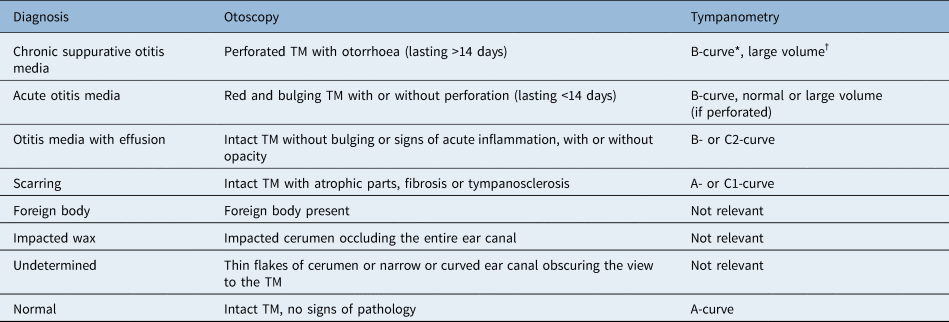
*Tympanometry curves were classified according to Jerger and Fiellau-Nikolajsen, in which type A is a normal peaked curve with pressure between +50 and −99 daPa, type B is a flat curve without a peak, type C1 is a peaked curve with negative pressure (−100 to −199 daPa) and type C2 is a peaked curve with negative pressure of −200 daPa or less;Reference Jerger23,Reference Fiellau-Nikolajsen and Lous24 †ear canal volumes of 0.4–1.5 ml were considered normal. TM = tympanic membrane
Statistical analysis
Statistical analyses were performed using SPSS® (version 21) statistical software. Findings were presented using descriptive statistics.
Ethics
The study was conducted in accordance with the Declaration of Helsinki and was approved by the Medical Research Council of Zimbabwe (approval number: MRCZ/B/1071). Written approval was obtained from local authorities. All participating children and their parents volunteered for participation, and there was no compensation for participation.
Results
A total of 455 students were examined of which 212 (47 per cent) were female. This represented 96.2 per cent of the 473 students in the classes enrolled in the study. Out of the 18 who were not examined, one refused and 17 were not present on the day of examination. A further four students were excluded because of failure to cooperate, leaving a total of 451 students included for analysis. The median age was 7.7 years (range, 4–13 years; interquartile range, 6.7–9.3 years) (Figure 1).
Graph showing age-sex distribution of study participants.

Two (0.4 per cent) cases of CSOM were found. Both were unilateral (clinical findings presented in Table 2). A diagnosis of otitis media with effusion (OME), acute otitis media or CSOM was made in eight (1.7 per cent) participants. Any middle-ear pathology (CSOM, acute otitis media, OME, scarring, foreign body or wax) was present in 95 students (21.1 per cent), the most common diagnosis being scarring followed by impacted wax.
Final middle-ear diagnosis for all participants individually and per ear

Discussion
In this cross-sectional study on CSOM frequency in Zimbabwean rural schoolchildren, we found that the prevalence of CSOM was only 0.4 per cent. Additionally, the overall prevalence of clinically important otitis media disease (i.e. CSOM, acute otitis media and otitis media with effusion (OME)), was similarly low at 1.7 per cent (Table 2). Together with a previous Zimbabwean study, our findings suggest that Zimbabwe belongs in the lowest WHO category for middle-ear disease burden along with countries such as Australia, Israel and Denmark.Reference Acuin1 This is somewhat unexpected as CSOM and ear problems in general are usually inversely correlated to the gross domestic product.25 In comparison, similar studies from sub-Saharan Africa have found CSOM rates ranging from 0.4–5.3 per cent and overall otitis media from 2.1–11.7 per cent.Reference Westerberg, Skowronski, Stewart, Stewart, Bernauer and Mudarikwa8,Reference Hatcher, Smith, Mackenzie, Thompson, Bal and Macharia13,Reference Bastos, Reimer and Lundgren14
• Chronic suppurative otitis media (CSOM) is a global health problem causing hearing loss in millions of children and even life-threatening complications in tens of thousands
• The burden of disease in sub-Saharan African children is uncertain because only a few prevalence studies exist
• This study investigated the prevalence of CSOM and other clinically significant middle-ear diseases in primary school children in a rural region of Zimbabwe
• A total of 451 children were examined with otoscopy and tympanometry, with only two cases of CSOM (0.4 per cent) found, one case of acute otitis media (0.2 per cent) and 5 cases (1.1 per cent) of otitis media with effusion
• This study, in conjunction with a previous study, indicates that middle-ear disease is relatively infrequent in Zimbabwe compared to other countries in sub-Saharan Africa
• This study adds to the pool of knowledge regarding CSOM prevalence in sub-Saharan Africa
Scarring (i.e. tympanosclerosis, atrophy and fibrosis) was present in 15 per cent, and although this is indicative of previous otitis media infections, it is usually clinically irrelevant in terms of risk of hearing loss or progression to tympanic membrane perforation. Impacted wax was found in 2.7 per cent of participants. The presence of wax is a common cause of conductive hearing loss in sub-Saharan Africa.Reference Mulwafu, Kuper and Ensink26 A recent study in Cameroon found impacted wax to be the cause of conductive hearing loss in 31.5 per cent of all cases across all age groups. In some prior studies of middle-ear pathology, participants with wax were excluded, whereas other studies have provided wax removal. In the current study, it was decided to include the children and categorise them as ‘impacted wax’ or ‘undetermined’ (depending on the amount; Table 1). This decision was made because wax removal can be unpleasant and because we wished the study to reflect the real-life clinical setting in Zimbabwe.
There are several possible explanations for the low prevalence of CSOM in Zimbabwe. Firstly, studies have indicated a higher prevalence in younger children (less than 6 years) and older children (more than 12 years).Reference Hunt, Mulwafu, Knott, Ndamala, Naunje and Dewhurst9,Reference Simões, Kiio, Carosone-Link, Ndegwa, Ayugi and Macharia10 Our cohort had a median age of 7.7 years with only a small portion younger than the age of six or older than 12 (Figure 1). Thus, the most commonly affected age groups were under-represented in our study. Secondly, CSOM appears to be more prevalent in low socio-economic areas where risk-factors such as crowding, malnutrition and poor access to medical care are more common.Reference Acuin1,Reference Olatoke, Ologe, Nwawolo and Saka6,Reference Hunt, Mulwafu, Knott, Ndamala, Naunje and Dewhurst9,Reference Minja and Machemba27–Reference Lasisi, Olaniyan, Muibi, Azeez, Abdulwasiu and Lasisi29 Although the children in our cohort came from a low-income rural area, it is difficult to assess how their living conditions compare to those of other seemingly comparable studies.Reference Hunt, Mulwafu, Knott, Ndamala, Naunje and Dewhurst9 If these differ, that could also contribute to the lower prevalence of CSOM in our study. Thirdly, immunisation coverage is high in Zimbabwe as it is publicly available. Official figures state that in 2013, 92 per cent of children had received the pneumococcal vaccine introduced the previous year,30 so many of the children are likely protected against Streptococcus pneumoniae. As this bacterium is a common cause of otitis media in high-income countries, a significant decline in acute otitis media has been demonstrated in the USA after the introduction of a heptavalent pneumococcal conjugate vaccine.Reference Grijalva, Poehling, Nuorti, Zhu, Martin and Edwards31,Reference Poehling, Szilagyi, Grijalva, Martin, LaFleur and Mitchel32 Nonetheless, recent studies from Africa found Streptococcus pneumoniae in less than two per cent of cases.Reference Tiedt, Butler, Hallbauer, Atkins, Elliott and Pieters33,Reference Chirwa, Mulwafu, Aswani, Masinde, Mkakosya and Soko34 Therefore the effect of immunisation on the prevalence of CSOM in Africa is debatable. Lastly, the participants in this survey constitute only a small proportion of children in the examined age groups in Zimbabwe, and the study is limited to a single province. Zimbabwe is a large country where the population live in dissimilar climates, changing seasons and large differences in standards of living. Furthermore, two recently published articles have utilised high spatial resolution techniques to demonstrate that the prevalence of certain diseases in Africa shows significant regional and even subnational heterogeneity.Reference Osgood-Zimmerman, Millear, Rebecca, Shields, Brandon and Graetz35,Reference Dwyer-Lindgren, Cork, Sligar, Steuben, Wilson and Provost36 Therefore, extracting estimates of otitis media prevalence rates in the whole of Zimbabwe based on this study must be considered with caution.
Strengths and limitations
The validity of our findings is supported by the standardised methodology and diagnoses in accordance with internationally recognised criteria and by utilisation of state-of-the-art examination equipment. However, the true prevalence of CSOM in Mashonaland East may be underestimated in this study because participants were enrolled from primary schools. Because approximately ten per cent of children in Zimbabwe do not attend primary school,21 these children were unavailable for enrolment. School fees constitute a significant financial burden in this low-income setting, and children with disabilities, including hearing disabilities, might therefore be less likely to attend school. This, in turn, would lead to an underestimation of the prevalence of ear disease.
Conclusion
In this cross-sectional study, we found a low prevalence of CSOM and other middle-ear disease in rural Zimbabwe compared with similar countries in sub-Saharan Africa. As a school-based study, the frequency of CSOM in the province may be underestimated, since ten per cent of children do not attend school. Therefore population-based cohort studies from various provinces are needed to estimate the burden of middle-ear disease in Zimbabwe more accurately.
Acknowledgements
The authors wish to thank all the teachers, parents and school children for giving us the assistance we needed to complete the study. This study was supported by a grant from The Oticon Foundation (Smørum, Denmark; grant number: 15-1293) to University Hospital Rigshospitalet, Copenhagen, Denmark. No funding bodies were involved in designing the study, collection, analysis or interpretation of data, nor in the writing or publication of the report.
Competing interests
None declared



