New Global History: Mining Historical Big Data and Asking Big Questions
Global historians of the great divergence study connections and offer comparisons between different socioeconomic, political, and cultural areas of Asia, Europe, and the Americas. Their aim is to better understand differences in economic development and modernisation processes across Western and Eastern areas. Comparative/connective studies have mainly paid attention to contacts, connections, and differences between China and its Western counterparts, especially since publication of Kenneth Pomeranz's seminal work The Great Divergence and research by other members of the California school.Footnote 1 Global history thus challenges the Eurocentric (British centric) approaches, which have been dominant, by incorporating new studies and comparisons between China and Europe and European-controlled America.Footnote 2
Debate has centred upon gaps in economic development between northwestern Europe (Great Britain, Belgium, and the Netherlands) and regions of Asia (mainly China) since the first industrial revolution. The “new” global history research agenda offers case study observations of how global processes influence, and are influenced by, local socioeconomic forces across Asian, American, and European regions. Accordingly, this article presents a case study that focuses upon the circulation of goods that connected Chinese and Western markets (Europe and the Americas), providing new empirical archival evidence, which researchers can represent in a new database management system (DBMS), the GECEM (Global Encounters between China and Europe) Project Database, to quantify trade, consumption, and wealth accumulation.Footnote 3 When incorporating new information and comparing world regions, one must delineate a suitable chronology and geographical coordinates. In accordance with historians’ questions and hypotheses about global economic history, researchers must store this new big data in a DBMS that permits information analysis using computational and quantitative methods.
Big data applied to global (economic) history must be stored and accessed according to current computer and quantitative methods that support the research analyses exemplified in this article.Footnote 4 For the early modern period in many circumstances, applications of data mining and quantitative methods involve biases, but cross-referencing sources and data points can contribute to the normalisation of data and improved understanding of historical information.
Historical data are scattered across regions, nations, and continents, giving the historical sources special particularities according to the institutions, polities, and empires that produced such vast documentation, which is of extreme value for early modern historians. An additional problem is the diverse language and structure of the sources; for example, probate inventories (which register the goods owned by a person at the time of death) are different in Europe, the Americas, and Pacific regions (see, e.g., Portuguese probate inventories of Macau compared to the Spanish inventories in the Philippines), or maritime customs duty records, such as those of Qing China compared to the Spanish empire's almojarifazgo (royal rights levied in the ports of the Spanish empire) in the Philippines.Footnote 5
However, comparisons can be made according to a historian's questions and research hypothesis through the clustering of data and by properly organising the scattered information of the archives with multi-relational databases as tool and method.Footnote 6 Thus, a new generation of global historians seeks to identify comparisons and connections across regions by utilising new sources to quantify economic growth during the early modern period.Footnote 7
Searching for solutions to myriad practical problems has led global historians to breach traditional disciplinary boundaries in favour of interdisciplinary research. This methodological feat is facilitated by applying new methods that cluster datasheets and arrange diverse sources in several languages through the incorporation of multi-relational databases. Among emerging approaches during the last decade, social network analysis (SNA) is an important tool used by global historians to analyse market integration, wealth accumulation, circulation of goods, and trade partnerships (e.g., the commenda contract as the main financial form engaging transnational networks) in and across Eastern and Western regions.Footnote 8
For the case study in this article, we have employed multi-relational databases and new computational coding languages, which enables the cross-referencing of new empirical evidence gleaned from diverse sources such as the Local Gazetteers of China [zhōngguó dìfāng zhì 中国地方志], trade records, customs duties, and probate inventories held in archives including the Historical Archives of Macau, First Historical Archives of China, Archivo General de Indias in Seville, Archivo Histórico Provincial de Sevilla, Archives Départementales des Bouches du Rhône, and Archive de la Chambre de Commerce de Marseille.Footnote 9 The historical sources in these archives, located in Europe, China, and Macau, have been thoroughly incorporated through clustering the data and cross-referencing it within the GECEM Database, providing the main empirical evidence for our case study, which compares Macau in south China and Marseille in Western Mediterranean Europe as two geo-strategic ports orientated to the overseas trade that allowed the introduction of Western goods to China (wines, liquors, mirrors, glassware, clocks) and Chinese goods to Europe (tea, porcelain, silk). This research allows us to observe how consumer behaviour changed through the action of local traders and how this is correlated to economic growth and possible divergences and/or convergences between China and Europe from a local frame.
Through application of the so-called jeux d’échelles (playing with scales) from local to global perspectives, we can observe economic processes through the circulation of goods in the context of merchant alliances; for example the Hong merchants of Canton and Chinese and European companies such as the Grill Company or Roux-Frères in Macau that connected Fujian and Guangdong provinces with Western markets via the Manila galleons, all acting as the underlying linchpins within Western Mediterranean markets, with Marseille as the main centre of redistribution of Asian (Chinese) goods.Footnote 10 Within this analytical framework, the symbiotic relationship between microhistory and global history is both evident and possible despite traditional historiographical debates that argue that global history is too ambitious and microhistory is more valid as a reinforcement of national narratives.Footnote 11
Our research argues, therefore, that global history starts at the very local scale, which can address the big questions such as the reevaluation of the great divergence debate. Specifically, in our comparison of Macau and Marseille, did divergence occur because of technological advancement, knowledge, and the confluence of socioeconomic and cultural forces in northwestern Europe; or the so-called luck of Europe in finding the Americas; or the outcome of the respective state capacity of the European and Qing empires? Analysing the global circulation of goods and formation of trade networks by examining nonofficial trade from the bottom up might help us to understand the divergent paths of economic development in Europe and East Asia (i.e., China, Japan, and India) at the dawn of the first industrial revolution.
Conventional approaches to the topic of divergence have mainly examined the potential rise of real wages, living standards, and gross domestic product (GDP) in Great Britain and the Netherlands as the main economic forces that prompted early globalisation through market integration that conventionally is dated to 1820.Footnote 12 Some economic historians and specialists dealing with this have attempted to find answers to these questions using big numeraire, statistics, and methods such as GDP per capita, which produces some questionable results, as this scholarship makes backward projections using 1990 as a benchmark year, in international dollars, to year 1 AD.Footnote 13 Quantitative methods are relevant as a set of tools to observe tendencies of economic change and fluctuation over time due to several political and sociocultural endogenous factors (local uprisings, plagues, famines, weak states), or exogenous factors (foreign interference, trade blockades, or piracy) that are variables across polities and empires of the early modern period.
This requires a thorough analysis of the historical sources and a set of socioeconomic and cultural factors to calibrate data and statistics in a more comprehensive way. Beyond indices one should observe the historical sources and the institutions that have produced these sources, and ask why, how, by whom, and when they were produced. Otherwise, analysing numeraire, statistics, and quantifications would be a sterile endeavour. Any data measurements by historians are always biased since we are dealing with a small pool of sources and scattered data. For this reason, we should quantify what can be quantifiable and do it in the proper way.Footnote 14 Fancy econometric models and databases are just a tool or method, a valuable one, among others that interdisciplinary research requires, but not a goal per se.
GECEM Database: Modelling a New Software Solution for Quantitative Analysis
We present the creation of a new database (GECEM) and its application through Intentionally-Linked Entities (ILE), which are the fields created to input the selected information from the historical sources (e.g., fiscal data from tax records, goods shipped from trade registers, or goods listed in probate inventories)Footnote 15. This information is analysed and connected to other software such as Geographical Information Systems (GIS), GEPHI (for social network analysis), and GENOPRO (genealogy software) to draw maps and figures to show an accurate analysis and comparison of the circulation of goods, formation of trade networks, and market integration within the process of economic development in Qing China and early modern Europe at the dawn of the nineteenth century.
The use of this new methodological tool provides a more accurate picture of the complexity of the historical reality in economic terms when making comparisons between Chinese and European regions (see for example Figure 7 and Maps 1 and 2 in the next section). When referring to China we use data from Macau and the provinces of Guangdong and Fujian as the main coastal regions for international commerce and circulation of goods. For the case of Europe, we use data from Marseille and Seville as the main eighteenth-century economic axis that integrated Eastern markets through the creation of the merchant networks and business partnerships that allowed the introduction of East Asian (Chinese) goods into western European local economies. Cross-referencing Chinese and European historical sources using this new database as methodology we can observe how consumer behaviour and trade on a local basis was correlated with economic growth and the great divergence debate.
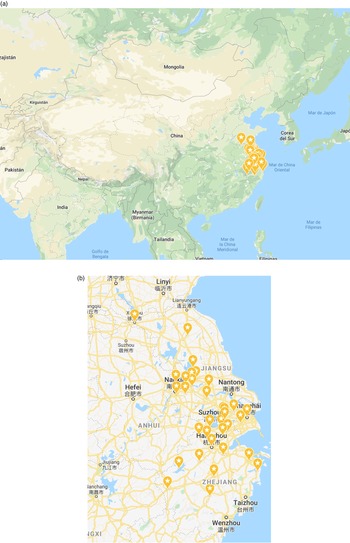
Overview of the distribution of areas with sericulture and silk production in Jiangsu, Zhejiang, and Shanghai.
Source: Authors’ own elaboration through the GECEM Project Database and Software QGIS v3.12. Base map from Natural Earth raster through data of records from First Historical Archives of China (FHAC) and China Local Gazetteers.

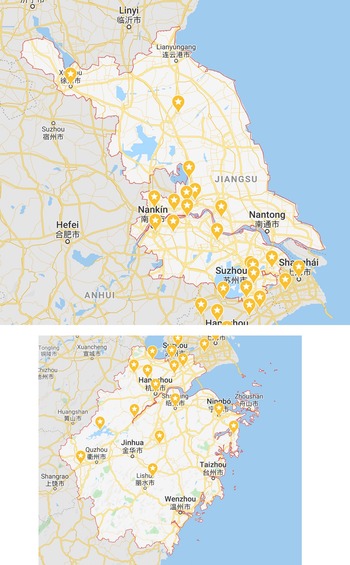
Distribution of places with sericulture and silk production in Jiangsu and Zhejiang provinces.
Source: Authors’ own elaboration through the GECEM Project Database and Software QGIS v3.12. Base map from Natural Earth raster through data of records from FHAC and China Local Gazetteers.

To tackle the problem of ordering such scattered sources and information, the GECEM Database presents an innovative solution: a new method of coding and ordering the information and its application through ILE.Footnote 16 Traditional scholarship in the field of history continues to reluctantly observe the use and application of computational sciences to history, without acknowledging the dialogue of history with other areas of the social sciences and the humanities, such as economics, geography, IT (information technology), sociology, international relations, sinology, and so on.Footnote 17 More traditional historians state that the use of databases and software to help historical analysis is useless and meaningless while they continue using conventional methods or registering information using Excel tables or notebooks.Footnote 18 The GECEM Database is predicated on an interdisciplinary approach which will facilitate the ultimate objective of historians: finding accurate answers for current historical debates, renewing global (economic) history research, and accelerating the long-lasting and incremental research on the great divergence debate.
Therefore, the database will not be the end goal itself for the historian; it is a powerful tool to find answers to big questions regarding long-term economic development in China and Europe. This is precisely what differentiates GECEM from other historical databases that have followed a linear model of innovation and its components of research, invention, innovation, and diffusion.Footnote 19 Such databases employ multigenerational panel datasets output through Excel and PDF files from which macro aggregates (e.g., population data, GDP) are used as the main economic indicators.
Certainly, determining consumer behaviour and the circulation of Asian goods of Chinese origin in Europe (mainly through the trade axis Cadiz-Seville-Marseille) and of European and American goods in China (through the trade nodes Manila-Macau-Canton) is an arduous task. Analysing the circulation and distribution of commodities between such distant geographies and the building of the business and commercial networks that made these happen from the seventeenth to the nineteenth century, and then correlating these two factors with economic growth and consumption patterns, requires primary sources of different provenance (in both European and Asian languages) to be woven together using a complex computer system. In doing so, the following elements (entities) were considered essential in the design and structure to input historical information in the GECEM Database. The main entities are as follows:
• Source Reference: This entity contains the location and citation information for each historical source stored in the database, including name of file, repository, folder, and localisation and identifiers of the historical document.Footnote 20
• Social Actor: This entity represents most of the identifying information for the many roles (producer, receiver, or other) of the main social actor in the primary document. Its basic structure includes gender, honorific and noble titles, name, family name, geographic information (kingdom, reign, settlement, parish), alias, civil status, age, family size, identity (such as religious confession, if any), and different occupations.
• Goods: This entity holds key information about the individual goods and products used to analyse the circulation and exchange of goods and patterns of consumption. Usually we are considering an Asian or European commodity that may have been mentioned in a wide range of sources: probate inventories, travel boarding documentation, commercial correspondence, organisational records of commercial enterprises or embargoes, business terminations, bankruptcy files, and so on. This might allow us to identify the origin of the good, for example whether it came from East Asia (China) in the case of silks, porcelains, teas, or if the goods that ultimately appear in probate inventories are of local production as “import-substitution” goods. This is an important problem to solve because probate inventories rarely mention the origin of goods. However, within the GECEM Database, it is possible to cross-reference sources on trade and consumption to track the origin and shipping trajectories of goods entering Western Mediterranean markets via Cadiz-Seville-Marseille, the main centres of redistribution of Chinese goods.
• Tax Revenue: This entity encompasses Chinese and European fiscal sources. Based on the relevance of these registers a unique entity was created for each so that their rich information could be properly stored. For the Chinese side we include Jiang/Jiangsu customs [jiāng hǎiguān 江海关], Zhe/Zhejiang/Ningbo customs [zhè hǎiguān 浙海关], Min/Fujian customs [mǐn hǎiguān 闽海关], and Yue/Canton customs [yuè hǎiguān 粤海关]. For the European side, the data includes the almojarifazgo (a port tax that Spanish authorities charged to merchant ships). These sources allow us to follow the trajectory and origin of Chinese goods shipped to Manila and from there introduced into American and European markets.
• Ship: This field stores data about ships that were found in documental archive searches. This entity is considered broadly to include ships that transported items as well as ships that captured cargoes.
• Trip: This entity requires a thorough understanding of the historical sources to differentiate the entity “ship” from the entity “trip” to avoid the possibility of wrongly duplicating a single shipment that different vessels shipped in partnership. Official destinations as well as alternative possible arrivals or emergency naval layovers due to, for example, weather conditions, scarcity of food and beverage provisions, or epidemics, are registered in this section. This entity is fundamental to observing global circulation of goods from the origin market to the end market.
• Letter: This entity contains information from documents such as commercial and trading correspondence, including (among others) date, trade partners, credit, goods, origin, ship, cargo, and currency.
• Social Relationships: This is a key entity that allows the building of social networks (based on family or on trade connections) that fostered the circulation of Western and Eastern goods in the early modern period, integrating the South China Sea with Western Mediterranean markets.
• Geographical data: This information is closely linked with previous entities, having become one of the most fundamental tools in the ILE analysis from the GECEM Database that the scientific community will be able to make use of.
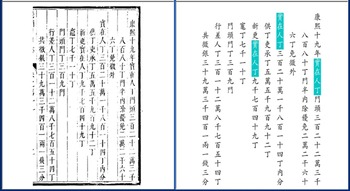
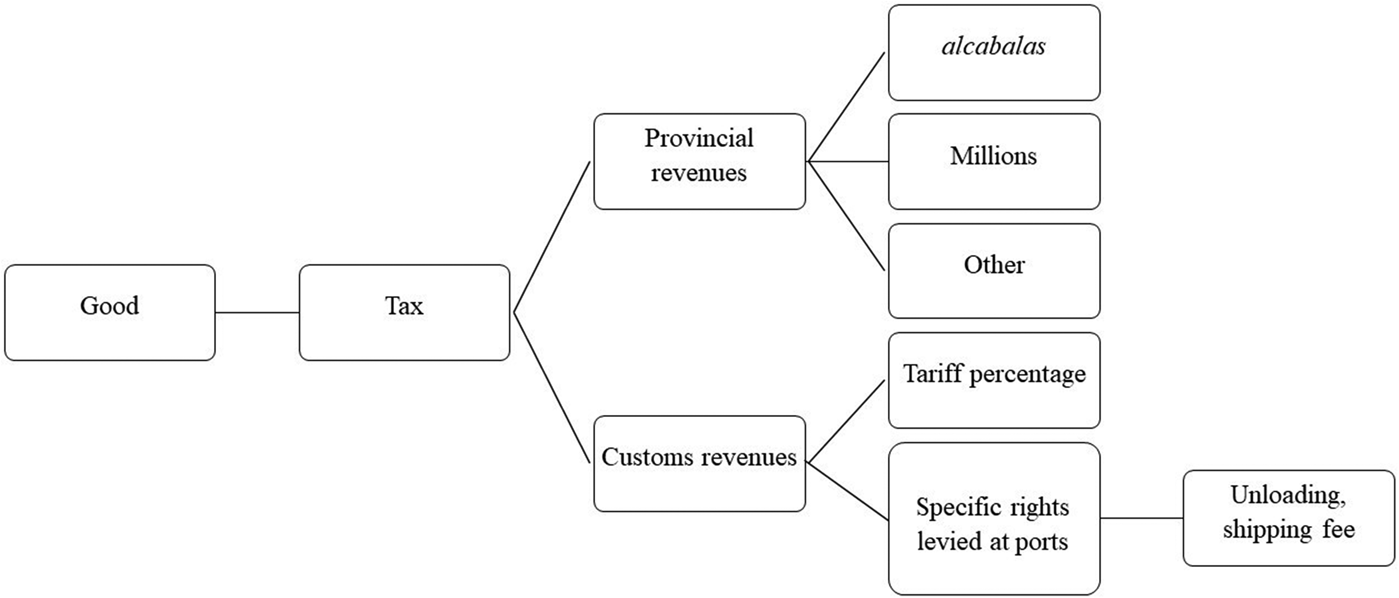
The most complex data to input are the Chinese sources that register taxes by household, resulting from the low control of the Chinese authorities over the local and provincial taxation systems. Documents like the one shown in Figure 1 correspond to local Qing China registers, the so-called Local Gazetteers of China [zhōngguó dìfāng zhì 中国地方志], and show the complexity of adapting this type of information to the structure of the database. Such difficulty also prompted the research team to include possible levies and non-tariff barriers to the database (Figure 2).
Chinese fiscal documentation in Hebei province, 1680.
Source: Renmin University of China Library (RUCL), Rare Book Collection, Zhongguo Difang Zhi, Hebei province, Kangxi reign.

Fiscal structure of the general reference guide.
Source: Elaboration by Nadia Fernández-de-Pinedo.

Macau and Marseille Case Study: Circulation of Global Goods and Trade Networks in South China and Western Mediterranean Europe, 1680–1840
Our case study uses the GECEM Database to analyse the formation of trade networks and the social agents who participated in the Macau market to ship Chinese goods overseas to American and European markets via the Manila galleons. Examining the role played by the Jesuits who had settled in Macau, and who acted as the main economic agents in this market, throws a light on the formation and development of these global commercial activities, illuminating how the members of the Society of Jesus acted as agents for the exchange of goods, and how they disseminated their consumption in the frontier areas of the Iberian empires. The economic and trade intermediation of the Jesuits (beyond their missionary and religious activities) in the city of Macau and in the region of south China was fundamental for the global circulation of Chinese goods.Footnote 21 Macau and the South China Sea markets formed a long-distance connection that integrated European and Chinese markets through these “non-state” agents in the early modern period.Footnote 22
Marseille was the main transnational entrepôt in Western Mediterranean markets connecting Europe with Asia via Levantine routes,Footnote 23 mainly through the mercantile activities of Armenian traders from Aleppo and New Julfa.Footnote 24 However, with these traders’ expulsion from Marseille at the end of the seventeenth century, they shifted their trade routes to the Indian and Pacific markets (mainly the South China Sea) through the intermediation of the Compagnie Française des Indes Orientales and the East India Company.
Through the spatiality and mediation prompted by global trade, social actors fostered the progressive integration of long-distance markets through the purchase and introduction of goods. Thus, the geographical and spatial variable plays a relevant role in the traceability of global goods from the origin market to the end market. The mediation of trade agents from Marseille, mainly the Roux-Frères Company and Jesuit networks (Portuguese mainly), developed a dense and “non-state” official trade network of Eurasian markets via Macau and Marseille in south Europe and south China respectively. Thus, western trade operated in the Pacific through the Manila galleons, but also connected Pacific, Indian, and Mediterranean markets through transnational mercantile communities. These spaces should be observed from a global perspective, moving away from Eurocentric views, given that they were spaces that connected empires and polities.Footnote 25 Macau was a central node for trade exchanges between the Iberian empires and south China through the Manila-Macau route, consolidated from the period of the Iberian Union (1580–1640). The port of Macau also developed commercial relations with the Chinese, Dutch, French, and English empires throughout the early modern era.
The significant role the Jesuits had developed as traders became very relevant for this region. Father Alonso Sánchez highlighted this in a letter to the Father General towards the end of the sixteenth century:
But above all, what the Society faces, in these parts [Macau] and in Luçon and New Spain, where it has already arrived, and will have arrived in Spain, is the merchandise and the treatment more established in our people than in Genoese, and it is not [surprising] because we never take anything from our breasts that we do not do with more “eficatia” (efficiency) and “mañas” (skill) than any other kind of people.Footnote 26
The eficatia e mañas (efficiency and skill) of Macau's Jesuits took different forms, all of them with the aim of financing their activities in the region.Footnote 27 The members involved in the Society of Jesus trade networks participated in the exchange of Chinese products, and even had an important share of such trade ceded by the Senado da Cámara of Macau.Footnote 28 The Jesuits were assigned by contract between two hundred fifty and three hundred silk spikes that they took on trust from the merchants of Macau to sell on their behalf in Japan.Footnote 29 Thus, Macau, Nagasaki, and Manila were part of a nonofficial trade system that integrated American and European markets for the circulation of global goods such as silk, tea, and porcelain.
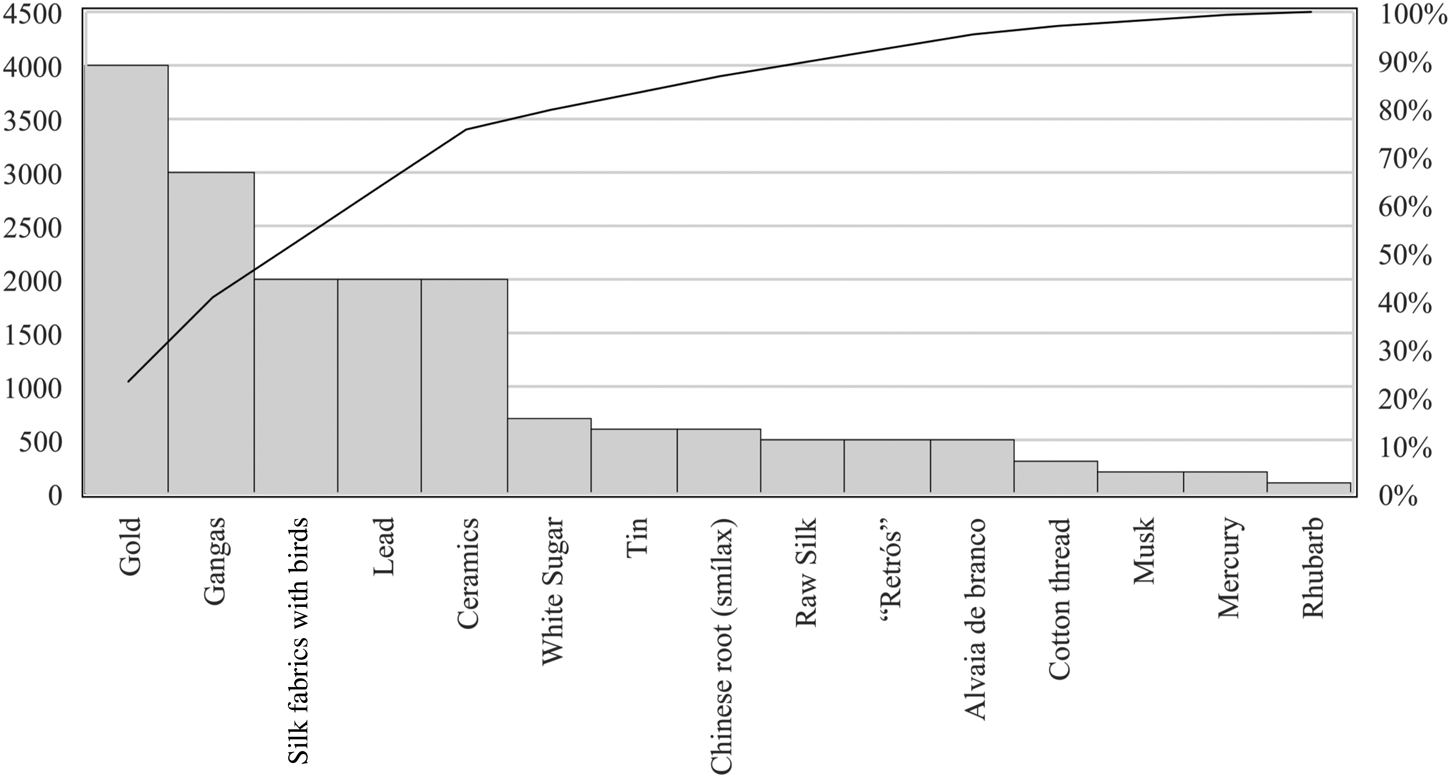
Figure 3 is an illustrative example of how goods circulated in East Asian markets from Macau to Japan, and from there to western markets via Manila. These goods can be divided into three main groups: textiles (silk and cotton); precious metals (gold, mercury, tin, and lead); and high-value drugs (musk, Chinese root, and rhubarb).Footnote 30 These are all groups that repeatedly appear in other commercial circuits.
Goods shipped by Jesuits of Macau to Japan in the seventeenth century.
Source: Elaboration through the GECEM Project Database. Data for this figure, in Portuguese, appears in Loureiro, “Navios, mercadorias e embalagens,” 37. A transcript of all the goods transported by the Jesuits is in Reference Boxer and VilarinhoBoxer, O grande navio, 163–8. The information comes from a document kept in the Biblioteca da Ajuda, Lisbon. Colecçao Jesuítas na Asia. Codex 49-V-7.* “Retrós”: that is what silk was called at the time, “trustworthy and twisted” (fiada e torcida). Loureiro, “Navios, mercadorias e embalagens,” 41. * Ceramics (“Ranqueis”): corresponds to ten porcelain plates. Compare with Loureiro, “Navios, mercadorias e embalagens,” 50, n. 22

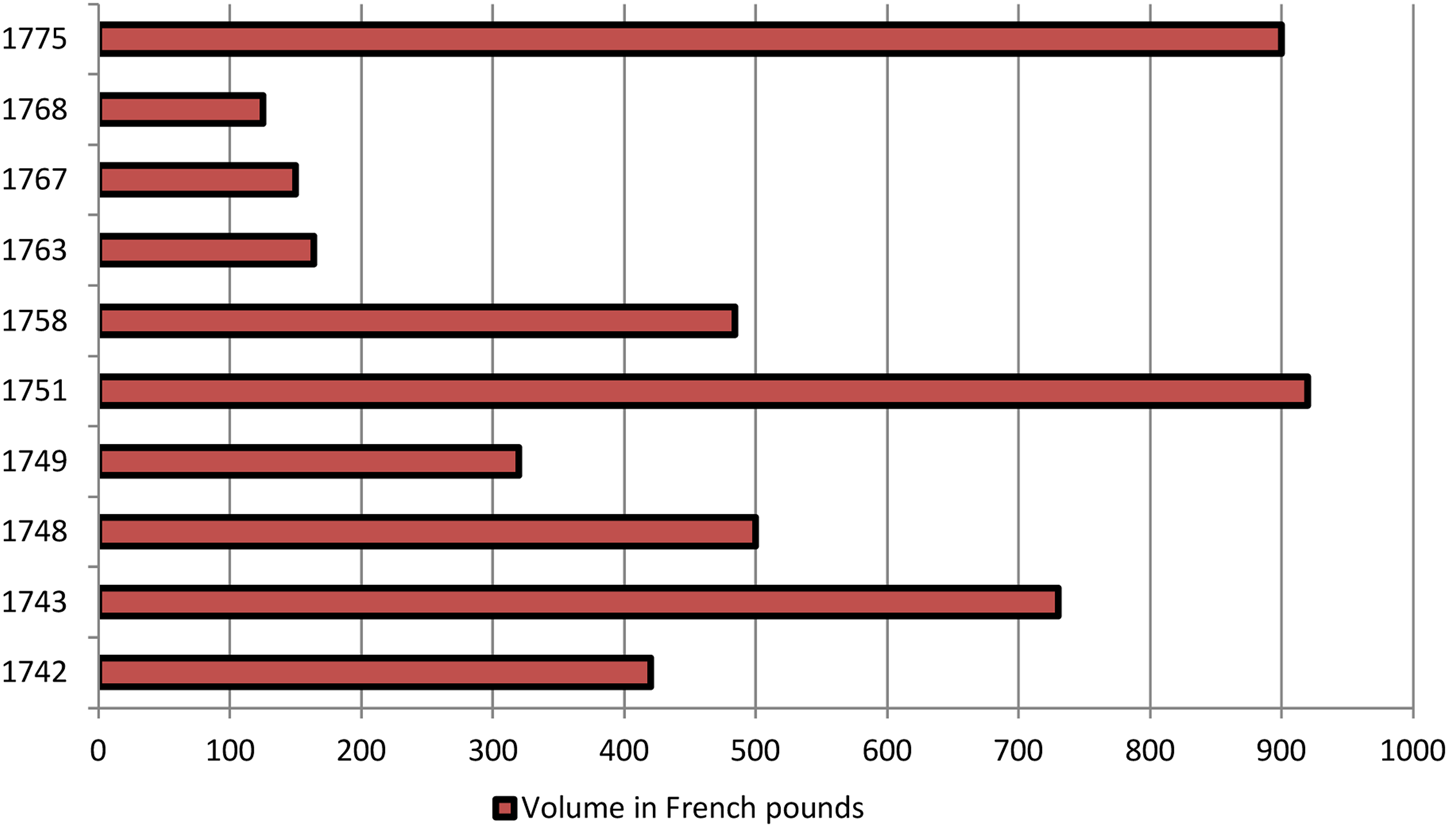
Members of the Society of Jesus were thus directly involved in commercial traffic in Macau in the transition from the Ming to the Qing dynasty, even owning their own vessels with which they carried out commercial missions to various points. In the seventeenth century, at the dawn of the arrival of the Manchus to the Beijing court, Macau's Jesuits had junks and collaborated with other merchants participating jointly in the commercial activities of Manila.Footnote 31 An incident in the early 1700s points out the Jesuit links with trade connecting south China with Western Mediterranean markets in Marseille. The sources show that Father Manuel Queirós Pereira was one of the owners of the ship Jesús, María e José. This ship, captained by Francisco Leite Pereira, was captured by the French corsair Henry Bouynot during its return journey from Batavia in February 1712.Footnote 32 Among the most relevant goods transported were silk, tea, and porcelain (see Figures 4, 5, and 7) which through this nonofficial and contraband trade were redistributed from Marseille to other European regions. Bouynot later sold the ship cargo in the port of Manila to Aleixo Pessoa.Footnote 33
Redistribution of Chinese porcelains from Marseille to Spain, 1740–1780.
Source: Data elaborated and analysed through the GECEM Project Database. Archive de la Chambre de Commerce de Marseille (ACCM), Statistique. Serie I.

Redistribution of Chinese tea and opium from Marseille to Spain, 1740–1780.
Source: Data elaborated and analysed through the GECEM Project Database. ACCM, Statistique. Serie I.

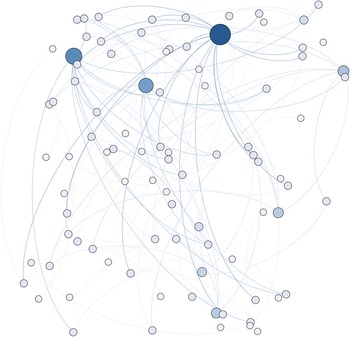
With Marseille as the main redistribution hub, then, a wide array of typologies of Chinese silks, teas, porcelains, and also opium, were thus introduced into Mediterranean markets from Macau and Canton. Figure 6 shows how this unregulated trade was controlled by small and medium companies mainly from southern France, headquartered in Marseille, during the eighteenth century. Figure 6 displays the Marseille trade network, mainly represented by French traders (in dark blue and big dots) who had the main weight of business in the network, and the small dots represented small subsidiary companies in partnership with the Marseille traders that operated in southern Spain (Cartagena, Seville, Cadiz), Malta, and to a lesser degree in Italy. Bicaix, Bernal, Vidal, Bremond, Davide, Roux, and Trouchaud were some of the main companies with Marseille origins that operated in southern Spain, and small companies from Malta and Italy (mainly Genoa) were, among others, families named Pirriramun, Canteli, Carpe, Capdequia, Gandulfo, Gandulla, Grech, Matalona, Paragallo, Peretti, Pericano, Peseto, Pesano, Sizilia, Socori, and Sese o Ycar.
Marseille trade network in the Western Mediterranean for the introduction of silk, porcelain, tea, and opium, 1740–1780.
Source: Data elaborated and analysed through the GECEM Project Database. Protocols of Archivo Histórico Provincial de Murcia (AHPM); (ACCM), Statistique, Serie I; AHM, Leal Senado.

From Origin Markets to End Markets: Silk Production and Global Circulation in South China and Spain
Examining the private silk production of the Jiangnan area in the early Qing dynasty during the so-called High Qing period (Kangxi, Yongzheng, and Qianlong reigns 1662–1799), and the relationship between the imperial silk factories and private silk manufacturing, reveals the development of first-class techniques and exquisite designs. The private silk industry in Jiangnan was quite prosperous in this period, and the circulation of Chinese goods and commercial connections intensified. This rapid development was mainly due to the action of private trade and new rich business elites of south China (Macau, Canton, and Xiamen), population growth due to the incorporation of western lands by the Manchu emperors, and the high demand for Chinese silks in Europe. The trade axis Suzhou-Hangzhou-Xiamen/Amoy-Canton, with Macau as the main node connecting overseas trade with China, contributed to intensify this silk trade into Europe, in which the axis Marseille-Cadiz-Seville was the main hub of redistribution in Western Mediterranean markets.
The local and global export trade in either ready-to-use or semi-elaborated silk was quite developed in this period. Mining data and specific terms in the Chinese sources and cross-referencing them with typologies of silks in the Spanish sources related to trade registers and silk cargoes help us to identify that the origin market of these goods was south China. Imperial silk factories were developed and boosted in Nanjing, Suzhou, and Hangzhou.Footnote 34 The information on silk production from these factories can be analysed in the First Historical Archives of China (FHAC) as memorials to the throne, records of the imperial household department [nèiwùfŭ 内务府], and the “Collected Status of Qing” [dàqīng huìdiǎn 大清会典], among others.
Detailed information concerning private silk manufacturing and trade is quite scattered, however, in the imperial archives. Consequently, sources of the imperial archives are cross-referenced with the Local Gazetteers of China [zhōngguó dìfāng zhì 中国地方志]. By making queries and cross-referencing sources through the GECEM Database it is possible to trace the global circulation of Chinese silks produced locally in south China and traded from there to the European end markets such as Marseille as a main centre of redistribution. Taking advantage of the potential of digital humanities tools, the GECEM Database data output searches have been made to identify typologies of Chinese silks introduced into Western markets based on the typologies that appear in Spanish sources. The query function of the GECEM Database has been carried out to search entries such as “silk” [sīchōu 丝紬], “sericulture” [cánsāng 蚕桑], “weaving” [zhīzào 织造], “silk manufacturing” [sīzhī 丝织], “gauze” [chou 紬], “satin” [duàn 缎], “damask” [líng 绫], “thick loosely woven silk” [juàn 绢], and “Nanjing silk” [Nánjīng sī 南京丝], which was named nankines in the Spanish sources. Thus, the most used Chinese characters related to silk records concerning private silk production in the Jiangnan area between 1662 and 1799 have been thoroughly cross-referenced in both Chinese and European sources.
The silk-related search results obtained from the gazetteers are categorised by volume and named from the different places of origin; therefore, maps can be made accordingly to show the locations of sericulture and silk production and origin markets in south China, in the Jiangnan area (see Maps 1 and 2), where Chinese silks were exported to European markets. As we can see directly from the maps, in Jiangsu and Zhejiang provincesFootnote 35 where the imperial silk factories were built, private silk production was correspondingly popular in the nearby cities, towns, and villages.
The development of private silk production and manufacturing in the Jiangnan area means it can be designated as the origin market of first-class raw silk, thanks to smooth transportation due to the river networks and a strong commercialised society.Footnote 36 As Maps 1 and 2 show, besides the cities of Nanjing, Suzhou, Hangzhou, Zhenjiang, and Huzhou, many silk producing villages and towns were scattered in the two provinces of Jiangsu and Zhejiang, where the private silk industry was generally settled. High-quality silk was kept for local production and trade in China, whereas lower-quality silk was exported to European markets.Footnote 37 Through source analysis and data searches in the GECEM Database, locations have been identified concerning local silk production listed in the search results from gazetteers in Jiangsu and Zhejiang provinces during the Kangxi, Yongzheng, and Qianlong period (see Table 1). As mentioned in the local gazetteers, these are places where the private silk industry was established, all having a vast typology of silk products, expanded manufacturing scale, advanced weaving techniques, and renovated production processes.
List of places in China Local Gazetteers with data on local silk production in Jiangsu, Zhejiang, and Shanghai (1662–1799).

Source: Data elaborated and analysed through the GECEM Project Database from FHAC and China Local Gazetteers sources. As there were places with the same name pronunciations but different characters, the Chinese characters are adopted to avoid confusion.
The imperial silk factories became innovative during the seventeenth and eighteenth centuries. The plain satin of weaver Chen [chéng 程] was the most outstanding; it was named after another weaver and called “Yang plain satin” [yǎng sù 仰素] and became popular in the capital and other provinces. The fabric of “thread satin” [xiànduàn 线缎] could be made plain or with a pattern, and in different thickness. Though raw silk for satin, thin silk, gauze, or yarn was obtained from other provinces, the best weavers were from Jiangning.Footnote 38
In principle Spanish cities and centres of trade, taxes such as the almojarifazgo (tax levied at Spanish ports), the alcabala, or the décima (tenth) tax, which was a special tax on purchases established in the city of Madrid, are the main historical records to observe the entry of original Chinese goods (mainly silks) into Western Mediterranean and Spanish local markets. These were the end markets that absorbed the demand for Chinese silks produced in the abovementioned origin markets in Shuzhou, Nanjing, and the areas of Jiangsu, Shanghai, and Zhejiang.
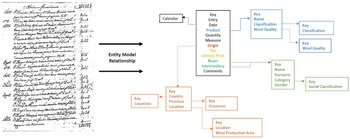
Each time a product was brought into the local markets of Spain, mainly in Seville, Cadiz, Cartagena, or Madrid, the supervisors of overseas trade and guild members registered individual entries, noting who brought it in; the month, day, and year; the amount of the tax; and the origin of the product. The names of taxpayers (and the person's status or title, if they had one) or intermediaries were used to identify not only individual purchases but also family purchases when items for an entire household were transported into the city. From this data we established a classification system (1) by the number of entries (with one single item per entry), (2) by the name of person and their title, and (3) by the product. That resulted in a dataset of 7,477 records regarding tax registers (see Figure 7).
Example of modelling the GECEM Database to search typologies of China silks in Spanish sources.
Source: Elaboration by Nadia Fernández-de-Pinedo through the GECEM Project Database.

The main consequence of such dynamic trade meant that European silks faced stiff competition from Asia. Original Chinese silks were mainly introduced into Western Mediterranean markets, and into Spain, through nonofficial trade and smuggling activities. Consequently, legislation was eventually enacted to protect the domestic textile industry from such competition. The imported “European” silks were in fact Chinese-made as these silks were redistributed from Western Mediterranean ports, mainly from Marseille. This, combined with the inability of local producers to match the quality of Chinese silks and volumes of nonofficial trade, resulted in the stagnation of local silk workshops in Spain.
Thus, an overall decline in silk production in Spain—due to financial costs from production and exporting, combined with the arrival of cheap silk—led to an increase in silks imports from China through nonofficial trade. In Madrid, based on the Francisco Martínez de la Mata Memorial, it is clear that in 1621 and again in 1630 several criticisms were raised arguing that Spain's national industry was harmed by allowing in foreign silk goods, and thus silks from the Indies, China, Persia, and Portugal should be banned in Spain.Footnote 39
Marseille was the main intermediary point between Western Mediterranean ports (Cartagena, Genoa, and Venice) and the coastal and inner areas of Spain, where these new products were distributed.Footnote 40 The European and Spanish silk industry faced strong headwinds at its inception, whether from legal costs or smuggling issues. Spanish consumers, meanwhile, were attracted to foreign silks for their price, quality, dyes, drawings, and reputation.
Francisco de Viana highlighted in his 1765 report the advantages of creating a company to establish direct trade between the Philippines and Spain through the Cape of Good Hope.Footnote 41 According to this report, some European countries used engaño (cheating) practices, and were thus responsible for the adverse effects on the Spanish economy. These countries included England, France, the Netherlands, Sweden, and Denmark. In the port of Canton in China, ships from “cheater” nations brought European commodities (such as fine cloth, pearls, watches, and lots of wine), as well as grana (red dye) from the Americas and anfión (opium) from India in exchange for tea, crockery, furniture made of maque (laquer) or charol (patent leather), rosewood litterbins, candlesticks, and items made of white copper. But the main items were raw silk, semi-elaborated silk, silk fabrics, and silk manufactures. The raw silk was intended to manufacture silk fabrics and clothing in Europe, but the volumes of imported semi-elaborated silk and ready-to-use products were the most relevant in these exchanges. Each of these European nations had factories in Canton, where silk was woven in such a way as to emulate Chinese techniques of production. These Chinese-made fabrics were then shipped as if they had been made in France or England, with no one knowing of the deception except for Manila and Cadiz-Seville merchants. Manila was the only port connecting south China markets from Canton and Macau with the American Spanish-controlled colonies, from where the Chinese fabrics and manufactures were loaded onto ships bound for European markets.
Conclusions
By cross-referencing Chinese and European sources through the GECEM Database (in this research we have mainly used French, Spanish, and Portuguese sources), one major historiographical problem regarding the identification of the origin of silks introduced into European (Spanish) markets has been solved. Asian and high-quality raw or semi-elaborated silks as well as manufactures were brought to Marseille from the ports of South America (Acapulco, Veracruz, Lima, Buenos Aires) and the eastern Mediterranean (Cairo, Smyrna, or Istanbul) and distributed to craftsmen in southern France and Spain to imitate techniques in China's silk production and to sell Chinese ready-to-use textiles.
Studies of consumption benefit from analyses of fiscal sources. This allows a look at real demand and offers rich information on the structure of supply and demand that can complement sources such as probate inventories or ship cargoes, among others. For example, the décima tax discussed above, which took place over a three-year period, offers a snapshot of consumer behaviour and the circulation of Chinese goods (silk, tea, porcelain) within Western Mediterranean regions. Cross-referencing between Chinese and European sources is the critical methodological underpinning for a bottom-up process of mining historical big data to shed light on and readdress questions such as how the circulation of global goods and changes in patterns of consumption were correlated to economic growth in China and Europe, with Macau and Marseille as the main case study. As has been demonstrated in this article, both areas acted as main trade nodes connecting south China and Western Mediterranean markets in which trade networks and merchants acted as “non-state” agents, bypassing state supervision. This has allowed us to conclude that silks and porcelains in Western Mediterranean markets were mainly of Chinese origin, demonstrating therefore the failure of European states (here we mainly present the Spanish case) in finding “import-substitution” for Chinese goods, and the concomitant stagnation of local centres of silk production in Spain, which could not compete with the demand for original Chinese silks and goods. The fiscal and trade sources and memorials in Chinese and Spanish archives offer an accurate view of Spain's weak state capacity to regulate trade and contraband, mainly facilitated by French traders in Marseille in coalition with traders settled in Macau such as the Jesuits, or Chinese traders in Macau, Canton, and Manila. These are causal factors that explain the failure at the state and local levels in Spain regarding “import-substitution,” regulation of overseas trade, transportation costs, consumer choices, foreign competition, and smuggling.
These new insights indicate that a bottom-up approach to analysing global trade unveils an alternative path towards modernisation and economic growth between China and Europe. This approach reevaluates the debate concerning the great divergence on a very local basis by mining new historical big data for both regions, thus disentangling the economic forces and the unregulated forces behind the exchange and circulation of the global goods markets in south China and Western Mediterranean Europe.
Funding
This research has been sponsored and financially supported by GECEM (Global Encounters between China and Europe: Trade Networks, Consumption and Cultural Exchanges in Macau and Marseille, 1680–1840), a project hosted by the Pablo de Olavide University (UPO) of Seville (Spain) and funded by ERC Starting-Grant, ref. 679371, under the European Union's Horizon 2020 Research and Innovation Programme, www.gecem.eu. The Principal Investigator is Manuel Perez-Garcia. This research has also been part of the academic activities of the Global History Network in China (GHN), www.globalhistorynetwork.com.
Acknowledgements
This research is a result of academic activities organised by the GECEM Project, such as the permanent lecture series in Global and East Asian History held annually at Shanghai Jiao Tong University and Pablo de Olavide University; workshops and international conferences such as the Sixth Eurasia Trajeco-GECEM panel at the Thirty-Sixth International Congress of the Latin American Studies Association (LASA); and the panel at the Eighteenth World Economic History Conference in 2018. We are grateful for comments and suggestions made by J. B. Owens, Vitit Kantabutra, Patrick O'Brien, Lucio de Sousa, Joe P. McDermott, Mihoko Oka, Pengsheng Chiu, Hamashita Takeshi, Bartolomé Yun-Casalilla, Debin Ma, Liu (Michael) Shiyung, Robert Antony, and Xiangyu (Ellen) Cai. We thank the reviewers and editors for their comments to improve the results of our research. Any errors are our own.