INTRODUCTION
Calcium is an essential mineral in the avian diet, required throughout the annual cycle (Simkiss Reference SIMKISS1967). Periodically, however, needs for calcium increase significantly above baseline to support specific activities such as growth of young and egg-laying. Too little calcium can lead to incomplete mineralization of the skeleton or retard growth in nestlings and fledglings (Graveland Reference GRAVELAND1996a, Reference GRAVELAND1996b; Tilgar et al. Reference TILGAR, MÄND and MÄGI2002, Reference TILGAR, MÄND, OTS, MAGI, KILGAS and REYNOLDS2004, Reference TILGAR, MÄND, KILGAS and REYNOLDS2005). In egg-producing females insufficient calcium can lead to lowered clutch sizes, defective shells, decreased hatching rates and/or nest desertion (Bidwell & Dawson Reference BIDWELL and DAWSON2005, Graveland & Drent Reference GRAVELAND and DRENT1997, Tilgar et al. Reference TILGAR, MÄND and LEIVITS1999, Reference TILGAR, MÄND and MÄGI2002).
Many species of bird, especially large non-passerines, mitigate the effects of low calcium by producing medullary bone. Calcium stored in medullary bone is easily mobilized when demand is high but exogenous calcium is unavailable (Reynolds & Perrins Reference REYNOLDS and PERRINS2010, Tilgar et al. Reference TILGAR, MÄND, KILGAS and REYNOLDS2005). Passerines either do not produce medullary bone or do so in quantities too small to meet requirements for egg production (Blum et al. Reference BLUM, TALIAFERRO and HOLMES2001, Pahl et al. Reference PAHL, WINKLER, GRAVELAND and BATTERMAN1997; but see Squire et al. Reference SQUIRE, BRAGUE, SMITH and OWEN2011). The skeleton of a female passerine also does not supply significant calcium during egg laying (Krementz & Ankney Reference KREMENTZ and ANKNEY1995, Pahl et al. Reference PAHL, WINKLER, GRAVELAND and BATTERMAN1997), and no other means of storing calcium in these birds has been identified. Rather, passerines meet their calcium needs from exogenous sources (Graveland Reference GRAVELAND1996a, Reynolds Reference REYNOLDS1997). Altricial nestlings obtain calcium from food supplied by their parents.
Investigators studying temperate birds found that the seeds, spiders and insects that form the bulk of the diet of breeding females and nestlings generally contain insufficient calcium to meet the requirements for egg-laying and growth (Bureš & Weidinger Reference BUREŠ and WEIDINGER2000, Graveland & van Gijzen Reference GRAVELAND and VAN GIJZEN1994). To obtain necessary calcium many passerines eat snails, which have a calcareous shell, or millipedes (Diplopoda) and woodlice (pillbugs, Isopoda), which have calcareous exoskeletons (Bureš & Weidinger Reference BUREŠ and WEIDINGER2000, Reference BUREŠ and WEIDINGER2003; Taliaferro et al. Reference TALIAFERRO, HOLMES and BLUM2001).
Little is known about the calcium needs of tropical passerines, although their calcium requirements are likely comparable to those of temperate birds with similar-sized eggs and young. The calcium contents of seeds and insects in tropical areas are also likely comparable to those of their temperate counterparts, so that tropical insectivores and granivores may also require alternative sources of calcium. However, tropical avifaunas differ significantly from temperate avifaunas in that adults of many species, both non-passerine and passerine, eat primarily fruit, which also forms an important part of the diet of their altricial nestlings (Foster Reference FOSTER1976, O'Brien Reference O'BRIEN1997, Snow Reference SNOW1970, Snow Reference SNOW1961, Reference SNOW1962). I hypothesized that the calcium contents of fruits eaten by neotropical frugivorous birds during the breeding season are also insufficient to meet their needs. To test this, I (1) compared the calcium contents of fruits of 34 species with the calculated needs of hypothetical 10-g and 25-g birds and 26 species of frugivore that breed at a study site in south-eastern Peru and (2) evaluated the suitability of the fruits for birds, based on bird weights and rictal widths of the bill. I also hypothesized that snails, woodlice and millipedes, as well as natural mineral licks, could serve as alternative sources of calcium; I evaluated their suitability based on their calcium contents and availability.
STUDY AREA AND METHODS
Study area
The work was carried out at the Cocha Cashu Biological Station (11°53′S, 71°24′W; altitude c. 333 m; Google Earth < http://www.google.com/earth/index.html >) in Manu National Park, Department of Madre de Díos, Peru. The study site was an 11-km2 area of mature (old) floodplain forest surrounding Cocha Cashu, an oxbow lake along the Manu River (described in Terborgh Reference TERBORGH1983, Reference TERBORGH and Gentry1990). Rainfall averages about 2400 mm y−1, most falling during a rainy season from mid-October to mid-April (Foster Reference FOSTER2008). The area is covered by a nutrient-rich alluvial soil estimated to be at least 300 y post-deposition (Gentry & Terborgh Reference GENTRY, TERBORGH and Gentry1990, Riley Reference RILEY1994). Chemical contents and other soil characteristics are described in Riley (Reference RILEY1994). Avian reproduction begins as early as late August in some species and can extend into December, although the bulk of nesting occurs from September to mid-November, by which time most species are caring for fledglings.
Fruit sampling
Species of trees and shrubs fruiting during September, October and November were observed for from 30 min to 20 h over various years to determine which fruits the birds were eating; fruit use was not quantified. Food plants were also identified based on seeds and/or pulp regurgitated or defecated by birds beneath their perches or in holding bags after capture in mist nets. Small branches were cut from trees and ripe fruits removed by hand, or fruits were collected from the ground beneath trees too tall to sample directly. Only fresh, intact, ripe fruits without seed or pulp parasites or other damage were analysed. Fruit characteristics were recorded, and a sample of fruits (n = 10–55) or feeding units (seed plus fleshy aril or pulp) and their component parts were weighed to 0.01 g on an electronic balance and measured with calipers (greatest length, width and depth or diameter, to 0.1 mm). The fleshy pulp was separated from the seed(s) with a scalpel and forceps; adherent remains were removed with a towel. Wet weights of the cleaned seed(s) and any protective structure (e.g. capsule) were subtracted from the weight of the whole fruit to determine the wet weight of pulp per fruit. Pulp is the only part of the fruit that a bird digests. A sample consisting of pulp from several fruits was weighed and air dried in the field for nutrient analyses.
Each sample was dried again in the laboratory at 65 °C to constant mass that was used to determine water content (%) of fresh pulp. The calcium content (% dry weight) of one sample of each species was determined at the Palmer Research and Extension Center Laboratory, University of Alaska, Fairbanks. Tissues were digested in a 5:3 mixture of nitric:perchloric acids, boiled, cooled and brought to volume. The solution and an NBS reference standard were then analysed on an ICP (Inductively coupled plasma)-Emission Spectrometer, Optima 300 XL. The wet weight of pulp per fruit was multiplied by the per cent dry weight of the pulp (100% – % water) and the product by the per cent of calcium in dry pulp to calculate the amount (mg) of calcium available to the bird through digestion.
Calcium needs
A female black-throated blue warbler (Dendroica caerulescens), which weighs about 10 g, lays eggs with shells containing about 20 mg of calcium (Taliaferro et al. Reference TALIAFERRO, HOLMES and BLUM2001), whereas a 25-g great tit female lay eggs with shells containing 31–35 mg of calcium (Graveland & van Gijzen Reference GRAVELAND and VAN GIJZEN1994). These figures suggest that the eggshell of a small bird (≤25 g) contains between 1.2 and 2.0 mg of calcium per g body weight of the adult. Using a dietary calcium retention of 60% (Graveland & van Gijzen Reference GRAVELAND and VAN GIJZEN1994), a hypothetical 10-g bird should ingest about 33 mg of calcium, and a 25-g bird about 55 mg (range = 52–58 mg) of calcium to meet its needs for one eggshell. (Actual retention may be lower given the rapid gut passage time of frugivorous birds (Karasov Reference KARASOV1990) and the potential presence of calcium oxalate in fruits (Franceschi & Horner Reference FRANCESCHI and HORNER1980).)
The hypothetical birds were assumed to swallow fruits (or feeding units) whole, removing 98.7% of the pulp from the seed(s) before it was regurgitated or eliminated in the feces (Foster Reference FOSTER1987). The number of fruits of each plant species a hypothetical 10-g or 25-g bird would have to eat to obtain sufficient calcium to produce a single eggshell was estimated by multiplying the available calcium in the pulp of one fruit by 0.987 to determine the amount of calcium ingested and then dividing the calcium requirement per egg (either 33 mg or 55 mg) by that number. The number of fruits of each plant species that a bird would have to eat was then multiplied by its fresh weight and the result divided by 10 g and then 25 g to determine the weight of whole fruits that the hypothetical birds would have to consume daily as a per cent of the birds’ weights. Birds generally feed on a mix of fruits. However, the quantities of each species consumed by individuals are unavailable, so the hypothetical birds were assumed to eat fruits only of the species being considered.
Developing young require significant amounts of dietary calcium for mineralization of the skeleton and formation of other tissues. The calcium content of a 14-d-old nestling great tit is c. 0.48% wet weight; the nestling achieves about 75% of its growth during week two of the nestling period (Graveland & van Gijzen Reference GRAVELAND and VAN GIJZEN1994). Applying these values and an assimilation measure of 60% (Graveland & van Gijzen Reference GRAVELAND and VAN GIJZEN1994), a hypothetical 10-g or 25-g fledgling would need to ingest 8.6 or 21.4 mg of calcium each day, respectively, to meet its calcium needs during week two of the nestling period, when those needs are greatest.
Bird data
Bird weights are from Dunning (Reference DUNNING2008), and rictal widths (rw; side to side at the rictal commissure of the bill; sometimes referred to as gape width) were measured with calipers to 0.1 mm on study skins in the U.S. National Museum of Natural History, Washington, DC or the Louisiana Museum of Zoology, Baton Rouge. Samples of species ranged from one to 11 individuals. Values reported are means for species with n ≥ 2. Bird taxonomy and common names follow Dickinson (Reference DICKINSON2003) and Gill & Wright (Reference GILL and WRIGHT2006).
Invertebrate sampling
Snails (live and empty shells), woodlice (pillbugs) and millipedes were sampled from leaf litter and above-ground vegetation in a 1.6-ha forest plot at Cocha Cashu between 13 and 20 October 2008. The plot contained 289 0.56-m2 (75 ×75 cm) traps of fine-mesh fibreglass screen deployed by colleagues for another study. The traps were elevated 1 m above the ground and laid out at 8-m intervals in a 17 × 17 grid. A 2-wk accumulation of leaves, fruit and detritus falling from above into 20 randomly selected traps was searched for invertebrates. In addition, a 0.25-m2 (50 × 50 cm) litter plot was laid out on the ground within 2 m of each of the 20 traps. The litter for a width of 20 cm around a plot was removed so that organisms attempting to escape would be visible. Litter within the sample area was removed piece by piece and examined for invertebrates. Woodlice, millipedes and snails were collected and sorted by morphospecies. Lengths of woodlice and millipedes and shell diameters of snails were measured with a ruler to the nearest mm, weighed on an electronic balance to 0.01 g, and air dried. We also collected, weighed and air dried samples from egg masses of the freshwater apple snail Pomacea diffusa Blume 1957 (Ampullariidae) taken from emergent vegetation in shallow water along the Cocha Cashu lake margin. The samples were redried to constant mass at 65 °C and weighed. Calcium content was analysed at the Palmer Research Center laboratory.
RESULTS
Fruit characteristics
Birds were observed regularly feeding on fruits of 34 species in 17 plant families, including hemiepiphytes, climbers, shrubs and understorey to canopy trees (Table 1). Many of the fruits were also consumed by mammals. The fruits were of two morphotypes: (1) a seed or seeds surrounded by a fleshy, usually soft and juicy pulp (e.g. pericarp); n = 23 species, including drupes, pseudodrupes, berries, arillodes, syngonia and pseudofruits; (2) a seed or seeds surrounded by a fleshy, often dry and oily, pulp (e.g. aril, arillode, pericarp) and enclosed in a dehiscent capsule; n = 11 species. The fleshy fruits were generally swallowed whole as were pulp-seed(s) feeding units, after being plucked from their capsules. Fruits of Coussapoa villosa (Urticaceae) are tiny but tightly packed into heads up to 30 × 35 × 23 mm (height × width × depth) and 15 g. When feeding, birds reach into the fruit head and grab a variable number of fruits with the bill (MSF pers. obs.). The average weights of the fruits or edible fruit parts (i.e. not including the capsule) of the 34 species ranged from 0.03 to 3.9 g (mean ± SD = 1.03 ± 1.18 g). They measured from 3.5 to 23.7 mm (mean ± SD = 11.4 ± 5.23 mm) long by 3.1 to 18.4 mm (9.7 ± 3.8 mm) wide, the dimension that a bird most likely would have to accommodate to swallow a fruit whole.
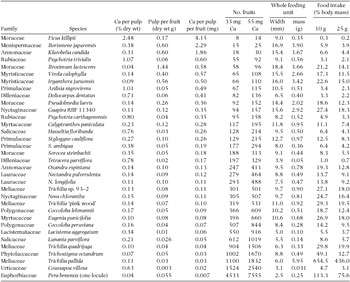
Characteristics of fruits (average concentrations of calcium in fruit pulp, amounts of pulp per fruit, amounts of calcium per fruit, and fruit weights and widths (minimum dimension that would have to pass through the rictal gape of a bird swallowing the fruit or feeding unit whole)) of 34 plant species eaten by birds during their breeding season at the Cocha Cashu Biological Station, Madre de Díos, Peru. The numbers of each fruit that hypothetical 10-g and 25-g birds must eat to obtain the calcium required (33 and 55 mg, respectively) to produce the shell of one egg (calculated after Graveland & van Gijzen Reference GRAVELAND and VAN GIJZEN1994; values rounded up to next whole number), and the weights of those fruits as a percentage of the birds’ body weights. Species are listed in descending order according to the amount (mg) of Ca per pulp per fruit. Nomenclature follows Tropicos.org, 2013 < http://www.tropicos.org/ >.

Fruit calcium content
The calcium content of the pulp of a fruit is a product of the per cent calcium in the dry pulp of that fruit and the amount of dry pulp it contains, attributes whose values are not significantly correlated (Spearman rs = −2.15, Puncorr = 0.22). The calcium in the pulps of the fruits was low, ranging from 0.04% to 2.48% (mean ± SD = 0.376% ± 0.47%, n = 34) dry weight. Per cent calcium in Ficus killipii was greatest and more than 2.3 times that of the species with the next highest per cent (Table 1). The calcium concentration of the dry pulp exceeded 1.0% in only three species (9% of those sampled), and 0.5% in only eight species (24%; Table 1). Most of the fruits or feeding units were small and included little pulp (wet weight, range = 0.03–3.19 g, mean ± SD = 0.67 ± 0.79 g, n = 34) and/or the pulp had a high water content (range = 21–92%, mean ± SD = 73% ± 18.5%, n = 34). As a result, the amount of dry pulp per fruit was small (range = 0.003–1.44 g, mean ± SD = 0.17 ± 0.289 g; n = 34). Because the amount of pulp is limited and the per cent of calcium is low, the absolute amount of calcium per pulp per fruit was low for most species (range = 0.007–4.15 mg, mean ± SD = 0.441 ± 0.812 mg), again being greatest in F. killipii. Species with the greatest percentages of calcium per dry pulp or the greatest amounts of dry pulp per fruit are not necessarily among the species with the greatest amounts of calcium per pulp per fruit (Table 1).
Bird attributes
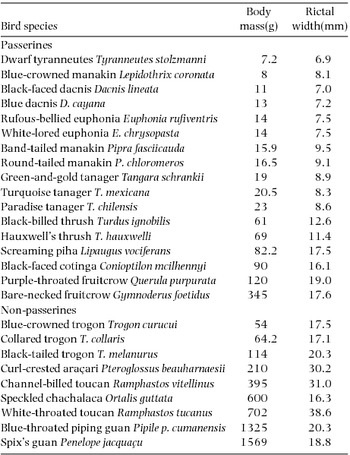
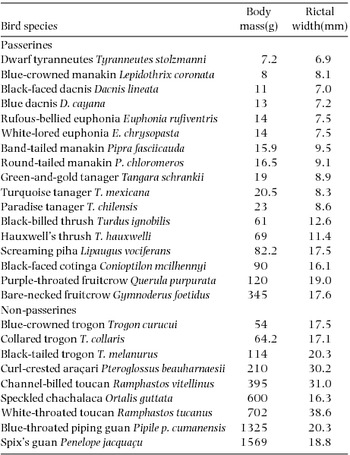
Among 26 common species of frugivorous birds breeding at Cocha Cashu, 11 species (all passerines) weigh less than 25 g (7.2–23.0 g, Table 2). The average rictal widths of these species range from 6.9 to 9.5 mm. Six of the remaining 15 bird species are passerines with average body weights ranging from 61 to 345 g and rictal widths of 11.4 to 17.6 mm. Weights of the nine non-passerine species range from 54 to 1569 g; their rictal widths range from 16.3 to 38.6 mm.
Body weights (from Dunning Reference DUNNING2008) and rictal widths (distance between the lateral commissures at the base of the bill) of 26 species of passerine and non-passerine frugivores resident at the Cocha Cashu Biological Station, Madre de Díos, Peru. Distribution data from Terborgh et al. (Reference TERBORGH, FITZPATRICK and EMMONS1984); taxonomy and common names updated to Dickinson (Reference DICKINSON2003) and Gill & Wright (Reference GILL and WRIGHT2006), respectively. Species listed in ascending order of body mass. Wheelwright (Reference WHEELWRIGHT1985) noted that rictal width ( = his gape width) measurements from study skins are slightly smaller than those taken from live birds.
Invertebrates
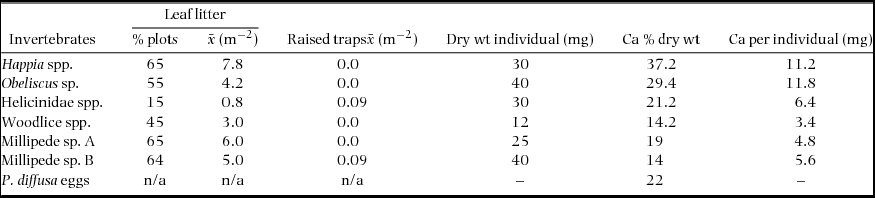
Live individuals and empty shells of two unidentified species of Happia (Systhrophiidae; up to c. 10 mm diam.), one unidentified species of Obeliscus (Subulinidae; narrow, cone-shaped shell up to 13 mm long) and two unidentified species of Helicinidae (up to 7 mm in diam.) were found in the leaf litter (Table 3). One live helicinid sp. was located in the above-ground traps. However, colleagues located eight of these snails in above-ground traps (= c. 0.05 individuals m−2), in an earlier sample (N. Suarez pers. comm.). In addition, live Obeliscus sp. was often observed on vegetation. Snails varied considerably in size. Pomacea egg masses (c. 10 cm × several cm) were common on emergent vegetation along the lake edge.
Occurrence in leaf litter and overhead vegetation of snails, woodlice (pillbugs) and millipedes in mature floodplain forest at Cocha Cashu Biological Station, Madre de Díos, Peru, 13–20 October 2008, and weights and calcium contents of those invertebrates and the eggs of Pomacea diffusa.
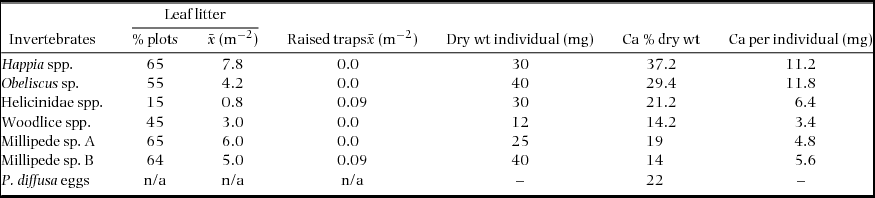
Two species of woodlice (Armadillidiidae; c. 1 cm long), which were not distinguished, were moderately common in the leaf litter (Table 3). One individual was found in understorey vegetation. Millipedes of various species were common in the leaf litter. Individuals of most species were too large for small (≤25 g) passerines to eat but could be consumed easily by larger passerines (e.g. black-billed thrush (Turdus ignobilis), screaming piha (Lipaugus vociferans)) and non-passerines. Two morphospecies of millipede of sizes (20–30 mm long) appropriate for consumption by small passerines were common in the leaf litter (Table 3) and present in above-ground traps.
DISCUSSION
Fruit as a calcium source
For a fruit to be a suitable source of calcium, birds must be able to eat it efficiently. Yet many of the fruits sampled here are too large for most 10-g to 25-g birds to swallow whole. For example, fruits of seven of the eight species (Table 1) with ≥0.49 mg of calcium per pulp per fruit are between 9.0 and 18.4 mm wide, whereas 11 common species of small (≤25 g) frugivorous passerines at Cocha Cashu have rictal widths of only 6.9 to 9.5 mm (Table 2). Consequently, these smaller birds would only be able to remove bites of fleshy pulp from the most calcium-rich fruits, which is far less efficient than swallowing fruits whole (Foster Reference FOSTER1987). Interestingly, the dwarf tyranneutes (Tyranneutes stolzmanni, mean rw = 6.9 mm) and blue-crowned manakin (Lepidothrix coronata, 8.1 mm) feed on fruits of Ficus killipii (MSF unpubl. data), whose average height × diameter is 7.8 (range = 5.6–10) × 9.1 mm (7.5–10.3 mm), and F. pertusa, which have a mean diameter of 9.02 mm (Tello Reference TELLO2003). The birds may select the smallest fruits, compress the fruits between the mandibles, or take bites rather than whole fruits.
On the other hand, many fruits that are small enough to be swallowed easily contain so little pulp that a very large number must be eaten in a day to meet calcium needs for one eggshell. For example, a 25-g bird would need to eat 329 Tetracera parviflora fruits or 916 Lacistema aggregatum fruits to obtain sufficient calcium, and a 10-g bird a whopping 1524 fruits of Coussapoa villosa. The time required to eat such a large number of fruits may be as prohibitive as eating large fruits piecemeal. Spending considerable time and energy feeding to meet calcium needs may have a negative impact on a bird's other activities and increase its predation risks (Foster Reference FOSTER1987, Howe Reference HOWE1979, Reynolds et al. Reference REYNOLDS, MÄND and TILGAR2004). Great tits, for example, neglect maintenance and alter other behaviours to increase search effort when deprived of calcium (Graveland & Berends Reference GRAVELAND and BERENDS1997). However, many tropical frugivores appear to spend little time foraging and a lot of time ‘loafing’ (Foster Reference FOSTER1987, pers. obs.; Snow Reference SNOW1961, Reference SNOW1962), so females may be able to spend more time feeding during egg laying and when feeding nestlings.
Another attribute of a suitable calcium source is a calcium content high enough so that the number (or weight) of fruits a bird requires to meet its needs does not exceed its physical capacity to eat and process them in the time available. A hypothetical 10-g bird would have to eat from 8 to 4533 fruits daily of the plant species considered here and the hypothetical 25-g bird, from 14 to 7555 (Table 1). These values range from 0.3 to 654 times and 0.2 to 436 times adult body weight for the 10-g and 25-g birds, respectively. Data on the weight of fruits a bird in the wild actually eats per day are lacking, although birds do engage in hyperphagy during periods of increased need (Greenberg & Marra Reference GREENBERG and MARRA2005, McWilliams & Karasov Reference MCWILLIAMS and KARASOV1998a, Reference MCWILLIAMS and KARASOV1998b). Captive Eurasian bullfinch (Pyrrhula pyrrhula; mean wt = 21.9 g) fed pear buds in winter (Summers Reference SUMMERS1982), and captive cedar waxwing (Bombycilla cedrorum; c. 31.6 g) fed artificial foods and fruits at −20 °C (McWilliams et al. Reference MCWILLIAMS, CAVIEDES-VIDAL and KARASOV1999) daily ate 1.6 and 1.5 times their body weights, respectively. Crocker et al. (http://www.pesticides.gov.uk/Resources/CRD/Migrated-Resources/Documents/R/ResearchPN0908.pdf) estimated that the bullfinch, common blackbird (Turdus medulla, c.113 g) and song thrush (T. philomelos, c. 67.5 g) eating fruit would need to consume approximately 3, 2 and 2.3 times their body weights, respectively, to meet their daily energetic needs. Finally, Taliaferro et al. (Reference TALIAFERRO, HOLMES and BLUM2001) considered a food weight:bird body weight ratio of 4 to 6 (weight of caterpillars a black-throated blue warbler would need to eat to obtain sufficient calcium) untenable.
To evaluate the suitability of the fruits (Table 1) as a calcium source, I arbitrarily set a food intake limit at three times a bird's body weight and compared that to the weight of fruits of each species that 10-g and 25-g birds would have to eat to meet their calcium needs. Using this criterion, fruits of only two species met the calcium needs of a 10-g bird, and fruits of only five species met those of a 25-g bird (Table 1). The other six species of frugivorous passerine considered here weigh from 61 to 345 g and have rictal widths of 12.6 to 17.6 mm and should be able to swallow whole fruits of most of the plant species considered as should the nine non-passerine species (Table 2). However, the calcium needs of these larger birds are also larger than those of their smaller counterparts, so they too may face time constraints on feeding (especially if eating very small fruits) as well as physical limitations on the weights of food that they can consume. A 111-g black-tailed trogon (Trogon melanurus), for example, would likely have trouble processing 200 3.67-g Klarobelia candida fruits (total = 734 g, ≥6.6 times its body weight) in a day.
The calcium:energy ratio of some fruits could also present a problem. Although the amount of calcium required relative to energy required for nestling growth may be low, a nestling may have to consume food substantially in excess of its energetic needs to meet its calcium needs (Seastedt & MacLean Reference SEASTEDT and MACLEAN1977). This situation is analogous to the imbalance in the relative amounts of protein and energy sometimes found in the diets of altricial nestlings that are fed fruit (Snow Reference SNOW1961, Reference SNOW1962). The consequences of that imbalance are generally applicable to an imbalance between the intake of any nutrient and energy (Foster Reference FOSTER1978, Ricklefs Reference RICKLEFS and Paynter1974).
Among the five plant species whose fruits appear to be suitable sources of calcium for birds weighing ≤25 g, one would expect Ficus killipii (and other similar fig species) to be preferred. The fruits are relatively small and contain enough calcium so that the number of fruits required is small. This agrees with the findings of Wendeln et al. (Reference WENDELN, RUNKLE and KALKO2000) who compared the average calcium concentration in fig fruits (range = 1.21–1.91%) to that of non-fig fruits (0.39–0.48%) and found that figs contained ‘more than three times as much calcium’. O'Brien et al. (Reference O'BRIEN, KINNAIRD, DIERENFELD, CONKLIN-BRITTAIN, WRANGHAM and SILVER1998) also found that many fig species contain high levels of calcium likely sufficient for eggshell production in birds and for bone mineralization in young birds and mammals. In contrast, the pulp of Ficus maxima, which I also sampled from Cocha Cashu, had a calcium concentration of only 0.52% dry weight. Ripe fruits of this species are large (mean ht × diam = 18.7 × 20.7 mm, mean wt = 29.9 g), green and apparently eaten only by mammals (MSF unpubl. data). At least 30 species of Ficus have been reported in the vicinity of Cocha Cashu (Robin B. Foster pers. comm.), and trees of some species fruit asynchronously, so fig fruits can be available year round (Bleher et al. Reference BLEHER, POTGIETER, JOHNSON and BÖHNING-GAESE2003, Kinnaird & O'Brien Reference KINNAIRD and O'BRIEN2007, Lambert & Marshall Reference LAMBERT and MARSHALL1991). In addition, some species of bird (Kinnaird et al. Reference KINNAIRD, O'BRIEN and SURYADI1996; pale-winged trumpeter, Psophia leucoptera, Peter Sherman pers. comm.) can track the appearance of ripe fruits in both space and time and should be able to exploit synchronously fruiting figs as well. Fruit crops of figs tend to be very large (in the tens of thousands) and to ripen more or less synchronously within a tree so that many individuals of multiple consumer species can feed simultaneously (Bronstein & Hoffmann Reference BRONSTEIN and HOFFMANN1987, Jordano Reference JORDANO1983, Tello Reference TELLO2003). In contrast, several other plant species with high-calcium fruit pulp (e.g. Psychotria spp., Ardisia nigrovirens, Doliocarpus dentatus) produce relatively small crops that can be quickly depleted by only a few birds.
Invertebrates as a calcium source
If fruits do not meet the calcium needs of frugivorous birds during reproduction or are too large for small birds to consume efficiently, then the birds will require an alternative source of calcium. Many temperate-zone passerines meet their calcium needs by consuming snail shells, woodlice and/or millipedes. This is likely true as well for various species of tropical frugivores, including thrushes (Turdidae; Collar Reference COLLAR, del Hoyo, Elliott and Christie2005), cotingids (Cotingidae; Snow Reference SNOW, del Hoyo, Elliott and Christie2004), barbets (Capitonidae; Medway & Wells Reference MEDWAY and WELLS1976, Short & Horne Reference SHORT, HORNE, del Hoyo, Elliott and Sargatal2002) and trogons (Trogonidae; Collar Reference COLLAR, del Hoyo, Elliott and Sargatal2001), which eat arboreal and terrestrial snails, isopods and diplopods. The resplendent quetzal (Pharomacherus mocinno) feeds snails to its young (Collar Reference COLLAR, del Hoyo, Elliott and Sargatal2001). Calcium contents of the tropical invertebrates we sampled (Table 3) are in line with those that have been reported for other species in these groups (Bureš & Weidinger Reference BUREŠ and WEIDINGER2000, Graveland & van Gijzen Reference GRAVELAND and VAN GIJZEN1994, Taliaferro et al. Reference TALIAFERRO, HOLMES and BLUM2001).
Although the shells and exoskeletons of the snails, woodlice and millipedes have much higher percentages of calcium (14–37% dry tissue) than do the fruits, they weigh relatively little (Table 3). Nevertheless it is likely that a female or growing young could meet its calcium needs with only a few of these organisms. A 10-g female bird would need to consume only three Happia or Obeliscus shells to obtain 33 mg of calcium for an eggshell, whereas a 25-g bird could obtain the 55 mg of calcium it requires by eating 10 millipedes of species B (Table 3). Likewise, nestlings of a 10-g or 25-g bird could meet their needs for calcium (8.2 or 20.5 mg calcium d−1, respectively) when growing most rapidly, by consuming from one Obeliscus sp. shell to three woodlice, and from two Obeliscus sp. to six woodlice, respectively.
The abundance of these invertebrates in the study area reflects the richness of the soil and high levels of exchangeable calcium (Gentry & Terborgh Reference GENTRY, TERBORGH and Gentry1990, Riley Reference RILEY1994). The calcium contents of the mean number of the five snail species that we encountered in the leaf litter, when summed proportionately (Table 3), is 142 mg m−2. The woodlice and small millipedes add another 62 mg calcium m−2 when summed proportionately (Table 3). Any of these same invertebrates in the vegetation would further augment the available calcium. Taliaferro et al. (Reference TALIAFERRO, HOLMES and BLUM2001) reported that the snails at their study site in the north-eastern United States provided an average of about 26.4 mg of calcium m−2, which these authors suggested was sufficient to support avian reproduction. Ramsay & Houston (Reference RAMSAY and HOUSTON1999) reported that Discus rotundatus snails, which accounted for about 92% of the calcium used by the blue tit (Cyanistes caeruleus) in Scotland to form eggs shells, supplied about 0.822 mg of calcium m−2 of leaf litter and surface soil. This low amount reflects the low level of exchangeable soil calcium (0.02 mg g−1), which they attributed to acid rain. Surprisingly, they found no evidence of eggshell defects, although Graveland and colleagues (Graveland et al. Reference GRAVELAND, VAN DER WAL, VAN BALEN and VAN NOORDWIJK1994, Ramsay & Houston Reference RAMSAY and HOUSTON1999) found that 40% of females produced eggs with defective shells in a forest with an exchangeable soil calcium level of 0.04 mg g−1. Thus, no clear threshold of snail or crustacean abundance (i.e. calcium availability) required for normal reproduction has been identified. Levels of exchangeable soil calcium (soil surface, mean = 7.9 mg g−1, N = 3; 10 cm deep, mean = 3.3 mg g−1, N = 3; Riley Reference RILEY1994) in old floodplain forest at Cocha Cashu are considerably higher and apparently sufficient to meet the needs of small passerines, if not the entire avifauna, for reproduction.
Species richness and density of snails vary markedly among soil types, localities, years, seasons, and species, with calcium insufficiencies among birds often tied to naturally or anthropogenically depressed snail populations (Graveland & van der Wal Reference GRAVELAND and VAN DER WAL1996). Unfortunately, the global decline in the abundance of terrestrial snails continues (Lydeard et al. Reference LYDEARD, COWIE, PONDER, BOGAN, BOUCHET, CLARK, CUMMINGS, FREST, GARGOMINY, HERBERT, HERSHLER, PEREZ, ROTH, SEDDON, STRONG and THOMSON2004) and likely will have an increasing negative impact on bird reproduction and population sizes.
We did not observe any birds eating Pomacea eggs. Some species lay distasteful eggs, but the latter become increasingly palatable during development, and birds do eat the eggs of some species (Guimãres Reference GUIMÃRES1981, Snyder & Snyder Reference SNYDER and SNYDER1971). Forest frugivores generally do not feed in littoral habitats. Whether these eggs are a source of calcium for other bird species during reproduction remains to be determined.
Mineral licks
Mineral licks, horizontal strata in riverside cliff faces or landslide clearings where various species of mammals and birds congregate to eat dirt or drink water that has accumulated in adjacent soil depressions, are another possible source of calcium (Bravo et al. Reference BRAVO, HARMS and EMMONS2010, Brightsmith & Aramburú Muñoz-Najar Reference BRIGHTSMITH and ARAMBURÚ MUÑOZ-NAJAR2004, Emmons & Stark Reference EMMONS and STARK1979). Geophagous organisms are likely seeking some mineral(s) lacking from their diets, although the specific mineral(s) is unknown and may differ among species and localities. The concentration of calcium in mineral licks is significantly higher than that in adjacent soils. Soils from seven mineral licks in Peru contained from 130 to 1420 mg of calcium g−1 of soil (Brightsmith & Aramburú Muñoz-Najar Reference BRIGHTSMITH and ARAMBURÚ MUÑOZ-NAJAR2004, Emmons & Stark Reference EMMONS and STARK1979), which means that 10-g or 25-g birds could obtain the calcium they require to produce an eggshell by eating 0.25 to 0.5 g of soil. However, passerines are only rarely observed at mineral licks, where high predation risk may be a deterrent to small (≤25 g) birds (Brightsmith Reference BRIGHTSMITH2004, Diamond et al. Reference DIAMOND, BISHOP and GILARDI1999).
CONCLUSIONS
Birds require significant amounts of calcium for egg shell formation and nestling growth, but with one exception, the fruits of species regularly eaten by tropical frugivorous birds in south-eastern Peru do not contain sufficient calcium to meet the needs of hypothetical 10-g and 25-g birds or of species of small (≤25 g) tropical passerines. The amount of pulp per fruit is limited and the per cent of calcium is low. Some fruits are too large for most small birds to eat efficiently; others are so small that the numbers required to meet the needs of birds of all sizes far exceed the numbers that the birds can process in a day. Fruits of Ficus killipii (and likely of other similar fig species) are an exception. They are small, contain significant amounts of calcium, and are produced in large numbers. It is also likely that frugivorous birds consume snails, woodlice and/or millipedes, which are high in calcium and can be abundant in leaf litter and vegetation in tropical forests. However, data on diets and calcium assimilation rates of tropical birds as well as on nutrient contents of tropical fruits are extremely limited. Additional information will be necessary to determine the general applicability of these findings to tropical birds and fruits in other areas.
ACKNOWLEDGEMENTS
I am grateful to the Depto. de Áreas Naturales Protegidas, Instituto Nacional de Recursos Naturales del Perú (INRENA) and to the administration of Parque Nacional del Manu for permission to carry out research in the park. I am also indebted to A. S. H. Breure (National Museum of Natural History/Naturalis, Leiden) for identifying the snails; J. V. Remsen and M. G. Harvey for data from specimens in the Louisiana Museum of Natural History; R. B. Foster (RBF), P. Nuñez and J. Terborgh for help in identifying plants; F. A. Wilkinson, D. Huaman, and a host of others for assistance in the field; and V. Swamy and N. Suarez for access to the contents of the above-ground traps. L. H. Emmons, D. J. Brightsmith, P. T. Sherman, R. W. McDiarmid and W. Galiano S. helped in other ways. S. J. Reynolds provided references and stimulating discussion, and J. Choo and F. A. Wilkinson improved the manuscript with their comments.