1. INQUIRING ACROSS DISCIPLINES
What is the composition’s form? How does the work operate formally? Although common questions within musical discourse, such macro-structural temporal aspects are rarely, if ever, discussed in the growing body of literature dealing with sound and audiovisual installations. This absence is noteworthy; after all, sound and audiovisual installations, by virtue of their use of sonic materials unfolding in time, must exhibit some time-based structural or formal features. A better understanding of temporal form in media installations could lead to formal analysis of existing works and the gleaning of potential techniques for future use, while providing renewed attention to the relationship between spatial architecture, time-based media and the mobile visitor.
Furthermore, practical and theoretical reflections on temporal form in installation works can complement the (largely visual art-centric) discourse on sound or audiovisual installations from a musical, time-based, compositional perspective. In this sense, we can ask ‘How is an installation composed?’ – that is, how do the artist’s decisions structure the temporal first-person experience of a given work. Such cross-disciplinary application of musical frameworks in the context of installation art can occasionally result in conceptual dissonance; that is, at times, musical concepts are inadequate to account for certain aspects of audiovisual practice in the installation context. However, in my experience, fleshing out this conceptual dissonance leads to fruitful observations regarding temporal form, as well as the ways in which it can be extended in space and time in both artistic practices.
2. A CASE-STUDY IN RESISTANCE
In contemporary music discourse, form is defined as the overall structure of a concert work, the ‘constructive organising element’ (Whitall Reference Whittall2014) that ‘[governs] the presentation, development, and interrelationship of [musical] ideas’ (Owens Reference Owens2014). While discussions of form in writings on musical aesthetics often rely on affiliation with one philosophical school or another (a brief overview of changing attitudes towards ‘form’ in relation to classicism, structuralism and post-structuralism is provided in Whitall Reference Whittall2014), in compositional practice form generally accounts for the ‘disposition of certain structural units successively in time’, or the ways in which materials or ‘musical structure’ are ‘put together’ (Whitall Reference Whittall2014; Kirby Reference Kirby2013). Thus, formal analysis of notable concert works usually focus on ‘the critical discussion of musical character and style … technical examination of [pitch] structures … [and] motivic and rhythmic processes’ rather than the classification of generic formal categories (Whitall Reference Whittall2014).
In Western musical scholarship, form is usually analysed with reference to a score, in which a time period is represented from a ‘bird’s-eye’ view and read from start to end. At times, form is analysed with reference to perceptual listening experience, privileging temporal-aural perception over spatial-visual analysis. This approach may be undertaken when a score is not available (as in many works of electroacoustic music), or when analysis aims to understand the perception of form through aural experience. Even in such cases, the listening experience is eventually abstracted and represented architectonically: time-based parameters are contemplated as shapes (of a gesture, of the overall form), and the overall experience is analysed with regards to the arrangement of constituting units (phrases, sections etc.).
This conception of musical form has not developed in a vacuum, but rather, has evolved through dialogue with the primary musical presentation practice: the concert performance.Footnote 1 The analytical emphasis on discovering constituting parts and their connections within a singular whole make perfect sense in a performance practice with relatively well-defined conventions: generally, audiences can expect to hear sequences of sanctioned (sound-based) material vocabulary emanating from a localised source (the stage), and experienced from a privileged, static vantage point, with each ‘work’ (or singular form) book-ended by performative acts (i.e. entrances, clapping) indicating clear beginnings and ends.
In contrast, sound and audiovisual installations are presented under an entirely different and less codified set of conditions. While most works involve spatially distributed sonic materials that unfold in time, these ‘energetic’ media architectures (Sterken Reference Sterken2001: 263) are encountered by a mobile visitor within a user-determined temporal frame. That is, in opposition to the concert work, installations (1) lack formalised or ‘sanctioned’ material vocabulary,Footnote 2 and often involve (2) the ‘literal presence … [of a mobile] … embodied [visitor]’ (Bishop Reference Bishop2005: 6). The latter aspect in particular limits the artist’s control of (3) the temporal frame (start and ending point, as well as duration of exposure), and (4) the focus and position of the audience, who are often not presented with a (5) privileged viewing or listening position.
In this sense, sound installations resist traditional conception of musical form. As composer and sound artist Robin Minard writes, while ‘conventional musical concepts most often deal with narrative forms … communicated through a musical syntax which unfolds in time and conceived as a function of the traditional concert hall’, installations ‘[eschew] temporal narrative progression … [and] instead [unfold] in space through … our perceptual investigations of [spatial] surroundings’ (Minard Reference Minard1999: 81). Similarly, Simon Emmerson reflects that ‘the experience of music performance transforms time into the space of form through accumulation in memory [… while conversely] sound installation [transforms] space into an experience in time, [which] although reformed into the space of memory [lacks the] equivalent definitive a priori form’ (Emmerson Reference Emmerson2014: 5, emphasis added by the author). In other words, in order to become useful in installation contexts, traditional concert-based musical approaches to formal structures must be adapted to situations in which sound materials are dispersed spatially and temporally, and are experienced by a mobile visitor at their own pace.
3. REDEFINING FORM AS FIRST-PERSON EXPERIENCE
The installation artist Olafur Eliasson posits that in his time-based installations (as well as everyday spatial experience), the three Euclidian dimensions (length, width and height) are not only modulated by the fourth, topological dimension (time), but also by the fifth ‘dimension’ of perceiver subjectivity: Your Engagement Sequence (or YES), the first-person sequential unfolding of four-dimensional experience (Eliasson Reference Eliasson2006: 62–7). This relational engagement, which inscribes the former four dimensions with a ‘softness through negotiation … is only possible when the fourth dimension is present; without a notion of temporality the idea of engagement does not make sense’ (Eliasson Reference Eliasson2006: 66).
Eliasson’s concept can be extended to the understanding of form in installations, allowing a reconciliation of intra-work architectural-temporal compositional structures (i.e. the manner in which media is dispersed in space and develops in time) and the unpredictability of the mobile perceiving-visitor. Following Eliasson, we can contemplate form as the particular temporal experience of the first-person subject as they navigate in, through and out of the work’s frame. That is, form as the particular first-person narrativisation of experience in a given installation.Footnote 3
Using this definition, one can engage in a first-person qualitative analysis of formal structures in sound and audiovisual installations, tracing connections between the poietic construction of formal-structural possibilities and the aesthetic perception of formal structures. Of course, such as approach negates the notion of a singular form accounting for the operation of a single installation work; there are at least as many forms as there are visitors experiencing the work. In this sense, the following analyses of temporal form in installation works are more akin to the analysis of musical compositions governed by indeterminate principles than analysis of traditionally scored works; it is an act of tracing restricted ranges of outcomes arising from certain pre-determined conditions.
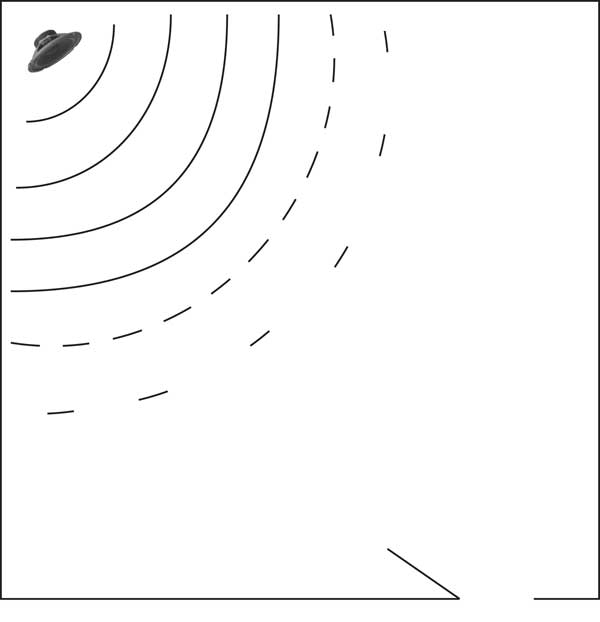
In order to illustrate these notions, consider the following basic example: a sound installation consisting of a single loudspeaker, placed at the corner of a large room opposite the entrance. The single speaker emits a 40-minute loop of slowly evolving radio static. Analysis of experiential form in such a work would begin by understanding the spatio-temporal unfolding of ‘energetic’ media architectures within the enclosing ‘material’ space (Sterken Reference Sterken2001: 263). In this case, a single speaker – localised at a particular corner – disperses sound throughout the room, with the sonic material (radio static) played back at a moderate dynamic level (see Figure 1).
Analysis of sonic media architecture in the example sound installation.
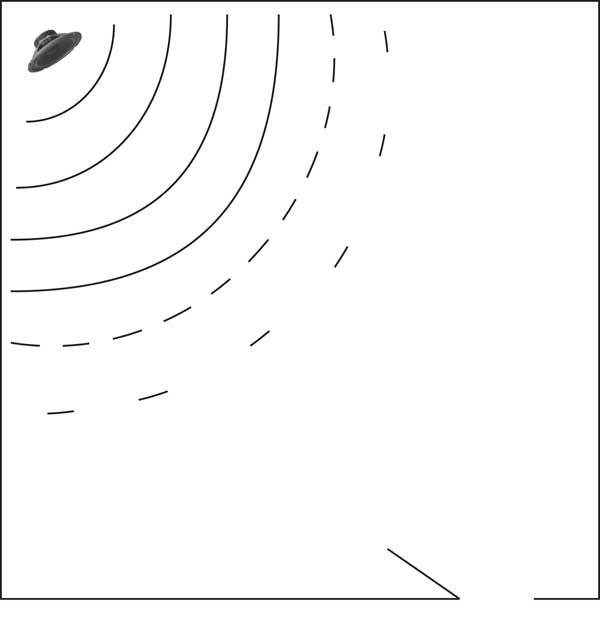
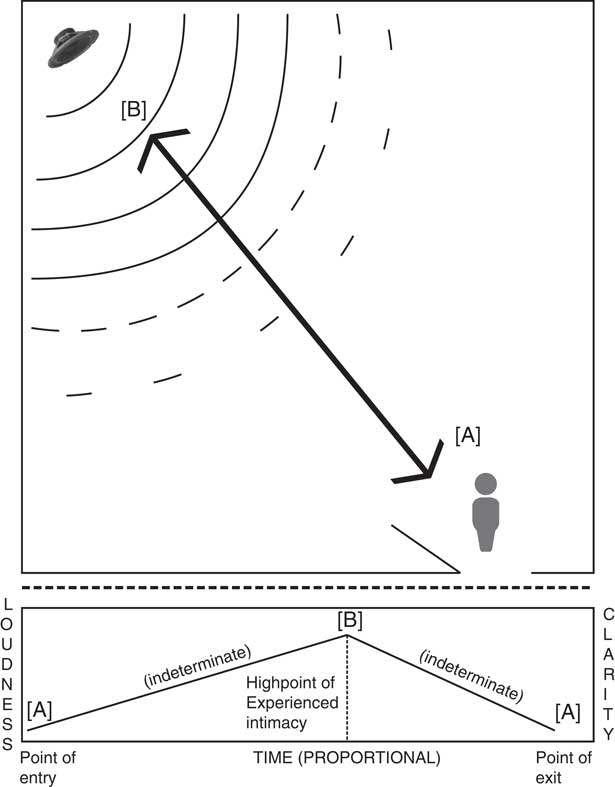
Although energetic space can be analysed from an objective standpoint independent of the perceiver, this abstraction bears little resemblance to the experience of installation works where ‘space [becomes] a pulsating encounter, created through movement of sounds, modified by movement of the person experiencing the space – movement … as space-shaping temporal process; space as time-space’ (Kern Reference Kern1984). That is, following the architectonic understanding of sonic media from a ‘bird’s-eye’ view, subsequent analysis must address the ways in which a visitor reconfigures their experience to sonic media through movement. In our example, given the placement of the speaker in the far end of an empty room (opposite the entrance), we can speculate that most visitors would spend an indeterminate period of time walking towards the speaker in order to investigate the sound-producing device (see Figure 2).
Analysis of the visitor’s movement affordances (above) and corresponding experiential formal shape in the example sound installation (below).
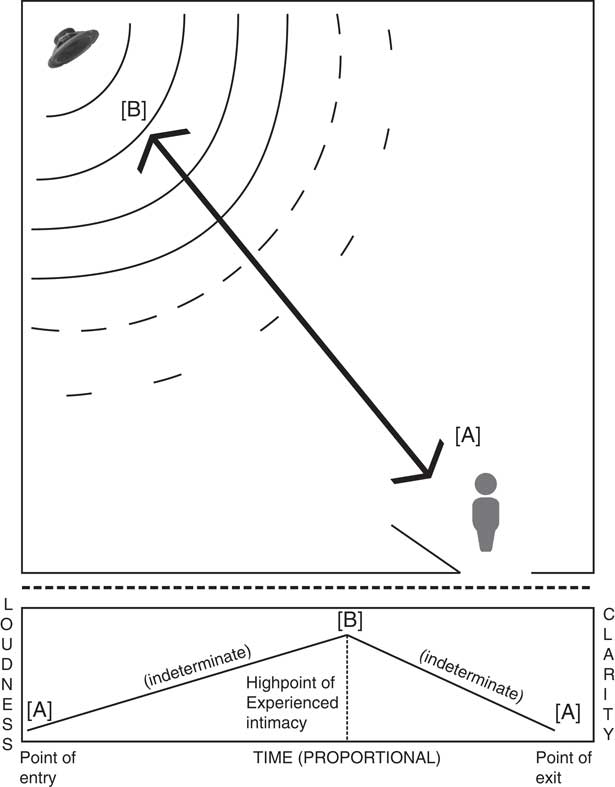
Analysing the hypothetical visitor’s resulting experience from a formal perspective – as if this was a concert piece – we can envision a perceptual increase in loudness and sonic clarity as the visitor approaches the speaker. Although the speed at which this change will occur as well as the overall time spent near the speaker before leaving the room is indeterminate, most visitors will experience a similar formal ‘shape’ despite their individual variations: an approach towards the sound source, a steady state while near the sound source (which may include additional movement near and away from the object), followed by movement away from the sound source and out of the presentation space. The possibility and likelihood of this experiential form can be traced to the artist’s decisions regarding spatial and sonic composition; for instance, placing the speaker right near the entrance way would not afford the same possibility.
An analysis of experiential form can also extend beyond the perceptual categories of loudness and clarity. For instance, the act of walking towards a speaker contains a psychological dimension: the visitor is encouraged (due to the lack of barriers in the room) to explore an unfamiliar environment until arriving at the object of attention and investigating it from a more intimate perspective. Depending on the placement of the speaker, various experiential affects can be afforded: pressing one’s ear against a speaker reproducing quiet sounds and mounted at head-height is considerably more intimate than looking up at an inaccessible (and perhaps imposing) speaker mounted overhead. Furthermore, as noted by Gaston Bachelard, specific architectural features such as corners, angles (‘cold’) and curves (‘warm … has nest-like powers’) afford symbolic and behaviour-altering meanings (Bachelard Reference Bachelard1994: 146). In this sense, placement of sound or media-emitting objects can be conceived as a compositional decision even within the supposedly neutral ‘white-cube’ setting of the gallery.
Although this example illustrates a very basic formal structure, it begins to clarify the relationship between spatio-temporal compositional strategies and the constrained possibilities of experiential form that could result. Adding additional media-producing elements while paying attention to their spatial placement and the affordances of the visitor’s movement can increase the complexity of the resulting experiential form. Spatial configurations can thus be envisioned as enabling a ‘bodily flow of an individual whose decisions as to where to be [construct] the [media] composition’ (Labelle Reference Labelle2006: 73).
4. SPATIAL COMPOSITION AS FORMAL CONSTRAINT
As seen in our example analysis, spatial design is one compositional aspect of sound and audiovisual installations. By composing spatially dispersed sound-producing objects, the artist creates a relationship between ‘built structures of … sound … and the human body’ (Leitner Reference Leitner2008: 135), while constraining the possibilities of spatio-temporal experience in collaboration with an active, mobile visitor.
Broadly speaking, most sound and audiovisual installations use variants of two general spatial design strategies, creating what I will term closed or open spaces. A closed space uses architectural barriers to restrict possibilities of visitor mobility while affording others. For instance, composer and artist Bernhard Gàl’s collaboration with architect Yumi Kori, Defragmentation/red, utilises the existing architecture of a water reservoir to create a light-and-sound saturated corridor through which visitors navigate. A closed space is created via the architectural barrier of a hallway and its movement affordances: visitors walk along a pre-determined path (the hallway), while controlling their own pace and direction (forward and backwards) within the given path. A closed space thus establishes a spatio-temporal sequence or quasi-linear narrative; ‘it is space which has a beginning and an end. Space is here a sequence of spatial sensations’ (Leitner Reference Leitner2008: 135).
In contrast, open spaces are characterised by fewer architectural barriers. The lack of architectural barriers allows viewers greater freedom in determining their movement pathways within a given spatial design. In this sense, open spaces allow multiple possibilities of linear narratives through space. For example, in my audiovisual installation Room Dynamics, 12 incandescent light bulbs and 12 small speakers are dispersed throughout a gallery space in various heights and locations. Spectator mobility is limited solely by the boundaries of the gallery space, as well as the occasional low-hanging light bulb around which a spectator may navigate. Otherwise, each visitor is free to move around the audiovisual environment, determining their own spatio-temporal pathway and resulting experiential sequence in collaboration with the built structures provided by the artist.
Some installations exhibit a hybrid set of features that relate to both closed and open spatial designs. For instance, artificiel’s condemned_bulbs – in which the Montréal-based collective activates 401000-watt incandescent bulbs through modulation of electrical voltage to each bulb, resulting in both light and sound (as the ‘singing’ of the filament resonates within the glass encasing) – uses a grid design that simultaneously encourages and restricts movement. This spatial design affords rectilinear movement pathways in a modified open space, where each row of light bulbs can be defined as a single closed spatial unit. Janet Cardiff’s The Forty Part Motet – in which a multitracked recording of Thomas Tallis’s Spem in Alium is presented using a circle of speakers surrounding a central seating area – operates in a similar manner: the spatial design encourages visitors to occupy the central area (to ‘be inside the work’) from which a mix of all voices can be heard, while allowing visitors to investigate the polyphony of voices by walking near the perimeter of speakers, rebalancing and remixing the perception of voices through movement.
In contrast to front-centric stage or cinematic presentation models, both open and closed spatial designs share an important feature: they encourage visitor movement through the eschewing of a privileged viewing (or listening) position. In this sense, by ‘[denying] the viewer any one ideal place from which to survey the work’ (Bishop Reference Bishop2005: 13) in its entirety, the artist creates an impetus for exploratory movement. In turn, it is this exploratory movement that actualises the work and co-produces the visitor’s experience of temporal formal structures.
5. MOBILE VISITORS AND CO-PRODUCED SPATIO-TEMPORAL STRUCTURES
As a visitor encounters a sound installation, exploring it spatially and sensorially, the resulting experiential form emerges through a process of co-production. Sound and audiovisual installations may be specifically designed in order to amplify this process.
Co-produced spatio-temporal structures operate through the geographical placement of relatively static (or slowly evolving) media materials within the presentation space. These spatial structures are experienced sequentially, mixed and balanced dynamically, by the visitor’s exploratory movement through the installation. That is, co-produced temporal structures exemplify the interrelation of space and time, as temporal development is activated exclusively by movement through space. In the absence of spectator movement, these structures can no longer be described as temporal, as they are not enacted in time. In this sense, co-produced temporal structures adapt musical-compositional strategies by relegating time from its status of ‘dominating linear band’ (Schulz Reference Schulz1999: 32) and elevating space as the primary compositional stratum; ‘[if] we can speak of [traditional] composition at all, then [such spatial approaches to compositional structures are] only a kind of generator for a process that in essence resists completion’ (Schulz Reference Schulz1999: 32).
In his text Sound Installation Art, composer and sound artist Robin Minard describes two compositional strategies with which he creates co-produced spatio-temporal structures: the ‘conditioning’ and ‘articulation’ of space (Minard Reference Minard1999: 75–9). A ‘conditioning of space … implies the creation of a static or uniform spatial state … [which] does not exclude slow evolutions in spatial characteristics’ (p. 75). A conditioned space produces a homogeneous media-architectural ‘“colouring” of the space’ (pp. 75–9), and a relatively uniform co-produced temporal structure, as movement does not usually correlate to significant sonic change.
An example of a co-produced spatio-temporal structure enabled through spatial conditioning can be found in La Monte Young and Marian Zazeela’s long-running installation Dream House. This work consists of a light-saturated room in which spatially dispersed loudspeakers produce singular, unchanging sinusoidal frequencies. Walking into the room, the visitor becomes aware of multiple psychoacoustic phenomena (binaural beat patterns as well as constructive and destructive phase interference) changing relative to their position. In my own experience of Dream House, even a slight tilting of the head will produce perceptible changes to the overall sound aggregate; however, as soon as one stands still, the sound becomes static. That is, the evolution of the sound aggregate (created through frequency and spatial relations of multiple sinusoidal waves) is animated in time through motion: a temporalisation of space (Labelle Reference Labelle2006: 162).
In contrast to spatial conditioning, Minard suggests that the ‘articulation of space … implies a spatialisation of sound … the spatial localisation of sound elements’ (Minard Reference Minard1999: 79). Within an open spatial design, an articulation of space creates ‘gradations in colouring effects … different “regions” of colour or luminosity instead of one uniform spatial colouring … [the perception of] different musical elements localised at different points in space’ (Minard Reference Minard1996: 19). For instance, Minard’s Music for Passageways, involves a quadraphonic composition playing through 32 speakers, each of which is embedded in vertically oriented pipes of particular dimensions and resonant tunings. As the spectator moves through the open space between resonant tubes, the temporal negotiation of pitch relation is enacted. Another such example can be found in Bernhard Leitner’s Parabolic Dishes. Beaming, in which parabolic dishes are used to create sonically demarcated spatial regions,Footnote 4 an ‘acoustically structured space’ (Leitner Reference Leitner2008: 90) through which visitors negotiate different sounds and timbres through spatial exploration.
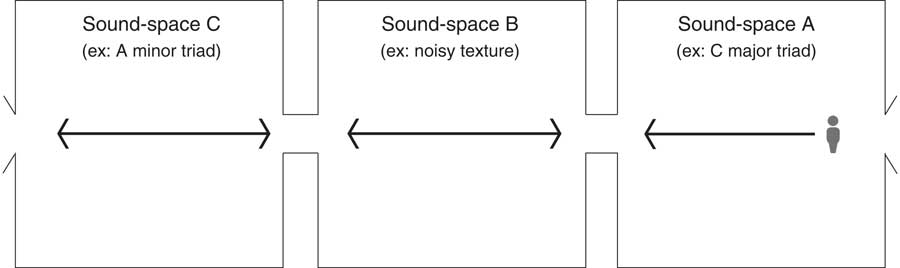
The ‘articulation of space’ (Minard Reference Minard1999: 79) in installations using closed spatial designs can offer a more deterministic variation of co-produced spatio-temporal structures. For instance, in Minard’s Stationen, a multichannel sound environment occupying a bell tower, the verticality of the material architecture is highlighted through ‘a vertically-organised sound colour … an overtone-based chord’ arranged from low to high in vertical space (Minard Reference Minard1999: 98). As the spectator ascends the bell tower, they attend to the rising sonorities occupying the space. In this manner, a determinate sequential structure (B always occurs after A or C) may be combined with the indeterminacy of the visitor’s direction and speed of movement, generating greater compositional control over perceptual sequences that are nonetheless co-produced.Footnote 5
The co-production of temporal sequence through movement using consecutive sound-spaces in a closed space.
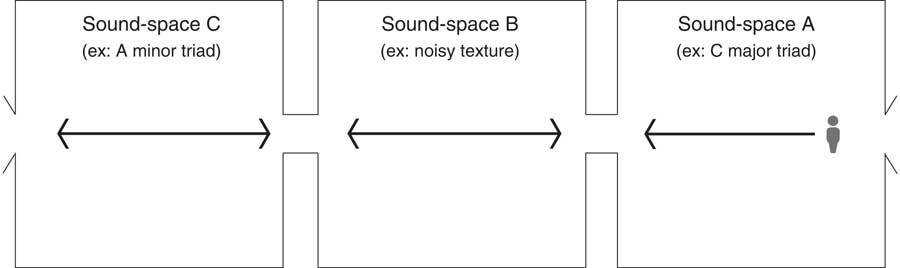
In this sense, one can imagine a formal structure using differentiated sonic materials which is composed spatially, but experienced temporally through the visitor’s movement at their own pace (see Figure 3). Once again, the combination of open spatial designs and ‘articulated’ media architectures can act as a catalyst for the visitor’s exploratory movement. That is, in ‘creating static [media] space in installations … which call forth different combinations of sounds depending on the listener’s position in the room … [the artist may provoke] an active exploration of the sound space’ (Gàl Reference Gàl2005: 71). In this sense, the ‘articulation of space’ (Minard Reference Minard1999: 79) can create the very conditions necessary for its perception as co-produced spatio-temporal structure.
6. MOTIVIC UNITS AND DEVELOPMENTAL WRITING IN INSTALLATION CONTEXTS
Despite the differences between concert and installation contexts, some traditionally musical concepts of motivic writing – the repetition, variation and contrasting of recognisable motivic units – can be adapted to installation contexts in order to create perceptually salient, developmental structures. Although motifs can be perceived from a static vantage point, their inclusion within an artistic context in which visitor movement is encouraged results in an encounter between two temporalities: (1) the intra-work temporal development of media materials and (2) the spatio-temporal experiential re-sequencing enacted by a mobile visitor. In this sense, the experience of motivic structures in installations is still co-produced through ‘collaboration’ between artist and visitor. However, in contrast to strategies involving co-produced spatio-temporal structures, motivic structures can develop in time independently of the visitor’s movement.
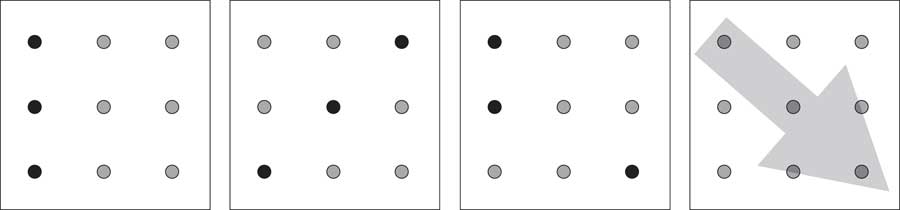
With greater emphasis on spatial experience in installation contexts, space emerges as a new compositional stratum in which relationships between materials may be expressed. In other words, spatial positioning of motivic materials can create, reinforce, or modify developmental structures. If we consider sound-producing objects (or assemblages in the case of acoustic-mechanical sound installations) as instrumental ensembles, the activation of a solitary sound-producing object can be conceived as a solo; the activation of two objects in dialogue, a duet; the activation of a group of objects, a section or aggregate. Following the metaphor of an instrumental ensemble, the playback of a short sound event (for instance, a staccato-like impact sound) by one loudspeaker followed by the exact repetition of the sound from a different loudspeaker is not perceived as a direct repetition (as it perhaps would if emitted twice from the same loudspeaker). Rather, the spatial location of the sound has varied, and thus, the two sounds are perceived as closely related, yet nonetheless distinct, sonic units. This adaptation of musical counterpoint to the spatial realm offers a powerful device with which to create developmental spatio-temporal structures in installation works (see Figure 4). The effectiveness of this device stems from the organic synthesis of the strengths of each medium: the musical comparison of related motifs based on similarity and temporal displacement is combined with installation art’s consideration of experiential aspects of space.
Spatial counterpoint figures as a prominent compositional device in Iannis Xenakis’s commentaries and dramaturgical sketches of Polytope de Montréal. In this work, 1,200 light-emitting objects, mounted on various architectural ruled surfaces, are divided into ‘vertical and horizontal cross-sections’, differentiated in layered levels using mathematical systems such as the ‘theory of Groups’ (Xenakis Reference Xenakis2008: 213). Spatial counterpoint enables the demarcation of different light gestalt units while governing their temporal development through space: light-gestalts ‘collide … evolve’ (p. 202), perform ‘rhythmic invasion’ (p. 213), become ‘stationary, or mobile, slowed down or accelerated, revolving, contracted, or dilated’ (p. 257). Xenakis further develops spatially differentiated light gestalts in time through ‘logical operators of conjunction, disjunction, or of complementary action’ (p. 258).
Analysing Xenakis’s writings alongside the partial video documentation of the second indoor polytope, the Polytope de Cluny, one can glean two related compositional devices: spatial transposition and spatial modulation of motifs. Spatial transposition involves a spatial displacement of a sonic or audiovisual gestalt. Akin to the transposition of musical notes, the internal relations of the gestalt (size/volume, behaviour, tempo, timbre, etc.) remain intact; it is only the positioning in space (the pitch-space of the stave, the surrounding architectural space) that changes. In contrast, spatial modulation involves a variation of the original gestalt: a ‘responding’ gesture, such as a spatial inversion (along one or several axes) of a sonic or audiovisual trajectory. Algorithmic application of spatial transposition and modulation are used extensively in my work Room Dynamics to develop contrapuntal structures in space, articulating spatially distinct motifs and governing their temporal development.Footnote 6
Similarly, principles of spatial transposition and modulation can be extended to the composition and development of simultaneously activated object aggregates: the motivic use of spatial units within a media architecture. Simple spatial units, for example, ‘lines’ of adjacently activated light and sound-producing objects in my installation Room Dynamics, can be used as effective motivic units due to their recognisability. The temporal development of such motivic units can then be algorithmically governed by principles of spatial transposition and modulation. Such simple, geometrical aggregates are commonly used in works using grid-formations (see, for instance, artificiel’s condemned bulbs or Ziegler’s forest 2 – cellular automaton), as this spatial design allows the creation of various simple shapes (straight or curved lines, squares, circles, etc.).
However, simultaneous activation of sound-producing or audiovisual objects can also occur without the inscription of a discernible shape (such as a line or circle) in space. Such activation of non-adjacent object-aggregates may be likened to the inscription of a sonic or audiovisual ‘chord’ in space. Just as the vertical axis of pitch-relations provides a measure of intervallic distance between simultaneous pitches, the three-dimensional space of an audiovisual architecture can afford a sense of distance-relation between simultaneously activated media-producing objects. However, this distance-relation is purely spatial, and thus much poorer than pitch relations in terms of resolution and perceptual salience, while lacking the hierarchical nature of harmonic pitch relations altogether. In this sense, the extension of the musical metaphor of the ‘chord’ to the spatial realm is significantly limited: care in the composition of each spatial ‘chord’, as well as limiting the total number of ‘chords’ used is necessary, or progressions of spatial ‘chords’ will be reduced to meaningless perceptual ‘noise’. The use of spatial chords in Chris Ziegler and Paul Modler’s audiovisual performance-installation Neoson (video example 1) – in which a media architecture of computer controlled neon tubes to which transducers are attached – is especially effective due to (1) a low number of spatial chords coupled with (2) subtle variability of articulation applied to each activated audiovisual object. Another successful use of spatial chords – albeit within a much smaller spatial setting – can be seen in Nicolas Bernier’s audiovisual performance for mechanically controlled tuning forks frequencies (a).
In addition to individual media-objects, simple shapes and ‘chord’-like arrangements of object-aggregates, dynamic trajectories of media materials (involving sequential activation of adjacent media-producing objects) can also be used as motivic units with which to develop time-based structures. The motivic use of quick successions of spatially distributed sound events, perceived as sonic trajectories, can be found in Bernhard Leitner’s works Serpentinata (a serpent-like construction on which 40 loudspeakers are mounted) and Ton-Raum TU Berlin (a site-specific installation consisting of 42 loudspeaker). In both works, rapidly displaced sounds create the sensation of movement, while individual movement trajectories are identified based on their speed, starting and ending location, and sonic quality.
Particularly salient media trajectories – for instance, the audiovisual diagonal trajectory experienced in Chris Ziegler’s Forest 2 – cellular automaton (video example 2) – can also be used as a repeated motif that structures or demarcates larger temporal sections. Another variation on this technique is evident in Ziegler and Modler’s Neoson (video example 3), in which slow audiovisual trajectories are created through overlapping sound and light intensity ramps. The resulting dynamic spatial transformation is recognisable as a motif, while highlighting both the architectural divisions of the space (through increased reflectivity in semi-closed chambers) and the continuity between adjacent chambers.
Four strategies for developmental motivic writing in an ensemble of nine media objects (from left to right): (a) a simple shape and its (b) spatial modulation, (c) a spatial ‘chord’ and (d) a movement trajectory.
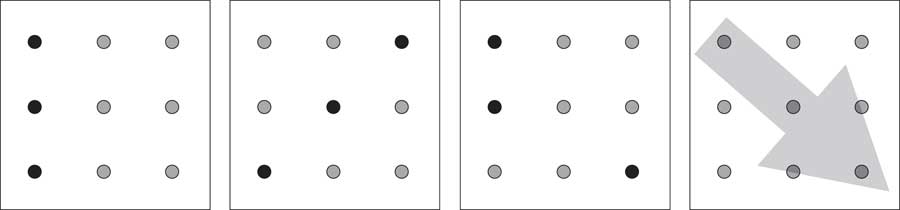
Once sonic or audiovisual trajectories are identified as motifs, these structural units can be developed throughout a given time-period using through-composed or algorithmic approaches. The latter is used extensively in my work Room Dynamics, as audiovisual trajectories are developed and varied through aleatoric changes in the speed, intensity, duration, spatial pathway, and sonic manifestation (video example 4). These quick successions of light and sound intensities transform the appearance, size and character of navigable space, while exhibiting larger developmental movement from slow to fast, near-stroboscopic trajectories.
7. INSTALLATION ‘STATES’, MACRO-STRUCTURES AND NESTED FORMS
Although a singular co-produced or motivic-developmental compositional strategy can comprise the entire formal structure of a given installation, it is not uncommon for several strategies to be combined sequentially in order to create complex macro-scale formal structures. In this situation, each cohesive compositional strategy may be conceived as an installation ‘state’. Similar in some respects to musical movements or sections, installation ‘states’ differ from the former in several respects. Generally, musical movements appear once within the fixed temporal structure of the work, and (with exception of works such as Karlheinz Stockhausen’s Klavierstück XI, in which movement order is modular) their sequence is usually fixed. In contrast, in a continuously running installation, a ‘state’ can manifest numerous times in various sequential orders.
Given the possibility that a single installation ‘state’ may manifest multiple times within a visitor’s experience of the work, variation between subsequent re-manifestations may be desired. In Room Dynamics, unique manifestation of each installation state is achieved through application of algorithmic principles to various compositional parameters. For instance, algorithmic principles can be applied to macro-compositional parameters, such as density of events (for instance, density of audiovisual pulses, video example 5, excerpt from Room Dynamics), in order to create a unique manifestation of similar large-scale compositional gestures. In other cases, variation within an installation ‘state’ can be achieved through interactive or responsive systems: both Chris Ziegler’s Forest 2 – cellular automaton and UVA’s Array track spectator movements, using the resulting data to modify compositional parameters. This results in a unique manifestation of installation ‘states’ based on the behaviour of spectators (Ziegler, 2013: personal correspondence; UVA).
In most installations using multiple ‘states’, the sequencing or ordering of each installation ‘state’ is determined through one of two general approaches. The most basic type of formal structuring involves the creation of a fixed order of ‘states’ that repeat indefinitely: in other words, a loop, usually exhibiting some form of developmental structure. At times, the length of the compositional loop is longer than the average duration experienced by a visitor; consequently, a visitor’s experience of formal structure may not relate to the one prescribed by the artist. However, reflecting on his use of fixed sonic loops of approximately 45 minute duration in his sound installations, Berhard Gál comments that while ‘in many cases the offered sound situations are much too long … [for the average visitor’s exposure to a work, it is] certainly no mistake to shape places so that people want to remain there, so that they want and get more from an installation’ (Gál 2005: 68).
A second approach to the creation of macro-scale formal structures involves indeterminate sequential order of installation ‘states’, not unlike musical works using mobile form. For instance, Gál’s RGB, in which ‘nine different light and sound choreographies … [define the] perceptual space for three to five minutes’ (Gál 2005: 40) uses uniform randomness to govern the order of sound and light ‘states’. While the resulting macro-form does not exhibit a developmental approach to form, it can be considered an audiovisual variation of Stockhausen’s ‘moment form’, in which ‘self contained entities, capable of standing on their own [are still] in some nonlinear sense belonging to the context of the composition’ (Kramer Reference Kramer1988: 207).
An indeterminate sequence of installation ‘states’ does not necessarily imply randomness or the eschewing of macro-scale developmental structures. For instance, in my installation Room Dynamics, a macro-scale modular form following a developmental structure – a movement from highly individualised light and sound behaviours towards coordinated group behaviours – is achieved through algorithmic processes. In this rule-based process, 18 possible installation ‘states’ are considered for selection based on a first-order Markov chain, operating alongside a ‘self-monitoring’ system which excludes future possibilities based on their past frequency and time of occurrence. For example, ‘installation state A’ may transition to states ‘B’, ‘C’ or ‘D’ (all of which manifest increased density of events) but never ‘E’ or ‘F’ (which manifest decreased density of events); however, since ‘state D’ has been recently manifested, it is excluded from the transition table, with states ‘B’ and ‘C’ remaining as the only transition possibilities. This approach results in several perceptually salient formal arc-structures, which manifest throughout variable durations (between 25 and 45 minutes) while utilising different sets of constituent installation ‘states’.
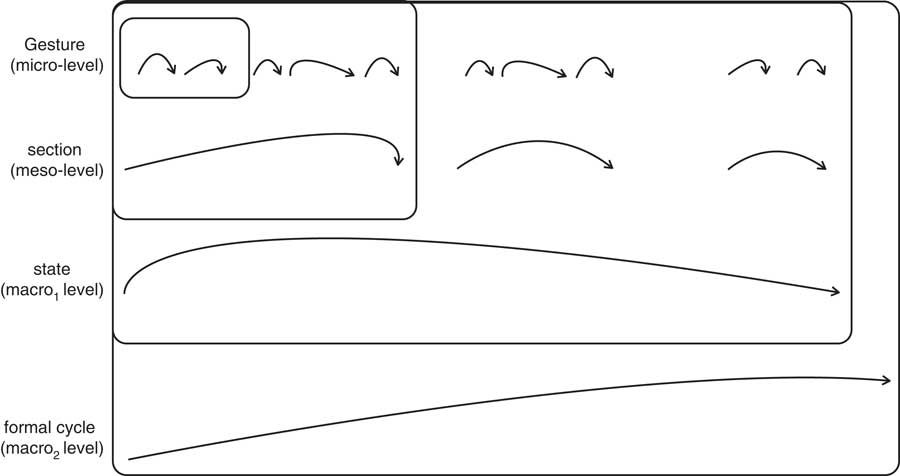
Due to limited time in the installation space, it is unlikely most visitors will perceive macro-scale developmental arc structures in full. Rather, depending on the temporal frame enacted by the visitor – the points at which they choose to enter and leave the installation, as well as the elapsed duration of their stay – most will only perceive fragments of macro-level structures. In order to address the indeterminate period of exposure to the installation, Room Dynamics is designed using the concept of nested compositional arcs existing simultaneously in multiple formal levels (see Figure 5): micro (gesture), meso (section) and macro (‘state’, formal cycle of a collection of subsequent ‘states’). In this manner, visitors may attend to developmental ‘“local [or] fractal forms” – small segments … designed to be grasped at shorter and more immediate timescales and pieced together in many possible ways’ while creating the possibility for ‘[revelation of] the shape and order of larger structures’ (Emmerson Reference Emmerson2014: 8)
Nested developmental arcs in overlapping temporal levels in Room Dynamics.
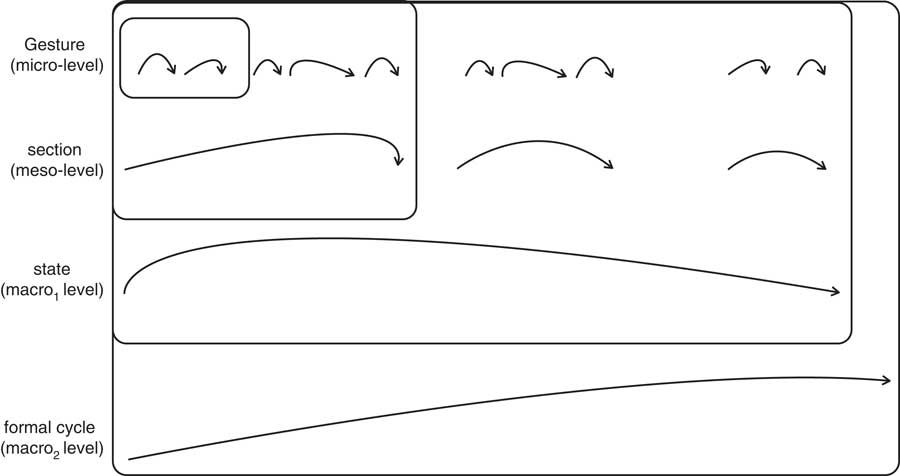
With this approach, algorithmically controlled developmental arcs can be applied to various compositional parameters throughout the work. For example, the micro-level arcs may control density of audiovisual trajectories while the meso-level arc controls a timbral development; macro1-level (‘state’) arc may control a global parameter such as loudness of sonic component, while macro2-level can control a spatial development of events from the centre of the room to its peripheries. By composing multiple developmental arcs in simultaneous temporal levels, the visitor is guaranteed to experience some sense of movement or development towards an as-of-yet unattained ‘goal’ or manifestation, regardless of the particular time-period in which they explore the installation. The resulting sense of development may even encourage some visitors to extend their durational experience of the work in order to attend to these developing macro-level structures. That is, by appealing to the visitor’s sense of curiosity as to ‘how things will develop’ or ‘what will happen next’, the use of nested developmental arcs increases the possibility that macro-scale formal structures will be perceived.
8. FUTURE PERSPECTIVES
By considering installations from a compositional and formal standpoint, my inquiry offers new perspectives on the temporal dimensions of sound and audiovisual installations. By repurposing the concept of musical form to installation contexts and defining first-person experiential form as an experimental model through which time-based dimensions of installations can be considered, a renewed set of tools becomes available for analysis and creation of sound installations. While the adaptation of musical concepts to the installation context can occasionally be difficult, in my own experience, the ‘conceptual dissonance’ between the initial idea and its problematic adaptation can be used as a critical lens through which new theoretical models and practical techniques are developed.
Although the compositional techniques suggested – including composition of open and closed spaces, the co-production of spatio-temporal structures and the use of motivic units in nested compositional arcs – are inevitably preliminary and incomplete, they provide initial directions for future practice-based work and theoretical inquiry in this area. Certainly, further writing on the temporal dimensions of media installations by composers, in terms of creation and perception of temporal form, would be helpful in placing my own reflections within a wider context. At the same time, such scholarship would provide a necessary complementary perspective to the predominantly visual art-centric discourse on sound art and audiovisual installations.
Some of my proposals could be applicable not only to the study of temporal dimensions of media installations, but also to a re-engagement with musical form beyond the concert setting. For instance, some of the reflections, approaches, and inherent problems discussed above may be of relevance to the study of musical situations involving mobile audiences, such as concert-installations (whether using electronic sound production methods or live instrumentalists, as seen in Anthony Braxton’s Sonic Genome Project), music with interactive or audience participation components, site-specific musical interventions, or soundwalks. Perhaps some methodologies may even be useful for analysis of existing experimental concert-music works, which could be theorised as precursors to concert-installations due to extensive duration or modified presentation practice (Morton Feldman’s String Quartet II is but one example).
In my own artistic practice, I have found the approaches and techniques detailed in this article to be useful in the contemplation and creation of temporal form in sound installations. However, much like musical composition, the creative act is never as simple as choosing a formal template or strategy and populating it with ‘content’; balancing spatial and temporal compositional strategies while attending to the ways in which these strategies interact with one another (as well as the work’s conceptual subject matter or site-specific location) can not, thankfully, be reduced to a set of guidelines. However, by extending the notion of musical form outwards in space and time in a manner integrating the visitor as a collaborator or co-producer of the work, an in-depth discussion of such issues can begin.
Supplementary Material
To view supplementary material for this article, please visit http://dx.doi.org/10.1017/S1355771815000059