Disasters, whether they are natural or man-made, can do tremendous damage to many aspects of our lives, resulting in much death and disability. China has experienced several detrimental disasters in recent years, including the Sichuan earthquakes in 2008, the Yushu earthquakes in 2010, and the Tianjin explosion in early 2015. In other areas where natural disasters rarely take place, such as Guangzhou, the third largest city in China and the largest in south China, man-made disasters are deemed likely to happen because of the large population and the large number of industries crowded within limited spaces. Disasters such as fires and chemical poisonous gas leakage are particularly likely.
To reduce the harmful impacts of disasters, effective preparedness and response strategies are badly needed.Reference Rokkas, Cornell and Steenkamp 1 The World Health Organization has stressed that preventive measures and preparedness are of equal and perhaps more fundamental importance, despite the importance of relief supplies in emergencies. 2 In China, the State Council recently published the national comprehensive disaster prevention and reduction plan (2011-2015), 3 which emphasizes the principle “Prevention first, comprehensive disaster reductive intervention.” A greater emphasis on efforts to put on disaster education is a critical part of the plan, which aims at raising public awareness of disaster prevention and reduction by offering appropriate education programs to the public and in different school settings, including primary schools, high schools, and universities.
University students are a special group of people who are characterized by great flexibility in thinking and reasoning, able to adapt to challenging situations and analyze multiple pieces of information simultaneously. University students are believed to have better planning and organization skills, to have better control of impulses, and to be able to allocate attention to a specific task under high-pressure situations.Reference Codreanu, Celenza and Alabdulkarim 4 Having these qualities, university students should be able to learn rescue knowledge and skills more quickly and effectively than other populations. They can be a great force for disaster reduction in public rescue and disaster education if they receive adequate disaster education during college. What’s more important, after graduating from school, they will become part of the public and be able to influence all of society. Not only can they protect themselves by having the necessary rescue skills during and after disasters, but they will also be able to help and educate others with their disaster preparedness knowledge.
On the other hand, research on disaster preparedness among university students has suggested that university students are more vulnerable to disasters compared with the general public and are overlooked in preparedness efforts.Reference Tanner and Doberstein 5 - Reference Lu, Chen and Cai 8 For instance, studies indicated that 53.4% to 91.2% of university students failed the disaster coping knowledge and skills tests,Reference Mai and Zhang 7 , Reference Chen, Fang and Liu 9 and 65.6% to 88.5% of students had no disaster rescue skills learning experiences.Reference Mai and Zhang 7 , Reference Lu, Chen and Cai 8 Among all kinds of disasters preparedness, coping with fire was the biggest worry.Reference Dong, Chen and Wang 10
Education is an important way to improve disaster preparedness among university students, and disaster preparedness should be a crucial component of the college curriculum.Reference Jose and Dufrene 11 , Reference Loke and Fung 12 The current status of disaster education at the university level remains unexplored in China. Most of the educational research on disaster preparedness has focused only on health professional students;Reference Loke and Fung 12 little is known about students from other disciplines. Specifically, we do not know how much disaster knowledge students already have and what knowledge and skills students need to learn. The current study aimed to address these 2 issues by surveying university students on designed items.
The Guangzhou Higher Education Mega (GHEM) center is located in an island of Panyu District, Guangzhou, China. It has been built up from a village since 2003. Its area is about 34.3 square kilometers and can accommodate nearly 180,000 students, which make up 15% and 30% of Guangdong Province’s undergraduate and graduate student population, respectively. The total population amounts to 350,000 people (including the remaining village population) and is equivalent to a medium-sized city. Ten universities have campuses in GHEM: Sun Yat-Sen University (SYSU), South China University of Technology (SCUT), Guangdong University of Foreign Studies (GUFS), South China Normal University (SCNU), Guangdong University of Technology (GUT), Guangdong Pharmaceutical University (GPU), Guangzhou University of Chinese Medicine (GUCM), Guangzhou University (GU), Guangzhou Academy of Fine Arts (GAFA), and Xinghai Conservatory of Music (XCM). Of these 10 universities, SYSU, SCUT, SCNU, and GU are comprehensive universities providing programs in all disciplines; GPU and GUCM are specialized in medicine; GAFA and XCM are specialized in art; and the other universities including GUFS and GUT mainly focus on foreign study and technology, respectively. These 10 universities provide various programs, including undergraduate-diploma, undergraduate, and graduate. GHEM is a great place for academic communication and student contacts because of its convenient space and is a good place to study university students’ disaster education for centralized universities.
This study aimed to investigate the current status of disaster education and students’ demand for future disaster education in GHEM. This study was designed to obtain insights for developing appropriate disaster education courses for university students in Guangzhou.
METHODS
Participants and Sampling
This was a cross-sectional study. Students from 10 universities in GHEM were recruited, and convenience sampling was used for this study.
Questionnaire
A self-administered questionnaire was developed by the authors to assess the current status of and the demand for disaster education. The questionnaire was based on a review of relevant literature and questionnaires and included 3 parts. The first part collected demographic information including gender, major, year of school, student’s program (undergraduate-diploma, undergraduate, or graduate), school type, number of children in one’s family, and home location. The second part assessed the current status of disaster education from the aspects of experience and resources. The last part measured the student’s demand for future disaster education, including 2 questions concerning whether a systematic course in the university is necessary and whether the student would enroll in such a course if it were available. These 2 questions measured the student’s need for a disaster education course and their willingness to enroll in the course. The last part also included 16 items on the specific content of disaster education. Students were asked to rate the 16 items on a 5-point Likert scale to indicate their need for a specific content, with 1 indicating “strongly not needed” and 5 indicating “strongly needed.” Higher scores indicated higher demand for the specific content. The content validity of the questionnaire was reviewed and evaluated by experts from universities and hospitals in the field of disaster medicine and disaster education. The Cronbach α for the 16 items was 0.815.
Data Collection
Data collection was conducted from September 2013 to July 2014. Five trained undergraduates were the data collectors. For each participant, informed consent was obtained right before the data collection. The data collectors explained the purpose, use of data, and importance of the study before the data collection. The collection proceeded at rest time in the participant’s dormitory. The questionnaires were collected on the spot after the participants finished with their responses.
Data Analysis
All statistical analyses were done with the SPSS statistical software package (version 16; IBM Corp, Armonk, NY). Chi-square analyses were conducted to determine the association of the demographic variables (ie, gender, major, year of school, student’s program, school type, number of children in one’s family, and home location) with experience, demand, and willingness to attend. Independent sample t-tests for dichotomous variables (eg, gender) and 1-way ANOVA for ordinal variables (eg, year of school) were conducted with disaster education context as the dependent variable to determine its associations with the demographic variables. The significance a level was set at 0.05 for all analyses.
RESULTS
Demographics
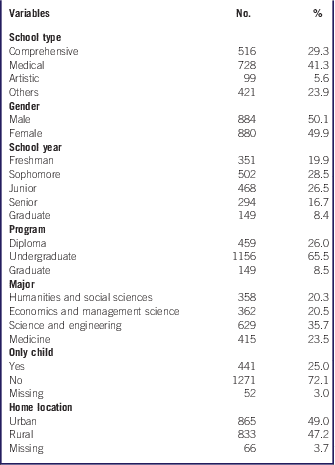
A total of 2000 questionnaires were administered and 1893 questionnaires were returned, resulting in a response rate of 94.7%. A total of 1764 questionnaires were valid, resulting in a valid response rate of 88.2%. Medical students were the majority of respondents, making up 41.3% of the sample, followed by students from comprehensive universities, who made up 29.3% of the sample. The numbers of male and female participants were almost equal (male, n=884; female, n=880). The sample mainly consisted of undergraduate students (91.5%), and among them, sophomores and juniors made up the majority (28.5% and 26.5%, respectively). The majority of participants majored in science and engineering (35.7%). One-quarter of participants were the only child in their family, and 49.0% of participants had their home located in an urban area. The demographic information is presented in Table 1.
Demographic Information of the Participants

Current Status of Disaster Education
In total, 1373 of the participants (ie, 77.8%) had received disaster education before, through lectures (38.0%), courses (32.4%), activities at the students’ union (11.0%), and other resources (9.9%; eg, Internet, TV, and family education).
Demand for a Disaster Education Course
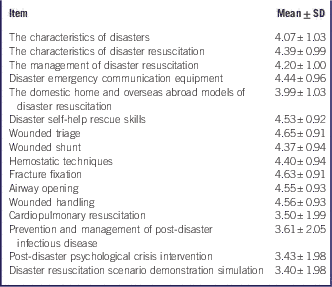
In total, of the 1764 participants, 1508 (85.5%) indicated that a systematic course of disaster education should be offered in universities and 1330 participants (75.4%) indicated that they would like to enroll in such a course if it were available. For disaster course content, the total mean score for the 16 items was 4.17 (with a standard deviation of 0.84), and individual item mean scores are presented in Table 2. Among the 16 items, the items on disaster rescue skills (eg, “wounded triage,” “fracture fixation,” “wounded handling,” and “airway opening”) were rated with the highest scores, indicating that these emergency rescue skills were most needed by the participants.
Students’ Demand for Disaster Course Content

Current Status and Future Demand by Demographics
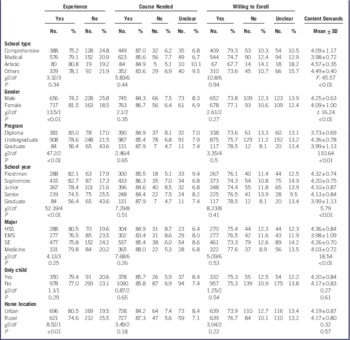
Table 3 presents the results from the chi-square analyses of disaster education experience (experience), the need for a disaster education course (course needed), and willingness to enroll in the disaster education course (willing to enroll) by demographic information. The last column presents the results from the t-tests or ANOVA tests for the demand for disaster course content (content demands).
Associations Between Demographics and Disaster EducationFootnote a

a Abbreviations: HSS, humanities and social sciences; EMS: economics and management science; SE, science and engineering.
For education experience, significant differences were observed between genders (χ2/df=13.5/1, P<0.01), with female students having had more education experiences than male students (81.5% vs. 74.2%, respectively); across programs (χ2/df=47.2/2, P<0.01), with graduate students having had much fewer education experiences than undergraduates (56.4% vs. 78.6% and 83.0% of diploma students, respectively); across school year (χ2/df=52.19/4, P<0.01), with freshmen and juniors tending to have more education experience (82.1% and 82.7%, respectively); and between home locations (χ2/df=8.52/1, P<0.01), with students from urban areas having had more disaster education than students from rural areas (80.5% vs. 74.6%, respectively). No statistically significant difference was found for “course needed” or “willing to enroll” by demographic variables.
For content demands, statistically significant differences were observed for all demographic variables except “only child” and “home location.” Post hoc analyses were conducted after a significant robust F test was observed. Bonferroni correction was used to adjust the type I error rate.
School Type
The results suggested that there was an overall significant difference across school types [F (3, 1759)=45.57; P<0.01]. Post hoc analysis was conducted and suggested that, on average, artistic students (mean=4.57) and students from other school types (mean=4.49) rated significantly higher scores than did medical students (mean=3.98) and students from comprehensive schools.
Gender
Male students rated higher scores (4.25) than female students (mean=4.09).
Program
An overall difference was observed across programs [F (2, 1760)=110.64; P<0.01]. Post hoc analysis was conducted and suggested that, on average, undergraduate students rated significantly higher (mean=4.36) than graduate students (mean=3.99), and graduate students rated significantly higher than undergraduate-diploma students (mean=3.73).
School Year
An overall difference was observed across school years [F (4, 1758)=5.79; P<0.01]. Post hoc analysis was conducted and suggested that, on average, freshmen rated significantly higher scores (mean=4.32) than juniors (mean=4.10), seniors (mean=4.13), and graduate students (mean=3.99).
Major
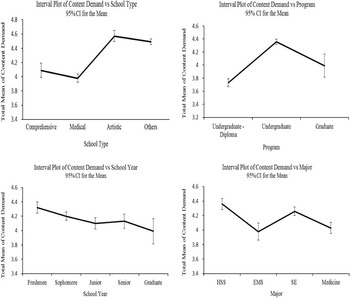
An overall difference was observed across majors [F (3, 1759)=18.54; P<0.01]. Post hoc analysis was conducted and suggested that, on average, students from humanities and social sciences (mean=4.36) rated significantly higher than students from science and engineering (mean=4.26), and both rated significantly higher scores than students from economics and management science (mean=3.98) and students from medicine (mean=4.03). The mean comparisons for the post hoc analyses are presented in Figure 1.
Interval Plot of Demand for Disaster Education Content by School Type, Program, School Year, and Major. Abbreviations: CI, confidence interval; HSS, humanities and social sciences; EMS, economics and management science: SE, science and engineering.

DISCUSSION
Nowadays, disaster preparedness is getting more and more attention from all of society. The rapid increase in public awareness of disaster preparedness may have provided a great opportunity to improve our society-level disaster preparedness. Improving the disaster coping skills of the general public and university students has been a key component of the disaster prevention and reduction plan. 3 , Reference Yeager, Menachemi and McCormick 13 Because it is believed that university students are a special group who are able to have an influential impact on all of society, the current study focused on improving disaster preparedness among university students. Meanwhile, the Chinese government also requires universities to establish a disaster preparedness plan that is linked to the broader national emergency management plan.Reference Cusack, Arbon and Ranse 14
Our findings revealed that although most of the students had some disaster education experience, a majority of students still indicated that a systematic disaster preparedness education course should be offered at universities. This observed discrepancy could be due to the fact that most of the students’ disaster education experiences were superficial and did not really help with disaster preparedness in deed. This finding suggests that current disaster education courses, if available, are not meeting the students’ need.
Although some related courses offered at universities may have introduced fragments of disaster prevention and reduction education, and students may be able to acquire some knowledge and skills from outside class either actively or passively, that education is far behind the need of students. As shown, university students are creative and energetic for learning, and universities are the perfect places to pass on knowledge and skills. With that said, a disaster education course focused on disaster preparedness should be developed and offered to students at universities.
The results from this study, particularly those observed from human science students, suggested that a systematic disaster education course with a focus on rescue skills should be developed and offered at universities. Rescue skills can be used by students to save themselves and others in emergency situations and are critical skills needed by the public in disaster preparedness. If university students can master rescue skills during their college studies, they can be a remarkable force in disaster prevention and reduction after graduation.
Among all rescue skills addressed in the survey, wounded triage, fracture fixation, wounded handling, and self-help rescue skills were the most desired, followed by hemostatic techniques and wounded shunt. Surprisingly, cardiopulmonary resuscitation (CPR) was least desired. To our knowledge, many schools have courses or lectures to teach students CPR, but other skills are unfamiliar to them. On the other hand, fracture fixation, hemostatic techniques, and wounded shunt are more common in disaster rescue. Therefore, the core of these disaster education courses should include the techniques of how to deal with the wounded in a disaster and not be limited to CPR. To develop a disaster course attractive to university students, the keys are these techniques on how to deal with the wounded in a disaster, which should be systematically arranged in simulated disaster scenes.
Practically, learning rescue skills is the most difficult part of disaster education and should be supervised by professionals and requires a certain amount of hands-on practice. It seems plausible for students to learn rescue skills to a certain degree just by taking courses that are focused on theoretical knowledge, or by studying materials by themselves from the Internet. However, professional-level rescue skills have to be learned from professionals, and enough hands-on activity is needed to grasp the skills. Nonmedical universities may face challenges in offering disaster education courses in the sense that they may not have the necessary resources (eg, professionals, equipment) to support the courses. With this consideration in mind, collaborations should be established between universities in GHEM to make better use of resources that are only available in particular universities. Obviously, the medical or nursing schools should take responsibility for training students’ rescue skills and take a leading role in developing an intercollegiate disaster education course. The medical/nursing school campus can be used as the training base.Reference Cusack, Arbon and Ranse 14
An interesting finding of the current study was that medical students demonstrated almost the same level of disaster education experience and disaster education demand as did students from other universities, which suggests that disaster education needs to be improved not only at regular universities but also at medical schools. The literature reveals that most of the existing disaster education courses offered at some medical schools were optional.Reference Öztekin, Larson and Altun Uğraş 15 What’s more, some of the faculty at medical and nursing schools themselves did not have enough disaster preparedness knowledge and rescue skills.
Our findings suggest that upperclassmen have fewer disaster education experiences compared with their peers from lower classes. This phenomenon may be a result of upperclassmen having less passion in participating in student union activities and lowerclassmen having more interest in learning disaster preparedness knowledge because of their increased awareness of the need for it. Findings from the current study suggest that university students may not have the desired level of disaster preparedness when entering society after graduation.
Another point we want to make, which is supported by findings from both the current study and previous studies, is that disaster education should consist of a series of courses and be offered to students at different class levels each and every semester. As was found with the existing college curriculum, a single disaster education course could not meet the students’ need for disaster preparedness education. Research on health professional students’ disaster preparedness has suggested that simulation can increase students’ understanding of disaster preparedness and their ability and confidence in handling disastrous situations and working in teams.Reference Loke and Fung 12 , Reference Kaplan, Connor and Ferranti 16 Taking this perspective, disaster education should be provided in multiple forms, including giving in-class lectures, holding student union activities, and providing hands-on practice. For example, an in-class lecture, which mainly introduces rescue skills related to disaster-induced injury, should be offered to the first-year student, and then disaster drills should be scheduled for these students every semester in their following semesters.
The current findings suggest that male students are less likely to have had disaster experience compared with female students. In Chinese culture, girls are considered frailer than boys, so families usually pay more attention to teaching girls skills to keep themselves away from dangerous situations. The current finding also suggests that male students were relatively passive in seeking disaster education resources, which may relate to the phenomenon that male students often devoted more time to playing computer games than did female students. Thus, developing online courses designed as disaster educational games should be a potential part of systematic disaster education.
Another interesting finding from the current study was that students from rural areas were less likely to have had disaster education than were students from urban areas, which suggests that social condition can affect university students’ disaster preparedness. In rural areas, computers and the Internet are limited resources that many students do not have access to. Thus, it is less likely for students from rural areas to learn disaster prevention and reduction knowledge from the Internet than for their peers who grew up in urban areas. It is also less likely for them to learn disaster education from their parents because their parents themselves possibly do not have that knowledge given their low education level.
Limitations
This study had 3 potential limitations. First, a self-reported questionnaire was used in collecting data. Thus, the results observed may be vulnerable to several biases such as social desirability bias. Second, we used convenience sampling to recruit the subjects. The obtained sample may not be a representative sample of the target population; thus, generalization of our findings may be limited. Last, some demographic data such as disaster experience, which may have impacted the current findings, were not included in our study. Further study can discuss more comprehensive factors that may influence disaster education in university students, such as experience with disaster.
CONCLUSIONS
Current disaster education in the GHEM center is behind the university students’ needs. Although many university students have had some disaster education from multiple channels, a systematic disaster course focused on rescue skills (especially wounded triage, fracture fixation, wounded handling, and self-help rescue skills) is strongly needed by the students in GHEM. Collaborations should be established among the universities in GHEM to develop intercollegiate-level courses, and medical/nursing schools should play a leading role in training students. In addition, disaster drills should be performed on a semester basis for improving and strengthening disaster preparedness among university students. Therefore, the government and universities should support building a simulated disaster rescue center and recruit faculty from emergency departments, especially those who have had disaster relief experience.
Funding
This study was supported by the Guangzhou Social Science Project (11Q34).