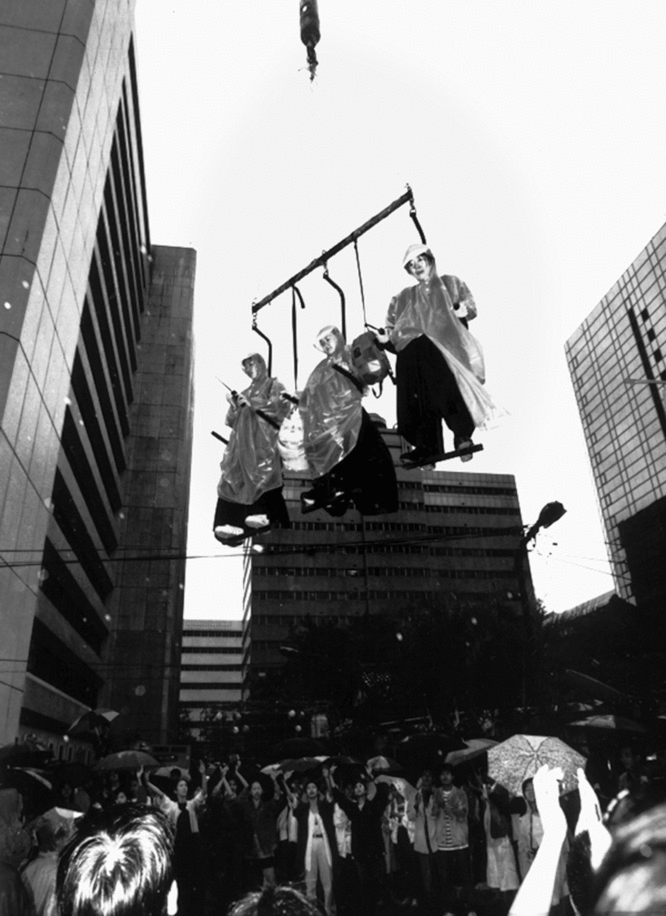
In 1994, Ondine Shiau (蕭渥廷) was buffeted for twenty-four hours by an oncoming typhoon while she dangled from a crane fifteen storeys above Taiwan's first modern dance school in an act that she called ‘My House in the Sky’.Footnote 2 The stunt was a ploy to stop the demolition of the studio of Tsai Jui-yueh (蔡瑞月) who, in 1937, had been the first Taiwanese to travel to Japan to study modern dance. Able to return home only after the end of the Second World War, Tsai improvised a dance on the boat when one of her compatriots composed the above song expressing their mutual yearning. She became Taiwan's foremost dancer, but after the 2–28 Incident and the ‘White Terror’ that followed, her long years in Japan made her suspect by the Chinese Nationalist regime (Kuomintang, KMT).Footnote 3 She was imprisoned for two years and later immigrated with her son to Australia.Footnote 4
Ondine Shiau is raised by a crane in ‘My House in the Sky’ (1994) to protest against the demolition of the Tsai Jui-yueh studio. Photograph courtesy of Tsai Jui-yueh Cultural Foundation. Photograph: Deng Huien(鄧惠恩).

Shiau, her daughter-in-law, remained behind to preserve Tsai's school, which became a touchstone for activism in dance, especially in promoting Taiwan rather than China as a native homeland for the island's inhabitants.Footnote 5 After Tsai's death in 2008, Shiau initiated the Tsai Jui-yueh Dance Festival, which frequently frames these homeland sentiments around themes of environmental protection, such as ‘Back to Nature, Our Home’ (2010) and ‘Think Like a Mountain’ (2011). In 2014, the theme ‘Save Your Nation, Save Yourself’ referenced both the two decades since the studio's rescue from demolition and the so-called ‘Sunflower Movement’, which had emerged onto the political scene earlier that year. Once again, the crane lifted political activists and artists high above the studio to encourage activism among Taiwanese millennials who had previously been dismissed by their elders as apolitical consumers of the ‘Strawberry Generation’ – pampered children, easily bruised. Since 2010, KMT president Ma Ying-jeou had been opening up Taiwan to Chinese labour and investment, resulting in skyrocketing housing prices, stagnant salaries and low-wage-earners losing jobs.Footnote 6 Faced with what they perceived as an erosion of Taiwan's de facto independence, hundreds of university students occupied the Taiwan legislature for the first time in its history and thousands more joined outside to protest against the secretive Cross-Strait Service Trade Agreement (CSSTA) made by President Ma with the People's Republic of China (PRC). It was a strident and powerful demonstration by a generation that saw Taiwan's civil institutions, such as a free press, being undermined, commercial interests being sold out to the PRC, and their future in a free democratic homeland jeopardized.
Members of many of Taiwan's small theatre troupes participated in the protest, and two productions involving a critique of the destruction of Taiwan's agricultural way of life incorporated references to it when they were staged later in 2014. Sun Son Theatre's Mulian Rescues Mother Earth (目蓮拯救母親大地) and San Que Yi's Earth Project (土地計劃-首部曲) combined the promotion of Taiwan as an independent homeland with the necessity of protecting its natural environment. There was a precedent for this: since the 1980s, theatre practitioners had engaged in theatre activism in localized protests over nuclear waste, illegal logging, rubbish dumps and unjust land-grabbing. After the Fukushima nuclear disaster in 2011, demonstrations against construction of a fourth nuclear power plant galvanized nationwide protest and united the various activist groups.Footnote 7 And yet, back in their urban theatre spaces, few troupes have delved into the environmental consequences of Taiwan's post-industrial present beyond nostalgic reminiscences for an agrarian past.
The two 2014 performances attempted to portray the complex and sometimes contradictory dynamics of these circumstances. Both combined mythical and documentary approaches to address the internal pressures on the densely populated island's land and water, while implying a critique of Chinese and American economic forces by referencing the Sunflower Movement. Mulian Rescues Mother Earth considered how to preserve small rural communities in the context of globalization by portraying a hypothetically perfected village that nonetheless struggles to serve all its members. It discussed the deep-seated structural problems, however, without situating them in real and felt characterizations. The Earth Project depicted the demise of specific Taiwanese communities as a result of overexploited and diminishing resources by linking several real situations and personal histories. Its narrative engaged with emotional grievances, but did not probe the deeper context of the problems; thus each production lacked the dimension that the other prioritized, while both still valorized an agrarian ideal. Derived from interviews with some of the artists involved and performance analysis of the two plays, this article examines the productions in the contexts of the Sunflower demonstration, the older tradition of the literary pastoral and its Taiwanese manifestation, and the history of Taiwanese performance activism.
A brief history of homeland culture and the environment
Chinese literature has a long tradition of eulogizing the simple country life with implicit or explicit criticism of the city, exemplified in Tao Yuan-ming's (陶淵明376–427) Peach Blossom Spring (桃花源) about the poet retreating from the court to enjoy the pleasures of being a gentleman farmer. Such paeans, however, usually ignore or obscure the realities of labour and hardship. Greg Garrard analyses the emotional aspects associated with the Western pastoral tradition by noting three distinct orientations to time: the elegy looks back to a vanished past with a sense of nostalgia, the idyll celebrates a bountiful present, and the utopia looks forward to a redeemed future.Footnote 8 While Chinese poetry often expresses aspects of the first two, it rarely contemplated utopia as a redeemed future until the advent of the Chinese Communist Party's socialist realism. Given Taiwan's unique status as a sovereign state that was doubly colonized, whose present statehood is unrecognized by the rest of the world, and whose future is to be determined by the PRC government as much as by the Taiwanese themselves, the modern theatre has focused on rapidly changing social values and their impact on personal relationships, rather than portray the complex attitudes toward the island's environment.
Although the modernization of Taiwan began during Japanese colonization (1895–1945), the Japanese primarily developed the island's agriculture and wanted to sustain it for the long term. As geographer Richard Edmonds describes the situation. ‘Under the Japanese, land use policies had been rigidly enforced, but this was largely abandoned by the Nationalists in the 1950s. The lax attitude encouraged short-sighted land use including indiscriminate clear-cutting and burning . . . This was often done with disregard to land ownership rights’.Footnote 9 The burst of unregulated industrialization, the rapid trebling of the population, and the unplanned urban development that occurred from the 1960s to the 1980s all contributed to severe environmental degradation.
Within three decades Taiwan was transformed from a self-sustaining agricultural exporting nation to an industrialized one that had to subsidize its agriculture. Both the speed of change and the evident destruction of the environment, cultivated and wild, also spurred a new conservation consciousness. However, despite the creation of six national parks in the late 1980s and the growing effectiveness of local environmental groups in protecting wild areas, the Taiwanese majority's cultural affiliation with nature remained identified with an agrarian lifestyle, primarily the production of rice.Footnote 10 Most of the cultural expressions currently advocating a native homeland conceive of it in terms of the ‘pastoral’, which accommodates human habitation and the use of nature. In modern parlance, this expresses a ‘shallow ecology’ rather than the ‘deep ecology’ of preserving wilderness devoid of human presence. On the one hand, the pastoral is a popular sentimental conceit expressed by city-dwellers and promulgated in advertising, and on the other, it is a complex imaginary of how people see themselves, for it remains within the living memory of many citizens. Hence, despite media reports of agricultural abuse, such as the overuse of pesticides, hormones and fertilizers; improper water diversion; pollution from pig farms; and erosion and river silting from upland cultivation, the serene, bucolic image depicted in Tsai's song prevails in the popular imagination. The steady decline of people actually living off the land notwithstanding, the notion of rural tranquility has become poignantly evocative of homeland, and the attachment to rice as the food of stability and of family bonding remains strong.
This attitude was exemplified in Rice (2013) by the internationally renowned Cloud Gate Dance Theatre, in which the rice paddy serves as a metonym for both personal childhood home and homeland. As choreographer Lin Hwai-min (林懷民) explained, ‘As children we'd roll around in the field. After harvest, the farmers would spread out their rice grains in an empty space in the courtyard. We loved to mess around with it . . . Rice is something you take for granted but is so precious’.Footnote 11 His town had grown rice for the Japanese emperor but after the war when farmers began using chemical fertilizers and pesticides it lost its reputation. Now it once again produces organic rice for export.
Farmers in Cloud Gate Dance Theatre's Rice. Photograph by Liu Chen-hsiang (劉振祥).
Lin took his dancers to participate in the harvest, saying that they needed the physical experience of putting their feet in the muddy soil. Rice, which ranges from the intimate and sensuous details of the rice seed germinating in the earth to the panoramic scope of the waving chartreuse rice stalks, celebrates the ‘culture’ arising from agriculture. It does not exclude the fatigue of the farmers but nonetheless portrays Taiwan cultivating its pastoral roots to compete successfully in the global marketplace. The 2014 spoken drama performances of Sun Son and San Que Yi, however, explored the darker side of the attempts to cope with current economic realities.
‘Saving’ Mother Earth
Sun Son (Sound/Body, 身聲劇場) Theatre's Mulian Rescues His Mother was an adaptation of a Buddhist parable about filial piety. The project was initiated the year before by Taipei Arts Festival director Keng Yi-wei (耿一偉), who commissioned award-winning German director and playwright Kevin Rittberger to collaborate with the local troupe. Rittberger made two trips to Taiwan. On the second, he arrived a day after the Sunflower demonstrators had decamped, although his dramaturg and translator Chen Yi-Chun (陳佾均) had kept him appraised of the action and the Sun Son actors had participated in the outdoor demonstrations. As an artist with an interest in alternative social systems, Rittberger met with leaders of farmers’ unions and rural activists protesting against the building of industrial parks and petrochemical plants. He interviewed filmmaker Cho Li (卓立), whose film The Rice Bomber (白米炸彈客) – depicting a young man who protested against the plight of Taiwan's rice farmers when the country joined the World Trade Organization in 2001 – had just featured in the 2014 Berlinale. And, along with two Sun Son members, he visited the remote aboriginal village of Smangus (司馬庫斯), which, previously cut off from electricity and vehicular transport, has become an eco-cooperative billed as a ‘utopian experiment’ by Taiwan's media.Footnote 12 Smangus seemed to serve as a kind of working demonstration of the social theory that Rittberger sought to dramatize. As he asked rhetorically in his programme notes, ‘how can we imagine small units of people as autonomous, self-governed zones woven with bigger and more global territories?’Footnote 13
Sun Son itself is a physical theatre collective whose members compose and perform an eclectic style of movement, live music and puppetry. Located on the banks of the Tamsui river in a former chicken-farm-turned-arts-centre, its collaborative aesthetic and creative method epitomized the ‘social soul’ that Rittberger was looking for in the production.Footnote 14 Sun Son also has a predilection for adapting folk tales, aboriginal myths and Chinese legends, resonating with Rittberger's method of utilizing Western myths, and making them appropriate partners to adapt the Mulian narrative. However, in the process of their collaboration, differences of interpretation emerged, in terms of both cultural understanding and artistic priorities.
‘Mulian Rescues His Mother’ is a canonical myth for Mahayana Buddhists, celebrated each August, during the Month of Hungry Ghosts (鬼月), when the spirits of deceased ancestors return to earth. The Ullambana Sutra, the earliest extant source, gives a terse rendition of how the Buddha's favoured disciple, Mulian, discovers that his mother has died and gone to hell. It does not specify what sin she committed, but a sixteenth-century urtext for the later popular dramas tells of her eating meat during a period of vegetarian fasting.Footnote 15 Mulian risks the journey to hell, but, unable to do anything for his mother, begs the Buddha for help. He is told that if all people feed the roaming hungry ghosts for the month, his mother will be released. This combination of a son's compassion and the community's participation alleviates the mother's torment. The tale's cultural significance lies in its synthesis of Buddhism and Confucianism, demonstrating that even a Buddhist monk who must give up all earthly ties is still an exemplar of filial piety.
Despite their many discussions about the story's cultural significance, Sun Son and Rittberger approached it from opposing vantage points. For troupe director Ng Chong Leong, Mulian is a sacred myth with deep roots for all ethnic Chinese, whether religious or not. From his standpoint, it was necessary to accept belief in some form of judgement after death as a fundamental principle of Chinese culture depicted in the story.Footnote 16 Rittberger, however, who had been invited by Keng ‘to bypass the subconscious self-censoring of the story's religious and cultural context’,Footnote 17 told Ng that he did not believe in any form of afterlife retribution, and instead wanted to consider the story only in a secular context.Footnote 18
Though the two collaborators shared similar political views favouring the preservation of small Taiwanese communities, their fundamental differences about how to express it through the myth created an unresolved tension between the narrative and the social theories that underlay the production. Rittberger was influenced by cybernetic theorist Stafford Beer's concept of ‘syntegration’. The theory proposes the optimum management of knowledge through human organization based on the icosahedron, a twelve-edged, thirty-strut polygon in which each strut represents a person and each edge a topic.Footnote 19 Rittberger adopted the icosahedron, supposedly the most stable structure in nature, as the symbolic model for a futuristic utopia. The performance opened with a prologue, a darkened stage on which a large globe broke apart to reveal a naked actress as ‘Mother Earth’ retreating upstage between Mulian and Yama, God of Death. Then the lights came up on three icosahedrons – giant, medium, and small – that visually represented a thirty-person community. The villagers, dressed in loose-fitting pastel costumes, purposefully go about their business.Footnote 20 Their concentrated expressions and dance-like movements, which include clambering in and out of the larger icosahedrons, suggest that everyone is working and living together harmoniously. Two characters express discontent: Mulian, who paces, apparently searching for his mother, and Mayonnaise Man, who lounges about, refusing to contribute to the day's work. This maverick new character is so-called because he seems to eat nothing but mayonnaise.Footnote 21 His function is to disrupt the community's complacent status quo, but when the village spokesperson, Papagan, who parrots the dogma of the icosahedron, complains to Mulian about Mayonnaise Man's indolence, Mulian pays little attention, preoccupied with how to save his mother.
As a result of the Mayonnaise Man dominating the action, the play departed significantly from the traditional representation of the Mulian story that is popularly performed in opera, film and television formats. All versions indulge in gruesome visions of hell and display the suffering of the mother with ghoulish prurience, never questioning whether she merits such punishment (whatever she did). While the graphic depictions of hell are usually the major attractions, in the Sun Son revision there was only a single illuminated pole, the symbolic connection between Earth and the underworld ruled by Yama. In addition, to make the myth relevant in a contemporary environmental context, Sun Son and Rittberger had to decide what sin the mother could have committed to warrant terrible punishment. Wanting to deconstruct the story's essentialist concepts of ‘good’ and ‘evil’, Rittberger suggested she be guilty of consumerist materialism, implying that the so-called ‘good mothers’ of today buy their children too many electronic gadgets that foster a dependency on technology and use up natural resources. At a climactic moment, therefore, Mayonnaise Man dumps an armful of electronic goods on the floor, and demands of Mulian and the audience, ‘Do good mothers buy these?’ This put the young urban middle-class spectators of Taiwan's theatre in a quandary. Not only is a Taiwan a major producer of electronics, but mobile phones and laptop computers were instrumental to the Sunflower protest. Mulian's expression of duty is arguably attenuated by this vision of an e-waste inferno, as he is left with no way to perform his act of filial devotion. If his mother's sin is capitalist consumption, how is he, a contemporary dutiful son, expected to ‘rescue’ her as ‘Mother Earth’?
Sun Son Mulian and Mayonnaise Man argue about the electronic gadgets bought by ‘good mothers’ in Mulian Rescues Mother Earth. Photograph: Chen Youwei (陳又維).
Mayonnaise Man continues to agitate the community until it finally expels him. He goes out into the wild like a prophet to spread the word of an ideal society and is later discovered to have been killed, the implication being that it is Mayonnaise Man, not Mulian, who sacrifices himself for Mother Earth. Rittberger's vision sat uncomfortably with Taiwanese social norms, which are group-oriented but nonetheless uphold the Confucian primacy of the family. Moreover, Rittberger employed such an abstract view of nature that it was reduced to mathematical principles and stripped of recognizable cultural affinities. Relying on geometrical forms to symbolize optimally harmonious relations without their further dramatization, and aphoristic dialogue with vague philosophical referents, the performance placed a deeply felt story and an intellectual enquiry into alternative social systems in awkward juxtaposition. Many reviewers expressed confusion at how the long, didactic conversations were supposed to inform the Mulian myth. One was particularly exasperated at being unable to follow the many disconnected levels of interpretation:
Given the scattered plot, in the end who does Mulian save? His mother? Society? Nature? Or himself? Or can he not save anything? Or are all saved? And how to save? Without further narrative development or extended scenes, these associated multiple social issues are facilely displayed in one flash phenomenon, becoming meaningless echoes, the scenes piled like pages of an empty white book critiquing society.Footnote 22
Rather than confronting the specific dilemma of Taiwan forging an independent homeland separate from China, Rittberger seemed to understand the Taiwanese conflict primarily in terms of small country producers versus global corporate hegemony, as exemplified by Taiwan's contentious entry into the WTO in 2002. Given his varied experiences encountering so many different people in Taiwan, however, it is odd that so few of their particularities were reflected in his script. Rather, it distilled them all into a generic political critique that was reaffirmed during the curtain call when the actors sang the Chilean protest song ‘El pueblo unido, jamás será vencido’ (The People United Will Never Be Defeated) that had also been sung in Spanish and Mandarin at the Sunflower demonstrations.Footnote 23
Mulian Rescues Mother Earth presented an outline of structural issues and a cast of political types without penetrating their surfaces or investing them with sufficient personal traits and emotions to make them more than ideological mouthpieces. Mulian seems the odd man out, deprived of his original purpose and superfluous in this utopia. Eliminating Mulian’s traditional trappings, as well as any obvious signs of ‘Taiwaneseness’, the play radically tore apart cultural norms, perhaps indicating the painful process ahead of reconceptualizing the pastoral to meet the demands of the Taiwanese homeland surviving in the twenty-first century. A few months later, San Que Yi’s Earth Project also asked uncomfortable questions about the viability of the pastoral imaginary but did so with concrete examples of Taiwan's current environmental crisis.
San Que Yi's Earth Project: what's an oyster to do?
San Que Yi (三缺一, Short One Actor), presented two interrelated plays – ‘Revival from the River’ (還魂記) and ‘Oyster Night March’ (蚵仔夜行軍) – which together comprised its Earth Project (土地計劃-首部曲). The project was instigated by director Wei Chuan-chan (魏雋展), who had journeyed around the island in 1996 and, driven by his love for Taiwanese oyster omelets, visited the oyster farms on the west coast. He was told by the farmers to eat his fill at the time because the Guoguang Petrochemical Company was building a new factory nearby that they knew would reduce their harvest.Footnote 24 However, neither they nor Wei knew how drastically it would devastate the waters and their livelihood.
The result of two years’ research in rural Taiwan, the two Earth Project plays were united by their focus on the conflicts arising between agriculture and industry from water depletion and pollution. While the subject of industrial exploitation of natural resources is not unique to Taiwan, the troupe's cultural expression of it was. Earth Project incorporated Taiwanese, the language of the countryside appreciated in modern theatre performance for its poetic expressions and earthy humour. In contrast to the stilted language of the Mulian production, this use of the local idiom immediately grounded the performance. The Earth Project’s portrayal of the present dystopic landscape and its displaced people evoked a nostalgic yearning for an agrarian past with only a very tentative hope for a better future. However, because it portrayed industry as the evil destroyer of both the environment and agriculture with fairy-tale-like simplicity, it did not plumb the systemic inequities caused by government corruption and capitalist price manipulation. Instead, the complexity of the situation was implied by the inability of the protagonists to resolve anything in the end.
‘Revival from the River’, presented first in the programme, employed an elegiac tone and surreal ambience through the interpenetrating worlds of the living and the dead to depict the current plight of the Choshui (濁水溪), the longest river in the country. Not only is the river depleted by dams, with its waters siphoned off to serve agriculture, industry, and urban development, but also factories have sucked up groundwater, creating severe subsidence in its alluvial fan, so that when typhoons strike, floods are increasingly damaging. Director He Hsiang-yi (賀湘儀) combined the stories of several communities involved in conflict between industry and agriculture, and then interwove them with the legend of the River King (溪王), an ancient deity who required the annual sacrifice of a maiden to keep the waters flowing for croplands.
In this contemporary version, a little girl dies after falling into a sinkhole, and becomes a spirit, rendered visible by a child's dress stiffened and manipulated on a pole. She accompanies the dying River King, represented by an enormous black plastic cape topped by a tragic mask, reminiscent of Peter Schumann's Bread and Puppet aesthetic. He is about to be weakened further by another channel dug through rice fields to supply water to a new factory. When a female factory employee who objects to the channel and the village headman's wife both die, the little girl conceives of a plan to put the soul of the former into the revived body of the latter. The female employee agrees to the switch if the River King promises to negotiate with the God of Death to resurrect her aborted child (fathered by her boss). Thus the rice paddy about to be violated and the aborted child are put on the same footing as the endangered future. Unable to stop the channel, the woman finally throws herself into the ditch and refuses to budge, but her physical protest is futile. Moreover, the River King no longer possesses the powers of regeneration and cannot resurrect her child. The village head and his mother are compelled to sell their field to the factory, and in the last scene the roar of backhoes drowns out their attempts to communicate with each other.
The production is despairing, as neither the once-potent River King nor the human rituals enacted to appease him have any efficacy. The little girl's ‘sacrifice’ is in vain, as her spirit cannot revive him. Traditional culture and small agrarian communities capitulate to the industrial juggernaut, which is no longer seen as a source of national prosperity, but only as a means of enrichment for a few at the expense of the environment and the people who live directly from it. ‘Revival from the River’ is a fractured myth with no redemption, as the women are sacrificed with no beneficial result.
The fatalistic melancholy of the first play was abruptly dispelled by the vivacity of ‘Oyster Night March’, which portrayed pollution-plagued oysters taking on a petrochemical plant. Raised to cling to bamboo poles, the cultivated oysters believe that when they mature they ascend the pole to oyster ‘heaven’ ruled by the deity ‘Hoja’ (delicious), until one oyster discovers that in truth they are cracked open and eaten. He goes away and encounters the wild or ‘rock’ oysters. When they complain that the factory's heavy metals have deformed them, the actors pull their stretchy white costumes inside out and over their heads to become writhing and grimacing butoh bivalves, chanting for revenge.
When oyster farmer Ah Ming Bo loses his family to pollutant-induced cancers, he joins the oysters to march against the factory they call the ‘fire dragon’. As creatures low in the biological food chain and anthropomorphized to protest man-made pollution that deprives them of even a subsistence living, the oysters parallel farmers in relation to urban capitalists’ illicit land-grabbing. They launch their revolution, shouting the Sunflower slogan ‘peace, reason and non-violence’, mimicking the students speaking to government.Footnote 25 When a fire breaks out at the factory, the oysters immolate themselves, bequeathing their spirits to Ah Ming Bo to carry on the struggle, implying both that there will be no stopping the protest and at the same time that there will be no cessation of human damage to the environment. Without the factory, there are no jobs and the polluted waters prevent Ah Ming Bo's return to oyster farming. Like the rice farmers who were forced to sell their land in the first play, this play ends with him not knowing what to do. This ambivalence is problematic, since one does not know if it arises from the character's personal lack of resources, the troupe's inability to resolve the plot, or the very real dilemma of a country in the throes of post-industrial transition. San Que Yi adopts the victims’ limited perspective about how to deal with the threat and its aftermath. At first, the army of humorously disgruntled oysters seemed a more hopeful allegory than the lone woman in the first play, but in the end their action and sacrifice was also equivocal and inconclusive.
The deformed oysters plan their march on the ‘fire dragon’, the petrochemical factory in ‘Oyster Night March’. Photograph: Chen Zhangzhi (陳張志).
The Earth Project employs the fluid transformations of deities, humans, animals, bodies and souls found in many traditional Asian theatre forms, and bypasses theatrical realism to operate on a metaphysical plane that merges a particular event with symbolic referents. The mystical conjunctions of the three dead women negotiating with the withered River King were intriguing, and the deformed oysters jiving to Ah Ming Bo strumming ‘Rock Oysters’ Rock and Roll’ were comic: but they were not exploited to their full potential to counter the hard reality of the technological transformation of the land and water into human-use products, of fecund nature into wasteland. Critic Wu Zheng-han contended that the fables were too politically correct and naive to effectively confront the depth and complexity of the environmental destruction and the inequities of Taiwan's socio-economic system.Footnote 26 He mentions the difficulty of weaving the real stories and comical absurdity into an eco-political critique that can get to the core of the problem. In tandem, the performances portrayed a mock pastoral of the past cut off, the present out of harmony, and the future endangered. Instead of performing its plays as part of an actual protest against the factories, Earth Project staged presentations depicting protest, encapsulating its critique within a theatre piece rather than putting it to work in activism.
What The Earth Project lost in immediacy and political directness, however, it arguably gained in aesthetic and theoretical distance, allowing us to contemplate the efficacy of artistic activism, of protesting against something, albeit with the alternative uncertain. The Earth Project drew on rich sources of documentary and mythical material found in local archives, personal narratives, ancient lore and contemporary events. Recognizing that they have not, as yet, consolidated them into effective eco-drama, San Que Yi members plan to develop each play into a longer piece to be performed alone.Footnote 27 The project resonates as complicated political allegory for it poses the question about what next step should be taken to revive the Taiwanese countryside.
Young urban environmentalists and theatre artists might champion the farmers’ right to continue their way of life unmolested, but at the same time rural youth leave the countryside, gravitating towards jobs in the city. By simplistically pitting agriculture against industry, the two plays did not deal with the harsh realities of agribusiness or the globalized marketplace. Moreover, they did not take into account the growing trend in cities for organic produce and of farms also serving as weekend retreats. By refusing to put any positive spin on the situation, their pessimistic ambiguity falls within the purview of many of Taiwan's cultural endeavours that are highly conscious of national ambiguity and insecurity.
Conclusion: you don't know what you've got till it's gone
The Portuguese, the first Europeans to see Taiwan in 1544, named it Ilha Formosa (Beautiful Island), but Ondine Shiau relates that her view from the crane in 1994 revealed Taipei as an ugly jumble of concrete with little green space.Footnote 28 Chi Po-lin's documentary Beyond Beauty: Taiwan from Above (看見台灣, 2013) gave Taiwanese their first all-encompassing aerial view of Taiwan. The juxtaposition of the beauty of its forests, mountains and farmlands with the industrial destruction of its rivers, wetlands, mountaintops and coastal areas is heartbreaking. A Museum of Science exhibit of photographs from the film likened them to Apollo 17’s ‘blue marble’ view of the Earth, giving Taiwanese a new sense of the island they inhabit and a proportionate and cohesive concept of it as home, one that supported them and also needed their protection.Footnote 29
However, live theatre still has difficulty engaging these polarities and dramatizing the challenge of changing internal situations while under economic and military threat by a powerful neighbour. Critic Guo Liang-ting suggested that San Que Yi's Earth Project was just at the beginning of its inquiry. When one of the oysters asked the audience whether they were prepared for the hard work of real change, Guo returned the question to the actors and wondered whether they had sufficient commitment to follow through as well.Footnote 30 The Earth Project received funding from a local computer company – one of those that make use of the Choshui River – and when employees asked if the performers wanted to shut it down, they replied they just wanted cleaner, less harmful practices.Footnote 31 But they did not thoroughly investigate the underlying structures of competitive WTO economics that drive such factories to produce goods cheaply at the expense of workers and the environment. Rittberger and Sun Son, on the other hand, tried to unravel the system that creates the vicious circle and replace it with what Elinor Fuchs has called ‘the new pastoral’ that ‘draws on a perceptual faculty not unlike that developed by ecology, a systems-awareness that moves sharply away from the ethos of competitive individualism toward a vision of “the whole,” however defined in any given setting’.Footnote 32
Both eco-productions were based on some concept of the pastoral and incorporated extensive research into the lives of small-scale farmers and the practices of agricultural activists. But they also revealed the difficulty of dramatically integrating theoretically constructed visions with the specificity of local conditions. Rittberger and Sun Son evolved an abstract utopian model that made little use of Taiwan's uniqueness, and San Que Yi fused many individual stories without evolving beyond a ‘good–bad’ melodrama. However, by referencing the Sunflower Movement, both productions echoed the larger unanswered question concerning the island's freedom and sovereignty.
At the Sunflower demonstrations, music captured the prevailing sentiments about Taiwan as a homeland with the song ‘Island Sunrise’ (島嶼天光), which not only became the anthem of the movement but also won the music industry's Golden Melody award.Footnote 33 The lyrics do not relate specifically to the causes of the protest but emphasize an emotional attachment to the motherland with the opening, ‘Dear Mother, please don't worry’:
Sung in Taiwanese, it expresses an identity that embraces all those born on the island, whose contemporary aspirations are invested in that homeland. The two productions were affected by this idealistic vision, but being offered to the public at a different time and place, they also undertook a more eco-critical stance about how Taiwanese themselves should behave toward the ‘mother’. Interspersed with the conflict between Mayonnaise Man and the community in Mulian Rescues Mother Earth were shadow-puppet scenarios featuring an enormous doll-like Mother Earth and a diminutive, squeaky-voiced Mulian. He discovers she is more than a metaphor, and she ridicules him for having the hubris to think he could ‘save’ her. She tells him to recall the natural world of his childhood, the universal formula for nostalgia that Lin Hwai-min utilized in Rice. A similar sentiment was expressed by an oyster farmer interviewed by Sun Son. He was trying to help his community survive by inviting city children to participate in the harvest, hoping the experience would stimulate their desire to preserve it. When asked what his goal was, he replied,
How it felt in our childhood, what the ecology was like back then . . . We'd like to have half of it back, that'd be good enough. In the evening, when I want to hear insects sing, there they are . . . when I want to see birds flying, there they are still flying around. I just want to minimally meet the standards in both economic development and protecting the environment.Footnote 35
But this is no longer the childhood of urban youth; few members of the present generation have those memories, and for the pastoral to be part of the future, it must be reimagined rather than remembered. Indeed, even preserving elements of the current political, economic and agricultural status quo will require compromise. The two theatre productions invoked the pastoral but acknowledged it as a utopian ideal that encapsulates otherwise inchoate homeland yearnings. Neither was fully successful in capturing the scope and nuance of Taiwan's current environmental and political challenges, but together they presented the macrocosm of global pressure on small states and the microcosm of locally contested land and water use. They also both adapted myths to look critically at traditional values while at the same time extending those ethics to include the environment. They both portrayed the highly charged emotions that attend any major shift in the work and territory that defines people's lives. The Sunflower Movement contributed to political change in January 2016 when voters overwhelmingly elected a president and legislature that stand strongly for a Taiwanese homeland, if not outright independence. It remains to be seen how that transfer of power will translate on the ground, and in the theatre; whether the pastoral, functioning as a collective dream, can in reality offer viable alternatives for Taiwanese society, and what further role it will play in the national consciousness.